Investment community learned that humanoid intelligence company Current Robotics (Yuanliu) has disclosed its first round of financing—having completed Seed Round, Angel Round, and Pre-A Round financing, with a cumulative amount reaching hundreds of millions of yuan.
The investors include well-known market-oriented institutions such as BV Baidu Ventures, Hillhouse Capital, Oasis Capital, Monolith Capital, Qianhai Founation Capital, Fosun Capital, Junsan Capital, as well as industrial players like Zhiyuan, Xinghaimap, and Jike Technology.
Behind it is founder Zhu Yichen, a post-95s individual who started leading VLA research early on, publishing over 40 top-tier conference papers during this period. Years of accumulated technical expertise have coalesced into a complete infrastructure covering whole-body dexterous manipulation foundation models, data collection equipment, and world model evaluation strategies, continuously translating real human behavior into humanoid capabilities.
“Humanoid intelligence begins with humans.” Following the philosophy of Current Robotics, we are witnessing robots starting to move from demonstration stages into thousands of households.
Post-95s Prodigy, Quickly Completes Three Rounds of Financing
The journey of Current Robotics began with Zhu Yichen.
A post-95s, former Head of Embodied Intelligence at Midea Group, and one of China's earliest researchers to publish work on VLA and world models. He led his team to propose the diffusion model and VLM end-to-end VLA paradigm (TinyVLA), expanding CoT strategies (DiffusionVLA & DexVLA, published in ICML and CoRL), and was among the first to propose using world models for embodied strategy evaluation (dWorldEval, published as ICML Spotlight).
The π0 paper by Physical Intelligence cited research from only one Chinese team—the TinyVLA and ScaleDP work completed by Zhu Yichen's team. Since then, this research has expanded from VLA models and human demonstration data to whole-body robot learning, forming the technical foundation of Current Robotics.
Venturing naturally followed. Zhu Yichen observed that past humanoid robots either focused on whole-body locomotion to make robots “walk” better or on hand manipulation to make them “grasp” better, ultimately resulting in a “move first, then stop to operate” sequence. However, real-world tasks are rarely this simple; even a simple action requires stable coordination between hand and body.
This necessitates “Whole-Body Dexterous Manipulation” (Loco-Dexterous Manipulation). Current Robotics' solution is system integration, placing whole-body mobility, posture coordination, and fine hand interactions into the same policy for training. The resulting whole-body dexterous manipulation model, Curr-0, enables robots to continuously adjust their actions while moving. Currently, five publicly shown task types are completed by a single policy with shared weights, differentiated via language instructions.
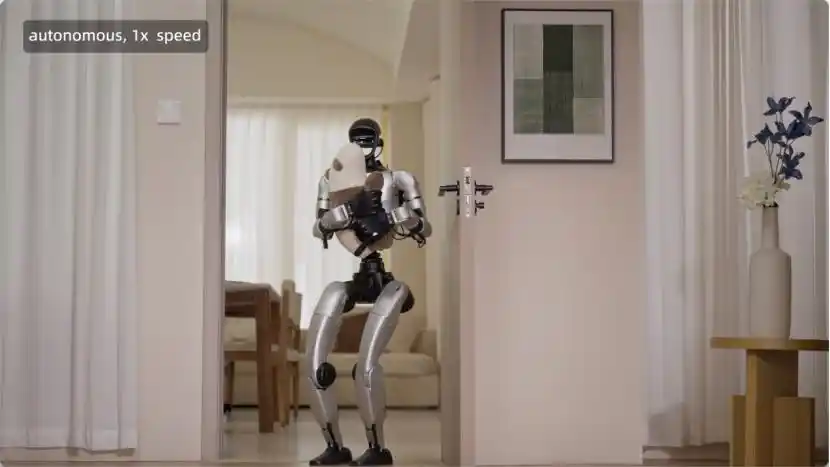
Robot carrying an object through a door frame and placing it at a specific location
With the model, more practical implementation issues arose—firstly, data. Current Robotics developed its own whole-body exoskeleton data collection system, expanding collection scenarios from labs to more realistic environments like factories, offices, and homes. Secondly, faster evaluation and iteration by exploring the use of world models to evaluate real robot policies.
To date, the company focuses on Loco-Dexterous Manipulation, having established full-chain technical capabilities covering data collection, model training, world model-based evaluation, and post-training, aiming to enhance robots' mobile manipulation and capability generalization across different tasks and environments.
This is particularly scarce in the current landscape where embodied intelligence often lacks practicality, data, and generalization. Therefore, Current Robotics attracted collective investment from renowned market-oriented institutions immediately upon founding, a clear indication of its appeal. Even rarer was the alliance of industrial players, whose significance extends beyond capital to industrial coordination.
Investment community learned that Current Robotics has joined the Yishu Intelligent Data Ecosystem Alliance initiated by Xinghaimap to jointly build a complete chain from data collection and annotation to application. Additionally, the company is a strategic partner of Mifen Technology, Zhiyuan's embodied intelligent data platform.
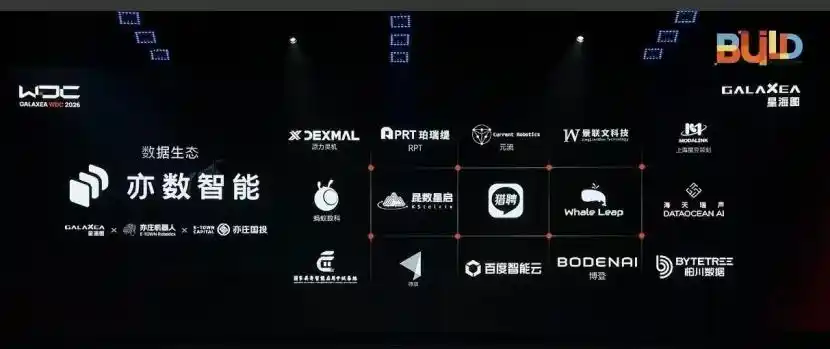
Providing capital, orders, and ecosystems—this investment approach is particularly distinctive in the era of embodied intelligence. After all, having scenarios enables the formation of a data flywheel, allowing robots to develop stable working capabilities in the real world at lower costs and in shorter timeframes.
Building Embodied Intelligent Infrastructure
From the outset, Current Robotics focused on gaps in existing embodied intelligence technical routes.
For example, to light a mosquito coil, a natural idea is for the robot to first walk to the spot, then stop to operate. The corresponding technical solution is to train mobility and manipulation policies separately, then stitch them together via systems engineering. This approach might work on factory assembly lines, but once entering real scenes like homes, clear cracks appear between movement and operation.
This is not hard to understand: even if a robot stands still to complete a desktop task, its waist and lower limbs still need adjustment based on upper body movements. Using only the “stitching” method, once the body tilts, hand force application is disrupted, making the robot appear clumsy.
The Whole-Body Dexterous Manipulation Foundation Model Curr-0 released by Current Robotics is designed precisely for coordination—achieving hand-foot synergy through fully coupled navigation movement, whole-body balance, and dexterous hands. From tearing tea bags and clearing desktop trash to carrying objects through door frames, these refined tasks difficult to simply split into “walk” and “do” phases show impressive performance under Current Robotics' solution.
Following the model, data sources also need updating. Mainstream first-person collection covers rich environments and behaviors but cannot accurately reproduce human motion states and physical interaction information like contact forces; onboard teleoperation offers higher precision but is harder to scale due to equipment and cost constraints.
Can data simultaneously reflecting environment, body motion, and physical interaction be collected efficiently? Based on this, Current Robotics developed its Whole-Body Data Collection Equipment, using head-mounted devices, data gloves, full-body exoskeletons, and electromyography equipment to record first-person vision, hand and whole-body movements, and full-body forces during real-world tasks—all without needing to deploy a robot first. This extends data collection directly into real human task scenarios, offering better cost and applicability while supporting the real data needed for humanoid robot brains.
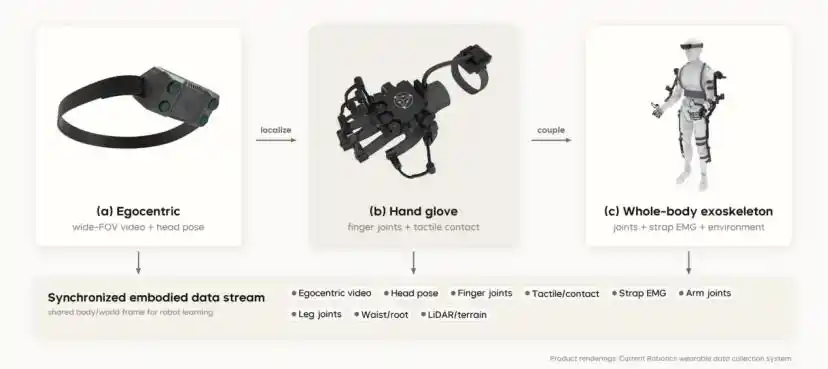
HumanEx Wearable System
Finally, evaluation and post-training. Traditional real-machine evaluation relies on robots, venues, and manual resets, with high hardware, time, and scene reproduction costs. Especially in tasks with continuously changing contact states, precisely returning the environment to its previous state after failure is difficult, directly impacting model iteration efficiency.
Based on this, Current Robotics early on began exploring using world models for robot policy evaluation. The team proposed WorldEval, dWorldEval, executing robot policies in generated future worlds to evaluate performance by predicting task progress; later in Hi-WM (Human-in-the-World-Model, published at RSS 2026 Robot World Models Workshop), human takeover was added—when policies make errors or encounter uncertainty, humans can directly intervene to correct, with new interaction trajectories continuing for post-training.
This week's release of CurrentWorld-0 further advances Current Robotics' work on world model-based strategy evaluation and post-training toward a more complete interactive environment. The team defines it as an Interactive World Simulator, first integrating cross-embodiment, multi-view, and force-tactile prediction into a unified framework.
Once a robot changes embodiment, its action space and control methods also change. Different robots inherently struggle to share the same low-level control representations, but CurrentWorld-0 effectively preserves these differences, allowing different robot platforms to act according to their own ways while learning shareable environment dynamics from cross-platform interactions.
After resolving embodiment differences, new issues arise regarding “how to see.” Real robots often rely simultaneously on head, wrist, and third-person views; the same task looks vastly different from different angles, but the underlying object states, robot poses, and task progress cannot diverge. If an object is pushed away in one view, other views must synchronize; even if obstructed mid-way, subsequent states must continue the interaction that already occurred.
And when robots truly contact objects, RGB quickly reveals limitations. Whether a grasp is stable, how end-effector forces change, whether objects show signs of slipping—these aren't always directly discernible from images. Therefore, CurrentWorld-0 further incorporates force and tactile sensation into prediction, allowing physical feedback not easily covered by vision during contact to also evolve with actions.
From folding socks and arranging cushions to peeling cucumbers and opening bottles to pour wine, CurrentWorld-0 handles not just rigid-body manipulation; flexible objects, fluids, and complex contacts are integrated into the generated environment. At the policy evaluation stage, the model must continuously respond to the robot's actual executed actions: if a policy already grasps incorrectly, subsequent states shouldn't be “corrected” back to common successful trajectories by video priors; originally exposed failure records need preservation, not “fixing.”
This is also the basis for CurrentWorld-0's use in policy comparison. Robot policies can first run, compare, and expose failure modes in generated environments, with results then compared to real-machine performance. Team results show that relative performance of different policies corresponds well to real robot tests, and major failure modes in real-machine execution can be reproduced in generated environments.
After evaluation, these failure experiences can be further utilized. When a policy reaches an error-prone point, humans can take over mid-way; even the same intermediate state can be saved, rolled back, and different recovery methods attempted from there. The resulting corrective trajectories can then be used for policy post-training, transforming problems exposed in one evaluation round into training data for the next.
At this point, CurrentWorld-0 has formed a relatively complete model evaluation and post-training collection pipeline: policies first validated in generated environments, problems exposed, then human correction supplements new interaction experiences, continuing into post-training.
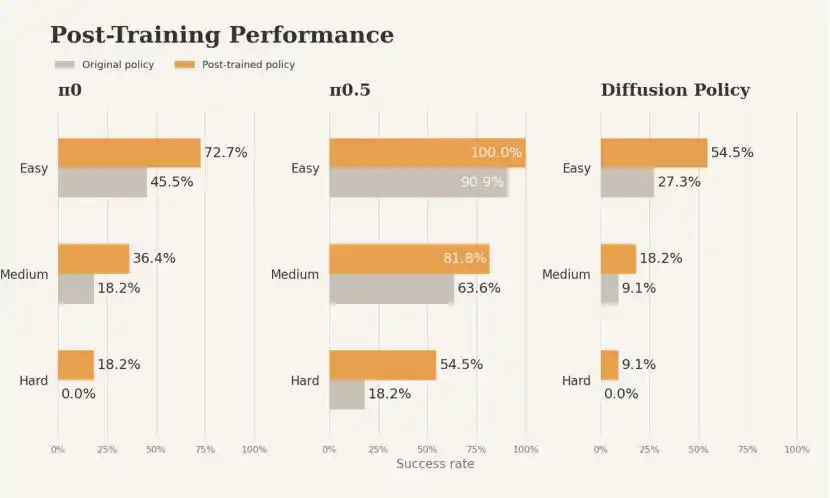
【CurrentWorld-0 multimodal corrective trajectories used for post-training results】
Thus, Current Robotics has gradually established a data, model, and evaluation system centered on whole-body dexterous manipulation: real data provides physical experience, models transform this experience into mobility and manipulation capabilities, world models then undertake strategy validation, failure correction, and post-training, driving continuous iteration of robot capabilities.
The Critical Leap,Robots Move Towards the Real World
“When can robots start working?”
As we see, embodied intelligence is shedding its storytelling facade, entering the “submitting answers” phase focused on implementation. No matter how beautiful the demos or how spectacular the performances, ultimately they must land in real task scenarios, far more complex and rough than conceptual models—
On one hand, traditional fixed workstation operations only touch a narrow slice of physical labor; most real tasks require movement between spaces. On the other hand, robots face a continuous, complex, inexhaustible real world, with training and iteration workloads behind it immeasurable, urgently requiring an efficient, streamlined data collection and processing approach.
From HumanEx, Curr-0 to CurrentWorld-0, Current Robotics is connecting real human experience, robot capability learning, and subsequent evaluation iteration, achieving a full-stack closed loop: front-end collection of real behavior, middle formation of whole-body dexterous manipulation capabilities, policies then entering world models for validation, with new data generated near failures flowing back into training.
The more profound aspect lies in starting with the end in mind.
The market is voting with real money; the industry红利 of embodied intelligence belongs only to those who can truly implement and create real industrial value. During this, industry competition extends from building embodiments to seizing data and infrastructure. Those who first establish data and next-generation model evolution barriers will hold advantage in the new iteration cycle.
To this, Current Robotics offers an extremely end-game oriented answer—first assume infinite data, then design solutions based on how human intelligence truly operates. Thus, navigation, body balance, and hand movements can be fully coupled, localization integrated end-to-end, and data collection can capture richer details within real workflows.
The widely known ending of *The Great Gatsby* states: “So we beat on, boats against the current, borne back ceaselessly into the past.” This is the origin of Current Robotics' name—overcoming limitations of existing technology, moving upstream, building bridges between human experience and humanoid robots. As the company logo, inspired by Leonardo da Vinci's *Vitruvian Man*, symbolizes the human body as a measure of motion, proportion, and design.
Current Robotics company logo
After all, the source of humanoid intelligence remains human. Through wearable devices collecting data, simulating human motion to create foundation models, and combining human takeover evaluation and post-training, Current Robotics is precisely using hardware, data pipelines, and model closed loops to continuously translate real human behavior into stronger humanoid capabilities.
Current Robotics' wearable collection system captures signals termed “incidental human behavior”—naturally emergent, free, task-adjacent physical behaviors that occur when humans perform real tasks in real environments. These physical priors, difficult to simulate and impossible to describe with language instructions, can never be separated from original human demonstrations, revealing the unique value of human intelligence in human-robot collaboration.
“Unconscious behavior is quite important in humanoids. It's sufficiently human-like, can bring greater emotional value, often surpassing pure functionality.” Zhu Yichen once shared. For instance, a robot holding an object with both hands and pushing a door open with its body—simple human-like behaviors become vivid and remarkable.
This scene may not be distant. “Growing from the most authentic human intelligence, ultimately returning to the real living world,” a blueprint of harmonious human-robot coexistence is unfolding before our eyes.
This article comes from the WeChat public account “Investment Community” (ID: pedaily2012), author: Yu Mengying