As Circle, the First Stablecoin Stock, Resolves to Shed Its Label

链捕手Dipublikasikan tanggal 2026-05-12Terakhir diperbarui pada 2026-05-12

Abstrak

Circle, the "stablecoin stock," reported its Q1 2026 results, showing a 20% YoY revenue increase to $694M despite a 15% drop in net profit due to post-IPO stock-based compensation and operational investments. The company's USDC stablecoin hit a record $770B in circulation with on-chain transaction volume soaring 263% YoY. However, market share slightly declined amid competition. The key market catalyst was the announcement of a $222M pre-sale for the ARC token of Circle's new institutional-focused Layer 1 blockchain, Arc, valuing the network at $30B. Led by a16z, the round included major investors like BlackRock and Apollo. CEO Jeremy Allaire positioned this as a strategic pivot from a stablecoin issuer to a broader internet platform and "financial OS" company. Circle also launched "Agent Stack" products for AI agent payments using USDC. While reaffirming its full-year 2026 guidance, the company noted the financial impact of Arc is not yet included, leaving room for future upside. Following the report, CRCL's stock surged nearly 16%. Wall Street analysts remain largely bullish on the long-term narrative, though some caution about near-term execution risks and the current immaterial contribution of new initiatives like Arc. The focus is now on Arc's mainnet launch, ARC token adoption, and evolving U.S. crypto regulation.

Author: Chloe, ChainCatcher

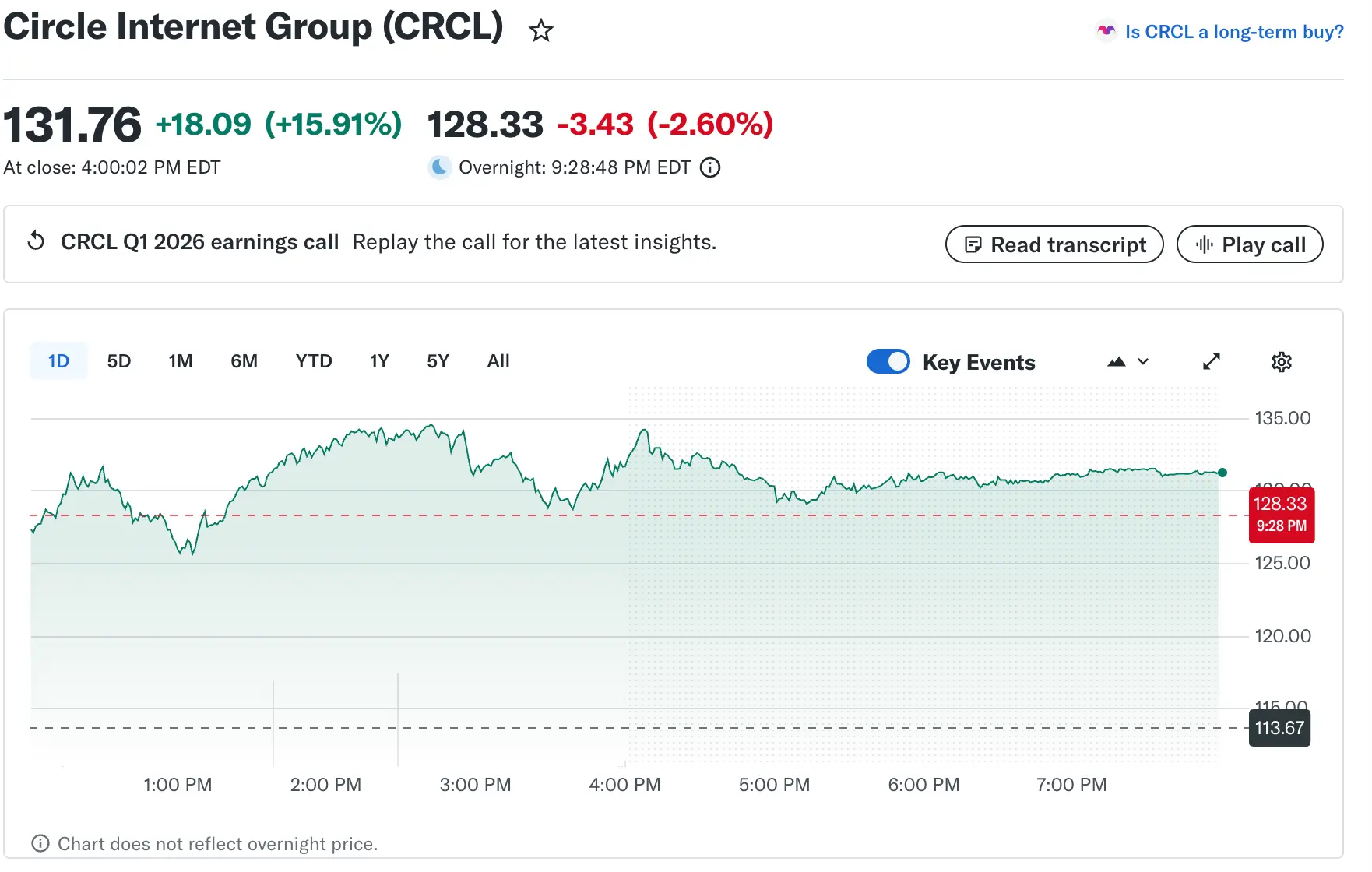
Circle released its first-quarter earnings for 2026 before the market opened yesterday, posting double-digit year-over-year revenue growth and simultaneously disclosing that its new public chain Arc's native token completed a pre-sale of $222 million at a $3 billion valuation. Although net profit declined 15% year-over-year due to increased stock-based compensation and operational investments, market focus remained centered on the long-term narrative of Arc and AI agent payments. CRCL's stock price surged nearly 16% that day, closing at $131.76, hitting a new high since mid-March.
USDC Scale Hits New Record, On-chain Transaction Volume Up 263% YoY

Circle's first-quarter total revenue and reserve income reached $694 million, a 20% increase year-over-year. Breakdown:

  • Reserve Income: $653 million, up 17% YoY, primarily benefiting from a 39% YoY increase in average USDC circulation, partially offset by a 66 basis point decrease in reserve yield (down to 3.5%).

  • Other Revenue: $42 million, roughly doubling YoY, reflecting strong growth in subscription, service, and transaction revenues.

  • Net Income from Continuing Operations: $55 million, down 15% YoY, mainly due to stock-based compensation and related payroll taxes post-IPO, as well as increased investment in products, distribution, and operational infrastructure.

  • Adjusted EBITDA: $151 million, up 24% YoY; Adjusted EBITDA margin was 53%.

Notably, both revenue and net income fell short of Wall Street analysts' expectations prior to the earnings release. According to Bloomberg, sell-side analysts had forecast revenue around $720.8 million and a reserve yield of 3.56%, neither of which were met. However, the adjusted EBITDA of $151 million exceeded the market expectation of $137.9 million, providing some support. This also indicates that the interest rate environment will be one of the most critical external variables for Circle moving forward.

On the operational front, USDC circulation reached $77 billion, up 28% YoY. First-quarter USDC on-chain transaction volume reached $21.5 trillion, a 263% YoY increase, reflecting a significant rise in stablecoin usage density as a payment and settlement medium.

According to Visa Onchain Analytics data, USDC accounted for 63% of stablecoin transaction volume in Q1. Meanwhile, Circle's USYC has become the world's largest tokenized money market fund as of May 7. Other key operational metrics include a USDC "platform retention" balance of $13.7 billion at quarter-end, up 254% YoY; 7.2 million "active wallets" holding over $10 in USDC, up 47% YoY; and a stablecoin market share of 28%, down 62 basis points YoY, directly reflecting competitive pressure from Tether and other rivals.

Public Chain Arc Completes $222 Million Token Financing with Star-Studded Investor Lineup

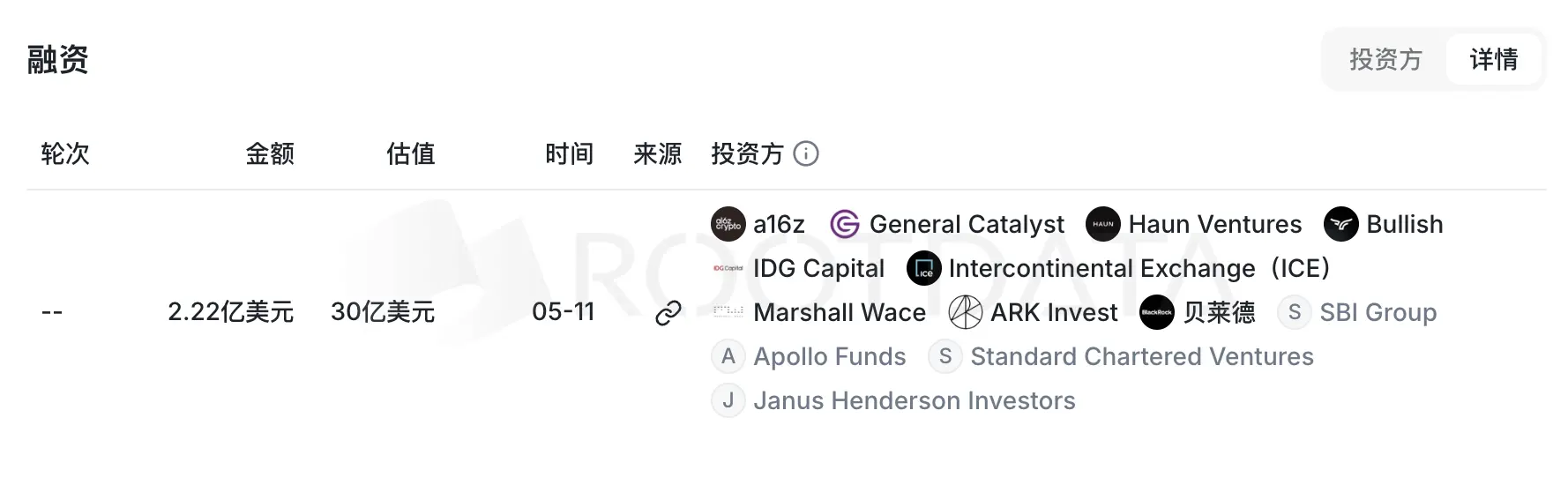
Circle also announced that the native token ARC for Arc, its institutionally-focused Layer 1 public chain, has completed a $222 million pre-sale, with a fully diluted network valuation of $3 billion. According to crypto asset data platform RootData, the financing was led by a16z with a $75 million investment. Other participating investors include BlackRock, Apollo Funds, Intercontinental Exchange (ICE), Standard Chartered Ventures, ARK Invest, Bullish, and over ten other institutions.
Circle CEO Jeremy Allaire stated that the company is transitioning from a stablecoin issuer to a broader internet platform company, entering the operating system and application business. Regarding token distribution, Circle holds 25% of the initial 10 billion token supply, 60% is allocated to network builders and participants, and 15% is reserved as long-term reserves.

Notably, Circle stated that this financial forecast does not incorporate the financial impact of the ARC token pre-sale, Arc incentive programs, or future Arc-related revenues.

Reaffirms Previously Announced Full-Year Guidance, No Adjustments

Additionally, Circle simultaneously launched a series of "Agent Stack" products, including Circle CLI (Command Line Tool), Agent Wallets, and Agent Marketplace, enabling developers and merchants to create, fund, and monetize AI agent-driven activities using USDC across multiple public chains and payment protocols.

The earnings report also revealed that, in terms of payment business, the Circle Payments Network (CPN) processed an annualized transaction volume of $8.3 billion as of March 31, based on the past 30 days of activity. Managed Payments, launched in April, allows financial institutions to offer stablecoin payment services without managing digital assets themselves.

New enterprise use cases for USDC include: Kyriba embedding USDC into its corporate treasury system, and Polymarket expanding its use of USDC as a core collateral and settlement asset.

Finally, regarding the outlook for the full year 2026, Circle chose to reiterate its previously announced performance guidance without any upward or downward revisions. Specifically, USDC circulation is still expected to maintain a 40% compound annual growth rate (CAGR) over multi-year cycles. FY2026 other revenue is projected between $150 million and $170 million; RLDC margin is expected between 38% and 40%; and adjusted operating expenses are forecast at $570 million to $585 million.

Similarly, this set of guidance does not incorporate the financial impact of the ARC token pre-sale, Arc incentive programs, or future Arc-related revenues, meaning there is room for upward revision once the Arc ecosystem successfully launches.

Majority of Wall Street Analysts Issue Bullish Ratings

Following the earnings release, CRCL surged approximately 16% that day, closing at $131.76, reaching its highest level since March 18. The stock has gained 66% year-to-date, with market capitalization rebounding to around $35 billion.

Wall Street analysts are generally optimistic about Circle's stock price performance over the next 12 months and beyond. According to TipRanks statistics, the consensus target price is $138.50. Among them, Peter Christiansen of Citi gave a 12-month target of $243, while Gautam Chhugani of Bernstein set a target of $190. Along with ten other analysts, all issued "Buy" ratings.

However, analysts still retain some reservations about short-term execution risks. Clear Street analyst Owen Lau pointed out that while the narratives of Arc and Agent Stack are eye-catching, they are "not yet a material business." John Todaro of Needham & Co. noted that recent DeFi protocol hacks could indirectly affect USDC use cases: "If capital leaves DeFi, how does that impact Circle's business?" Andrew Jeffrey of William Blair believes that CRCL stock price volatility will remain high in the short term, but Circle holds a significant advantage in "stablecoin commerce" with multiple catalysts progressing simultaneously.

It can be seen that Circle's earnings report presents a dual structure: the stablecoin business is still scaling rapidly, but unit economics are being compressed by interest rates and distribution costs. The market's willingness to award a 16% single-day gain is more of a bet that the Arc public chain, ARC tokenomics, and AI agent payments can reposition Circle from a stablecoin issuer to a "network financial operating system" in the medium to long term, opening up second and third growth curves beyond the existing USDC spread model.

Perhaps the market's focus going forward will be on the Arc mainnet launch timeline, market acceptance of the ARC token after public circulation, and the impact of subsequent U.S. GENIUS Act and Clarity Act implementations on the overall stablecoin competitive landscape.

Pertanyaan Terkait

QWhat was Circle's stock price performance after the release of its Q1 2026 earnings report?

AFollowing the release of its Q1 2026 earnings report, Circle's stock (CRCL) rose nearly 16% on the day, closing at $131.76, which was a new high since mid-March.

QWhat major development did Circle announce alongside its earnings?

AAlongside its earnings, Circle announced that the native token ARC of its new institutional finance-focused Layer 1 blockchain, Arc, completed a pre-sale of $222 million at a fully diluted network valuation of $30 billion.

QWhat were the key financial results for Circle in Q1 2026?

AIn Q1 2026, Circle's total revenue and reserve income was $694 million, a 20% year-over-year increase. However, net income from continuing operations was $55 million, down 15% YoY. Adjusted EBITDA was $151 million, a 24% YoY increase.

QWho led the funding round for the ARC token?

AThe funding round for the ARC token was led by the venture capital firm Andreessen Horowitz (a16z), which invested $75 million.

QAccording to the article, what is the main transformation that Circle's CEO Jeremy Allaire described for the company?

ACircle's CEO Jeremy Allaire stated that the company is transforming from a stablecoin issuer into a broader internet platform company, entering the operating system and application businesses.

Bacaan Terkait

Dalam Kepungan Modal, Desentralisasi adalah Satu-satunya Pertahanan Public Blockchain

Oleh Omid Malekan, Profesor Tambahan Keuangan di Columbia Business School Di dunia yang penuh dengan kekuasaan dan keserakahan, penulis berpendapat bahwa desentralisasi adalah satu-satunya pertahanan penting untuk blockchain publik melawan pengepungan modal dan korporasi besar. Sementara banyak dalam industri kripto menganggap skalabilitas, pengembangan bisnis, dan pendanaan besar sebagai prioritas, penulis yakin hanya jaringan yang benar-benar terdesentralisasi dan netral sejak lahir yang dapat menghindari pengambilalihan dan korupsi oleh kepentingan kapitalis. Logika dasarnya adalah realistis dan Machiavellian: perusahaan yang mencari keuntungan pada akhirnya akan mencoba menguasai atau menetralkan teknologi yang mengancam model bisnis mereka yang sudah mapan. Jaringan terpusat atau "izin" (permissioned), termasuk blockchain konsorsium perusahaan, rentan terhadap pengambilalihan kontrol internal, yang lebih berbahaya daripada serangan eksternal. Sejarah jaringan pembayaran seperti Visa dan Mastercard menunjukkan pola di mana inisiatif yang awalnya netral berubah menjadi alat monopoli yang mencari keuntungan. Penulis memberikan contoh konkret: sebuah CEO perusahaan blockchain konsorsium mengklaim jaringannya lebih "adil" daripada Ethereum karena calon peserta hanya perlu "membuktikan nilai" mereka kepada anggota yang ada. Namun, dalam praktiknya, jaringan seperti ini justru dapat mengabadikan oligopoli dengan mengecualikan pesaing. Motivasi sebenarnya di balik banyak solusi blockchain semi-terpusat yang didukung perusahaan mungkin hanyalah taktik penundaan untuk memperlambat adopsi teknologi desentralisasi sejati. Kesimpulannya, meskipun tidak sempurna, blockchain publik yang terdesentralisasi seperti Ethereum tetap merupakan pilihan terbaik yang realistis. Pasar pada akhirnya akan mengalir ke infrastruktur yang paling aman dan netral, karena sistem terpusat pada dasarnya tidak efisien dan bergantung pada gesekan untuk menghasilkan keuntungan. Hanya desentralisasi penuh yang dapat bertahan dari pengepungan modal dan menjadi senjata efektif melawan raksasa industri lama.

Foresight News10m yang lalu

Dalam Kepungan Modal, Desentralisasi adalah Satu-satunya Pertahanan Public Blockchain

Foresight News10m yang lalu

Aturan Bitcoin Ditentukan oleh Siapa? BIP-110 Picu Perbedaan Pendapat dalam Tata Kelola

BIP-110, sebuah proposal untuk membatasi data non-keuangan di blockchain Bitcoin (seperti yang digunakan oleh Inskripsi dan Runes), telah memicu kembali perdebatan mendalam tentang tata kelola Bitcoin. Proposal ini bertujuan memberlakukan batasan konsensus baru—seperti membatasi ukuran skrip output dan OP_RETURN—untuk satu tahun, guna mencegah data arbitrer membebani node. Namun, langkah ini mengubah perdebatan dari lapisan kebijakan (penerusan/penggalian) ke lapisan konsensus, yang membuat transaksi yang saat ini valid menjadi tidak valid. Dukungan dan penentangan terbelah. Pendukung, termasuk node Bitcoin Knots, berpendapat bahwa kebijakan default node (seperti yang diubah di Core v30) sudah tidak efektif dan batasan harus ditingkatkan ke lapisan konsensus. Penentang seperti Adam Back dan Michael Saylor berargumen bahwa Bitcoin harus tetap netral dan tanpa izin; mengubah konsensus untuk melarang jenis transaksi tertentu merusak prinsip dasarnya. Saylor, mewakili pemegang korporat besar, juga memperingatkan risiko preseden tata kelola dan potensi perpecahan rantai. Kontroversi ini juga menyoroti dinamika kekuasaan yang kompleks: penambang dengan kekuatan hashrate, operator node yang menegakkan aturan, pengembang inti dengan akses commit, dan pemegang aset institusional seperti Saylor—masing-masing memiliki klaim legitimasi yang berbeda atas arah Bitcoin. Terlepas dari apakah BIP-110 diaktifkan (menggunakan sinyal penambang 55%), tekanan uji tata kelola ini mengungkap pertanyaan mendasar: Siapa yang berhak memutuskan apa itu Bitcoin dan bagaimana aturannya berevolusi? Perdebatan ini pada akhirnya lebih tentang otoritas dan prinsip daripada sekadar data "sampah".

链捕手36m yang lalu

Aturan Bitcoin Ditentukan oleh Siapa? BIP-110 Picu Perbedaan Pendapat dalam Tata Kelola

链捕手36m yang lalu

Paus Misterius Bertaruh $2.5 Miliar Agar BTC Tembus $72.000 pada Agustus, Level $70.000 Jadi Kunci

Seorang trader anonim melakukan aksi spektakuler dengan membeli 20.000 opsi call Bitcoin pada harga strike $70.000 dan secara simultan menjual 20.000 opsi call pada strike $72.000 di Deribit, membentuk struktur bull call spread. Transaksi dengan nilai nominal total $25 miliar ini berakhir tanggal 31 Juli, hanya dua hari setelah keputusan suku bunga Federal Reserve AS. Dengan harga Bitcoin saat ini sekitar $64.289, trader ini bertaruh bahwa aset kripto tersebut akan naik lebih dari 9% dalam 10 hari untuk menembus level psikologis $70.000. Namun, jalan menuju target tersebut tidak mulus. Analisis on-chain menunjukkan basis biaya pembeli terbaru terkonsentrasi di sekitar $69.000, yang kemungkinan akan menjadi area resisten kuat. Selain itu, aliran dana ETF Bitcoin AS yang fluktuatif—meski menunjukkan arus masuk bersih $272 juta dalam dua minggu, juga pernah mencetak arus keluar $424 juta dalam satu hari—menambah ketidakpastian untuk ledakan permintaan yang diperlukan. Skenario jangka panjang dari berbagai analis bervariasi, mulai dari target $150.000 pada akhir tahun (Bernstein) hingga peringatan potensi koreksi lebih dalam (NYDIG). Namun, untuk taruhan jangka pendek ini, fokusnya adalah pada pertemuan Fed dan kemampuan Bitcoin untuk mengatasi hambatan di sekitar $69.000-$70.000 dengan dukungan permintaan yang konsisten. Pasar kripto secara keseluruhan saat ini bernilai $2,23 triliun dengan dominasi Bitcoin sebesar 58,73%.

marsbit44m yang lalu

Paus Misterius Bertaruh $2.5 Miliar Agar BTC Tembus $72.000 pada Agustus, Level $70.000 Jadi Kunci

marsbit44m yang lalu

Meniru "Momen DeepSeek"? Wall Street Serempak Menyatakan: Kimi K3 Justru Memperkuat Kebutuhan Komputasi

Replika "Momen DeepSeek"? Wall Street Serentak Menyatakan: Kimi K3 Justru Memperkuat Kebutuhan Komputasi. Pasar sempat panik menyamakan peluncuran Kimi K3 dengan "Momen DeepSeek 2.0" yang sebelumnya menekan harga saham sektor semikonduktor. Namun, laporan terbaru dari bank investasi seperti UBS, Nomura, Bank of America Merrill Lynch, dan Citibank menyimpulkan pandangan berbeda: Kimi K3 bukanlah pengakhir, melainkan akselerator bagi permintaan komputasi. Kimi K3, model open-source dengan 2.8 triliun parameter yang dirilis Moonshot AI pada 16 Juli 2026, menampilkan kemampuan mendekati model mutakhir seperti konteks 1M token, inferensi "selalu aktif", kemampuan multimodal asli, dan arsitektur MoE. Fitur-fitur ini bukan cerita aset ringan. Mereka justru meningkatkan tekanan pada inferensi, memori, jaringan, dan penyimpanan. Analis berargumen bahwa model yang lebih kuat dan lebih terjangkau (seperti K3) akan memicu "Paradoks Jevons" di AI: peningkatan efisiensi malah meningkatkan konsumsi komputasi secara keseluruhan karena lebih banyak pengembang dan perusahaan yang dapat menerapkannya di lebih banyak skenario, sehingga meningkatkan volume token yang diproses. Selain itu, untuk mempertahankan keunggulan kompetitif, laboratorium AI terdepan AS seperti OpenAI dan Anthropic akan merespons dengan pelatihan skala lebih besar dan iterasi lebih cepat. Konsekuensinya, rantai pasokan infrastruktur AI diperkirakan tetap diuntungkan: 1. **Penyimpanan & Memori:** Peningkatan kebutuhan cache KV karena konteks panjang akan mendorong permintaan DDR5 server dan eSSD. HBM juga sangat dibutuhkan untuk deployment model open-source berskala besar. 2. **Komputasi & Foundry:** Hukum skala (*scaling law*) tetap berlaku, menguntungkan pemain seperti NVIDIA dan TSMC. 3. **Jaringan:** Deployment K3 membutuhkan konfigurasi kluster "super-node" (lebih dari 64 GPU), meningkatkan permintaan untuk modul optik dan chip optik. 4. **Platform Cloud:** Platform yang menghosting beragam model open-source (seperti Alibaba) mendapatkan daya tawar lebih kuat. Data menunjukkan penggunaan model AI China oleh pengembang global telah melonjak dari kurang dari 2% menjadi lebih dari 45% dalam setahun, menandakan adopsi yang meluas. Dengan demikian, selama penggunaan token terus tumbuh dan aplikasi seperti konteks panjang serta Agen terus meluas, kebutuhan akan komputasi, HBM, penyimpanan, jaringan, dan pusat data akan tetap tak terhindarkan. Model open-source yang lebih kuat dilihat sebagai pintu masuk bagi gelombang difusi permintaan berikutnya, bukan akhir dari kebutuhan infrastruktur AI.

链捕手52m yang lalu

Meniru "Momen DeepSeek"? Wall Street Serempak Menyatakan: Kimi K3 Justru Memperkuat Kebutuhan Komputasi

链捕手52m yang lalu

Trading

Spot
活动图片