a16z: AI's 'Amnesia', Can Continuous Learning Cure It?

marsbitDipublikasikan tanggal 2026-04-25Terakhir diperbarui pada 2026-04-25

Abstrak

The article "a16z: AI's 'Amnesia' – Can Continual Learning Cure It?" explores the limitations of current large language models (LLMs), which, like the protagonist in the film *Memento*, are trapped in a perpetual present—unable to form new memories after training. While methods like in-context learning (ICL), retrieval-augmented generation (RAG), and external scaffolding (e.g., chat history, prompts) provide temporary solutions, they fail to enable true internalization of new knowledge. The authors argue that compression—the core of learning during training—is halted at deployment, preventing models from generalizing, discovering novel solutions (e.g., mathematical proofs), or handling adversarial scenarios. The piece introduces *continual learning* as a critical research direction to address this, categorizing approaches into three paths: 1. **Context**: Scaling external memory via longer context windows, multi-agent systems, and smarter retrieval. 2. **Modules**: Using pluggable adapters or external memory layers for specialization without full retraining. 3. **Weights**: Enabling parameter updates through sparse training, test-time training, meta-learning, distillation, and reinforcement learning from feedback. Challenges include catastrophic forgetting, safety risks, and auditability, but overcoming these could unlock models that learn iteratively from experience. The conclusion emphasizes that while context-based methods are effective, true breakthroughs requ...

Original Author: Malika Aubakirova, Matt Bornstein, a16z crypto

Original Compilation: Deep Tide TechFlow

In Christopher Nolan's "Memento," the main character Leonard Shelby lives in a fragmented present. Brain damage has left him with anterograde amnesia, unable to form new memories. Every few minutes, his world resets, trapping him in an eternal "now," unable to remember what just happened or what will happen next. To survive, he tattoos words on his body and takes Polaroids, relying on these external props to replace the memory functions his brain can no longer perform.

Large language models live in a similar eternal present. After training ends, vast amounts of knowledge are frozen in their parameters; the model cannot form new memories or update its parameters based on new experiences. To compensate for this defect, we build a bunch of scaffolding for it: chat history acts as short-term sticky notes, retrieval systems serve as external notebooks, and system prompts are like tattoos on the body. But the model itself never truly internalizes this new information.

More and more researchers believe this is not enough. In-context learning (ICL) can solve problems, provided the answer (or fragments of the answer) already exists somewhere in the world. But for problems that require true discovery (like novel mathematical proofs), adversarial scenarios (like security attacks and defenses), or knowledge that is too implicit to be expressed in language, there is a strong argument that models need a way to directly write new knowledge and experience into their parameters after deployment.

In-context learning is temporary. True learning requires compression. Until we allow models to continuously compress, we might be stuck in the eternal present of "Memento." Conversely, if we can train models to learn their own memory architecture, rather than relying on external custom tools, we might unlock a whole new dimension of scaling.

This field of research is called continual learning. This concept is not new (see McCloskey and Cohen's 1989 paper), but we believe it is one of the most important research directions in AI today. The explosive growth of model capabilities over the past two to three years has made the gap between what models "know" and what they "can know" increasingly apparent. The purpose of this article is to share what we have learned from top researchers in this field, help clarify the different paths of continual learning, and promote the development of this topic within the startup ecosystem.

Note: This article was shaped by in-depth discussions with a group of excellent researchers, PhD students, and entrepreneurs who generously shared their work and insights in the field of continual learning. From theoretical foundations to the engineering realities of post-deployment learning, their insights have made this article much more solid than anything we could have written alone. Thank you for your time and ideas!

First, Let's Talk About Context

Before defending parameter-level learning (i.e., learning that updates model weights), it's necessary to acknowledge a fact: in-context learning does work. And there is a strong argument that it will continue to win.

The essence of a Transformer is a sequence-based next-token predictor conditioned on the input. Give it the right sequence, and you can get surprisingly rich behavior without ever touching the weights. This is why methods like context management, prompt engineering, instruction fine-tuning, and few-shot examples are so powerful. Intelligence is encapsulated in static parameters, and the manifested capabilities change dramatically based on what you feed into the context.

A recent in-depth article by Cursor on the scaling of autonomous programming agents is a good example: the model weights are fixed; what really makes the system run is the careful orchestration of context—what to put in, when to summarize, how to maintain a coherent state over hours of autonomous operation.

OpenClaw is another good example. It went viral not because of special model access (the underlying model is available to everyone), but because it extremely efficiently converted context and tools into a working state: tracking what you're doing, structuring intermediate outputs, deciding when to re-inject prompts, maintaining persistent memory of previous work. OpenClaw elevated the "shell design" of agents to the level of an independent discipline.

When prompt engineering first emerged, many researchers were skeptical that "just prompts" could become a serious interface. It seemed like a hack. But it is a native product of the Transformer architecture, requires no retraining, and automatically upgrades as models improve. As models get stronger, prompts get stronger. "Crude but native" interfaces often win because they are coupled directly to the underlying system, not fighting against it. So far, the trajectory of LLM development has followed this pattern.

State Space Models: Context on Steroids

As mainstream workflows shift from raw LLM calls to agent loops, in-context learning models are under increasing pressure. In the past, it was relatively rare for the context window to be completely filled. This usually happened when an LLM was asked to perform a long series of discrete tasks, and the application layer could trim and compress chat history in a straightforward way.

But for agents, a single task can consume a large portion of the total available context. Each step of an agent loop relies on the context passed from previous iterations. And they often fail after 20 to 100 steps because they "lose the thread": the context gets filled, coherence degrades, and they fail to converge.

Therefore, major AI labs are now investing significant resources (i.e., large-scale training runs) to develop models with ultra-long context windows. This is a natural path because it builds on what already works (in-context learning) and aligns with the industry's broader shift towards inference-time computation. The most common architecture involves interleaving fixed memory layers between standard attention heads, namely State Space Models (SSMs) and linear attention variants (collectively referred to as SSMs below). SSMs offer fundamentally better scaling curves in long-context scenarios.
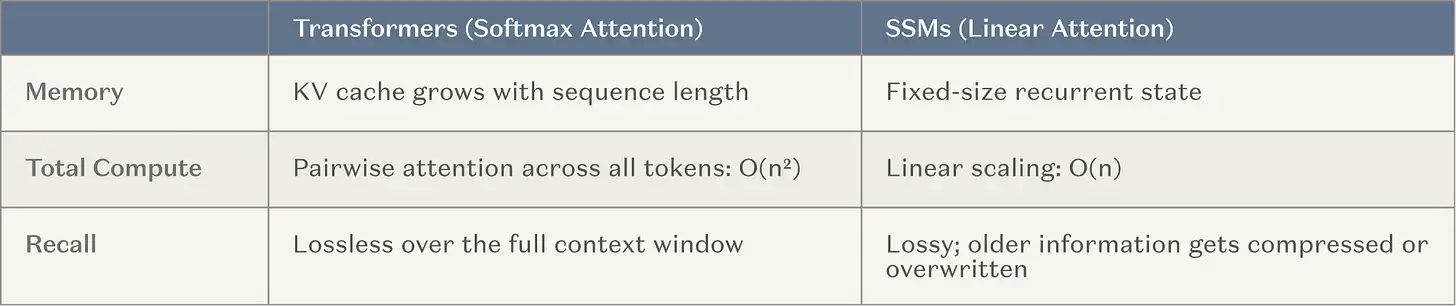
Figure Caption: Scaling comparison of SSM vs. traditional attention mechanism

The goal is to help agents increase the number of coherent run steps by several orders of magnitude, from about 20 steps to about 20,000 steps, without losing the broad skills and knowledge provided by traditional Transformers. If successful, this would be a major breakthrough for long-running agents.

You could even view this approach as a form of continual learning: although the model weights aren't updated, an external memory layer that rarely needs resetting is introduced.

So, these non-parametric methods are real and powerful. Any evaluation of continual learning must start here. The question isn't whether today's context systems work—they do. The question is: have we already seen the ceiling, and can new methods take us further?

What Context Omits: The "Filing Cabinet Fallacy"

"What happened with AGI and pre-training is that, in a sense, they overshot... Humans are not AGI. Yes, humans do have a skill base, but humans lack a vast amount of knowledge. We rely on continual learning.

If I create a super-smart 15-year-old, he knows nothing. A good student, very eager to learn. You could say, go be a programmer, go be a doctor. Deployment itself would involve a process of learning, trial and error. It's a process, not throwing the finished product out there. — Ilya Sutskever"

Imagine a system with infinite storage space. The world's largest filing cabinet, every fact perfectly indexed, instantly retrievable. It can look up anything. Has it learned?

No. It was never forced to compress.

This is the core of our argument, referencing a point previously made by Ilya Sutskever: LLMs are essentially compression algorithms. During training, they compress the internet into parameters. Compression is lossy, and it is this lossiness that makes it powerful. Compression forces the model to find structure, generalize, and build representations that transfer across contexts. A model that memorizes all training samples is inferior to one that extracts underlying patterns. Lossy compression is learning itself.

Ironically, the mechanism that makes LLMs so powerful during training (compressing raw data into compact, transferable representations) is precisely what we stop them from doing after deployment. We halt compression at the moment of release, substituting it with external memory.

Of course, most agent shells compress context in some custom way. But doesn't the bitter lesson tell us that the model itself should learn this compression, directly and at scale?

Yu Sun shared an example to illustrate this debate: mathematics. Consider Fermat's Last Theorem. For over 350 years, no mathematician could prove it, not because they lacked the right literature, but because the solution was highly novel. The conceptual distance between existing mathematical knowledge and the final answer was too great.

When Andrew Wiles finally cracked it in the 1990s, he spent seven years working in near isolation, having to invent entirely new techniques to reach the answer. His proof relied on successfully bridging two different branches: elliptic curves and modular forms. Although Ken Ribet had previously shown that establishing this connection would automatically solve Fermat's Last Theorem, no one before Wiles possessed the theoretical tools to actually build that bridge. A similar argument can be made for Grigori Perelman's proof of the Poincaré conjecture.

The core question is: Do these examples prove that LLMs are missing something, some ability to update priors and engage in truly creative thinking? Or does this story恰恰证明恰恰相反——all human knowledge is just data available for training and recombination, and Wiles and Perelman merely demonstrate what LLMs could also do at a larger scale?

This question is empirical, and the answer is still uncertain. But we do know that there are many categories of problems where in-context learning fails today, and parameter-level learning could be useful. For example:
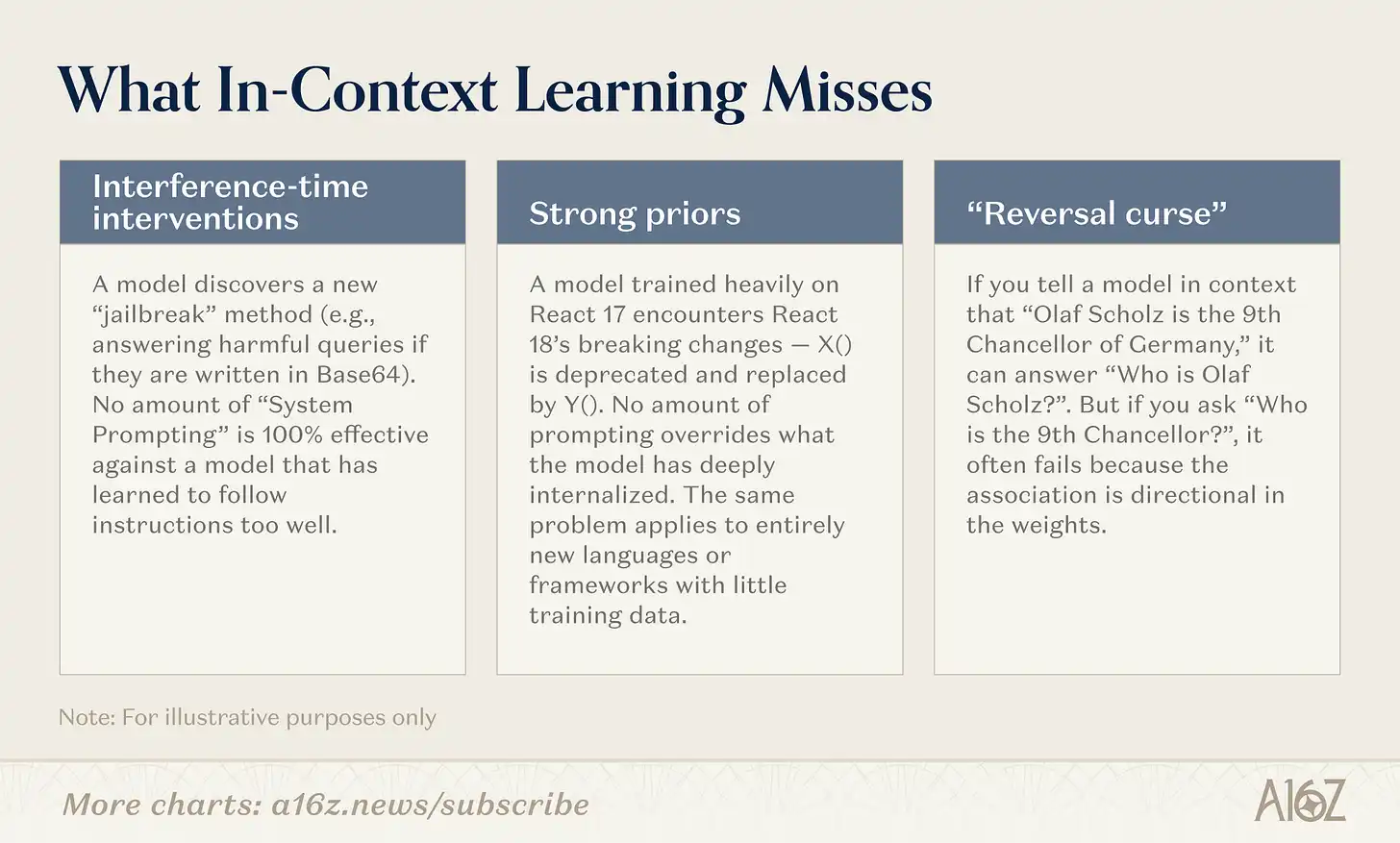
Figure Caption: Problem categories where in-context learning fails and parameter learning might succeed

More importantly, in-context learning can only handle things that can be expressed in language, while weights can encode concepts that prompts cannot convey in words. Some patterns are too high-dimensional, too implicit, too deeply structured to fit into context. For instance, the visual texture that distinguishes a benign artifact from a tumor in a medical scan, or the subtle audio fluctuations that define a speaker's unique rhythm—these patterns are not easily broken down into precise vocabulary.

Language can only approximate them. No prompt, no matter how long, can transmit these things; this kind of knowledge can only live in the weights. They reside in the latent space of learned representations, not in words. No matter how large the context window grows, there will always be knowledge that text cannot describe, knowledge that can only be carried by parameters.

This might explain why explicit "the robot remembers you" features (like ChatGPT's memory) often make users feel discomfort rather than delight. What users really want is not "recall," but "capability." A model that has internalized your behavioral patterns can generalize to new scenarios; a model that merely recalls your history cannot. The gap between "Here's what you wrote last time you replied to this email" (verbatim repetition) and "I understand your way of thinking well enough to anticipate what you need" is the gap between retrieval and learning.

Continual Learning Primer

There are multiple paths to continual learning. The dividing line is not "whether there is memory function," but: Where does compression happen? These paths exist on a spectrum, from no compression (pure retrieval, frozen weights), to full internal compression (weight-level learning, the model gets smarter), with an important middle ground (modules).
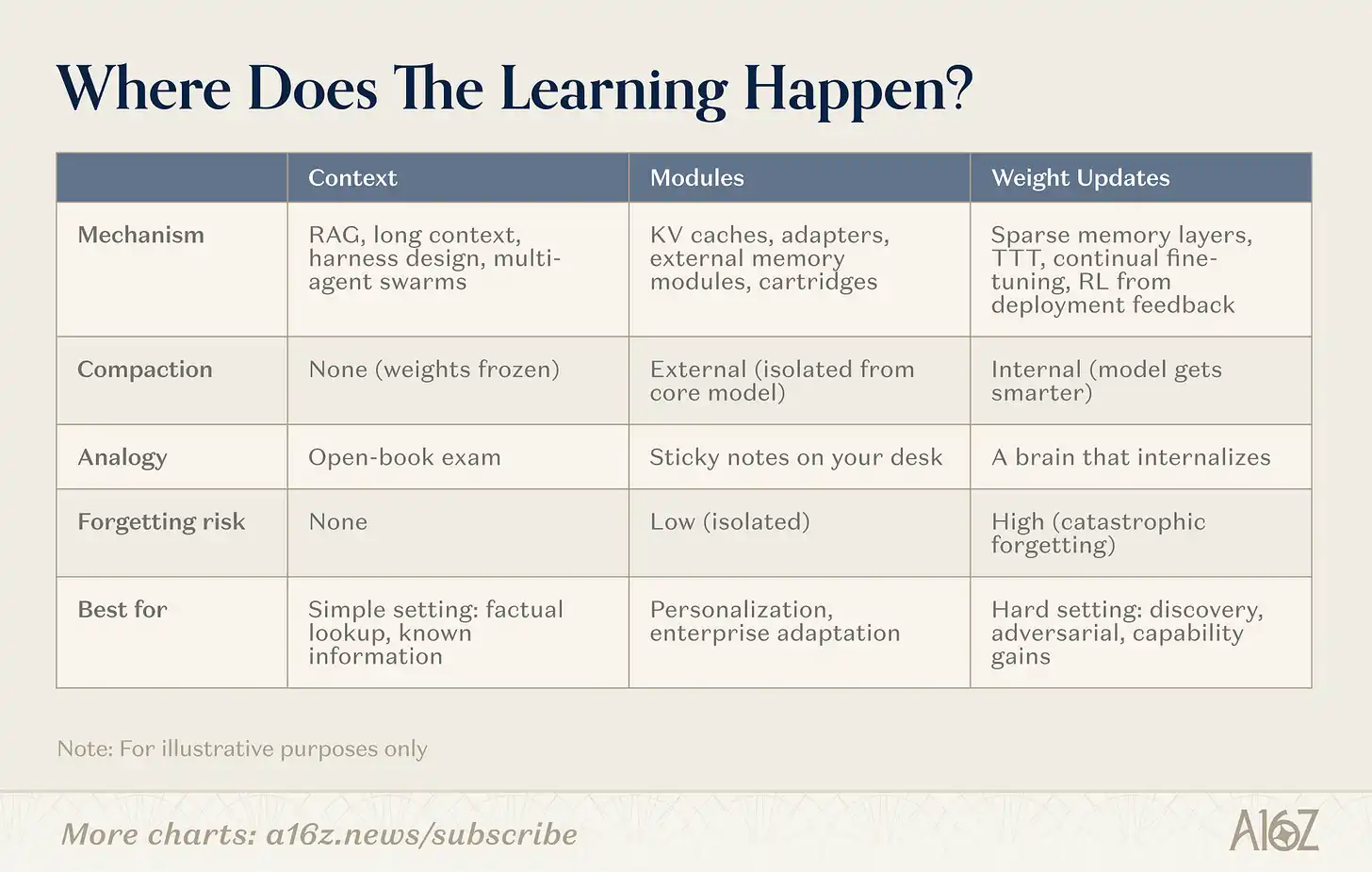
Figure Caption: Three paths of continual learning—Context, Modules, Weights

Context

On the context end, teams build smarter retrieval pipelines, agent shells, and prompt orchestration. This is the most mature category: infrastructure is proven, deployment paths are clear. The limitation is depth: context length.

A notable new direction: multi-agent architectures as a scaling strategy for context itself. If a single model is limited to a 128K token window, a coordinated group of agents—each holding its own context, focusing on a slice of the problem, communicating results—can approximate infinite working memory as a whole. Each agent does in-context learning within its own window; the system does aggregation. Karpathy's recent autoresearch project and Cursor's example of building a web browser are early cases. This is a purely non-parametric approach (no weight changes), but it significantly raises the ceiling of what context systems can do.

Modules

In the module space, teams build pluggable knowledge modules (compressed KV caches, adapter layers, external memory stores) that allow general models to specialize without retraining. An 8B model with the right module can match the performance of a 109B model on a target task, with a fraction of the memory footprint. The appeal is its compatibility with existing Transformer infrastructure.

Weights

On the weight update end, researchers are pursuing true parameter-level learning: sparse memory layers that update only relevant parameter segments, reinforcement learning loops that optimize the model from feedback, test-time training that compresses context into weights during inference. These are the deepest methods, and the hardest to deploy, but they truly allow the model to fully internalize new information or skills.

There are various specific mechanisms for parameter updates. Listing a few research directions:
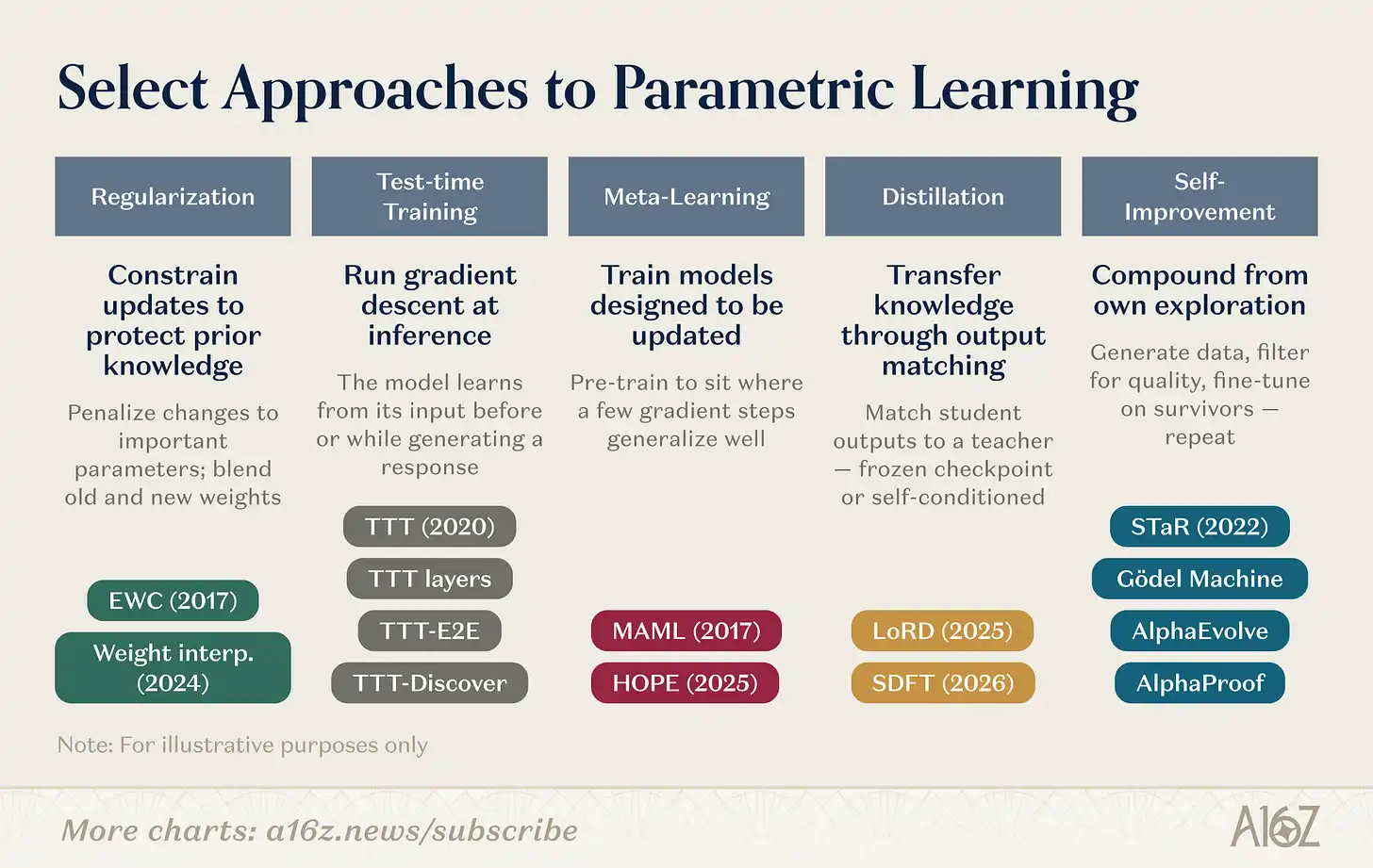
Figure Caption: Overview of research directions in weight-level learning

Weight-level research covers multiple parallel tracks. Regularization and weight space methods have the longest history: EWC (Kirkpatrick et al., 2017) penalizes parameter changes based on their importance to previous tasks; weight interpolation (Kozal et al., 2024) mixes old and new weight configurations in parameter space, but both are relatively fragile at scale.

Test-time training, pioneered by Sun et al. (2020) and later developed into architectural primitives (TTT layers, TTT-E2E, TTT-Discover), takes a截然不同的 approach: perform gradient descent on test data, compressing new information into parameters at the moment it's needed.

Meta-learning asks: Can we train models that know "how to learn"? From MAML's few-shot-friendly parameter initialization (Finn et al., 2017) to Behrouz et al.'s Nested Learning (2025), which structures the model as a hierarchical optimization problem with modules operating on different time scales for fast adaptation and slow updates, inspired by biological memory consolidation.

Distillation retains knowledge of previous tasks by having a student model match frozen teacher checkpoints. LoRD (Liu et al., 2025) makes distillation efficient enough for continuous operation by simultaneously pruning the model and the replay buffer. Self-distillation (SDFT, Shenfeld et al., 2026) flips the source, using the model's own outputs under expert conditions as the training signal, bypassing the catastrophic forgetting of sequential fine-tuning.

Recursive self-improvement operates on similar lines: STaR (Zelikman et al., 2022) bootstraps reasoning能力 from self-generated reasoning chains; AlphaEvolve (DeepMind, 2025) discovered algorithmic optimizations that had gone unimproved for decades; Silver and Sutton's "Age of Experience" (2025) defines agent learning as a never-ending stream of continuous experience.

These research directions are converging. TTT-Discover has already融合 test-time training and RL-driven exploration. HOPE nests fast and slow learning loops within a single architecture. SDFT turns distillation into a fundamental operation for self-improvement. The boundaries between columns are blurring. The next generation of continual learning systems will likely combine multiple strategies: regularization for stability, meta-learning for speed, self-improvement for compound growth. A growing number of startups are betting on different layers of this tech stack.

Continual Learning Startup Landscape

The non-parametric end of the spectrum is the most well-known. Shell companies (Letta, mem0, Subconscious) build orchestration layers and scaffolding, managing what goes into the context window. External storage and RAG infrastructure (e.g., Pinecone, xmemory) provide the retrieval backbone. The data exists; the challenge is getting the right slice in front of the model at the right time. As context windows expand, the design space for these companies grows, especially on the shell side, where a new wave of startups is emerging to manage increasingly complex context strategies.

The parametric end is earlier and more diverse. Companies here are experimenting with some version of "post-deployment compression," allowing models to internalize new information in their weights. The paths roughly correspond to different bets on *how* models should learn after release.

Partial Compression: Learning Without Retraining. Some teams are building pluggable knowledge modules (compressed KV caches, adapter layers, external memory stores) that allow general models to specialize without touching the core weights. The common argument is: you get meaningful compression (not just retrieval), while keeping the stability-plasticity trade-off manageable because learning is isolated, not spread throughout the parameter space. An 8B model with the right module can match the performance of much larger models on target task. The advantage is composability: modules can be plugged and played with existing Transformer architectures, can be swapped or updated independently, with much lower experimentation cost than retraining.

RL and Feedback Loops: Learning from Signals. Other teams bet that the richest signal for post-deployment learning already exists in the deployment loop itself—user corrections, task success/failure, reward signals from real-world outcomes. The core idea is that the model should treat every interaction as a potential training signal, not just an inference request. This is highly analogous to how humans improve at their jobs: do work, get feedback, internalize what works. The engineering challenge is converting sparse, noisy, sometimes adversarial feedback into stable weight updates without catastrophic forgetting. But a model that can truly learn from deployment compounds value in ways context systems cannot.

Data-Centric: Learning from the Right Signals. A related but distinct bet is that the bottleneck is not the learning algorithm, but the training data and surrounding systems. These teams focus on curating, generating, or synthesizing the *right* data to drive continuous updates: the premise is that a model with high-quality, well-structured learning signals needs far fewer gradient steps to improve meaningfully. This dovetails naturally with feedback loop companies but emphasizes the upstream question: it's one thing if the model *can* learn, another what it *should* learn from and to what extent.

New Architectures: Designing Learning Capability from the Ground Up. The most radical bet argues that the Transformer architecture itself is the bottleneck, and continual learning requires fundamentally different computational primitives: architectures with continuous-time dynamics and built-in memory mechanisms. The argument here is structural: if you want a continually learning system, you should embed the learning mechanism into the underlying foundation.
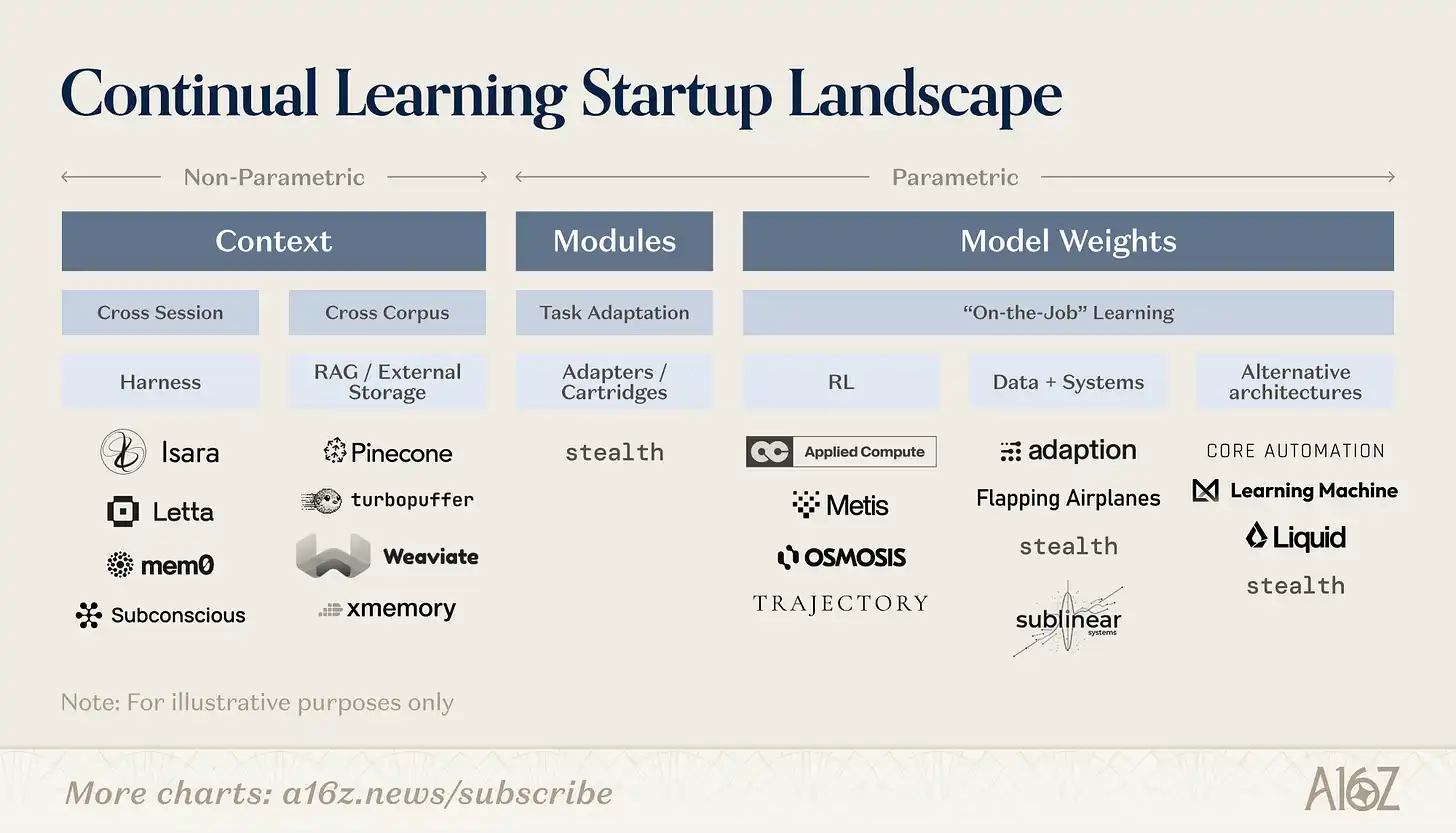
Figure Caption: Continual Learning Startup Landscape

All major labs are also actively working within these categories. Some are exploring better context management and chain-of-thought reasoning, others are experimenting with external memory modules or sleep-time compute pipelines, and several stealth companies are pursuing new architectures. The field is early enough that no single approach has won yet, and given the breadth of use cases, there shouldn't be just one winner.

Why Naive Weight Updates Fail

Updating model parameters in a production environment triggers a cascade of failure modes that are not yet resolved at scale.
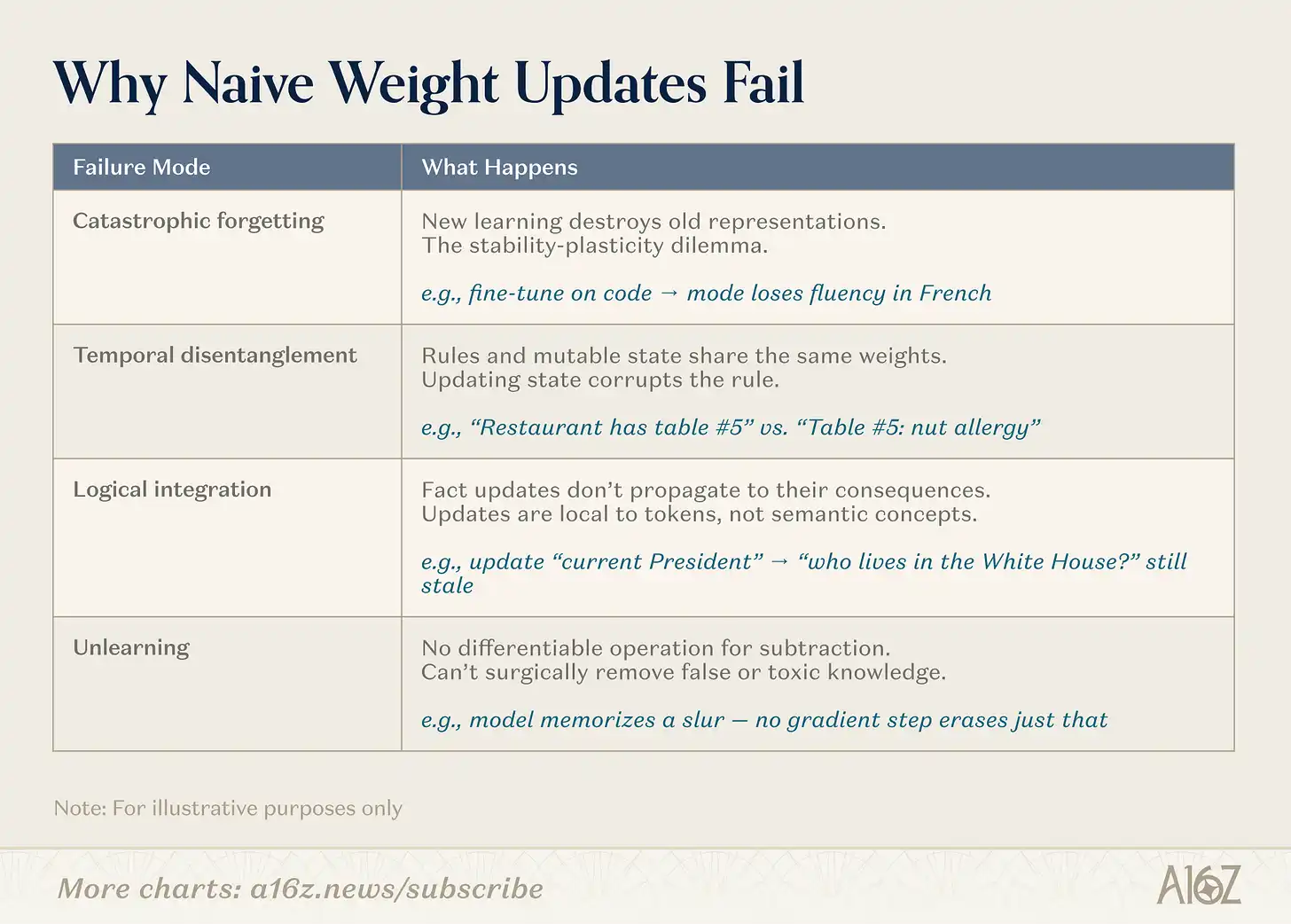
Figure Caption: Failure modes of naive weight updates

The engineering problems are well-documented. Catastrophic forgetting means a model sensitive enough to learn from new data will destroy existing representations—the stability-plasticity dilemma. Temporal decoupling refers to the fact that invariant rules and mutable state are compressed into the same set of weights; updating one corrupts the other. Logical integration fails because fact updates don't propagate to their corollaries: changes are confined to the token sequence level, not the semantic concept level. Unlearning is still impossible: there is no differentiable subtraction operation, so there is no precise surgical removal method for false or toxic knowledge.

There is a second class of problems that receives less attention. The current separation between training and deployment is not just an engineering convenience; it is a boundary for safety, auditability, and governance. Opening this boundary causes multiple things to go wrong simultaneously. Safety alignment can degrade unpredictably: even narrow fine-tuning on benign data can produce widespread misaligned behavior.

Continuous updates create an attack surface for data poisoning—a slow, persistent version of prompt injection, but it lives in the weights. Auditability collapses because a continuously updated model is a moving target, making version control, regression testing, or one-time certification impossible. Privacy risks intensify when user interactions are compressed into parameters, baking sensitive information into representations that are harder to filter than information in a retrieved context.

These are open problems, not fundamental impossibilities. Solving them is part of the continual learning research agenda, just like solving the core architectural challenges.

From "Memento" to True Memory

Leonard's tragedy in "Memento" is not that he can't function—in any given scene, he is resourceful, even brilliant. His tragedy is that he can never compound. Every experience remains external—a Polaroid, a tattoo, a note in someone else's handwriting. He can retrieve, but he cannot compress new knowledge.

As Leonard navigates this self-constructed maze, the line between truth and belief begins to blur. His condition doesn't just deprive him of memory; it forces him to constantly reconstruct meaning, making him both the detective and the unreliable narrator of his own story.

Today's AI operates under the same constraints. We have built very powerful retrieval systems: longer context windows, smarter shells, coordinated multi-agent swarms, and they work. But retrieval is not learning. A system that can look up any fact is not forced to find structure. It is not forced to generalize. The lossy compression that made training so powerful—the mechanism that turns raw data into transferable representations—is precisely what we turn off the moment we deploy.

The path forward is likely not a single breakthrough, but a layered system. In-context learning will remain the first line of adaptive defense: it is native, proven, and improving. Module mechanisms can handle the middle ground of personalization and domain specialization.

But for those truly difficult problems—discovery, adversarial adaptation, implicit knowledge that cannot be put into words—we may need to let models continue to compress experience into parameters after training. This means advances in sparse architectures, meta-learning objectives, and self-improvement loops. It might also require us to redefine what a "model" is: not a fixed set of weights, but an evolving system comprising its memory, its update algorithm, and its ability to abstract from its own experience.

The filing cabinet is getting bigger. But a bigger filing cabinet is still a filing cabinet. The breakthrough is to let the model do after deployment what made it powerful during training: compress, abstract, learn. We stand at the turning point from amnesiac models to models with a glimmer of experience. Otherwise, we'll be stuck in our own "Memento."


Pertanyaan Terkait

QWhat is the core problem with current large language models (LLMs) regarding memory and learning after deployment, as discussed in the a16z article?

AThe core problem is that LLMs suffer from a form of 'amnesia' or an inability to form new memories after their initial training is complete. Their parameters are frozen, and they cannot internally update their knowledge based on new experiences. They rely on external scaffolds' like chat history (short-term sticky notes), retrieval systems (external notebooks), and system prompts (tattoos) to function, but the model itself never truly internalizes this new information.

QAccording to the article, what is 'continual Learning' and why is it considered a critical research direction in AI?

AContinual learning is the research field focused on enabling AI models to learn continuously and update their parameters (weights) after deployment, thereby internalizing new knowledge and experiences. It is considered critical because the gap between what a model 'knows' at release and what it 'could know' is becoming increasingly apparent. This ability is seen as essential for tackling problems requiring true discovery, adversarial scenarios, and internalizing knowledge that is too implicit to be expressed in language.

QWhat is the 'filing cabinet fallacy' argument presented in the article against relying solely on context learning (ICL)?

AThe 'filing cabinet fallacy' argues that a system with infinite storage and perfect retrieval (like a massive filing cabinet) does not constitute learning because it is never forced to perform compression. Compression, which is lossy, is what forces a model to find structure, generalize, and build transferable representations. Relying solely on context learning and external memory avoids this crucial compression step, preventing the model from truly learning and generalizing from new information after deployment.

QWhat are the three main paths or spectra of continual learning discussed in the article?

AThe three main paths on the continual learning spectrum are: 1. **Context:** Building smarter retrieval pipelines, agent shells, and prompt orchestration without updating model weights. 2. **Modules:** Using pluggable knowledge modules (compressed KV caches, adapter layers, external memory stores) to specialize a general model without full retraining. 3. **Weights:** Pursuing true parameter-level learning through methods like sparse memory layers, reinforcement learning loops from feedback, and test-time training to compress context into weights internally.

QWhat are some of the key challenges and failure modes associated with naively updating a model's weights in a production environment?

AKey challenges and failure modes include: - **Catastrophic Forgetting:** Updating on new data can destroy existing representations (the stability-plasticity dilemma). - **Temporal Decoupling:** Invariant rules and mutable state are compressed into the same weights; updating one can corrupt the other. - **Failure of Logical Integration:** Fact updates don't propagate to their logical corollaries. - **Safety & Security Risks:** Safety alignment can degrade unpredictably, creating a new attack surface for data poisoning. - **Auditability & Governance Collapse:** A continuously updated model is a moving target, making version control, regression testing, and certification difficult. - **Privacy Risks:** User interactions compressed into parameters can bake in sensitive information.

Bacaan Terkait

Analis yang Memprediksi Jatuhnya Bitcoin dari $82.000 Mengungkapkan Apa yang Akan Terjadi Selanjutnya

Analis kripto Tony, yang berhasil memprediksi penurunan Bitcoin dari puncak lokal sekitar $82.000, mengungkapkan pandangannya tentang pergerakan aset kriptu terdepan ini. Dalam posting di X, ia menyatakan bahwa BTC kemungkinan akan terus menurun dan berpotensi mencetak rekor rendah baru dalam beberapa bulan mendatang, sebelum akhirnya mencapai titik terendah dalam siklus bear ini. Tony merujuk pada level Resistance Rata-rata Bergerak 200 hari (200 MA) dan level Fibonacci 0,5 serta 0,618 sebagai alasan di balik penurunan harga. Ia juga menguraikan dua skenario: penurunan langsung atau "jebakan" berupa fake breakout di atas $85.000 untuk menjerat trader retail, yang kemudian akan diikuti oleh penjualan besar-besaran. Bagaimanapun, ia menegaskan tren utama masih bearish. Chart yang dibagikannya menunjukkan potensi penurunan Bitcoin hingga sekitar $50.000 pada Juli, bahkan mungkin di bawah $40.000. Analis lain, Colin, menambahkan bahwa area $65.000-$66.000 mungkin menjadi level support untuk koreksi jangka pendek yang bisa berlangsung beberapa minggu atau bulan. Namun, ia setuju bahwa retest ke level $60.000 dan potensi breakout ke bawah tahun ini masih sangat mungkin. Colin mencatat bahwa kerugian Bitcoin dalam siklus bear ini belum mencapai 70% seperti pada siklus sebelumnya, mengisyaratkan ruang untuk penurunan lebih lanjut. Pada saat penulisan, harga Bitcoin diperdagangkan di sekitar $66.300, turun lebih dari 6% dalam 24 jam terakhir. Kedua analis sepakat bahwa meski koreksi jangka pendek mungkin terjadi, pasar bull tidak akan segera dimulai, dan rekor rendah baru untuk tahun ini masih menjadi ekspektasi utama.

bitcoinist2j yang lalu

Analis yang Memprediksi Jatuhnya Bitcoin dari $82.000 Mengungkapkan Apa yang Akan Terjadi Selanjutnya

bitcoinist2j yang lalu

The Rally That Wasn't

Pasar Bitcoin mengalami tekanan tajam, dengan harga turun 13% ke kisaran $67,000, didorong oleh kondisi makro yang lebih ketat dan aliran keluar besar-besaran dari ETF spot AS. Analisis on-chain mengonfirmasi pasar masih dalam rezim bearish, dengan harga gagal bertahan di atas True Market Mean ($77.8k) dan bergerak menuju Realized Price ($53.9k). Basis biaya pemegang jangka pendek ($76.4k) kini berada di bawah rata-rata kunci, menunjukkan akumulasi oleh pembeli baru di level rendah, pola khas fase akhir bear market. Tekanan kerugian meningkat pesat, dengan rasio profit/rugi yang direalisasikan anjlok, mencerminkan dominasi realisasi rugi. Pemegang baru yang membeli di dekat puncak lokal ($78k-$82k) kini menghadapi tekanan terbesar. Selain itu, pemegang jangka panjang juga mulai menyerah, merealisasikan kerugian dalam jumlah signifikan. Di pasar off-chain, harga Bitcoin ditolak di sekitar basis biaya agregat ETF ($83k), mengubah level support sebelumnya menjadi resistance. Aliran permintaan spot telah mengering dan berbalik negatif, menunjukkan dominasi penjual. Meskipun likuidasi futures besar ($400M+) membantu membersihkan leverage berlebih, belum ada tanda pemulihan permintaan spot yang berkelanjutan. Pasar opsi mencerminkan sikap waspada, dengan premi volatilitas tinggi dan permintaan perlindungan downside yang tetap mengemuka, meski tanpa kepanikan ekstrem. Kesimpulannya, pasar Bitcoin tetap rapuh dengan tekanan jual dari berbagai kohor investor dan ketiadaan permintaan spot yang kuat. Pemulihan berkelanjutan memerlukan perbaikan dalam aliran spot, reklamasi profitabilitas oleh investor ETF, dan berkurangnya tekanan penjualan.

insights.glassnode4j yang lalu

The Rally That Wasn't

insights.glassnode4j yang lalu

Trading

Spot
Futures

Artikel Populer

Apa Itu $S$

Memahami SPERO: Tinjauan Komprehensif Pengenalan SPERO Seiring dengan perkembangan lanskap inovasi, munculnya teknologi web3 dan proyek cryptocurrency memainkan peran penting dalam membentuk masa depan digital. Salah satu proyek yang telah menarik perhatian di bidang dinamis ini adalah SPERO, yang dilambangkan sebagai SPERO,$$s$. Artikel ini bertujuan untuk mengumpulkan dan menyajikan informasi terperinci tentang SPERO, untuk membantu para penggemar dan investor memahami dasar-dasar, tujuan, dan inovasi dalam domain web3 dan crypto. Apa itu SPERO,$$s$? SPERO,$$s$ adalah proyek unik dalam ruang crypto yang berusaha memanfaatkan prinsip desentralisasi dan teknologi blockchain untuk menciptakan ekosistem yang mendorong keterlibatan, utilitas, dan inklusi finansial. Proyek ini dirancang untuk memfasilitasi interaksi peer-to-peer dengan cara baru, memberikan pengguna solusi dan layanan keuangan yang inovatif. Pada intinya, SPERO,$$s$ bertujuan untuk memberdayakan individu dengan menyediakan alat dan platform yang meningkatkan pengalaman pengguna dalam ruang cryptocurrency. Ini termasuk memungkinkan metode transaksi yang lebih fleksibel, mendorong inisiatif yang dipimpin komunitas, dan menciptakan jalur untuk peluang finansial melalui aplikasi terdesentralisasi (dApps). Visi mendasar dari SPERO,$$s$ berputar di sekitar inklusivitas, bertujuan untuk menjembatani kesenjangan dalam keuangan tradisional sambil memanfaatkan manfaat teknologi blockchain. Siapa Pencipta SPERO,$$s$? Identitas pencipta SPERO,$$s$ tetap agak samar, karena ada sumber daya publik yang terbatas yang memberikan informasi latar belakang terperinci tentang pendiriannya. Kurangnya transparansi ini dapat berasal dari komitmen proyek terhadap desentralisasi—sebuah etos yang banyak proyek web3 bagi, memprioritaskan kontribusi kolektif di atas pengakuan individu. Dengan memusatkan diskusi di sekitar komunitas dan tujuan kolektifnya, SPERO,$$s$ mewujudkan esensi pemberdayaan tanpa menonjolkan individu tertentu. Dengan demikian, memahami etos dan misi SPERO tetap lebih penting daripada mengidentifikasi pencipta tunggal. Siapa Investor SPERO,$$s$? SPERO,$$s$ didukung oleh beragam investor mulai dari modal ventura hingga investor malaikat yang berdedikasi untuk mendorong inovasi di sektor crypto. Fokus investor ini umumnya sejalan dengan misi SPERO—memprioritaskan proyek yang menjanjikan kemajuan teknologi sosial, inklusivitas finansial, dan tata kelola terdesentralisasi. Fondasi investor ini biasanya tertarik pada proyek yang tidak hanya menawarkan produk inovatif tetapi juga memberikan kontribusi positif kepada komunitas blockchain dan ekosistemnya. Dukungan dari investor ini memperkuat SPERO,$$s$ sebagai pesaing yang patut diperhitungkan di domain proyek crypto yang berkembang pesat. Bagaimana SPERO,$$s$ Bekerja? SPERO,$$s$ menerapkan kerangka kerja multi-faceted yang membedakannya dari proyek cryptocurrency konvensional. Berikut adalah beberapa fitur kunci yang menekankan keunikan dan inovasinya: Tata Kelola Terdesentralisasi: SPERO,$$s$ mengintegrasikan model tata kelola terdesentralisasi, memberdayakan pengguna untuk berpartisipasi aktif dalam proses pengambilan keputusan mengenai masa depan proyek. Pendekatan ini mendorong rasa kepemilikan dan akuntabilitas di antara anggota komunitas. Utilitas Token: SPERO,$$s$ memanfaatkan token cryptocurrency-nya sendiri, yang dirancang untuk melayani berbagai fungsi dalam ekosistem. Token ini memungkinkan transaksi, hadiah, dan fasilitasi layanan yang ditawarkan di platform, meningkatkan keterlibatan dan utilitas secara keseluruhan. Arsitektur Berlapis: Arsitektur teknis SPERO,$$s$ mendukung modularitas dan skalabilitas, memungkinkan integrasi fitur dan aplikasi tambahan secara mulus seiring dengan perkembangan proyek. Kemampuan beradaptasi ini sangat penting untuk mempertahankan relevansi di lanskap crypto yang selalu berubah. Keterlibatan Komunitas: Proyek ini menekankan inisiatif yang dipimpin komunitas, menggunakan mekanisme yang memberikan insentif untuk kolaborasi dan umpan balik. Dengan memelihara komunitas yang kuat, SPERO,$$s$ dapat lebih baik memenuhi kebutuhan pengguna dan beradaptasi dengan tren pasar. Fokus pada Inklusi: Dengan menawarkan biaya transaksi yang rendah dan antarmuka yang ramah pengguna, SPERO,$$s$ bertujuan untuk menarik basis pengguna yang beragam, termasuk individu yang mungkin sebelumnya tidak terlibat dalam ruang crypto. Komitmen ini terhadap inklusi sejalan dengan misi utamanya untuk memberdayakan melalui aksesibilitas. Garis Waktu SPERO,$$s$ Memahami sejarah proyek memberikan wawasan penting tentang trajektori dan tonggak perkembangannya. Berikut adalah garis waktu yang disarankan yang memetakan peristiwa signifikan dalam evolusi SPERO,$$s$: Fase Konseptualisasi dan Ideasi: Ide awal yang membentuk dasar SPERO,$$s$ dikembangkan, sangat selaras dengan prinsip desentralisasi dan fokus komunitas dalam industri blockchain. Peluncuran Whitepaper Proyek: Setelah fase konseptual, whitepaper komprehensif yang merinci visi, tujuan, dan infrastruktur teknologi SPERO,$$s$ dirilis untuk menarik minat dan umpan balik komunitas. Pembangunan Komunitas dan Keterlibatan Awal: Upaya jangkauan aktif dilakukan untuk membangun komunitas pengguna awal dan investor potensial, memfasilitasi diskusi seputar tujuan proyek dan mendapatkan dukungan. Acara Generasi Token: SPERO,$$s$ melakukan acara generasi token (TGE) untuk mendistribusikan token asli kepada pendukung awal dan membangun likuiditas awal dalam ekosistem. Peluncuran dApp Awal: Aplikasi terdesentralisasi (dApp) pertama yang terkait dengan SPERO,$$s$ diluncurkan, memungkinkan pengguna untuk terlibat dengan fungsionalitas inti platform. Pengembangan Berkelanjutan dan Kemitraan: Pembaruan dan peningkatan berkelanjutan terhadap penawaran proyek, termasuk kemitraan strategis dengan pemain lain di ruang blockchain, telah membentuk SPERO,$$s$ menjadi pemain yang kompetitif dan berkembang di pasar crypto. Kesimpulan SPERO,$$s$ berdiri sebagai bukti potensi web3 dan cryptocurrency untuk merevolusi sistem keuangan dan memberdayakan individu. Dengan komitmen terhadap tata kelola terdesentralisasi, keterlibatan komunitas, dan fungsionalitas yang dirancang secara inovatif, ia membuka jalan menuju lanskap keuangan yang lebih inklusif. Seperti halnya investasi di ruang crypto yang berkembang pesat, calon investor dan pengguna dianjurkan untuk melakukan riset secara menyeluruh dan terlibat dengan perkembangan yang sedang berlangsung dalam SPERO,$$s$. Proyek ini menunjukkan semangat inovatif industri crypto, mengundang eksplorasi lebih lanjut ke dalam berbagai kemungkinan yang ada. Meskipun perjalanan SPERO,$$s$ masih berlangsung, prinsip-prinsip dasarnya mungkin benar-benar mempengaruhi masa depan cara kita berinteraksi dengan teknologi, keuangan, dan satu sama lain dalam ekosistem digital yang saling terhubung.

75 Total TayanganDipublikasikan pada 2024.12.17Diperbarui pada 2024.12.17

Apa Itu $S$

Apa Itu AGENT S

Agent S: Masa Depan Interaksi Otonom di Web3 Pendahuluan Dalam lanskap Web3 dan cryptocurrency yang terus berkembang, inovasi secara konstan mendefinisikan ulang cara individu berinteraksi dengan platform digital. Salah satu proyek perintis, Agent S, menjanjikan untuk merevolusi interaksi manusia-komputer melalui kerangka agen terbuka. Dengan membuka jalan untuk interaksi otonom, Agent S bertujuan untuk menyederhanakan tugas-tugas kompleks, menawarkan aplikasi transformasional dalam kecerdasan buatan (AI). Eksplorasi mendetail ini akan menyelami seluk-beluk proyek, fitur uniknya, dan implikasinya untuk domain cryptocurrency. Apa itu Agent S? Agent S berdiri sebagai kerangka agen terbuka yang inovatif, dirancang khusus untuk mengatasi tiga tantangan mendasar dalam otomatisasi tugas komputer: Memperoleh Pengetahuan Spesifik Domain: Kerangka ini secara cerdas belajar dari berbagai sumber pengetahuan eksternal dan pengalaman internal. Pendekatan ganda ini memberdayakannya untuk membangun repositori pengetahuan spesifik domain yang kaya, meningkatkan kinerjanya dalam pelaksanaan tugas. Perencanaan Selama Rentang Tugas yang Panjang: Agent S menggunakan perencanaan hierarkis yang ditingkatkan pengalaman, pendekatan strategis yang memfasilitasi pemecahan dan pelaksanaan tugas-tugas rumit dengan efisien. Fitur ini secara signifikan meningkatkan kemampuannya untuk mengelola beberapa subtugas dengan efisien dan efektif. Menangani Antarmuka Dinamis dan Tidak Seragam: Proyek ini memperkenalkan Antarmuka Agen-Komputer (ACI), solusi inovatif yang meningkatkan interaksi antara agen dan pengguna. Dengan memanfaatkan Model Bahasa Besar Multimodal (MLLM), Agent S dapat menavigasi dan memanipulasi berbagai antarmuka pengguna grafis dengan mulus. Melalui fitur-fitur perintis ini, Agent S menyediakan kerangka kerja yang kuat yang mengatasi kompleksitas yang terlibat dalam mengotomatisasi interaksi manusia dengan mesin, membuka jalan untuk berbagai aplikasi dalam AI dan seterusnya. Siapa Pencipta Agent S? Meskipun konsep Agent S secara fundamental inovatif, informasi spesifik tentang penciptanya tetap samar. Pencipta saat ini tidak diketahui, yang menyoroti baik tahap awal proyek atau pilihan strategis untuk menjaga anggota pendiri tetap tersembunyi. Terlepas dari anonimitas, fokus tetap pada kemampuan dan potensi kerangka kerja. Siapa Investor Agent S? Karena Agent S relatif baru dalam ekosistem kriptografi, informasi terperinci mengenai investor dan pendukung keuangannya tidak secara eksplisit didokumentasikan. Kurangnya wawasan yang tersedia untuk umum mengenai fondasi investasi atau organisasi yang mendukung proyek ini menimbulkan pertanyaan tentang struktur pendanaannya dan peta jalan pengembangannya. Memahami dukungan sangat penting untuk mengukur keberlanjutan proyek dan potensi dampak pasar. Bagaimana Cara Kerja Agent S? Di inti Agent S terletak teknologi mutakhir yang memungkinkannya berfungsi secara efektif dalam berbagai pengaturan. Model operasionalnya dibangun di sekitar beberapa fitur kunci: Interaksi Komputer yang Mirip Manusia: Kerangka ini menawarkan perencanaan AI yang canggih, berusaha untuk membuat interaksi dengan komputer lebih intuitif. Dengan meniru perilaku manusia dalam pelaksanaan tugas, ia menjanjikan untuk meningkatkan pengalaman pengguna. Memori Naratif: Digunakan untuk memanfaatkan pengalaman tingkat tinggi, Agent S memanfaatkan memori naratif untuk melacak sejarah tugas, sehingga meningkatkan proses pengambilan keputusannya. Memori Episodik: Fitur ini memberikan panduan langkah demi langkah kepada pengguna, memungkinkan kerangka untuk menawarkan dukungan kontekstual saat tugas berlangsung. Dukungan untuk OpenACI: Dengan kemampuan untuk berjalan secara lokal, Agent S memungkinkan pengguna untuk mempertahankan kontrol atas interaksi dan alur kerja mereka, sejalan dengan etos terdesentralisasi Web3. Integrasi Mudah dengan API Eksternal: Versatilitas dan kompatibilitasnya dengan berbagai platform AI memastikan bahwa Agent S dapat dengan mulus masuk ke dalam ekosistem teknologi yang ada, menjadikannya pilihan menarik bagi pengembang dan organisasi. Fungsionalitas ini secara kolektif berkontribusi pada posisi unik Agent S dalam ruang kripto, saat ia mengotomatisasi tugas-tugas kompleks yang melibatkan banyak langkah dengan intervensi manusia yang minimal. Seiring proyek ini berkembang, aplikasi potensialnya di Web3 dapat mendefinisikan ulang bagaimana interaksi digital berlangsung. Garis Waktu Agent S Pengembangan dan tonggak Agent S dapat dirangkum dalam garis waktu yang menyoroti peristiwa pentingnya: 27 September 2024: Konsep Agent S diluncurkan dalam sebuah makalah penelitian komprehensif berjudul “Sebuah Kerangka Agen Terbuka yang Menggunakan Komputer Seperti Manusia,” yang menunjukkan dasar untuk proyek ini. 10 Oktober 2024: Makalah penelitian tersebut dipublikasikan secara terbuka di arXiv, menawarkan eksplorasi mendalam tentang kerangka kerja dan evaluasi kinerjanya berdasarkan tolok ukur OSWorld. 12 Oktober 2024: Sebuah presentasi video dirilis, memberikan wawasan visual tentang kemampuan dan fitur Agent S, lebih lanjut melibatkan pengguna dan investor potensial. Tanda-tanda dalam garis waktu ini tidak hanya menggambarkan kemajuan Agent S tetapi juga menunjukkan komitmennya terhadap transparansi dan keterlibatan komunitas. Poin Kunci Tentang Agent S Seiring kerangka Agent S terus berkembang, beberapa atribut kunci menonjol, menekankan sifat inovatif dan potensinya: Kerangka Inovatif: Dirancang untuk memberikan penggunaan komputer yang intuitif seperti interaksi manusia, Agent S membawa pendekatan baru untuk otomatisasi tugas. Interaksi Otonom: Kemampuan untuk berinteraksi secara otonom dengan komputer melalui GUI menandakan lompatan menuju solusi komputasi yang lebih cerdas dan efisien. Otomatisasi Tugas Kompleks: Dengan metodologinya yang kuat, ia dapat mengotomatisasi tugas-tugas kompleks yang melibatkan banyak langkah, membuat proses lebih cepat dan kurang rentan terhadap kesalahan. Perbaikan Berkelanjutan: Mekanisme pembelajaran memungkinkan Agent S untuk belajar dari pengalaman masa lalu, terus meningkatkan kinerja dan efektivitasnya. Versatilitas: Adaptabilitasnya di berbagai lingkungan operasi seperti OSWorld dan WindowsAgentArena memastikan bahwa ia dapat melayani berbagai aplikasi. Saat Agent S memposisikan dirinya di lanskap Web3 dan kripto, potensinya untuk meningkatkan kemampuan interaksi dan mengotomatisasi proses menandakan kemajuan signifikan dalam teknologi AI. Melalui kerangka inovatifnya, Agent S mencerminkan masa depan interaksi digital, menjanjikan pengalaman yang lebih mulus dan efisien bagi pengguna di berbagai industri. Kesimpulan Agent S mewakili lompatan berani ke depan dalam pernikahan AI dan Web3, dengan kapasitas untuk mendefinisikan ulang cara kita berinteraksi dengan teknologi. Meskipun masih dalam tahap awal, kemungkinan aplikasinya sangat luas dan menarik. Melalui kerangka komprehensifnya yang mengatasi tantangan kritis, Agent S bertujuan untuk membawa interaksi otonom ke garis depan pengalaman digital. Saat kita melangkah lebih dalam ke dalam ranah cryptocurrency dan desentralisasi, proyek-proyek seperti Agent S pasti akan memainkan peran penting dalam membentuk masa depan teknologi dan kolaborasi manusia-komputer.

911 Total TayanganDipublikasikan pada 2025.01.14Diperbarui pada 2025.01.14

Apa Itu AGENT S

Cara Membeli S

Selamat datang di HTX.com! Kami telah membuat pembelian Sonic (S) menjadi mudah dan nyaman. Ikuti panduan langkah demi langkah kami untuk memulai perjalanan kripto Anda.Langkah 1: Buat Akun HTX AndaGunakan alamat email atau nomor ponsel Anda untuk mendaftar akun gratis di HTX. Rasakan perjalanan pendaftaran yang mudah dan buka semua fitur.Dapatkan Akun SayaLangkah 2: Buka Beli Kripto, lalu Pilih Metode Pembayaran AndaKartu Kredit/Debit: Gunakan Visa atau Mastercard Anda untuk membeli Sonic (S) secara instan.Saldo: Gunakan dana dari saldo akun HTX Anda untuk melakukan trading dengan lancar.Pihak Ketiga: Kami telah menambahkan metode pembayaran populer seperti Google Pay dan Apple Pay untuk meningkatkan kenyamanan.P2P: Lakukan trading langsung dengan pengguna lain di HTX.Over-the-Counter (OTC): Kami menawarkan layanan yang dibuat khusus dan kurs yang kompetitif bagi para trader.Langkah 3: Simpan Sonic (S) AndaSetelah melakukan pembelian, simpan Sonic (S) di akun HTX Anda. Selain itu, Anda dapat mengirimkannya ke tempat lain melalui transfer blockchain atau menggunakannya untuk memperdagangkan mata uang kripto lainnya.Langkah 4: Lakukan trading Sonic (S)Lakukan trading Sonic (S) dengan mudah di pasar spot HTX. Cukup akses akun Anda, pilih pasangan perdagangan, jalankan trading, lalu pantau secara real-time. Kami menawarkan pengalaman yang ramah pengguna baik untuk pemula maupun trader berpengalaman.

1.3k Total TayanganDipublikasikan pada 2025.01.15Diperbarui pada 2026.06.02

Cara Membeli S

Diskusi

Selamat datang di Komunitas HTX. Di sini, Anda bisa terus mendapatkan informasi terbaru tentang perkembangan platform terkini dan mendapatkan akses ke wawasan pasar profesional. Pendapat pengguna mengenai harga S (S) disajikan di bawah ini.

活动图片













