$34.6 billion. This is the real money SoftBank has poured into OpenAI. To raise funds, Masayoshi Son liquidated his holdings in NVIDIA, Deutsche Telekom, Alibaba, and T-Mobile.
But he still doesn't think it's enough. He plans to add another $30 billion this year to increase his stake from 11% to 13%, even if it means taking on debt.
The force driving this 69-year-old investor to go all in is pure—with OpenAI's valuation soaring to $852 billion in February, SoftBank's paper profit already exceeds $45 billion.
This massive, rapid paper wealth effect is driving capital to chase AI regardless of cost. Three months after OpenAI's latest funding round, CNBC, Bloomberg, and other media reported that Anthropic is negotiating a new round of financing with investors, targeting a valuation of approximately $900 billion. A year ago, its valuation was only $61.5 billion.
From Silicon Valley to Wall Street, everyone is assuming AI's future will be realized as straight as a rocket's ascent. But is this a rational pricing of a great technological revolution or a trillion-dollar gamble on the AI concept?
The Yahoo Moment
In Silicon Valley 26 years ago, there was a familiar scene.
That year, the internet was at its zenith. A company, public for only four years, saw its market cap soar to $128 billion, surpassing Berkshire Hathaway.
It didn't lay fiber optic cables or build routers; it was the number one portal: Yahoo.
Yahoo's business model was clear: everyone who went online started at Yahoo. As internet traffic grew perpetually, Yahoo, as the gateway, would forever collect tolls from users and advertisers.
This was also the underlying logic behind Wall Street's high valuation for Yahoo. It did not disappoint, its stock price rising from the IPO price of $13 to nearly $500. Alongside numerous companies with ".com" in their names, it collectively propelled the Nasdaq index to 5,132 points.
Wall Street correctly saw the macro trend—the internet did change the world, traffic did explode—but they also made a fatal mistake:
They believed the portal's moat was insurmountable.
The market overlooked one thing: as internet infrastructure became ubiquitous, users would always find more precise gateways. Yahoo's comprehensive directory model, once confronted with precise ad targeting, would fundamentally shake its original ad distribution model.
On March 11, 2000, Yahoo's stock price turned at the peak and began a prolonged decline. A year later, the Nasdaq fell below 2,000 points. In 2017, Yahoo was acquired by Verizon for only $4.8 billion.
Today, OpenAI and Anthropic, selling tokens, resemble the Yahoos of the AI era.
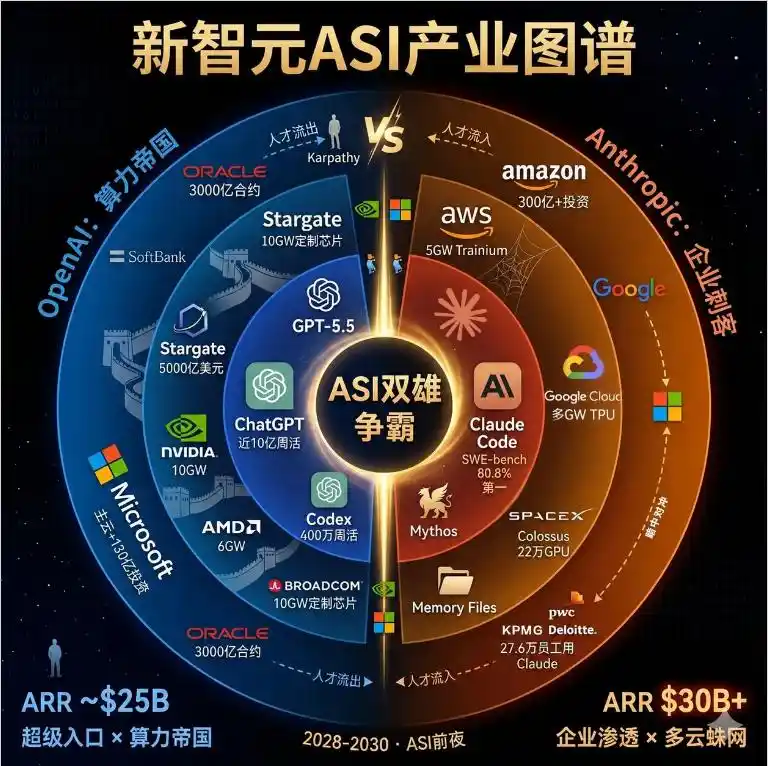
These two trillion-dollar giants provide API interfaces to enterprises and sell tokens to developers. The underlying logic for capital's trillion-dollar valuations is identical to back then: Any explosion of AI applications must purchase computing power and intelligence from large model companies; large models are the future toll booths of the AI era, and these toll booths will exist forever.
▲Image source: Xinzhiyuan
This overlooks the same issue as before. Large models are turning artificial intelligence into a cheap, ubiquitous utility like water, electricity, and gas at an astonishing speed.
Just as Yahoo couldn't stop the internet from deepening, when AI becomes omnipresent and numerous large models race simultaneously, a mere "model gateway" holds no pricing power for artificial intelligence.
Trillion-Dollar Arithmetic
Historical cases are just mirrors for reference; financial arithmetic is the real needle that bursts bubbles.
▲Image source: Xinzhiyuan
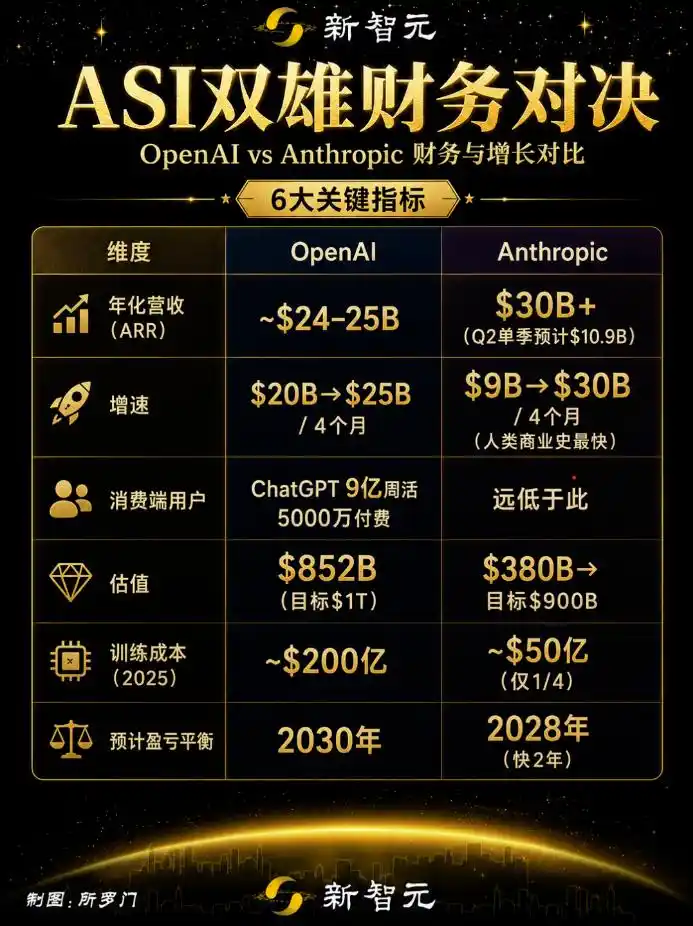
If we view OpenAI and Anthropic as future tech giants and assign them a high price-to-earnings (P/E) ratio like 30-40x, then to support a trillion-dollar market cap, these two companies would need to earn $25 to $30 billion in net profit annually, corresponding to $50 to $80 billion in revenue.
But reality falls far short of expectations.
A key metric for measuring these subscription-based AI companies is ARR (Annual Recurring Revenue). In April 2026, OpenAI's ARR was $25 billion, and Anthropic's was $30 billion.
If a company's ARR reaches $30 billion, it doesn't mean it earned $30 billion in the past year. It only means that in the past month, its user subscription fees amounted to $2.5 billion, multiplied by 12.
Moreover, ARR largely extrapolates based on the current API consumption rate. It includes a lot of short-term, exploratory development demand, even promotional water, like buying computing power and getting free tokens. The stickiness of this revenue is far less than the annual software service subscriptions of the SaaS era.
What makes the hope for profitability even dimmer is the promotions by large model companies. To compete and capture developer ecosystems, OpenAI and Anthropic have significantly lowered token prices over the past year.
Back then, to maintain its status as a traffic gateway, Yahoo had to provide vast amounts of free content, only to find traffic couldn't translate into equivalent profits. Today, large model companies, to preserve developer ecosystems, proactively turn intelligence into cheap commodities, yet enjoy monopoly-level high valuation premiums.
Behind this similar situation lies a brutal law of industrial chain profit:
The total profit of the entire AI industry chain is ultimately determined by the commercialization of the end application layer. The high valuation of large models essentially represents an advance draw on the future profits of the downstream application layer.
Looking at the current application layer, except for programming and some copywriting assistance, AI has yet to give birth to "super applications" that generate massive revenue. Most enterprise spending on AI still remains in the exploratory phase of cost reduction and efficiency gains—replacing some junior copywriters or customer service with AI—rather than the explosive phase of creating incremental revenue: creating entirely new markets worth billions or tens of billions of dollars through AI.
This is a link harboring significant risks. If downstream application companies find that purchasing AI computing power does not bring超额回报, they can press the pause button at any time. This pause could come from a performance bottleneck in a model iteration, a wave of public opinion, a batch of decisions based on executive preferences, a new round of economic downturn or volatility leading to a collective suspension of AI procurement budgets at downstream application companies for a period...
Whatever the trigger, once the downstream flow stops, the foundation of the upstream trillion-dollar market cap will instantly collapse.
Final Outcome Speculation
At the peak of capital frenzy, any slight disturbance can trigger an avalanche.
Like Yahoo back then, when the growth story can no longer be told, the trillion-dollar valuation will face the brutal execution of mean reversion. This means large model companies are inevitably headed down a path towards their final outcome.
The first path is a Yahoo-style crash.
The application layer fails to form a commercial closed loop. The token price war spirals out of control, and intelligence becomes a cheap commodity. Impatient capital begins seeking exits. The trillion-dollar valuation starts halving or even falling to a fraction.
Large model companies, stripped of their capital halo, are forced to cut back, lay off staff, cut losses, and return to ordinary software infrastructure profit margins.
Just as portal websites still exist today and Yahoo is still operating, it's no longer a darling of the capital market, only earning reasonable operating profits. Large model enterprises would devolve into "normal businesses" like cloud storage and cloud computing.
The second path is reconstructing the commercial closed loop.
One day, large model companies might truly find an ultimate model that makes enterprises pay en masse. Perhaps it's replacing the SaaS software of entire industries and taking a cut of the value created; perhaps AGI truly arrives and takes over the global digital workforce...
If this path is realized, the trillion-dollar market cap would have solid support. This requires time and is full of uncertainty. But capital markets, centered on the nature of VC funds, are most lacking in patience. Before dawn arrives, they might have already started stampeding out in the dark.
However, regardless of the path, we must be vigilant against a common sense that is easily obscured by fervor: The certainty of a macro trend never equals the certainty of individual destinies.
Most people believe AI will ultimately change the world, just as most believed the internet would change the world. But the issue is, the industry's prospects are one thing; being able to finish the long marathon and claim the crown is another.
In 2000, many correctly identified the direction of the internet but bet on Netscape, Yahoo, Pets.com, and ultimately lost their shirts. Today's OpenAI and Anthropic, while leading the race now, whether they can bridge the commercial closed-loop chasm, or whether they will be disrupted by more vertical, more efficient newcomers like the portals of old, remains a huge unknown. Discounting the industry's ultimate dividends in advance to the current frontrunners is the most classic feature of a bubble.
More alarmingly, while the bursting of the early internet bubble did not ultimately stop the internet's march in the long run, it did cause the Nasdaq to lose over three-quarters of its value at the time, leading to the collapse of大批 enterprises and连带 employee unemployment, causing real damage to the US and even the global economy for a considerable period.
When large model companies like OpenAI and Anthropic break through trillion-dollar valuations, when SoftBank leverages up regardless of cost to enter, when the entire Silicon Valley capital chain is tied to the expectation that "AI must deliver immediately," this potential systemic risk has reached a moment requiring high vigilance. Once the trillion-dollar valuations collapse, the negative wealth effect and credit contraction it triggers could have a far more severe反噬力度 on the macro economy than twenty years ago.
Technological revolutions are never smooth upward lines but are stacked by the birth and death of countless bubbles.
In 2000, Yahoo plunged over 80%, and countless investors' wealth vanished, but the internet did not die. It reshaped the world in deeper, more efficient ways. Today, if the trillion-dollar valuations of AI large models collapse, it does not mean the end of AI. It only means that AI will shed its financial speculation colors and truly, as a general-purpose technology, integrate silently and profoundly into thousands of industries.
The prospects are bright, the road is tortuous. Artificial intelligence is destined to become an inconspicuous yet indispensable infrastructure of this era, like water, electricity, and gas. But the process will inevitably have its ups and downs. When the rise is too fast and too steep, it's necessary to be vigilant of the crisis of the fall.
This article is from the WeChat public account "Huashang Taolue" (ID: hstl8888), by Huashang Taolue.