Bernstein Interprets MRNA's 177% Surge: What's Fundamentals and What's Hype?

marsbitDipublikasikan tanggal 2026-08-21Terakhir diperbarui pada 2026-08-21

Abstrak

Bernstein's analysis of Moderna's 177% stock surge following positive Phase 3 results for its individualized neoantigen therapy (INT) in melanoma distinguishes fundamental drivers from market speculation. The clinical breakthrough is real: the INTerpath-001 trial met its primary and key secondary endpoints, providing crucial validation for mRNA technology in oncology beyond infectious diseases. However, Bernstein argues the magnitude of the stock move cannot be justified by this single trial's fundamentals alone. The surge was amplified by three key factors: 1) A re-rating of Moderna's mRNA platform potential for expansion into other cancers, 2) A massive short squeeze, given ~15% of shares were sold short pre-announcement, and 3) The compelling "cancer vaccine" narrative that fueled broader investor enthusiasm. While the melanoma success is significant, Bernstein cautions that replication in lung, kidney, and bladder cancers—which have different immunogenicity—is not guaranteed. Furthermore, INT's commercial model faces challenges: it's a personalized treatment, not a mass-market vaccine, implying higher production costs and potential margin pressures despite a projected multi-billion dollar peak sales opportunity. The report also notes sector rotation, with some funds moving from crowded AI/semiconductor trades into defensive healthcare stocks, adding further momentum. In conclusion, Bernstein maintains a "Market-Perform" rating and a $45 price target, far below the po...

On August 19, Moderna and Merck announced the Phase 3 topline results for the personalized neoantigen therapy intismeran autogene (referred to as INT) in combination with Keytruda for the treatment of high-risk melanoma.

INTerpath-001 enrolled a total of 1,137 patients with stage IIB to IV cutaneous melanoma who had completed surgical resection and had not previously received systemic treatment. At the first interim analysis, the trial simultaneously met its primary endpoint of Recurrence-Free Survival (RFS) and the key secondary endpoint of Distant Metastasis-Free Survival (DMFS). Overall Survival (OS) data is not yet mature, and the trial will continue.

The company has so far only confirmed that the results are statistically significant and clinically meaningful, without disclosing specific hazard ratios, confidence intervals, patient subgroups, and full safety data. In other words, the market has confirmed the trial's success but does not yet know exactly how strong the efficacy is.

Following the announcement, Moderna's stock closed up about 177% to $174.38, with its market capitalization increasing by approximately $45 billion in a single day; Merck's stock rose about 13% to $152.20, with its market cap increasing by about $50 billion. The market debate quickly shifted from "Will the trial succeed?" to "Can such a scale of gains be justified by fundamentals?"

Clinical Breakthrough is Real, But Insufficient to Explain the 177% Surge

Bernstein believes that INTerpath-001 meeting both the RFS and DMFS endpoints at the first interim analysis suggests the efficacy is likely quite robust.

Interim analyses typically need to cross a higher statistical threshold. Based on this, the report speculates that the Phase 3 trial's RFS hazard ratio could be in the range of 0.50 to 0.65, and the DMFS hazard ratio might be close to 0.40, roughly consistent with previous Phase 2 data.

A hazard ratio below 1 means the relative risk of recurrence, distant metastasis, or death events is lower in the combination therapy group compared to the Keytruda monotherapy group. For example, a hazard ratio of 0.50 roughly represents an approximate 50% reduction in the relative risk of the relevant event, but does not equate to half of the patients being cured.

The above ranges are merely Bernstein's speculation based on statistical thresholds and past data, not the Phase 3 results announced by the companies. Specific efficacy, safety, and overall survival trends still await complete data.

However, the significance of this trial extends beyond melanoma. It is Moderna's first pivotal trial success outside of respiratory vaccines and the first personalized neoantigen regimen proven to further improve Keytruda's efficacy in a Phase 3 study.

This provides critical clinical evidence for expanding mRNA from infectious disease vaccines to cancer treatment and marks the starting point for the market's revaluation of Moderna's platform value.

The Market is Trading on Platform Revaluation and Short Covering

Clinical results can explain a stock price increase but are insufficient to explain its magnitude.

Bernstein believes that even with optimistic success expectations for all of INT's later-stage projects, it is difficult to justify Moderna's approximately 177% single-day surge. This rally is primarily driven by the convergence of three forces:

Clinical success reduces the residual risk for the melanoma project;

Investors begin pricing in the platform potential of mRNA expansion to more cancer types;

High short interest triggers short covering, amplifying short-term buying pressure.

Prior to the results announcement, approximately 14% to 15% of Moderna's float was sold short. After the clinical results exceeded pessimistic expectations, short sellers were forced to buy to cover their positions, and previously underweight investors also started chasing the rally. Moderna's trading volume that day approached 200 million shares, roughly equivalent to half of the company's total outstanding shares.
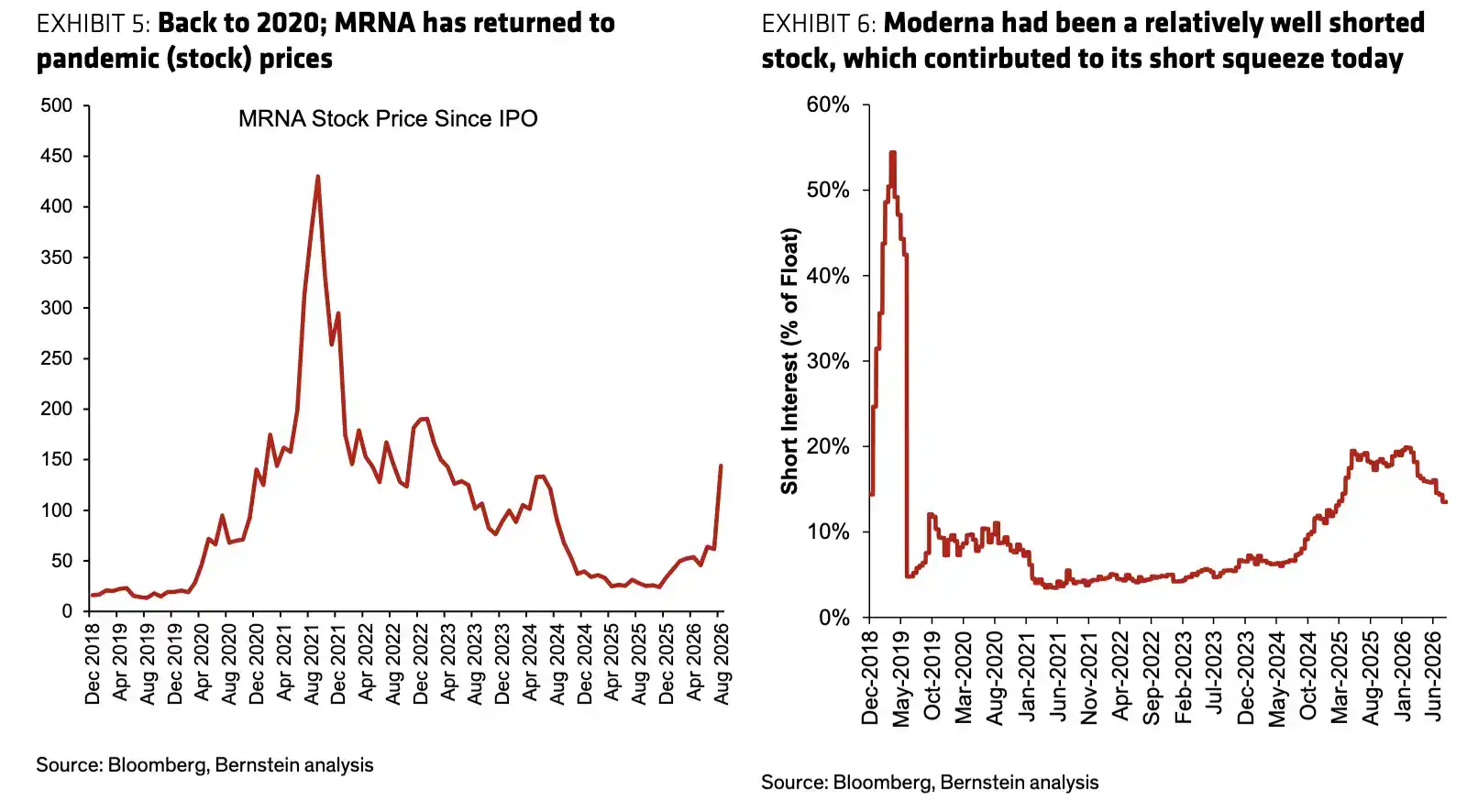
MRNA stock price chart (left) and short interest chart (right). MRNA's stock price surged on August 19, 2026, returning to pre-pandemic levels, while previously about 14-15% of its float was shorted, creating conditions for a short squeeze. Clinical data triggered the rise, but short covering further amplified the gains.

The news tag "cancer vaccine success" further amplified the spread effect. Compared to "personalized neoantigen therapy meets Phase 3 endpoints," this phrasing more easily leads the market to envision a large platform covering multiple cancer types.

Therefore, clinical data was the trigger for the rise, while platform narrative, short covering, and news effects amplified the gains. The amount of stock price increase does not mean the market has already confirmed that INT can generate equivalent levels of revenue and profit.

Melanoma is Just the Starting Point; Platform Replication Remains to Be Proven

Moderna and Merck currently have four Phase 3 studies and five Phase 2 studies around INT, covering melanoma, non-small cell lung cancer (NSCLC), renal cell carcinoma, and bladder cancer, and are beginning to enter unresectable or metastatic tumors.

Bernstein estimates that INTerpath-001 corresponds to a U.S. potential patient population of approximately 13,000 to 19,000 people, representing about 30% of the accessible patient population for the current Phase 3 and potential registration-enabling Phase 2 projects, and about 17% of all Phase 2 and Phase 3 projects.
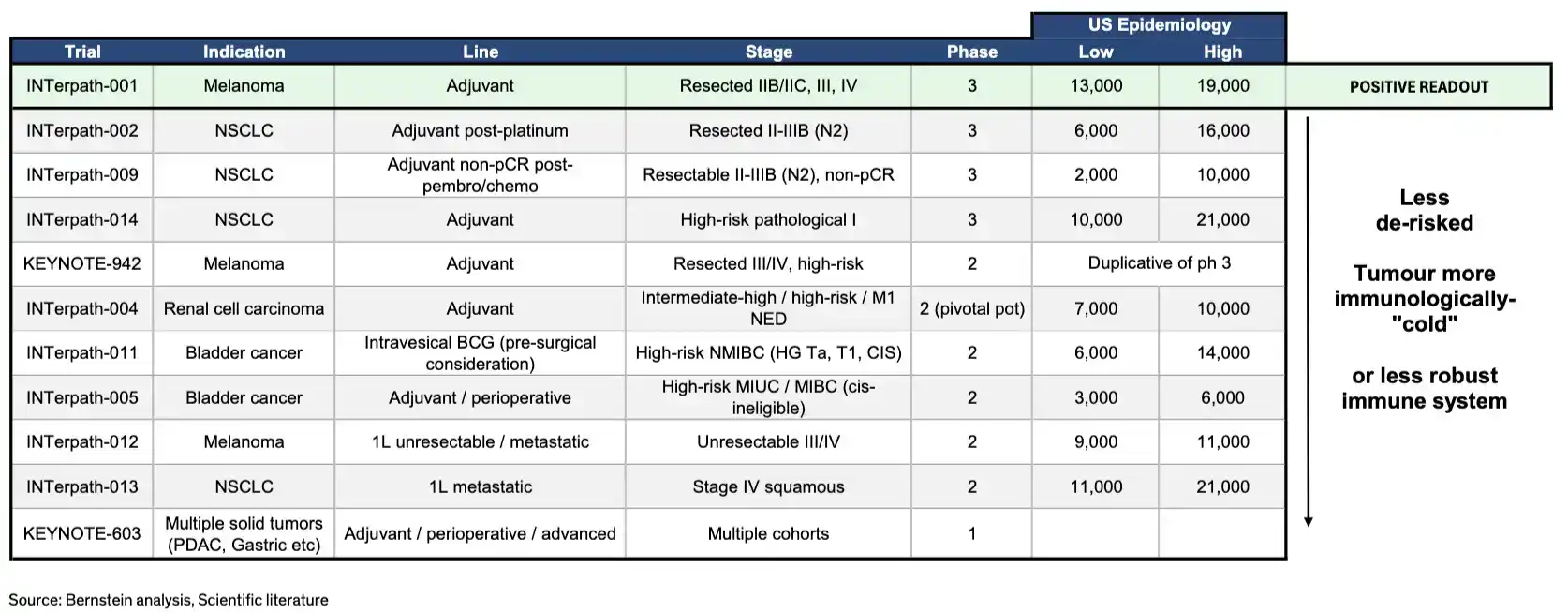
The U.S. accessible patient population for INTerpath-001 is approximately 13,000 to 19,000 people, representing only about 30% of the accessible patient total for current pivotal projects and about 17% of all Phase II and Phase III INT studies. Success in melanoma does not automatically guarantee the same results can be replicated in lung cancer, kidney cancer, and other cancer types.

If projects in lung cancer, kidney cancer, and bladder cancer can replicate the success in melanoma, INT's market potential will expand significantly. Bernstein currently gives an un-risk-adjusted sales forecast for early-stage melanoma and lung cancer of approximately $2.4 billion.

The report also uses Keytruda as an upside reference: its early-stage cancer indications generated about $7.9 billion in revenue in 2025, with an estimated $9.2 billion in 2028, and INT's future pricing could potentially be higher than Keytruda's.

But $2.4 billion is an un-risk-adjusted sales forecast, not profit, and certainly not realized performance. INT also has not yet covered several important Keytruda indications like triple-negative breast cancer, cervical cancer, and head and neck cancer.

More critically, melanoma typically has strong immunogenicity. Its success cannot be directly extrapolated to tumors with different immune microenvironments, such as lung cancer, kidney cancer, and bladder cancer.

INTerpath-001 proves the platform's *potential* for replication but does not prove replication *will* necessarily occur. The market has already started trading the endgame of success in other cancer types, but the relevant clinical data is still on the way.

Bernstein therefore maintains its "Market-Perform" rating and $45 price target for Moderna, far below the August 19 closing price of $174.38.

The "Cancer Vaccine" Label Blurs Commercial Realities

INT is not a preventive vaccine for healthy populations but a personalized treatment for cancer patients. At this stage, it is used as adjuvant therapy after patients have completed tumor resection, with the goal of reducing the risk of recurrence and distant metastasis caused by residual disease.

Tumor tissue and blood samples must be individually collected from each patient, followed by gene sequencing and algorithm analysis. The system selects up to 34 patient-specific neoantigens from the patient's tumor mutations, then produces the corresponding mRNA construct to induce a T-cell response against the tumor.
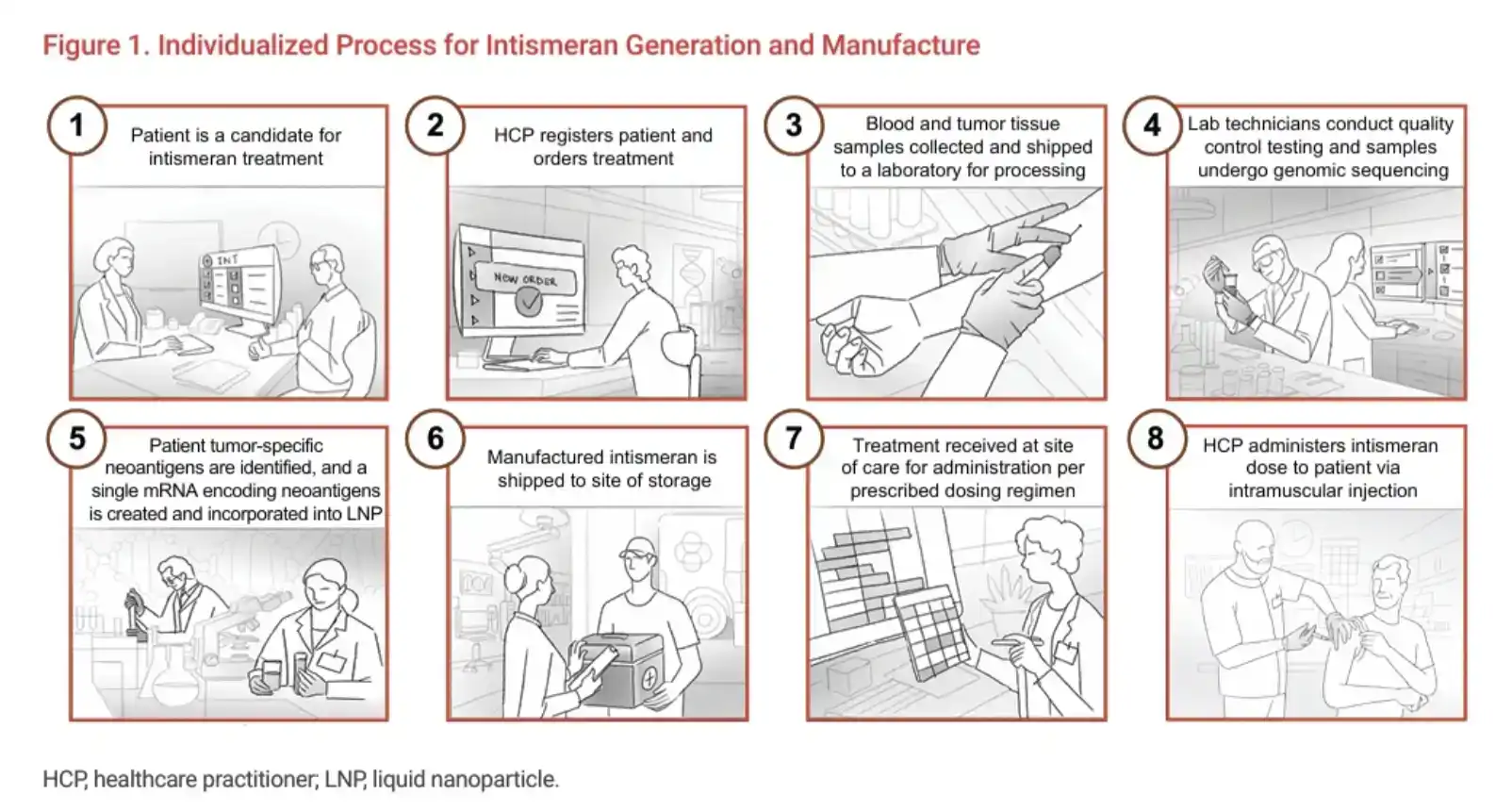
Therefore, while INT uses Moderna's mRNA platform, its business model is closer to that of a personalized oncology drug:

The target patient population is in the tens of thousands, not tens or hundreds of millions like traditional vaccines;

Each patient requires separate sequencing, design, and production;

Production costs are difficult to scale down rapidly like batch-produced vaccines;

Regulatory, pricing, and reimbursement will follow the oncology drug pathway.

"Cancer vaccine" is an easily communicable label, but it may amplify market imagination about patient scale while downplaying real-world constraints like personalized production costs and commercialization efficiency. The incremental impact of INT's success on traditional vaccine raw material suppliers is also relatively limited.

For Billions in Revenue, How Much Profit Ultimately Remains?

Compared to sales potential, Bernstein is more concerned about INT's profit margins.

Merck will be responsible for global commercialization. Moderna will participate in co-promotion in the U.S., while Merck will independently handle marketing and sales in markets outside the U.S. The two parties will share costs and profits per the agreement.

Bernstein uses the single melanoma indication as an example, assuming INT's peak sales reach $1.2 billion, with gross margins gradually improving from 35% at launch to 60%. After deducting approximately $250 million in SG&A expenses and profit sharing, the mature-stage contribution to Moderna's EPS would be about $0.60.

This is Bernstein's scenario calculation, not company guidance. It illustrates that even if INT becomes a billion-dollar product, personalized production costs and profit sharing will limit profit realization.

The market's current pricing, however, already implies multiple favorable conditions: success in other cancer types, smooth expansion of custom manufacturing, favorable pricing and reimbursement, and continuously improving gross margins. None of these conditions have yet been fully verified.

For Merck, INT's strategic value lies primarily in expanding Keytruda's usage. Most trials use an "INT + Keytruda" vs. "Keytruda monotherapy" design, so INT is first and foremost an add-on therapy, not a replacement for Keytruda.

If the combination regimen becomes the new standard of care, Bristol-Myers Squibb's Opdivo, Roche's Tecentriq, and AstraZeneca's Imfinzi could face market share pressure in some melanoma and NSCLC markets. However, the low initial gross margins and profit sharing could also weigh on INT's contribution to Merck's operating profit margin.

Therefore, Merck's approximately $50 billion market cap increase is similarly difficult to explain solely by the profits from the current melanoma project.

Pharma Sector Rally Also Influenced by AI Trading Rotation

Bernstein believes this rally is not entirely Moderna's individual stock story.

The report observes that the pharmaceutical and semiconductor sectors have recently shown a certain inverse trading characteristic. Against a backdrop of increasingly concentrated AI and semiconductor holdings, pharmaceuticals have started to be viewed by some investors as a relatively clean defensive option: demand is less affected by economic cycles, while potentially benefiting long-term from AI's application in drug discovery and clinical trials.
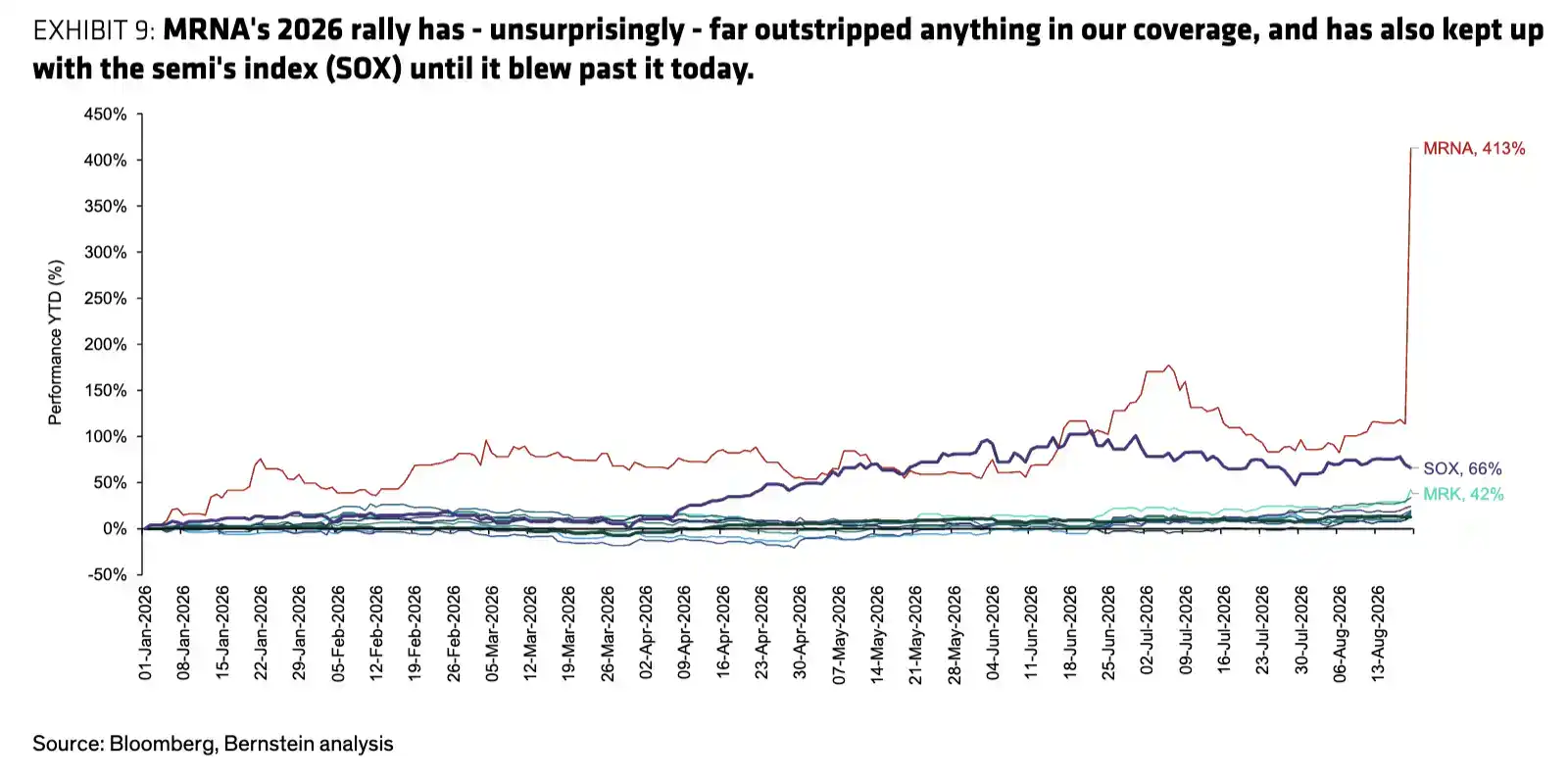
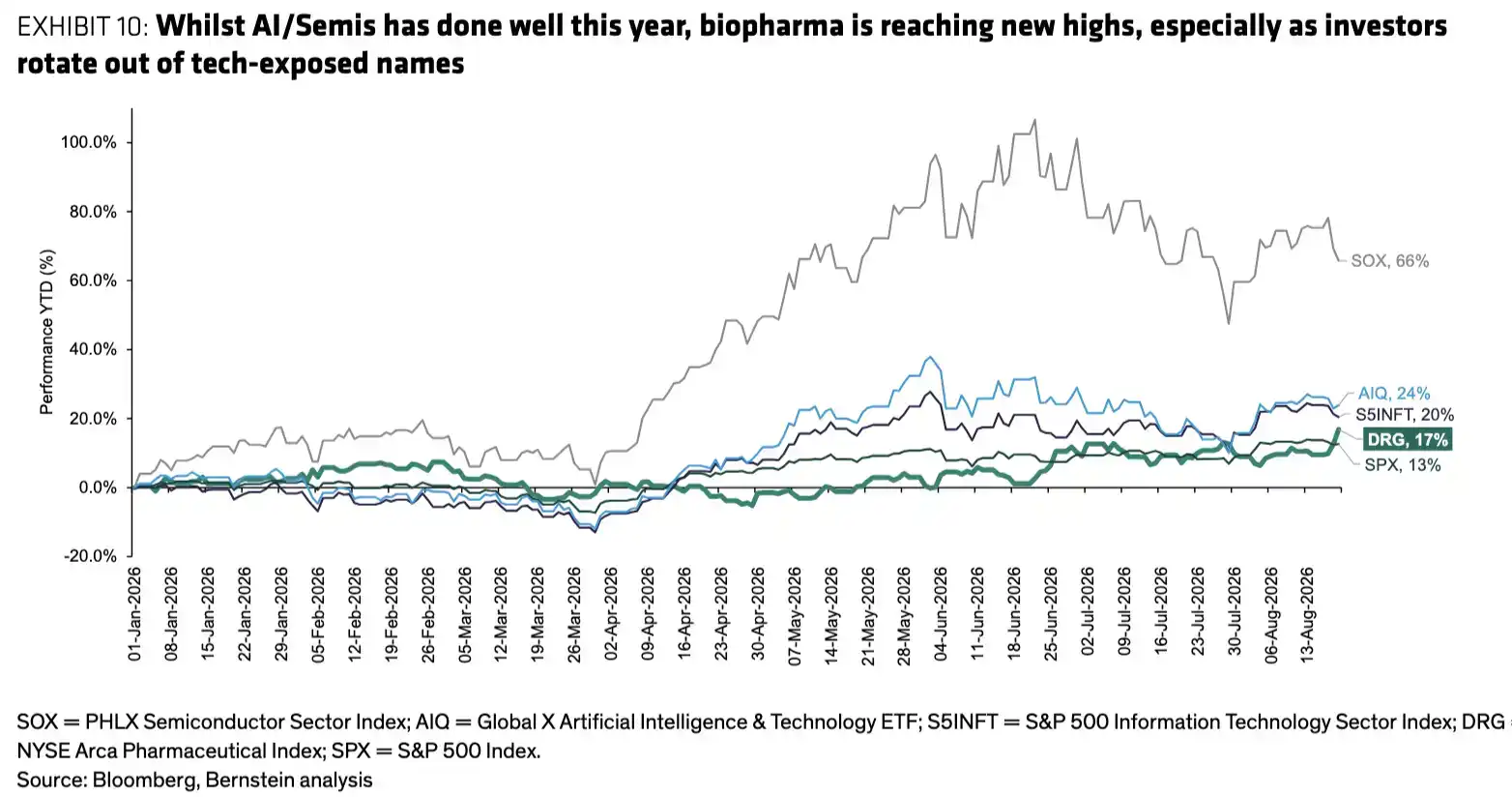
In 2026, the pharmaceutical sector (DRG) and the semiconductor index (SOX) show a clear inverse trading characteristic. When the AI theme experiences volatility and capital flows out of the tech sector, the pharmaceutical sector, as a defensive asset, sees capital inflows. Moderna's rise is not just an individual stock story but also a result of sector rotation.

This is merely Bernstein's interpretation of capital flows and does not imply a stable negative correlation between pharmaceuticals and semiconductors. However, when tech stock volatility rises, sector rotation can provide additional buying pressure for the pharma sector and amplify the market impact of INT's clinical results.

Thus, Moderna's rise contains three layers of trading: the foundation is the Phase 3 melanoma success, the middle layer is mRNA platform revaluation, and the outer layer consists of short covering and sector rotation. The further from the core, the greater the distance from quantifiable fundamentals.

From Clinical Breakthrough to Earnings Inflection Point: Three Validations Remain

INTerpath-001 has proven that mRNA personalized neoantigen therapy can succeed in a large Phase 3 trial. But to define it as Moderna's earnings inflection point, at least three more validations are needed:

First, complete Phase 3 data. The specific hazard ratios, safety profile, patient subgroups, and OS trends will determine INT's real advantage over Keytruda monotherapy.

Second, cross-cancer replication. Results from subsequent lung, kidney, and bladder cancer trials will determine whether melanoma is just a favorable indication or the starting point for a broader oncology platform.

Third, commercialization efficiency. Custom manufacturing cycles, capacity, pricing, reimbursement, and gross margins will determine whether sales can be converted into profits sufficient to support the valuation.

Bernstein does not deny the clinical value of INTerpath-001. Its real warning is: the market has rapidly jumped from a successful melanoma trial to endgame pricing based on a multi-cancer platform and long-term profit realization.

A clinical breakthrough has occurred, but an earnings inflection point is not yet confirmed. The current stock price is trading more on the imagination of platform success and short-term demand amplified by high short interest.


Kripto yang Sedang Tren

Pertanyaan Terkait

QAccording to the article, what clinical trial results did Moderna and Merck announce that led to Moderna's stock surging by approximately 177%?

AModerna and Merck announced positive topline results from the Phase 3 INTerpath-001 trial. The trial evaluated the combination of intismeran autogene (INT), an individualized neoantigen therapy, with Keytruda (pembrolizumab) for the adjuvant treatment of high-risk melanoma (stage IIB to IV) after complete resection. At its first interim analysis, the trial met both its primary endpoint of Recurrence-Free Survival (RFS) and a key secondary endpoint of Distant Metastasis-Free Survival (DMFS), demonstrating statistical significance and clinical meaning.

QBesides the positive clinical data, what other three key factors does Bernstein cite as drivers of Moderna's extreme stock price increase?

ABernstein identifies three additional factors that amplified the stock price movement beyond the clinical results: 1) The clinical success triggered a market re-evaluation of Moderna's mRNA platform potential beyond infectious diseases into oncology. 2) A high short interest (14-15% of float) led to forced short covering, which intensified buying pressure. 3) The use of the compelling but potentially oversimplified 'cancer vaccine' news label enhanced market excitement and broad investor attention.

QWhat does Bernstein estimate as the potential US patient population for the INT therapy based solely on the successful melanoma trial (INTerpath-001), and what does this represent relative to the broader program?

ABernstein estimates that the US addressable patient population for the INT therapy based on the successful melanoma trial (INTerpath-001) is approximately 13,000 to 19,000 patients. This represents about 30% of the patient population in the late-stage (Phase 3 and potential registrational Phase 2) projects and only about 17% of the patient population across all ongoing Phase 2 and Phase 3 INT studies.

QAccording to Bernstein's analysis, what are the key commercial and logistical differences between INT and a traditional mass-market vaccine?

AINT operates more like a personalized cancer drug than a traditional vaccine. Key differences include: 1) Its target patient population is in the tens of thousands, not millions or billions. 2) Each treatment is customized for an individual patient based on sequencing their tumor and blood samples to identify up to 34 specific neoantigens. 3) Its production cannot achieve the same economies of scale as batch-produced vaccines, keeping manufacturing costs higher. 4) Its regulatory path, pricing, and reimbursement will follow the model for oncology drugs, not vaccines.

QWhat three future validations does Bernstein argue are necessary to confirm the clinical breakthrough as a true inflection point for Moderna's business?

ABernstein states that three key validations are still required: 1) The release of full Phase 3 data, including specific hazard ratios, safety profiles, patient subgroups, and overall survival trends, to define the true advantage over Keytruda monotherapy. 2) Successful replication of the results across other cancer types (e.g., non-small cell lung cancer, renal cell carcinoma, bladder cancer) to prove the platform's broad applicability. 3) Demonstration of commercial efficiency, encompassing the therapy's custom production cycle, capacity, pricing, reimbursement, and ultimately, its gross margins, to ensure sales can translate into profits that justify the valuation.

Bacaan Terkait

Trading

Spot

Artikel Populer

Apa Itu $S$

Memahami SPERO: Tinjauan Komprehensif Pengenalan SPERO Seiring dengan perkembangan lanskap inovasi, munculnya teknologi web3 dan proyek cryptocurrency memainkan peran penting dalam membentuk masa depan digital. Salah satu proyek yang telah menarik perhatian di bidang dinamis ini adalah SPERO, yang dilambangkan sebagai SPERO,$$s$. Artikel ini bertujuan untuk mengumpulkan dan menyajikan informasi terperinci tentang SPERO, untuk membantu para penggemar dan investor memahami dasar-dasar, tujuan, dan inovasi dalam domain web3 dan crypto. Apa itu SPERO,$$s$? SPERO,$$s$ adalah proyek unik dalam ruang crypto yang berusaha memanfaatkan prinsip desentralisasi dan teknologi blockchain untuk menciptakan ekosistem yang mendorong keterlibatan, utilitas, dan inklusi finansial. Proyek ini dirancang untuk memfasilitasi interaksi peer-to-peer dengan cara baru, memberikan pengguna solusi dan layanan keuangan yang inovatif. Pada intinya, SPERO,$$s$ bertujuan untuk memberdayakan individu dengan menyediakan alat dan platform yang meningkatkan pengalaman pengguna dalam ruang cryptocurrency. Ini termasuk memungkinkan metode transaksi yang lebih fleksibel, mendorong inisiatif yang dipimpin komunitas, dan menciptakan jalur untuk peluang finansial melalui aplikasi terdesentralisasi (dApps). Visi mendasar dari SPERO,$$s$ berputar di sekitar inklusivitas, bertujuan untuk menjembatani kesenjangan dalam keuangan tradisional sambil memanfaatkan manfaat teknologi blockchain. Siapa Pencipta SPERO,$$s$? Identitas pencipta SPERO,$$s$ tetap agak samar, karena ada sumber daya publik yang terbatas yang memberikan informasi latar belakang terperinci tentang pendiriannya. Kurangnya transparansi ini dapat berasal dari komitmen proyek terhadap desentralisasi—sebuah etos yang banyak proyek web3 bagi, memprioritaskan kontribusi kolektif di atas pengakuan individu. Dengan memusatkan diskusi di sekitar komunitas dan tujuan kolektifnya, SPERO,$$s$ mewujudkan esensi pemberdayaan tanpa menonjolkan individu tertentu. Dengan demikian, memahami etos dan misi SPERO tetap lebih penting daripada mengidentifikasi pencipta tunggal. Siapa Investor SPERO,$$s$? SPERO,$$s$ didukung oleh beragam investor mulai dari modal ventura hingga investor malaikat yang berdedikasi untuk mendorong inovasi di sektor crypto. Fokus investor ini umumnya sejalan dengan misi SPERO—memprioritaskan proyek yang menjanjikan kemajuan teknologi sosial, inklusivitas finansial, dan tata kelola terdesentralisasi. Fondasi investor ini biasanya tertarik pada proyek yang tidak hanya menawarkan produk inovatif tetapi juga memberikan kontribusi positif kepada komunitas blockchain dan ekosistemnya. Dukungan dari investor ini memperkuat SPERO,$$s$ sebagai pesaing yang patut diperhitungkan di domain proyek crypto yang berkembang pesat. Bagaimana SPERO,$$s$ Bekerja? SPERO,$$s$ menerapkan kerangka kerja multi-faceted yang membedakannya dari proyek cryptocurrency konvensional. Berikut adalah beberapa fitur kunci yang menekankan keunikan dan inovasinya: Tata Kelola Terdesentralisasi: SPERO,$$s$ mengintegrasikan model tata kelola terdesentralisasi, memberdayakan pengguna untuk berpartisipasi aktif dalam proses pengambilan keputusan mengenai masa depan proyek. Pendekatan ini mendorong rasa kepemilikan dan akuntabilitas di antara anggota komunitas. Utilitas Token: SPERO,$$s$ memanfaatkan token cryptocurrency-nya sendiri, yang dirancang untuk melayani berbagai fungsi dalam ekosistem. Token ini memungkinkan transaksi, hadiah, dan fasilitasi layanan yang ditawarkan di platform, meningkatkan keterlibatan dan utilitas secara keseluruhan. Arsitektur Berlapis: Arsitektur teknis SPERO,$$s$ mendukung modularitas dan skalabilitas, memungkinkan integrasi fitur dan aplikasi tambahan secara mulus seiring dengan perkembangan proyek. Kemampuan beradaptasi ini sangat penting untuk mempertahankan relevansi di lanskap crypto yang selalu berubah. Keterlibatan Komunitas: Proyek ini menekankan inisiatif yang dipimpin komunitas, menggunakan mekanisme yang memberikan insentif untuk kolaborasi dan umpan balik. Dengan memelihara komunitas yang kuat, SPERO,$$s$ dapat lebih baik memenuhi kebutuhan pengguna dan beradaptasi dengan tren pasar. Fokus pada Inklusi: Dengan menawarkan biaya transaksi yang rendah dan antarmuka yang ramah pengguna, SPERO,$$s$ bertujuan untuk menarik basis pengguna yang beragam, termasuk individu yang mungkin sebelumnya tidak terlibat dalam ruang crypto. Komitmen ini terhadap inklusi sejalan dengan misi utamanya untuk memberdayakan melalui aksesibilitas. Garis Waktu SPERO,$$s$ Memahami sejarah proyek memberikan wawasan penting tentang trajektori dan tonggak perkembangannya. Berikut adalah garis waktu yang disarankan yang memetakan peristiwa signifikan dalam evolusi SPERO,$$s$: Fase Konseptualisasi dan Ideasi: Ide awal yang membentuk dasar SPERO,$$s$ dikembangkan, sangat selaras dengan prinsip desentralisasi dan fokus komunitas dalam industri blockchain. Peluncuran Whitepaper Proyek: Setelah fase konseptual, whitepaper komprehensif yang merinci visi, tujuan, dan infrastruktur teknologi SPERO,$$s$ dirilis untuk menarik minat dan umpan balik komunitas. Pembangunan Komunitas dan Keterlibatan Awal: Upaya jangkauan aktif dilakukan untuk membangun komunitas pengguna awal dan investor potensial, memfasilitasi diskusi seputar tujuan proyek dan mendapatkan dukungan. Acara Generasi Token: SPERO,$$s$ melakukan acara generasi token (TGE) untuk mendistribusikan token asli kepada pendukung awal dan membangun likuiditas awal dalam ekosistem. Peluncuran dApp Awal: Aplikasi terdesentralisasi (dApp) pertama yang terkait dengan SPERO,$$s$ diluncurkan, memungkinkan pengguna untuk terlibat dengan fungsionalitas inti platform. Pengembangan Berkelanjutan dan Kemitraan: Pembaruan dan peningkatan berkelanjutan terhadap penawaran proyek, termasuk kemitraan strategis dengan pemain lain di ruang blockchain, telah membentuk SPERO,$$s$ menjadi pemain yang kompetitif dan berkembang di pasar crypto. Kesimpulan SPERO,$$s$ berdiri sebagai bukti potensi web3 dan cryptocurrency untuk merevolusi sistem keuangan dan memberdayakan individu. Dengan komitmen terhadap tata kelola terdesentralisasi, keterlibatan komunitas, dan fungsionalitas yang dirancang secara inovatif, ia membuka jalan menuju lanskap keuangan yang lebih inklusif. Seperti halnya investasi di ruang crypto yang berkembang pesat, calon investor dan pengguna dianjurkan untuk melakukan riset secara menyeluruh dan terlibat dengan perkembangan yang sedang berlangsung dalam SPERO,$$s$. Proyek ini menunjukkan semangat inovatif industri crypto, mengundang eksplorasi lebih lanjut ke dalam berbagai kemungkinan yang ada. Meskipun perjalanan SPERO,$$s$ masih berlangsung, prinsip-prinsip dasarnya mungkin benar-benar mempengaruhi masa depan cara kita berinteraksi dengan teknologi, keuangan, dan satu sama lain dalam ekosistem digital yang saling terhubung.

405 Total TayanganDipublikasikan pada 2024.12.17Diperbarui pada 2024.12.17

Apa Itu $S$

Apa Itu AGENT S

Agent S: Masa Depan Interaksi Otonom di Web3 Pendahuluan Dalam lanskap Web3 dan cryptocurrency yang terus berkembang, inovasi secara konstan mendefinisikan ulang cara individu berinteraksi dengan platform digital. Salah satu proyek perintis, Agent S, menjanjikan untuk merevolusi interaksi manusia-komputer melalui kerangka agen terbuka. Dengan membuka jalan untuk interaksi otonom, Agent S bertujuan untuk menyederhanakan tugas-tugas kompleks, menawarkan aplikasi transformasional dalam kecerdasan buatan (AI). Eksplorasi mendetail ini akan menyelami seluk-beluk proyek, fitur uniknya, dan implikasinya untuk domain cryptocurrency. Apa itu Agent S? Agent S berdiri sebagai kerangka agen terbuka yang inovatif, dirancang khusus untuk mengatasi tiga tantangan mendasar dalam otomatisasi tugas komputer: Memperoleh Pengetahuan Spesifik Domain: Kerangka ini secara cerdas belajar dari berbagai sumber pengetahuan eksternal dan pengalaman internal. Pendekatan ganda ini memberdayakannya untuk membangun repositori pengetahuan spesifik domain yang kaya, meningkatkan kinerjanya dalam pelaksanaan tugas. Perencanaan Selama Rentang Tugas yang Panjang: Agent S menggunakan perencanaan hierarkis yang ditingkatkan pengalaman, pendekatan strategis yang memfasilitasi pemecahan dan pelaksanaan tugas-tugas rumit dengan efisien. Fitur ini secara signifikan meningkatkan kemampuannya untuk mengelola beberapa subtugas dengan efisien dan efektif. Menangani Antarmuka Dinamis dan Tidak Seragam: Proyek ini memperkenalkan Antarmuka Agen-Komputer (ACI), solusi inovatif yang meningkatkan interaksi antara agen dan pengguna. Dengan memanfaatkan Model Bahasa Besar Multimodal (MLLM), Agent S dapat menavigasi dan memanipulasi berbagai antarmuka pengguna grafis dengan mulus. Melalui fitur-fitur perintis ini, Agent S menyediakan kerangka kerja yang kuat yang mengatasi kompleksitas yang terlibat dalam mengotomatisasi interaksi manusia dengan mesin, membuka jalan untuk berbagai aplikasi dalam AI dan seterusnya. Siapa Pencipta Agent S? Meskipun konsep Agent S secara fundamental inovatif, informasi spesifik tentang penciptanya tetap samar. Pencipta saat ini tidak diketahui, yang menyoroti baik tahap awal proyek atau pilihan strategis untuk menjaga anggota pendiri tetap tersembunyi. Terlepas dari anonimitas, fokus tetap pada kemampuan dan potensi kerangka kerja. Siapa Investor Agent S? Karena Agent S relatif baru dalam ekosistem kriptografi, informasi terperinci mengenai investor dan pendukung keuangannya tidak secara eksplisit didokumentasikan. Kurangnya wawasan yang tersedia untuk umum mengenai fondasi investasi atau organisasi yang mendukung proyek ini menimbulkan pertanyaan tentang struktur pendanaannya dan peta jalan pengembangannya. Memahami dukungan sangat penting untuk mengukur keberlanjutan proyek dan potensi dampak pasar. Bagaimana Cara Kerja Agent S? Di inti Agent S terletak teknologi mutakhir yang memungkinkannya berfungsi secara efektif dalam berbagai pengaturan. Model operasionalnya dibangun di sekitar beberapa fitur kunci: Interaksi Komputer yang Mirip Manusia: Kerangka ini menawarkan perencanaan AI yang canggih, berusaha untuk membuat interaksi dengan komputer lebih intuitif. Dengan meniru perilaku manusia dalam pelaksanaan tugas, ia menjanjikan untuk meningkatkan pengalaman pengguna. Memori Naratif: Digunakan untuk memanfaatkan pengalaman tingkat tinggi, Agent S memanfaatkan memori naratif untuk melacak sejarah tugas, sehingga meningkatkan proses pengambilan keputusannya. Memori Episodik: Fitur ini memberikan panduan langkah demi langkah kepada pengguna, memungkinkan kerangka untuk menawarkan dukungan kontekstual saat tugas berlangsung. Dukungan untuk OpenACI: Dengan kemampuan untuk berjalan secara lokal, Agent S memungkinkan pengguna untuk mempertahankan kontrol atas interaksi dan alur kerja mereka, sejalan dengan etos terdesentralisasi Web3. Integrasi Mudah dengan API Eksternal: Versatilitas dan kompatibilitasnya dengan berbagai platform AI memastikan bahwa Agent S dapat dengan mulus masuk ke dalam ekosistem teknologi yang ada, menjadikannya pilihan menarik bagi pengembang dan organisasi. Fungsionalitas ini secara kolektif berkontribusi pada posisi unik Agent S dalam ruang kripto, saat ia mengotomatisasi tugas-tugas kompleks yang melibatkan banyak langkah dengan intervensi manusia yang minimal. Seiring proyek ini berkembang, aplikasi potensialnya di Web3 dapat mendefinisikan ulang bagaimana interaksi digital berlangsung. Garis Waktu Agent S Pengembangan dan tonggak Agent S dapat dirangkum dalam garis waktu yang menyoroti peristiwa pentingnya: 27 September 2024: Konsep Agent S diluncurkan dalam sebuah makalah penelitian komprehensif berjudul “Sebuah Kerangka Agen Terbuka yang Menggunakan Komputer Seperti Manusia,” yang menunjukkan dasar untuk proyek ini. 10 Oktober 2024: Makalah penelitian tersebut dipublikasikan secara terbuka di arXiv, menawarkan eksplorasi mendalam tentang kerangka kerja dan evaluasi kinerjanya berdasarkan tolok ukur OSWorld. 12 Oktober 2024: Sebuah presentasi video dirilis, memberikan wawasan visual tentang kemampuan dan fitur Agent S, lebih lanjut melibatkan pengguna dan investor potensial. Tanda-tanda dalam garis waktu ini tidak hanya menggambarkan kemajuan Agent S tetapi juga menunjukkan komitmennya terhadap transparansi dan keterlibatan komunitas. Poin Kunci Tentang Agent S Seiring kerangka Agent S terus berkembang, beberapa atribut kunci menonjol, menekankan sifat inovatif dan potensinya: Kerangka Inovatif: Dirancang untuk memberikan penggunaan komputer yang intuitif seperti interaksi manusia, Agent S membawa pendekatan baru untuk otomatisasi tugas. Interaksi Otonom: Kemampuan untuk berinteraksi secara otonom dengan komputer melalui GUI menandakan lompatan menuju solusi komputasi yang lebih cerdas dan efisien. Otomatisasi Tugas Kompleks: Dengan metodologinya yang kuat, ia dapat mengotomatisasi tugas-tugas kompleks yang melibatkan banyak langkah, membuat proses lebih cepat dan kurang rentan terhadap kesalahan. Perbaikan Berkelanjutan: Mekanisme pembelajaran memungkinkan Agent S untuk belajar dari pengalaman masa lalu, terus meningkatkan kinerja dan efektivitasnya. Versatilitas: Adaptabilitasnya di berbagai lingkungan operasi seperti OSWorld dan WindowsAgentArena memastikan bahwa ia dapat melayani berbagai aplikasi. Saat Agent S memposisikan dirinya di lanskap Web3 dan kripto, potensinya untuk meningkatkan kemampuan interaksi dan mengotomatisasi proses menandakan kemajuan signifikan dalam teknologi AI. Melalui kerangka inovatifnya, Agent S mencerminkan masa depan interaksi digital, menjanjikan pengalaman yang lebih mulus dan efisien bagi pengguna di berbagai industri. Kesimpulan Agent S mewakili lompatan berani ke depan dalam pernikahan AI dan Web3, dengan kapasitas untuk mendefinisikan ulang cara kita berinteraksi dengan teknologi. Meskipun masih dalam tahap awal, kemungkinan aplikasinya sangat luas dan menarik. Melalui kerangka komprehensifnya yang mengatasi tantangan kritis, Agent S bertujuan untuk membawa interaksi otonom ke garis depan pengalaman digital. Saat kita melangkah lebih dalam ke dalam ranah cryptocurrency dan desentralisasi, proyek-proyek seperti Agent S pasti akan memainkan peran penting dalam membentuk masa depan teknologi dan kolaborasi manusia-komputer.

1.2k Total TayanganDipublikasikan pada 2025.01.14Diperbarui pada 2025.01.14

Apa Itu AGENT S

Cara Membeli S

Selamat datang di HTX.com! Kami telah membuat pembelian Sonic (S) menjadi mudah dan nyaman. Ikuti panduan langkah demi langkah kami untuk memulai perjalanan kripto Anda.Langkah 1: Buat Akun HTX AndaGunakan alamat email atau nomor ponsel Anda untuk mendaftar akun gratis di HTX. Rasakan perjalanan pendaftaran yang mudah dan buka semua fitur.Dapatkan Akun SayaLangkah 2: Buka Beli Kripto, lalu Pilih Metode Pembayaran AndaKartu Kredit/Debit: Gunakan Visa atau Mastercard Anda untuk membeli Sonic (S) secara instan.Saldo: Gunakan dana dari saldo akun HTX Anda untuk melakukan trading dengan lancar.Pihak Ketiga: Kami telah menambahkan metode pembayaran populer seperti Google Pay dan Apple Pay untuk meningkatkan kenyamanan.P2P: Lakukan trading langsung dengan pengguna lain di HTX.Over-the-Counter (OTC): Kami menawarkan layanan yang dibuat khusus dan kurs yang kompetitif bagi para trader.Langkah 3: Simpan Sonic (S) AndaSetelah melakukan pembelian, simpan Sonic (S) di akun HTX Anda. Selain itu, Anda dapat mengirimkannya ke tempat lain melalui transfer blockchain atau menggunakannya untuk memperdagangkan mata uang kripto lainnya.Langkah 4: Lakukan trading Sonic (S)Lakukan trading Sonic (S) dengan mudah di pasar spot HTX. Cukup akses akun Anda, pilih pasangan perdagangan, jalankan trading, lalu pantau secara real-time. Kami menawarkan pengalaman yang ramah pengguna baik untuk pemula maupun trader berpengalaman.

2.5k Total TayanganDipublikasikan pada 2025.01.15Diperbarui pada 2026.06.02

Cara Membeli S

Diskusi

Selamat datang di Komunitas HTX. Di sini, Anda bisa terus mendapatkan informasi terbaru tentang perkembangan platform terkini dan mendapatkan akses ke wawasan pasar profesional. Pendapat pengguna mengenai harga S (S) disajikan di bawah ini.

活动图片