ENS Plans Large-Scale Expansion of Institutional Activity via Foundation Launch

cryptonews.ruDipublikasikan tanggal 2026-08-11Terakhir diperbarui pada 2026-08-11

Abstrak

The Ethereum Name Service ($ENS) DAO token holders ratified the "Next Era of $ENS DAO" proposal, leading to the launch of the $ENS Foundation on-chain as a legal operational entity with a paid executive director, staff, and a five-member board, according to an August 11 blog post by $ENS Labs. This new foundation addresses limitations of the DAO structure, enabling activities like signing standardization agreements, hiring full-time staff, pursuing trademark infringements, and interacting with regulators and courts. $ENS Labs will now focus on technical development, including the ENSv2 upgrade, while the foundation handles off-chain operations, engages with bodies like ICANN and W3C, and pursues a .eth top-level domain. The $ENS DAO retains 54.6% of the total token supply and control over the protocol. The foundation is funded by .eth domain registration revenues, with its transactions subject to a 9-day security council veto period. It is a separate legal entity from $ENS Labs. The inaugural board includes Alexander Urbelis (Executive Director, former $ENS Labs CISO), founder Nick Johnson ($ENS Labs CEO), and three independent directors. Board terms last two years. This update follows governance tensions earlier in the year, including a June proposal for a temporary security council restructure. CEO Nick Johnson's significant token holdings reportedly influenced a vote against extending prior security council agreements, leading to a new eight-member council. Currently,...

$ENS token holders have ratified the "Next Era $ENS DAO" proposal and launched the executable code on the blockchain, creating the $ENS Foundation as a working organization with a paid executive director, employees, and a five-member board of directors, $ENS Labs announced in a blog post on August 11.

This change provides $ENS with its first legal entity capable of holding meetings where the DAO cannot. Furthermore, this entity will handle day-to-day operations, while token holders will continue to control the protocol.

Why the DAO Could Not Sign Documents

According to data from $ENS Labs, the DAO is not qualified to sign standardization agreements, hire full-time employees, sue a trademark owner for a phishing clone, or respond to legal inquiries.

Until now, most representative work remained undone, with some of it being handled by $ENS Labs; however, given that the company primarily specializes in engineering development, it was not prepared to objectively assess this role.

Now that the Foundation has been launched, $ENS Labs states it can focus on development, including the upgrade to ENSv2.

The Foundation has been tasked with taking on the off-chain computational workload. It can now join discussions with ICANN, IETF, and W3C and pursue recognition for the .ens top-level domain.

As a legal entity, it is also responsible for engaging with regulators, registrars, standardization bodies, and courts. Additionally, its duties include consolidating the $ENS brand's trademarks and assets to be able to combat impersonators.

What $ENS Says About Where the Money Remains

$ENS DAO's share of the total token supply is 54.6%, and it will continue to be under the control of the DAO, which includes token holders.

The Foundation, funded by revenue from .eth domain registrations, stores its assets in its own accounts; however, its transactions are now subject to a nine-day lock.

During these nine days, the $ENS Security Council can cancel any transaction that falls outside the Foundation's mandate.

The same post emphasized that the $ENS Foundation and $ENS Labs are not legally identical, and each functions as a separate legal entity. The Foundation does not own $ENS Labs, and the latter has no governance rights over the Foundation, its funds, or the protocol.

The closest ties the labs have with the Foundation are that the founder holds a seat on the Foundation's five-member board of directors; however, he does not participate in decisions regarding funding for the labs.

Who is on the $ENS Foundation's Five-Person Board of Directors?

The inaugural board includes Alexandre Urbelis, a cybersecurity attorney who previously held the roles of Chief Legal Counsel and Chief Information Security Officer (CISO) at $ENS Labs, and served as CISO for the NFL, and now holds the position of Executive Director.

Nick Johnson, founder and CEO of $ENS Labs, holds the founder seat.

The board consists of the remaining three Ventures and ETHGlobal; Brett Sun, co-founder of Prelude; and Anthony Leutenegger, CEO of Aragon. Kartik Talwar from A.Capital

Board directors will serve for two years, and their terms may be renewed by token holders.

The update from $ENS comes in a year already marked by some governance conflicts on the platform. In June a proposal for an interim review aimed to restructure their operations with a focus on the DAO and the foundation.

Johnson, the CEO, who owns approximately 3.26 million $ENS (equivalent to US bonds), has also been a source of some controversy, as, given the size of his holdings, he has the ability to influence the course of voting. This occurred when, reportedly, at the end of June, he managed to secure around 80% of votes against extending agreements with the Security Council.

They later approved a new eight-member council with a stricter requirement of 5 out of 8 votes for a two-year term.

Currently, $ENS is trading at approximately $4.12, down over 1.9% in the last 24 hours, according to CoinMarketCap data. It is now more than 95% below its peak of $85.69 reached in November 2021.


Kripto yang Sedang Tren

Pertanyaan Terkait

QWhat did the token holders of Ethereum Name Service ($ENS) vote to create, and what is its main purpose?

AThe $ENS token holders ratified the 'Next Era $ENS DAO' proposal and launched the executable code on the blockchain, creating the $ENS Foundation. Its main purpose is to serve as a legal operating entity that can handle tasks the DAO cannot, such as signing standardization agreements, hiring full-time employees, pursuing legal action, and engaging with regulatory bodies and standards organizations.

QWhy was a foundation necessary for the $ENS ecosystem, according to the article?

AThe $ENS DAO lacked the legal authority to perform key functions like signing contracts, hiring full-time staff, suing trademark infringers, or responding to court requests. The new foundation takes over these off-chain operational burdens, allowing the DAO to focus on protocol governance and $ENS Labs to concentrate on technical development, including the upgrade to ENSv2.

QHow is the $ENS Foundation funded, and what financial safeguards are in place?

AThe $ENS Foundation is funded by revenue from .eth domain registrations. As a financial safeguard, the foundation's transactions are locked for nine days. During this period, the $ENS Security Council has the power to veto any transaction that falls outside the foundation's mandate.

QWho is the Executive Director of the newly formed $ENS Foundation, and what is his background?

AThe Executive Director of the $ENS Foundation is Alexander Urbelis. His background includes serving as Chief Legal Officer and Chief Information Security Officer (CISO) at $ENS Labs, and previously as CISO for the NFL.

QWhat recent governance controversy involving $ENS founder Nick Johnson is mentioned in the article?

AThe article mentions a governance controversy where $ENS Labs CEO and founder Nick Johnson, who holds approximately 3.26 million $ENS tokens, reportedly influenced a vote in late June. He was able to sway about 80% of votes against extending agreements with the Security Council. This later led to the approval of a new, 8-member council with stricter requirements.

Bacaan Terkait

Segel Perusahaan Huvycon Disikat Ratusan Orang, ‘Deterrensi Nuklir’ Dalam Perang Bisnis Tingkat Tinggi Kembali Beraksi

Pada 19 Agustus, Haowei Huaxin mengumumkan bahwa ratusan orang memasuki gedung perusahaan, memboboti lemari besi, dan mengambil segel perusahaan termasuk segel Partai, segel perusahaan, segel kontrak, serta segel tanda tangan legal. Perusahaan ini adalah produsen semikonduktor dengan sertifikasi kerahasiaan nasional. Konflik ini berakar pada struktur kepemilikan. Didirikan pada 2010 oleh China Electronics Technology Group Corporation dan Haite High-tech, Haowei Huaxin kemudian melihat perubahan kepemilikan pada 2021 setelah investasi dari Zhengyi Financial. Ini mengakibatkan sengketa kontrol antara Haite High-tech (pemegang saham lama) dan pihak yang didukung Zhengyi (sekarang Qingdao Haiyue Holding). Sengketa ini telah melibatkan saling klaim, pengusiran pejabat, penyitaan aset perusahaan sebelumnya, dan bahkan tuduhan pengelolaan fasilitas semikonduktor yang tidak semestinya. Meskipun Haite High-tech memenangkan beberapa putusan pengadilan dan arbitrase pada 2024-2026 yang menguatkan hak nominasi direksinya, mereka belum berhasil mendapatkan kembali kendali operasional dan segel perusahaan. Nilai Haowei Huaxin diperkirakan antara 12 hingga 16 miliar yuan, sangat kontras dengan nilai tercatatnya sebesar 832 juta yuan dalam laporan Haite High-tech. Kehilangan kontrol atas aset berharga ini merupakan pukulan besar bagi Haite High-tech. Haite High-tech menyatakan tindakan "pengambilan segel" pada 19 Agustus adalah upaya advokasi pemegang saham yang disepakati oleh lima pemegang saham selain Qingdao Haiyue. Insiden "perebutan segel perusahaan" bukanlah hal baru dalam persengketaan bisnis Tiongkok, seperti yang terlihat dalam kasus NVC Lighting, Weihe Shares, Dangdang, Bitmain, dan Tanshi. Meskipun menguasai segel memberikan keuntungan operasional jangka pendek dengan memblokir aktivitas hukum pihak lain, hal ini tidak menyelesaikan sengketa kepemilikan yang mendasarinya. Pihak yang kehilangan segel dapat melaporkan ke polisi, mendeklarasikan segel hilang, atau mengajukan segel baru. Pada akhirnya, tindakan seperti ini hanya memperpanjang ketidakpastian, sebagaimana terlihat dalam kasus-kasus sebelumnya yang berlarut selama bertahun-tahun. Esensi tata kelola perusahaan yang baik tidak terletak pada penguasaan segel fisik.

marsbit1m yang lalu

Segel Perusahaan Huvycon Disikat Ratusan Orang, ‘Deterrensi Nuklir’ Dalam Perang Bisnis Tingkat Tinggi Kembali Beraksi

marsbit1m yang lalu

Dua 'Paus' di ETH Jual Aset Senilai $63 Juta di Tengah Tekanan Penjual yang Menguat

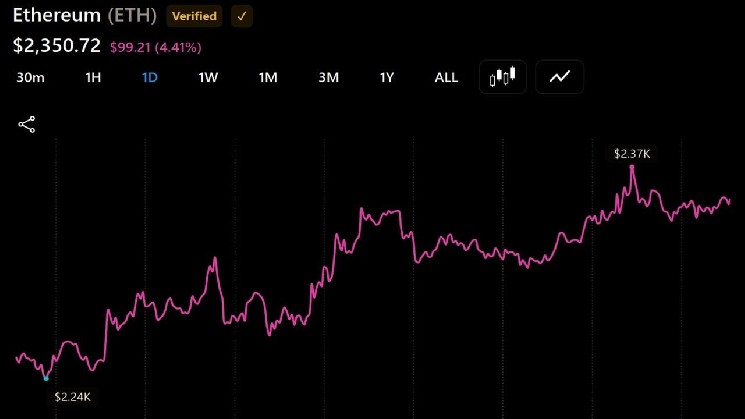
Platform analisis blockchain Lookonchain melaporkan bahwa dua "ikan paus" atau pemain besar telah menjual aset Ethereum ($ETH) senilai total sekitar $63 juta di tengah tekanan penjualan. Pemain pertama, yang dikenal sebagai "7 Siblings," menjual 14,000 $ETH senilai $32.85 juta dengan harga rata-rata $2,346. Entitas ini memiliki pola khas: membeli $ETH saat harga turun tajam dan kemudian mengambil keuntungan melalui transfer besar yang terkoordinasi. Meski masih menjadi salah satu dompet $ETH terbesar, aksi jualnya kali ini dianggap sebagai pengambilan keuntungan biasa. Beberapa jam kemudian, dompet anonim lain (0xFD10) menjual 11,252 stETH dan 1,824 $ETH, menghasilkan sekitar $30.78 juta. Berbeda dengan "7 Siblings", motif penjualan dompet ini kurang jelas. Penjualan besar-besaran ini merupakan bagian dari tren yang lebih luas, di mana pemegang jangka panjang dan trader swing memanfaatkan kenaikan harga dan stabilitas lokal untuk mengurangi posisi mereka. Meski terjadi penjualan, harga $ETH bertahan di sekitar $2,350, bahkan menunjukkan kenaikan dari level $2,286 beberapa jam sebelumnya. Aksi para "ikan paus" ini menjadi sorotan. Jika penjualan berlanjut dan harga tembus di bawah $2,300, perhatian bisa beralih ke zona $2,000. Namun, pemulihan harga yang berkelanjutan akan mengindikasikan bahwa penjualan Jumat lalu hanya pengambilan keuntungan sesaat, bukan awal dari fase distribusi yang lebih dalam.

cryptonews.ru32m yang lalu

Dua 'Paus' di ETH Jual Aset Senilai $63 Juta di Tengah Tekanan Penjual yang Menguat

cryptonews.ru32m yang lalu

MSX Pengamatan Harian Saham AS: Laporan Keuangan FY2027 Q1 Alibaba: Pertumbuhan Pendapatan AI Cloud Mencapai Rekor Tertinggi, AI Cloud Telah Mencapai Siklus Profitabilitas

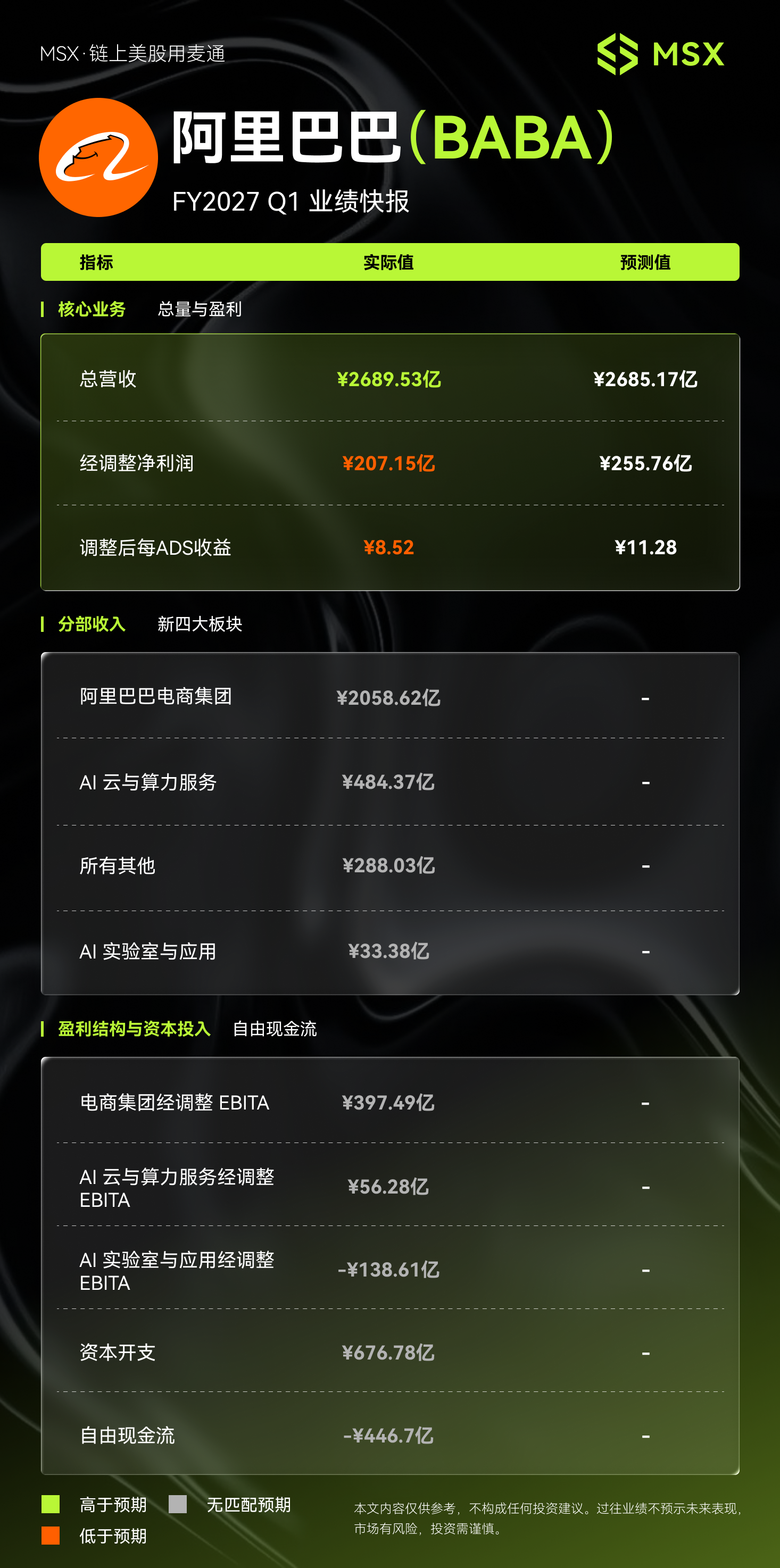
**Laporan Kuartal FY2027 Q1 Alibaba: Pendapatan AI Cloud Tumbuh Tertinggi, Untung Meningkat Pesat** Laporan keuangan Alibaba untuk kuartal pertama tahun fiskal 2027 (FY2027 Q1) menunjukkan pendapatan total Rp2.689,53 triliun, tumbuh 9% dan sedikit melampaui ekspektasi pasar. Namun, laba bersih yang disesuaikan turun 38% menjadi Rp207,15 triliun, terutama karena peningkatan investasi di bidang AI dan dua biaya satu kali: penyisihan denda EU Digital Services Act (Rp5,5 miliar euro) dan penurunan nilai goodwill (Rp44,58 triliun). Struktur bisnis menunjukkan pergeseran signifikan: * **AI Cloud & Layanan Komputasi** adalah bintang utama dengan pendapatan Rp484,37 triliun (naik 45%) dan EBITA yang disesuaikan melonjak 133% menjadi Rp56,28 triliun, dengan margin laba naik ke 12%. Ini menunjukkan bahwa bisnis AI Cloud sudah mencapai siklus profitabilitas. * **Grup E-niaga Alibaba** mengalami diferensiasi internal: **Ritel Instan** di Tiongkok tumbuh kuat sebesar 45% menjadi Rp532,95 triliun, hampir sepenuhnya mengimbangi penurunan 8% pada **E-niaga Tradisional** Tiongkok (Rp1.109,00 triliun). * **AI Lab & Aplikasi** masih dalam fase investasi, mencatat kerugian disesuaikan Rp138,61 triliun. Arus kas bebas menjadi negatif Rp446,70 triliun karena pengeluaran modal yang melonjak 75% menjadi Rp676,78 triliun, mencerminkan investasi agresif dalam infrastruktur AI dan komputasi. Meski demikian, arus kas dari operasi tetap tumbuh 11% menjadi Rp229,45 triliun, menunjukkan bahwa pembakaran uang tunai adalah pilihan strategis, bukan akibat operasi yang buruk. Intinya, meski laba turun secara keseluruhan, inti pertumbuhan dan profitabilitas baru Alibaba (AI Cloud, Ritel Instan) tampak kuat. Tantangan ke depan adalah apakah perbaikan profitabilitas AI Cloud dapat mengimbangi kecepatan depresiasi dari investasi komputasi besar-besaran ini.

Odaily星球日报36m yang lalu

MSX Pengamatan Harian Saham AS: Laporan Keuangan FY2027 Q1 Alibaba: Pertumbuhan Pendapatan AI Cloud Mencapai Rekor Tertinggi, AI Cloud Telah Mencapai Siklus Profitabilitas

Odaily星球日报36m yang lalu

Trading

Spot

Artikel Populer

Cara Membeli ENS

Selamat datang di HTX.com! Kami telah membuat pembelian Ethereum Name Service (ENS) menjadi mudah dan nyaman. Ikuti panduan langkah demi langkah kami untuk memulai perjalanan kripto Anda.Langkah 1: Buat Akun HTX AndaGunakan alamat email atau nomor ponsel Anda untuk mendaftar akun gratis di HTX. Rasakan perjalanan pendaftaran yang mudah dan buka semua fitur.Dapatkan Akun SayaLangkah 2: Buka Beli Kripto, lalu Pilih Metode Pembayaran AndaKartu Kredit/Debit: Gunakan Visa atau Mastercard Anda untuk membeli Ethereum Name Service (ENS) secara instan.Saldo: Gunakan dana dari saldo akun HTX Anda untuk melakukan trading dengan lancar.Pihak Ketiga: Kami telah menambahkan metode pembayaran populer seperti Google Pay dan Apple Pay untuk meningkatkan kenyamanan.P2P: Lakukan trading langsung dengan pengguna lain di HTX.Over-the-Counter (OTC): Kami menawarkan layanan yang dibuat khusus dan kurs yang kompetitif bagi para trader.Langkah 3: Simpan Ethereum Name Service (ENS) AndaSetelah melakukan pembelian, simpan Ethereum Name Service (ENS) di akun HTX Anda. Selain itu, Anda dapat mengirimkannya ke tempat lain melalui transfer blockchain atau menggunakannya untuk memperdagangkan mata uang kripto lainnya.Langkah 4: Lakukan trading Ethereum Name Service (ENS)Lakukan trading Ethereum Name Service (ENS) dengan mudah di pasar spot HTX. Cukup akses akun Anda, pilih pasangan perdagangan, jalankan trading, lalu pantau secara real-time. Kami menawarkan pengalaman yang ramah pengguna baik untuk pemula maupun trader berpengalaman.

520 Total TayanganDipublikasikan pada 2024.12.10Diperbarui pada 2026.06.02

Cara Membeli ENS

Diskusi

Selamat datang di Komunitas HTX. Di sini, Anda bisa terus mendapatkan informasi terbaru tentang perkembangan platform terkini dan mendapatkan akses ke wawasan pasar profesional. Pendapat pengguna mengenai harga ENS (ENS) disajikan di bawah ini.

活动图片