When Meme Traffic Meets RWA: The Financial Ambitions of Hyperliquid and Robinhood

marsbitDipublikasikan tanggal 2026-08-11Terakhir diperbarui pada 2026-08-11

Abstrak

When Meme traffic meets RWA: Hyperliquid and Robinhood's Financial Ambitions This article explores the transformative role of speculation in financial market evolution, arguing it can provide the liquidity and capital foundation for mature, compliant businesses. The analysis draws parallels to historical examples, like 19th-century Chicago grain markets, where speculators provided necessary counterparty liquidity for farmers, eventually establishing a global pricing infrastructure. The author examines contemporary cases in crypto. The launch of Uniswap's Pools meme token platform on Robinhood Chain—originally built for tokenized stock trading—demonstrates how speculative meme trading can drive significant user adoption and liquidity. Despite initial volatility, this traffic can seed future, more substantial financial activities. Similarly, Hyperliquid, which began with high-leverage crypto trading, has successfully migrated its speculative model to real-world assets (RWAs) like equities, commodities, and indices. By July, RWA perpetual contract volumes on Hyperliquid surpassed its crypto trading for the first time, showcasing how speculation can build new, all-weather pricing layers. The core thesis is that speculation itself is neutral. Its long-term value and sustainability are determined by the underlying assets it engages with. While pure bubbles collapse, speculation anchored to valuable assets—be it wheat, gold, or equities—can evolve into foundational market infrast...

Author: Prathik Desai, Token Dispatch

Compiled by: Saoirse, Foresight News

"When the capital development of a country becomes a by-product of the activities of a casino, the job is likely to be ill-done." – John Maynard Keynes, 1936

The crypto industry is often criticized, with the common perception that it is entirely driven by speculation, and many label it as a casino with no fundamental support. But many fail to realize that speculation is often a leading signal of market evolution. A group of speculators, scorned by the mainstream, gather together to form liquidity, and the mature, compliant businesses of the future are built upon this very liquidity.

In this article, I will analyze this evolutionary path in light of recent phenomena in the crypto market: a public chain originally intended for stock trading launches a Meme coin issuance platform; a perpetual futures trading platform transforms into infrastructure for bulk commodity trading; and a brokerage firm, relying on funds from frog-themed tokens, supports the construction of its on-chain stock trading system.

The story unfolds......

In the crypto space, speculation has many names: market noise, bubbles, casinos. But one point is almost never acknowledged: in the industry's march towards maturity, speculation can become the foundation upon which upper-layer business models grow.

However, it must be clarified: not all bubbles can transform into foundations. Bubbles that remain purely speculative for too long will eventually burst quickly. But if a bubble can combine with a sustainable trading scenario and continuously generate trading activity, it can become the foundation, supporting the landing of more businesses.

This is not a new phenomenon; it has been repeated throughout the long history of finance.

Consider the Chicago grain market in the 1840s. The Chicago Board of Trade introduced futures markets with the original intention of helping farmers, whose harvests were highly uncertain, lock in selling prices in advance to minimize losses. But for every farmer wanting to sell grain forward, there needed to be a counterparty willing to take on the long side of the forward contract and bear the price risk. Speculators filled this gap. The essence of a functional risk transfer market is speculative capital voluntarily taking on the price risk that farmers wanted to shed.

The key to the birth of the futures market was the decoupling of "physical grain" and "grain as a traded commodity." American historian William Cronon termed this process the abstraction of grain. Once grain trading was simplified into warehouse receipt notes, ownership could be freely transferred, allowing speculators to participate in trading on a large scale. Massive speculative trading created sufficient liquidity, enabling farmers to always find counterparties. This ample liquidity ultimately allowed Chicago to grow into the global pricing center for wheat.

Interestingly, at the time, a large number of people resisted and despised this type of trading. The Grange Movement openly criticized exchange speculators, accusing them of profiting from farmers' labor. Yet this mechanism eventually evolved into indispensable price discovery infrastructure for the global agricultural economy. If there had been no speculators acting as counterparties in the 1870s, the global wheat market today would not have a mature pricing system.

Economist John Maynard Keynes's remarks on speculation are well-known, but his complete view more clearly reveals the dual role of speculation. Keynes divided market activities into two categories: enterprise investment, which forecasts the earnings an asset will produce over its full lifetime; and speculation, which forecasts the psychology of the market. He feared that in markets with ample liquidity, speculation would cannibalize enterprise investment.

A closer reading of his discourse shows speculation's dual nature.

"Speculators may do no harm as bubbles on a steady stream of enterprise. But the position is serious when enterprise becomes the bubble on a whirlpool of speculation. When the capital development of a country becomes a by-product of the activities of a casino, the job is likely to be ill-done."

Speculation that exists independently of underlying assets is highly risky; but if speculation is anchored to valuable underlying assets, it can play a positive role.

As early as the first known book on securities markets – Joseph de la Vega's "Confusion of Confusions" written in 1688 – the author noted that the Amsterdam Exchange attracted both investors and gamblers. Most existing exchanges started this way. But over time, this history faded, and a stereotype formed: that serious investment needs were the original purpose of exchanges. This is not the case.

Looking at the Present

On August 5th, the crypto industry's largest decentralized exchange, Uniswap, launched the Pools issuance platform, allowing users to issue and trade Meme coins on Robinhood Chain. This blockchain was built by the eponymous brokerage firm, initially aiming to serve its 30 million funded accounts for tokenized stock trading.

The story goes much further. Before the Pools platform officially launched, traders unearthed the yet-to-be-public smart contract, conducting over $150 million in trades through it. This forced Uniswap to simultaneously support both the test and official contract versions and delay the launch plan. The platform's top token, FRONG, named after the frog video filename used in Uniswap's pre-launch promotional material, was minted six days early via the same contract; on the day the platform officially opened, the token had 12,141 holders.

Interpret this as you will: approximately $150 million in capital traded a frog-themed token on infrastructure not yet officially operational, built on a public chain originally designed for securities trading. FRONG has now become the unofficial mascot of the Pools platform. It's hard not to suspect this was a deliberately orchestrated move to drive traffic to Uniswap's latest V4 version chain. Even if not planned, on-chain Uniswap V4 daily trading volume surged from $86.2 million to $228.3 million, nearly tripling.

But as stated at the article's outset, not all bubbles and speculation can foster sustainable business models. Whether a speculative activity can last long-term depends fundamentally on *what* it is speculating on. We can look at shturl.c.

For years, shturl.c has made speculation its core product and is now one of the largest Meme coin issuance platforms. Seventy percent of Meme coins on the platform have a lifespan of less than a day, with only a tiny fraction surviving over a month.
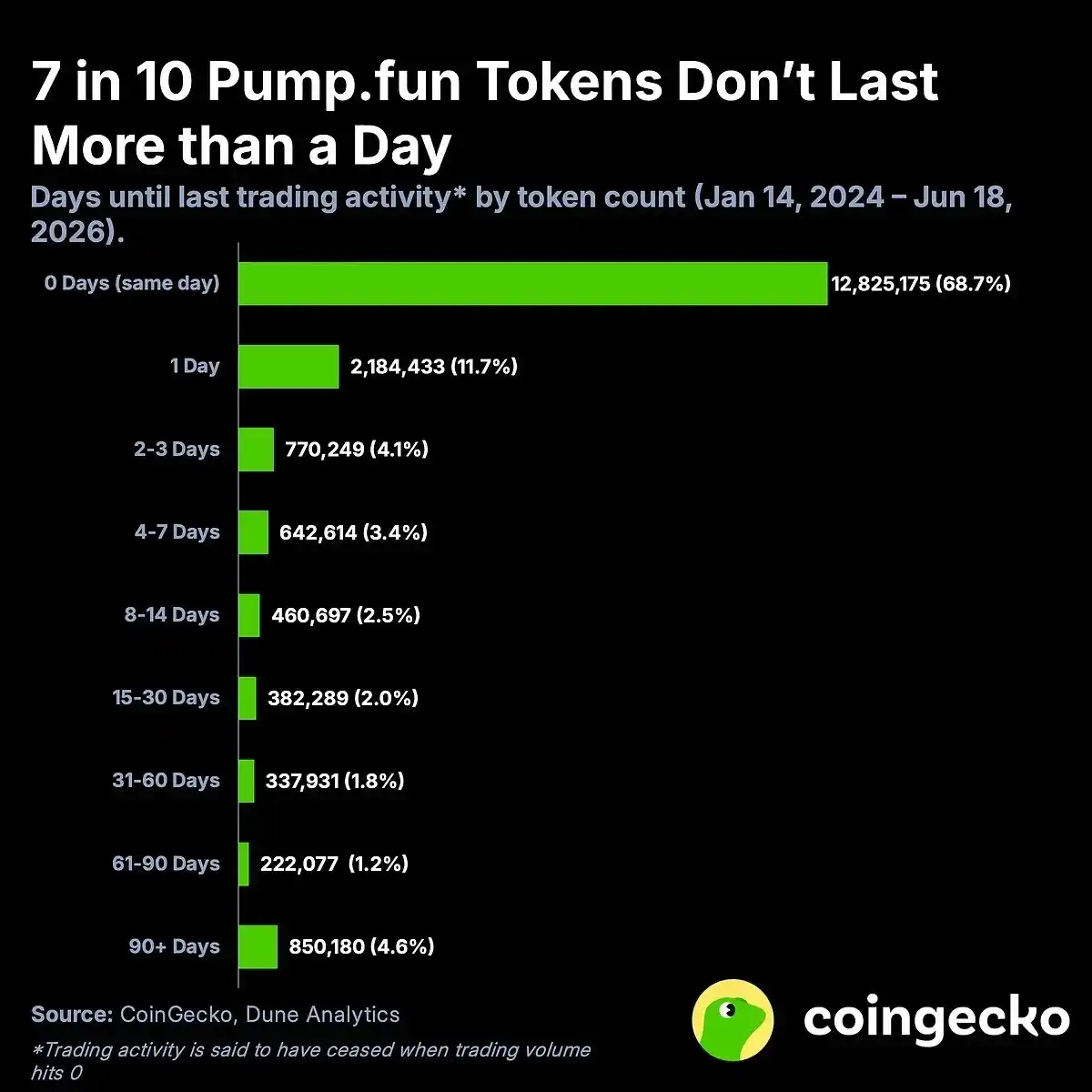
@Coingecko

From January–July 2026, the protocol's fee revenue nearly halved compared to the same period last year, reaching only $420 million. Despite this, it remains one of the crypto industry's most revenue-generating protocols, with annual revenue of $620 million and a net profit of $584 million last year.

Hyperliquid is another platform of this type. It initially focused on high-leverage cryptocurrency trading, catering to traders' directional bets. Later, it extended the leveraged trading model to various assets for round-the-clock trading, unrelated to crypto. Under the HIP-3 governance framework, the platform has now launched perpetual contracts for Nvidia, Tesla, Nasdaq tracking products, gold, crude oil, silver, stock indices, and more. When oil-related news breaks on a Sunday, traders can immediately take positions, while traditional markets wait until Monday to open.

In early July, the platform's real-world asset perpetual contract volume historically surpassed cryptocurrency trading for the first time, accounting for 52% of total volume.

Although Hyperliquid's overall trading volume has shrunk by nearly half from its 2025 peak, growth in real-world asset trading has offset the decline in crypto trading pairs. This is precisely the value speculation can create: Hyperliquid migrated the leverage trading model that attracts native crypto users to assets like gold, pre-IPO company equity, and stock indices, building a new round-the-clock pricing layer. Many traditional trading platforms are now emulating this model.

Robinhood Chain is replicating this development path in real-time.

Although the team positions this public chain as underlying infrastructure for on-chain stock trading, CEO Vlad Tenev is happy with the traffic brought by Meme coin traders.

"We built Robinhood Chain with the goal of being the best public chain for real-world asset trading... but it's also excellent for trading Meme coins."

Riding the wave of Meme coin trading, the chain surpassed Base chain in daily active users within three weeks of launch. The traffic and capital from Meme coin trading serve as the seed capital for the future development of the on-chain stock trading system.

Of course, this doesn't guarantee that speculation will inevitably upgrade into a mature business. Whether this transformation can be completed depends on the platform's own choices.

Robinhood, with 30 million funded users and multiple business lines, has strong distribution capabilities that could potentially convert the traffic from Meme coin trading into a user base for on-chain securities trading. We can see that its Q2 prediction market revenue skyrocketed over tenfold year-over-year to $156 million, accounting for 20% of the platform's total trading revenue.

The Nature of Speculation

Many still fail to understand speculation. Speculation itself is neither absolutely good nor bad. Stripped of all labels, speculation is simply one of humanity's oldest instincts.

When people convert their views into financial bets, speculation is naturally born.

In its most primitive form, speculation is the search for liquidity to price an asset; wherever liquidity flows, it prices that asset. The asset can be a sack of wheat, Nvidia stock, a frog video named frong.mp4, the outcome of a football match, or the probability of a presidential candidate winning.

The attributes of the underlying asset itself determine the direction and boundaries of speculation. Once speculation loses the support of a valuable underlying asset, the hype generated by the same capital ultimately struggles to precipitate long-term, valuable outcomes. This rule runs through the history of finance, and the crypto industry is treading the same path.

Hyperliquid tied leverage trading to assets like gold, building a new pricing system in just two years; Robinhood leverages the unexpected traffic from Meme coin speculation to simultaneously build the underlying channels for on-chain securities trading.

What kind of system speculation ultimately constructs depends on how much value the underlying asset can bear.


Kripto yang Sedang Tren

Pertanyaan Terkait

QAccording to the article, how does the author view the role of speculation in the evolution of financial markets?

AThe author argues that speculation can serve as a foundational layer for future, more mature financial infrastructure. While often criticized, speculation aggregates liquidity, which can later be leveraged to build sustainable and compliant business models, such as price discovery systems or asset trading platforms.

QWhat historical example does the author use to illustrate the positive function of speculation?

AThe author cites the 19th-century Chicago grain market. Speculators provided the necessary liquidity and counterparty risk-taking in the newly created futures market, which allowed farmers to hedge their price risks. This speculative activity was crucial in establishing Chicago as a global wheat pricing center.

QHow does the Hyperliquid platform demonstrate the transition from pure speculation to a valuable financial infrastructure?

AHyperliquid started as a high-leverage crypto trading platform. By extending its perpetual contract model to non-crypto assets like stocks (Nvidia, Tesla), indices, and commodities (gold, oil), it created a 24/7 pricing layer. The article notes that trading volume for these real-world assets now surpasses its crypto volume, showing how speculative crypto capital helped build a broader asset pricing system.

QWhat is the connection between Meme coin trading and Robinhood Chain's long-term ambitions?

ARobinhood Chain was initially built to facilitate tokenized stock trading for its users. However, the massive influx of users and liquidity from Meme coin trading (e.g., via the Uniswap Pools launch) provided unexpected seed capital and user traffic. Robinhood aims to channel this speculative activity to support the development of its core infrastructure for on-chain securities trading.

QWhat key factor determines whether speculative activity can lead to sustainable business development, according to the article's conclusion?

AThe decisive factor is the underlying asset or subject of the speculation. Speculation must be anchored to a valuable underlying asset to have a positive, lasting impact. The nature and value-carrying capacity of the underlying asset define the direction and boundaries of what the speculative activity can eventually build (e.g., gold vs. a fleeting meme).

Bacaan Terkait

Grayscale: «Jika Proposal Diterima, Harga Dua Altcoin Ini Bisa Naik»

Kepala Penelitian Grayscale, Zack Pandl, menyatakan bahwa jika perubahan tokenomik yang sedang dibahas dalam komunitas Ethereum ($ETH) dan Solana ($SOL) diimplementasikan, laju pertumbuhan pasokan kedua aset kripto tersebut dapat melambat secara signifikan. Hal ini berpotensi berdampak positif pada harga. Menurut Pandl, perubahan yang diusulkan dalam kode ekosistem Ethereum dan Solana bertujuan untuk mengurangi laju inflasi tahunan token $ETH dan $SOL. Dengan segala kondisi lain tetap sama, melambatnya pertumbuhan pasokan dapat mengurangi jumlah token baru yang masuk ke pasar, sehingga meningkatkan kelangkaan aset yang ada. Perkiraan Grayscale menunjukkan bahwa jika aturan ini diterapkan, inflasi pasokan tahunan Ethereum bisa turun menjadi sekitar 0,4% pada akhir 2031 — mendekati laju pertumbuhan pasokan Bitcoin. Inflasi pasokan tahunan Solana diproyeksikan turun menjadi sekitar 1,1%. Sebagai perbandingan, pasokan emas tumbuh sekitar 1,8% per tahun, sedangkan inflasi indeks harga konsumen AS sekitar 3,3%. Perubahan yang diusulkan untuk Ethereum dan Solana masih dalam diskusi komunitas dan belum disetujui secara final. Pandl mencatat bahwa proposal untuk Solana tampaknya mendapat dukungan lebih luas dan karena itu memiliki kemungkinan lebih besar untuk diimplementasikan. Namun, penurunan inflasi token juga dapat mengurangi imbalan bagi investor yang melakukan staking, karena sebagian besar pendapatan staking $ETH dan $SOL berasal dari penerbitan token baru. Pandl menekankan bahwa melambatnya pertumbuhan pasokan dapat meningkatkan kelangkaan, memberikan tekanan kenaikan pada harga $ETH dan $SOL, dan investor yang memegang token tanpa staking khususnya mungkin mendapat manfaat. *Ini bukan rekomendasi investasi.

cryptonews.ru34m yang lalu

Grayscale: «Jika Proposal Diterima, Harga Dua Altcoin Ini Bisa Naik»

cryptonews.ru34m yang lalu

Trading

Spot

Artikel Populer

Apa Itu MEME 2.0

Memecoin 2.0: Kebangkitan $MEME 2.0 di Dunia Cryptocurrency Pendahuluan Dalam lanskap cryptocurrency yang terus berkembang, sebuah pesaing baru telah muncul. Memecoin 2.0, yang disimbolkan sebagai $MEME 2.0, membawa konsep koin meme ke tingkat yang menarik. Sebagai produk sampingan dari Memecoin yang asli, proyek ini telah menarik perhatian komunitas kripto dengan mengalihkan fokus dari insentif finansial yang biasa ke pengalaman yang menarik dan menghibur. Beroperasi di blockchain Ethereum, Memecoin 2.0 dengan berani mendefinisikan kembali keterlibatan komunitas di ranah kripto. Apa itu Memecoin 2.0, $MEME 2.0? Pada intinya, Memecoin 2.0 adalah proyek cryptocurrency yang memprioritaskan semangat komunitas dan kesenangan yang terkait dengan budaya meme. Berbeda dengan cryptocurrency konvensional, yang berkonsentrasi pada kasus penggunaan praktis dan manfaat yang nyata, Memecoin 2.0 membedakan dirinya dengan menerima sisi yang lebih ringan dari mata uang digital. Proyek ini ada tanpa janji utilitas, peta jalan yang terstruktur, atau pengembalian finansial, tetapi lebih fokus pada pengembangan komunitas yang dinamis yang berpusat pada meme dan kesenangan yang dibagikan. Dengan melakukan hal ini, proyek ini memanfaatkan tren budaya meme yang berkembang di ruang online, menjadikannya pemain yang unik di dunia aset digital. Pencipta Memecoin 2.0, $MEME 2.0 Meskipun telah dilakukan penelitian mendalam tentang asal-usul Memecoin 2.0, identitas eksplisit penciptanya tetap tidak diketahui. Anonimitas ini tidak jarang terjadi di komunitas kripto, di mana banyak proyek dipimpin oleh individu atau kelompok yang lebih memilih untuk tetap berada di belakang layar. Kurangnya informasi yang tersedia untuk umum mengenai pencipta proyek ini dapat dipandang sebagai langkah strategis, menyoroti keterlibatan komunitas daripada ketenaran individu dalam ruang ini. Investor Memecoin 2.0, $MEME 2.0 Informasi mengenai para investor atau dukungan finansial untuk Memecoin 2.0 jarang ditemui. Ketidakadaan detail ini mungkin menunjukkan bahwa proyek ini didanai sendiri atau bahwa fokusnya pada komunitas daripada struktur investasi tradisional telah menarik jenis pendukung yang berbeda. Karena dunia koin meme biasanya melibatkan lebih banyak keterlibatan akar rumput daripada investasi institusional, pendekatan ini sejalan dengan etos proyek yang digerakkan oleh komunitas. Bagaimana Memecoin 2.0, $MEME 2.0 Bekerja? Memecoin 2.0 beroperasi sepenuhnya di blockchain Ethereum, memanfaatkan fitur keamanan dan skalabilitas yang kuat. Dengan memanfaatkan kekuatan Ethereum, Memecoin 2.0 dapat menawarkan lingkungan yang aman untuk interaksi pengguna sambil memastikan bahwa transaksi efisien dan hemat biaya. Salah satu atribut unik dari Memecoin 2.0 terletak pada strukturnya yang digerakkan oleh komunitas. Nilai dan popularitas token $MEME 2.0 berasal dari partisipasi aktif penggunanya, bukan dari utilitas yang melekat. Desain ini memperkuat fokus proyek pada aspek hiburan dari cryptocurrency, menunjukkan bahwa tawa dan keterlibatan komunitas adalah mata uang sejati yang mendorong kesuksesannya. Selain itu, proyek ini cocok dalam ekosistem yang lebih luas dari koin meme, di mana nilai setiap koin meme berfluktuasi berdasarkan budaya, tren, dan keterlibatan komunitas daripada prinsip ekonomi tradisional. Garis Waktu Memecoin 2.0, $MEME 2.0 Untuk lebih memahami evolusi dan tonggak sejarah Memecoin 2.0, berikut adalah garis waktu yang menyoroti peristiwa signifikan dalam sejarahnya: 2024: Proses penciptaan Memecoin 2.0 diakui sebagai cabang dari Memecoin yang asli, menetapkan dirinya di dalam konteks koin meme yang berkembang pesat sambil beroperasi di blockchain Ethereum. 13 Juli 2024: Memecoin 2.0 secara resmi memposisikan dirinya sebagai koin meme yang berfokus pada komunitas di jaringan Ethereum, menekankan pendekatan yang berfokus pada hiburan yang mengundang pengguna untuk terlibat dan berpartisipasi dalam pertumbuhannya. Poin Kunci Tentang Memecoin 2.0, $MEME 2.0 Beberapa karakteristik penting yang mendefinisikan Memecoin 2.0: Pendekatan Berfokus pada Komunitas: Misi utama Memecoin 2.0 adalah menciptakan pengalaman komunitas yang menyenangkan dan menarik, memanfaatkan kesenangan kolektif yang bersumber dari budaya memetik. Dibangun di atas Ethereum: Beroperasi di blockchain Ethereum memberikan proyek ini infrastruktur penting yang memastikan keamanan dan skalabilitas. Kurangnya Utilitas atau Peta Jalan: Dalam suatu perubahan yang mencolok dari cryptocurrency tradisional, Memecoin 2.0 tidak menjanjikan fitur utilitarian atau pengembalian finansial, menegaskan kembali komitmennya terhadap keterlibatan komunitas dan interaksi sosial. Fokus pada Budaya Memetik: Dengan menerima aspek humor dan budaya dari fenomena meme, Memecoin 2.0 menyediakan platform bagi pengguna untuk terlibat dengan kripto secara offline dan online. Konteks Tambahan: Signifikansi Koin Meme Koin meme telah muncul sebagai kelas cryptocurrency yang berbeda, sering kali didorong oleh humor dan pendekatan ringan terhadap perdagangan. Koin-koin ini umumnya tidak memiliki utilitas signifikan atau peta jalan pengembangan, menarik pengguna dengan janji kesenangan, interaksi komunitas, dan relevansi budaya. Dalam lanskap ekosistem kripto yang lebih luas, koin meme menghidupkan kembali pentingnya keterlibatan komunitas, menolak pendekatan yang hanya berorientasi keuntungan. Proyek-proyek seperti Memecoin 2.0 membuka era di mana hiburan dapat harmonis dengan aspirasi finansial, menjadikan blockchain sebagai taman bermain untuk kreativitas dan interaksi sosial. Kesimpulan Memecoin 2.0, atau $MEME 2.0, mewujudkan gelombang baru cryptocurrency yang memprioritaskan keterlibatan komunitas di atas struktur finansial yang kaku. Dengan fokus pada humor dan interaksi sosial, proyek ini memanfaatkan daya tarik yang mengelilingi budaya meme. Dengan beroperasi di blockchain Ethereum, Memecoin 2.0 memanfaatkan kemampuan teknologi sambil tetap teguh dalam komitmennya terhadap nilai hiburan dari mata uang digital. Seiring ruang seputar cryptocurrency terus berkembang, Memecoin 2.0 menjadi sebuah bukti bahwa masa depan aset digital mungkin sangat bergantung pada pengalaman bersama, tawa, dan hubungan komunitas yang kuat. Di dunia kripto yang tidak dapat diprediksi, mungkin kebahagiaan dapat sama berharganya dengan keuntungan finansial tradisional.

288 Total TayanganDipublikasikan pada 2024.04.04Diperbarui pada 2024.12.03

Apa Itu MEME 2.0

Cara Membeli MEME

Selamat datang di HTX.com! Kami telah membuat pembelian Memeland (MEME) menjadi mudah dan nyaman. Ikuti panduan langkah demi langkah kami untuk memulai perjalanan kripto Anda.Langkah 1: Buat Akun HTX AndaGunakan alamat email atau nomor ponsel Anda untuk mendaftar akun gratis di HTX. Rasakan perjalanan pendaftaran yang mudah dan buka semua fitur.Dapatkan Akun SayaLangkah 2: Buka Beli Kripto, lalu Pilih Metode Pembayaran AndaKartu Kredit/Debit: Gunakan Visa atau Mastercard Anda untuk membeli Memeland (MEME) secara instan.Saldo: Gunakan dana dari saldo akun HTX Anda untuk melakukan trading dengan lancar.Pihak Ketiga: Kami telah menambahkan metode pembayaran populer seperti Google Pay dan Apple Pay untuk meningkatkan kenyamanan.P2P: Lakukan trading langsung dengan pengguna lain di HTX.Over-the-Counter (OTC): Kami menawarkan layanan yang dibuat khusus dan kurs yang kompetitif bagi para trader.Langkah 3: Simpan Memeland (MEME) AndaSetelah melakukan pembelian, simpan Memeland (MEME) di akun HTX Anda. Selain itu, Anda dapat mengirimkannya ke tempat lain melalui transfer blockchain atau menggunakannya untuk memperdagangkan mata uang kripto lainnya.Langkah 4: Lakukan trading Memeland (MEME)Lakukan trading Memeland (MEME) dengan mudah di pasar spot HTX. Cukup akses akun Anda, pilih pasangan perdagangan, jalankan trading, lalu pantau secara real-time. Kami menawarkan pengalaman yang ramah pengguna baik untuk pemula maupun trader berpengalaman.

694 Total TayanganDipublikasikan pada 2024.12.12Diperbarui pada 2026.06.02

Cara Membeli MEME

Diskusi

Selamat datang di Komunitas HTX. Di sini, Anda bisa terus mendapatkan informasi terbaru tentang perkembangan platform terkini dan mendapatkan akses ke wawasan pasar profesional. Pendapat pengguna mengenai harga MEME (MEME) disajikan di bawah ini.

活动图片