Author: Nancy, PANews
Since reaching a local high about two months ago, the price of HYPE has been in a sustained correction, but Hyperliquid's ecosystem expansion has not stalled. With HIP-3 driving growth in RWA trading demand, the platform's share of the global perpetual contracts market continues to increase.
At the same time, competition around the HIP-3 ecosystem entry points is heating up. Trade.xyz dominates due to its first-mover advantage, while multiple deployers are attempting to capture a share of the market by snatching up popular tickers and introducing capital support.
RWA Overtakes Crypto as Core Growth Sector, Trade.xyz Faces Siege from Newcomers "Grabbing Tickets"
The bear market has not hindered Hyperliquid's rapid expansion. However, what is fueling its growth now is not trading in crypto assets like Bitcoin and Ethereum, but the increasingly hot RWA sector.
Currently, Hyperliquid is accelerating its rise in the global perpetual contracts market. Hypeflow data shows that as of August 3rd, based on the 14-day rolling average calculated by Open Interest (OI) size, Hyperliquid already holds a 10.1% share of the global perpetual contracts market, up from just 7.1% half a year ago.
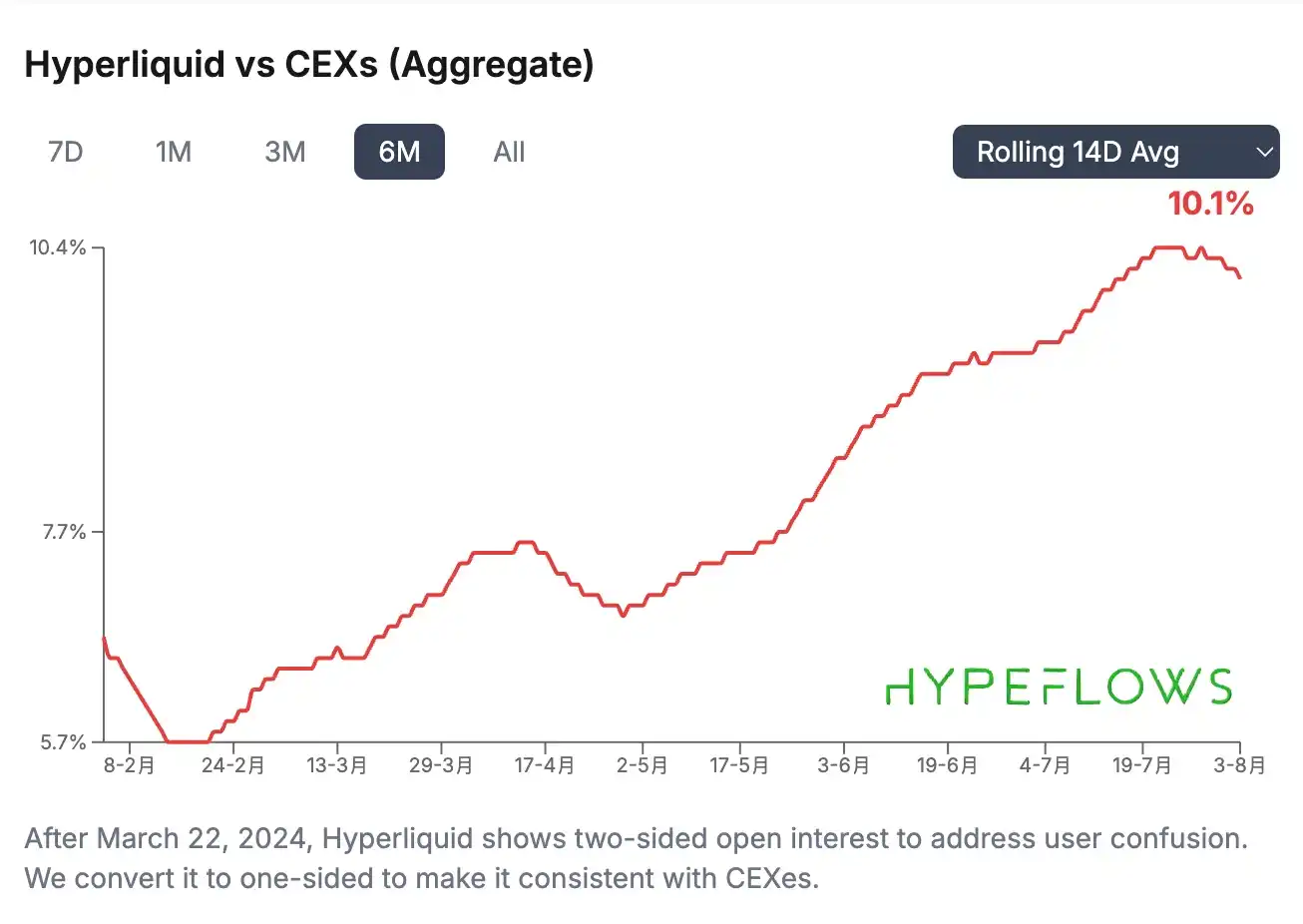
The core driver of Hyperliquid's growth comes from the RWA trading demand brought by HIP-3.
Blockworks data shows that as of August 1st, HIP-3-related RWA assets accounted for 41% of Hyperliquid's perpetual contract trading volume, recently rising to as high as 74%. At the same time, the trading share of traditional crypto assets like Bitcoin has been declining, indicating that Hyperliquid's current growth logic has shifted from crypto-native asset trading to an on-chain perpetual trading market covering stocks, commodities, and more real-world asset targets.
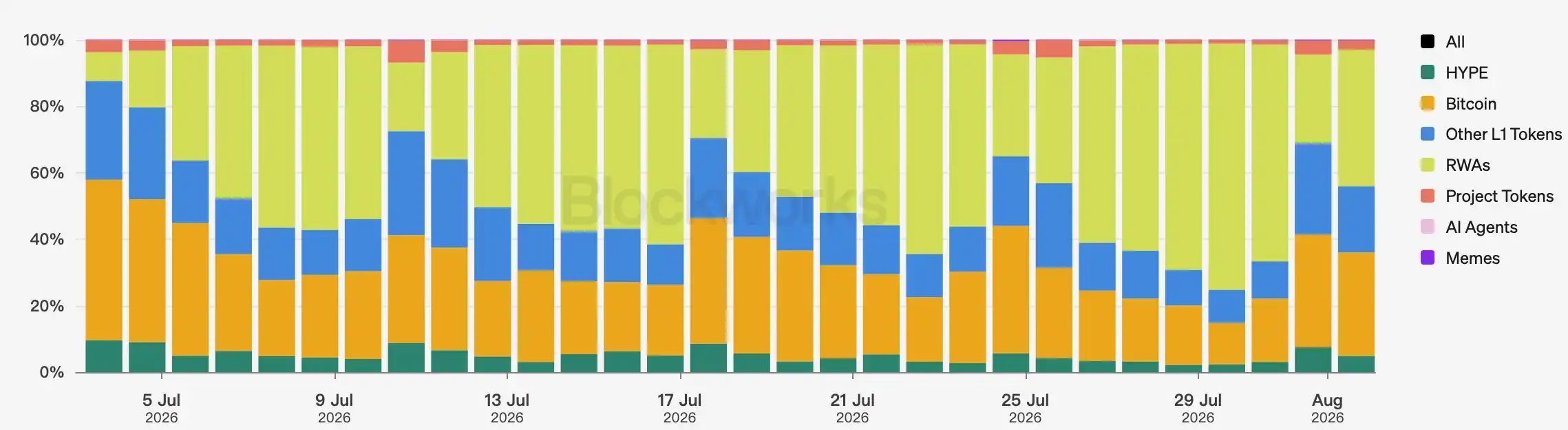
As the HIP-3 ecosystem continues to expand, more and more deployers are entering the competition.
Currently, Trade.xyz holds a leading market position thanks to its first-mover advantage, with various trading data repeatedly setting new records. According to official disclosures, Trade.xyz's cumulative trading volume has reached $408.4 billion, with weekend cumulative turnover exceeding $26 billion and a peak of over 60,000 unique traders in a single day.
However, competitors of Trade.xyz are accelerating their entry into the HIP-3 market using differentiated strategies and lower participation barriers.
For example, Paragon is laying out in the HIP-3 ecosystem by buying up tickers. hl.eco data shows that since July 15th, Paragon has successively acquired 13 tickers, spending a total of approximately 6,328 HYPE, valued at around $333,000. Prior to this, ticker auctions within the HIP-3 ecosystem were almost monopolized by Trade.xyz.
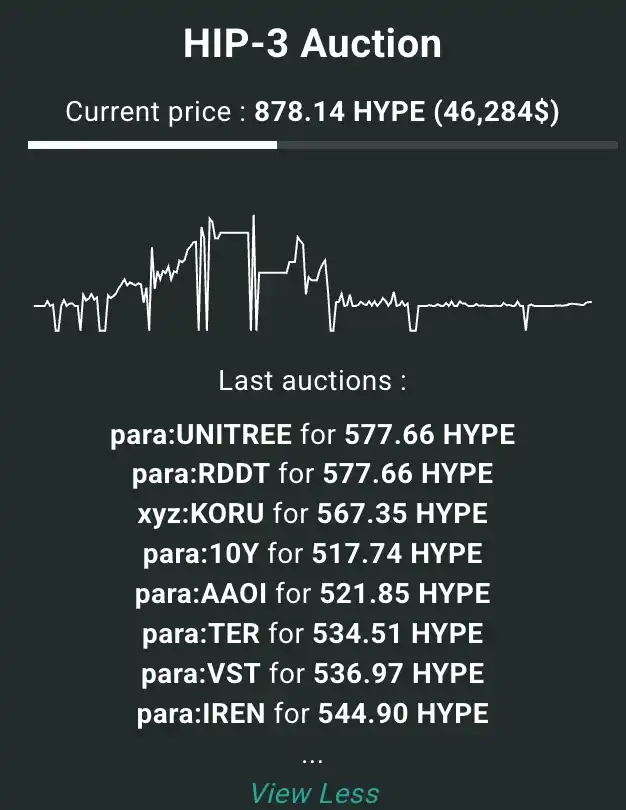
In terms of asset selection, Paragon has adopted a differentiated entry strategy. Its recently acquired tickers cover multiple segments of the AI industry chain, including fiber optics & optical modules (GLW, CRDO, AAOI, CIEN), semiconductor equipment (LRCX, TER), storage (STX), computing power & energy supporting infrastructure (IREN, VST, NET), as well as recently auctioned hot narrative targets like the humanoid robot company Unitree (UNITREE) and the social platform Reddit (RDDT).
Compared to Trade.xyz's focus on mainstream large-cap stocks, Paragon pays more attention to assets with relatively weaker liquidity in traditional markets but strong narrative appeal, which are suitable for on-chain perpetual trading. The community believes this strategy essentially secures positions in high-growth sectors at a lower cost in advance.
However, in terms of current scale, Paragon still lags significantly behind Trade.xyz. ASXN data shows Paragon's latest weekly trading volume is approximately $15.55 million, a 12.8x increase from early July, but still less than 0.01% of Trade.xyz's trading volume during the same period. During the same period, the number of weekly traders on Paragon grew from 1,260 to 12,760, while Trade.xyz reached 18.7 million traders.
Meanwhile, the participation barrier for the HIP-3 ecosystem is also lowering. Previously, HIP-3 deployers needed to stake 500,000 HYPE, a high threshold that limited entry for some projects. However, with ecosystem development, more deployers are starting to reduce entry costs through capital and resource collaboration.
For instance, Hyperion, the second-largest HYPE DAT company, provides 500,000 HYPE staking support and has partnered with Skew Technologies to launch institutional-grade perpetual futures products. By acquiring equity participation in Skew and a share of listing service revenue, Hyperion allows Skew to focus on product development and user distribution without needing to lock up a large amount of HYPE itself. Their business scope may further expand to markets related to HIP-4 in the future. Multicoin Capital invested $1.75 million in a seed round for Trasia, becoming its sole seed investor. The project also received commitments exceeding $35 million worth of HYPE and USDC.
HYPE Continues to Fall from Highs, Are Institutions Playing High-Sell, Low-Buy?
Despite the ecosystem's counter-trend expansion, the price of the HYPE token has failed to sustain its upward trajectory.
In mid-June this year, the price of HYPE once surged to near its historical high of $77 before entering a sustained correction phase. According to CoinGecko data, HYPE has fallen 26.8% over the past 30 days.
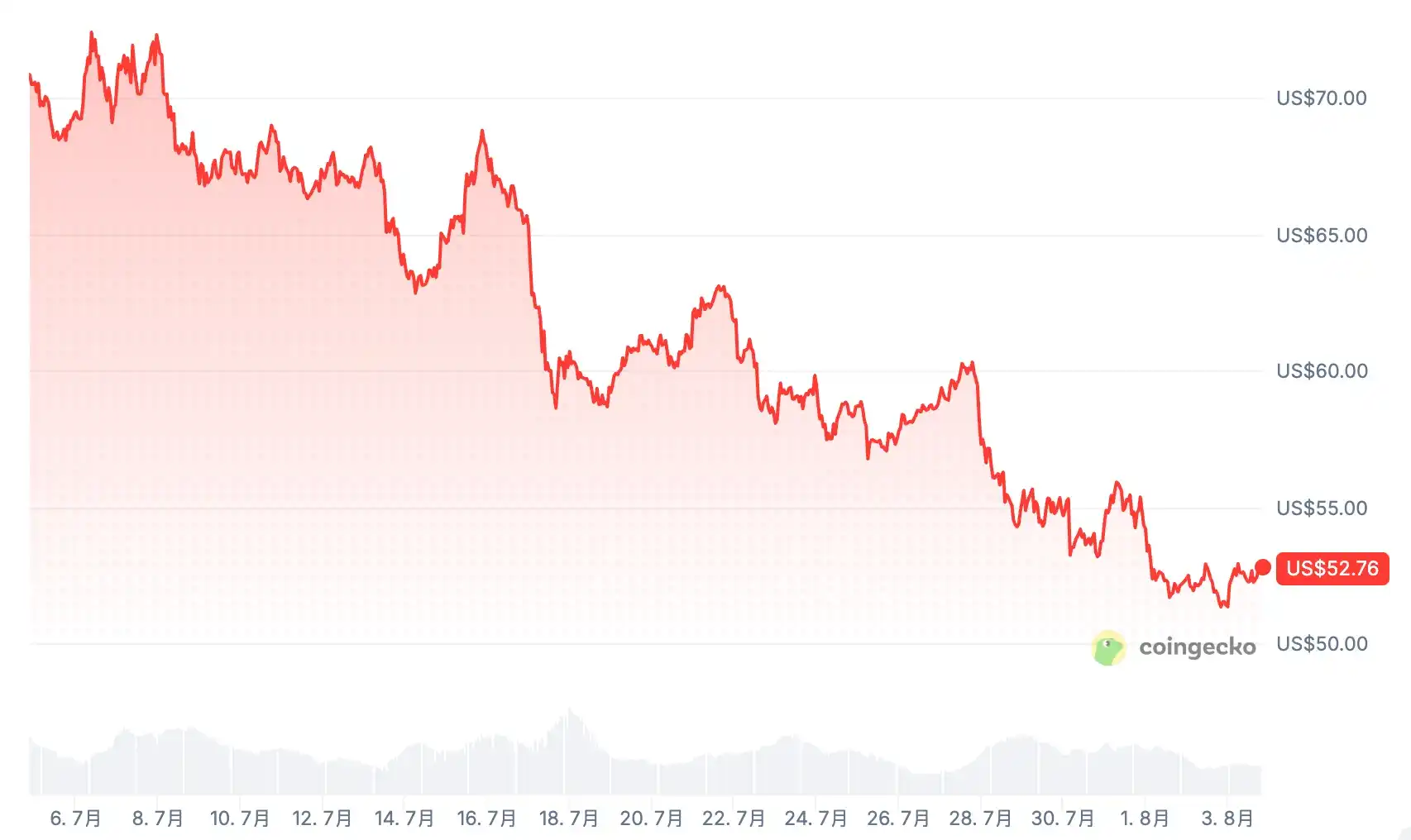
Behind this round of correction, ETF fund outflows and whale profit-taking are the main factors.
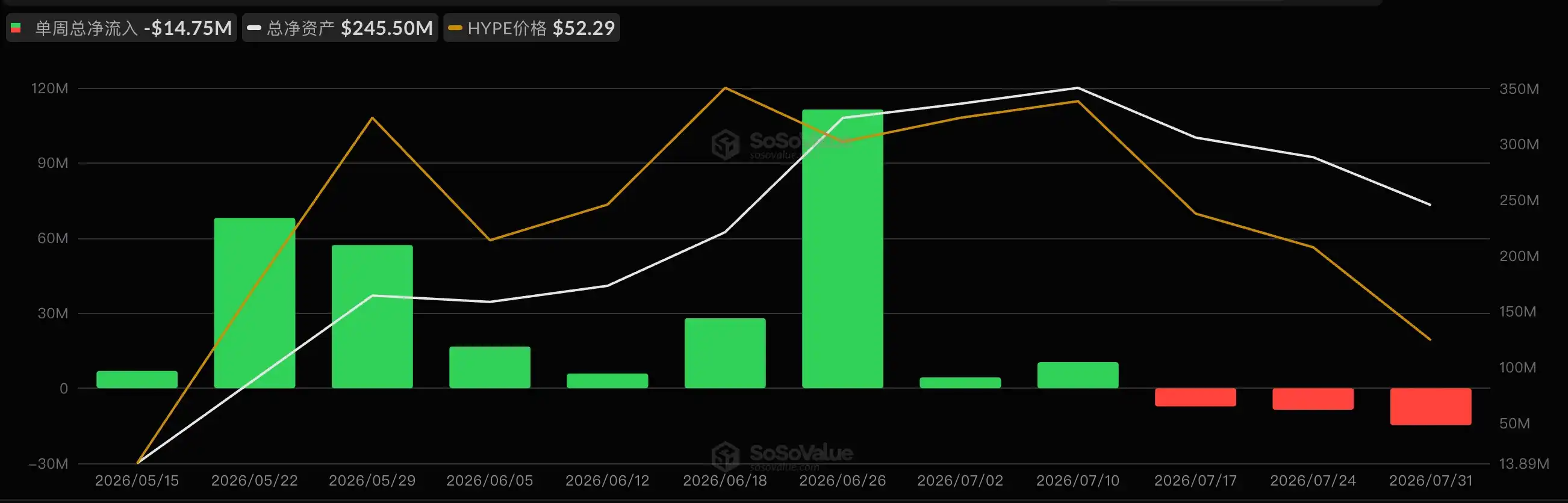
On one hand, inflows into HYPE spot ETFs have noticeably cooled. SoSoValue data shows that since late June, HYPE spot ETF inflows have gradually cooled and turned into net outflows. In the week of June 26th, weekly net inflows into HYPE spot ETFs once exceeded $110 million. Since then, inflow sizes have continuously shrunk. Entering July, ETFs saw consecutive net outflows, with cumulative net outflows for the month exceeding $15.16 million.
On the other hand, some institutional whales have recently conducted large on-chain operations. Multicoin Capital unstaked 1.96 million HYPE (worth ~$120 million) on July 22nd and transferred part of the tokens to exchanges; a Paradigm-linked wallet unstaked approximately 2.92 million HYPE (worth ~$171 million) on July 24th; an a16z-linked address also transferred about 437,000 HYPE (worth ~$28.38 million) to multiple trading platforms in mid-July. Additionally, addresses linked to Selini Capital, Bitwise, and market maker Cumberland also transferred HYPE to exchanges, with amounts ranging from several million to tens of millions of dollars.
However, these on-chain actions do not equate to selling. For example, Multicoin Capital co-founder Tushar Jain stated that unstaking was mainly for wallet rotation and privacy management needs, not for selling tokens; the founder of Selini Capital also responded that there was no dumping, and HYPE is still used in multiple business scenarios; the a16z-linked entity appeared to engage in high-sell, low-buy, repurchasing approximately $7.335 million worth of HYPE.
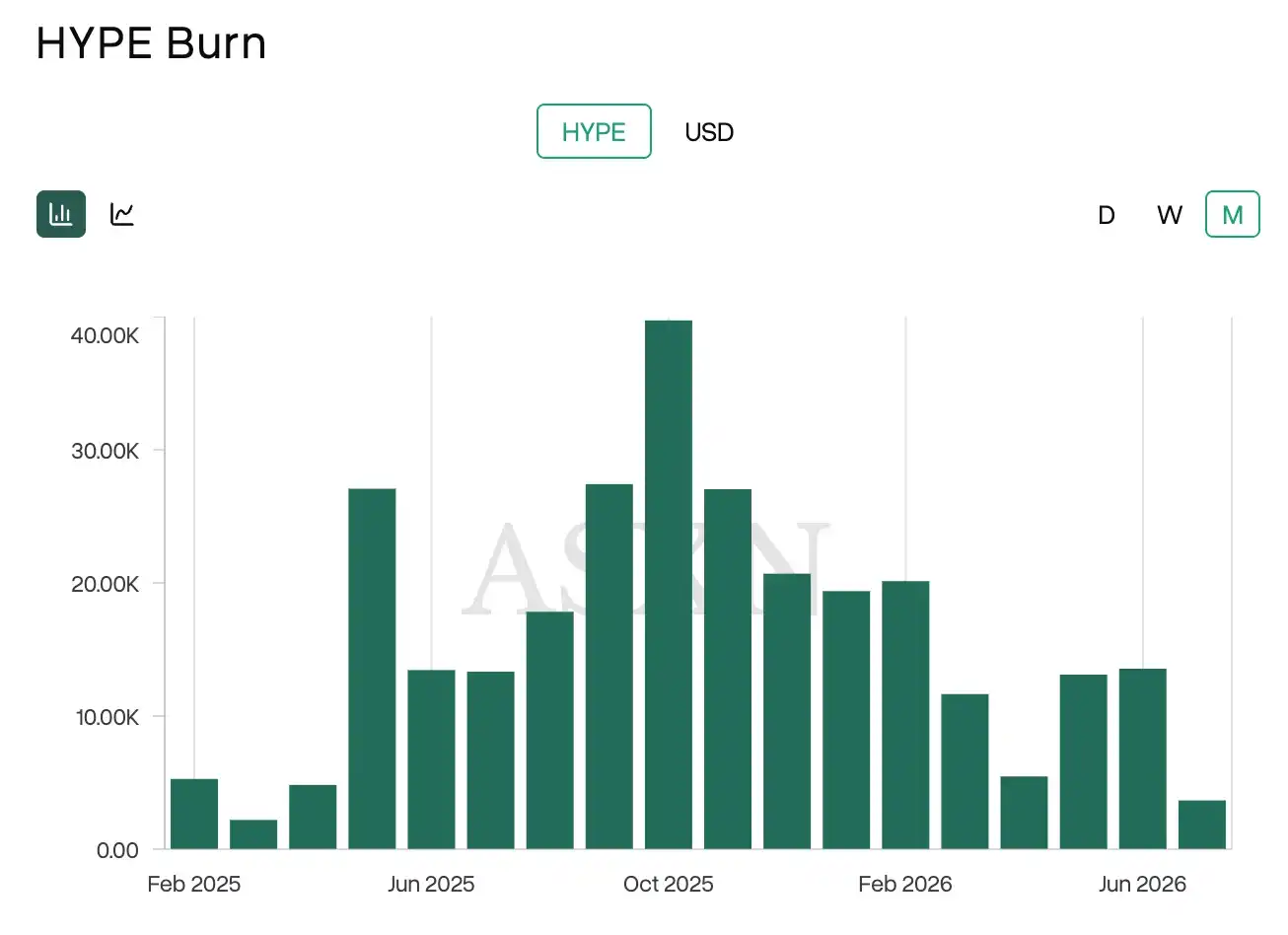
Aside from changes in fund flows, the decline in Hyperliquid's revenue has also weakened the HYPE buyback intensity, further affecting short-term market support. ASXN data shows that HYPE buybacks in July amounted to approximately $244,000, down 72.4% from $886,000 in June.
It's worth mentioning that team token unlocks have not created the large-scale selling pressure the market previously feared. According to a recent tweet by MLM, since HYPE team tokens began unlocking in December 2025, approximately 4.93 million HYPE have been allocated to team members, worth about $270 million at current prices, accounting for about 0.493% of the total supply. Of this, about 1.19 million were sold on the secondary market, cashing out about $32.5 million, and about 3.14 million were transferred to OTC platforms, valued at about $132 million at the time of transfer. In total, about 4.33 million HYPE were sold, amounting to about $165 million.
During the same period, the Assistance Fund has cumulatively repurchased about 9.8 million HYPE, investing about $364 million, averaging monthly repurchases of about 1.23 million HYPE worth $46 million. The repurchase speed is more than twice the selling speed of current and former team members.
This means the main pressure on HYPE currently is not from team unlocks, but rather from changes in market demand. Meanwhile, the Hyperliquid team seems intent on using OTC methods more to reduce the impact of unlocks on secondary market liquidity, while the Assistance Fund's continued buybacks have to some extent alleviated supply-side pressure on circulation.
In the short term, Trade.xyz, with its liquidity, user scale, and first-mover advantage, remains the absolute leader in the HIP-3 ecosystem, making it difficult for other deployers to pose a direct challenge. However, in the long term, as asset types continue to diversify, participation barriers keep lowering, and more infrastructure and capital forces enter, the HIP-3 ecosystem may experience larger-scale expansion.
For Hyperliquid, the continuous enrichment of its ecosystem and assets could not only expand trading demand but also potentially strengthen the platform's network effects, providing new growth space for HYPE's value capture.