Qualcomm Chip Price Hike Deals a Blow to Android Phones

marsbitDipublikasikan tanggal 2026-07-31Terakhir diperbarui pada 2026-07-31

Abstrak

Qualcomm has officially announced a new round of price increases for its entire chip portfolio, effective September 1. The hikes, reaching up to 18% for the flagship Snapdragon 8 Elite Gen 6 Pro, follow similar moves by MediaTek, intensifying cost pressures on the already strained smartphone industry. CEO Cristiano Amon confirmed the plan, citing the need to offset rising industry-wide costs and restore declining profit margins. Qualcomm's Q3 FY2026 results showed a 25% drop in net profit, with mobile revenue plunging 20% year-over-year, hitting its lowest level since 2021. The surge in AI computing demand has led memory manufacturers to prioritize HBM production, creating a shortage in general-purpose DRAM and NAND Flash chips. Their prices soared by 93%-98% and 55%-60% respectively in Q1 2026, causing the memory cost share in smartphones to jump from 10%-15% to over 30%. Coupled with the soaring cost of advanced nodes like TSMC's 2nm and packaging, overall chip costs have reached historic highs. These upstream pressures are forcing downstream smartphone brands like Xiaomi, OPPO, and vivo to cut orders for mid-to-low-end models by up to 20% and use cost-saving measures like older chipsets. Reportedly, the Snapdragon 8E5 will be repurposed as a "long-lasting" chip for sub-brand phones in H2 2026. Amid this cost crisis, the Android market remains sluggish. Q2 2026 smartphone shipments in China fell 4.3% year-over-year, marking five consecutive quarters of decline. Major An...

Recently, global chip giant Qualcomm officially announced a new round of price adjustments for its product line. Effective September 1st, the entire series of chip products will see double-digit percentage price increases, with the new flagship Snapdragon 8 Elite Gen 6 Pro seeing the highest increase of up to 18%.

Following MediaTek's announcement of price hikes for its Dimensity series chips in late June, Qualcomm has now followed suit. This brings a new wave of cost pressure to the already strained mobile terminal industry.

It is reported that Qualcomm issued price increase notifications to global customers on July 24th local time. The new prices will uniformly apply to all chip products shipped after September 1st, covering multiple product lines including smartphones, tablets, wearables, and automotive chips. Qualcomm CEO Cristiano Amon confirmed the adjustment plan during the earnings call, stating that the core reason for the price increase is to hedge against rising costs across the entire industry chain, repair the company's declining gross margin, and drive profitability back to historical normal levels.
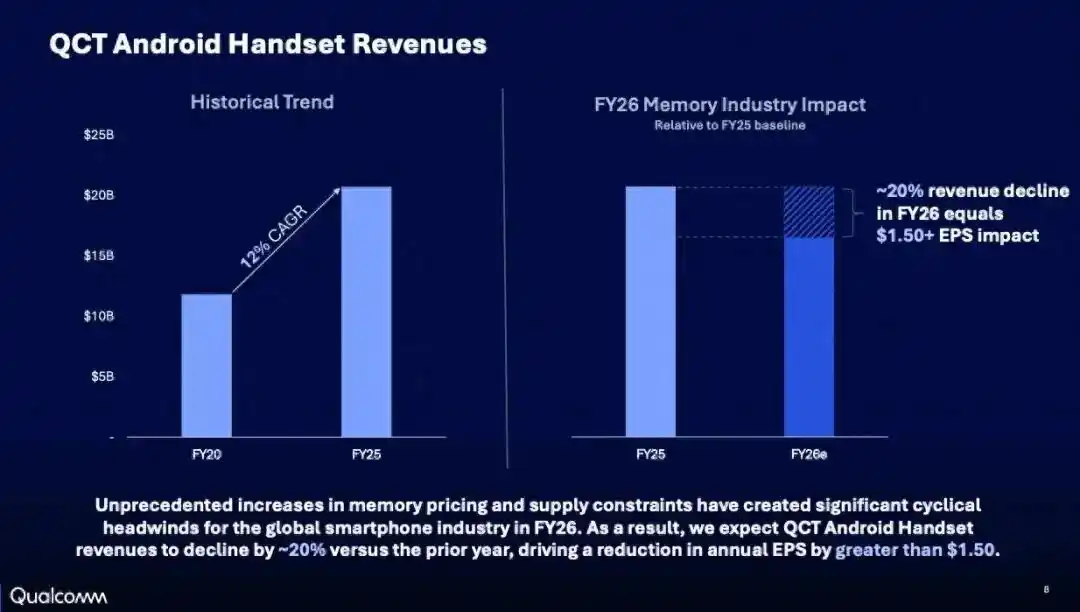
Data shows that Qualcomm's Q3 FY2026 revenue was $9.947 billion, a year-over-year increase of 4%, but net profit plummeted by 25% YoY. Revenue from the mobile handset business plunged by 20% YoY, hitting the lowest record since 2021. The main reason cited is industry-wide price increases triggered by the AI boom.

As demand for AI computing power surges, memory manufacturers like Samsung and SK Hynix have significantly increased production capacity for HBM memory, leading to an imbalance in the supply and demand for general-purpose memory chips.

According to data from TrendForce, general-purpose DRAM contract prices increased by 93%-98% quarter-over-quarter in Q1 2026, while NAND Flash contract prices rose by 55%-60% QoQ. The share of memory costs in mobile phone material costs has skyrocketed from 10%-15% to over 30%. At the same time, the wafer cost for TSMC's 2nm advanced process has exceeded $30,000, coupled with a price increase of over 20% for advanced packaging, pushing chip costs to a historical high.

The cost pressures on chip giants have ultimately been passed down to downstream smartphone manufacturers, trapping the industry in a vicious cycle.

Previously, continuous price increases for memory chips had already squeezed the profit margins of terminal manufacturers. To control costs, brands like Xiaomi, OPPO, and vivo have significantly reduced orders for mid-range and low-end models in 2026, with cuts up to 20%. Some manufacturers are also compressing costs by simplifying hardware configurations and even resorting to using older-generation chips.

Reportedly, the Snapdragon 8 Gen 5 Ultimate Edition (SD 8E5) released last September has "been forced" to become a long-lasting workhorse chip. Qualcomm is set to release a downclocked version specifically for sub-brand iterative new models in the second half of this year, offering performance not inferior to the standard SD 8E5 but at a price significantly lower than the concurrently released SD 8E6.

Under heavy cost pressure, the Android smartphone market continues to be sluggish. IDC data shows that domestic smartphone shipments in Q2 2026 fell by 4.3% year-over-year, marking five consecutive quarters of decline. The market shares of major Android brands like OPPO, vivo, Xiaomi, and Honor have all dropped significantly. In contrast, Huawei and Apple, which do not rely on external high-end SoC chips, have seen noticeable growth in market share, leveraging their advantages in self-developed chips and stable pricing.

Compared to smartphone manufacturers, Qualcomm could potentially pass on cost pressures even without raising prices.

Currently, Qualcomm is accelerating its business diversification transformation, focusing on new sectors like automotive, IoT, and data centers. Its automotive business has achieved 23 consecutive quarters of double-digit year-over-year growth, and it recently secured a ten-year chip supply agreement with BMW. However, the scale of these new businesses is still limited and cannot fully offset the gap left by the handset business.

Industry insiders predict that as the rising costs of chips and memory are fully reflected in the second half of the year, price increases for new Android flagship models may exceed market expectations. The decline in domestic smartphone market shipments in 2026 could further widen.

This article is sourced from the WeChat public account "镁客网", author: 镁客网

Kripto yang Sedang Tren

Pertanyaan Terkait

QAccording to the article, what is the main reason for Qualcomm's decision to increase the prices of its chips across the board?

AThe main reason for Qualcomm's price increase is to hedge against rising costs across the entire industry supply chain, repair the company's declining gross margin, and restore profitability to historically normal levels.

QWhich specific Qualcomm chip model is mentioned as seeing the highest price increase, and what is the percentage?

AThe new flagship chip, the Snapdragon 8 Elite Gen 6 Pro, is mentioned as having the highest price increase, reaching up to 18%.

QHow did the surge in AI computing power indirectly affect smartphone material costs, specifically regarding memory?

AThe surge in AI computing power led memory manufacturers like Samsung and SK Hynix to significantly increase production of HBM memory. This created an imbalance in supply and demand for general-purpose memory chips, causing DRAM and NAND Flash contract prices to soar. As a result, the proportion of memory costs in smartphone material costs surged from 10-15% to over 30%.

QWhat contrasting trend in market share is highlighted between brands like OPPO, vivo, and Xiaomi compared to Huawei and Apple?

AThe article highlights that mainstream Android brands like OPPO, vivo, Xiaomi, and Honor have all seen significant declines in market share. In contrast, Huawei and Apple, which do not rely on external high-end SoC chips and benefit from their in-house chip advantages and stable pricing, have shown noticeable growth in market share.

QWhat strategy did Qualcomm adopt regarding the Snapdragon 8E5 chip to help smartphone manufacturers cope with cost pressures?

ATo help smartphone manufacturers cope with cost pressures, Qualcomm is planning to release a down-clocked version of the Snapdragon 8E5 chip in the second half of the year. This version will offer performance comparable to the standard Snapdragon 8E5 but at a significantly lower price than the concurrently released Snapdragon 8E6, making it suitable for sub-brand iterative new models.

Bacaan Terkait

Berita Buruk bagi Mereka yang Mengharapkan Kejatuhan Besar Bitcoin (BTC): Analis Terkenal Memberikan Penjelasan yang Sangat Jelas!

Berita buruk bagi mereka yang mengharapkan penurunan besar Bitcoin (BTC): seorang analis ternyata menyatakan pendapatnya dengan sangat jelas! Analis kripto terkenal yang dikenal dengan nama Killa mengatakan bahwa BTC kemungkinan besar tidak akan mengalami penurunan tajam ke kisaran $36.000–$48.000 seperti yang banyak diperkirakan investor. Ia menjelaskan bahwa dalam siklus bearish sebelumnya, Bitcoin biasanya membentuk tiga titik terendah utama, dengan dua titik terakhir menjadi penentu pasar. Setelah turun ke sekitar $59.000, Bitcoin membentuk divergensi bullish kecil, namun tekanan penjual tidak cukup kuat untuk mendorong harga lebih rendah. Situasi ini menunjukkan pasar semakin menguat, bukan melemah, dan kondisi yang diperlukan untuk skenario crash besar sebagian besar telah hilang. Analis tersebut menyatakan bahwa Bitcoin kini telah memasuki fase akumulasi yang jelas, dengan level sekitar $57.000 sebagai batas bawah penting. Meskipun mungkin terjadi penurunan jangka pendek di bawah level ini sesekali, itu tidak menandai dimulainya pasar bearish baru. Berdasarkan analisis pola siklus pasar sebelumnya, harga cenderung pulih setelah mencapai titik terendah besar. Ia menambahkan, melihat tren historis, penurunan berkepanjangan dan tajam BTC ke kisaran $36.000–$48.000 tidak sesuai dengan struktur pasar saat ini. Jika Bitcoin memang akan memulai gelombang penurunan baru ke sekitar $40.000, hal itu seharusnya sudah terjadi saat ini. *Ini bukan rekomendasi investasi.

cryptonews.ru33m yang lalu

Berita Buruk bagi Mereka yang Mengharapkan Kejatuhan Besar Bitcoin (BTC): Analis Terkenal Memberikan Penjelasan yang Sangat Jelas!

cryptonews.ru33m yang lalu

Saham Jatuh Lebih Parah daripada Cryptocurrency, Kemana Perginya Uang?

Pasar saham global, khususnya Korea Selatan, mengalami penurunan tajam pada akhir Juli, dengan indeks Kospi bahkan memicu circuit breaker. Saham-saham semikonduktor seperti SK Hynix dan produk leveraged ETF terkait ambruk drastis, mencerminkan proses deleveraging paksa global yang menargetkan posisi ramai. Yang menarik, Bitcoin justru relatif stabil, tampak 'lebih tahan' daripada saham teknologi. Penurunan ini dipicu oleh laporan keuangan SK Hynix yang meski bagus tapi di bawah ekspektasi, persaingan dari China, serta tekanan dari proses unwinding carry trade Yen Jepang. Ini bukan keruntuhan logika AI, melainkan lebih karena likuidasi posisi leverage oleh pedagang ritel dan dana lindung nilai. Uang yang keluar dari pasar saham ternyata tidak mengalir ke Bitcoin. Bitcoin hanya tampak stabil karena sudah mengalami koreksi besar lebih dulu (sekitar 21% pada Mei-Juni) melalui arus keluar besar-besaran dari ETF spot AS. Uang mencari aman justru mengalir ke aset seperti emas. Narasi 'emas digital' Bitcoin terpisah: emas untuk perlindungan, Bitcoin untuk potensi pertumbuhan. Agar aliran modal besar masuk ke Bitcoin, dibutuhkan tiga kondisi: tekanan likuidasi global mereda, The Fed menurunkan suku bunga tanpa resesi, dan regulasi crypto (seperti CLARITY Act) yang jelas disahkan. Bitcoin saat ini bukan safe haven, melainkan aset yang sudah mengalami koreksi lebih awal. Namun, korelasi yang rendah dengan Nasdaq pasca tekanan ini justru bisa menarik minat institusi di masa depan sebagai diversifikasi portofolio saat kondisi membaik.

marsbit1j yang lalu

Saham Jatuh Lebih Parah daripada Cryptocurrency, Kemana Perginya Uang?

marsbit1j yang lalu

Trading

Spot

Artikel Populer

Cara Membeli CHIP

Selamat datang di HTX.com! Kami telah membuat pembelian USD.AI (CHIP) menjadi mudah dan nyaman. Ikuti panduan langkah demi langkah kami untuk memulai perjalanan kripto Anda.Langkah 1: Buat Akun HTX AndaGunakan alamat email atau nomor ponsel Anda untuk mendaftar akun gratis di HTX. Rasakan perjalanan pendaftaran yang mudah dan buka semua fitur.Dapatkan Akun SayaLangkah 2: Buka Beli Kripto, lalu Pilih Metode Pembayaran AndaKartu Kredit/Debit: Gunakan Visa atau Mastercard Anda untuk membeli USD.AI (CHIP) secara instan.Saldo: Gunakan dana dari saldo akun HTX Anda untuk melakukan trading dengan lancar.Pihak Ketiga: Kami telah menambahkan metode pembayaran populer seperti Google Pay dan Apple Pay untuk meningkatkan kenyamanan.P2P: Lakukan trading langsung dengan pengguna lain di HTX.Over-the-Counter (OTC): Kami menawarkan layanan yang dibuat khusus dan kurs yang kompetitif bagi para trader.Langkah 3: Simpan USD.AI (CHIP) AndaSetelah melakukan pembelian, simpan USD.AI (CHIP) di akun HTX Anda. Selain itu, Anda dapat mengirimkannya ke tempat lain melalui transfer blockchain atau menggunakannya untuk memperdagangkan mata uang kripto lainnya.Langkah 4: Lakukan trading USD.AI (CHIP)Lakukan trading USD.AI (CHIP) dengan mudah di pasar spot HTX. Cukup akses akun Anda, pilih pasangan perdagangan, jalankan trading, lalu pantau secara real-time. Kami menawarkan pengalaman yang ramah pengguna baik untuk pemula maupun trader berpengalaman.

633 Total TayanganDipublikasikan pada 2026.04.21Diperbarui pada 2026.06.02

Cara Membeli CHIP

Diskusi

Selamat datang di Komunitas HTX. Di sini, Anda bisa terus mendapatkan informasi terbaru tentang perkembangan platform terkini dan mendapatkan akses ke wawasan pasar profesional. Pendapat pengguna mengenai harga CHIP (CHIP) disajikan di bawah ini.

活动图片