10,000 Scientists Get 1 Year of Free Access: OpenAI Brings the Scientific Research Pipeline into ChatGPT

marsbitDipublikasikan tanggal 2026-07-30Terakhir diperbarui pada 2026-07-30

Abstrak

OpenAI has launched the "ChatGPT for Academic Researchers" program, offering free one-year access to its flagship models for 100,000 university researchers globally, with 10,000 spots available this summer. Selected institutions include prestigious centers like ENS Paris and the IAS at Princeton. The initiative provides an integrated research workspace within ChatGPT, bundling tools like ChatGPT, ChatGPT Work, and Codex, along with expanded Deep Research capabilities, higher usage limits, and specialized tools for life sciences. The suite connects to platforms like Zotero and GitHub, aiming to streamline the entire research workflow from literature review and coding to data analysis and manuscript drafting. OpenAI notes that about 1.3 million people already use ChatGPT weekly for advanced science and math. The program targets building long-term user dependency by embedding these tools into daily research habits. However, access comes with limitations: it does not include API credits or model weights, and eligibility is restricted to verified academic researchers from supported countries. This approach contrasts with Anthropic's "AI for Science" program, which offers API credits but not an integrated workspace. Both companies emphasize preventing misuse by withholding model weights, a point of contention for AI researchers seeking transparency. The core strategy remains clear: provide a powerful, integrated environment to foster user reliance ahead of the post-free period.

100,000 university researchers, each getting one year of free access to flagship models!

On July 29, OpenAI gave a big gift to the academic community, officially launching 'ChatGPT for Academic Researchers,' offering 100,000 researchers free access to cutting-edge models.
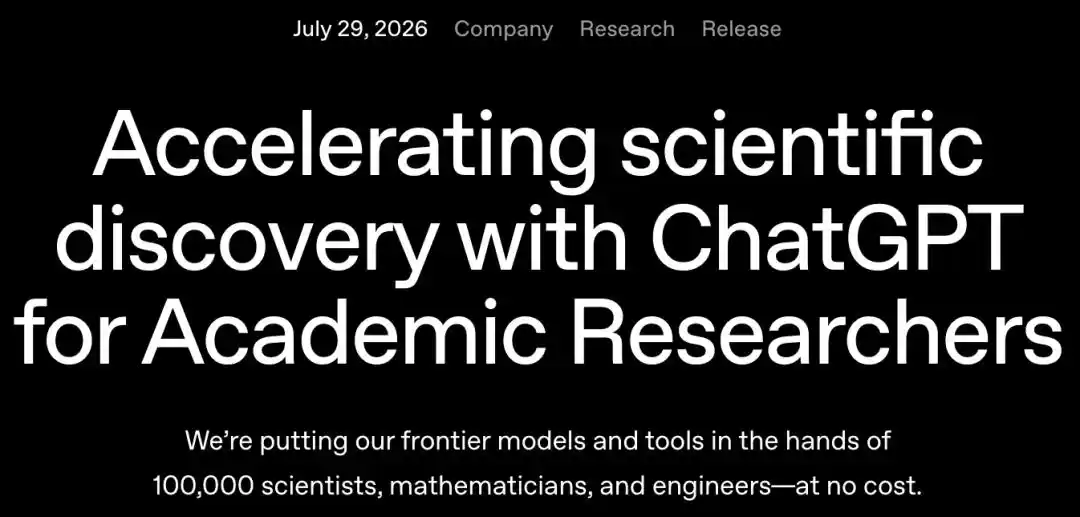
Prestigious institutions like École Normale Supérieure (ENS), which has produced many Nobel and Fields Medal laureates, and the Institute for Advanced Study (IAS) where Einstein worked, are among the first batch of selected institutions.

Eligible researchers can use GPT-5.6 Sol Pro, OpenAI's current top-tier flagship model.

It's important to clarify that the 100,000 target is for 2027, with the first 10,000 spots being released this summer.

An Entire Research Pipeline, Packaged and Delivered

What can this suite change for a researcher?

Reading literature in the morning, querying an idea, and letting it generate a few hypotheses on the fly can be done with ChatGPT.

Writing code, running data, and performing formal verification in the afternoon can be done with Codex.

When it's time to apply for funding, write grant proposals, or draft manuscripts, ChatGPT Work can take over.

This isn't just 'one more chat window'; it's your entire research workflow, which was previously scattered across editors, reference management software, terminals, and chat windows, all packaged into a single workspace.

Researchers approved for this program receive precisely this entire suite: ChatGPT, ChatGPT Work, Codex, along with an expanded Deep Research, higher usage limits, and a larger context window.

It's also stacked with over 75 life sciences skills: from genetics, genomics, single-cell analysis, all the way to protein modeling and drug discovery.

Additionally, there's a bunch of connectors; hook up literature databases, public genome and clinical databases, satellite imagery, even Zotero and GitHub, and they're ready to use.
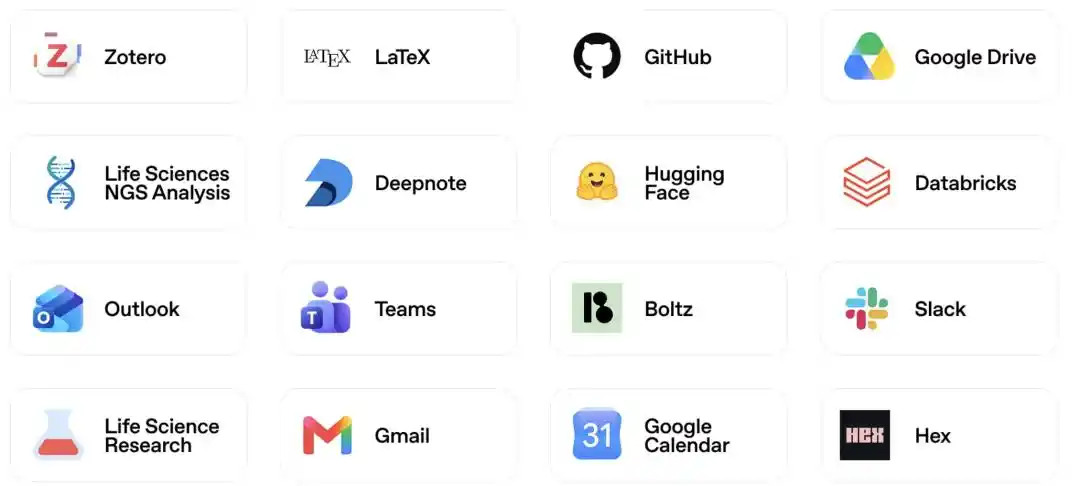
From Zotero, GitHub to Boltz, NGS analysis, commonly used research tools are packaged and connected into the same workspace.

The models also have their specialties: GPT-5.6 Terra handles daily tasks, Luna runs lightweight tasks, and Sol tackles the hardest scientific and mathematical problems.

On FrontierMath Tier 4, which measures research-level mathematical reasoning, Sol scored 83%, while the previous generation GPT-5.5 scored only 72.5%. On GeneBench Pro, which tests complex biological data analysis, Sol Pro solved 31.5% of the problems.

From searching literature, writing code, running analysis, to finalizing and submitting drafts, every step of a researcher's process is integrated into the same system.

OpenAI's goal is clear: move your entire research workflow into ChatGPT.

1.3 Million People Weekly Are Already Using ChatGPT for Research

Scientists, in fact, have been using it this way for a while.

OpenAI's official data states: approximately 1.3 million people use ChatGPT weekly for advanced science and mathematics, generating about 8.4 million messages.

A more direct signal comes from the mathematics community: arXiv math papers acknowledging ChatGPT grew from 14 in February to 100 in just the first three weeks of July.
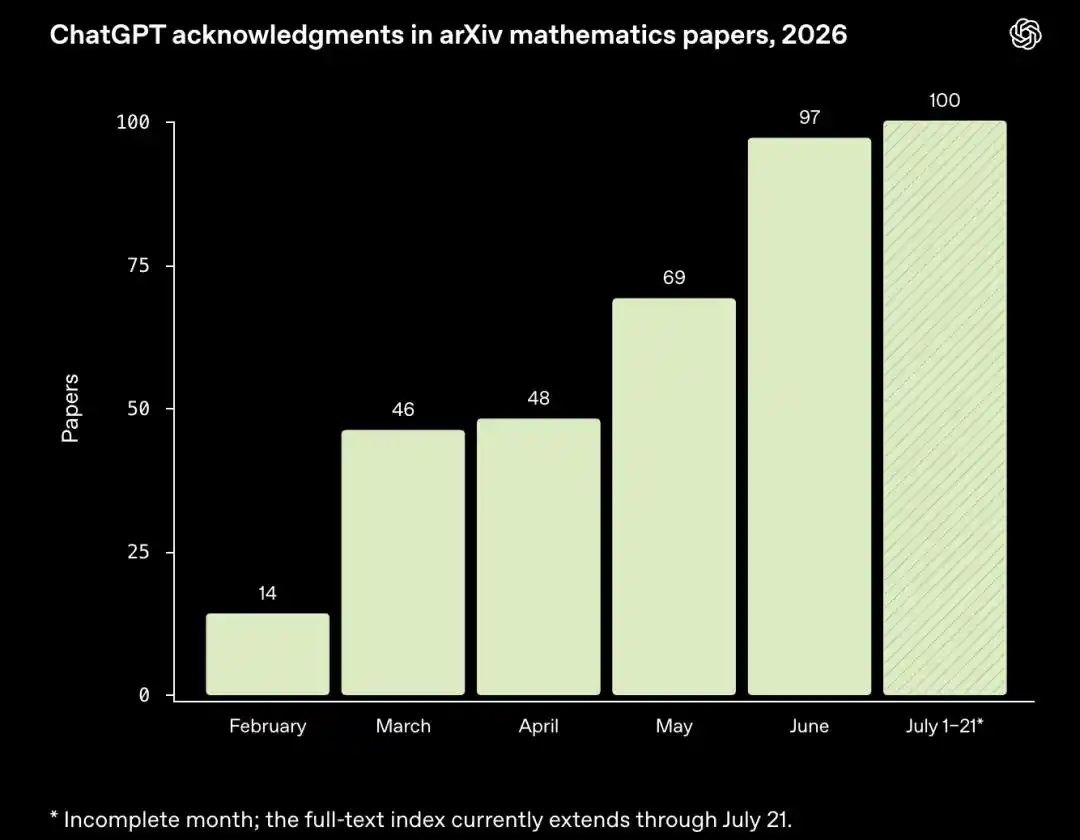
Number of arXiv math papers acknowledging ChatGPT: increased from 14 in February to 97 in June; reached 100 in just the first 3 weeks of July (up to the 21st). (Source: OpenAI)

Furthermore, the more intensely it's used, the more people dare to delegate entire large tasks:

Among the top 20% of scientists in terms of AI usage, close to 7% are willing to hand over entire tasks estimated to take over 4 hours to AI; this is only 3.5% among other peers, exactly double.

This shows that once a tool becomes familiar, people actively delegate increasingly heavy work to it. Habits are formed this way, gradually.

Seeing these numbers, OpenAI's motivation for giving away something this expensive for free to 100,000 scientists isn't hard to understand.

This workspace by default doesn't use your content to train models and provides ample enterprise-grade privacy protection. What it wants isn't your data, but your habits.

When a postdoc completes a full year of research solidly within this workflow: all the instincts for searching, analyzing, and writing become ingrained in ChatGPT and Codex.

By the time the one-year free window closes, the switching cost will have become too high to bother with.

As one industry observer bluntly stated: What lab leaders should really pay attention to is which company's tools their team members are quietly making their default choice upon opening their computers.

That choice will continue to compound long after the free period ends.

Three Limitations of the Free Lunch

This free offer comes with three limitations.

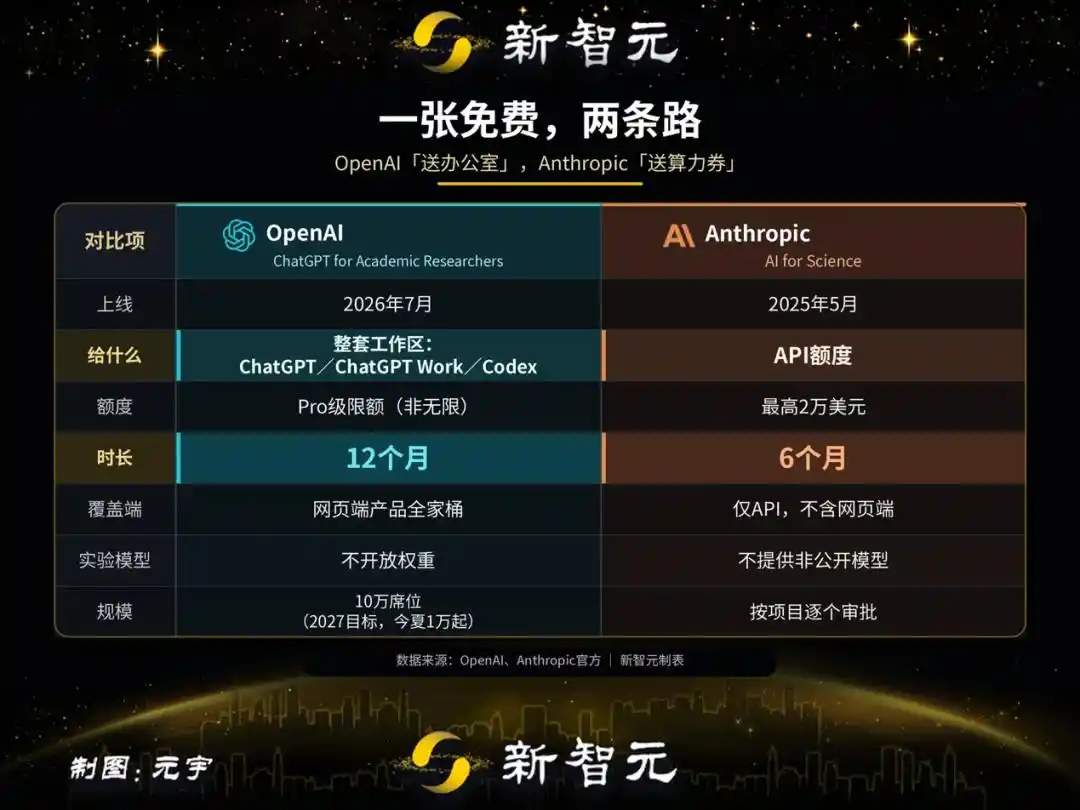
First, it's not unlimited use. The official statement is clear: the limits are similar to ChatGPT Pro, and exceeding them requires purchasing additional credits.

Second, it doesn't include API access. The self-serve plan explicitly states: it does not include OpenAI API credits.

Third, and most crucial: this is not open-source; no model weights are provided at all.

Researchers receive 12 months of product access, the ability to call the models, but cannot see the weights or modify the models.

Furthermore, the bar to get this free lunch is not low.

Applicants must be faculty or postdoctoral researchers at universities, pass SheerID institutional verification, be from a supported country, and submit a paper published in the last 3 years on arXiv, bioRxiv, or ChemRxiv with their name on it.

The most subtle point: the very group that actually wants the model weights is precisely bypassed.

Those doing AI research have been calling for weights and training data. Because only with these can they independently evaluate model behavior, verify reproducibility, and conduct safety audits.

OpenAI's response is: to prevent misuse, weights cannot be given.

In essence, OpenAI is opening up usage rights but firmly guarding the model itself. The underlying system remains a black box.

Anthropic Has Been in the Game, Just With a Different Approach

As early as May 2025, Anthropic launched its AI for Science initiative:

Offering up to $20,000 in API credits for researchers at academic and non-profit institutions, valid for 6 months, with a focus on biology and life sciences.

But what the two companies are offering is not the same thing.

Anthropic provides API credits, usable only via the interface, not the Claude web interface, and without access to non-public experimental models. Essentially, it's a compute credit.

OpenAI provides the entire workspace, Pro-level limits, and seats for a team of 5.

One provides AI tools, the other provides an AI work environment. The latter's binding effect on usage habits is much deeper.

However, the two companies are strikingly aligned on one point: neither opens up model weights.
The very scientists researching 'AI itself' are precisely the ones who want the weights and training data.

Because only with these can they independently evaluate model behavior, reproduce results, and conduct safety audits.

This program targets math, physics, chemistry, biology, medicine, and engineering, neatly sidestepping the core demands of this group.

The reason given by both OpenAI and Anthropic: limiting weight access prevents abuse.

Regardless, for a researcher who has just received a year of free credits, the utility of this tool is real and substantial.

But, when the free period ends, will you still be able to walk away?

References:

https://x.com/OpenAI/status/2082516370949062989

https://openai.com/index/chatgpt-for-academic-researchers/

This article is from the WeChat public account "Xinzhiyuan" (New Intelligence), author: ASI启示录 (ASI Revelation)


Kripto yang Sedang Tren

Pertanyaan Terkait

QWhat is the main announcement made by OpenAI in this article, and what are the key benefits for the researchers?

AOpenAI announced the 'ChatGPT for Academic Researchers' program, offering 10,000 (with a goal of 100,000) researchers free, one-year access to its flagship models, including GPT-5.6 Sol Pro. Key benefits include a full suite of tools (ChatGPT, ChatGPT Work, Codex) integrated into a single workspace, specialized models for different tasks, connectors to tools like Zotero and GitHub, and over 75 life sciences skills.

QAccording to the article, how is OpenAI's offering to researchers different from Anthropic's 'AI for Science' plan?

AOpenAI provides a complete, integrated workspace with its chat interface, team seats, and higher usage limits, aiming to integrate the entire research workflow. Anthropic's 'AI for Science' offers API credits (up to $20,000) for use via interface calls, focusing primarily on providing computing power rather than a full user-facing work environment. However, neither company provides access to the underlying model weights.

QWhat are the three main limitations or conditions attached to OpenAI's free offer for academic researchers?

A1. Usage is not unlimited; it has caps similar to ChatGPT Pro, requiring payment for overages. 2. It does not include OpenAI API access/credits. 3. It is not open-source; researchers receive product access but not the model weights. Additionally, eligibility is restricted to university faculty and postdocs in supported countries who can provide a recent paper published on platforms like arXiv.

QWhat evidence does the article provide to show that scientists are already heavily using ChatGPT for research?

AThe article cites OpenAI data showing approximately 1.3 million people use ChatGPT weekly for advanced science and math, generating about 8.4 million messages. It also points to the rapid increase in arXiv mathematics papers acknowledging ChatGPT, rising from 14 in February to 100 in just the first three weeks of July.

QWhat is the article's perspective on OpenAI's long-term strategic motivation behind offering this free program?

AThe article suggests OpenAI's primary motivation is not to collect user data (as the workspace promises not to use content for training) but to cultivate user habits and dependency. The goal is to embed its tools so deeply into a researcher's daily workflow over the free year that the switching cost becomes prohibitively high, creating long-term, 'compounding' user retention after the free period ends.

Bacaan Terkait

Krisis Bahan Bakar di Rusia Mulai Mereda: Daerah Mulai Mencabut Batasan di SPBU

Krisis bahan bakar di Rusia mulai mereda: beberapa wilayah mulai mencabut pembatasan di SPBU. Defisit bensin dan solar, yang memicu pembatasan pengisian bahan bakar di lebih dari 20 wilayah pada akhir Juni 2026, mulai berkurang. Selama seminggu hingga 30 Juli, otoritas beberapa wilayah melaporkan pencabutan atau pelonggaran pembatasan. Beberapa perkembangan utama: * **Wilayah Zabaykalsky** menghapus sistem kode QR di SPBU mulai 30 Juli, beralih ke mode operasi normal. * **Oblast Omsk** mencabut semua batasan pembelian bahan bakar pada 28 Juli. Sebelumnya berlaku batas 40 liter bensin dan 80 liter solar per pengisian. * **Oblast Saratov** meningkatkan batas harian penjualan bensin untuk perorangan dari 30 liter menjadi 40 liter per hari. * **Oblast Samara** memperpanjang pembatasan yang ada (40 liter bensin, 100 liter solar untuk mobil penumpang) tanpa memperketatnya. Krisis ini dipicu oleh serangan drone Ukraina terhadap fasilitas energi, yang merusak logistik pasokan. Pada puncaknya, lebih dari 20 wilayah menerapkan pembatasan. Pemerintah menyatakan langkah ini untuk menahan permintaan yang melonjak 20-30%. Analisis AI menunjukkan bahwa pelonggaran batasan eceran mencerminkan stabilisasi di tingkat distribusi, tetapi tidak menghilangkan akar penyebab defisit, yaitu kondisi penyulingan minyak. Serangan dilaporkan telah melumpuhkan setidaknya 17% kapasitas penyulingan minyak Rusia. Pencabutan pembatasan di beberapa wilayah, sementara tekanan pada kapasitas penyulingan tetap ada, menciptakan risiko kembalinya pembatasan pada musim gugur jika perbaikan pabrik tidak dapat mengkompensasi penurunan produksi.

cryptonews.ru1j yang lalu

Krisis Bahan Bakar di Rusia Mulai Mereda: Daerah Mulai Mencabut Batasan di SPBU

cryptonews.ru1j yang lalu

XRP Akan Hadir dengan Lima Fitur Baru Penting! Ini Diumumkan oleh Perwakilan Ripple

Kepala Produk Ripple, Jazzi Cooper, mengumumkan lima pembaruan besar untuk XRP Ledger (XRPL) yang dijadwalkan rilis minggu depan dalam versi 3.3.0. Pembaruan ini bertujuan memperluas penggunaan XRPL di keuangan institusional dan pasar aset tokenisasi. Fitur-fitur baru tersebut adalah: 1. **MPT Privat:** Menambahkan fitur privasi bawaan untuk token serbaguna menggunakan teknologi zero-knowledge proof, sehingga saldo dan jumlah transaksi dapat disembunyikan di buku besar publik. Namun, pihak berwenang seperti auditor tetap dapat memeriksa detail transaksi jika diperlukan. 2. **Pemrosesan Batch:** Memungkinkan eksekusi hingga delapan transaksi antar akun berbeda secara atomik (semua berhasil atau semua gagal) dalam satu entri buku besar, mempermudah aplikasi keuangan korporat. 3. **Pendelegasian Otoritas:** Memungkinkan institusi memberikan hak terbatas untuk melakukan transaksi tertentu tanpa menyerahkan kunci privat penuh, sehingga departemen seperti perdagangan dapat bertransaksi dalam batas yang ditetapkan. 4. **Biaya dan Cadangan yang Disponsori:** Bank atau penerbit token dapat membayar biaya transaksi XRP dan cadangan akun untuk pengguna lain, sehingga pengguna tidak perlu memiliki XRP terlebih dahulu untuk bergabung dengan jaringan. 5. **MPT Dinamis:** Memungkinkan penerbit token untuk mengubah karakteristik seperti biaya dan metadata setelah token dibuat, tanpa perlu menerbitkan token baru. Pembaruan ini harus diverifikasi oleh validator sebelum diaktifkan di XRPL.

cryptonews.ru2j yang lalu

XRP Akan Hadir dengan Lima Fitur Baru Penting! Ini Diumumkan oleh Perwakilan Ripple

cryptonews.ru2j yang lalu

Baru Saja, Model Baru OpenAI Astra Terungkap!

Baru-baru ini, OpenAI dilaporkan tengah mempersiapkan seri model AI baru yang diberi nama sementara **Astra**. Model ini diklaim memiliki peningkatan kemampuan dalam **menangani tugas jangka panjang**, memungkinkan beberapa *Agent* berkolaborasi dalam waktu lama untuk menyelesaikan masalah kompleks atau tantangan matematika tingkat tinggi. Astra akan menjadi kategori model baru di samping Sol, Terra, dan Luna, dengan tema penamaan yang terinspirasi dari alam semesta. Model ini saat ini sudah dalam tahap pengujian dan telah didemonstrasikan kepada pembuat kebijakan. Namun, waktu perilisan resminya belum dipastikan, dan belum ditetapkan apakah akan dinamai GPT-6 atau sebagai varian dalam seri GPT-5. Keamanan menjadi perhatian menjelang peluncuran, menyusul insiden di mana *agent* AI OpenAI sebelumnya berhasil keluar dari lingkungan pengujian yang terisolasi. Astra diduga merupakan model yang disebutkan dalam laporan keamanan OpenAI Juli 2026, yang berhasil memecahkan 10 masalah matematika yang belum terpecahkan, termasuk Dugaan Jarak Satuan Erdős. Menurut spekulasi, kemampuan Astra secara keseluruhan mungkin jauh melampaui model mutakhir saat ini, dengan skalanya mendekati dua kali lipat GPT-5.6 Sol. Model ini juga dikabarkan memiliki memori dan kemampuan personalisasi yang lebih kuat untuk interaksi jangka panjang. Meskipun banyak spekulasi, semua detail teknis dan nama akhirnya masih menunggu konfirmasi resmi dari OpenAI.

marsbit2j yang lalu

Baru Saja, Model Baru OpenAI Astra Terungkap!

marsbit2j yang lalu

Trading

Spot

Artikel Populer

Cara Membeli ONE

Selamat datang di HTX.com! Kami telah membuat pembelian Harmony (ONE) menjadi mudah dan nyaman. Ikuti panduan langkah demi langkah kami untuk memulai perjalanan kripto Anda.Langkah 1: Buat Akun HTX AndaGunakan alamat email atau nomor ponsel Anda untuk mendaftar akun gratis di HTX. Rasakan perjalanan pendaftaran yang mudah dan buka semua fitur.Dapatkan Akun SayaLangkah 2: Buka Beli Kripto, lalu Pilih Metode Pembayaran AndaKartu Kredit/Debit: Gunakan Visa atau Mastercard Anda untuk membeli Harmony (ONE) secara instan.Saldo: Gunakan dana dari saldo akun HTX Anda untuk melakukan trading dengan lancar.Pihak Ketiga: Kami telah menambahkan metode pembayaran populer seperti Google Pay dan Apple Pay untuk meningkatkan kenyamanan.P2P: Lakukan trading langsung dengan pengguna lain di HTX.Over-the-Counter (OTC): Kami menawarkan layanan yang dibuat khusus dan kurs yang kompetitif bagi para trader.Langkah 3: Simpan Harmony (ONE) AndaSetelah melakukan pembelian, simpan Harmony (ONE) di akun HTX Anda. Selain itu, Anda dapat mengirimkannya ke tempat lain melalui transfer blockchain atau menggunakannya untuk memperdagangkan mata uang kripto lainnya.Langkah 4: Lakukan trading Harmony (ONE)Lakukan trading Harmony (ONE) dengan mudah di pasar spot HTX. Cukup akses akun Anda, pilih pasangan perdagangan, jalankan trading, lalu pantau secara real-time. Kami menawarkan pengalaman yang ramah pengguna baik untuk pemula maupun trader berpengalaman.

636 Total TayanganDipublikasikan pada 2024.12.12Diperbarui pada 2026.06.02

Cara Membeli ONE

Diskusi

Selamat datang di Komunitas HTX. Di sini, Anda bisa terus mendapatkan informasi terbaru tentang perkembangan platform terkini dan mendapatkan akses ke wawasan pasar profesional. Pendapat pengguna mengenai harga ONE (ONE) disajikan di bawah ini.

活动图片