Pennsylvania Bill Could Bar Sportsbooks from Participating in Prediction Market-Making

cryptonews.ruDipublikasikan tanggal 2026-07-28Terakhir diperbarui pada 2026-07-28

Abstrak

A bipartisan group of lawmakers in Pennsylvania introduced House Bill 2711, which could prohibit gambling companies, including sportsbooks, from serving as liquidity providers or market makers on prediction market platforms. The bill aims to separate prediction market infrastructure from gambling entities. It would ban platforms from contracting or sharing revenue with companies engaged in gambling and imposes consumer protections, including age restrictions and bans on markets related to minors, health, and death. Unlike proposals in other states, it seeks to regulate rather than ban prediction markets, focusing on restricting liquidity sources. The bill contrasts with another Pennsylvania proposal (HB 2497) that would license and tax such platforms. This legislative push occurs amid a national debate over whether prediction contracts are gambling or financial derivatives, following a recent federal court ruling that federal commodity law preempts state gambling laws for CFTC-registered exchanges.

A group of bipartisan Pennsylvania legislators has introduced a bill that could prohibit sportsbooks and other gambling companies from serving as liquidity providers or market makers on prediction platforms. House Bill 2711 was introduced on July 22 by Representative Tarik Khan and referred to the House Consumer Protection, Technology and Utilities Committee. It has a total of 24 co-sponsors—20 Democrats and four Republicans.

The bill would ban a provider from offering a prediction market in Pennsylvania if its liquidity provider or market maker knowingly engages in gambling activities in the course of regular business, both within and outside the state. The restriction applies to parent companies, subsidiaries, affiliates, joint ventures, employees, and legal entities operating for the financial interest of another company.

Prediction platforms would also be barred from entering into contracts or sharing revenue with companies ordinarily engaged in gambling. A new chapter in the bill dedicated to prediction markets does not define the term “gambling activity” nor clarify how these provisions would apply to platforms affiliated with sports betting operators, leaving uncertainty about how broadly courts or regulators would apply this restriction.

This provision emerges as traditional sports betting groups move beyond consumer-facing prediction apps to the infrastructure underpinning their contracts. Companies like DraftKings and Flutter engage in market-making activities, and DraftKings recently launched its own DKeX exchange after acquiring CFTC-registered firm Railbird Technologies.

If HB 2711 is passed and applied broadly, it could prevent sportsbook-controlled market makers from supporting contracts offered to Pennsylvania residents. It could also complicate partnerships where a prediction exchange shares revenue with a casino, sportsbook, or gambling-affiliated company. Furthermore, unlike proposals in several other states, this bill treats prediction markets as an activity to be regulated, not banned. Thus, the focus of the restrictions imposed on gambling operators is limiting liquidity, not an outright prohibition.

The bill sets a minimum age of 21 and requires platforms to exclude self-excluded users, company employees, employees of settling organizations, and individuals with insider information. Providers would need to implement commercially reasonable safeguards against fraud, manipulation, and misuse of material nonpublic information. Additionally, the bill prohibits markets related to scholastic sports, sporting events involving minors, individual health conditions, and so-called “death markets”—contracts tied to a person’s death, attempted murder, assassination, or mass casualty events. Athletes, coaches, officials, candidates, campaign staff, and others capable of influencing an event’s outcome could be held liable for trading related contracts.

Since this proposal does not establish a licensing regime, enforcement functions are assigned to the Attorney General, who would gain powers to investigate, impose fines, and shut down platforms operating in violation. This distinguishes it from House Bill 2497, introduced on May 8 by Representative Danilo Burgos and co-sponsored by Khan, which is before the House Gaming Oversight Committee. The earlier bill proposed licensing by the Pennsylvania Gaming Control Board, with fees of $1 million for an initial permit and $1 million annually, a tax of 20% on prediction betting gross revenue plus a 2% local assessment, and fines for unlicensed operators of up to $25,000.

A combined 22% rate would be significantly lower than what Pennsylvania already charges its licensed operators, who pay 36% on sports betting revenue and 54% on online slots revenue—among the highest rates in the nation. Burgos framed his bill around what he calls “regulatory arbitrage,” arguing that platforms claiming to offer financial derivatives rather than gambling products circumvent safeguards established for casinos and sportsbooks.

These two measures did not emerge as competing initiatives but developed in parallel: in March, Burgos circulated a memo on licensing and taxation, and in late April, Khan filed his insider trading bill. Khan is a co-sponsor of both bills, and in contemporary publications they are described as complementary measures: HB 2497 treats sports event contracts as bets regulated by the state, while HB 2711 supplements them with conduct and consumer protection rules.

Pennsylvania’s gambling regulator has taken a more confrontational stance. In May, the PGCB informed the Commodity Futures Trading Commission (CFTC) that sports event contracts constitute illegal wagers under state law and accused federally regulated exchanges of operating as unlicensed sportsbooks accessible to individuals under 21. Pennsylvania also joined a coalition of 40 states arguing that sports event contracts should fall under state gambling oversight.

On April 6, the Third Circuit Court of Appeals in KalshiEX LLC v. Flaherty ruled 2–1 that the Commodity Exchange Act preempts state gambling laws concerning sports event contracts on CFTC-registered exchanges and upheld an injunction preventing New Jersey from taking enforcement action against Kalshi. This precedent is binding on federal courts in Pennsylvania. In her dissent, Judge Jane Roth argued that Kalshi’s contracts are “virtually indistinguishable” from products offered by DraftKings and FanDuel—the very intersection targeted by HB 2711’s liquidity provisions, but from the opposite side.

Neither Pennsylvania bill has received a committee vote or hearing. Nevertheless, HB 2711 introduces a new fault line in the nationwide struggle: states may not only challenge whether prediction markets can function but also attempt to separate their trading infrastructure from the gambling companies increasingly seeking to control it.

end-content

Kripto yang Sedang Tren

Pertanyaan Terkait

QWhat is the main objective of Pennsylvania House Bill No 2711?

AThe bill aims to prohibit sportsbooks and other gambling companies from serving as liquidity providers or market makers on prediction markets platforms in Pennsylvania.

QHow might HB 2711 affect companies like DraftKings if passed broadly?

AIt could prevent their affiliated market makers from supporting contracts offered to Pennsylvania residents and complicate revenue-sharing partnerships between prediction exchanges and gambling entities.

QHow does HB 2711 differ from the earlier Pennsylvania bill HB 2497 in its regulatory approach?

AHB 2711 focuses on consumer protection rules and conduct, granting enforcement power to the Attorney General without a licensing regime, while HB 2497 proposes a state licensing and taxation system for prediction markets as gambling activities.

QWhat significant legal precedent is mentioned that could impact Pennsylvania's ability to regulate prediction markets?

AThe Third Circuit Court's ruling in KalshiEX LLC v. Flaherty, which held that the Commodity Exchange Act preempts state gambling laws for event contracts on CFTC-registered exchanges, setting a binding precedent for federal courts in Pennsylvania.

QWhat key consumer protection measures are outlined in HB 2711?

AIt sets a minimum age of 21, requires platforms to exclude certain individuals (like those self-excluded or with insider information), mandates fraud protections, and bans markets on topics like youth sports, individual health, and 'death markets'.

Bacaan Terkait

Posisi Long Bitcoin Senilai $134 Juta 'Menguap' saat Harga BTC Jatuh di Bawah $63.000 Menjelang Rapat Penting Fed

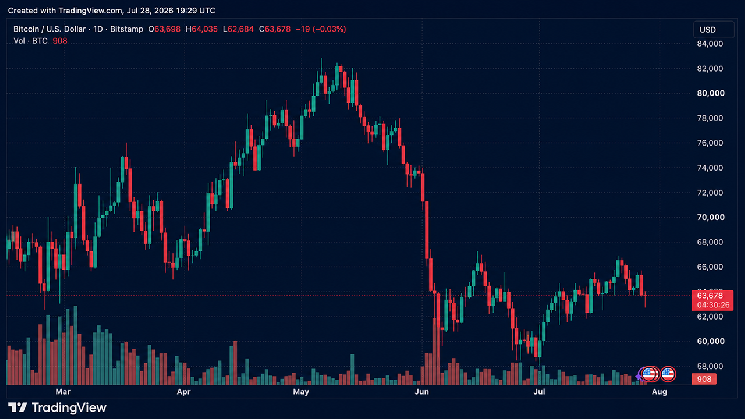
Harga Bitcoin (BTC) turun tajam pada Selasa, sempat menyentuh level terendah di bawah $63.000 sebelum sedikit pulih dan diperdagangkan di sekitar $63.660. Penurunan ini menyebabkan likuidasi posisi long (beli) senilai $134 juta yang didanai dengan leverage di pasar derivatif, sementara posisi short (jual) yang dilikuidasi bernilai $22 juta. Secara total, likuidasi terkait BTC melebihi $156 juta. Meski mengalami kerugian bulanan 4%, Bitcoin tetap berada di jalur untuk mencatatkan keuntungan bersih pada Juli, membalikkan tren penurunan dari Juni. Namun, pekan terakhir Juli ini dianggap kritis untuk menentukan tren pasar pada paruh kedua tahun 2026. Para ahli menyoroti beberapa faktor kunci yang akan mempengaruhi pasar: pertemuan Komite Pasar Terbuka Federal Reserve (FOMC), data indeks inti Pengeluaran Konsumsi Pribadi (PCE), serta laporan pendapatan dari raksasa teknologi seperti Apple, Microsoft, dan Amazon. Mike McCloskey, pakar pasar, menekankan bahwa konferensi pers Ketua Fed Kevin Warsh akan memberikan sinyal penting mengenai pandangan bank sentral terhadap inflasi dan kemungkinan pelonggaran kebijakan moneter. McCloskey menambahkan bahwa kombinasi data PDB kuartal II yang solid dan penurunan inflasi inti PCE dapat mendukung narasi disinflasi dan memberi ruang bagi Fed untuk mempertahankan suku bunga. Skenario ini berpotensi mendorong Bitcoin menuju kisaran $68.000-$70.000 pada Agustus. Sebaliknya, data yang lebih kuat dari perkiraan atau retorika 'hawkish' dari Fed, ditambah dengan hasil perusahaan yang mengecewakan, dapat mendorong BTC kembali ke kisaran $58.000-$60.000. Pasar telah menunggu selama enam minggu, dan pekan ini akan menentukan apakah kesabaran itu terbayarkan.

cryptonews.ru22m yang lalu

Posisi Long Bitcoin Senilai $134 Juta 'Menguap' saat Harga BTC Jatuh di Bawah $63.000 Menjelang Rapat Penting Fed

cryptonews.ru22m yang lalu

Trading

Spot

Artikel Populer

Cara Membeli BILL

Selamat datang di HTX.com! Kami telah membuat pembelian Billions Network (BILL) menjadi mudah dan nyaman. Ikuti panduan langkah demi langkah kami untuk memulai perjalanan kripto Anda.Langkah 1: Buat Akun HTX AndaGunakan alamat email atau nomor ponsel Anda untuk mendaftar akun gratis di HTX. Rasakan perjalanan pendaftaran yang mudah dan buka semua fitur.Dapatkan Akun SayaLangkah 2: Buka Beli Kripto, lalu Pilih Metode Pembayaran AndaKartu Kredit/Debit: Gunakan Visa atau Mastercard Anda untuk membeli Billions Network (BILL) secara instan.Saldo: Gunakan dana dari saldo akun HTX Anda untuk melakukan trading dengan lancar.Pihak Ketiga: Kami telah menambahkan metode pembayaran populer seperti Google Pay dan Apple Pay untuk meningkatkan kenyamanan.P2P: Lakukan trading langsung dengan pengguna lain di HTX.Over-the-Counter (OTC): Kami menawarkan layanan yang dibuat khusus dan kurs yang kompetitif bagi para trader.Langkah 3: Simpan Billions Network (BILL) AndaSetelah melakukan pembelian, simpan Billions Network (BILL) di akun HTX Anda. Selain itu, Anda dapat mengirimkannya ke tempat lain melalui transfer blockchain atau menggunakannya untuk memperdagangkan mata uang kripto lainnya.Langkah 4: Lakukan trading Billions Network (BILL)Lakukan trading Billions Network (BILL) dengan mudah di pasar spot HTX. Cukup akses akun Anda, pilih pasangan perdagangan, jalankan trading, lalu pantau secara real-time. Kami menawarkan pengalaman yang ramah pengguna baik untuk pemula maupun trader berpengalaman.

295 Total TayanganDipublikasikan pada 2026.05.07Diperbarui pada 2026.06.02

Cara Membeli BILL

Diskusi

Selamat datang di Komunitas HTX. Di sini, Anda bisa terus mendapatkan informasi terbaru tentang perkembangan platform terkini dan mendapatkan akses ke wawasan pasar profesional. Pendapat pengguna mengenai harga BILL (BILL) disajikan di bawah ini.

活动图片