Japanese and Korean Stock Markets Crashed! Nikkei Plummets Over 4%, KOSPI Plunges 8%, Market Panics Ahead of AI Giants' Earnings Week

marsbitDipublikasikan tanggal 2026-07-28Terakhir diperbarui pada 2026-07-28

Abstrak

Japanese and South Korean stock markets plunged sharply in early Tuesday trading, with the Nikkei 225 down over 4% and the KOSPI index tumbling 8%, triggering a circuit breaker. The sell-off was led by semiconductor and equipment stocks like Tokyo Electron, Kioxia, Samsung Electronics, and SK Hynix, the latter dropping as much as 30%. The primary driver is mounting investor concern over the sustainability of the AI boom. Worries intensified following news related to Nvidia's major AI supply agreements and rising debt insurance costs. Analysts point to fears over excessive capital expenditure, crowded trades in AI-related stocks, and high corporate debt levels. Market sentiment has soured ahead of key earnings reports from major tech firms, including Meta and SK Hynix. While SK Hynix is expected to post record results, its recent 38% price drop from June highs reflects deep skepticism about whether AI infrastructure spending can maintain its pace and deliver returns. The sell-off appears more driven by a sharp deterioration in sentiment than by immediate fundamental changes.

On Tuesday morning, dragged down by concerns related to Nvidia's (NVDA.O) significant AI supply agreements and intensifying market competition, investor sentiment was hit, causing Japanese and Korean stock markets to open lower and extend losses.

As of the time of writing, the Nikkei 225 Index had plunged over 4% intraday, hitting its lowest level since May 22; the TOPIX Index saw its biggest drop of 2.7%. South Korea's KOSPI Index widened its losses to 8%, triggering a trading halt for 20 minutes. The Korea Exchange had also earlier activated the KOSPI sidecar mechanism, temporarily suspending program sell orders on the KOSPI.

Semiconductor and equipment stocks like Tokyo Electron, Kioxia, Samsung Electronics, and SK Hynix led the declines, all falling more than 9%. Among them, SK Hynix's stock price plummeted as much as 30%, marking its biggest single-day drop in history; Kioxia's stock price fell up to 18%, its largest decline since last November. As the global sell-off in semiconductor stocks intensified, investor sentiment regarding the sustainability of the AI boom continued to deteriorate.

Amid a wave of AI-related deals totaling over $750 billion, the cost of debt default insurance for Nvidia surged, triggering a decline in tech stocks. Hideyuki Ishiguro, Chief Strategist at Nomura Asset Management, stated that following reports on Nvidia's significant investment deals, the rise in its credit risk is being viewed by investors as a negative signal.

Additionally, Ishiguro pointed out that China's progress in the semiconductor manufacturing equipment sector poses a threat to Japanese suppliers—who have long held a competitive advantage in this field.
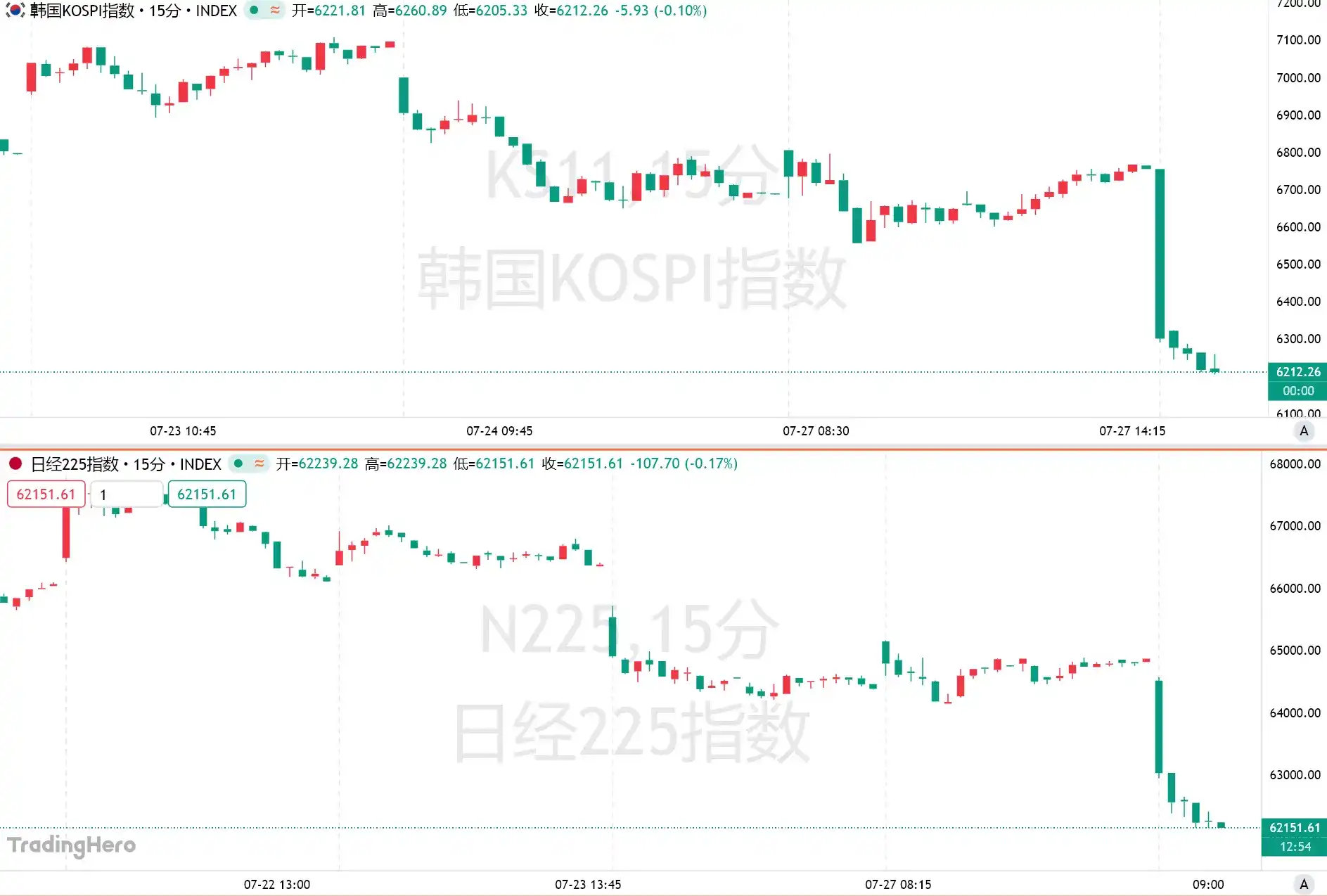
These declines point to deepening concerns in the market regarding crowded stock positioning and rising corporate debt levels as AI infrastructure development advances.

"The recent sell-off in semiconductor stocks seems to be driven more by sharply deteriorating market sentiment than by any immediate change in fundamentals," said Jung In Yun, CEO of Fibonacci Asset Management Global. "Investors are increasingly questioning whether the pace of AI infrastructure spending can be sustained."

Chris Larkin of Morgan Stanley E*Trade said: "This week is packed with potential surprises, both good and bad. Geopolitics and oil prices could be the biggest variables, but an optimistic reaction to strong earnings from the Magnificent Seven is not a given, especially if AI spending levels continue to surprise."

Kyle Rodda, Senior Analyst at Capital.com, wrote in a note to clients: "These companies embody the key themes currently affecting market sentiment—excessive capital expenditure and spending by AI companies, which investors worry will erode returns."

This week, several top tech companies, including Meta Platforms Inc. (META), are set to release key earnings. News earlier this month that Meta planned to sell excess AI computing capacity had already sparked concerns about demand. Apple Inc. (AAPL) has issued warnings about cost pressures, and reports indicate it is lobbying for approval to purchase memory components from competitors.

Investors are also awaiting the full results for Samsung Electronics' June quarter. Kim Minji, a portfolio manager at Seoul's Must Asset Management, said the world's largest traditional memory chipmaker is catching up to SK Hynix in the HBM field.

Furthermore, although SK Hynix is expected to announce another quarter of record-breaking earnings on Wednesday, investor sentiment has clearly weakened. The core market concern is that continuously rising memory prices may force customers to reduce purchases and seek lower-cost alternatives.

Since hitting a historic high in June, SK Hynix's stock price has cumulatively fallen 38%, with market worries about overcrowded trading and leverage amplifying price volatility. In this round of adjustment, the company's market capitalization shrinkage is second only to SpaceX (SPCX) globally.

In just over a month, approximately $470 billion in market value has evaporated from SK Hynix. The South Korean memory chipmaker, once seen as one of the world's hottest AI trades, is now becoming one of the most contentious holdings in investor portfolios.

Shawn Oh, Head of Korea Cash Equities Business at NH Investment & Securities, stated in a research report that, considering the current attractive valuation and the ongoing deleveraging by Korean retail investors, SK Hynix remains "an extremely attractive buying opportunity." However, he also noted that the market is reducing stock positions ahead of the U.S. tech company earnings season.

The market expects SK Hynix's June quarter sales to more than double year-on-year, reaching about $57 billion; operating profit is projected to increase sixfold year-on-year. But James Ooi, a market strategist at Tiger Brokers, said the significance of SK Hynix's earnings may transcend the company itself.

"SK Hynix's performance could also become a sentiment barometer for the global AI hardware sector," he said, adding that market expectations have largely been priced in already, so "even a slight miss could trigger a sharp reaction."

Hebe Chen, Senior Market Analyst at Vantage Global Prime, said: "The recent sell-off in chipmakers shows that doubts about spending, returns, and valuations are deepening, not subsiding. With several major catalysts approaching, the hesitation to buy the dip suggests investors are waiting for stronger evidence before rebuilding risk exposure."


Kripto yang Sedang Tren

Pertanyaan Terkait

QWhat were the main factors cited as causing the sharp decline in Japanese and South Korean stock markets on Tuesday morning?

AThe main factors were investor concerns about NVIDIA's major AI supply agreement and increasing market competition, which negatively impacted sentiment. Specific triggers included a surge in NVIDIA's debt default insurance costs within the large AI-related deal wave and worries about competition from China in semiconductor manufacturing equipment for Japanese firms.

QWhat specific market mechanisms were triggered in the South Korean market due to the sell-off, and for what key stock index?

AFor the South Korean KOSPI index, the decline widened to 8%, triggering a market-wide circuit breaker which halted trading for 20 minutes. The Korea Exchange also initiated a sidecar mechanism for the KOSPI, temporarily suspending program selling.

QWhich semiconductor and equipment stocks were mentioned as leading the declines, and what were some of their significant losses?

ATokyo Electron, Kioxia, Samsung Electronics, and SK Hynix were mentioned as leading the declines. Specific notable losses included SK Hynix's stock plunging as much as 30% (its biggest-ever daily drop) and Kioxia's stock falling up to 18% (its largest drop since November of the previous year).

QAccording to analysts cited in the article, what is the core investor worry regarding the current AI boom that is driving the market sell-off?

AThe core investor worry, as stated by analysts, is skepticism about the sustainability of AI infrastructure spending and capital expenditure. Investors are increasingly questioning whether the pace of AI-related spending can continue, fearing it will erode company returns. The sell-off reflects deepening concerns over crowded stock positions and rising corporate debt levels in the AI build-out.

QWhy is SK Hynix's upcoming earnings report considered significant beyond the company's own performance, and what potential market reaction is anticipated?

ASK Hynix's earnings report is seen as a potential sentiment barometer for the global AI hardware sector. The market has largely priced in high expectations, so even a slight miss in earnings could trigger a significant and volatile negative reaction across related stocks. Its performance is being watched for clues about the broader health and trajectory of AI demand.

Bacaan Terkait

Feishu Menjadi Doubao

Ini mungkin hari terpenting dalam sejarah Feishu selama satu dekade. Pada 30 Juli, ByteDance mengumumkan restrukturisasi besar-besaran. Feishu tidak lagi beroperasi secara independen dan tim penjualan/pemasaran mandirinya dibubarkan. Feishu, yang telah dijalankan sebagai unit bisnis mandiri selama sepuluh tahun, kini diintegrasikan. Apakah ini berarti Feishu kalah? Mungkin tidak. Narasinya telah berubah. Perjuangan Feishu selama ini untuk menjadi "super app" atau pintu masuk utama dihadapkan pada realitas baru era AI. Perusahaan global seperti Google, Microsoft, Tencent, dan Alibaba kini fokus pada penyematan AI langsung ke dalam alur kerja, bukan lagi pada logika 'pintu masuk'. ByteDance menyadari bahwa AI telah menjadi alasan utama perusahaan membeli produk. Data Q2 2026 menunjukkan bahwa lebih dari 90% klien baru Feishu juga membeli produk AI-nya. Pelanggan membeli solusi AI, bukan sekadar perangkat lunak. Oleh karena itu, kemampuan Feishu, model besar Doubao, dan infrastruktur cloud Volcano Engine harus disatukan untuk bersaing. Doubao pun mulai menjadi pusat gravitasi organisasi ByteDance, menyerap tim produk Feishu. Yang juga signifikan adalah pembentukan platform layanan kreativitas, yang menyatukan semua saluran penjualan ke klien perusahaan di bawah satu atap. Ini menandai pergeseran mendalam: ByteDance untuk pertama kalinya berpikir seperti perusahaan B2B sejati, mengatur dirinya di sekitar kebutuhan pelanggan, bukan produk. Kesimpulannya, perubahan terbesar hari ini bukanlah integrasi Feishu ke Doubao, melainkan bukti bahwa AI mulai mengatur ulang struktur organisasi perusahaan. Model AI kini mulai menentukan bagaimana sebuah perusahaan diorganisir, siapa yang melapor kepada siapa, dan ke mana sumber daya dialokasikan. ByteDance adalah yang pertama, tetapi bukan yang terakhir.

marsbit8m yang lalu

Feishu Menjadi Doubao

marsbit8m yang lalu

Kompetisi Emisi RWA Babak Kedua: Aset On-Chain Senilai Puluhan Miliar Masih Tertidur di Tengah Dilema Tingkat Pemanfaatan

Penulis: Jae, PANews Meskipun RWA (Aset Dunia Nyata) mencapai skala bersejarah $320 miliar dengan pertumbuhan ~22% pada Juli, data mengungkap masalah mendasar: hampir 90% aset tokenisasi ini "tertidur" di rantai, tidak digunakan dalam aktivitas DeFi seperti pinjaman atau kolateral. Laporan dari BeInCrypto Intelligence dan RWA.xyz menunjukkan bahwa lebih dari 70% dari 1.289 aset tokenisasi (nilai >$100k) tidak memiliki transaksi dalam seminggu. Platform besar pun menunjukkan kesenjangan antara skala dan pemanfaatan. **Securitize** (mitra penerbit BlackRock's BUIDL), dengan skala $49 miliar, hanya memiliki tingkat pemanfaatan DeFi ~0.7%. **Ondo Finance** (~$35 miliar aset) memiliki pemanfaatan ~2.7%. Sebaliknya, **Maple Finance**, protokol kredit dengan AUM $23 miliar, mencapai pemanfaatan DeFi 62% karena model bisnisnya yang mengikat aset langsung ke aktivitas pinjaman. Beberapa faktor menyebabkan rendahnya pemanfaatan: 1. **Sifat Aset**: Tokenisasi surat berharga negara (seperti BUIDL) bertujuan untuk pendapatan tetap dan ditahan, bukan untuk diperdagangkan, sehingga pemanfaatan DeFi-nya rendah (~5%). Aset ini banyak digunakan sebagai cadangan untuk stablecoin. 2. **Kendala Kepatuhan**: Sebagian besar RWA diklasifikasikan sebagai sekuritas, memerlukan KYC/whitelist, yang membatasi transfer dan penggunaan di protokol DeFi tanpa izin seperti Aave. 3. **Kurangnya Infrastruktur**: Kurangnya pasar sekunder yang likuid, mekanisme penilaian real-time, dan penebusan instan menghambat perdagangan dan penggunaan. Fokus kompetisi RWA bergeser dari "siapa yang menerbitkan lebih banyak" ke "siapa yang dapat memanfaatkannya". Protokol kredit asli (Maple, Centrifuge) memiliki keunggulan dalam pemanfaatan. Integrasi lapisan distribusi (mis., Securitize dengan UniswapX) dan kemitraan dengan pintu masuk seperti **Robinhood Crypto** menjadi krusial, karena mereka menyediakan basis pengguna dan likuiditas yang sudah ada. Misalnya, produk Maple, SyrupUSDG, mencapai kapitalisasi pasar $1 miliar dalam satu bulan setelah diluncurkan di Robinhood, dibandingkan dengan 9 bulan melalui promosi mandiri. Kesimpulannya, $320 miliar membuktikan kelayakan tokenisasi, tetapi pemanfaatan rendah menandai ini baru langkah pertama. Tantangan berikutnya adalah membuat aset-aset ini aktif beredar, digunakan, dan menciptakan nilai di dalam ekosistem DeFi, melampaui sekadar pencatatan di blockchain.

marsbit8m yang lalu

Kompetisi Emisi RWA Babak Kedua: Aset On-Chain Senilai Puluhan Miliar Masih Tertidur di Tengah Dilema Tingkat Pemanfaatan

marsbit8m yang lalu

Trading

Spot

Artikel Populer

Cara Membeli 4

Selamat datang di HTX.com! Kami telah membuat pembelian 4 (4) menjadi mudah dan nyaman. Ikuti panduan langkah demi langkah kami untuk memulai perjalanan kripto Anda.Langkah 1: Buat Akun HTX AndaGunakan alamat email atau nomor ponsel Anda untuk mendaftar akun gratis di HTX. Rasakan perjalanan pendaftaran yang mudah dan buka semua fitur.Dapatkan Akun SayaLangkah 2: Buka Beli Kripto, lalu Pilih Metode Pembayaran AndaKartu Kredit/Debit: Gunakan Visa atau Mastercard Anda untuk membeli 4 (4) secara instan.Saldo: Gunakan dana dari saldo akun HTX Anda untuk melakukan trading dengan lancar.Pihak Ketiga: Kami telah menambahkan metode pembayaran populer seperti Google Pay dan Apple Pay untuk meningkatkan kenyamanan.P2P: Lakukan trading langsung dengan pengguna lain di HTX.Over-the-Counter (OTC): Kami menawarkan layanan yang dibuat khusus dan kurs yang kompetitif bagi para trader.Langkah 3: Simpan 4 (4) AndaSetelah melakukan pembelian, simpan 4 (4) di akun HTX Anda. Selain itu, Anda dapat mengirimkannya ke tempat lain melalui transfer blockchain atau menggunakannya untuk memperdagangkan mata uang kripto lainnya.Langkah 4: Lakukan trading 4 (4)Lakukan trading 4 (4) dengan mudah di pasar spot HTX. Cukup akses akun Anda, pilih pasangan perdagangan, jalankan trading, lalu pantau secara real-time. Kami menawarkan pengalaman yang ramah pengguna baik untuk pemula maupun trader berpengalaman.

804 Total TayanganDipublikasikan pada 2025.10.20Diperbarui pada 2026.06.02

Cara Membeli 4

Diskusi

Selamat datang di Komunitas HTX. Di sini, Anda bisa terus mendapatkan informasi terbaru tentang perkembangan platform terkini dan mendapatkan akses ke wawasan pasar profesional. Pendapat pengguna mengenai harga 4 (4) disajikan di bawah ini.

活动图片