Not AI, Not War: What the US Stock Market Should Worry About Is Japan?

marsbitDipublikasikan tanggal 2026-07-24Terakhir diperbarui pada 2026-07-24

Abstrak

Global markets may be underestimating a systemic risk from Japan. As the yen hits multi-decade lows and domestic asset appeal rises, the world's largest pension fund, the Government Pension Investment Fund (GPIF), faces policy pressure to repatriate substantial assets. Such a shift could pressure U.S. stocks, bonds, and the dollar. GPIF manages roughly $1.8 trillion, with about half invested overseas. Even a modest reallocation to Japan could boost yen demand and Japanese government bond buying, potentially raising U.S. yields and weakening the dollar. Unwinding of yen carry trades could further pressure risk assets. This potential move is driven by improving fundamentals in Japan: rising inflation, economic recovery, and narrowing yield gaps with the U.S. The yen's depreciation to levels not seen since 1986 also enhances domestic investment appeal. While markets currently price in limited risk, key indicators like the dollar-yen cross-currency basis swap are showing subtle shifts. A surge in hedging demand for yen appreciation could tighten liquidity and impact U.S. equities. Conversely, GPIF repatriation could benefit Japanese equities, which trade at a discount to U.S. markets and are driven by corporate governance reforms. However, persistent yen weakness remains a major hurdle for foreign investors' returns.

Author: Zhao Ying

The global market is underestimating a potential systemic risk—Japan. As the yen falls to multi-decade lows and the appeal of domestic Japanese assets rises, the world's largest pension fund is facing policy pressure to repatriate its massive asset holdings back to Japan on a large scale. Once this process begins, the US stock market, bond market, and the US dollar may come under simultaneous pressure.

Recently, Japanese Prime Minister Takaichi Sanae stated that the government will promote the Government Pension Investment Fund (GPIF) and other national pension funds to increase their investment in domestic Japanese financial assets. Finance Minister Katayama Satsuki previously gave a similar signal. Although the GPIF has not announced any formal asset allocation adjustments, the market has already begun to assess its potential impact: if the fund repatriates its overseas holdings back to Japan, US Treasury yields may rise, the US dollar may weaken, and risk assets may come under pressure.

Currently, the market's pricing of the aforementioned risk remains relatively calm, but some technical indicators are already showing subtle changes, and investors should not be complacent.

The $1.8 Trillion Variable

The GPIF manages approximately $1.8 trillion, with domestic and foreign assets each accounting for about half, of which its overseas holdings total about $930 billion. In recent years, the fund's holdings of Japanese government bonds have decreased from about $770 billion to about $515 billion, while its holdings of foreign bonds have increased from about $128 billion to about $470 billion.

This structural change means that even a small-scale asset reallocation could trigger significant waves in the global market. According to a MarketWatch report, analyst Michael Kramer pointed out that if the GPIF repatriates some of its overseas assets back to Japan, it will directly boost demand for the yen and introduce a massive buying wave into the Japanese government bond market—a positive for Japan, but for the US, it implies higher interest rates and a weaker dollar.

At the same time, any large-scale unwinding of yen carry trades (i.e., borrowing low-interest yen, converting to US dollars, and investing in US assets) would further pressure the performance of risk assets.

Yen and JGBs: The Appeal of Domestic Assets Is Rising

Driving the potential GPIF reallocation is a substantial improvement in the fundamentals of Japanese domestic assets. With Japan's inflation recovering and economic growth resuming, the appeal of domestic investment opportunities has significantly increased. In February, the yield spread between US and Japanese two-year government bonds narrowed to its lowest level since early 2022.

At the same time, the yen has continued to weaken, with USD/JPY breaking above 163, reaching its highest level since 1986. From a technical analysis perspective, if the exchange rate rises further, the next resistance level is around 176. According to a report by the Financial Times, Fredrik Repton of Neuberger Berman believes that if GPIF allocates more funds to domestic assets, this could be a "very elegant solution" to Japan's macroeconomic problems, but other domestic financial institutions would also need to follow suit, and "this process will take a long time."
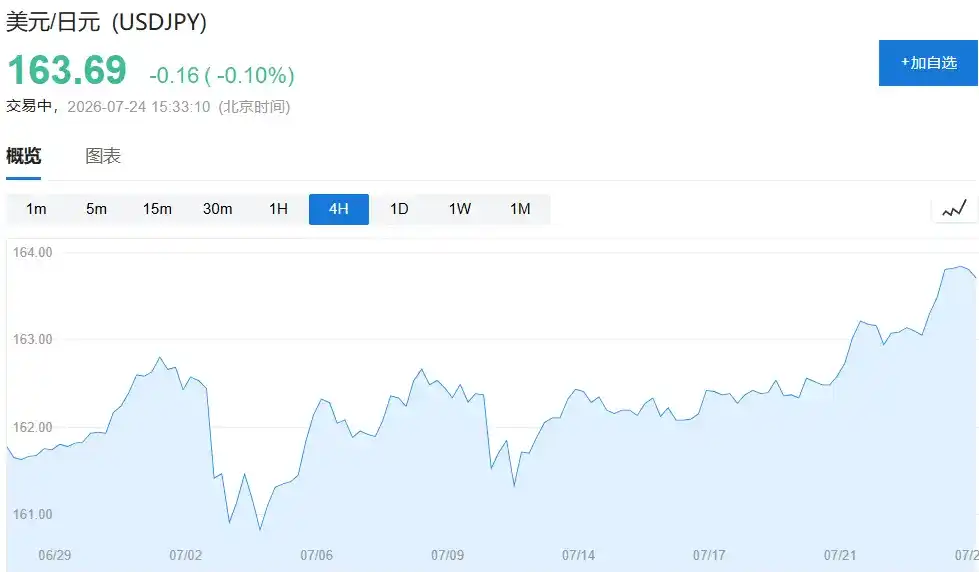
Japan's 10-year government bond yield recently touched 2.7%, the first time in 30 years. Deutsche Bank analyst Mallika Sachdeva pointed out in a recent report that the focus of Japanese authorities' policy may be shifting from exchange rate management to yield management, and if this shift materializes, it will put further pressure on the yen.

Market Not Yet Pricing It In, But Signals Are Emerging

Currently, the global market's reaction to the risk of Japanese capital repatriation remains relatively restrained. The five-year USD/JPY cross-currency basis swap recently stood at about minus 30 basis points, the narrowest level since this data series began in 2021, indicating that the market's hedging demand for a stronger yen has not yet risen significantly.

However, this indicator itself is a key signal for observing whether capital flows are beginning to shift. Historical data shows that the S&P 500 index and the cross-currency basis swap have moved in sync during multiple periods—whenever hedging demand rises sharply, the US stock market often declines as liquidity tightens accordingly. Once market expectations for yen appreciation heat up, the demand for USD hedging will climb accordingly, and the liquidity tightening effect will become more pronounced.

Japanese Stocks: The Other Side of the Risk

It is worth noting that while the potential asset reallocation by GPIF may bring pressure to US markets, it also provides a new narrative logic for Japanese stocks. The Japanese stock market is benefiting from drivers that are distinctly different from those in the US market: the concentration of the technology sector in the Topix index is much lower than in the S&P 500, its exposure to artificial intelligence is relatively limited, and its valuation still trades at a discount of more than 20% compared to the S&P 500.

Corporate governance reform is a core catalyst for Japanese stocks. Dan Rasmussen of Verdad Advisers points out that there are still about 1,000 companies in Japan whose stock prices are below book value, and among the cheapest quintile of companies, cross-shareholdings still account for about 40% of their market capitalization. As cross-shareholdings are gradually unwound, a large amount of historically accumulated profits is expected to be released, having a materially positive impact on corporate earnings.

However, for foreign investors, the persistently weakening yen is the biggest obstacle—over the past two years, yen depreciation has significantly eroded the real returns of foreign capital in the Japanese stock market. How to handle currency hedging, and whether the hedging cost is bearable, remain core issues facing global investors.


Kripto yang Sedang Tren

Pertanyaan Terkait

QWhat is the main systemic risk that global markets are currently underestimating according to the article?

AThe article states that global markets are underestimating the potential systemic risk posed by Japan. Specifically, the risk arises from the possibility that Japan's Government Pension Investment Fund (GPIF) and other national pension funds might reallocate a significant portion of their foreign assets back to domestic Japanese investments.

QWhat would be the likely impact on the US if GPIF repatriates a portion of its foreign assets back to Japan?

AIf GPIF repatriates part of its foreign assets, it would likely lead to higher U.S. Treasury yields, a weaker U.S. dollar, and pressure on U.S. risk assets like stocks. This is due to reduced demand for U.S. bonds and dollars, alongside potential unwinding of yen carry trades.

QWhat is the current approximate size of GPIF's foreign asset holdings?

AGPIF's foreign asset holdings amount to approximately $930 billion, which is about half of its total assets under management of roughly $1.8 trillion.

QWhat is one of the key fundamental improvements in Japan that makes domestic assets more attractive, according to the article?

AOne key improvement is the recovery in Japanese inflation and economic growth, which enhances the attractiveness of domestic investment opportunities. This is evidenced by the narrowing yield gap between U.S. and Japanese two-year government bonds.

QWhat is a major catalyst for the Japanese stock market mentioned in the article, distinct from U.S. market drivers?

AA major catalyst for the Japanese stock market is corporate governance reform. This includes the unwinding of cross-shareholdings, which could release historically accumulated profits and substantially boost corporate earnings, unlike the U.S. market which is more driven by technology and AI concentration.

Bacaan Terkait

Kes Perceraian Chey Tae-won Selesai: Mengungkap Garis Suksesi Tersembunyi di Balik Kerajaan Triliunan SK Hynix

Kasus perceraian Ketua SK Group, Choi Tae-won, akhirnya diputuskan, mengungkap garis suksesi tersembunyi di balik kerajaan triliunan won SK Hynix. Artikel ini menjelaskan perjalanan ketiga anaknya sebagai generasi penerus ketiga dalam keluarga Chaebol Korea Selatan yang tidak mengikuti skenario tradisional. Anak tertua, **Choi Yun-jung**, dianggap sebagai kandidat penerus yang paling jelas. Berpendidikan tinggi di bidang biologi dan informatika biomedis, dia memegang posisi eksekutif di SK Inc., mengelola perencanaan jangka panjang dan ekspansi global. Pernikahannya dengan pendiri startup infrastruktur AI mencerminkan pergeseran dari pernikahan dinasti tradisional. Anak kedua, **Choi Min-jung**, memiliki koneksi mendalam dengan SK Hynix, Washington, dan jaringan militer. Sebagai veteran Angkatan Laut Korea yang pernah bertugas di Teluk Aden, dia bekerja di divisi kebijakan internasional SK Hynix sebelum mendirikan startup perawatan kesehatan berbasis AI di AS. Dia menikahi mantan perwira Korps Marinir AS, menguatkan hubungannya dengan lingkungan geopolitik tempat perusahaan semikonduktor beroperasi. Putra satu-satunya, **Choi In-geun**, adalah yang paling sesuai dengan profil penerus tradisional namun justru paling diam. Setelah bekerja di SK E&S, dia kini berkarier di McKinsey Seoul, sebuah langkah yang dianggap sebagai pelatihan eksternal standar, bukan pernyataan suksesi. Kasus perceraian orang tua mereka, dengan tuntutan pembagian aset mencapai triliunan won, juga membawa ketiganya ke dalam narasi publik melalui berkas hukum. Sementara SK Hynix melonjak menjadi aset geopolitik global di era AI, ketiga anak ini tidak mewarisi jawaban sederhana, melainkan serangkaian tantangan kompleks industri AI global. Pewarisan bagi mereka bukan lagi sekadar masalah keluarga, melainkan uji kelayakan publik di panggung dunia baru.

marsbit6j yang lalu

Kes Perceraian Chey Tae-won Selesai: Mengungkap Garis Suksesi Tersembunyi di Balik Kerajaan Triliunan SK Hynix

marsbit6j yang lalu

2 Bulan, Valuasi Melonjak dari 88 Miliar Jadi 680 Miliar! OpenRouter, 'Stasiun Transit' AI Terbesar, Akan Diakuisisi

Stripe, pemroses pembayaran terbesar di dunia, dilaporkan sedang dalam negosiasi untuk mengakuisisi OpenRouter, pasar yang menghubungkan lebih dari 400 model AI besar, dengan harga sekitar 100 miliar USD. Harga ini mencerminkan lonjakan valuasi hampir 7 kali lipat dari 13 miliar USD dua bulan lalu. OpenRouter berfungsi sebagai lapisan perantara atau "mesin perbandingan harga" yang memungkinkan pengembang mengakses berbagai model AI (seperti GPT, Claude, atau model open-source) melalui satu API. Platform ini secara otomatis mencocokkan permintaan pengguna dengan model terbaik berdasarkan kompleksitas tugas, biaya, dan kecepatan, membantu aplikasi AI mengoptimalkan biaya tanpa mengubah pengalaman pengguna. Didirikan pada 2023 oleh Alex Atallah (salah satu pendiri OpenSea) dan Louis Vichy, OpenRouter telah mencatat pertumbuhan pesat dengan pendapatan tahunan mencapai 50 juta USD per April 2025. Akuisisi ini merupakan bagian dari strategi Stripe untuk memperluas infrastruktur ekonomi AI. Pada akhir 2025, mereka mengakuisisi Metronome, platform penagihan berbasis penggunaan. Dengan menggabungkan OpenRouter (pemilihan dan perutean model) dan Metronome (penagihan), Stripe bertujuan menawarkan solusi terpadu—dari pemilihan model, penagihan sesuai pemakaian, hingga pembayaran—bagi bisnis yang menggunakan AI. Langkah ini memperkuat posisi Stripe sebagai "pusat kendali" dalam alur kerja AI. Meski transaksi berpotensi diumumkan dalam sebulan, negosiasi masih bisa gagal.

链捕手6j yang lalu

2 Bulan, Valuasi Melonjak dari 88 Miliar Jadi 680 Miliar! OpenRouter, 'Stasiun Transit' AI Terbesar, Akan Diakuisisi

链捕手6j yang lalu

Trading

Spot

Artikel Populer

Cara Membeli WAR

Selamat datang di HTX.com! Kami telah membuat pembelian WAR (WAR) menjadi mudah dan nyaman. Ikuti panduan langkah demi langkah kami untuk memulai perjalanan kripto Anda.Langkah 1: Buat Akun HTX AndaGunakan alamat email atau nomor ponsel Anda untuk mendaftar akun gratis di HTX. Rasakan perjalanan pendaftaran yang mudah dan buka semua fitur.Dapatkan Akun SayaLangkah 2: Buka Beli Kripto, lalu Pilih Metode Pembayaran AndaKartu Kredit/Debit: Gunakan Visa atau Mastercard Anda untuk membeli WAR (WAR) secara instan.Saldo: Gunakan dana dari saldo akun HTX Anda untuk melakukan trading dengan lancar.Pihak Ketiga: Kami telah menambahkan metode pembayaran populer seperti Google Pay dan Apple Pay untuk meningkatkan kenyamanan.P2P: Lakukan trading langsung dengan pengguna lain di HTX.Over-the-Counter (OTC): Kami menawarkan layanan yang dibuat khusus dan kurs yang kompetitif bagi para trader.Langkah 3: Simpan WAR (WAR) AndaSetelah melakukan pembelian, simpan WAR (WAR) di akun HTX Anda. Selain itu, Anda dapat mengirimkannya ke tempat lain melalui transfer blockchain atau menggunakannya untuk memperdagangkan mata uang kripto lainnya.Langkah 4: Lakukan trading WAR (WAR)Lakukan trading WAR (WAR) dengan mudah di pasar spot HTX. Cukup akses akun Anda, pilih pasangan perdagangan, jalankan trading, lalu pantau secara real-time. Kami menawarkan pengalaman yang ramah pengguna baik untuk pemula maupun trader berpengalaman.

325 Total TayanganDipublikasikan pada 2024.12.11Diperbarui pada 2026.06.02

Cara Membeli WAR

Diskusi

Selamat datang di Komunitas HTX. Di sini, Anda bisa terus mendapatkan informasi terbaru tentang perkembangan platform terkini dan mendapatkan akses ke wawasan pasar profesional. Pendapat pengguna mengenai harga WAR (WAR) disajikan di bawah ini.

活动图片