After Burning Through 900 Billion, Zuckerberg Decides to Open a Casino Where You Can't Gamble

marsbitDipublikasikan tanggal 2026-06-26Terakhir diperbarui pada 2026-06-26

Abstrak

Mark Zuckerberg's Meta is venting a new app called Arena, a prediction market platform where users use points instead of real money to bet on outcomes of elections, sports, and world events. This move follows Meta's massive $90 billion cumulative loss in its Reality Labs metaverse division. Critics argue the "play money" model undermines the core mechanism of prediction markets, where real financial stakes ensure accurate forecasts. Arena is seen as Meta's attempt to copy established, fast-growing platforms like Polymarket and Kalshi while avoiding regulatory hurdles. The article suggests this may be less about creating a genuine prediction tool and more about social engagement, potentially acting as a gateway that introduces billions to the concept, from which licensed platforms could ultimately benefit.

Author: Max.s

A man who lost 90 billion dollars decides to start a project that doesn't involve spending money.

You read that right.

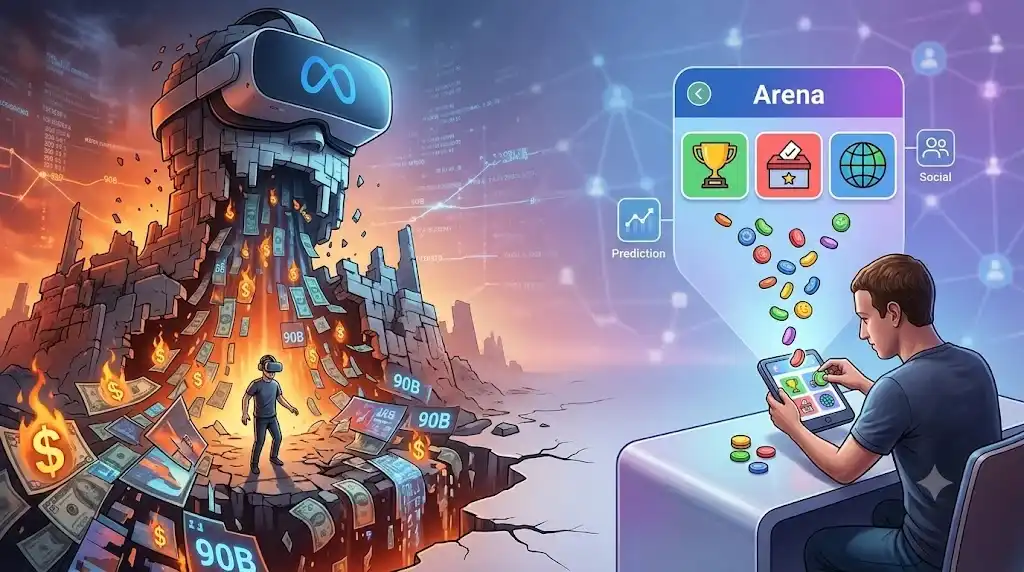
Just yesterday, The New York Times reported that Zuckerberg is personally leading the development of a prediction market app called Arena — users can bet on the outcomes of elections, sports, and major international events, but the chips are points. Not dollars, not USDC, but 'fun beans'.

That's right! The kind you don't feel bad about losing all night in mahjong.

What Lessons Can 90 Billion Dollars Buy?

First, let's review Meta's "Chronology of Burning Money."

In 2021, Zuckerberg renamed Facebook to Meta, announcing plans to build the metaverse. His Reality Labs division began spending lavishly — VR headsets, the virtual social platform Horizon Worlds, immersive office spaces...

And the result?

Horizon Worlds' monthly active users once fell below 200,000, failing to even reach its initial goal of 500,000. It lost 17.7 billion dollars in 2024 and 19.2 billion dollars in 2025, with cumulative losses approaching 90 billion dollars. 90 billion. That's enough money to buy several Polymarkets.

And Meta itself admitted that its loss scale for 2026 would be "in line with 2025."

In other words, before even filling this bottomless pit of the metaverse, Zuckerberg is already eagerly digging a new hole next to it.

From "Changing the World" to "Copying Others' Homework"

Interestingly, this isn't Meta's first attempt at prediction markets.

During the early days of the pandemic in 2020, Meta launched a crowdsourced prediction app called Forecast, allowing users to guess the course of current events. The result? It was quietly taken down in 2022.

Back then, Polymarket wasn't hot yet, Kalshi hadn't won its lawsuit against the CFTC, and the entire prediction market's annual trading volume was less than 50 billion dollars.

Now? In 2026, the industry's trading volume has surpassed 130 billion dollars, Kalshi's valuation is hitting 40 billion dollars, and Polymarket's valuation is 9-15 billion dollars.

Others made the cake bigger, and Zuckerberg smells it and comes running.

Does this playbook sound familiar? Snapchat launches Stories → Instagram launches Stories. TikTok popularizes short videos → Meta launches Reels. Twitter is still breathing → Meta launches Threads.

Every time it's: You get hot, I copy it, I crush you with 3.5 billion users worth of traffic.

Most of the time, this tactic works. But prediction markets are not short videos, nor are they ephemeral stories.
The Soul of a Prediction Market is "Real Money"

Let me explain why this is so absurd.

Prediction markets can forecast accurately because participants are betting their own money. You think seriously only when it hurts, you tell the truth only when you lose. Prices reflect probabilities because every dollar is a vote cast with real money.

Now Meta says: We're going to make a prediction market, but we won't let users spend real money.

This is like opening a Michelin-starred restaurant where all the dishes are made of air. The decor is luxurious, the menu is exquisite, customers come in droves — but everyone is just chewing on air.

Predictions without the constraint of real money aren't predictions; they're votes.

And the internet is never short on votes. Comment sections on Weibo vote every day, WeChat Moments are full of predictions every day — have you ever seen an accurate probability calculated from "likes"?

Zuckerberg, of course, knows this. The real purpose of the points system isn't to make predictions, but to bypass regulation.

In April 2026, the CFTC initiated the first-ever insider trading lawsuit in prediction market history — a US military officer profited on Polymarket using classified intelligence. The regulatory winds are already clear.

So Arena uses points. In the eyes of the law, this is a "game." In the eyes of the product, this is "social." In the eyes of prediction markets — this is an empty shell with its soul sucked out.

The Most Expensive "Toe-Dip"

Let's put the two most glaring numbers together:

Reality Labs cumulative losses: 90 billion dollars

Arena's starting design: A points game where you can't spend real money

A company that burned through 90 billion dollars on hardware and content turns around and creates a "zero-financial-risk" social toy.

This isn't "learning a lesson"; this is a cat that got scalded by boiling water — now it's even afraid to touch lukewarm water.

The lesson from the metaverse is crystal clear: the cost of creating a new track out of thin air is extremely high. But Zuckerberg's takeaway seems to be: Then I won't create a new track, I'll just copy one that others have already proven.

The problem is, the premise of others' success is real money. Polymarket made its name in the 2024 election because every dollar was a vote with real money. Kalshi could raise money from Morgan Stanley because of its CFTC license and years of federal litigation.

These things, no matter how much traffic you have, cannot be replicated.

3.56 billion daily active users is indeed terrifying. But if those 3.56 billion people come to Arena and cast a bunch of "fun bean predictions" with points, then what?

The predicted probabilities are inaccurate → Users find it boring → Engagement drops → Zuckerberg says "it's an experimental project" → Quietly taken down.

The script is exactly the same as Forecast.

Maybe Zuck Just Doesn't Care About Accurate Predictions

Finally, let's consider a "contrarian view" — what if we've got it wrong?

Maybe Zuckerberg never intended to build a real prediction market. Maybe Arena's goal is simply to be a hot-topic social platform: users come here not to make money, but to see what others think, argue with friends, and show off their "prediction accuracy."

In essence, it's no different from arguing on Weibo, just with an added scoring system.

In this logic, points aren't a defect; they're by design. Real money would actually scare away ordinary users. What Meta wants isn't financial depth; it's user time.

If this path works, Kalshi and Polymarket might actually benefit — Meta introduces the concept of "prediction" to billions who have never touched financial derivatives. A small portion of them might think, "Points aren't exciting enough, I want to play with real money," and then flow to licensed platforms.

Meta grows the pie, and the professional platforms eat it.

This is probably the outcome everyone doesn't want to see, but the one most likely to happen.

So the question is: Do you think Zuckerberg has finally gotten smart this time, or is he just repeating past mistakes in a cheaper way?


Pertanyaan Terkait

QWhat is the main project that Mark Zuckerberg is reportedly leading at Meta, according to the New York Times article?

AHe is reportedly leading the development of a prediction market application called Arena, where users can bet on outcomes like elections, sports, and international events using points instead of real money.

QWhat is one of the major reasons given in the article for why a prediction market without real money might fail?

AThe article argues that the accuracy of a prediction market relies on participants using their own real money, which forces serious consideration and truthful predictions. Without this financial stake, it becomes mere voting or opinion-sharing, lacking the mechanism to reflect accurate probabilities.

QHow does the article describe Meta's previous attempt at a prediction market called Forecast?

AMeta launched Forecast during the early pandemic in 2020 as a crowdsourced prediction app. However, it was quietly shut down in 2022, before the prediction market industry experienced its major growth.

QWhat potential legal and regulatory reason is suggested for Arena using points instead of real currency?

AThe article suggests that using points instead of real money is likely a strategy to circumvent strict financial regulations. By framing it as a 'game' or 'social' feature, it avoids being classified and regulated as a financial betting or trading platform.

QWhat alternative, less conventional motivation for the Arena project does the article propose at the end?

AThe article proposes that perhaps Zuckerberg's goal isn't to create an accurate financial prediction market at all. Instead, Arena might aim to be a social platform for discussing and engaging with trending events, where the point system is designed for engagement and user retention, not financial depth. This could, in turn, popularize the concept of prediction markets and drive some users to seek out real-money platforms like Polymarket.

Bacaan Terkait

Pendiri ENS Ingin 'Merebut Kekuasaan' dari Tangan DAO

Pada 29 Juni, proposal perpanjangan kewenangan veto Komite Keamanan ENS DAO selama dua tahun memasuki tahap voting on-chain. Pendiri ENS, Nick Johnson, menggunakan kepemilikan ENS-nya yang besar untuk memberikan suara menentang, meningkatkan suara penolakan menjadi 3,55 juta. Komite Keamanan, dibentuk Juli 2024 dengan kewenangan veto 4/8, bertujuan melindungi perbendaharaan DAO sebesar $350 juta dari proposal berbahaya. Tindakan Nick Johnson ini dipandang sebagai langkah awal dalam upayanya mereformasi tata kelola ENS DAO. Pada November 2025, ia menyatakan keprihatinan bahwa DAO penuh dengan politik internal, menyebabkan orang-orang berkompetensi pergi. Sebelumnya, pada 19 Juni, COO ENS Katherine Wu mengajukan proposal untuk memperkuat Yayasan ENS, menyerahkan pengelolaan operasional sehari-hari dan perbendaharaan kepada yayasan yang direstrukturisasi, sementara DAO mempertahankan kekuasaan inti seperti upgrade protokol. Proposal ini menuai kontroversi, terutama terkait kontrol atas perbendaharaan. Nick menjelaskan bahwa penolakannya terhadap perpanjangan komite didasari kekhawatiran kurangnya checks and balances, serta potensi penyalahgunaan veto untuk tujuan politik. Menanggapi hal ini, Katherine mengajukan proposal revisi yang meningkatkan ambang eksekusi veto dari 4/8 menjadi 5/8 dan menambahkan mekanisme pembatasan. Langkah ini terjadi di tengah penurunan pendapatan ENS, dari lebih dari $10 juta (2023) menjadi kurang dari $2 juta (2025). Dengan kepemilikan token yang signifikan, Nick memiliki kemampuan untuk mendorong perubahan. Tekanannya kini adalah memastikan yayasan baru berkinerja lebih baik daripada tata kelola DAO sebelumnya.

Foresight News2m yang lalu

Pendiri ENS Ingin 'Merebut Kekuasaan' dari Tangan DAO

Foresight News2m yang lalu

Memprediksi Babak Gugur Piala Dunia, Seberapa Besar Perbedaan Level AI?

**Ringkasan: Prediksi Piala Dunia oleh AI, Seberapa Akuratkah Mereka?** Odaily Planet Daily menguji akurasi prediksi berbagai model AI (ChatGPT, Grok, Qwen, DeepSeek, Gemini, Claude) untuk babak knockout Piala Dunia dengan membandingkannya dengan hasil aktual. **DeepSeek dan Gemini** menonjol dengan prediksi brilian mereka untuk pertandingan Belanda vs Maroko. Keduanya tidak hanya meramal hasil seri 1-1 di waktu normal, tetapi juga memprediksi kemenangan Maroko melalui adu penalti, yang ternyata sangat akurat. **Grok dan Qwen** menunjukkan konsistensi dalam memprediksi skor tepat untuk pertandingan dengan tim favorit yang jelas, seperti Kanada 1-0 atas Afrika Selatan dan Brasil 2-1 atas Jepang. Mereka pandai memperkirakan seberapa sulit tim unggul akan menang. **ChatGPT** lebih kuat dalam menganalisis dinamika dan kesulitan pertandingan. Misalnya, ia memperkirakan Jepang dan Pantai Gading akan memberikan perlawanan sengit meski kalah, yang terbukti benar. Namun, ChatGPT cenderung ragu untuk memprediksi kejutan besar. Kegagalan kolektif terjadi pada pertandingan Jerman vs Paraguay. Semua model AI meramalkan kemenangan mudah Jerman, tetapi Paraguay berhasil membawa pertandingan ke adu penalti dan mengeliminasi Jerman. **Kesimpulan:** Setiap model AI memiliki keunggulannya masing-masing. DeepSeek dan Gemini paling berani dan akurat dalam memprediksi kejutan. Grok dan Qwen stabil untuk prediksi skor pada pertandingan favorit. ChatGPT unggul dalam analisis proses pertandingan. Pemilihan model bergantung pada kebutuhan: apakah untuk prediksi skor/kejutan atau untuk memahami alur pertandingan.

Odaily星球日报31m yang lalu

Memprediksi Babak Gugur Piala Dunia, Seberapa Besar Perbedaan Level AI?

Odaily星球日报31m yang lalu

Apakah Web3 Gaming Masih Punya Putaran Berikutnya? Pemain Senior Merekap: Saat Suhu Tertinggi, Setidaknya Kamu Harus Lari Setengahnya

**Ringkasan Wawancara dengan 'Ayam Cari Uang', Pemain Web3 Game Berpengalaman** Dalam wawancara GMA ini, pemain Web3 game veteran dengan nama samaran "Ayam Cari Uang" membagikan pengalamannya bermain dan berinvestasi di game-game seperti Mobox, StepN, dan Seraph. Berikut adalah poin-poin utama: **Perjalanan & Motivasi:** Dia tertarik dengan Web3 game karena kombinasi potensi penghasilan, kesenangan bermain, dan kepuasan dalam meneliti mekanisme game. Latar belakangnya sebagai pedagang barang dalam game tradisional (seperti MapleStory) membantu pola pikirnya, meskipun tidak sepenuhnya diterapkan langsung. **Sumber Keuntungan & Kesalahan Umum:** Menurutnya, keuntungan besar di awal era game Web3 terutama berasal dari **bonus zaman (era红利)**. Kesalahan terbesar pemain biasa adalah menghitung siklus balik modal **(ROI)** saat hype sedang puncak, karena harga aset dan output terus menurun, membuat perhitungan awal jadi tidak realistis dan berujung rugi. **Hubungan Pemain-Proyek-Whale:** Sering terjadi hubungan yang penuh persaingan antara pengembang proyek, pemain besar (whale), dan pemain kecil. Banyak game Web3 yang akhirnya menjadi ajang spekulasi di antara ketiganya, alih-alih memiliki pemain yang benar-benar ingin menikmati game dan berkontribusi pada ekonomi. **Masalah Inti Game Web3:** Masalah terbesar adalah kebanyakan game Web3 **bukan game yang matang**. Seharusnya, fondasinya adalah game yang bagus dan menarik, baru kemudian memanfaatkan blockchain. Saat ini, banyak game dipenuhi orang yang hanya ingin cepat kaya, bukan pemain yang rela membayar untuk pengalaman bermain, sehingga ekonomi game sulit berkelanjutan. **Masa Depan & Saran:** Dia masih percaya game Web3 bisa populer lagi di masa depan, mungkin dimulai dari proyek yang sangat spekulatif. Namun, untuk game Web3 yang matang dan berkelanjutan, kemungkinan besar akan datang dari **pengembang game tradisional besar** yang membawa IP matang, konten game solid, dan sistem aset NFT, menarik baik pemain tradisional maupun pemain crypto. Untuk pemula, sarannya: **jangan main jika belum pernah mencoba**, risikonya terlalu tinggi seperti berjudi. Bagi yang masih ingin bertahan, prinsipnya adalah: berani masuk saat aset rendah dan belum populer, tetapi **saat hype memuncak dan semua orang membicarakannya, setidaknya jual separuh dari kepemilikan Anda**.

marsbit1j yang lalu

Apakah Web3 Gaming Masih Punya Putaran Berikutnya? Pemain Senior Merekap: Saat Suhu Tertinggi, Setidaknya Kamu Harus Lari Setengahnya

marsbit1j yang lalu

Trading

Spot
活动图片