The 800V Voltage Standard Championed by Nvidia: Which Infrastructure Providers Stand to Benefit?

marsbitDipublikasikan tanggal 2026-06-15Terakhir diperbarui pada 2026-06-15

Abstrak

NVIDIA is actively promoting the 800VDC architecture as a key direction for its next-generation AI factories and high-power racks, particularly for the upcoming Rubin and Kyber platforms. The primary driver is the rapidly increasing power density of AI racks, with designs like GB200/GB300 NVL72 reaching 120-140kW and future systems potentially hitting 180-220kW. At such high power levels, traditional low-voltage power delivery becomes inefficient due to massive current, leading to significant copper use, cable bulk, heat, and power loss. The 800VDC standard aims to increase efficiency by transmitting power at higher voltage and lower current to the rack before stepping it down locally for GPUs. NVIDIA claims this can improve efficiency by up to 5%, reduce total cost of ownership (TCO) by up to 30%, and cut copper usage by approximately 45%. This shift redefines infrastructure roles, pushing power engineering to the forefront alongside GPU performance. Key beneficiaries and ecosystem partners highlighted include: 1. **Power Infrastructure Providers:** Companies like Vertiv, Schneider Electric, Delta Electronics (台达电), and Korean firms LS Electric and HD Hyundai Electric are involved in designing next-gen AI factory power distribution, rack power supplies, and backup systems. 2. **Power Semiconductors:** Suppliers of SiC/GaN devices, such as Infineon and STMicroelectronics, are better suited for high-voltage, high-efficiency conversion in this new architecture. 3. **Connec...

TL;DR

Over the past few years, the star of AI infrastructure has been the GPU. Those who secured more H100s or B200s had a stronger supply of computing power. But as we move into the Rubin and subsequent platforms, investors need to look one level deeper: Can the GPUs fit into the rack? Can the rack receive stable power? Can the heat be dissipated? Can the systems be fully loaded and tested before leaving the factory?

This is precisely why 800VDC is now being discussed in the market. Since 2025, Nvidia has consistently and publicly advocated for 800VDC architecture, incorporating it into the design direction for next-generation AI factories and high-power racks. On the surface, this is a shift in voltage specification from traditional low voltage to high-voltage DC. Looking deeper, AI servers are no longer just assemblies of boards and chips; they are increasingly resembling power engineering projects.

Ordinary investors can think of it this way: a full rack of AI servers is like a small building with extremely high electricity consumption. Past power delivery methods could still support racks of several dozen or even a hundred kilowatts. But as power continues to increase, the problem is no longer just "how many GPUs to buy," but rather how to deliver the electricity, how to dissipate the heat, and how to run the machines at full load continuously before they leave the factory.

High-Power Racks Are Approaching the Limits of Low-Voltage Power Supply

The starting point for this change is the rapid rise in AI rack power. Traditional server racks might only consume a few to tens of kilowatts. With Nvidia's GB200/GB300 generation, whole-rack power has entered the hundred-kilowatt range. According to Tom’s Hardware, the GB200/GB300 NVL72 consumes approximately 120-140kW.

Power density could climb further post-Rubin. Some supply chain and industry estimates suggest the Rubin NVL72 might reach approximately 180-220kW. This range is not officially confirmed by Nvidia and should still be considered third-party estimates, but the direction is clear: leading-edge AI racks are becoming higher-density power consumption units.

The power issue can be explained by a formula: Power equals Voltage multiplied by Current. To deliver the same 600kW of power, if the voltage is lower, a larger current is required. A larger current necessitates thicker cables and busbars, causes more severe heat generation, and leads to higher power loss in the lines.

Traditional low-voltage power supply is like using a very thick water pipe to slowly move a large volume of water. It works, but the pipe gets thicker, heavier, and takes up more space. Rack space, which should be reserved for GPUs, memory, networking, and cooling structures, gets crowded out by power shelves, cables, and busbars. At power levels of several hundred kilowatts and beyond, continuing to rely on low-voltage, high-current systems becomes increasingly uneconomical.
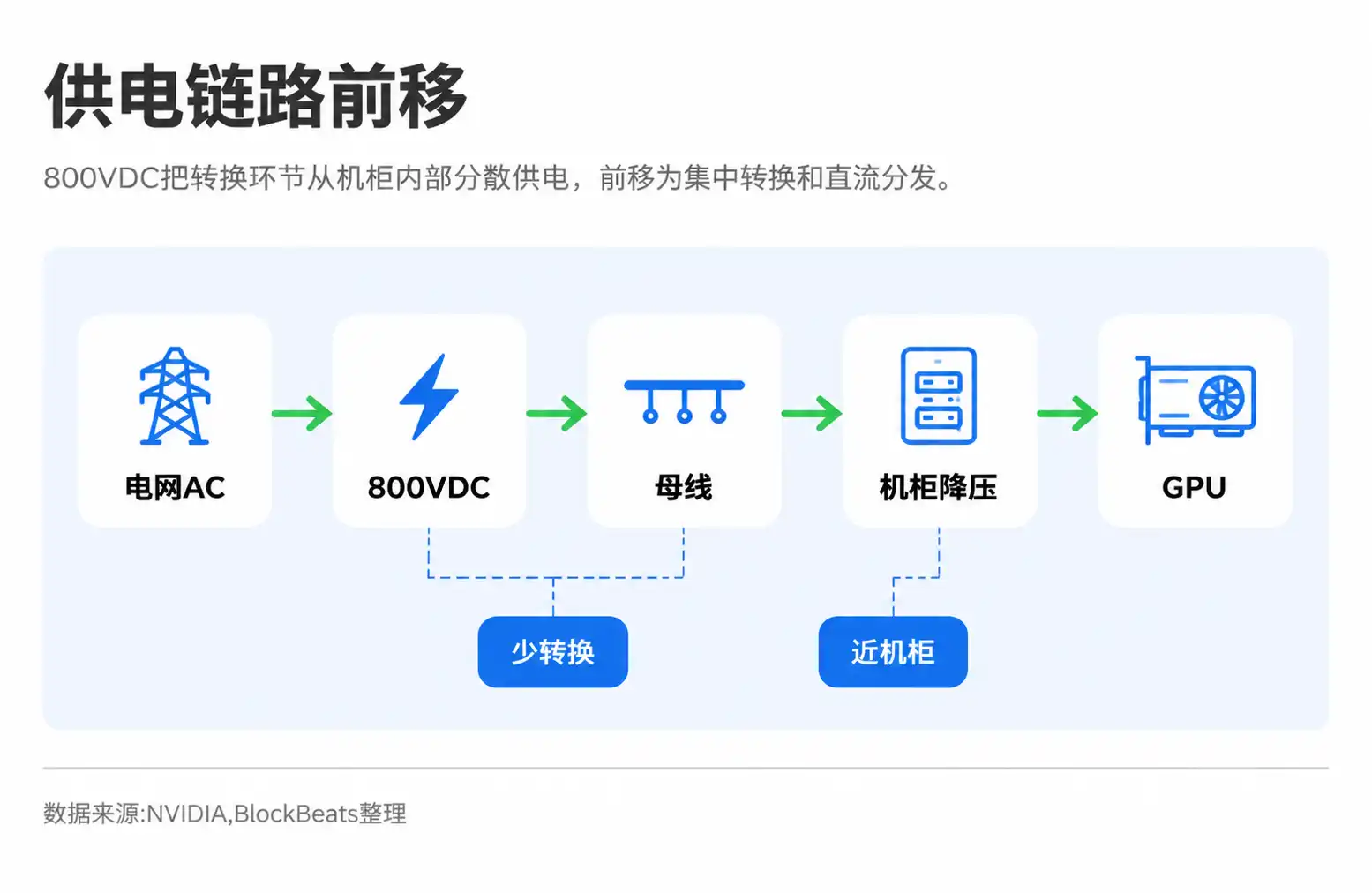
The idea behind 800VDC is to increase the voltage, deliver power more efficiently to the vicinity of the rack, and then step it down locally for use by the GPUs. It's akin to increasing water pressure to use narrower pipes to deliver the same amount of water. Nvidia's official materials state that 800VDC can reduce current, copper usage, cable volume, and conversion stages, potentially increasing efficiency by up to 5% and improving TCO by up to 30%. Some third-party and partner calculations also mention that copper usage could drop by about 45%, with actual benefits depending on the data center and rack integration methods.
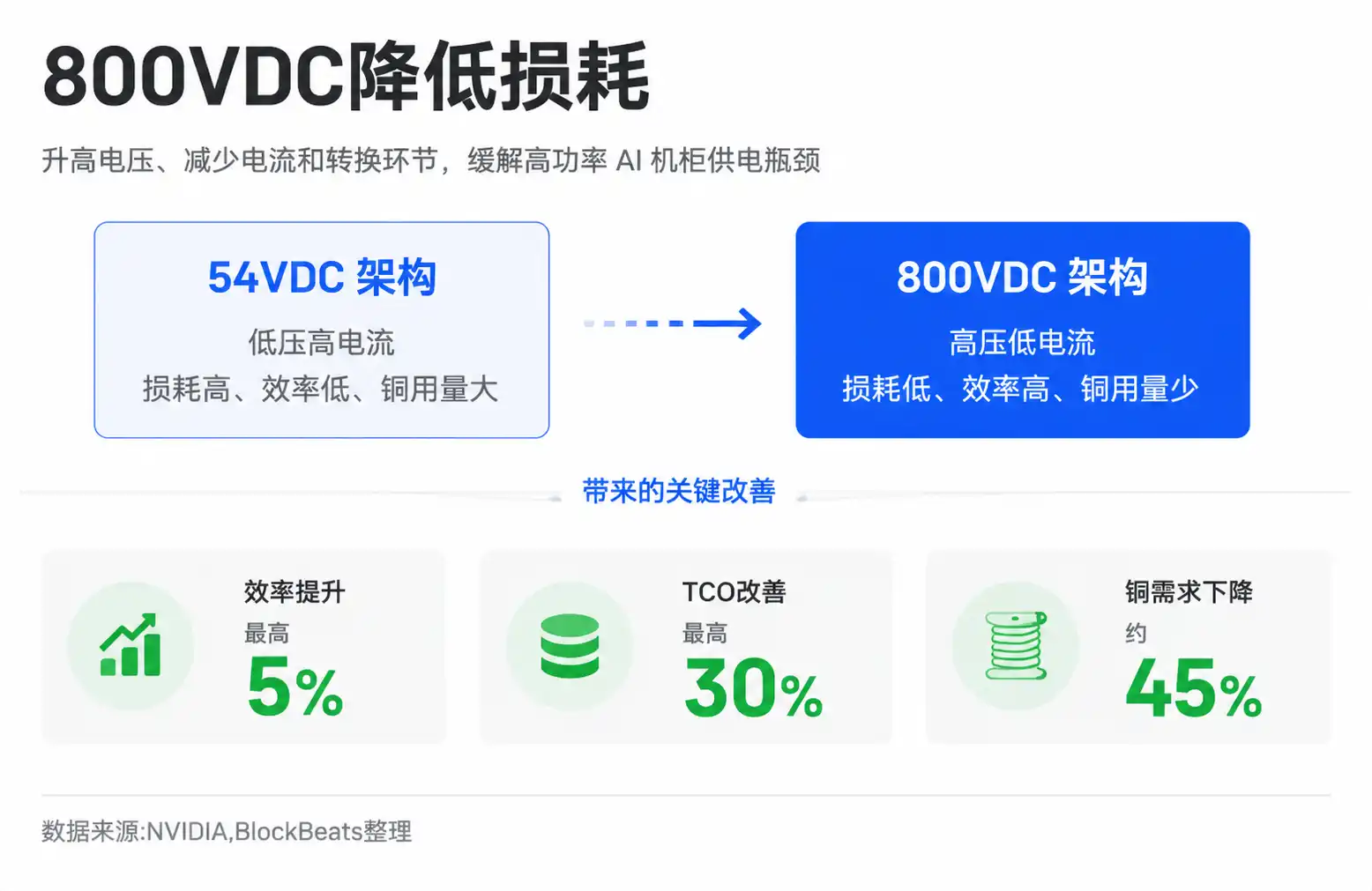
This isn't just about saving copper. For Nvidia, the core value of 800VDC is to enable continued increases in compute density for next-generation AI racks. Low-voltage systems aren't unusable, but in the highest-density AI factories, they are beginning to approach engineering limits.

Nvidia Redefines Infrastructure Roles with Reference Architecture

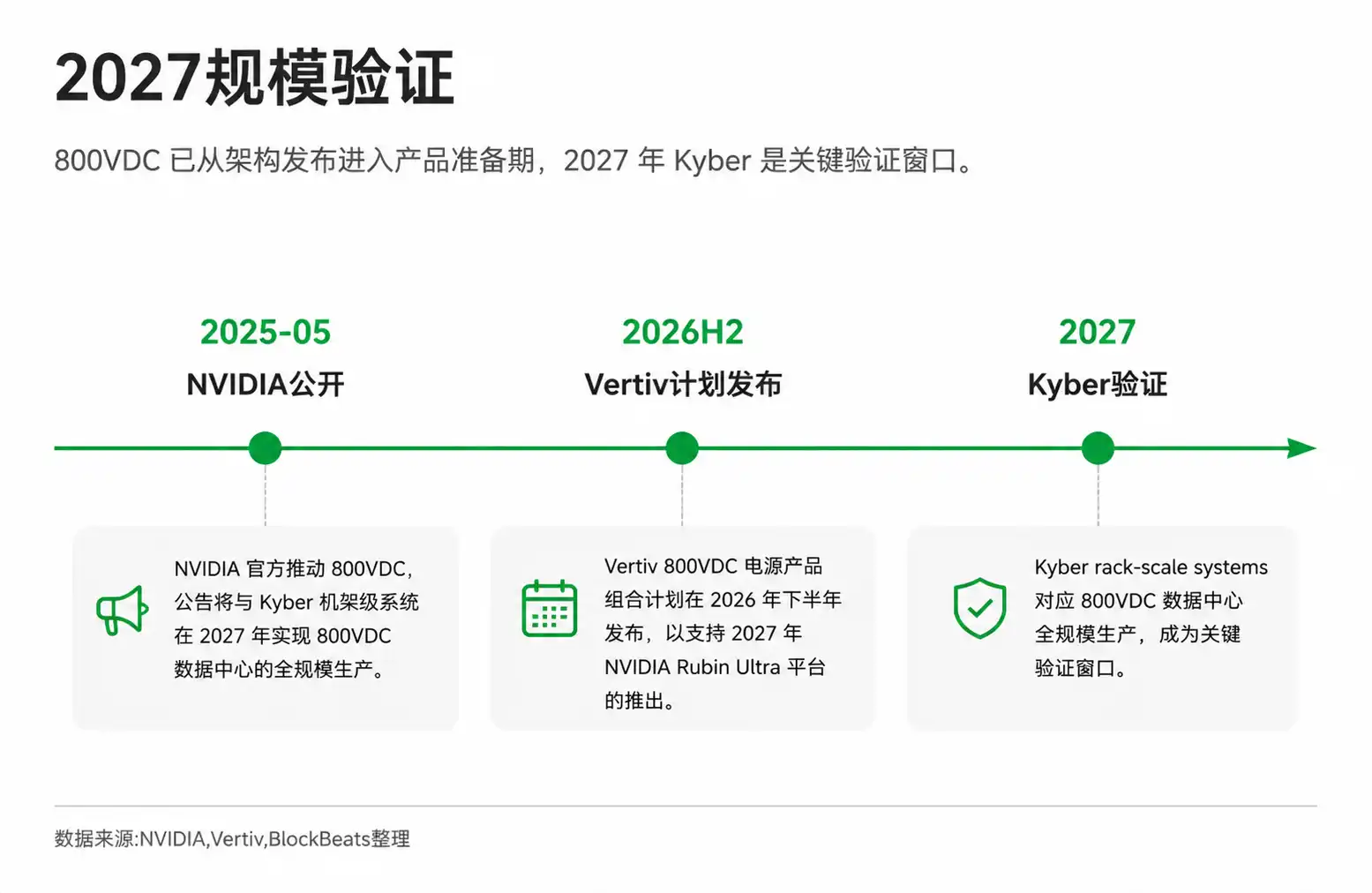
What's significant about Nvidia is not just proposing a voltage solution, but using a reference architecture to redefine the division of labor within the ecosystem. Since 2025, Nvidia has publicly introduced the 800VDC architecture multiple times, showcasing its design direction for high-power systems like Rubin and Kyber racks in technical blogs and at forums like OCP.

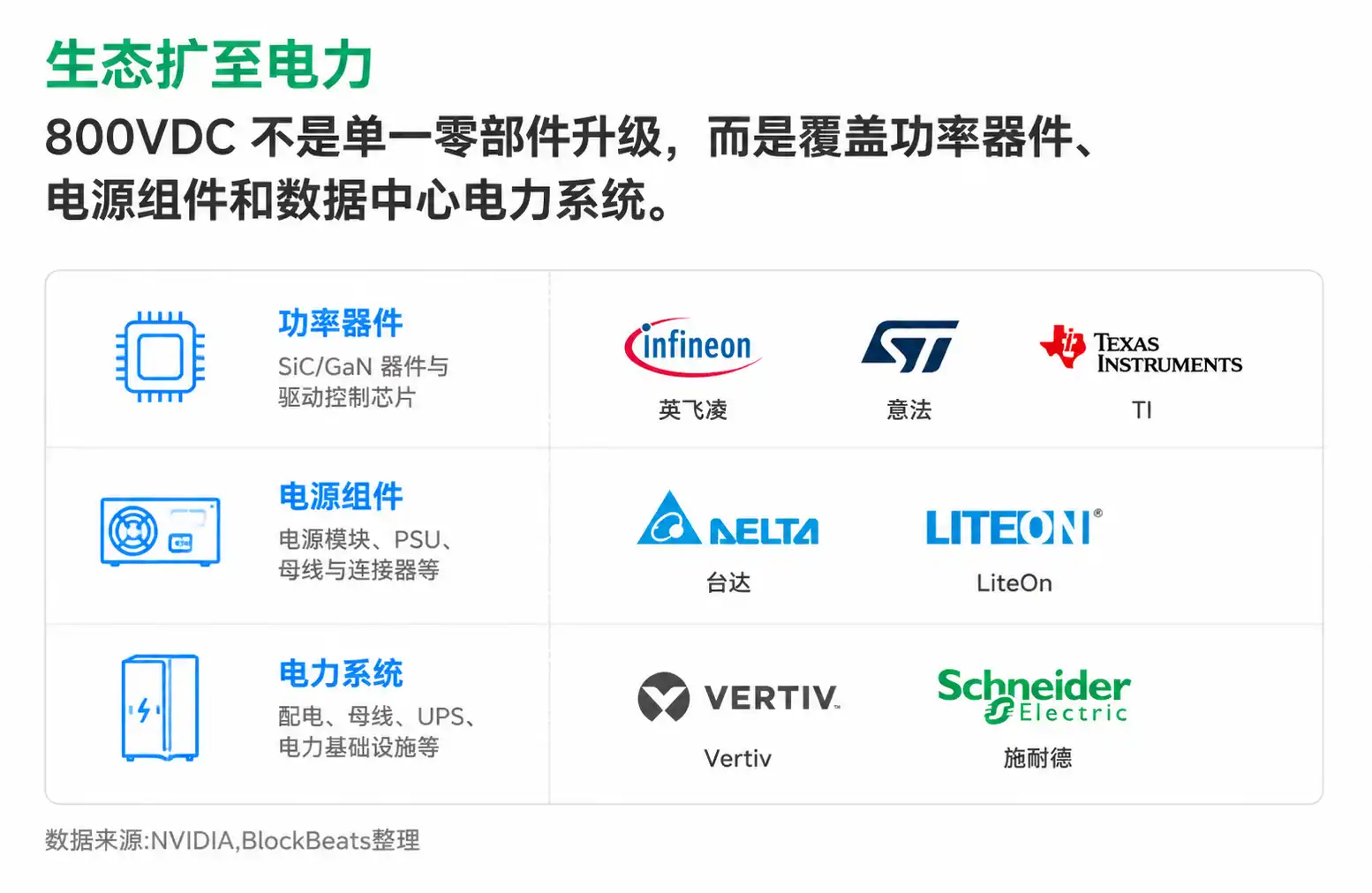
According to Nvidia's official blog, its 800VDC ecosystem partners include Delta Electronics, Schneider Electric, Vertiv, Infineon, STMicroelectronics, as well as companies like ABB, Eaton, GE Vernova, Hitachi Energy, Siemens, Navitas, and Texas Instruments. It's more accurate to describe this as ecosystem collaboration and adaptation, not to be directly interpreted as confirmed orders.
800VDC involves not a single component upgrade, but a change across an entire chain: from data center power distribution and rack power supplies to backup batteries, power devices, connectors, and whole-rack integration. Previously, power conversion might have been distributed across multiple stages like UPS, PDU, server PSUs, and motherboard power delivery. Under a high-voltage DC architecture, power is delivered closer to the rack, then stepped down by modules within or near the GPU.
The weighting within the value chain will also shift accordingly. In the traditional server era, investors focused more on GPUs, CPUs, memory, and system integrators. In the era of high-power AI racks, power shelves, busbars, connectors, power semiconductors, liquid cooling systems, and whole-rack validation capabilities are all becoming part of the delivery capability.

Boundaries must also be clarified. 800VDC is more like an important reference architecture for leading-edge, high-density AI factories, not a standard that all data centers will immediately switch to. Many existing data centers will continue using traditional AC or hybrid architectures. New projects will also adopt it in layers based on power density, cost, owner willingness to retrofit, and safety regulations. What the market is truly trading on is not that everything will switch to 800V this year, but that the infrastructure rules for the highest-density AI racks post-2027 are changing.

Power Supplies, Connectors, Liquid Cooling, and Whole-Rack Testing Move to the Forefront

From an investment perspective, the most direct impact of 800VDC is bringing infrastructure segments that were previously in the background to the forefront.

The first category is power infrastructure companies, such as Vertiv, Schneider Electric, Delta Electronics, and some South Korean and Taiwanese power equipment manufacturers. They are not just selling traditional data center power equipment; they need to participate in the design of power distribution, rack power supply, backup batteries, and high-voltage DC systems for the new generation of AI factories. According to Asia Business Daily, Nvidia has communicated with South Korean power equipment companies like LS Electric, HD Hyundai Electric, and Hyosung regarding 800VDC data center infrastructure. This report is based on industry insider information and should not be equated with confirmed orders, but it illustrates that power equipment providers are being included in the AI factory ecosystem.

The second category is power devices, namely next-generation power switches like SiC/GaN (Silicon Carbide/Gallium Nitride). These are better suited than traditional silicon devices for high-voltage, high-frequency, high-efficiency scenarios. They were often discussed in the context of electric vehicles, charging piles, and industrial power supplies, but are now spilling over into AI data centers. Companies like Infineon and STMicroelectronics are therefore coming into investors' view. However, the benefits for power semiconductors also depend on specific designs, supply share, pricing, and yield, and cannot be simply equated to "800VDC concept stocks."

The third category is connection and mechanical structures, including busbars, power busways, high-voltage connectors, high-end backplanes, and some thick-copper, multi-layer PCBs. When voltage increases and current decreases, copper loss pressure eases, but requirements for insulation, safety, connection reliability, and structural design become higher. Low-end copper materials do not inherently benefit; what's truly valuable are connection and power delivery materials that can adapt to high-power, high-reliability racks.

The fourth category is liquid cooling and whole-rack ODM. As power increases, heat dissipation is no longer a secondary issue. For servers to run stably in customer data centers, they must undergo whole-rack level testing before leaving the factory, including power supply, cooling, networking, and GPU full-load stability. Whole-rack deliverers like Dell, Wiwynn, and Wistron are competing not just on assembly efficiency, but also on whether they have sufficient power, space, liquid cooling testing, and system tuning capabilities.

Design Direction is Clear, but Delivery Capability Requires Real-World Testing

Nvidia has provided a clear technical direction, but supply chain execution won't automatically be smooth. The tension here is precisely what investors need to track.

Independent supply chain analyst Dan Nystedt has recently cited Taiwanese media and industry information multiple times: AI server ODM revenues are strong, Rubin-related production preparations are advancing, but components, power infrastructure, and whole-rack burn-in testing (full-load aging tests) are becoming real constraints. Burn-in can be understood as stress testing of servers before they leave the factory. The power supply, cooling, and system stability of a whole rack of GPUs running at full load for extended periods must all pass together.

If a single rack requires continuous power at the 100-200kW level, the testing facility itself needs power and cooling capacity approaching that of a small data center. Such supply chain signals cannot be written as the industry already commonly having its own power generation, nor can they be directly interpreted as power supply having replaced GPUs as the biggest bottleneck. It's more of a reminder: Delivery in the Rubin era is not just about GPU arrival and motherboard assembly, but about power, liquid cooling, testing, and whole-rack stability all being in place simultaneously.

The logic behind the revaluation of some ODMs, power equipment, and liquid cooling companies is also here. Their value doesn't just come from participating in AI servers, but from their ability to reliably deliver high-power racks to cloud providers. In the future, if everyone gets the same Nvidia reference design, what truly differentiates them might be testing facilities, power capacity, liquid cooling debugging experience, and delivery yield.

For AI cloud providers like CoreWeave and Nebius, 800VDC is not a direct component-benefit logic, but a variable affecting capital expenditure efficiency and deployment speed. Whether high-density racks can be deployed on time impacts computing power delivery, depreciation schedules, and revenue realization. High-speed interconnect or optical module chains, like those involving Marvell or Lumentum, belong more to a parallel logic of AI cluster expansion and should not be confused with direct beneficiaries of 800VDC.

2027 to See Kyber Racks and Order Fulfillment

The direction of 800VDC is much clearer than a year ago: Nvidia is officially promoting it, partners are adapting, physical constraints exist, and leading-edge high-density AI factories need more efficient power delivery. But it is still in the preparation and early deployment window. Nvidia officially states that full-scale production for 800VDC will correspond with the 2027 Kyber rack-scale systems; true validation will depend on whether subsequent products and customer projects materialize.

What's most worth watching next is not whether a company mentions "AI power" in its announcements, but whether it has clearly entered into 800VDC-related products, customer validation, and order fulfillment. Whether ODMs disclose stronger whole-rack testing capabilities, the reliability of liquid cooling systems under prolonged full load, and whether data center owners are willing to retrofit power distribution and safety regulations for high-voltage DC architecture will all influence the rhythm of this trade.

If Rubin-related racks ramp up smoothly and 800VDC component orders move from samples and validation to volume procurement, the market will continue to increase the weighting placed on power supply, liquid cooling, connectors, and whole-rack delivery capabilities. Conversely, if power consumption configurations are lower than expected, customers adopt more conservative hybrid architectures, or testing power and liquid cooling reliability slow down delivery, the 800VDC trade will also shift from directional judgment back to verifying orders and timing. GPUs remain the core, but post-Rubin, the ability to stably deliver a whole rack of high-power systems is beginning to become a variable in asset pricing.

Pertanyaan Terkait

QAccording to the article, why is NVIDIA promoting the 800VDC standard for future AI infrastructure?

ANVIDIA is promoting the 800VDC standard because the power requirements of high-density AI server racks are pushing the limits of traditional low-voltage power delivery. By moving to higher voltage, 800VDC can deliver the same power with lower current, which reduces copper usage, cable size, and power loss, improves efficiency, and allows for continued increases in computing density within a rack.

QWhat are the four main categories of infrastructure companies that the article suggests are brought to the forefront due to the 800VDC push?

AThe four main categories are: 1) Power infrastructure companies (e.g., Vertiv, Schneider Electric, Delta Electronics) involved in design for new AI factories; 2) Power semiconductor companies (e.g., Infineon, STMicroelectronics) producing SiC/GaN devices for efficient high-voltage switching; 3) Connector and structural companies handling busbars, high-voltage connectors, and specialized PCBs; and 4) Liquid cooling and rack-level ODM companies responsible for full rack integration and pre-deployment burn-in testing.

QWhat new challenge for server manufacturers (ODMs) does the article highlight in relation to high-power AI racks like those for Rubin?

AThe article highlights that delivering high-power AI racks requires new capabilities beyond assembly. A key challenge is conducting full rack-level burn-in testing, where an entire rack of GPUs is run at full load for an extended period. This requires the ODM to have access to substantial electrical power and advanced cooling (like liquid cooling) in their testing facilities to ensure system stability before shipment.

QWhat is the key timeline that the article associates with the full-scale production of 800VDC architecture?

AAccording to the article, NVIDIA states that full-scale production for the 800VDC architecture is aligned with the launch of the "Kyber rack-scale systems," which is expected in 2027. True validation will depend on the subsequent product rollouts and customer project implementations.

QHow does the article caution investors about interpreting the list of NVIDIA's 800VDC ecosystem partners?

AThe article cautions that the list of NVIDIA's 800VDC ecosystem partners (including companies like Delta, Schneider, Vertiv, Infineon, etc.) represents collaboration and design adaptation, and should not be directly interpreted as confirmed orders already being placed. The market's focus should shift to tracking which companies secure concrete orders, pass customer validation, and demonstrate actual delivery capabilities.

Bacaan Terkait

AGI Bukan Akhir, Makalah Baru DeepMind: Menuju ASI, Kemajuan AI yang Sesungguhnya Baru Dimulai

Jika Kecerdasan Buatan Umum (AGI) tercapai, apakah itu titik akhir? Tim Google DeepMind dalam laporan terbarunya berpendapat bahwa AGI **bukanlah akhir perjalanan**. AI diprediksi akan terus berkembang melampaui kemampuan tim ahli manusia terbaik, menuju Superintelligence (ASI). Laporan ini membedakan tiga konsep: AGI (kecerdasan setara manusia rata-rata), ASI (melampaui manusia di hampir semua bidang), dan UAI (batas teoretis maksimal). Transisi dari AGI ke ASI dapat melalui empat jalur potensial: 1. **Ekspansi Lanjutan**: Meningkatkan skala komputasi, model, dan data. 2. **Inovasi Algoritma**: Penyempurnaan paradigma yang ada atau pergeseran paradigma baru. 3. **Peningkatan Diri Secara Rekursif**: AI yang lebih kuat membantu mengembangkan generasi AI berikutnya yang lebih kuat. 4. **Koordinasi Multi-Agen**: Kecerdasan kolektif dari banyak sistem AGI yang berkolaborasi. Namun, terdapat enam kemacetan potensial: dinding data, tekanan sumber daya ekonomi & alam, batasan paradigma jaringan saraf saat ini, meningkatnya kesulitan penelitian, hambatan abstraksi, serta tantangan regulasi dan penerimaan sosial. Laporan ini juga menyoroti bahwa jika AI melampaui manusia, sistem evaluasi (benchmark) yang ada menjadi tidak relevan. Diperlukan kerangka pengukuran baru, seperti tugas kolaborasi/kompetisi multi-agen, pengujian yang dihasilkan otomatis, atau indikator tidak langsung seperti produktivitas ekonomi. ASI bukanlah sistem ajaib yang mahatahu; perkembangannya tetap dibatasi oleh hukum fisika, kompleksitas komputasi, data, sumber daya, dan umpan balik dunia nyata. Arah dan kecepatan kemajuan AI masih penuh ketidakpastian, sehingga memerlukan penelitian, prediksi, dan mekanisme evaluasi yang terus diperbarui.

marsbit38m yang lalu

AGI Bukan Akhir, Makalah Baru DeepMind: Menuju ASI, Kemajuan AI yang Sesungguhnya Baru Dimulai

marsbit38m yang lalu

Penetapan Harga Pra-Pasar untuk OpenAI: Bisnis Baru dengan Masa Hidup Setengah Tahun di Hyperliquid

Penulis: Curry, TechFlow Deep潮 Di tengah demitasi SpaceX, kontrak pra-pencatatan SPCX di Hyperliquid viral, namun sedikit yang tahu bahwa di baliknya ada tim bernama Trade.xyz. Tim anonim yang baru muncul tahun ini ini menguasai lebih dari 90% posisi kontrak pra-pencatatan di Hyperliquid, menjadi penggerak utama tren Pre-IPO SpaceX di on-chain. Hanya tiga hari setelah SpaceX IPO, Ventuals, pesaing dengan backing Paradigm yang menawarkan kontrak pra-pencatatan untuk SpaceX, OpenAI, dan Anthropic, mengumumkan penutupan setelah beroperasi sembilan bulan. Menariknya, Ventuals tutup bukan karena bangkrut, tetapi melalui akuisisi, dengan modal pengguna dikembalikan 1:1. Perbedaan kesuksesan keduanya terletak pada pemilihan aset. Trade.xyz memilih SpaceX yang tanggal IPO dan harga patokannya (Nasdaq) jelas, sehingga harga pra-pencatatannya memiliki "jangkar" realitas. Sebaliknya, Ventuals mematok pada OpenAI dan Anthropic yang belum ada rencana IPO nyata. Harga acuannya setengah berasal dari transaksi saham internal (private) dan setengah lagi dari rata-rata harganya sendiri di platform, menciptakan siklus harga yang terisolasi dari pasar sebenarnya. Akibatnya, likuiditas rendah dan harga cenderung mandek di level tertinggi. Saat tutup, Ventuals membekukan harga akhir berdasarkan rata-rata 24 jam terakhir: OpenAI di $1341.80 dan Anthropic di $1618.90 per saham. Ironisnya, harga yang dianggap kurang representatif ini justru digunakan oleh beberapa karyawan dan investor internal perusahaan tersebut sebagai acuan valuasi, menunjukkan kebutuhan kuat akan harga real-time untuk aset privat. Bisnis penentuan harga pra-pencatatan ini semakin ramai. Coinbase meluncurkan kontrak berkelanjutan pra-pencatatan, Polymarket membuat pasar prediksi, dan Citi menawarkan saham perusahaan privat yang ditokenisasi. Kebutuhan akan akses perdagangan aset privat seperti ini nyata, terutama bagi investor ritel. Namun, penutupan Ventuals menggarisbawahi tantangan utama: harga memerlukan mekanisme koreksi dari pasar yang terbuka dan likuid. Tantangan ini tetap ada terlepas dari siapa penyelenggaranya, sampai perusahaan seperti OpenAI benar-benar go public dan memiliki harga pasar yang sesungguhnya.

marsbit48m yang lalu

Penetapan Harga Pra-Pasar untuk OpenAI: Bisnis Baru dengan Masa Hidup Setengah Tahun di Hyperliquid

marsbit48m yang lalu

Dialog dengan Kepala Strategi Digital Morgan Stanley: Bitcoin Mencapai Satu Juta Dolar Bukan Tidak Mungkin, Tapi Saya Harap Perlahan

Morgan Stanley mengelola triliunan dolar aset dan sekarang membawa Bitcoin ke klien mereka. Amy Oldenburg, Kepala Strategi Aset Digital di Morgan Stanley, membagikan wawasannya tentang perjalanan Bitcoin. Ia menyoroti kontras antara ETF Bitcoin (MSBT) yang mencetak rekor peluncuran hari pertama di bank tersebut, dengan sebagian besar penasihat keuangan yang masih enggan merekomendasikannya karena harga Bitcoin cenderung stagnan sejak rekomendasi resmi bank. Oldenburg berpendapat bahwa adopsi Bitcoin selanjutnya mungkin memerlukan katalis berupa peristiwa yang mengganggu sistem keuangan tradisional. Ia tidak terkejut jika Bitcoin mencapai satu juta dolar dalam lima tahun, tetapi berharap kenaikan tersebut terjadi secara perlahan untuk stabilitas aset. Dia menekankan pentingnya pendidikan dalam mengatasi kesenjangan pemahaman, termasuk perbedaan mendasar antara memegang Bitcoin secara langsung dan melalui ETP, serta perbedaan antara berbagai aset kripto. Meskipun institusi keuangan besar seperti Morgan Stanley menawarkan layanan terpusat yang memudahkan likuiditas dan perencanaan warisan, Oldenburg menghargai dan berharap semangat 'cypherpunk' dan kedaulatan diri dalam ekosistem Bitcoin tetap hidup. Menurutnya, perjalanan aset digital masih sangat panjang dan akan terus berkembang seiring dengan kemajuan teknologi.

marsbit1j yang lalu

Dialog dengan Kepala Strategi Digital Morgan Stanley: Bitcoin Mencapai Satu Juta Dolar Bukan Tidak Mungkin, Tapi Saya Harap Perlahan

marsbit1j yang lalu

"Tujuh Raksasa" Tidak Cukup Lagi? IPO SpaceX Diborong Retail, Wall Street Sajikan "Sepuluh Raksasa AI & Teknologi"

SpaceX meluncurkan IPO pada hari Jumat dengan sukses besar, menarik investasi ritel bersih sebesar $117 juta pada hari pertama, atau 56% dari semua pembelian saham ritel AS hari itu. Menanggapi fenomena ini, lembaga riset Vanda Research mengusulkan konsep baru "FAB 10" (Frontier AI & Big Tech 10) untuk menggantikan grup "Tujuh Raksasa" yang lama. Konsep ini mencakup sepuluh perusahaan teknologi dan AI terdepan, dengan menambahkan SpaceX, OpenAI, dan Anthropic ke dalam tujuh raksasa yang ada. OpenAI dan Anthropic diharapkan akan go public akhir tahun ini dengan valuasi yang sangat tinggi. Analis Vanda berpendapat bahwa perusahaan-perusahaan ini mewakili arah industri teknologi dan AI untuk dekade mendatang. Namun, antusiasme investor ritel terhadap SpaceX berpotensi mengalihkan modal dari sektor lain seperti saham semikonduktor, yang sebelumnya populer. Sementara itu, Bank of America memiliki versi lain yang disebut "AI Big 10", yang lebih berfokus pada perusahaan perangkat keras semikonduktor seperti Broadcom, AMD, dan Micron. Perbedaan ini mencerminkan taruhan berbeda tentang pemain kunci masa depan. Analis memperingatkan bahwa valuasi di sektor teknologi secara keseluruhan mulai menunjukkan tanda-tanda gelembung. Keberlanjutan optimisme pasar, terutama mengingat valuasi SpaceX yang mencapai $1,75 triliun, masih harus diuji oleh waktu.

marsbit1j yang lalu

"Tujuh Raksasa" Tidak Cukup Lagi? IPO SpaceX Diborong Retail, Wall Street Sajikan "Sepuluh Raksasa AI & Teknologi"

marsbit1j yang lalu

Trading

Spot
Futures

Artikel Populer

Cara Membeli T

Selamat datang di HTX.com! Kami telah membuat pembelian Threshold Network Token (T) menjadi mudah dan nyaman. Ikuti panduan langkah demi langkah kami untuk memulai perjalanan kripto Anda.Langkah 1: Buat Akun HTX AndaGunakan alamat email atau nomor ponsel Anda untuk mendaftar akun gratis di HTX. Rasakan perjalanan pendaftaran yang mudah dan buka semua fitur.Dapatkan Akun SayaLangkah 2: Buka Beli Kripto, lalu Pilih Metode Pembayaran AndaKartu Kredit/Debit: Gunakan Visa atau Mastercard Anda untuk membeli Threshold Network Token (T) secara instan.Saldo: Gunakan dana dari saldo akun HTX Anda untuk melakukan trading dengan lancar.Pihak Ketiga: Kami telah menambahkan metode pembayaran populer seperti Google Pay dan Apple Pay untuk meningkatkan kenyamanan.P2P: Lakukan trading langsung dengan pengguna lain di HTX.Over-the-Counter (OTC): Kami menawarkan layanan yang dibuat khusus dan kurs yang kompetitif bagi para trader.Langkah 3: Simpan Threshold Network Token (T) AndaSetelah melakukan pembelian, simpan Threshold Network Token (T) di akun HTX Anda. Selain itu, Anda dapat mengirimkannya ke tempat lain melalui transfer blockchain atau menggunakannya untuk memperdagangkan mata uang kripto lainnya.Langkah 4: Lakukan trading Threshold Network Token (T)Lakukan trading Threshold Network Token (T) dengan mudah di pasar spot HTX. Cukup akses akun Anda, pilih pasangan perdagangan, jalankan trading, lalu pantau secara real-time. Kami menawarkan pengalaman yang ramah pengguna baik untuk pemula maupun trader berpengalaman.

894 Total TayanganDipublikasikan pada 2024.12.10Diperbarui pada 2026.06.02

Cara Membeli T

Diskusi

Selamat datang di Komunitas HTX. Di sini, Anda bisa terus mendapatkan informasi terbaru tentang perkembangan platform terkini dan mendapatkan akses ke wawasan pasar profesional. Pendapat pengguna mengenai harga T (T) disajikan di bawah ini.

活动图片