When Even the Shovel Sellers Borrow to Buy Shovels: The US Stock AI Sector Evaporates Trillions in a Week, as the Market Begins Pricing AI's 'Bill'

marsbitDipublikasikan tanggal 2026-06-11Terakhir diperbarui pada 2026-06-11

Abstrak

Last week saw a sharp sell-off in the US AI sector, erasing trillions in market value despite companies reporting record financials. Key events included Alphabet's massive equity raise despite having over $1.2 trillion in cash, Broadcom's stock plummeting after its quarterly report, a 4% Nasdaq drop, and Oracle's stock falling even after posting record revenue and backlog. The market's focus shifted from stellar income statements to cash flow and balance sheets, questioning the massive and increasingly leveraged capital expenditures required to fund the AI infrastructure race. Analysts point out that while growth is strong, profitability and the visibility of AI monetization are now under scrutiny. The financing chain stretches from cash-rich giants like Alphabet raising debt and equity, to chipmakers like Broadcom facing margin pressure, to cloud providers like Oracle with negative free cash flow funding via debt, and finally to unprofitable AI labs like OpenAI and Anthropic—who are the ultimate customers for much of this infrastructure. The market is beginning to price the risk of this concentrated, leveraged bill coming due, with the upcoming SpaceX IPO serving as the next test for this financing ecosystem.

Author: Ada, Deep Tide TechFlow

Over the past week, the US stock AI sector presented a strange picture, with records being broken one after another and stocks being sold off one after another.

On June 1, Alphabet, sitting on hundreds of billions in cash, announced one of the largest equity financings in history; On June 3 after market close, Broadcom delivered its best-ever quarterly report, only for its stock to crash the next day; On June 5, the Nasdaq plunged 4% in a single day, with the semiconductor sector shedding roughly $1 trillion in market value in one session; On June 10 after market close, Oracle reported record revenue and backlog, yet its stock still fell; On June 11, the pricing moment arrived for what is set to be the largest SpaceX IPO in history. The financial numbers themselves are not the issue; the problem is the way these numbers are being achieved: more and more money is being borrowed into this AI infrastructure race through increasingly complex means. When the market began tallying up this bill, even record-breaking numbers couldn't save stock prices.

The Same Script: Record First, Then Get Sold Off

Broadcom went first. According to its earnings report and multiple media outlets, for its fiscal Q2 ended May 3, Broadcom's revenue reached $22.219 billion, up 48% year-over-year; AI chip revenue was $10.8 billion, surging 143% year-over-year; and earnings per share exceeded Wall Street expectations. But the market focused solely on one gap: the company's AI chip revenue guidance for the next quarter is $16 billion, below analyst expectations, and CEO Hock Tan did not raise the full-year AI revenue target, mentioning that Google might diversify its chip supply chain. Nonetheless, Broadcom's stock plummeted about 15% the next day, erasing nearly $280 billion in market value in a single day, making it one of the largest single-day market cap losses in Wall Street history.

Oracle's turn came a week later. According to its earnings report and CNBC, for its fiscal Q4 ended May 31, Oracle's revenue was $19.2 billion, up 21% year-over-year; cloud infrastructure revenue was $5.8 billion, up 93% year-over-year; adjusted EPS was $2.11, beating analyst expectations of $1.95. The backlog was even more staggering: Remaining Performance Obligations (RPO) reached $638 billion, skyrocketing 363% year-over-year, far exceeding analyst expectations of $595.7 billion. Yet the stock also didn't find favor, dropping about 9% in after-hours trading.

Sandwiched between these two earnings reports was a broad sell-off on June 5. According to TheStreet and CNBC, the Nasdaq Composite Index fell 4% that day, its worst single-day performance since the April 2025 tariff turmoil, triggered by Broadcom's cautious AI chip outlook, with AMD and Intel leading the decline across the entire semiconductor sector.

It is worth noting that the June 5 plunge wasn't solely about "AI skepticism." That day, US non-farm payrolls added 172,000 jobs, far exceeding expectations, pushing up rate hike expectations and triggering a rotation from high-valuation growth stocks into defensive sectors like healthcare and consumer staples. AI stocks, having the highest valuations, fell the hardest. In other words, macroeconomic interest rates and sector rotation were one driver, while concerns over AI capital expenditures were another. The two factors compounded, rather than having a single cause.

What's Being Sold Off Isn't the Income Statement, It's the Cash Flow Statement

Putting these three market segments together reveals a commonality: the income statement is still recording "record-breaking" numbers, but the market has already switched to reading the cash flow statement and the balance sheet. The pricing focus has shifted from "how much was earned" to "how much more will be burned and borrowed to earn this."

Oracle is the most straightforward case study. According to its earnings report, for the full FY2026, operating cash flow reached a record $32 billion, up 54% year-over-year, but free cash flow was negative $23.7 billion. For the year, the company has already raised $43 billion in debt and $5 billion in equity. What truly broke investor sentiment was its forward-looking language. According to CNBC, Oracle plans to raise approximately $40 billion more in FY2027 through a combination of debt and equity. A company that just raised nearly $50 billion, with negative free cash flow, and now forecasts another $40 billion financing round—when this appears alongside "record-breaking" numbers, the market chose to price the former.

Broadcom's logic is similar, but manifests elsewhere. According to Barron's, Broadcom lowered its Q3 gross margin guidance from 77% to 74%, attributing it to a higher revenue mix from lower-margin AI chips. Coupled with a retreat from "selling complete systems" to "selling only chips," and customers demanding chip leases to pass on financing pressure, the market sees a business with explosive growth, but deteriorating margins and capital intensity.

Goldman Sachs provided a framework for this shift. According to its research report, investors' tolerance for capital expenditure growth depends on earnings strength and the visibility of AI monetization; the same report noted that Alphabet's stock rose due to raising its profit guidance, while Meta's fell due to flat guidance. The market is no longer indiscriminately rewarding "growth," but differentiating winners from losers based on "the ability to monetize."

The Financing Chain Takes Center Stage: Even the Most Cash-Rich Players Are Borrowing

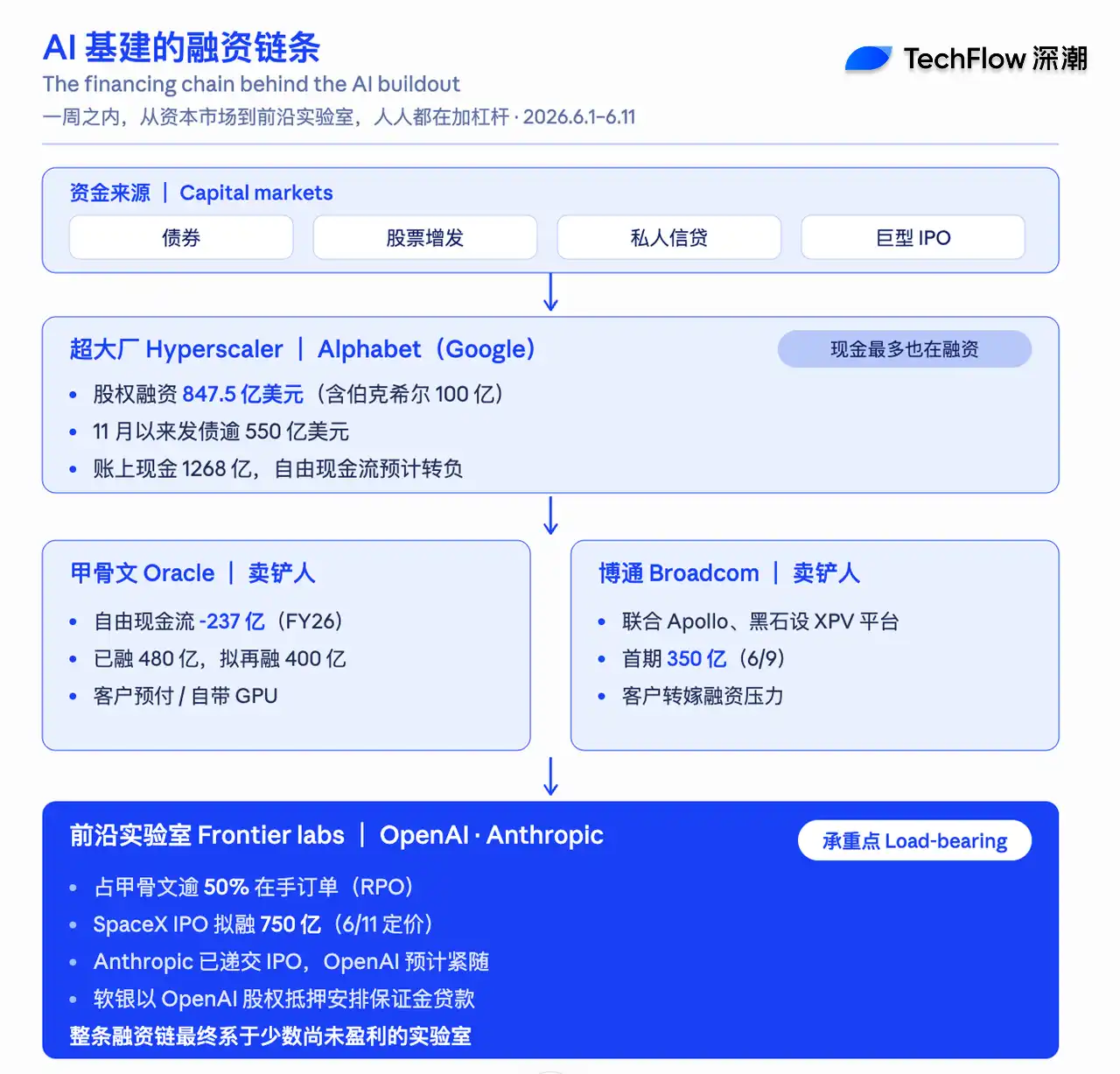
If the income statement is the surface, the financing chain is the true protagonist of this past week. From the very upstream to the very downstream, almost every link is paying for this same AI infrastructure build-out by leveraging up or diluting equity.

The most convincing case study is Alphabet. According to its SEC filing, on June 1, it announced an $80 billion equity financing; on June 2, it upsized and priced the deal at $84.75 billion, including a $10 billion private investment from Berkshire Hathaway. The anomaly is that this company is not short on cash at all. According to multiple media reports, Alphabet had $126.8 billion in cash as of March 2026, annual operating cash flow of $174 billion, and has issued over $55 billion in new debt since November. Despite this, Melius Research estimates Google's free cash flow will turn negative in the coming years. Investor Dan Niles' commentary on this is that capital is not infinite, and the fact that Google, with "the strongest technology stack in all of AI," still needs to raise massive amounts of financing precisely illustrates the intensity of this round of investment.

Looking downstream, every link on the chain is doing the same. New cloud vendor Oracle has negative free cash flow, relies on dual-track debt and equity financing, and asks customers to prepay for GPU costs or bring their own GPUs to reduce its own construction capital outlay; the chip "shovel sellers" like Broadcom, on June 9, partnered with Apollo and Blackstone to establish the AI XPV Platform, with an initial $35 billion targeting over 20 gigawatts of computing power by 2028, serving frontier labs including Anthropic and OpenAI. And at the very end of the chain, the labs are simultaneously employing even more aggressive tools: there were previous reports of SoftBank arranging margin loans secured by OpenAI equity; now SpaceX is rushing towards a Nasdaq IPO targeting $75 billion, Anthropic has confidentially filed for an IPO, and OpenAI is expected to follow closely.

The total scale of this investment is also rapidly inflating. According to CreditSights, the combined capital expenditure for mega-cap companies in 2026 is estimated at around $750 billion, up about 67% from 2025; Goldman Sachs' alternative metric puts the 2026 capex forecast for mega-caps at $518 billion, revised up from $314 billion at the start of the year. Whichever metric is used, the direction is consistent: expenditures are accelerating, the portion that can be covered by operating cash flow is shrinking, and the gap needs to be filled by capital markets.
The Chain's Pressure Point Rests on a Few Unprofitable Labs

Leverage itself isn't terrifying; what's terrifying is who the leverage ultimately rests upon. Pulling this financing chain to its end reveals that its pressure point is highly concentrated.

Oracle's $638 billion backlog seems impregnable, but according to Bank of America, over 50% comes from OpenAI alone; simultaneously, Oracle also disclosed that most of the RPO growth in the past two quarters came from large AI contracts, with customers either prepaying GPU costs or procuring GPUs themselves before handing them to Oracle. Broadcom's six major custom chip customers are similarly concentrated among a handful like Google, Meta, Anthropic, and OpenAI. In other words, from the financing of the mega-caps, to the orders of the "shovel sellers," to the injection of private credit and insurance funds, the ultimate payer for the entire chain converges onto a small group of unprofitable frontier labs like OpenAI and Anthropic, who are themselves queuing up for funding.

The record-breaking revenue is real, and the $638 billion backlog is real; but the buyers of these orders are highly concentrated, are themselves sustained by financing, and the leverage of the entire chain is being re-examined by the market. This past week, the market did not deny AI's growth; it simply started demanding to see clearly who will pay the bill for this growth, and how. SpaceX is set to price after market close on June 11 and list on the Nasdaq at $135 per share, with a valuation of approximately $1.77 trillion on June 12. Whether this largest-ever IPO can be digested smoothly will be the next stress test for this financing chain.


Kripto yang Sedang Tren

Pertanyaan Terkait

QWhat were the main reasons behind the significant sell-off in the AI sector of the U.S. stock market over the past week?

AThe sell-off was driven by a combination of macroeconomic factors and sector-specific concerns. The stronger-than-expected U.S. non-farm payrolls data raised interest rate expectations, triggering a rotation from high-valuation growth stocks (like AI) into defensive sectors. Simultaneously, the market began to reassess the massive capital expenditure required for AI infrastructure. Companies like Broadcom and Oracle reported record revenues but also signaled the need for continued heavy investment and financing, leading to a market focus on negative free cash flow and growing debt, which caused their stock prices to fall despite strong earnings.

QHow did the market's valuation focus shift for AI companies like Oracle and Broadcom, according to the article?

AThe market's valuation focus shifted from the income statement (profit and revenue growth) to the cash flow statement and balance sheet. Investors are no longer just rewarding 'record' earnings; they are now pricing in the significant capital required to generate those earnings. For example, Oracle's record $638 billion backlog and revenue were overshadowed by its negative free cash flow and plans for further large-scale debt and equity financing. For Broadcom, the market focused on the declining gross margin guidance and the increased capital intensity of its AI chip business, even as AI revenue soared.

QWhy did Alphabet, despite having a massive cash reserve, conduct a major equity financing round?

AAlphabet announced an $84.75 billion equity financing round even with $1268 billion in cash and strong annual operating cash flow because, according to analyst estimates (like from Melius Research), its free cash flow is projected to turn negative in the coming years due to the immense intensity of AI infrastructure investment. As noted by investor Dan Niles, this move by a company with the 'strongest technology stack in AI' highlights the enormous scale of capital required for this buildout, suggesting that even the most cash-rich players need to tap external funding to sustain the AI arms race.

QWhat is the common weak point or 'pressure point' in the AI infrastructure financing chain identified in the article?

AThe common weak point or 'pressure point' in the AI financing chain is its heavy reliance on a small group of unprofitable, frontier AI labs like OpenAI and Anthropic. A significant portion of the record orders for companies like Oracle (over 50% from OpenAI alone) and Broadcom's major custom chip customers are concentrated with these labs. These labs are themselves dependent on continued fundraising (e.g., private credit, impending IPOs) to pay their bills. This creates a concentrated risk where the entire chain's viability depends on the financial health and ability of a few non-profitable entities to keep raising capital.

QWhat upcoming event does the article suggest will be the next major test for the AI financing chain?

AThe article suggests that SpaceX's upcoming IPO, scheduled to price on June 11 and list on Nasdaq on June 12 with a target valuation of approximately $1.77 trillion, will be the next major test for the AI financing chain. As the largest IPO in history, its success in being absorbed by the market will serve as a crucial indicator of investor appetite and capacity to fund the massive capital requirements at the end of the AI infrastructure investment chain.

Bacaan Terkait

Mundur Terhitung: GPT-5.6 – Tinggalkan Khayalan API Tunggal, Iterasi Daya Komputasi Secepat Apa Pun Takkan Lawan Satu Aturan Kepatuhan

Pada pertengahan Juni, tiga peristiwa industri — pembatasan akses Fable 5 karena kepatuhan regulasi, pengumuman open-source GLM-5.2, dan kebocoran tanggal rilis GPT-5.6 — menandai titik balik dalam industri AI global. Logika dasarnya telah berubah: Pertama, **"ketersediaan" kini lebih penting daripada "kemajuan teknis"**, dengan rantai pasok model besar memasuki fase "sistem ganda": model tertutup yang dikontrol dan model open-source lokal. Kedua, **penghalang kompetisi raksasa model tertutup bergeser**. Fokus teknis beralih dari "kecerdasan bahasa" ke "kecerdasan spasial (model dunia)" yang sangat bergantung pada komputasi. Ketiga, menghadapi risiko kepatuhan regulasi lintas batas yang常态, **desain arsitektur "model-agnostic" telah menjadi kebutuhan dasar bagi pengembang aplikasi untuk menjaga keberlanjutan bisnis**. Fable 5 (Anthropic) dibatasi aksesnya bagi non-warga AS hanya 72 jam setelah diluncurkan, menunjukkan bahwa kemajuan teknologi kini berbanding lurus dengan risiko regulasi. Di sisi lain, model open-source seperti GLM-5.2 menawarkan peningkatan kinerja yang stabil dan keunggulan biaya signifikan (hingga 90% lebih murah), sekaligus menjadi cadangan penting untuk manajemen risiko kepatuhan perusahaan global. Sementara itu, GPT-5.6 dikabarkan akan fokus pada "kecerdasan spasial" atau "model dunia", berusaha membangun keunggulan baru di bidang seperti simulasi industri dan robotika yang membutuhkan daya komputasi masif. Kesimpulannya, logika evaluasi infrastruktur AI telah berubah dari sekadar kinerja teknis menjadi pertimbangan gabungan antara kinerja, kepatuhan regulasi, dan stabilitas akses. Bagi pengembang, ketergantungan pada API tertutup tunggal mengandung risiko tinggi. Menerapkan arsitektur "model-agnostic" untuk memungkinkan peralihan cepat ke alternatif open-source lokal telah menjadi prinsip dasar untuk menjaga kelangsungan bisnis.

marsbit2j yang lalu

Mundur Terhitung: GPT-5.6 – Tinggalkan Khayalan API Tunggal, Iterasi Daya Komputasi Secepat Apa Pun Takkan Lawan Satu Aturan Kepatuhan

marsbit2j yang lalu

Perang Subsidi Token "Raksasa AI", Sudah Hampir Selesai?

Perang subsidi token antara raksasa AI seperti Google, OpenAI, dan Anthropic mungkin tidak akan segera berakhir, tetapi sifatnya berbeda dari perang subsidi era internet. Analisis dari SemiAnalysis menunjukkan bahwa harga token saat ini sebenarnya sudah sangat disubsidi, dengan paket berlangganan AI premium bahkan mungkin disubsidi hingga 70 kali lipat dari biaya berlangganannya. Namun, tidak seperti layanan seperti taksi online atau pengiriman makanan, token AI hampir tidak memiliki efek "penguncian" (*lock-in effect*). Pengguna dan pengembang dapat dengan mudah beralih antara model AI karena API yang semakin standar. Ini berarti begitu subsidi dihentikan dan harga dinaikkan, pengguna bisa langsung beralih. Bill Maris dari Google Ventures memprediksi dengan keyakinan 100% bahwa Google, dengan pendapatan iklannya yang besar, bisa memotong harga token hingga 80% sebagai senjata. Bagi OpenAI dan Anthropic yang bergantung pada pendanaan investor, hal ini akan menjadi tekanan bisnis yang berat, terutama setelah mereka masuk bursa dan harus menunjukkan profitabilitas. Dua skenario akhir yang mungkin adalah: 1) skenario monopolistik ala internet di mana satu pemenang muncul dan kemudian menaikkan harga, atau 2) skenario "listrik-air-bahan bakar" di mana token menjadi infrastruktur dasar yang terstandarisasi dengan margin keuntungan yang sangat tipis. Artikel berargumen bahwa skenario kedua lebih mungkin karena kurangnya efek penguncian pada token AI. Kompetisi ini mungkin bukan perang untuk dimenangkan, melainkan permainan tanpa akhir untuk tetap berada di meja permainan. Bagi pengguna, selama perang subsidi ini berlanjut, mereka akan terus menikmati akses ke kemampuan AI canggih dengan biaya yang sangat terjangkau dibandingkan dengan biaya komputasi sebenarnya.

marsbit2j yang lalu

Perang Subsidi Token "Raksasa AI", Sudah Hampir Selesai?

marsbit2j yang lalu

Di Luar Lapangan: Permainan Mengejar Keuntungan di Sekitar Piala Dunia

Di luar lapangan, Piala Dunia bukan hanya festival penggemar sepak bola, tetapi juga jendela langka bagi spekulasi global. Turnamen ini memusatkan perhatian, emosi, identitas, kesenjangan informasi, dan sumber daya langka selama lebih dari sebulan, menciptakan ekosistem spekulasi yang luas. Pasar prediksi seperti Polymarket dan Kalshi mencatat pertumbuhan pesat, dengan volume perdagangan miliaran dolar, menawarkan narasi kekayaan baru dibandingkan taruhan olahraga tradisional yang tetap menjadi tulang punggung dengan basis pengguna yang matang. Pasar saham juga bereaksi, menciptakan "saham konsep" seperti produsen ayam goreng di Korea Selatan yang harganya melonjak terkait acara nonton bareng. Pasar sekunder tiket menjadi arena arbitrase, di mana harga bisa meroket untuk pertandingan tim populer seperti Portugal, sementara tiket lain justru turun. Barang koleksi seperti stiker Panini dan jersey edisi terbatas juga menjadi komoditas spekulasi, dengan harga melambung di platform seperti eBay. Spekulasi lebih liar muncul di crypto melalui ribuan token meme bertema Piala Dunia yang sangat volatil, meski penuh risiko penipuan. Lapisan terakhir adalah bisnis informasi: alat pelacak tiket seperti SeatSidekick dan layanan berlangganan rekomendasi taruhan memanfaatkan permintaan akan data dan keunggulan informasi. Intinya, Piala Dunia telah menjadi eksperimen spekulasi raksasa di mana aliran perhatian dan emosi menciptakan jaringan perdagangan global yang menyelesaikan transaksinya sendiri jauh dari lapangan hijau.

marsbit3j yang lalu

Di Luar Lapangan: Permainan Mengejar Keuntungan di Sekitar Piala Dunia

marsbit3j yang lalu

Trading

Spot
Futures

Artikel Populer

Cara Membeli BILL

Selamat datang di HTX.com! Kami telah membuat pembelian Billions Network (BILL) menjadi mudah dan nyaman. Ikuti panduan langkah demi langkah kami untuk memulai perjalanan kripto Anda.Langkah 1: Buat Akun HTX AndaGunakan alamat email atau nomor ponsel Anda untuk mendaftar akun gratis di HTX. Rasakan perjalanan pendaftaran yang mudah dan buka semua fitur.Dapatkan Akun SayaLangkah 2: Buka Beli Kripto, lalu Pilih Metode Pembayaran AndaKartu Kredit/Debit: Gunakan Visa atau Mastercard Anda untuk membeli Billions Network (BILL) secara instan.Saldo: Gunakan dana dari saldo akun HTX Anda untuk melakukan trading dengan lancar.Pihak Ketiga: Kami telah menambahkan metode pembayaran populer seperti Google Pay dan Apple Pay untuk meningkatkan kenyamanan.P2P: Lakukan trading langsung dengan pengguna lain di HTX.Over-the-Counter (OTC): Kami menawarkan layanan yang dibuat khusus dan kurs yang kompetitif bagi para trader.Langkah 3: Simpan Billions Network (BILL) AndaSetelah melakukan pembelian, simpan Billions Network (BILL) di akun HTX Anda. Selain itu, Anda dapat mengirimkannya ke tempat lain melalui transfer blockchain atau menggunakannya untuk memperdagangkan mata uang kripto lainnya.Langkah 4: Lakukan trading Billions Network (BILL)Lakukan trading Billions Network (BILL) dengan mudah di pasar spot HTX. Cukup akses akun Anda, pilih pasangan perdagangan, jalankan trading, lalu pantau secara real-time. Kami menawarkan pengalaman yang ramah pengguna baik untuk pemula maupun trader berpengalaman.

229 Total TayanganDipublikasikan pada 2026.05.07Diperbarui pada 2026.06.02

Cara Membeli BILL

Diskusi

Selamat datang di Komunitas HTX. Di sini, Anda bisa terus mendapatkan informasi terbaru tentang perkembangan platform terkini dan mendapatkan akses ke wawasan pasar profesional. Pendapat pengguna mengenai harga BILL (BILL) disajikan di bawah ini.

活动图片