1 Billion DOT Minted Out of Thin Air, Yet Hacker Only Made $230,000

marsbitDipublikasikan tanggal 2026-04-13Terakhir diperbarui pada 2026-04-13

Abstrak

On April 13, a security breach occurred involving the Polkadot bridge on the Ethereum network, where an attacker exploited a replay vulnerability in the MMR proof mechanism of Hyperbridge’s ISMP protocol. By reusing a historically valid proof and pairing it with a malicious request, the attacker bypassed verification and gained admin and minting rights over the wrapped DOT contract on Ethereum. They then minted 1 billion wrapped DOT tokens—2,805 times the existing supply—and attempted to liquidate them. However, due to extremely low liquidity in the wrapped DOT market, the massive sell-off crashed the token’s price by 99.98%, from $1.22 to approximately $0.000128. The attacker ultimately exchanged the tokens for only about 108.2 ETH (worth roughly $237,000), with gas costs as low as $0.74. The same exploit had been used previously in attacks on MANTA and CERE tokens, resulting in a total loss of around $242,000. Polkadot confirmed that the incident only affected DOT bridged via Hyperbridge to Ethereum and did not impact the native Polkadot network or DOT on other bridges. Exchanges including Upbit and Bithumb temporarily suspended DOT deposits and withdrawals as a precaution. The event highlights ongoing vulnerabilities in cross-chain infrastructure and the critical role of liquidity in limiting actual damages during large-scale exploits. It also reflects a broader trend of increasing DeFi security incidents in early 2026.

Author: Zhou, ChainCatcher


On the morning of April 13th Beijing time, on-chain monitoring platforms issued alerts one after another: abnormal issuance of Polkadot bridged assets was detected on the Ethereum network.

According to CertiK's analysis, the attacker submitted a carefully crafted cross-chain request to the HandlerV1 contract on the Ethereum side via Hyperbridge's ISMP protocol, and paired it with a real MMR proof that had been historically accepted by the system, successfully bypassing the verification mechanism.
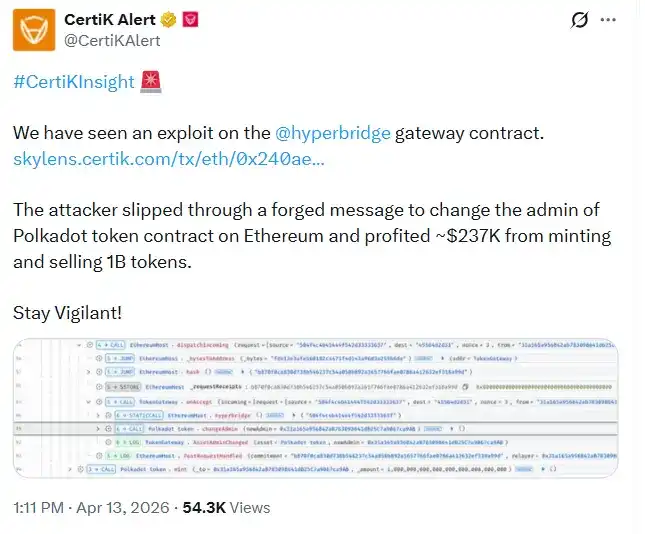
BlockSec Phalcon subsequently issued a technical alert, characterizing this vulnerability as an MMR proof replay vulnerability. According to their analysis, the root cause of the vulnerability lies in the fact that the replay protection of the HandlerV1 contract only verifies whether the hash of a request has been used before, but the proof verification process did not bind the submitted request payload to the proof being verified.

This logical flaw allowed the attacker to replay a historically valid proof and pair it with a newly constructed malicious request, thereby executing the ChangeAssetAdmin operation via the TokenGateway.onAccept() path, transferring the admin and minting permissions of the wrapped DOT contract on Ethereum (address: 0x8d...8F90b8) to an address controlled by the attacker.

On-chain data shows that after obtaining minting permissions, the attacker minted 1 billion wrapped DOT tokens, a quantity approximately 2805 times the reported circulating supply of about 356,000 tokens on Ethereum at the time.

Subsequently, the attacker exchanged the entire amount for approximately 108.2 ETH via Odos Router and Uniswap V4 liquidity pools, and transferred it to the attacker's external account, profiting about $237,000 at the time, with the gas cost for the entire attack being only about $0.74.

BlockSec Phalcon also mentioned that a previous attack using the same method had occurred, targeting MANTA and CERE tokens, resulting in a loss of about $12,000. The total combined loss from both attacks is approximately $242,000.

Following the incident, major South Korean exchanges Upbit and Bithumb announced the suspension of deposit and withdrawal services for DOT and the AssetHub Polkadot network to prevent potential fake deposit risks.

Polkadot officials stated that this vulnerability only affects DOT bridged to Ethereum via Hyperbridge, and does not affect DOT assets within the Polkadot ecosystem, nor DOT transferred via other bridges. Polkadot and its parachains, as well as native DOT, remain secure and unaffected. Hyperbridge has currently been suspended to investigate the issue.

It is worth mentioning that despite the minting scale reaching 1 billion tokens, the actual loss is far lower than the theoretical figure.Due to the extremely limited on-chain liquidity of wrapped DOT on Ethereum, the concentrated sell-off of 1 billion tokens instantly crashed the price of wrapped DOT from $1.22 to $0.00012831, a drop of 99.98%, rendering the vast majority of tokens unable to be effectively liquidated.

According to CoinMarketCap data, the price of native DOT tokens was also briefly dragged down by market sentiment, falling nearly 5%.

Users on X bluntly stated, who would have thought that DOT, once a cross-chain myth alongside Ethereum, would引爆 social media in this way. Cross-chain bridges have once again become the "Achilles' heel" of the crypto world. The once-deserted quiet has now turned into a scene of devastation and sighing. When 1 billion DOT appeared out of thin air, all technical indicators became worthless.

Other users jokingly remarked that low liquidity "saved Polkadot" in this incident by意外, limiting the actual loss to about $237,000.

However, while the low liquidity of bridged assets limited the hacker's profit, it exposed the potential fragility of the cross-chain interoperability layer.

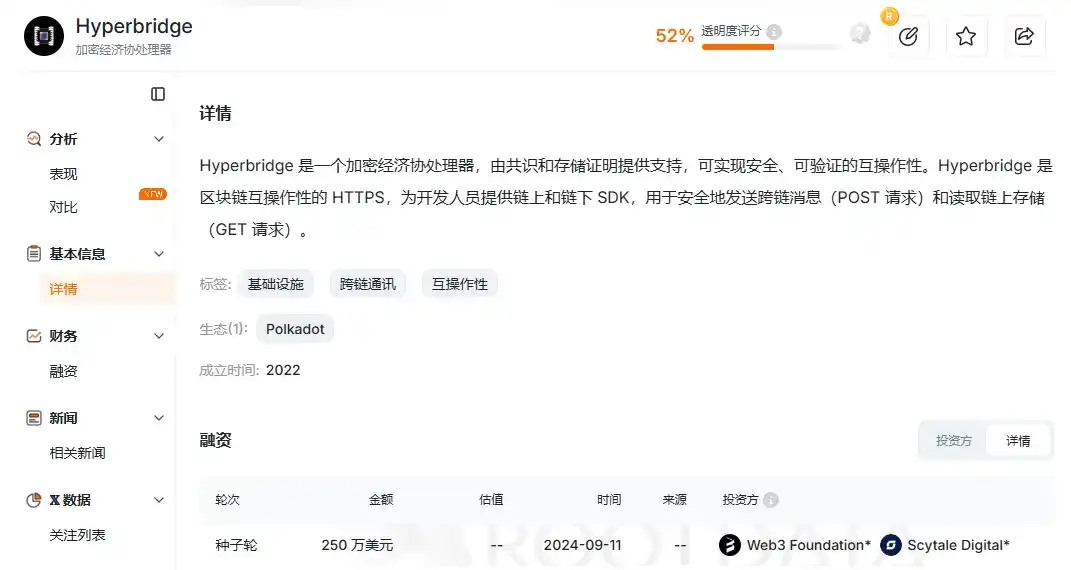
It is reported that Hyperbridge, developed by Polytope Labs, is a cross-chain interoperability project within the Polkadot ecosystem, long positioning itself as trust-minimized cross-chain infrastructure with its core security mechanism relying on cryptographic proofs instead of multi-signature committees. The project had previously emphasized its resistance to common bridge attacks.
<极p>

But this incident perhaps indicates that the integrity of the cryptographic proof mechanism itself is not sufficient to guarantee security; the specific implementation logic of the Gateway contract on the Ethereum side also constitutes an attack surface.

From a more macro perspective, this incident is a microcosm of the持续严峻 DeFi security landscape in 2026. Since the beginning of the year, several major attacks have occurred, including Venus generating $2.15 million in bad debt due to price manipulation, Resolve over-minting 80 million USR, and Drift losing over $285 million in assets. The attack methods varied and involved diverse areas.

Taking over minting rights for无限增发 is not a new attack模式. However, Hyperbridge's损失 was意外压低 due to its extremely shallow liquidity.

According to CertiK data, March alone recorded 46 security incidents, with total losses of approximately $39.8 million, the highest monthly record since November 2024. CertiK also pointed out that the increased frequency of code vulnerability exploits may be related to the rise of AI-assisted vulnerability mining tools.

The rise in attack frequency is also pushing the industry to重新审视 the boundaries of security and regulation. Circle's Chief Strategy Officer Dante Disparte previously, in response to the Drift Protocol theft, called for protocols, wallets, exchanges, and stablecoin issuers to treat security and accountability as a shared obligation. He suggested that DeFi protocols could develop on-chain technical protection measures参考 traditional market circuit breakers, and promote relevant legislation to enshrine property rights and financial privacy protection standards into law before the next major incident occurs.


Pertanyaan Terkait

QWhat was the core vulnerability exploited in the Hyperbridge attack on April 13th?

AThe attack exploited an MMR proof replay vulnerability. The flaw was in the HandlerV1 contract, where the replay protection only checked if a request's hash had been used before, but the proof verification process did not bind the submitted request payload to the proof being validated. This allowed the attacker to replay a historically valid proof with a new, forged request.

QHow much wrapped DOT did the attacker mint, and why was the actual financial gain so low compared to the amount minted?

AThe attacker minted 1 billion wrapped DOT tokens. However, the actual financial gain was only about $237,000 because the on-chain liquidity for wrapped DOT on Ethereum was extremely limited. The massive sell-off crashed the token's price by 99.98%, from $1.22 to approximately $0.00012831, making it impossible to liquidate the vast majority of the tokens.

QWhich other tokens were previously targeted using the same attack method mentioned in the article?

AAccording to the article, the same attack method was previously used against MANTA and CERE tokens, resulting in losses of approximately $12,000.

QWhat was the official response from Polkadot regarding the scope and impact of this incident?

APolkadot official stated that the vulnerability only affected DOT that was bridged to Ethereum via Hyperbridge. It did not affect DOT within the Polkadot ecosystem, DOT bridged through other bridges, or native DOT. They confirmed that Polkadot, its parachains, and native DOT remained secure and unaffected. Hyperbridge was paused for investigation.

QWhat broader trend in DeFi security does this event represent, according to the article?

AThe article states this event is a reflection of the increasingly severe DeFi security landscape in 2026. It cites other major incidents like the Venus protocol ($2.15M in bad debt), Resolve (80M USR over-minted), and the Drift Protocol hack (over $285M). It also notes a rise in code vulnerability exploits, potentially linked to the emergence of AI-assisted bug-finding tools, with March alone seeing 46 security incidents totaling ~$39.8M in losses.

Bacaan Terkait

Debut Wash: Ketua FED yang Paling Paham Crypto Sepanjang Sejarah Akan Datangkan Kejutan atau Teror Bagi Pasar?

**Penampilan Perdana Kevin Warsh: Ketua Fed Paling Paham Crypto, Akan Bawa Kejutan atau Kekhawatiran?** Ketua Federal Reserve yang baru, Kevin Warsh, bersiap untuk konferensi pers kebijakan moneter pertamanya di tengah situasi sulit: inflasi yang bangkit kembali, tekanan pasar untuk menaikkan suku bunga, dan desakan Presiden Trump untuk menurunkan suku bunga. Yang unik, Warsh adalah ketua Fed pertama yang secara terbuka memiliki portofolio investasi tidak langsung yang signifikan di aset kripto dan perusahaan Web3, mencakup berbagai sektor seperti blockchain, DeFi, dan infrastruktur pembayaran. Pemahaman pribadinya tentang teknologi ini berbeda dengan pendahulunya. Analisis kebijakannya berfokus pada dua hal: **sikap hawkish melawan inflasi** yang mungkin berarti lingkungan suku bunga ketat, dan **sikap ramah terhadap aset digital** yang bisa membawa perubahan regulasi dari "pencegahan" menjadi "integrasi dan inovasi". Dampak pada pasar kripto dapat dilihat dari: **pergeseran ekspektasi regulasi** yang lebih mendukung, **penetapan ulang premi risiko** bergantung pada komunikasi kebijakan yang jelas dari Warsh, serta **aliran modal global** yang mungkin mengalir lebih deras ke aset kripto karena legitimasi yang meningkat. Dua skenario utama untuk penampilan perdananya: 1. **Kejutan:** Gabungan sikap kebijakan moneter yang relatif lunak (dovish) dan sinyal ramah kripto dapat memulihkan sentimen pasar. 2. **Kekhawatiran:** Sinyal hawkish yang lebih keras dari perkiraan, seperti isyarat kenaikan suku bunga, dapat memicu tekanan jual di aset berisiko, termasuk kripto. Meski secara etika Warsh telah menjual semua kepemilikannya terkait kripto, pemahaman mendalamnya tentang blockchain diharapkan dapat membentuk kerangka regulasi yang lebih koheren dan mendukung, menjadi infrastruktur penting bagi arus utama aset kripto dalam jangka panjang.

marsbit6j yang lalu

Debut Wash: Ketua FED yang Paling Paham Crypto Sepanjang Sejarah Akan Datangkan Kejutan atau Teror Bagi Pasar?

marsbit6j yang lalu

AGI Bukan Akhir, Makalah Baru DeepMind: Menuju ASI, Kemajuan AI yang Sesungguhnya Baru Dimulai

Jika Kecerdasan Buatan Umum (AGI) tercapai, apakah itu titik akhir? Tim Google DeepMind dalam laporan terbarunya berpendapat bahwa AGI **bukanlah akhir perjalanan**. AI diprediksi akan terus berkembang melampaui kemampuan tim ahli manusia terbaik, menuju Superintelligence (ASI). Laporan ini membedakan tiga konsep: AGI (kecerdasan setara manusia rata-rata), ASI (melampaui manusia di hampir semua bidang), dan UAI (batas teoretis maksimal). Transisi dari AGI ke ASI dapat melalui empat jalur potensial: 1. **Ekspansi Lanjutan**: Meningkatkan skala komputasi, model, dan data. 2. **Inovasi Algoritma**: Penyempurnaan paradigma yang ada atau pergeseran paradigma baru. 3. **Peningkatan Diri Secara Rekursif**: AI yang lebih kuat membantu mengembangkan generasi AI berikutnya yang lebih kuat. 4. **Koordinasi Multi-Agen**: Kecerdasan kolektif dari banyak sistem AGI yang berkolaborasi. Namun, terdapat enam kemacetan potensial: dinding data, tekanan sumber daya ekonomi & alam, batasan paradigma jaringan saraf saat ini, meningkatnya kesulitan penelitian, hambatan abstraksi, serta tantangan regulasi dan penerimaan sosial. Laporan ini juga menyoroti bahwa jika AI melampaui manusia, sistem evaluasi (benchmark) yang ada menjadi tidak relevan. Diperlukan kerangka pengukuran baru, seperti tugas kolaborasi/kompetisi multi-agen, pengujian yang dihasilkan otomatis, atau indikator tidak langsung seperti produktivitas ekonomi. ASI bukanlah sistem ajaib yang mahatahu; perkembangannya tetap dibatasi oleh hukum fisika, kompleksitas komputasi, data, sumber daya, dan umpan balik dunia nyata. Arah dan kecepatan kemajuan AI masih penuh ketidakpastian, sehingga memerlukan penelitian, prediksi, dan mekanisme evaluasi yang terus diperbarui.

marsbit7j yang lalu

AGI Bukan Akhir, Makalah Baru DeepMind: Menuju ASI, Kemajuan AI yang Sesungguhnya Baru Dimulai

marsbit7j yang lalu

Trading

Spot
Futures

Artikel Populer

Cara Membeli DOT

Selamat datang di HTX.com! Kami telah membuat pembelian Polkadot (DOT) menjadi mudah dan nyaman. Ikuti panduan langkah demi langkah kami untuk memulai perjalanan kripto Anda.Langkah 1: Buat Akun HTX AndaGunakan alamat email atau nomor ponsel Anda untuk mendaftar akun gratis di HTX. Rasakan perjalanan pendaftaran yang mudah dan buka semua fitur.Dapatkan Akun SayaLangkah 2: Buka Beli Kripto, lalu Pilih Metode Pembayaran AndaKartu Kredit/Debit: Gunakan Visa atau Mastercard Anda untuk membeli Polkadot (DOT) secara instan.Saldo: Gunakan dana dari saldo akun HTX Anda untuk melakukan trading dengan lancar.Pihak Ketiga: Kami telah menambahkan metode pembayaran populer seperti Google Pay dan Apple Pay untuk meningkatkan kenyamanan.P2P: Lakukan trading langsung dengan pengguna lain di HTX.Over-the-Counter (OTC): Kami menawarkan layanan yang dibuat khusus dan kurs yang kompetitif bagi para trader.Langkah 3: Simpan Polkadot (DOT) AndaSetelah melakukan pembelian, simpan Polkadot (DOT) di akun HTX Anda. Selain itu, Anda dapat mengirimkannya ke tempat lain melalui transfer blockchain atau menggunakannya untuk memperdagangkan mata uang kripto lainnya.Langkah 4: Lakukan trading Polkadot (DOT)Lakukan trading Polkadot (DOT) dengan mudah di pasar spot HTX. Cukup akses akun Anda, pilih pasangan perdagangan, jalankan trading, lalu pantau secara real-time. Kami menawarkan pengalaman yang ramah pengguna baik untuk pemula maupun trader berpengalaman.

448 Total TayanganDipublikasikan pada 2024.12.12Diperbarui pada 2026.06.02

Cara Membeli DOT

Diskusi

Selamat datang di Komunitas HTX. Di sini, Anda bisa terus mendapatkan informasi terbaru tentang perkembangan platform terkini dan mendapatkan akses ke wawasan pasar profesional. Pendapat pengguna mengenai harga DOT (DOT) disajikan di bawah ini.

活动图片












