Why We No Longer Love Crypto

比推Dipublikasikan tanggal 2026-03-11Terakhir diperbarui pada 2026-03-11

Abstrak

The article "Why We No Longer Passionate About Crypto" explores the growing sense of disillusionment among crypto veterans. Many who once found excitement in the space now feel stuck, particularly those not working on stablecoins, financial infrastructure, or DeFi. The author notes that the previous era—where developer-focused products thrived on vibes rather than revenue—ended about 18 months ago. The crypto market for non-financial applications is now seen as limited, with an estimated annual addressable market of only $200–300 million, leading many builders to feel they have few viable paths forward. The rise of AI has intensified this frustration, as it offers faster innovation and more tangible product development compared to crypto’s current constraints. The author outlines several unappealing options for those exploring crypto-AI intersections: tokenizing traditional AI products without real utility, building decentralized AI infrastructure (which lacks immediate feedback), or competing with giants in AI-focused stablecoin infrastructure. Despite this pessimism, the author concludes with a note of optimism: Crypto’s unique value lies in its ability to serve as "capital superconductor" for growth. The convergence of AI-driven product innovation and crypto’s programmable capital mechanisms could fuel a new generation of "agent-based companies," creating a renewed sense of purpose for those who remain.

Author: Kydo (@0xkydo)

Original Title: Why crypto is not that fun anymore

Compiled and Arranged: BitpushNews


These days, a tweet struck a chord. It revealed a shared, yet rarely mentioned sense of helplessness—many of us no longer enjoy working here (in crypto) anymore.
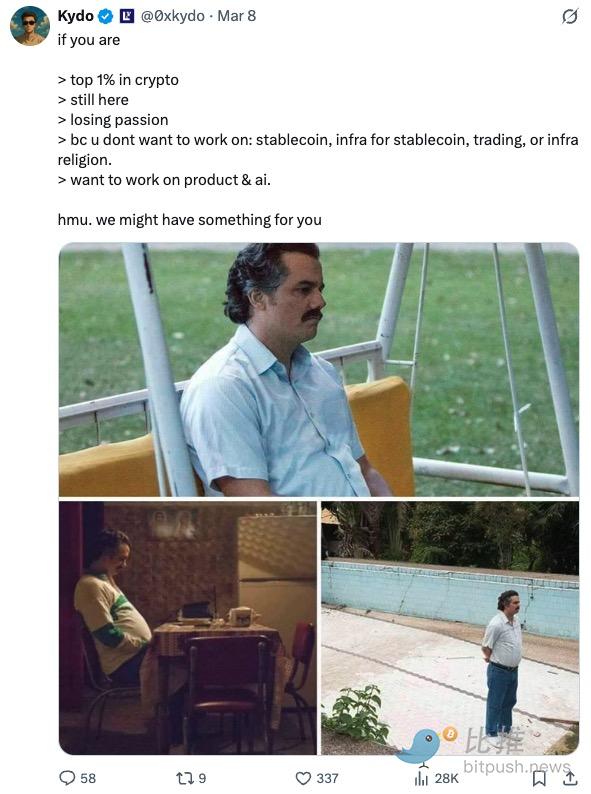
Tweet:

If you are

> in the top 1% of the crypto space

> still here

> but losing passion

> because you don't want to work on: stablecoins, stablecoin infrastructure, trading, or infrastructure-level "evangelism"

> want to build products and AI

Contact me. We might have something for you.

I want to elaborate.

If you are not working on stablecoins or are not someone extremely passionate about financial markets, you are likely not happy in the cryptocurrency space right now.

Worse, you are seeing the AI field developing at a pace and with an excitement that makes your daily work feel like standing still. I understand this all too well because that's exactly how I felt. That's why I wrote that tweet.

And the fact that it resonated with so many people (I've received 60 DMs so far) tells me that many of you feel the same way but haven't said it out loud.

So, let me say the "unsaid" things.

Selling to Crypto Developers is No Longer Viable

In the previous "meta," selling things to crypto developers worked. Back then, metrics were more important than revenue. Partner logos were more important than revenue. A "vibe" was more important than revenue. You were a cost center for others, and everyone was spending money.

That "meta" died about 18 months ago. We wish we had pivoted earlier.

There is also a growing consensus today: cryptocurrency is only suitable for finance. Haseeb from Dragonfly has said it, Kyle from Multicoin has said it, Toly from Solana has said it. Most of you think so too, even if you won't say it publicly.

I understand why people reach this conclusion. Most tokens are meme coins. They don't own anything and can't owe you anything because the only thing that can truly be "owned" is on-chain state, which is extremely limited.

This is also why crypto-native applications like trading and lending are currently the only two categories that can truly make money on-chain.

But many of us are not building in DeFi. Many of us build infrastructure to enable new use cases beyond DeFi.

Here's an uncomfortable truth: according to our analysis, the total addressable market for this kind of work is only about $200-300 million per year. This pie is to be divided among hundreds of institutions. The most successful companies can only achieve tens of millions in annual revenue. After years of maturation, this is the ceiling.

If you are building a venture-scale enterprise, this gives you a very clear set of choices. If you want to serve crypto developers, the market is small. So, you either put on a suit and sell your infrastructure to traditional finance; or, like many others, choose to pack up and switch to AI.

Many are switching to AI because they understand their strengths. They understand their team's expertise. They know their competitive advantage is not in long, complex B2B sales in traditional finance. This is why so many of you feel lost right now.
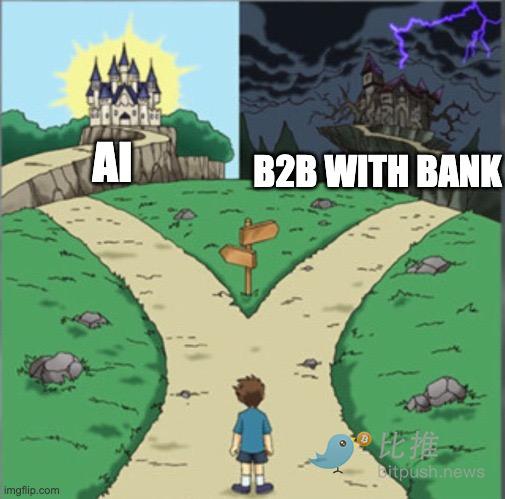
The Dead End of Crypto x AI

So you look at the only area that still feels vibrant—the intersection of crypto and AI—trying to find your footing. But the options laid out there aren't great either.

Option One: Traditional business + AI + issue a token. This token has no real utility, like most other tokens. You're essentially building a regular product and slapping a layer of financialization on top. It's frustrating because you've been playing this game for five years.

Option Two: Decentralized AI infrastructure. Privacy, security, verifiability: this is the missionary route, the old "meta." But I guess this doesn't interest many of you: not many want to embark on another long-term "building a religion" style endeavor with no immediate feedback, no revenue.

Option Three: Stablecoin infrastructure for AI agents. This is interesting from a business perspective, but extremely competitive. Circle, Stripe, and all the major stablecoin players are going all in. As a startup, going to war with them without any clear beachhead to capture is frustrating.

The Choices Faced, and Why People Are Leaving

So, these are the actual choices on the table today:

You can stay in the "religious realm" of crypto, building for a resilient, decentralized future.

You can put on a suit and join the big players to evangelize the gospel of stablecoins.

You can build a "shovel-selling" company for the stablecoin ecosystem.

You can stay in DeFi: trading, lending, and the financial plumbing of the internet.

Or, you can build a niche vertical product that, while not a billion-dollar venture target, actually makes money and satisfies real users.

Beyond that, you don't have better options. This is why you are likely to switch to AI. Honestly, I understand.

This is why cryptocurrency is no longer that fun.

The above is my diagnosis. This is the conclusion I reached after six months of feeling, analyzing, and stress-testing. If you came here for an honest take on "why crypto feels stuck," you've got it. You can close this article now. Go for a walk, touch some grass.

But I'll tell you this: I have never been so excited about the work I'm doing. The last time I felt this way was probably when I first heard about cryptocurrency and its potential. And it's not just me—everyone around me feels the same. So, if you want to hear the short version of what I believe in, read on.

Just know that from here on out, I'm selling my beliefs.

What I Truly Find Interesting

The question I've been trying to answer for the past six months is: How do you find a market large enough, with a clear business model rooted in crypto, and a product-oriented, non-financial solution that can be used by people both inside and outside the crypto space?

The answer I kept coming back to is: Cryptocurrency is a superconductor for capital. Capital fuels growth. The problem in the past was that we were fueling things that weren't growing—pouring gasoline on ice and expecting it to burn brighter.

AI has dramatically reduced the difficulty of starting and growing things—from a product perspective. Now one person can build what used to require a fifty-person team. The cost of creating a real product, a real business, is plummeting. These things are growing fast, with revenue, real users, and real feedback loops. They need fuel to accelerate. And cryptocurrency is the best fuel mechanism ever invented for this purpose.

This is the only interesting problem I see now: How do you take crypto's superpower—instant, global, programmable capital formation—and point it at things that are actually growing?

We think the answer is "agentic companies." To achieve this, you first need tokens to be able to "own" things, and coincidentally, we've spent the last five years building that foundation. Now, we're going to turn it into a product and achieve that goal.


Twitter:https://twitter.com/BitpushNewsCN

Bitpush TG Discussion Group:https://t.me/BitPushCommunity

Bitpush TG Subscription: https://t.me/bitpush

Original article link:https://www.bitpush.news/articles/7618924

Kripto yang Sedang Tren

Pertanyaan Terkait

QWhy does the author believe that many people in the crypto space are no longer enjoying their work?

AThe author believes that many are no longer enjoying their work because the focus has shifted heavily towards financial applications like stablecoins and trading, which may not align with their interests. Additionally, the rapid and exciting progress in AI makes their current work in crypto feel stagnant in comparison.

QWhat are the main options available for crypto developers today, according to the article?

AThe main options are: staying in the 'religious' crypto space for a decentralized future, selling infrastructure to traditional finance, building 'picks and shovels' for the stablecoin ecosystem, continuing in DeFi (trading and lending), or creating a niche product that generates real revenue but isn't a billion-dollar venture-scale business.

QWhat is the estimated annual market size for non-DeFi crypto infrastructure work mentioned in the article?

AThe estimated annual addressable market size for non-DeFi crypto infrastructure work is about $200-300 million, which is shared among hundreds of organizations, with the most successful companies generating tens of millions in annual revenue.

QWhat does the author identify as the core problem with previous attempts to fuel growth in crypto?

AThe author states that the core problem was that capital was being provided to things that weren't growing—'pouring gasoline on ice and expecting it to burn hotter'—instead of fueling things that are actually growing.

QWhat is the author's proposed solution to make crypto fun and impactful again?

AThe author's proposed solution is to leverage crypto's superpower as an instant, global, programmable capital formation mechanism and direct it towards things that are genuinely growing, specifically 'agentic companies,' by enabling tokens to 'own' things and using this foundation to build products.

Bacaan Terkait

UNI Berhasil Melipatgandakan Nilainya dalam Dua Bulan di Tengah Tren Turun: Sebuah Pemulihan Nilai yang Terlambat 5 Tahun

UNI, token asli dari bursa terdesentralisasi (DEX) Uniswap, telah mengalami peningkatan harga hampir 100% dalam dua bulan (Juni-Juli), berlawanan dengan tren pasar yang lesu. Kenaikan ini didorong oleh aktivasi efektif "sakelar biaya" (*fee switch*) setelah tertunda selama bertahun-tahun. Mekanisme intinya adalah pemusnahan (*burn*) token UNI secara berkala. Sebagian biaya transaksi dari berbagai *pool* Uniswap (v2, v3, v4) dan pendapatan dari Unichain kini dialirkan ke kontrak khusus (TokenJar) yang secara otomatis membeli dan memusnahkan UNI dari pasar, menciptakan pembeli konstan. Awalnya, setelah diaktifkan pada Desember 2025, mekanisme ini hanya menghasilkan pendapatan dan pemusnahan yang kecil, sehingga respon pasar biasa saja. Situasi berubah drastis pada Juli dengan peluncuran Robinhood Chain, yang dirancang untuk tokenisasi saham. Volume perdagangan di Uniswap meledak, dan setelah ekstensi mekanisme biaya ke *pool* v4 dan rantai Robinhood, pendapatan harian protokol melonjak. Pemusnahan harian UNI meningkat dari sekitar $114,000 menjadi lebih dari $325,000, dengan Robinhood Chain menyumbang lebih dari setengahnya. Narasi utama pergeseran ini adalah transformasi UNI dari sekadar token tata kelola (*governance*) menjadi aset yang memiliki arus kas riil. Keberhasilan mekanisme *burn* ini juga didukung oleh struktur kepemilikan UNI yang sudah matang dan tersebar luas, tanpa tekanan penjualan besar dari *unlock* token baru, sehingga pembelian untuk pemusnahan berdampak nyata pada pasar. Tantangan ke depan adalah mempertahankan volume perdagangan tinggi di Robinhood Chain setelah subsidi gas berakhir dalam sekitar 90 hari, yang akan menentukan apakah kenaikan ini merupakan awal dari penemuan nilai jangka panjang atau hanya ilusi sementara.

marsbit1j yang lalu

UNI Berhasil Melipatgandakan Nilainya dalam Dua Bulan di Tengah Tren Turun: Sebuah Pemulihan Nilai yang Terlambat 5 Tahun

marsbit1j yang lalu

Sam Altman Mengakui: Pernah Terlalu Tinggi Memperkirakan AI Akan Merebut Pekerjaan! Jensen Huang: Narasi PHK Itu Sepenuhnya Terbalik

Sam Altman mengakui bahwa ia sebelumnya melebih-lebihkan kecepatan AI mengambil alih pekerjaan kerah putih tingkat pemula, dan "kiamat pekerjaan" mungkin tidak akan terjadi. Orang-orang tidak benar-benar menginginkan CEO AI karena mereka ingin tahu siapa yang bertanggung jawab atas keputusan dan siapa yang harus dimintai pertanggungjawaban jika terjadi masalah. Hampir bersamaan, Jensen Huang dari NVIDIA menyatakan bahwa narasi "AI menghancurkan pekerjaan" sepenuhnya terbalik. AI mengambil alih tugas-tugas tertentu dalam suatu pekerjaan, tetapi itu tidak sama dengan menghilangkan seluruh pekerjaan. Pekerjaan masih membutuhkan komunikasi, penilaian, koordinasi, peninjauan, dan tanggung jawab. Data dari Universitas Maryland dan LinkUp menunjukkan bahwa hingga kuartal keempat 2025, tidak ada bukti bahwa AI mengurangi permintaan tenaga kerja secara keseluruhan di AS. Posisi untuk lulusan baru justru meningkat. Namun, tugas-tugas standar yang menjadi tangga masuk bagi pekerja pemula sedang diambil alih oleh AI, sehingga menyulitkan mereka untuk mendapatkan pengalaman dasar. Kesimpulannya, nilai pekerjaan manusia justru meningkat ke arah tanggung jawab, membangun kepercayaan, dan menetapkan tujuan. Bagian dari pekerjaan yang membutuhkan pertanggungjawaban manusia dan kehadiran personal adalah pertahanan sejati yang tidak dapat digantikan oleh AI.

marsbit2j yang lalu

Sam Altman Mengakui: Pernah Terlalu Tinggi Memperkirakan AI Akan Merebut Pekerjaan! Jensen Huang: Narasi PHK Itu Sepenuhnya Terbalik

marsbit2j yang lalu

Perubahan Besar-besaran di Fed? Laporan: Walsh Pertimbangkan Kurangi Frekuensi Rapat Suku Bunga, Langgar Konvensi 40 Tahun

Ketua Fed Wall sedang mempertimbangkan untuk mengurangi frekuensi pertemuan suku bunga tahunan Komite Pasar Terbuka Federal (FOMC), yang dapat menjadi perubahan besar dalam cara operasi Fed selama beberapa dekade. Menurut The New York Times, Walsh mengusulkan ide penyesuaian frekuensi pertemuan dalam rapat Fed minggu ini. Pengaturan baru kemungkinan akan ditetapkan sebelum pertemuan suku bunga berikutnya pada pertengahan September, meskipun perubahan spesifik mungkin baru diterapkan lebih lambat. Mengurangi frekuensi pertemuan akan memutus kebiasaan "delapan kali setahun, sekitar setiap enam minggu sekali" yang telah berlaku sejak 1981. Hal ini berpotensi melemahkan kemampuan Fed untuk merespons perubahan inflasi dan pasar tenaga kerja, serta mengurangi saluran pasar untuk mendapatkan sinyal kebijakan moneter, membalikkan tren peningkatan transparansi informasi Fed selama beberapa dekade. Hukum Perbankan tahun 1935 mensyaratkan FOMC "mengadakan setidaknya empat pertemuan setiap tahunnya." Menariknya, Walsh sendiri sebelumnya menyatakan dalam sidang konfirmasi Kongres bahwa empat pertemuan "tidak cukup," menciptakan kontradiksi dengan arah diskusi saat ini. Sistem delapan pertemuan tahunan, yang ditetapkan di bawah mantan Ketua Paul A. Volcker, telah menetapkan kerangka kerja yang dapat diprediksi. Mengurangi jumlah pertemuan tidak hanya berarti lebih sedikit kesempatan untuk pemungutan suara, tetapi juga dapat mempersempit jendela informasi bagi publik untuk memahami penilaian jalur suku bunga Fed, lebih lanjut mengurangi transparansi kebijakan. Ini selaras dengan gaya Walsh yang telah mempersingkat pernyataan kebijakan pasca-rapat dan jarang menyampaikan pandangan terbuka. Pengurangan frekuensi pertemuan adalah bagian dari agenda "reformasi kelembagaan" Walsh sejak menjabat pada Mei. Sejarah menunjukkan frekuensi pertemuan Fed tidak selalu statis; sebelum 1981, rapat diadakan lebih sering, bahkan 19 kali pada tahun 1956. Sebuah memo internal tahun 1988 pernah mengevaluasi kelebihan dan kekurangan pertemuan yang lebih sering, menyimpulkan bahwa jadwal delapan rapat masih "dapat dianggap tepat." Jika rencana pengurangan Walsh diterapkan, dampaknya terhadap aliran informasi pasar, fleksibilitas kebijakan Fed, dan cara komunikasi bank sentral dengan pasar akan terus diawasi dengan ketat.

marsbit3j yang lalu

Perubahan Besar-besaran di Fed? Laporan: Walsh Pertimbangkan Kurangi Frekuensi Rapat Suku Bunga, Langgar Konvensi 40 Tahun

marsbit3j yang lalu

Trading

Spot

Artikel Populer

Cara Membeli FUN

Selamat datang di HTX.com! Kami telah membuat pembelian FUNTOKEN (FUN) menjadi mudah dan nyaman. Ikuti panduan langkah demi langkah kami untuk memulai perjalanan kripto Anda.Langkah 1: Buat Akun HTX AndaGunakan alamat email atau nomor ponsel Anda untuk mendaftar akun gratis di HTX. Rasakan perjalanan pendaftaran yang mudah dan buka semua fitur.Dapatkan Akun SayaLangkah 2: Buka Beli Kripto, lalu Pilih Metode Pembayaran AndaKartu Kredit/Debit: Gunakan Visa atau Mastercard Anda untuk membeli FUNTOKEN (FUN) secara instan.Saldo: Gunakan dana dari saldo akun HTX Anda untuk melakukan trading dengan lancar.Pihak Ketiga: Kami telah menambahkan metode pembayaran populer seperti Google Pay dan Apple Pay untuk meningkatkan kenyamanan.P2P: Lakukan trading langsung dengan pengguna lain di HTX.Over-the-Counter (OTC): Kami menawarkan layanan yang dibuat khusus dan kurs yang kompetitif bagi para trader.Langkah 3: Simpan FUNTOKEN (FUN) AndaSetelah melakukan pembelian, simpan FUNTOKEN (FUN) di akun HTX Anda. Selain itu, Anda dapat mengirimkannya ke tempat lain melalui transfer blockchain atau menggunakannya untuk memperdagangkan mata uang kripto lainnya.Langkah 4: Lakukan trading FUNTOKEN (FUN)Lakukan trading FUNTOKEN (FUN) dengan mudah di pasar spot HTX. Cukup akses akun Anda, pilih pasangan perdagangan, jalankan trading, lalu pantau secara real-time. Kami menawarkan pengalaman yang ramah pengguna baik untuk pemula maupun trader berpengalaman.

475 Total TayanganDipublikasikan pada 2025.06.25Diperbarui pada 2026.06.02

Cara Membeli FUN

Diskusi

Selamat datang di Komunitas HTX. Di sini, Anda bisa terus mendapatkan informasi terbaru tentang perkembangan platform terkini dan mendapatkan akses ke wawasan pasar profesional. Pendapat pengguna mengenai harga FUN (FUN) disajikan di bawah ini.

活动图片