BTC Medium-Term Trend Weakens, Short-Term Volatility Fails to Mask Directional Risks | Guest Analysis

marsbitDipublikasikan tanggal 2025-12-22Terakhir diperbarui pada 2025-12-22

Abstrak

This analysis by Odaily's guest analyst Conaldo examines Bitcoin's (BTC) current market stance, highlighting a weakening medium-term trend and short-term consolidation with directional risks. The core view is that BTC is in a corrective phase after breaking its long-term bullish trend line (since late 2022) and is now constrained by both this and a descending trend line from the October 2025 high. Until a significant volume-backed breakout occurs above these key levels, any price rises should be considered rebounds within a bearish structure. Last week's prediction of a shift to a consolidation pattern was accurate, with price oscillating in the $87.5K–$89K zone. The analyst successfully executed four short-term trades based on a quant model, yielding a 2.14% return. Technical analysis using weekly and daily charts (incorporating momentum and sentiment quant models) indicates BTC remains in a bearish market on both timeframes, with weak buying momentum and neutral sentiment, suggesting continued consolidation and downside risk. For the upcoming week (Dec 22–28), the market is expected to see wide-range fluctuations. The key area to watch is $89.5K–$91K. A breakdown could lead to deeper correction, while holding could allow for a limited rebound. Specific short-term trading plans (A and B) are outlined for both scenarios, involving 30% short positions with precise entry, stop-loss, and take-profit levels. Key macro events this week include reduced holiday liquidity, potent...

Odaily Guest Market Analyst Conaldo, Master of Financial Statistics from Columbia University, USA, focused on quantitative trading of US stocks during university and gradually expanded to digital assets such as Bitcoin, building a systematic quantitative trading model and risk control system through practical experience; possesses keen data insight into market fluctuations and is committed to continuous development in the professional trading field, pursuing stable returns; will delve into BTC technical, macro, and capital changes weekly, review and demonstrate practical strategies, and preview major upcoming events for reference.
Core Summary:

• From a macro technical perspective (see Figure 3 below): In the Bitcoin daily chart, the upward trend line representing the long-term bull market (since the end of 2022) and the downward trend line defining the recent correction (since the October 2025 high) are about to converge. The market is currently in a period of repair and volatility after breaking the long-term trend. Bitcoin's price is under dual pressure. Unless the price breaks through this dual pressure with strong volume, all upward movements can only be considered rebounds within a bearish pattern. The effective breakthrough of these two key trend lines will serve as the ultimate basis for judging the market's medium-term direction.

• Core View Validation: The core judgment proposed last week that "the market will most likely transition into a volatile adjustment pattern" was highly consistent with the actual market movement. The bulls and bears repeatedly contested the $87,500~$89,000 area, and the mid-week adjustment low of $84,456 had a relative error rate of about 1.18% compared to the predicted support area upper limit of $83,500.

• Strategy Execution Results Validation: Last week's trading strictly followed the established strategy, successfully completing four operations, achieving a cumulative return of 2.14%.

The following will review the market prediction, strategy execution, and specific trading process in detail.

I. Bitcoin Market Review Last Week (12.15~12.21)

1. Last Week's Trend Prediction and Operation Strategy Review:

Last week's forward-looking analysis clearly stated: The market will most likely transition into a volatile adjustment pattern. Among them, the $87,500~$89,000 area was defined as the key observation area. The outcome of the battle between bulls and bears here would directly determine the market's short-term direction choice. Special attention was needed: if this area was effectively broken below, it would directly affect the subsequent intensity and depth of the coin price adjustment. Below is the strategy review and analysis.

1. Market Trend Prediction Review:

• Core Pressure Level: First pressure looking at the $92,500~$94,500 area; second pressure looking at the $96,500~$98,500 area.

• Core Support Level: First support looking at the $87,500~$89,000 area; second support looking at the $80,000~$83,500 area.

2. Operation Strategy Review:

• Medium-term Strategy: Maintain a medium-term position (short) of about 65%.

• Short-term Strategy: To cope with the market trend, we initially drafted two short-term operation plans, A/B. Based on the actual evolution of the market, we ultimately executed Plan B as the core strategy.

• Opening Position: If the coin price falls below the $87,500~$89,000 area and is confirmed, establish a 30% short position.

• Risk Control: Stop loss set above $89,000.

• Closing Position: When the coin price falls to the $80,000~$83,500 area and shows resistance, close all short positions to take profits.

2. Last week, four short-term operations were successfully completed according to the plan (Figure 1), achieving a cumulative return of 2.14%. Specific transaction details and review are as follows:

Bitcoin 30-minute K-line chart: (Momentum Quantitative Model + Spread Trading Model)
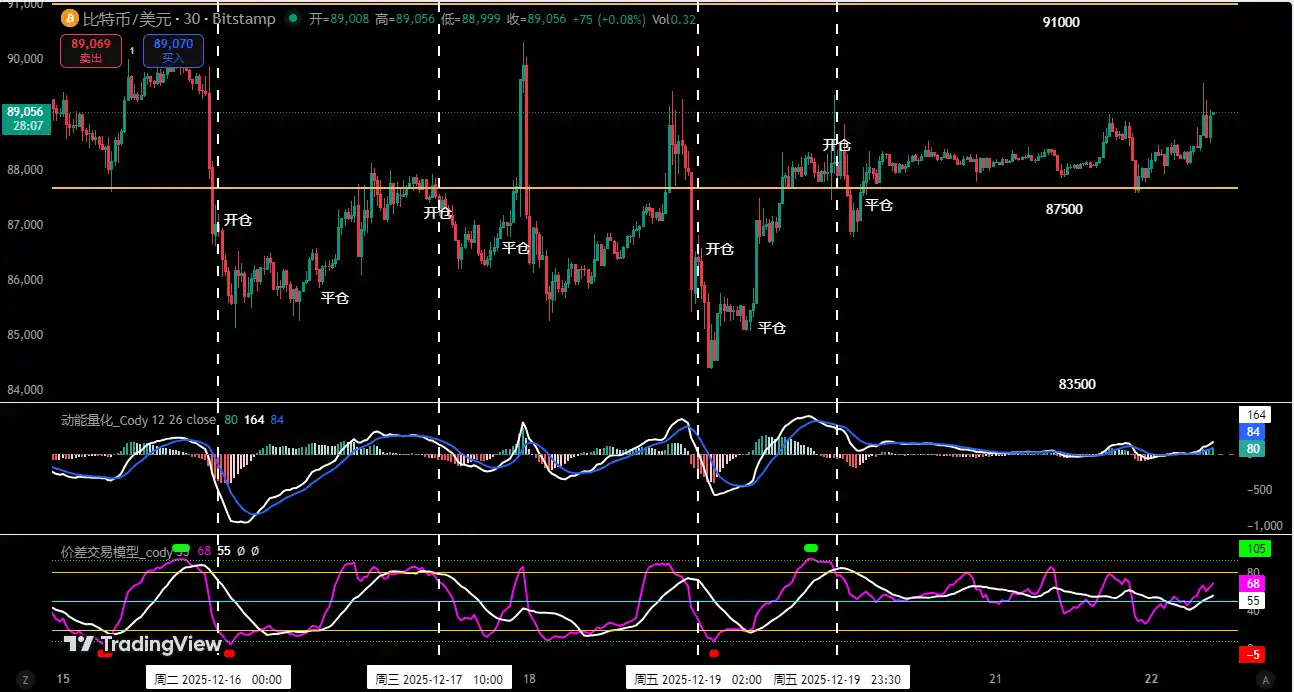
Figure 1

1. Transaction Details Summary:

2. Short-term Trading Review:

• First Transaction (Profit 0.73%): We strictly adhered to the idea of "effectively breaking through key points and going short with the trend." When the trigger condition was met, the spread trading model simultaneously issued a top signal. Based on this, we decisively established a 30% short position and finally took profits when the price fell near the previous low area.

• Second and Third Transactions (Cumulative Profit 1.41%): Based on the operation mode of "going short upon encountering resistance at the core pressure area during a rebound." When the coin price hit the $87,500~$89,000 area and encountered resistance, combined with resonance signals from both models, these two transactions were successfully completed.

• Fourth Transaction (Profit 0): The logic for opening the position was consistent with the previous two transactions. It must be emphasized that in this transaction, we strictly executed the principle of "immediately moving the stop loss to the opening cost price when the floating profit reaches 1%", resulting in the position being closed at breakeven.

II. Quantitative Technical Analysis: Based on Multi-Model and Multi-Dimensional Operations

Combining last week's market performance, the author will conduct an in-depth analysis of the evolution of Bitcoin's internal structure using multi-dimensional analysis models.

Bitcoin Weekly K-line Chart: (Momentum Quantitative Model + Sentiment Quantitative Model)
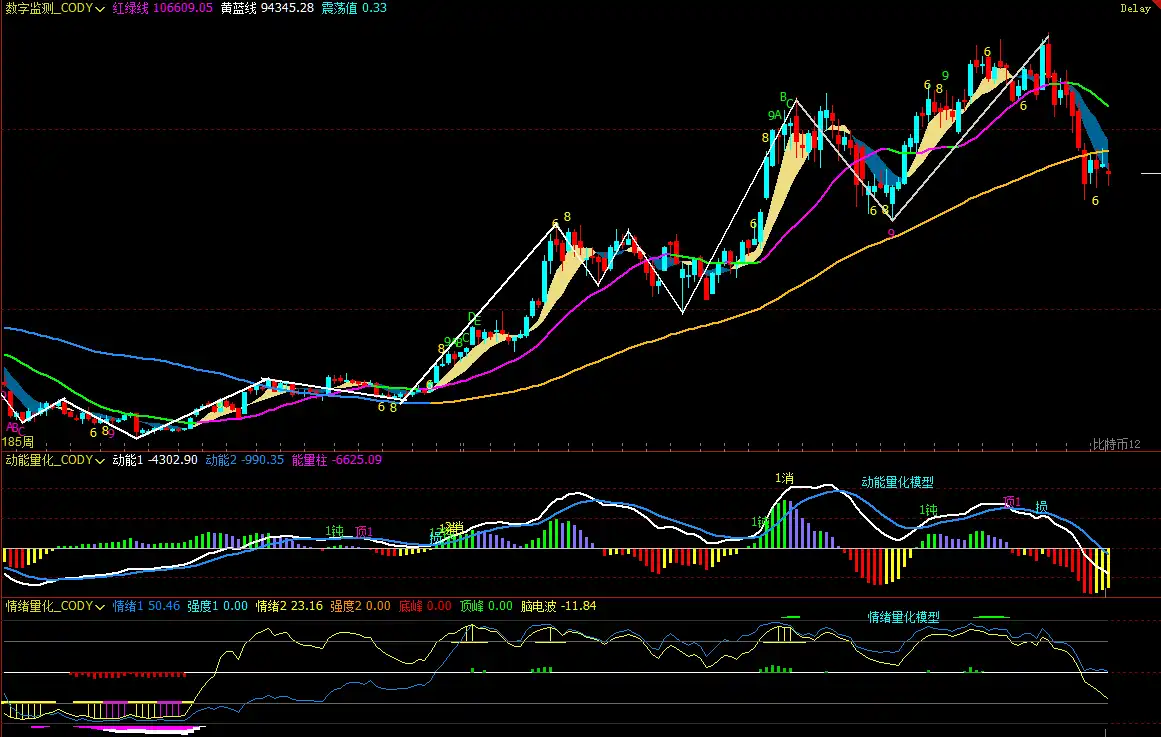
Figure 2

1. As shown in (Figure 2), analysis from the weekly chart:

Momentum Quantitative Model: After last week's adjustment, the two momentum indicator lines continue to operate below the zero axis. Although the rebound in the previous weeks prevented the negative momentum bars from expanding significantly, the current market structure remains weak, and we need to be vigilant about the risk of further release of adjustment pressure.

Momentum Quantitative Model Indicates: Coin price decline index: High

• Sentiment Quantitative Model: Blue sentiment line value 50.46, strength zero; yellow sentiment line value 23.16, strength zero, peak value is 0.

Sentiment Quantitative Model Indicates: Coin price pressure and support index: Neutral

• Digital Monitoring Model: The chart shows that the coin price has been below the bull-bear (yellow-blue line) dividing line for 5 weeks, increasing the probability of an effective break. Short-term bottom digital signals (above 9) have not yet appeared.

The above data indicates: Bitcoin is in a downward trend, entering a bear market on the weekly level, beware of adjustment risks.

Bitcoin Daily K-line Chart:
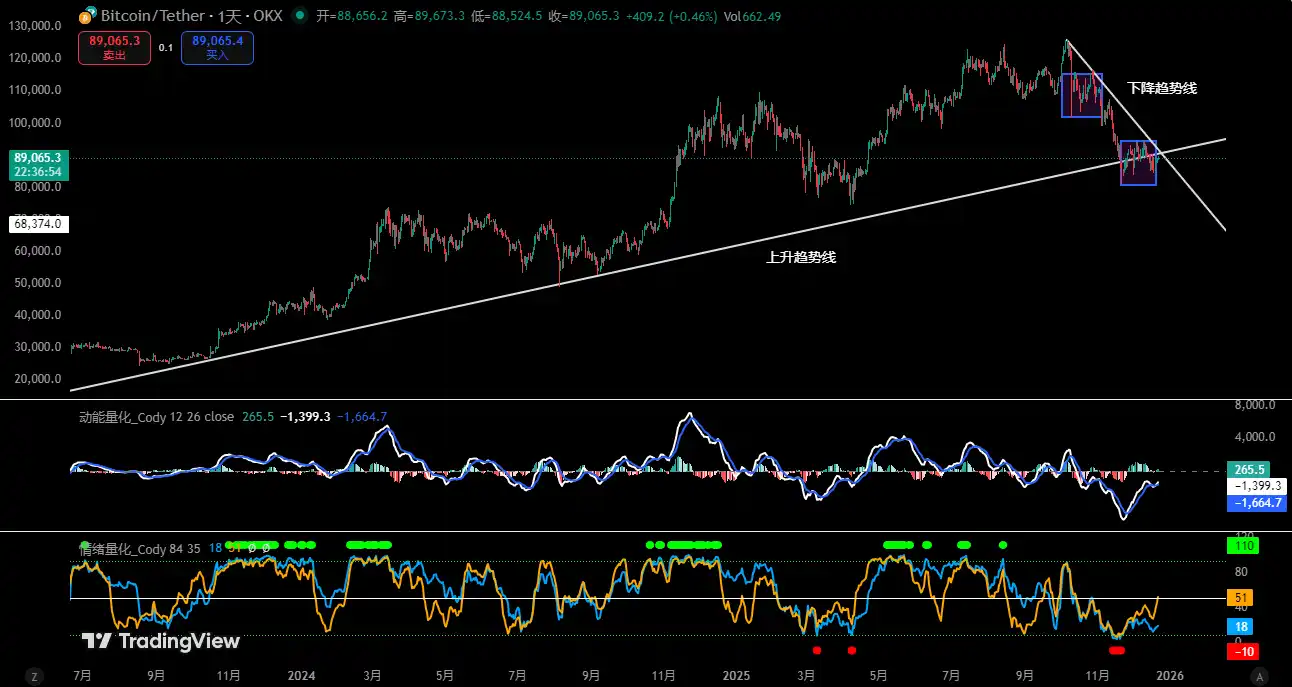
Figure 3

2. As shown in (Figure 3), analysis from the daily chart:

• Momentum Quantitative Model: In last week's行情, the two momentum lines experienced a repeated crossover process of "golden cross—dead cross—golden cross" below the zero axis. Trading volume did not放大, and the positive momentum bars did not grow significantly.

Momentum Quantitative Model Indicates: Fierce battle between bulls and bears for market control, weak buying momentum.

• Sentiment Quantitative Model: After last week's daily close, blue sentiment line value 17, strength zero; yellow sentiment line value 45, strength zero.

Sentiment Quantitative Model Indicates: Pressure and support index: Neutral

The above data suggests: The daily level is in a bear market, short-term market movements will still be反复.

III. This Week's Market Prediction (12.22~12.28)

1. The market is expected to mainly present a wide-range volatile pattern this week. The core observation interval is $89,500~$91,000. The outcome of the battle for this area will determine the short-term direction:

If effectively broken below: It will mean the adjustment intensity strengthens, and the expected adjustment range will expand, and the周期 will also延长.

If effectively held above: The market is expected to continue its volatile rebound, but the rebound space is expected to be relatively limited.

2. Core Pressure Levels:

• First Pressure Area: $89,500~$91,000 area

• Second Pressure Area: $93,000~$94,500 area

• Important Pressure Area: Around $97,000

3. Core Support Levels:

• First Support Level: $86,500~$87,500 area

• Second Support Level: $83,500~$84,500 area

• Important Support Level: Around $80,000.

IV. This Week's Operation Strategy (Excluding Sudden News Impact)(12.22~12.28)

1. Medium-term Strategy: Maintain a medium-term position (short) of about 65%.

2. Short-term Strategy: Use 30% of the position, set stop loss points, and look for "spread" opportunities based on support and pressure levels. (Using 30-minute as the operation cycle).

3. Focus on observing the battle between bulls and bears for the $89,500~$91,000 area and its outcome. To cope with the market行情, we have drafted two short-term operation plans, A/B:

Plan A: If this area is effectively held above:

• Opening Position: If the coin price rebounds to the $93,000~$94,500 area and encounters resistance, establish a 30% short position.

• Risk Control: Short stop loss set above $96,000.

• Closing Position: When the coin price falls to the $89,500~$91,000 area and shows resistance, close all short positions to take profits.

Plan B: If this area is effectively broken below:

• Opening Position: If the coin price falls below this area and is confirmed, establish a 30% short position.

• Risk Control: Stop loss set above $92,000.

• Closing Position: When the coin price falls to the $83,500~$84,500 area and shows resistance, consider partially or fully closing the position to take profits.

V. Special Notes

1. When opening a position: Immediately set the initial stop loss level.

2. When profit reaches 1%: Move the stop loss to the opening cost price (breakeven point) to ensure principal safety.

3. When profit reaches 2%: Move the stop loss to the position of 1% profit.

4. Continuous Tracking: Thereafter, for every additional 1% profit the coin price makes, move the stop loss同步 by 1%, dynamically protecting and locking in existing profits.

(Note: The above 1% profit trigger threshold can be flexibly adjusted by investors according to their own risk preferences and标的 volatility.)

VI. This Week's Macro Outlook and Key Events (12.22~12.28|Christmas Week)

1. Christmas Holiday Compresses Trading Hours, Liquidity Significantly Decreases

US stocks will close early on Wednesday and be closed all day Thursday this week. The holiday factor combined with year-end settlement results in overall lower market liquidity. Prices are more easily driven by sentiment and one-sided funds. Be wary of "false breakouts" and amplified short-term fluctuations under low trading volume.

2. Fed Chair Nomination Expectations Heat Up, Policy Continuity Becomes Market Focus

The market is watching whether Trump will announce the next Fed Chair nominee during the Christmas holiday. Currently, Kevin Hassett is seen as the明显领先 probability nominee, and his policy stance is considered偏向 "predictable gradual adjustment."

(If the nomination is announced, it will help stabilize interest rate expectations and risk appetite in the short term; if an unexpected candidate emerges, it may cause阶段性波动 in interest rates and the US dollar.)

3. US Q3 Data Finale, Verifying the "Soft Landing" Narrative

The revised US Q3 GDP, personal consumption expenditure, and core PCE data released on Tuesday will be used to confirm whether economic resilience and the inflation path are consistent with previous judgments.

(If the revisions are温和, the market will more easily maintain pricing for next year's interest rate cut path; if there are significant upward revisions, it may重新抬升 long-term rates.)

4. Employment Data as a Marginal Observation Indicator at Year-End

The initial jobless claims released on Wednesday, while not having trend significance, remain an auxiliary signal for observing whether the labor market is loosening around the holidays.

(Currently more偏向 "stable rather than deteriorating", the impact on the market is expected to be limited.)

5. BOJ Dynamics Provide Global Liquidity Reference

BOJ Governor Ueda's speech and the November unemployment rate data will continue to affect the market's judgment on the pace of Japan's monetary policy normalization.

(If yen volatility放大, it may cause emotional disturbance to global risk assets, especially US stocks and the crypto market.)

Financial markets are changing rapidly, all market analysis and trading strategies need to be adjusted dynamically. All views, analysis models, and operation strategies involved in this article are derived from personal technical analysis and are for personal trading log purposes only. They do not constitute any investment advice or operational basis. The market has risks, investment needs to be cautious, DYOR.


Pertanyaan Terkait

QWhat is the core technical perspective on Bitcoin's medium-term trend according to the analyst's daily chart analysis?

AThe analyst states that from a macro technical perspective, Bitcoin is in a period of repair and consolidation after breaking its long-term uptrend. The price is under dual pressure from the long-term bull market trendline (since late 2022) and the recent downtrend line (since the October 2025 high). All upward moves are considered rebounds within a bearish structure until the price breaks through this dual resistance with strong volume, using the effective break of these key trendlines as the final basis for judging the market's medium-term directional choice.

QWhat was the outcome of the trading strategy execution for the previous week (Dec 15-21)?

AThe trading strategy was strictly followed, resulting in four successful short-term operations with a cumulative realized return of 2.14%.

QBased on the weekly chart analysis (Figure 2), what do the momentum and sentiment quantitative models indicate about Bitcoin's market structure?

AThe momentum quantitative model shows both momentum indicator lines continue to run below the zero axis, indicating the market structure is still weak with a high risk of further adjustment pressure release. The sentiment quantitative model shows neutral pressure and support indices, with the blue sentiment line at 50.46 and the yellow at 23.16, both with zero intensity. This data suggests Bitcoin is in a downward trend on the weekly level, having entered a bear market, warranting caution against adjustment risks.

QWhat are the two short-term operation plans (A and B) proposed for the current week (Dec 22-28) and what triggers each?

APlan A is triggered if the price effectively holds above the 89,500-91,000 USD region: open a 30% short position if the price rebounds to the 93,000-94,500 USD region and meets resistance, with a stop-loss above 96,000 USD, and close the position for profit when the price falls to the 89,500-91,000 USD region and finds support. Plan B is triggered if the 89,500-91,000 USD region is effectively broken: open a 30% short position upon confirmation of the break, with a stop-loss above 92,000 USD, and close all or part of the position for profit when the price falls to the 83,500-84,500 USD region and shows resistance.

QWhat are the key macro events and their potential impacts highlighted for the Christmas week (Dec 22-28)?

AKey events include: 1) Reduced trading hours and significantly lower liquidity due to the Christmas holiday, increasing the potential for 'false breakouts' and amplified short-term volatility. 2) Increased expectations for the Fed Chair nomination, where the appointment of Kevin Hassett could stabilize rate expectations, while an unexpected pick might cause volatility. 3) The release of final US Q3 GDP, PCE, and core PCE data to confirm the 'soft landing' narrative; significant upward revisions could push long-term rates higher. 4) Jobless claims data as a marginal indicator, expected to have limited impact. 5) BOJ dynamics providing global liquidity cues, where amplified Yen volatility could cause sentiment disturbances in risk assets like crypto.

Bacaan Terkait

Apakah Saham AS Tidak Akan Turun Lagi? Jebakan "Melt-up" di Era Utang Tinggi

Judul yang menarik: "Apakah Saham AS Tidak Akan Turun Lagi? Jebakan 'Great Melt-up' di Era Utang Tinggi". Artikel ini membahas teori populer di Reddit yang menyatakan bahwa dengan utang pemerintah AS yang sangat besar (mencapai $40 triliun) dan defisit yang terus berlanjut, pasar saham secara matematis tidak mungkin turun lagi. Alasannya? Pemerintah diduga akan terus mencetak uang untuk membayar utang, menyebabkan inflasi yang pada gilirannya akan mengerek harga aset seperti saham. Ini disebut sebagai skenario "Great Melt-up" atau kenaikan harga aset yang didorong momentum dan FOMO (takut ketinggalan), bukan fundamental. Penulis, Graham Stephan, menganalisis teori ini dengan hati-hati. Dia mengingatkan bahwa fenomena serupa terjadi pada gelembung dot-com tahun 1990-an dan gelembung aset Jepang, yang akhirnya pecah dengan kerugian besar. Meski dalam dunia dengan utang tinggi, aset cenderung lebih baik daripada uang tunai, klaim bahwa saham "tidak mungkin turun" itu berbahaya dan keliru. Poin-poin kunci sanggahan: 1. Sejarah membuktikan, dalam hiperinflasi (seperti di Jerman, Zimbabwe), pasar saham bisa runtuh sebelum naik, dan banyak investor terpaksa menjual di titik terendah untuk memenuhi kebutuhan hidup. 2. Kenaikan harga nominal saham tidak sama dengan peningkatan kekayaan riil jika inflasi menggerus daya beli. 3. Indikator valuasi seperti CAPE Ratio menunjukkan pasar AS saat ini sangat mahal, sebanding dengan puncak gelembung internet tahun 1999. Kesimpulan penulis adalah skenario yang paling mungkin bukanlah default utang atau hiperinflasi, melainkan periode panjang "penindasan finansial" (financial repression), di mana inflasi sedikit lebih tinggi daripada suku bunga, sehingga utang terkikis perlahan dan daya beli uang tunai menurun. Saham mungkin terus naik dalam jangka panjang secara nominal, tetapi tetap berisiko mengalami koreksi besar (30-40% atau lebih) di tengah jalan, dan return riil (setelah inflasi) bisa jauh lebih rendah. Nasihat untuk investor: Jangan terpancing FOMO dan memasukkan semua modal ke saham yang paling mahal dengan leverage. Lebih baik menjaga portofolio yang terdiversifikasi (saham, properti, sebagian tunai, emas), memiliki rencana investasi rutin, dan menyimpan cukup cadangan likuiditas agar tidak terpaksa menjual di saat terburuk. Jangan jadikan harapan "pemerintah akan selalu menyelamatkan pasar" sebagai satu-satunya strategi keuangan Anda.

marsbit8m yang lalu

Apakah Saham AS Tidak Akan Turun Lagi? Jebakan "Melt-up" di Era Utang Tinggi

marsbit8m yang lalu

Nasib Bank Digital: Aplikasi yang Tercanggih Sekalipun Tak Ada Artinya Tanpa Izin Bank

**Nasib Bank Digital: Aplikasi Apapun yang Keren, Tidak Sebanding dengan Satu Lisensi Bank** Ratusan startup "bank baru" (neobank) meluncurkan layanan rekening, menarik miliaran pengguna dengan janji nol biaya. Namun, 76% dari mereka masih merugi. Rata-rata, neobank hanya menghasilkan $45 per pengguna per tahun, jauh di bawah $350 yang dicapai bank tradisional. Akar masalahnya adalah model bisnis inti. Neobank awal mengandalkan pendapatan dari biaya transaksi kartu debit, yang sangat kecil. Bank tradisional sebenarnya menghasilkan uang terutama dari **kredit** (pinjaman, hipotek) dan bunga yang dihasilkan. Tanpa lisensi bank penuh, neobank sangat dibatasi dalam menyalurkan kredit skala besar. Contoh sukses seperti **Nubank** di Brasil dan **Revolut** membuktikan titik ini. Nubank tumbuh besar karena bisnis kartu kredit dan pinjamannya, bukan dari rekening gratisnya. Revolut bertahan berkat pendapatan dari forex dan langganan sebelum akhirnya mengembangkan portofolio kreditnya yang tumbuh pesat. **Chime** butuh 12 tahun untuk pertama kali untung, dan titik baliknya adalah ketika produk pinjaman (gaji di muka, pinjaman kecil) meledak. Risiko sistemik juga mengancam. Runtuhnya perantara **Synapse** pada 2024 membekukan dana pengguna dan mengungkap kerapuhan model neobank yang bergantung pada infrastruktur pihak ketiga untuk penyimpanan dan penyelesaian dana. Satu-satunya perlindungan sejati terhadap risiko seperti ini adalah **memiliki lisensi bank sendiri**. Industri kripto kini menyadari hal ini. Banyak perusahaan seperti Paxos, Circle, dan Crypto.com kini mengajukan permohonan **Lisensi Trust Nasional** dari OCC AS. Lisensi ini memungkinkan mereka mengadakan aset, memproses pembayaran, dan beroperasi di bawah satu regulasi federal, menghilangkan ketergantungan pada bank mitra atau perantara yang berisiko. Kesimpulannya, bank digital yang bertahan akhirnya mengadopsi logika bisnis bank tradisional: profit sejati berasal dari kredit. Inovasi ada pada antarmuka yang lebih baik dan suku bunga yang lebih bersaing, tetapi intinya tetap sama. Untuk membangun bisnis keuangan yang tangguh dan menguntungkan dalam jangka panjang, **memegang lisensi bank ternyata lebih penting daripada sekadar memiliki aplikasi yang paling menarik.**

Foresight News16m yang lalu

Nasib Bank Digital: Aplikasi yang Tercanggih Sekalipun Tak Ada Artinya Tanpa Izin Bank

Foresight News16m yang lalu

Dengan Nama Amal, demi Keuntungan Keluarga: Bagaimana Keluarga Trump Mengubah Amal Menjadi Penghasilan?

**Judul: Amal untuk Keluarga: Bagaimana Keluarga Trump Mengubah Amal Menjadi Keuntungan?** Artikel ini menyoroti pola perilaku Eric Trump, putra kedua mantan Presiden AS Donald Trump, dalam mengelola yayasan amal anak-anaknya (sekarang bernama Curetivity) dan perusahaan cryptocurrency American Bitcoin (ABTC). Inti investigasi menunjukkan penggunaan amal dan bisnis untuk mengalirkan dana kembali ke kepentingan keluarga Trump, disertai pengelolaan yang tidak transparan dan taktik komunikasi publik yang manipulatif. **Yayasan Amal (Curetivity):** * Didirikan dengan tujuan baik untuk mendanai penelitian kanker anak di St. Jude Hospital. * **Konflik Kepentingan:** Mulai 2011, yayasan rutin membayar biaya sewa dan layanan ke klub golf, hotel, dan properti milik Trump, seperti Mar-a-Lago, dengan total lebih dari $500,000. Tagihan ini bahkan ditandatangani oleh Eric sendiri, yang saat itu juga menjabat sebagai direktur yayasan. * **Penyajian yang Menyesatkan:** Eric terus mengklaim yayasan memiliki "biaya operasional terendah" karena menggunakan fasilitas Trump "gratis," padahal faktanya yayasan membayar. * **Setelah Investigasi:** Menanggapi laporan media dan investigasi kantor jaksa agung New York, Eric melakukan perubahan kosmetik (mengganti nama, mundur dari dewan), tetapi kegiatan penggalangan dana tetap berlangsung di properti Trump. Aliran dana menjadi lebih tidak jelas dalam laporan keuangan. **American Bitcoin (ABTC):** * Pola serupa diterapkan di perusahaan cryptocurrency ini, di mana Eric terlibat. * **Klaim yang Dipertanyakan:** Eric mempromosikan ABTC sebagai "mesin pencetak uang" yang dapat menambang Bitcoin dengan biaya 53% lebih murah dari harga pasar. Investigasi *Forbes* menemukan klaim ini menyesatkan. Sebagian besar Bitcoin perusahaan berasal dari pembelian menggunakan dana hasil penerbitan saham baru, bukan dari penambangan yang efisien. Biaya penuh per Bitcoin jauh lebih tinggi dari yang diklaim. * **Akibatnya:** Harga saham ABTC anjlok ~90% dari puncaknya, merugikan investor ritel miliaran dolar. Sementara itu, Eric dan "orang dalam" lainnya mendapatkan keuntungan besar dari saham yang mereka peroleh dengan biaya sangat rendah. * **Respons Eric:** Menghadapi kritik, Eric tidak menjelaskan perhitungan biaya, tetapi menyerang media (Forbes) sebagai "senjata politik" dan memamerkan statistik positif lain. **Pola Umum:** Artikel ini menggambarkan pola berulang: (1) Membangun narasi publik yang menarik ("amal untuk anak-anak", "perusahaan crypto super efisien"). (2) Di balik layar, terjadi aliran dana atau keuntungan ke entitas keluarga Trump dengan pengelolaan yang dipertanyakan. (3) Saat terungkap, responsnya adalah penolakan keras, menyalahkan media atau motif politik, dan melakukan perubahan formal minimal untuk meredakan tekanan. (4) Setelah sorotan mereda, operasi berlanjut, dan keluarga Trump tampil sebagai "korban" yang akhirnya dibenarkan. Pola ini memungkinkan mereka terus mendapatkan keuntungan finansial dan politik.

marsbit25m yang lalu

Dengan Nama Amal, demi Keuntungan Keluarga: Bagaimana Keluarga Trump Mengubah Amal Menjadi Penghasilan?

marsbit25m yang lalu

Atas Nama Amal, Kepentingan Keluarga: Bagaimana Keluarga Trump Mengubah Amal Menjadi Keuntungan?

Artikel ini menginvestigasi bagaimana keluarga Trump, khususnya putra kedua Donald Trump, Eric Trump, diduga memanfaatkan yayasan amal dan perusahaan kripto untuk mengalihkan dana kembali ke bisnis keluarga. Diawali dengan pembelaan Eric di X menyangkut perusahaan kripto American Bitcoin (ABTC), yang sahamnya anjlok ~90%. Eric kemudian mengalihkan pembicaraan ke yayasan amal kanker anaknya, yang didirikan dengan niat baik dan telah menyumbang >$25 juta ke rumah sakit St. Jude. Namun, investigasi Forbes mengungkap setidaknya $500,000 dari dana yayasan (2011-2016) dialirkan kembali ke bisnis keluarga Trump melalui sewa tempat di klub golf dan properti Trump lainnya, dengan keterlibatan orang dalam seperti Dan Scavino. Polanya: publikasi pencapaian besar (misal, "biaya terendah"), penyangkalan, lalu penguburan dokumen. Skandal 2016 memaksa restrukturisasi dan perubahan nama menjadi Curetivity, namun aktivitas penggalangan dana tetap berlangsung di properti Trump, berpotensi menyuntikkan ratusan ribu dolar ke bisnis keluarga. Pola serupa terlihat di American Bitcoin, di mana Eric mengklaim biaya penambangan Bitcoin 53% lebih murah, tetapi laporan keuangan menunjukkan biaya sebenarnya mendekati $90,000 per koin. Sementara nilai saham runtuh dan investor rugi, kekayaan pribadi Eric justru melonjak. Respons Eric terhadap kritik konsisten: menyerang media dan memposisikan diri sebagai korban persekongkolan politik.

链捕手33m yang lalu

Atas Nama Amal, Kepentingan Keluarga: Bagaimana Keluarga Trump Mengubah Amal Menjadi Keuntungan?

链捕手33m yang lalu

Laporan Bernstein: AI yang Mandiri (Agentic AI) Akan Mengubah CPU dari Figuran Menjadi Bintang Utama, Rekomendasi Beli untuk Hygon Information

Laporan riset Bernstein berpendapat bahwa era kecerdasan buatan agen (agentic AI) akan mengubah peran CPU dari pendukung menjadi protagonis di pusat data, meningkatkan permintaan CPU server secara signifikan. Analis memproyeksikan bahwa pada 2030, total pasar yang dapat dialamatkan (TAM) untuk CPU server akan mencapai $223 miliar, tumbuh 6x lipat dari $37 miliar pada 2025, dengan pertumbuhan tahunan gabungan (CAGR) 43%. Pemicu utamanya adalah pergeseran beban kerja AI dari chatbot statis ke AI agen yang melibatkan siklus penalaran kompleks (retrieval, perencanaan, pemanggilan alat). Siklus ini membutuhkan kemampuan orkestrasi dan penjadwalan yang kuat dari CPU untuk menghindari idle GPU yang mahal. Proporsi GPU:CPU dalam kluster inferensi diperkirakan akan berubah dari 8:1 (2025) menjadi 1:1 (2029). Arm dinilai sebagai penerima manfaat terbesar karena efisiensi dayanya, ditambah strategi baru mereka memproduksi chip sendiri. Di antara produsen, AMD, Intel, dan khususnya Hygon (Hai Guang) dari China mendapat peringkat positif, dengan target harga Hygon dinaikkan menjadi 450 yuan karena prospek pertumbuhan pasar x86 China. Laporan ini juga menyoroti ketidakpastian dari sisi pasokan, terutama terkait ketersediaan kapasitas foundry dan memori untuk mendukung pertumbuhan CPU yang begitu cepat, serta ketergantungan pada proyeksi permintaan AI yang sangat optimis.

marsbit34m yang lalu

Laporan Bernstein: AI yang Mandiri (Agentic AI) Akan Mengubah CPU dari Figuran Menjadi Bintang Utama, Rekomendasi Beli untuk Hygon Information

marsbit34m yang lalu

Trading

Spot
Futures

Artikel Populer

Cara Membeli MASK

Selamat datang di HTX.com! Kami telah membuat pembelian Mask Network (MASK) menjadi mudah dan nyaman. Ikuti panduan langkah demi langkah kami untuk memulai perjalanan kripto Anda.Langkah 1: Buat Akun HTX AndaGunakan alamat email atau nomor ponsel Anda untuk mendaftar akun gratis di HTX. Rasakan perjalanan pendaftaran yang mudah dan buka semua fitur.Dapatkan Akun SayaLangkah 2: Buka Beli Kripto, lalu Pilih Metode Pembayaran AndaKartu Kredit/Debit: Gunakan Visa atau Mastercard Anda untuk membeli Mask Network (MASK) secara instan.Saldo: Gunakan dana dari saldo akun HTX Anda untuk melakukan trading dengan lancar.Pihak Ketiga: Kami telah menambahkan metode pembayaran populer seperti Google Pay dan Apple Pay untuk meningkatkan kenyamanan.P2P: Lakukan trading langsung dengan pengguna lain di HTX.Over-the-Counter (OTC): Kami menawarkan layanan yang dibuat khusus dan kurs yang kompetitif bagi para trader.Langkah 3: Simpan Mask Network (MASK) AndaSetelah melakukan pembelian, simpan Mask Network (MASK) di akun HTX Anda. Selain itu, Anda dapat mengirimkannya ke tempat lain melalui transfer blockchain atau menggunakannya untuk memperdagangkan mata uang kripto lainnya.Langkah 4: Lakukan trading Mask Network (MASK)Lakukan trading Mask Network (MASK) dengan mudah di pasar spot HTX. Cukup akses akun Anda, pilih pasangan perdagangan, jalankan trading, lalu pantau secara real-time. Kami menawarkan pengalaman yang ramah pengguna baik untuk pemula maupun trader berpengalaman.

280 Total TayanganDipublikasikan pada 2024.12.12Diperbarui pada 2026.06.02

Cara Membeli MASK

Diskusi

Selamat datang di Komunitas HTX. Di sini, Anda bisa terus mendapatkan informasi terbaru tentang perkembangan platform terkini dan mendapatkan akses ke wawasan pasar profesional. Pendapat pengguna mengenai harga MASK (MASK) disajikan di bawah ini.

活动图片












