Cardano founder Charles Hoskinson used an October 13 livestream to sketch an expansive, two-track future for the web, arguing that accelerating AI automation will force a structural split between a bot-dominated “slop land” and an invitation-only “human internet” whose trust rails run on decentralized identity, NFTs and on-chain incentive systems. In that architecture, he said, Cardano’s stack—spanning DIDs, the Midnight data-protection network, and a planned decentralized social platform—would serve as foundational infrastructure.
Opening with a diagnosis that “the internet is dying,” Hoskinson framed the problem as a runaway rise in automated accounts and AI-generated media that he believes has already tipped major platforms away from authentic human interaction. “The majority of internet users today are bots,” he claimed, citing “credible 2025 research” that allegedly pegs the share of botlike X accounts at 45%–64%.
“Over the next five years, the slop will get so bad that there’s going to be a better than 75% chance that what you see is a bot.” His contention is that this trajectory effectively nullifies social discourse: “We are no longer interacting with humans… The probability that it’s actually Bob and not Robo Bob is going to approach zero by 2030.”
Cardano’s Role In Rebuilding The Human Internet
Hoskinson’s proposed remedy centers on cryptographic identity and attestations. He placed decentralized identifiers (DIDs) at the core, coupled with “proof-of-humanity” methods that bind a persistent identifier to a verified person without leaking private data. “What [DIDs] allow you to do is assign to a person an ID and then you can prove properties about that person,” he said, adding that humanity checks could draw on a variety of approaches—from existing “Proof of Humanity”-style mechanisms to more novel biometric signals. He even referenced experiments related to his Quantum Hosky gaming venture, suggesting “your brain actually has a unique fingerprint… and you can use your brain for proof of human.”
Once identity is anchored, the Cardano founder argued, content itself must carry provenance. He envisions authenticity NFTs attached to media artifacts, cryptographically signed by a DID that has passed a humanity test. “When you look at content you will have a marketplace for non-slop… ‘Verified made by human,’ a proof of humanity,” he said. That, in turn, would allow clients to filter feeds to human-originated material and restore high-signal social spaces.
The architectural consequence, in Hoskinson’s view, is a bifurcated web: one substrate optimized for autonomous agents and AI-to-AI commerce, and a separate, admission-controlled human layer. “We’re basically going to create an invitation-only second internet… the only place humans are allowed to go,” he said. Agents would still traverse the open web to execute tasks on a user’s behalf—shopping, research, negotiations—while the human layer preserves identity, privacy and discourse.
Blockchains, he argued, are indispensable to both halves. For the human layer, the chain becomes “the ledger for humanity… the place where the DIDs live… where the NFT[s] verifying [genuine] content are.” For the agentic layer, it provides coordination of model licensing, personalization data, and payments among swarms of bots. He described a coming marketplace of pre-parameterized, task-specific agents—“Uncle Bob’s magic hatbot” as a toy example—bought, tuned and composed much like today’s app economy, but transacted as digital goods on an “AI ledger.” “What if that marketplace lives on an AI ledger?” he asked. “This will be the next-gen browser as the interface.”
Privacy-preserving data sharing, Hoskinson said, is where Cardano’s Midnight fits. Framing it as a way to “share without sharing,” he positioned Midnight as a substrate that lets users lend the semantic value of their personal data to agents (for example, preferences that improve recommendations) while keeping raw information shielded. “That’s why we got Midnight,” he said.
Hoskinson Plans A Decentralized Social Platform
Beyond identity and provenance, the Cardano founder called for new truth-seeking primitives built into social applications: prediction markets, “veracity bonds” and what he termed an “epistemic funnel.” In his telling, users and institutions that assert facts could post economic stakes that are slashed if claims later prove false, while consumers would run claims through layered tests—automated AI checks, authenticity NFTs, reputational vouching—before conferring belief. “I think all the media has to be here,” he said, arguing that economic consequences would curb low-quality publishing. “There are lots of money to be made in building these applications that enforce epistemic hygiene.”
On the business side, he forecast an AdTech realignment as human attention slips and agents transact directly with paywalled content on a micro-licensing basis. “Humans aren’t there to watch [ads]… a whole multi-trillion-dollar industry is going to be disrupted,” he said, predicting protocols where agents “check out” articles or datasets for cents and negotiate usage and summarization rights through machine-readable contracts. He referenced emergent “402/ATA”-style access standards and “X.42”-type protocols in that context, while stressing the need for a neutral settlement layer.
Bots Bots Bots, AI Slop, and the Death of the Internet https://t.co/VBsLOOGXGQ
— Charles Hoskinson (@IOHK_Charles) October 13, 2025
While much of the AMA surveyed the broader industry, Hoskinson repeatedly returned to Cardano’s roadmap and adjacent efforts. He suggested the ecosystem would move “after we get done with Midnight and get that out by RealFi and Quantum Hosky” to “some form of decentralized social network,” integrating proof-of-humanity credentials, authenticated content, and truth-market mechanisms. He also highlighted Lace as the prospective on-ramp: “We have the perfect interface for it… Lace is a great on and off ramp because it has the money there. It’s built right into the browser… and Lace is just about to go into mobile.”
The normative thread running through the session was a rejection of price fixation and a call to re-center crypto on coordination and civilizational resilience. “If you think it’s just token go up, token go down… you’re a useless person,” he said bluntly. He portrayed the industry’s purpose as “to liberate humanity’s economic, political, and social systems,” adding that blockchains “create a shared space for a synthetic objective reality… immutable, timestamped and auditable,” that lets societies bind rights and rules to accelerating technologies.
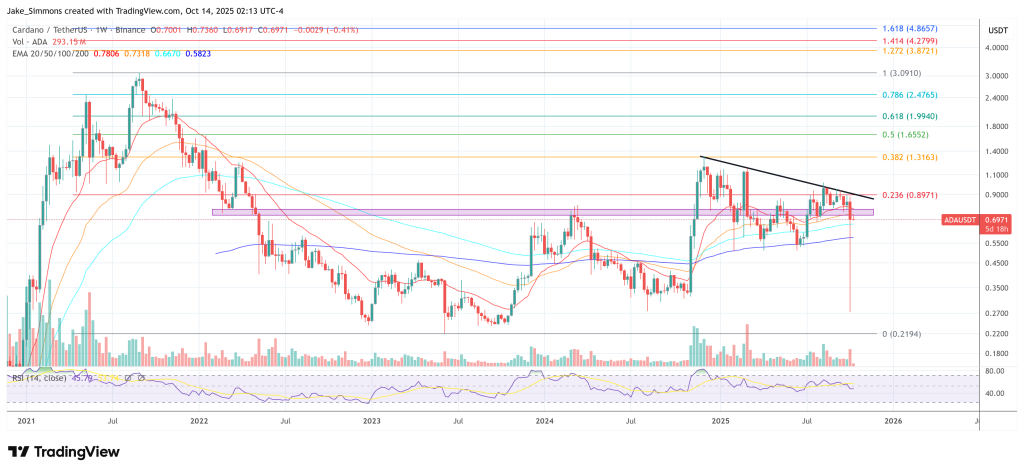
At press time, Cardano (ADA) traded at $0.69.

Related Posts