Cardano Founder Hails ‘Most Advanced Stablecoin Ever Built’

bitcoinistDipublikasikan tanggal 2025-08-01Terakhir diperbarui pada 2025-08-01

Abstrak

Cardano founder Charles Hoskinson has intensified the ecosystem’s push into regulated, privacy-preserving digital dollars, declaring on July 31 that “Moneta’s...

Trusted Editorial content, reviewed by leading industry experts and seasoned editors. Ad Disclosure

Cardano founder Charles Hoskinson has intensified the ecosystem’s push into regulated, privacy-preserving digital dollars, declaring on July 31 that “Moneta’s USDM is becoming the most advanced stablecoin ever built.” The remark, posted on X, came in the wake of a multi-day workshop in Buenos Aires that he said was “making progress on the first Private Stablecoin.”

Hoskinson’s endorsement dovetailed with a dense technical thread from Cardano developer Andrew Westberg that sketched how a privacy-enabled dollar could satisfy enterprise and legal requirements without turning public ledgers into open books. “The stablecoin is a small but important piece of the discussion in Argentina. That being said, the complexity is 10x to 20x that of USDM,” he wrote.

Why Cardano’s USDM Is A Next-Gen Stablecoin

Westberg walked the community through a role-based access model that would let a payroll recipient see only their own payment, an accountant see amounts without personal details, a CFO view the whole, and a court-ordered investigator gain full transparency during discovery. “Really cool tech, but it is a cambrian explosion of complexity to build out something where blockchain can truly eclipse and replace tradfi systems for the first time,” Westberg said.

Those comments follow months of public positioning by Input Output Global’s partner-chain Midnight, a zero-knowledge (“rational privacy”) network designed to let developers program selective disclosure and meet regulatory obligations while shielding counterparties and amounts. Midnight describes its approach as “programmable data protection” for enterprise-grade applications, with smart contracts written in a TypeScript-based language called Compact.

What Hoskinson hailed and what Westberg described are two closely related tracks. On Cardano’s base layer, Moneta Digital LLC issues USDM as a fiat-backed, regulated stablecoin. Moneta identifies itself as a US Money Services Business regulated at the federal level by FinCEN and relevant state authorities, and says reserves are held in bank deposits and money market funds managed by Fidelity and Western Asset Management.

Moneta also opened retail minting with a $1,000 minimum, a stated $0 minting fee, and availability in 19 US states, reflecting the incremental nature of state licensing. As of press time, DeFiLlama shows roughly $12 million USDM in circulation on Cardano.

In parallel, a privacy-preserving instrument is being built for Midnight. An X account branded “ShieldUSD” describes itself as a “fiat-backed privacy stablecoin on @MidnightNtwrk … issued by Moneta Digital LLC @USDMOfficial [and] built by @W3iSoftware,” the development studio where Westberg serves as CTO. While branding and final product details remain in flux, the direction is clear: a fiat-backed dollar with granular permissions that lives natively on a privacy chain and interoperates with public ledgers.

The core design debate—sparked by Westberg’s thread and community replies—turns on whether such complexity is overkill relative to today’s public stablecoins or the prerequisite for real-world finance to migrate on-chain. One respondent argued that USDC would be a “better fit” and that use cases for privacy coins without “government level integrations” are limited. Westberg countered bluntly: “Usdc is not capable of any of the above requirements. Everything it does is public.” He pointed to use cases beyond enterprise payroll—such as paying a public utility where the payer’s identity remains private while the public dataset is anonymized, or compliant remittances that disclose to a verifier only that the receiver is not in a sanctioned country.

Crucially, the privacy layer appears scoped to Midnight. Westberg and subsequent coverage have noted that once assets move off Midnight to public chains, users “lose the privacy,” even if the instrument remains interoperable with other stablecoins for liquidity or settlement. That trade-off—private by default where needed, public when bridged—tracks with Midnight’s own “selective disclosure” model and may reassure regulators that investigatory access can be granted “with a court order,” as Westberg’s payroll example emphasized.

Hoskinson’s choice of Buenos Aires as a backdrop is not incidental. Argentina has been a recurring stage for Cardano’s governance and adoption rhetoric, and for Hoskinson’s advocacy of “private money” that mimics the transactional privacy of cash while remaining auditable under law. The Buenos Aires workshop, framed by him as a milestone on the path to a “first Private Stablecoin,” underscores a push to marry compliance and confidentiality in a jurisdiction where inflation and dollarization have made stablecoins part of everyday economic life.

For Moneta and Cardano, the near-term milestones are prosaic but vital: expanding licensed jurisdictions, growing USDM’s fiat reserves and on-chain supply, integrating with Cardano DeFi venues, and, if the Midnight instrument launches as envisioned, proving that programmable privacy can slot into familiar workflows—payroll, bill payment, remittances—without recreating shadow banking on a blockchain. The longer-term test is market acceptance. USDM’s circulating supply—still modest relative to incumbents—will need to scale, and the privacy variant will need to demonstrate that role-based visibility and regulator-friendly access controls can survive contact with real compliance departments.

For now, the public signal from Cardano’s founder is unequivocal. “Moneta’s USDM is becoming the most advanced stablecoin ever built,” he wrote. The rest of the ecosystem—developers, enterprises, regulators, and users—will determine whether the architecture emerging on Midnight and Cardano can earn that superlative in production rather than in principle.

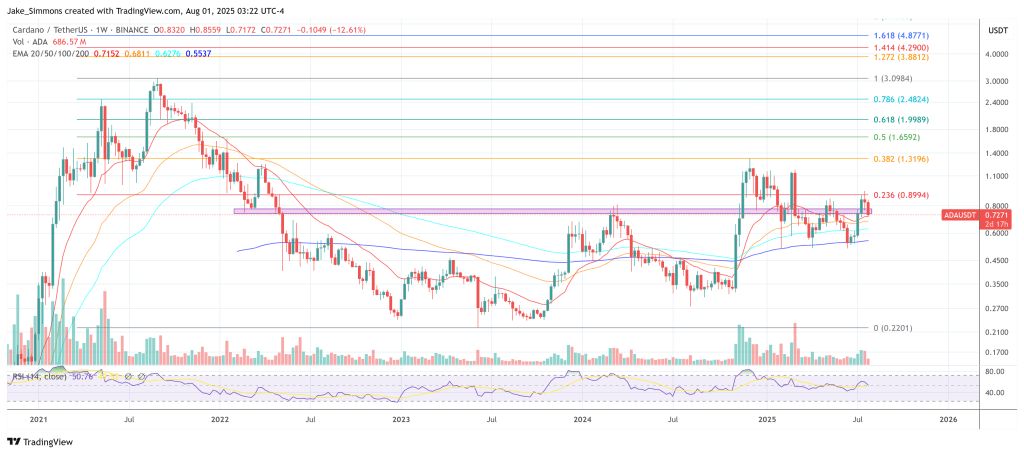
At press time, Cardano (ADA) traded at $0.72.
Cardano price
Cardano dips below key support, 1-week chart | Source: ADAUSDT on TradingView.com
Featured image created with DALL.E, chart from TradingView.com
Editorial Process for bitcoinist is centered on delivering thoroughly researched, accurate, and unbiased content. We uphold strict sourcing standards, and each page undergoes diligent review by our team of top technology experts and seasoned editors. This process ensures the integrity, relevance, and value of our content for our readers.

Jake Simmons has been a Bitcoin enthusiast since 2016. Ever since he heard about Bitcoin, he has been studying the topic every day and trying to share his knowledge with others. His goal is to contribute to Bitcoin's financial revolution, which will replace the fiat money system. Besides BTC and crypto, Jake studied Business Informatics at a university. After graduation in 2017, he has been working in the blockchain and crypto sector. You can follow Jake on Twitter at @realJakeSimmons.

Kripto yang Sedang Tren

Bacaan Terkait

Stablecoin Adalah 'Kaum Loyalis' Dunia Kripto: Open USD Membuat Sistem Moneter Lama Turun Langsung

**Ringkasan: Stablecoin Adalah "Pro-Kerajaan" dalam Dunia Kripto: Open USD Menarik Sistem Moneter Lama Turun Langsung** Munculnya Open USD, stablecoin dolar yang didukung oleh aliansi lebih dari 140 institusi seperti Visa, Mastercard, BlackRock, Google, dan Coinbase, menandai pergeseran persaingan stablecoin. Menurut cendekiawan Hu Yilin, ini bukan sekadar persaingan produk, melainkan perebutan infrastruktur dasar yang melibatkan keuangan tradisional, jaringan pembayaran, dan ekosistem blockchain. Hu Yilin berargumen bahwa stablecoin bukanlah "kaum moderat" dalam revolusi kripto, melainkan lebih mirip "reformis pro-kerajaan" di dalam sistem moneter lama. Mereka mengadopsi efisiensi blockchain namun tetap mempertahankan posisi sentral dolar AS dan Federal Reserve. Dengan demikian, stablecoin seperti Open USD tidak menantang hegemoni dolar, melainkan memperkuatnya dengan "paket peningkatan blockchain", menjadikan sistem dolar lebih efisien dan global. Dengan keterlibatan langsung raksasa keuangan tradisional, narasi awal stablecoin tentang mendisrupsi sistem lama menjadi bermasalah. Jika misinya hanya meningkatkan efisiensi, maka ketika sistem lama mengadopsi stablecoin sendiri, proyek asli kripto seperti Circle (penerbit USDC) kehilangan keunggulan revolusionernya. Hu Yilin membedakan antara jalur "moderat" seperti Michael Saylor (yang mempertahankan inti revolusioner "bitcoin standard") dan jalur "pro-kerajaan" stablecoin. Ia menegaskan bahwa revolusi kripto sejati, seperti revolusi Copernican dalam astronomi, memerlukan pergeseran paradigma mendasar: keyakinan bahwa tatanan moneter dan aktivitas ekonomi pasar tidak memerlukan bank sentral sebagai pusat tetap. Sementara stablecoin berguna sebagai alat transisi, jika dunia *on-chain* akhirnya tetap menggunakan dolar sebagai patokan, maka "revolusi blockchain" hanyalah alat tambahan (*add-on*) untuk sistem dolar.

marsbit22m yang lalu

Stablecoin Adalah 'Kaum Loyalis' Dunia Kripto: Open USD Membuat Sistem Moneter Lama Turun Langsung

marsbit22m yang lalu

Stablecoin Adalah 'Pihak Pro-Kerajaan' di Dunia Kripto: Open USD Membuat Sistem Moneter Lama Turun Tangan Sendiri

Stabil Open USD muncul, persaingan stablecoin berkembang dari perebutan pasar oleh startup kripto menjadi perang infrastruktur yang melibatkan keuangan tradisional, jaringan pembayaran, platform teknologi, dan ekosistem blockchain. Menurut cendekiawan Hu Yilin, stablecoin bukanlah "faksi moderat" dalam revolusi kripto, melainkan lebih seperti "reformis loyalis" di dalam sistem moneter lama: warisi efisiensi blockchain, tetapi pertahankan status sentral dolar AS dan Federal Reserve. Open USD, diluncurkan oleh 140+ lembaga seperti Visa, Stripe, BlackRock, dan Google, mewakili pergeseran signifikan. Alih-alih menantang hegemoni dolar, stablecoin seperti ini justru memperkuat dan membuat sistem dolar lebih efisien dengan teknologi blockchain. Hu Yilin mengibaratkannya dengan sistem Tychonic dalam revolusi Copernican—mengadopsi keunggulan teknis baru tetapi menolak inti revolusi dengan menjaga "Bumi (dolar)" tetap tak bergerak di pusat. Hal ini menciptakan dilema bagi perusahaan stablecoin asli seperti Circle (penerbit USDC). Jika misi mereka hanya meningkatkan efisiensi sistem lama, maka ketika raksasa tradisional seperti Visa meluncurkan stablecoin mereka sendiri, pembenaran revolusioner perusahaan asli memudar. Untuk tetap relevan, inovator kripto perlu mempertahankan elemen "pembangkangan" yang sejati, seperti menjunjung standard kripto asli (seperti Bitcoin), desentralisasi, atau resistensi sensor. Kesuksesan stablecoin berbasis dolar justru dapat memperkuat hegemoni dolar, di mana aktivitas on-chain yang berkembang menguntungkan aset dolar off-chain. Bagi aset kripto seperti Ethereum yang bercita-cita tinggi, bergantung pada narasi "bahan bakar" atau biaya transaksi saja tidak cukup; mereka harus berani mengusung narasi revolusi moneter yang mendasar. Inti revolusi kripto, analog dengan momen Copernican, adalah meyakinkan pasar bahwa tatanan moneter yang stabil tidak memerlukan bank sentral tetap sebagai pusatnya. Stablecoin adalah alat transisi yang bermanfaat, tetapi revolusi sejati terjadi ketika pasar percaya bahwa uang dapat ditentukan secara desentralisasi oleh aktivitas pasar itu sendiri, bukan oleh otoritas pusat. Open USD mungkin merupakan langkah kooptasi oleh sistem lama, sementara revolusi sesungguhnya menuntut pergeseran paradigma yang lebih radikal.

链捕手25m yang lalu

Stablecoin Adalah 'Pihak Pro-Kerajaan' di Dunia Kripto: Open USD Membuat Sistem Moneter Lama Turun Tangan Sendiri

链捕手25m yang lalu

Trading

Spot

Artikel Populer

Cara Membeli ADA

Selamat datang di HTX.com! Kami telah membuat pembelian Cardano (ADA) menjadi mudah dan nyaman. Ikuti panduan langkah demi langkah kami untuk memulai perjalanan kripto Anda.Langkah 1: Buat Akun HTX AndaGunakan alamat email atau nomor ponsel Anda untuk mendaftar akun gratis di HTX. Rasakan perjalanan pendaftaran yang mudah dan buka semua fitur.Dapatkan Akun SayaLangkah 2: Buka Beli Kripto, lalu Pilih Metode Pembayaran AndaKartu Kredit/Debit: Gunakan Visa atau Mastercard Anda untuk membeli Cardano (ADA) secara instan.Saldo: Gunakan dana dari saldo akun HTX Anda untuk melakukan trading dengan lancar.Pihak Ketiga: Kami telah menambahkan metode pembayaran populer seperti Google Pay dan Apple Pay untuk meningkatkan kenyamanan.P2P: Lakukan trading langsung dengan pengguna lain di HTX.Over-the-Counter (OTC): Kami menawarkan layanan yang dibuat khusus dan kurs yang kompetitif bagi para trader.Langkah 3: Simpan Cardano (ADA) AndaSetelah melakukan pembelian, simpan Cardano (ADA) di akun HTX Anda. Selain itu, Anda dapat mengirimkannya ke tempat lain melalui transfer blockchain atau menggunakannya untuk memperdagangkan mata uang kripto lainnya.Langkah 4: Lakukan trading Cardano (ADA)Lakukan trading Cardano (ADA) dengan mudah di pasar spot HTX. Cukup akses akun Anda, pilih pasangan perdagangan, jalankan trading, lalu pantau secara real-time. Kami menawarkan pengalaman yang ramah pengguna baik untuk pemula maupun trader berpengalaman.

1.5k Total TayanganDipublikasikan pada 2024.12.10Diperbarui pada 2026.06.02

Cara Membeli ADA

Diskusi

Selamat datang di Komunitas HTX. Di sini, Anda bisa terus mendapatkan informasi terbaru tentang perkembangan platform terkini dan mendapatkan akses ke wawasan pasar profesional. Pendapat pengguna mengenai harga ADA (ADA) disajikan di bawah ini.

活动图片