Ripple CTO Drops Bombshell On Pre-IPO Shares As Linqto Meltdown Explodes

bitcoinistDipublikasikan tanggal 2025-07-01Terakhir diperbarui pada 2025-07-01

Abstrak

Linqto’s once-celebrated promise to “democratize” (Ripple) pre-IPO investing is collapsing under the weight of federal probes, a looming bankruptcy filing...

Trusted Editorial content, reviewed by leading industry experts and seasoned editors. Ad Disclosure

Linqto’s once-celebrated promise to “democratize” (Ripple) pre-IPO investing is collapsing under the weight of federal probes, a looming bankruptcy filing and a furious customer base that now numbers roughly 13,000.

According to an internal review first detailed by The Wall Street Journal, investigators for the Securities and Exchange Commission and the US Department of Justice are examining allegations that former chief executive William Sarris secretly marked up Ripple shares by more than 60 percent, sold customer stock without permission and promoted deals to thousands of investors who failed to meet accredited-investor standards. New management concedes that client accounts have been frozen since February and warns that a Chapter 11 filing could leave many investors as unsecured creditors.

A March 14 press release from the company’s new leadership confirmed “pervasive securities-law violations,” the pausing of all trading and the dismissal of nearly half the staff while Linqto “explores all options to preserve value,” including court-supervised restructuring. The same statement insists that the special-purpose vehicles (SPVs) holding customers’ assets remain on issuer cap tables, but concedes that an independent forensic review is under way to verify that claim.

Into that vacuum stepped attorney John E. Deaton, who told his X followers that the situation is a “total clusterfuck” and that roughly 11,500 Linqto users bought units in SPVs that, in turn, were supposed to own Ripple shares. Deaton says as many as 5,000 of those investors are non-accredited, creating “a regulatory compliance nightmare” now squarely on the SEC’s radar. He plans to host a live session at 3 p.m. EST today to detail what he calls a “heavily involved” enforcement action and to explain why simply refunding principal would strip investors of six- and seven-figure gains booked on private-share price appreciation.

“You Never Owned Ripple Shares”— CTO

Ripple’s chief technology officer David Schwartz—better known online as “JoelKatz”—added fuel to the blaze by reminding holders that they never owned Ripple equity outright. “You don’t own the shares directly,” Schwartz wrote, “but you own a portion of a legal entity that owns the shares.” He elaborated, saying: “So if you ‘bought’ Z shares, you own X fraction of a legal entity with Y shares where X×Y=100. This generally lets you buy ‘shares’ more easily and in smaller quantities, but the equivalent per-share price is usually higher.”

This clarification dismantled a key misconception among many Linqto clients who believed they were holding Ripple stock directly. The implications are now being examined not only by the SEC but also by customers who fear their indirect ownership could be rendered illiquid or encumbered in bankruptcy court.

When pressed about whether those SPVs could be affected by Linqto’s financial collapse, Schwartz responded: “The legal entity that owns the shares that you own part of should not have exposure to Linqto going bankrupt. So a direct encumbrance on the shares to cover Linqto’s debts shouldn’t happen. But the entity may face operational challenges depending on exactly how it’s structured.”

That operational risk is precisely what has many investors on edge. If trustees, custodians, or record-keepers tied to those SPVs are forced to restructure, change providers, or liquidate assets, investors may find themselves in prolonged legal limbo with no access to their holdings—even if the shares remain technically intact on the cap table.

The Alleged George Soros Link

Complicating perceptions further, Schwartz addressed a separate thread linking billionaire George Soros to Ripple. He clarified that Soros Fund Management backed PolySign—another private company in which many Linqto users invested—during its 2022 acquisition of fund administrator MG Stover, but said he was “not aware of any Soros connection to Ripple.”

Initially, Schwartz wrote: “It wouldn’t surprise me very much since his funds own bits of almost everything (Salesforce, Amazon, Google, JP Morgan, Goldman, Uber, FedEx, and many more), but I couldn’t find any actual connection.”

However, after further reflection, he corrected himself: “Oh, wait, I remember now. Yes, Soros’ fund did invest in PolySign to help finance the acquisition of MG Stover! No connection to Ripple AFAICT though.”

The deeper regulatory concern is structural. Linqto created more than 500 SPVs, each designed to pool hundreds of retail investors while keeping the underlying issuer’s shareholder count below the 2,000-owner threshold that triggers public-reporting obligations. Internal emails obtained by investigators show former executives exhorting staff to “take no prisoners” in sales campaigns—at times buying back Ripple shares from customers at $55 each, only to flip them to Ripple for $61, banking an $8 million spread. If those shares never made it into the SPVs—as suggested in confidential memos cited by investigators—questions of beneficial ownership, tax liability and voting rights could embroil Ripple itself in discovery.

What happens next will hinge on three converging clocks: Linqto’s restructuring timetable, the SEC’s enforcement calendar and the pace at which SPV trustees can—or cannot—demonstrate clean title to almost half a billion dollars’ worth of private-company shares. Until then, thousands of would-be Ripple shareholders remain locked out of their accounts, watching from the sidelines as a legal and regulatory cyclone decides whether their “pre-IPO dream” survives or is wiped out in a courtroom ledger.

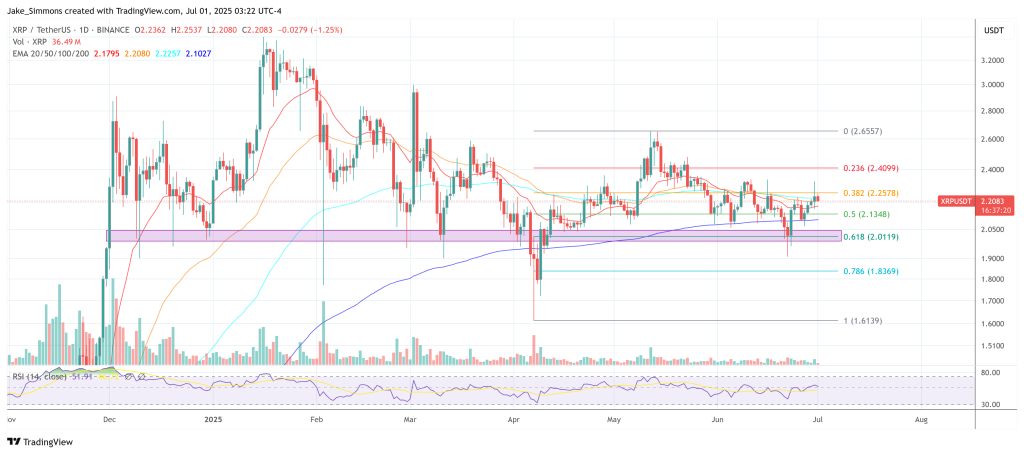
At press time, XRP traded at $2.20.
XRP price
XRP price, 1-day chart | Source: XRPUSDT on TradingView.com
Featured image created with DALL.E, chart from TradingView.com
Editorial Process for bitcoinist is centered on delivering thoroughly researched, accurate, and unbiased content. We uphold strict sourcing standards, and each page undergoes diligent review by our team of top technology experts and seasoned editors. This process ensures the integrity, relevance, and value of our content for our readers.

Jake Simmons has been a Bitcoin enthusiast since 2016. Ever since he heard about Bitcoin, he has been studying the topic every day and trying to share his knowledge with others. His goal is to contribute to Bitcoin's financial revolution, which will replace the fiat money system. Besides BTC and crypto, Jake studied Business Informatics at a university. After graduation in 2017, he has been working in the blockchain and crypto sector. You can follow Jake on Twitter at @realJakeSimmons.

Bacaan Terkait

Pendiri Baixing.com: Saya Percaya Setengah pada Pernyataan "Model Bahasa Besar Melahap Segalanya"

Pendiri 58 Tongcheng (situs rakyat): Saya Percaya Setengah dengan Pernyataan "Model Bahasa Besar Menelan Segalanya". Banyak orang berbicara tentang "model besar adalah segalanya", tetapi penulis tidak sepenuhnya percaya. Pernyataan "menelan segalanya" sering kali muncul karena pemahaman terbatas tentang masa depan. Internet pun disebutkan akan menelan segalanya, namun kenyataannya tidak. Penulis lebih setuju melihat model bahasa besar sebagai fondasi penting, seperti jaringan tulang punggung internet atau pembangkit listrik. Tanpa fondasi ini, dunia tidak bisa berkembang. Namun, setelah fondasi terbentuk, hal yang menarik justru terjadi di atasnya. Seperti listrik: setelah ditemukan, aplikasi pertamanya adalah bola lampu. Tapi kemudian muncul berbagai peralatan seperti mesin cuci, TV, dan penyedot debu. Listrik adalah dasar, tetapi peralatan spesifik itulah yang benar-benar mengubah dunia. Demikian pula, model bahasa besar menyediakan kecerdasan dasar, tetapi kecerdasan ini harus dimasukkan ke dalam "mesin" atau "alat" yang ditujukan untuk skenario spesifik agar dapat berfungsi dan mengubah dunia. Claude Code untuk menulis kode, Claude Design untuk desain, VoiceDrop untuk menulis artikel — meski menggunakan model dasar yang sama, mereka menyelesaikan masalah yang berbeda. Hanya memiliki listrik atau air tidak cukup untuk mencuci pakaian tanpa mesin cuci. Kecerdasan itu bagus, tetapi sebagian besar hal di dunia memerlukan kombinasi berbagai elemen untuk bekerja. Model bahasa besar mungkin bisa menggantikan banyak hal di bidang perangkat lunak, tetapi tidak banyak skenario yang hanya membutuhkan satu elemen. Saat ini, selain model besar, diperlukan lapisan seperti "Harness" untuk menghubungkannya dengan kode dan membentuk sesuatu yang benar-benar bisa digunakan. Lapisan antarmuka ini membantu memasukkan kecerdasan, seperti listrik atau air, ke dalam aplikasi spesifik, mengubahnya menjadi mesin yang memecahkan masalah konkret. Penulis mengakui bahwa ada logika tertentu di balik "menelan segalanya", terutama terkait perangkat lunak yang ada saat ini. Banyak perangkat lunak, seperti CRM, sistem informasi rumah sakit (HIS), dan berbagai sistem lainnya, dibangun dari aturan, formulir, alur kerja yang tetap. Lapisan ini memang mungkin banyak "ditelan" oleh model bahasa besar karena terdiri dari instruksi jelas yang dapat dieksekusi komputer — sesuatu yang sangat dikuasai model bahasa besar. Namun, di lapisan ini, selain perangkat lunak, ada banyak hal lain: informasi pelanggan, kemampuan eksekusi (seperti memesan tiket pesawat), kepercayaan, dan banyak hal di dunia fisik. Ini tidak akan ditelan. Setelah "menelan" lapisan perangkat lunak lama, justru terbuka ruang yang lebih besar untuk perangkat lunak baru di atasnya. Perangkat lunak baru kemungkinan akan memiliki antarmuka yang lebih "mengalir", tidak terlalu kaku dengan aturan. Jika bagian aturan diserahkan kepada AI, seperti yang dilakukan Salesforce dengan CRM-nya, maka imajinasi dan kemungkinan baru akan terbuka — bagian yang saat ini belum kita lihat. Kesalahan umum adalah, ketika teknologi baru datang, karena kita belum melihat jalan yang lebih besar di depannya, kita hanya fokus pada apa yang ada di depan mata. Penulis mengingatkan bahwa pada 2004, banyak yang mengira internet hampir berakhir dan perusahaan seperti Sina, Sohu, NetEase akan memonopoli segalanya. Beberapa tahun kemudian, segalanya berubah drastis. Kesimpulannya, model besar itu penting — ia adalah fondasi dan titik fokus utama saat ini. Namun, begitu menjadi sesuatu yang stabil dan dapat disediakan secara berkelanjutan, dibutuhkan berbagai "mesin" dan "alat" di atasnya untuk memecahkan masalah spesifik. Lapisan tebal itulah — di mana dan bagaimana ia digunakan — yang akan menjadi arus utama gelombang kedua. "Menelan segalanya" adalah istilah yang tidak tepat. Yang penting adalah menemukan peluang di area yang "ditelan"nya.

marsbit46m yang lalu

Pendiri Baixing.com: Saya Percaya Setengah pada Pernyataan "Model Bahasa Besar Melahap Segalanya"

marsbit46m yang lalu

Akankah Klaim BTC Satoshi Noah Doe ‘Mengganggu Seluruh Industri’? Para Tergugat Menyatakan…

Setelah empat belas tahun, Bitcoin dari era Satoshi kembali menjadi pusat gugatan hukum. Pada 6 Juli, amicus brief kedua diajukan untuk menentang upaya "Noah Doe" mengklaim kepemilikan atas koin Satoshi sebagai "properti terlantar." Tiga penggugat dengan nama samaran—Noah Doe, ABC Company, dan XYZ Company—berusaha memperoleh kepemilikan hukum atas 39.069 dompet Bitcoin yang tidak aktif. Mereka mengklaim telah memberi pemberitahuan lewat fungsi OP_RETURN Bitcoin, memberi pemilik dompet 90 hari untuk menanggapi. Setelah periode itu, sekitar 2.900 dompet dihapus, menyisakan 39.069 yang mereka anggap terlantar. Namun, para tergugat menentang gugatan ini. Mereka menekankan bahwa penggugat tidak memiliki kunci privat untuk mengakses Bitcoin dan tidak punya bukti bahwa pemilik dompet melihat pemberitahuan tersebut. Hanya mengandalkan ketidakaktifan dompet sebagai bukti penelantaran dinilai berbahaya, karena banyak investor sengaja menyimpan Bitcoin tanpa bergerak selama bertahun-tahun. Mereka memperingatkan bahwa mengabulkan tuntutan penggugat akan mengganggu seluruh industri dan hak properti digital. Argumen ini diperkuat oleh aktivitas baru-baru ini di dompet Satoshi dengan alamat *1LwWtSs7tMCwcRczQd5kVMv3xpWw6w4Sxe*, yang baru saja memindahkan 15 BTC. Dompet ini termasuk dalam daftar tergugat. Para ahli seperti Alex Thorn menegaskan bahwa kepemilikan Bitcoin bergantung pada kontrol kunci privat, bukan riwayat transaksi, sehingga ketidakaktifan dompet tidak membuktikan penelantaran. Singkatnya, penggugat berusaha mendapatkan kendali hukum atas dompet yang dianggap terlantar, sementara tergugat menolak dengan alasan klaim tersebut lemah dan berpotensi merusak hak properti digital.

ambcrypto1j yang lalu

Akankah Klaim BTC Satoshi Noah Doe ‘Mengganggu Seluruh Industri’? Para Tergugat Menyatakan…

ambcrypto1j yang lalu

Trading

Spot
活动图片