The Rainmakers of the Crypto Market

Token TerminalDipublikasikan tanggal 2024-06-17Terakhir diperbarui pada 2024-08-23

Introduction

This week’s newsletter focuses on protocols (blockchains & decentralized applications) that generate the most fees. Understanding which protocols that generate the most fees is interesting for a few different reasons:

  1. Which protocols' services are users willing to pay for?
  2. What services do these protocols provide and how do they charge their users (business model)?
  3. How much are the users actually paying?
  4. Are some market sectors more popular than others?
  5. Is there a dominant protocol within these market sectors?

We’ll learn that analyzing only one chart from the Terminal can tell us a lot about the industry dynamics in the crypto market.

Let’s dive in!


1. Top fee-generating protocols with a highlight on Blockchains
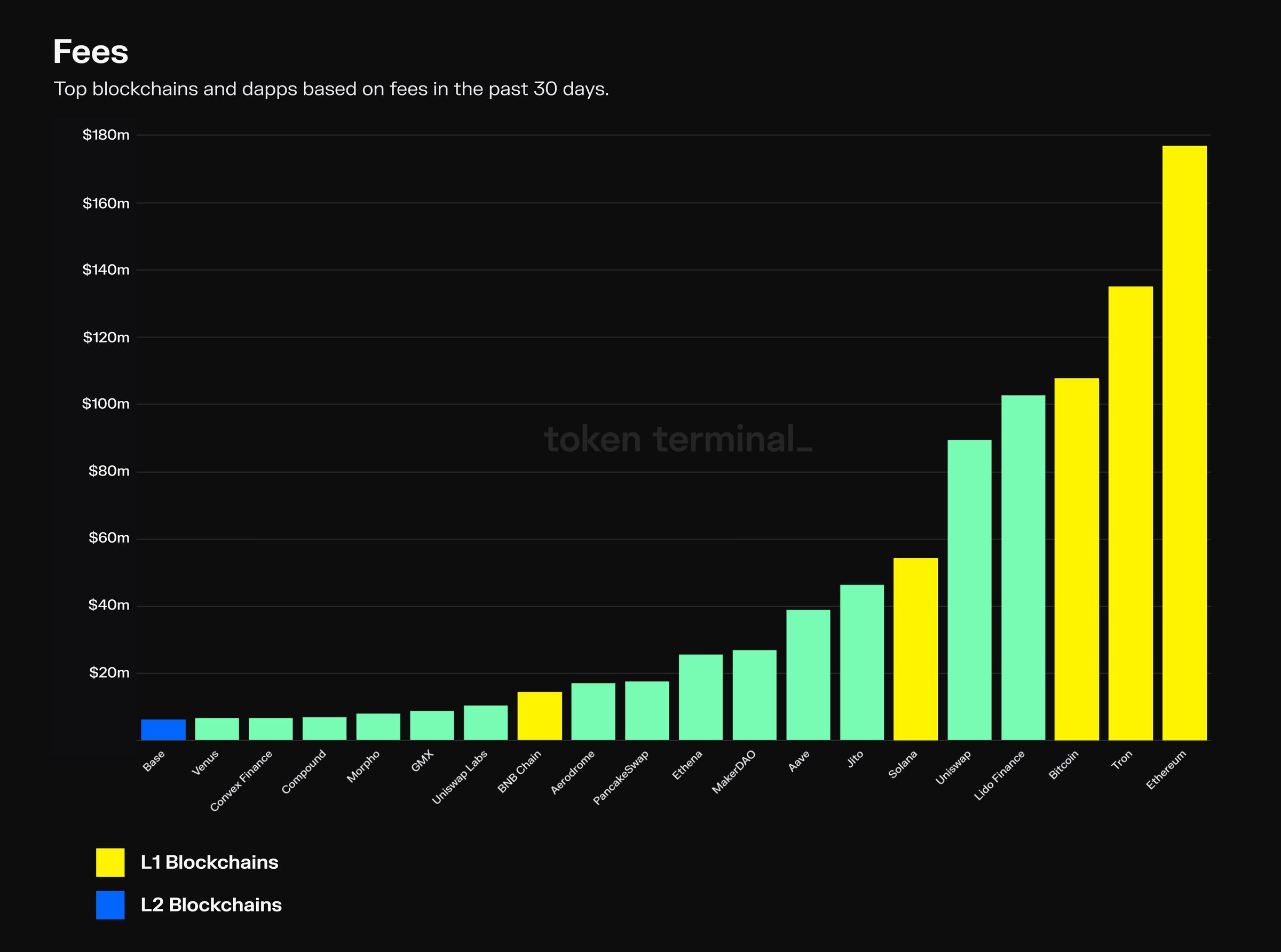
Highlighted protocols: Ethereum, Tron, Bitcoin, Solana, BNB Chain, and Base.

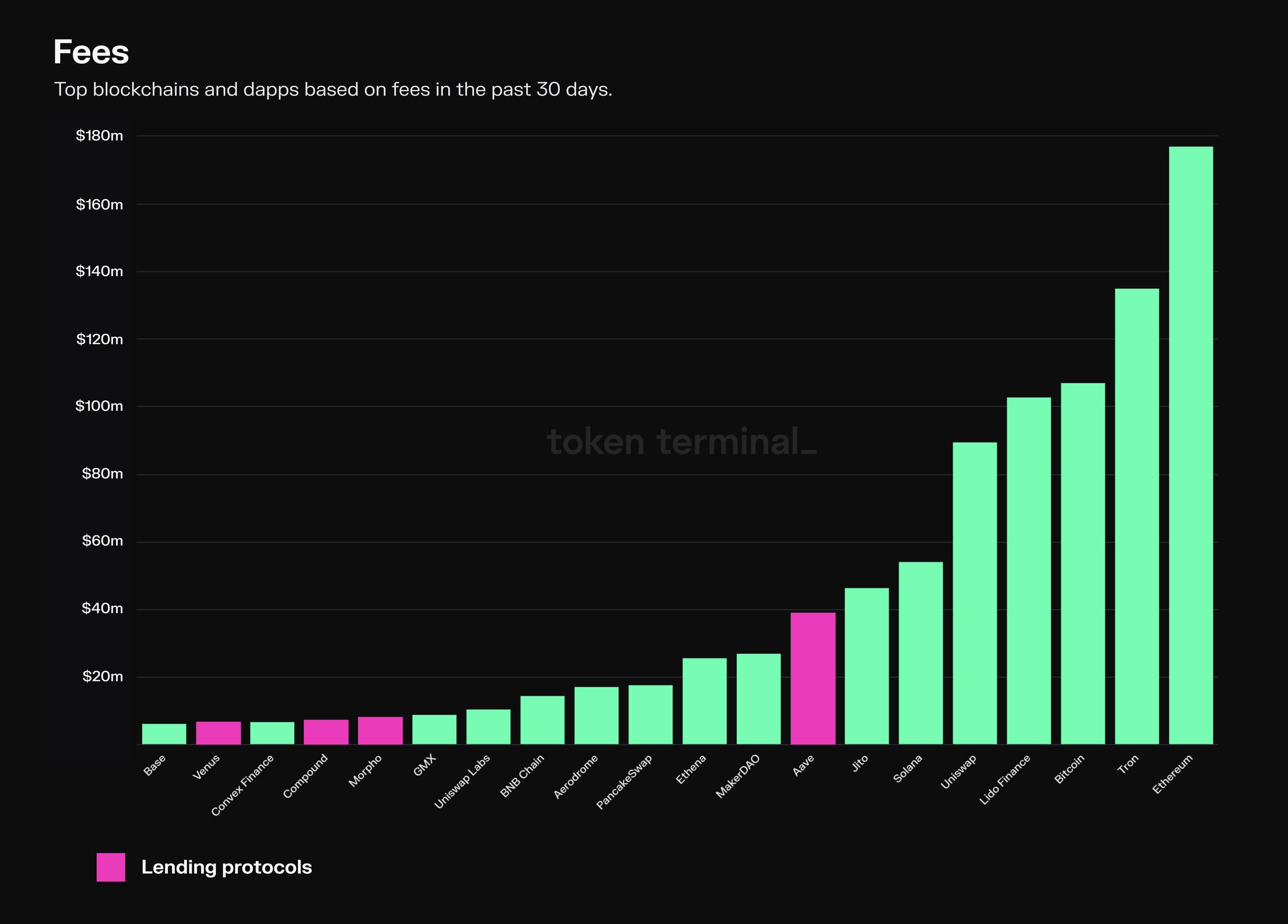
A majority of Fees is generated by general-purpose blockchains

  • Of the top 20, 5 are L1 blockchains, while only 1 is an L2 blockchain.
  • In the past 30 days, Ethereum generated the most Fees (~$180M). It’s worth highlighting that Base, despite the relatively low average transaction fee of ~$0.03 (compared to ~$4.5 on the Ethereum L1), still places among the top 20 because of the surge in user activity on the L2.
  • Outside of L1 & L2 blockchains, all the other protocols in the top 20 belong to the DeFi category.

2. Top fee-generating protocols with a highlight on Lido Finance and Jito
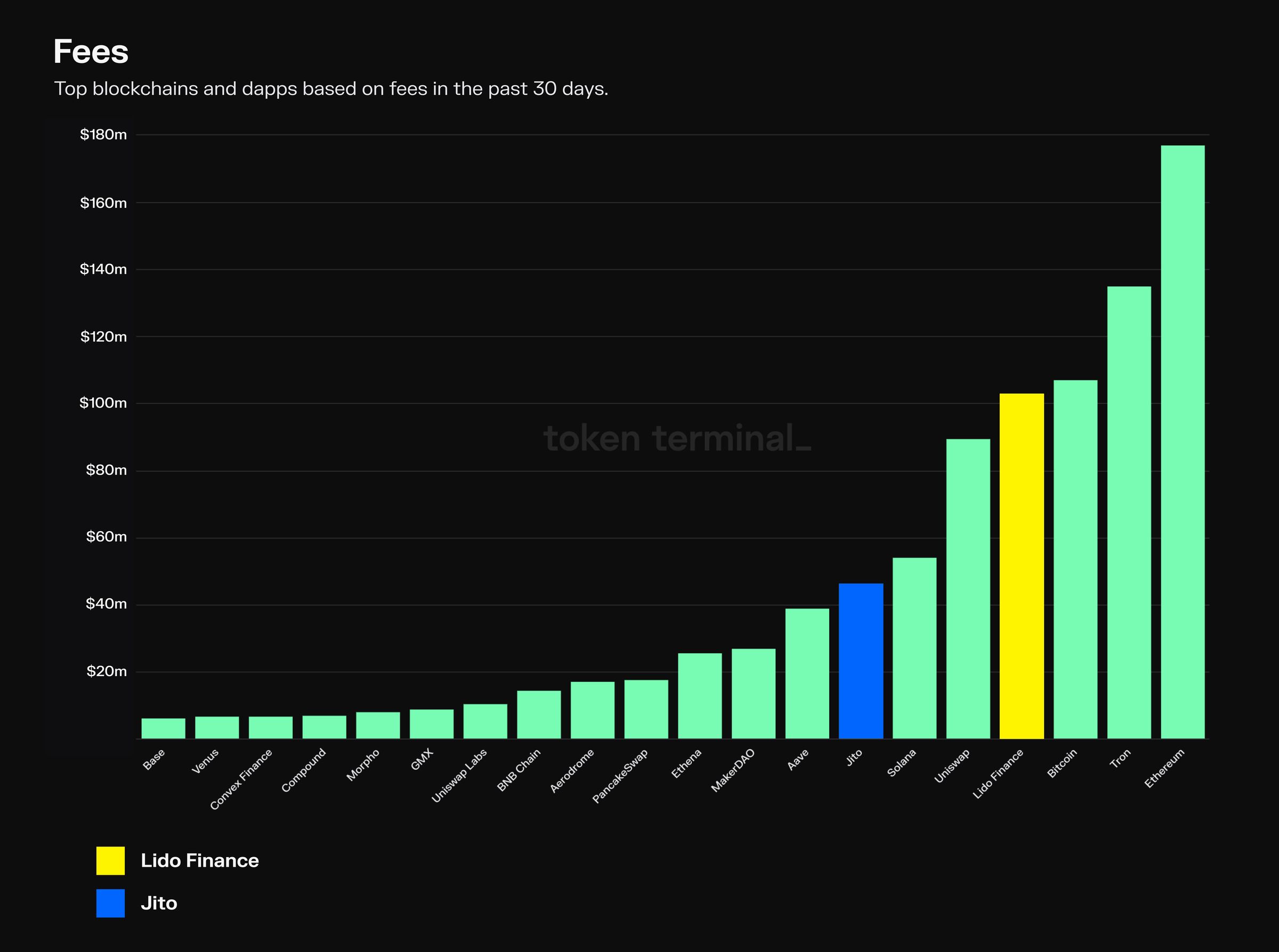
Highlighted protocols: Lido Finance and Jito.

Lido generates the most Fees out of all applications in crypto

  • Jito runs 2 different businesses: liquid staking (JitoSOL) and an MEV marketplace. The former monetizes via an AUM based management fee, and the latter by a take rate on the MEV tips paid to validators (the above chart includes only the MEV tips). Lido runs 1 business: liquid staking. It monetizes by charging a take rate on the staking rewards it earns for its depositors.
  • Lido generates ~2x in Fees compared to Jito, but Jito is growing faster.
  • Lido has $33.5B in Assets staked, whereas Jito has $1.6B. Lido’s fully diluted market cap is $1.9B, whereas Jito’s is $2.5B.

3. Top fee-generating protocols with a highlight on Exchanges (DEX)
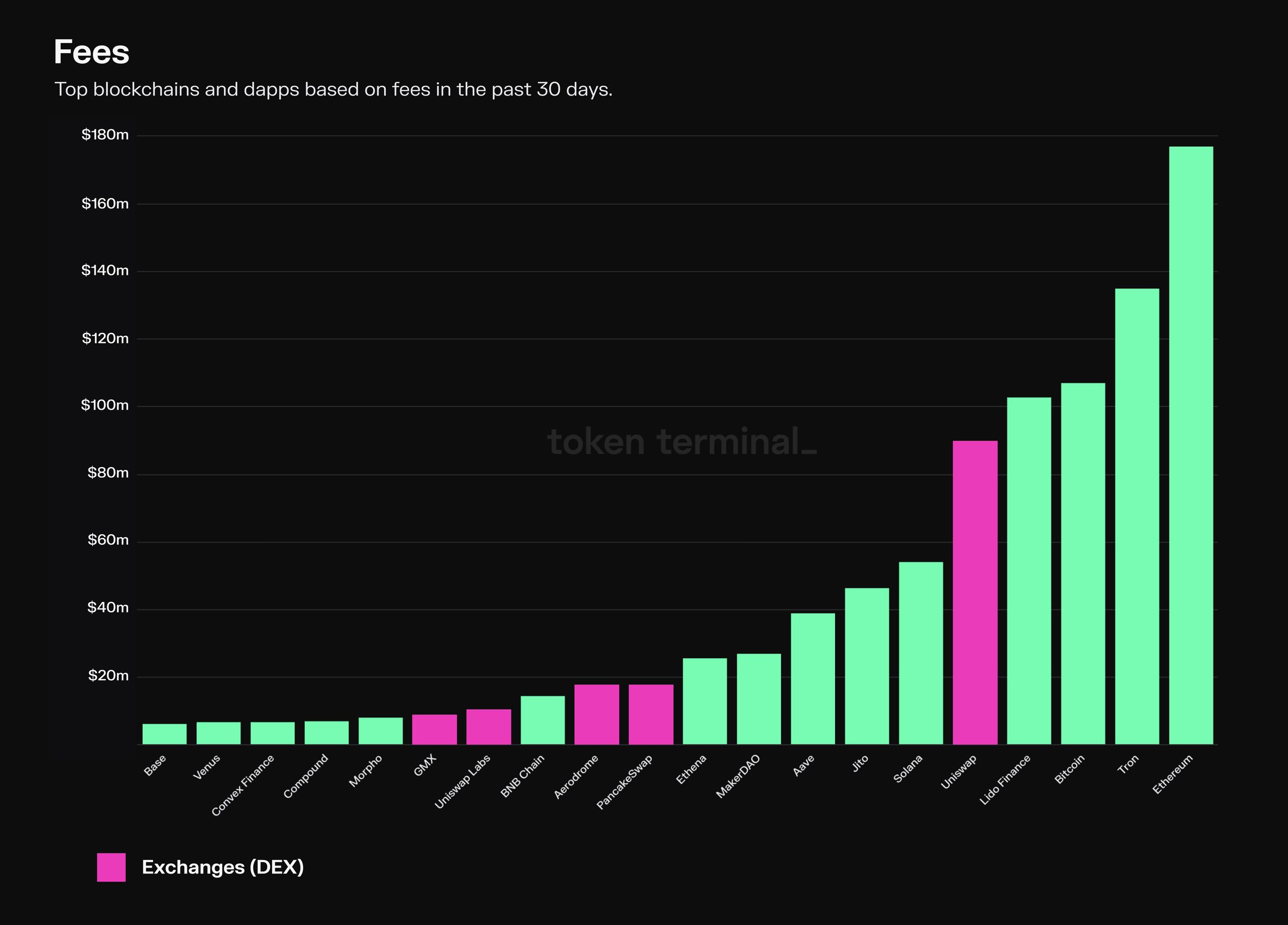
Highlighted protocols: Uniswap, PancakeSwap, Aerodrome, Uniswap Labs, and GMX.

The Uniswap DAO dominates the DEX category with monthly Fees nearing $100M

  • The Uniswap DAO generates the most Fees among DEXs. Note that Uniswap Labs is included as a separate entity, it monetizes by charging users who access the Uniswap Protocol through the official Uniswap Labs frontend application.
  • Uniswap DAO generates over ~2x in Fees compared to all the other DEXs in the top 20.
  • Aerodrome, a Base-native DEX, generates ~2x more fees than its underlying L2 blockchain.

4. Top fee-generating protocols with a highlight on MakerDAO and Ethena
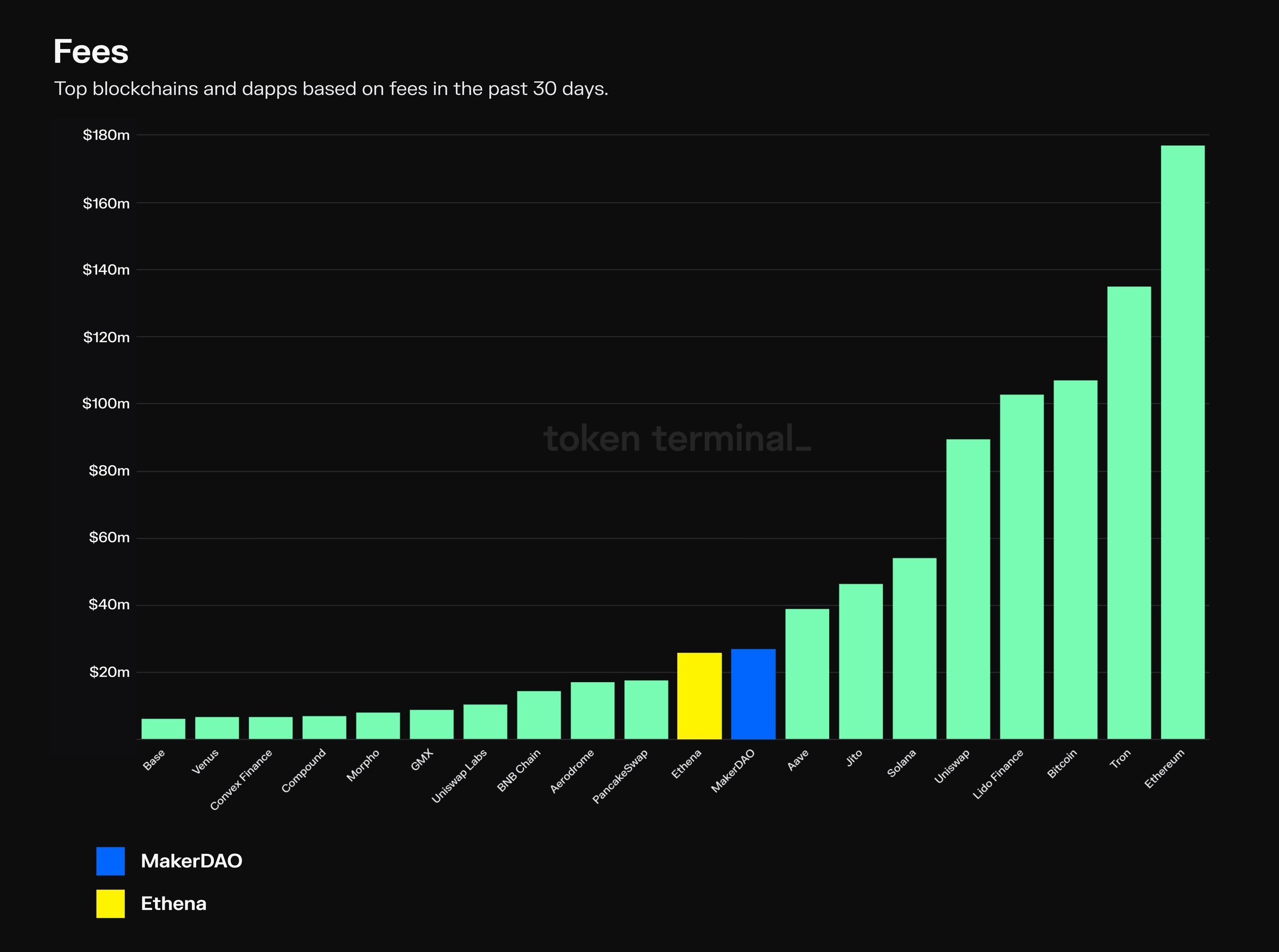
Highlighted protocols: MakerDAO and Ethena.

Ethena is on track to overtake MakerDAO in Fees

  • MakerDAO and Ethena dominate the decentralized Stablecoin issuers category.
  • The biggest stablecoin issuers, Tether (USDT) and Circle (USDC) are not included as they earn their Fees & Revenue offchain.
  • Ethena was launched in November 2024, whereas MakerDAO was launched already in November 2017.

5. Top fee-generating protocols with a highlight on Lending protocols
Highlighted protocols: Aave, Morpho, Compound, and Venus.

Aave is the 4th most fee-generating application in crypto

  • Aave is the clear market leader in the lending category, with a ~$30M Fee gap to Morpho, which comes in 2nd place in the lending market sector.
  • Compound and Aave both launched in 2020, but Aave has since managed to outcompete Compound in terms of Active loans and Fees.
  • Despite Aave’s dominance in the lending category, Venus stands out as the clear market leader for lending on the BNB Chain. Right now, ~90% of Venus’ Fees are generated from its deployment on the BNB Chain.

6. Top fee-generating protocols; breakdown by chain
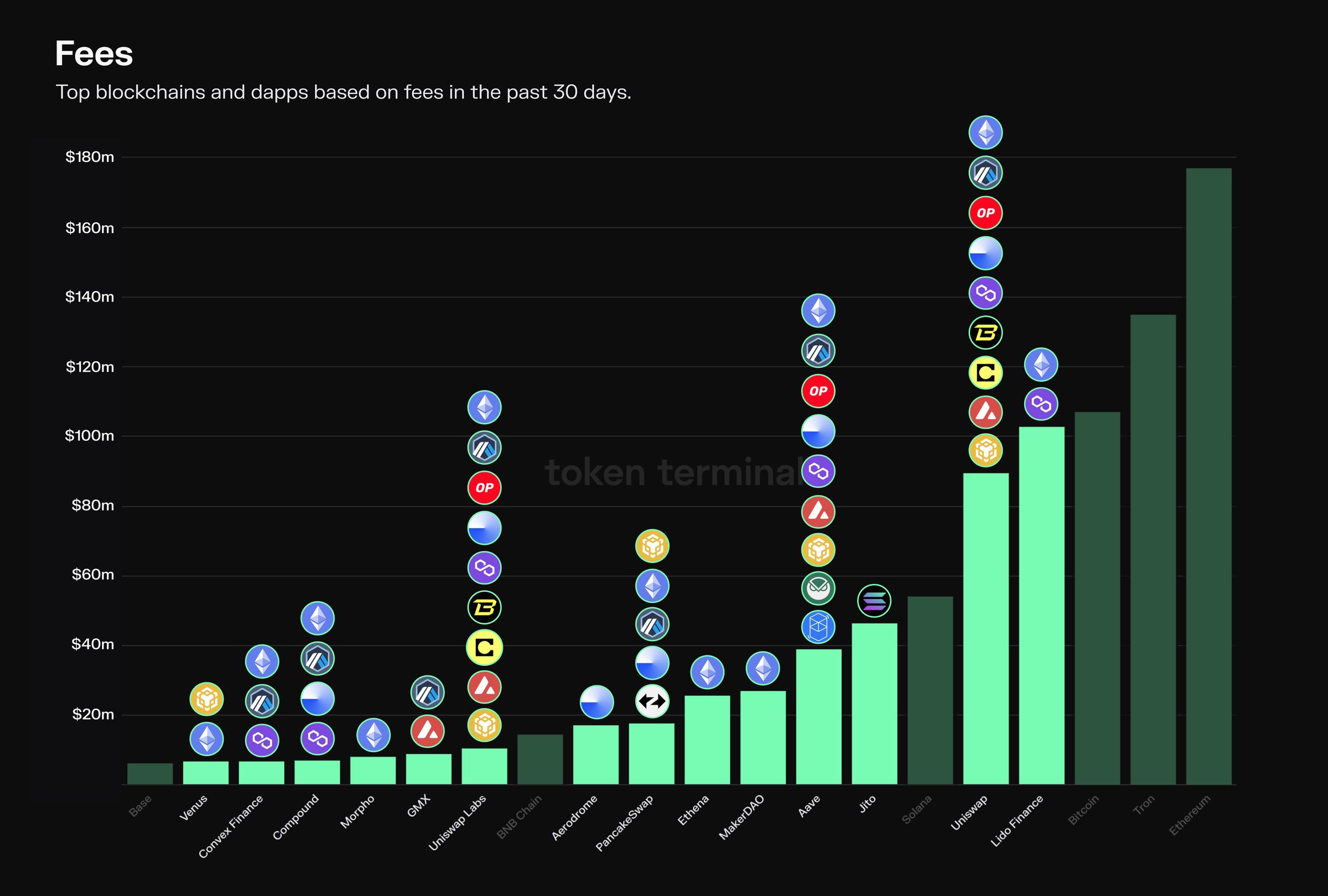
Highlighted which blockchains the applications are deployed to.

Most of the top fee-generating applications are deployed to multiple blockchains

  • A vast majority of the top 20 fee-generating applications in crypto have a deployment on Ethereum (L1 and L2s).
  • It is worth noting that asset issuers (Stablecoin issuers and Liquid staking providers) tend to be governed from a single chain, while their core product (stablecoin or LST) is made available as a bridged asset on multiple other chains.
  • Of the top 20, Aerodrome is the only application that has been launched from an L2 blockchain (Base).

FAQ

What are Fees?

  • The aggregate fees paid by the end users of the protocol’s service.
  • The methodology for Fees varies between Market sectors, because protocol’s in different Market sectors tend to have different business models:
    • Blockchains L1 & L2 = sell blockspace for transaction fees
    • Liquid staking = invest users’ stake to earn staking rewards
    • Exchange (DEX, Derivatives) = enable asset exchange against trading fees
    • Lending = provide loans against interest payments
    • Stablecoin issuers = provide access to USD against interest payments and/or invest user deposits to earn yield
    • Asset management = invest user deposits to earn yield

What’s the difference between Fees and Revenue?

  • Revenue is calculated based on the take rate (%) that the protocol applies to Fees.
  • The take rate can be anything between 0-100%.
  • Currently, the Uniswap DAO and Bitcoin both have a take rate of 0%, whereas Ethereum tends to have a take rate of ~80%.

What’s the difference between Revenue and Earnings?

  • Earnings is calculated by subtracting (i) Token incentives and (ii) Operating expenses from the Revenue.
    • Token incentives = an indication of how much the protocol spends on user acquisition. It’s calculated as the USD value of the protocol’s native tokens that have been distributed to users.
    • Operating expenses = an indication of how much the protocol spends on personnel and infrastructure to develop, maintain, and improve the protocol.
      • Note that a vast majority of protocols do not post their Operating expenses onchain, which is why that metric is yet to be added for most protocols.

When should you look at Fees vs. Revenue or Earnings?

  • As a rule of thumb, investors should pay attention to Fees for early-stage protocols that have not started to monetize yet, and Revenue and/or Earnings for protocols that have started to monetize:
    • Early-stage: Fees, indicates that the protocol has paying customers.
    • Later-stage: Revenue, indicates that the protocol is able to monetize its paying customers.
    • Mature-stage: Earnings, indicates that the protocol is able to return value to its tokenholders.
  • It’s also important to look at the ratios between:
    • Revenue / Fees = ideally, the protocol has so much leverage over its supply-side (LPs) that it can charge a high take rate on the Fees.
    • Earnings / Revenue = ideally, the protocol operates with a (i) low user acquisition spend, and (ii) operational overhead, which leads it to retain a high % of Revenue as Earnings.

The authors of this content, or members, affiliates, or stakeholders of Token Terminal may be participating or are invested in protocols or tokens mentioned herein. The foregoing statement acts as a disclosure of potential conflicts of interest and is not a recommendation to purchase or invest in any token or participate in any protocol. Token Terminal does not recommend any particular course of action in relation to any token or protocol. The content herein is meant purely for educational and informational purposes only, and should not be relied upon as financial, investment, legal, tax or any other professional or other advice. None of the content and information herein is presented to induce or to attempt to induce any reader or other person to buy, sell or hold any token or participate in any protocol or enter into, or offer to enter into, any agreement for or with a view to buying or selling any token or participating in any protocol. Statements made herein (including statements of opinion, if any) are wholly generic and not tailored to take into account the personal needs and unique circumstances of any reader or any other person. Readers are strongly urged to exercise caution and have regard to their own personal needs and circumstances before making any decision to buy or sell any token or participate in any protocol. Observations and views expressed herein may be changed by Token Terminal at any time without notice. Token Terminal accepts no liability whatsoever for any losses or liabilities arising from the use of or reliance on any of this content.

Stay in the loop

Join our mailing list to get the latest insights!

Email
Sign up

Kripto yang Sedang Tren

Bacaan Terkait

Ledakan Super Spiral Tak Terkalahkan, Laporan Keuangan Micron Nyalakan Panjangnya Banteng Semikonduktor

**Ringkasan Artikel: Micron Kembali Mendorong Lembu Panjang Semikonduktor dengan Laporan Keuangan Ledakan** Pada 25 Juni dini hari waktu Beijing, Micron Technology merilis laporan keuangan Q3 tahun fiskal 2026 yang sangat diantisipasi, melampaui semua ekspektasi pasar. **Kinerja Luar Biasa Melebihi Perkiraan Paling Agresif** * **Pendapatan Q3:** $414,56 miliar (naik 346% YoY), jauh melampaui perkiraan pasar ~$354 miliar. * **Laba Bersih GAAP:** $282,43 miliar (naik hampir 15x YoY). * **Panduan Q4 yang Mengejutkan:** Pendapatan diperkirakan mencapai ~$500 miliar (lebih tinggi dari ekspektasi tinggi Goldman Sachs sebesar $488 miliar), dengan margin kotor ~86%. **AI Mendrive Pertumbuhan di Seluruh Rantai Memori** Pendorong utamanya tetap AI, tetapi dampaknya kini meluas di luar HBM: * Semua lini bisnis inti tumbuh lebih dari 250-600%, termasuk memori cloud, pusat data, SSD pusat data, serta bisnis mobil dan embedded. * **HBM4** sudah dikirim secara massal ke pelanggan inti, **HBM4E** dalam pengembangan untuk produksi massal 2027, dengan kapasitas HBM 2026 terjual habis. * Permintaan untuk AI juga mengencangkan pasokan DRAM dan NAND tradisional, mendorong siklus harga yang kuat. Micron memperkirakan kondisi ketat pasokan-permintaan ini berlanjut hingga setidaknya 2027. **Stabilitas Jangka Panjang dengan Kontrak "Take-or-Pay"** Ini adalah perubahan bersejarah bagi industri yang biasanya sangat siklis: * Micron telah menandatangani **16 perjanjian strategis jangka panjang (SCA)** dengan pelanggan, sebagian hingga tahun 2030. * Perjanjian ini mencakup **20% pengiriman DRAM dan sepertiga pengiriman NAND**, menggunakan model **"Take-or-Pay"** yang mengikat. Bahkan jika pelanggan tidak mengambil semua barang, mereka tetap harus membayar. * **14 perjanjian awal** diperkirakan menjamin pendapatan sekitar **$1000 miliar**, dengan jaminan kinerja pelanggan sebesar ~$220 miliar (sekitar $180 miliar dalam bentuk tunai) untuk mendanai ekspansi. **Ekspansi Kapasitas Didukung Pesanan, Bukan Spekulasi** * Pengeluaran modal Q4 diperkirakan sekitar **$100 miliar**, difokuskan pada HBM, DRAM canggih, dan kemasan canggih. * Ekspansi ini didorong oleh **permintaan yang terkunci melalui kontrak jangka panjang**, bukan sekadar perkiraan permintaan masa depan, mengurangi risiko kelebihan kapasitas tradisional. **Dampak Pasar: Mengembalikan Kepercayaan pada Lembu Semikonduktor** Laporan keuangan Micron meredam kekhawatiran bahwa kenaikan sektor semikonduktor telah jenuh. Kinerja yang jauh melampaui ekspektasi dan visibilitas permintaan jangka panjang yang kuat ini: * Mengirimkan sinyal jelas bahwa **infrastruktur AI masih berakselerasi, bukan melambat**. * Mendorong saham Micron naik 16% dalam perdagangan setelah jam, dan mengerek naik saham semikonduktor global lainnya di AS, Korea Selatan (termasuk Samsung dan SK Hynix), dan China. * Menegaskan kembali bahwa **cerita AI masih panjang, dan memori semakin menjadi pemeran utama di dalamnya**.

Odaily星球日报13m yang lalu

Ledakan Super Spiral Tak Terkalahkan, Laporan Keuangan Micron Nyalakan Panjangnya Banteng Semikonduktor

Odaily星球日报13m yang lalu

Mengartikan Arsitektur Baru Ethereum Foundation: Menegaskan Kembali Kedaulatan Diri dalam Tren Institusionalisasi

Ethereum Foundation (EF) mengumumkan restrukturisasi internal menjadi lima lapisan kerja, disertai pengurangan 20% staf, untuk memperjelas fokus dan menegaskan kembali nilai inti kedaulatan diri (self-sovereignty) di tengah tren institusionalisasi crypto. Lima lapisan kerja tersebut adalah: 1. **Protocol Layer**: Mempertahankan atribut inti Ethereum (CROPS: Censorship-resistant, Robust, Open, Private, Secure) dan mengerjakan teknologi dasar seperti hard fork yang aman. 2. **Access Layer**: Memastikan pengguna dapat benar-benar menggunakan kemampuan kedaulatan diri Ethereum dalam praktik, dengan prinsip "zero option" yang menyediakan jalur tanpa perantara untuk setiap tindakan penting (membaca chain, bertransaksi, dll.). 3. **User Layer**: Menjembatani pengembangan teknologi dengan kebutuhan pengguna dan organisasi nyata, agar keputusan pengembangan berbasis pada realitas pengguna, bukan hanya visi teknis. 4. **Community Layer**: Memelihara dan menyebarkan konsensus nilai Ethereum, baik di dalam ekosistem (tentang tujuan dan prinsip) maupun dengan menghubungkannya ke bidang lain seperti teknologi sumber terbuka dan privasi. 5. **Institutional Layer**: Mengelola interaksi dengan lembaga, namun dengan premis kedaulatan diri, bukan memudahkan kontrol institusi atas pengguna. Tujuannya adalah menciptakan contoh integrasi yang lebih baik menggunakan teknologi Ethereum. Artikel ini merefleksikan bahwa meskipun adopsi institusi (seperti ETF) membawa crypto ke arus utama, hal itu juga berpotensi menggeser logika dasar seperti desentralisasi dan netralitas. EF melalui struktur barunya ingin menegaskan bahwa siapapun (individu atau institusi) dapat berpartisipasi di Ethereum, tetapi tanpa mengorbankan prinsip kedaulatannya sebagai "lautan bebas" digital yang tahan terhadap pengaruh dan pemaksaan terpusat.

marsbit30m yang lalu

Mengartikan Arsitektur Baru Ethereum Foundation: Menegaskan Kembali Kedaulatan Diri dalam Tren Institusionalisasi

marsbit30m yang lalu

Menginterpretasi Arsitektur Baru Ethereum Foundation: Menegaskan Kembali Kedaulatan Diri dalam Tren Institusionalisasi

Ethereum Foundation (EF) melakukan restrukturisasi besar dengan merilis arsitektur lima lapis kerja baru setelah mengurangi 20% karyawan. Tujuannya adalah memperjelas peran EF sambil menegaskan kembali nilai inti kedaulatan diri (self-sovereignty) di tengah tren institusionalisasi crypto. Lima lapis kerja tersebut adalah: 1. **Lapisan Protokol:** Fokus pada pemeliharaan atribut inti Ethereum (CROPS: Censorship-resistant, Robust, Open, Private, Secure) seperti keamanan, anti-kuantum, dan anti-MEV beracun. 2. **Lapisan Akses:** Memastikan pengguna dapat benar-benar menggunakan kemampuan kedaulatan diri, dengan prinsip *zero option* (selalu ada jalur tanpa perantara). 3. **Lapisan Pengguna:** Menjembatani pengembang dengan kebutuhan nyata pengguna/organisasi untuk menghindari pengambilan keputusan yang terisolasi. 4. **Lapisan Komunitas:** Membangun dan menyebarkan konsensus nilai Ethereum (tidak tunduk pada kepentingan terpusat, netral, pertahankan CROPS) baik di dalam maupun luar ekosistem. 5. **Lapisan Institusional:** Berinteraksi dengan lembaga tradisional, namun dengan prinsip kedaulatan diri sebagai landasan, bukan memudahkan kontrol institusi atas pengguna. Artikel menyoroti bahwa meski adopsi institusi (seperti ETF, stablecoin) membawa kesuksesan, hal itu juga mengikis narasi desentralisasi dan "dolarisasi" ekosistem. EF menekankan bahwa Ethereum harus tetap menjadi "laut bebas" yang netral dan tahan sensor. Restrukturisasi ini adalah upaya untuk menyeimbangkan kebutuhan pertumbuhan dengan komitmen pada nilai-nilai dasar yang membuat Ethereum unik, memastikannya tetap menjadi platform tepercaya bagi layanan global yang benar-benar tanpa izin.

链捕手33m yang lalu

Menginterpretasi Arsitektur Baru Ethereum Foundation: Menegaskan Kembali Kedaulatan Diri dalam Tren Institusionalisasi

链捕手33m yang lalu

Bitcoin Kembali Tembus di Bawah $60.000; Setelah 20 Bulan, yang Kita Tunggu Adalah Level Terendah Baru

Bitcoin kembali turun di bawah level psikologis kunci $60,000, menyentuh terendah $59,023 yang merupakan level terendah dalam hampir 20 bulan sejak Oktober 2024. Artikel ini mengidentifikasi dua penyebab utama penurunan ini. Pertama, ETF spot Bitcoin AS mengalami arus keluar bersih institusional terpanjang sejak diluncurkan, dengan penarikan sekitar $5,94 miliar dalam 30 hari, menciptakan tekanan jual berkelanjutan. Kedua, ekspektasi kebijakan moneter The Fed berubah drastis. Data ketenagakerjaan AS yang kuat dan komentar pejabat Fed yang hawkish meningkatkan probabilitas kenaikan suku bunga, mengurangi daya tarik aset berisiko tinggi seperti Bitcoin. Para analis memiliki pandangan berbeda tentang prospek pasar. 21Shares mempertahankan prediksi harga $100,000 di akhir tahun, dengan keyakinan bahwa arus masuk ETF sebelumnya akan menjadi penyangga. Di sisi lain, Arthur Hayes memperkirakan potensi penyentuhan dasar di sekitar $40,000 dalam enam bulan ke depan karena tekanan likuiditas. Sementara CryptoQuant menunjukkan bahwa harga rata-rata biaya investor saat ini sekitar $53,000, dan sinyal pemuluhan permintaan yang berkelanjutan belum terlihat jelas. Pasar kini memusatkan perhatian pada data inflasi AS yang akan datang dan sinyal kebijakan Fed selanjutnya. Kemampuan Bitcoin untuk bertahan di atas $60,000 akan menjadi ujian kritis untuk menentukan arah tren jangka pendek.

Odaily星球日报1j yang lalu

Bitcoin Kembali Tembus di Bawah $60.000; Setelah 20 Bulan, yang Kita Tunggu Adalah Level Terendah Baru

Odaily星球日报1j yang lalu

Trading

Spot
Futures

Artikel Populer

Cara Membeli TOP

Selamat datang di HTX.com! Kami telah membuat pembelian TOP AI Network (TOP) menjadi mudah dan nyaman. Ikuti panduan langkah demi langkah kami untuk memulai perjalanan kripto Anda.Langkah 1: Buat Akun HTX AndaGunakan alamat email atau nomor ponsel Anda untuk mendaftar akun gratis di HTX. Rasakan perjalanan pendaftaran yang mudah dan buka semua fitur.Dapatkan Akun SayaLangkah 2: Buka Beli Kripto, lalu Pilih Metode Pembayaran AndaKartu Kredit/Debit: Gunakan Visa atau Mastercard Anda untuk membeli TOP AI Network (TOP) secara instan.Saldo: Gunakan dana dari saldo akun HTX Anda untuk melakukan trading dengan lancar.Pihak Ketiga: Kami telah menambahkan metode pembayaran populer seperti Google Pay dan Apple Pay untuk meningkatkan kenyamanan.P2P: Lakukan trading langsung dengan pengguna lain di HTX.Over-the-Counter (OTC): Kami menawarkan layanan yang dibuat khusus dan kurs yang kompetitif bagi para trader.Langkah 3: Simpan TOP AI Network (TOP) AndaSetelah melakukan pembelian, simpan TOP AI Network (TOP) di akun HTX Anda. Selain itu, Anda dapat mengirimkannya ke tempat lain melalui transfer blockchain atau menggunakannya untuk memperdagangkan mata uang kripto lainnya.Langkah 4: Lakukan trading TOP AI Network (TOP)Lakukan trading TOP AI Network (TOP) dengan mudah di pasar spot HTX. Cukup akses akun Anda, pilih pasangan perdagangan, jalankan trading, lalu pantau secara real-time. Kami menawarkan pengalaman yang ramah pengguna baik untuk pemula maupun trader berpengalaman.

229 Total TayanganDipublikasikan pada 2024.12.10Diperbarui pada 2026.06.02

Cara Membeli TOP

Diskusi

Selamat datang di Komunitas HTX. Di sini, Anda bisa terus mendapatkan informasi terbaru tentang perkembangan platform terkini dan mendapatkan akses ke wawasan pasar profesional. Pendapat pengguna mengenai harga TOP (TOP) disajikan di bawah ini.

活动图片