World Liberty proposes using 5% of treasury to boost its stablecoin

cointelegraphPublished on 2025-12-18Last updated on 2025-12-18

Abstract

World Liberty Financial, backed by the Trump family, has proposed allocating 5% of its WLFI token treasury—worth approximately $120 million—to expand the supply of its USD1 stablecoin. The goal is to increase adoption and competitiveness in the stablecoin market by forming new CeFi and DeFi partnerships. The team argues that a larger USD1 circulation would drive demand for WLFI-governed services and strengthen the ecosystem. The proposal is currently under community vote, with initial responses showing slight opposition. USD1, launched in March, is the seventh-largest USD-pegged stablecoin with a $2.74 billion market cap, but still trails significantly behind competitors like PayPal’s PYUSD.

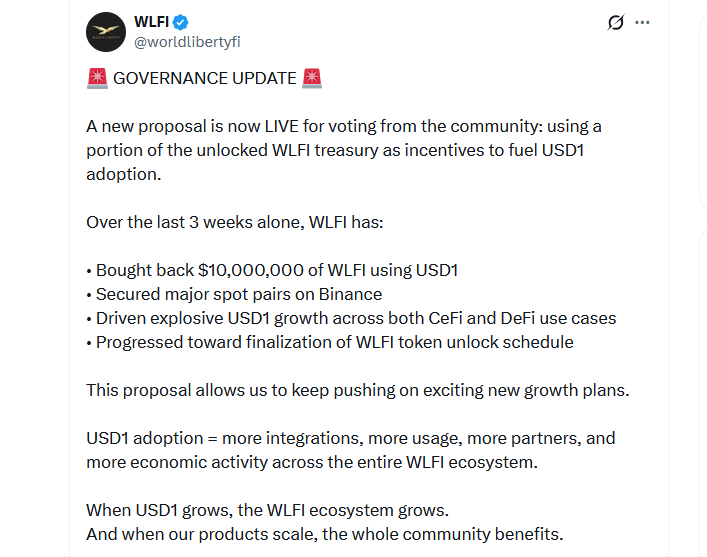
Trump family-backed World Liberty Financial has proposed using 5% of the project’s WLFI token treasury to grow the supply of its stablecoin USD1.

The proposal was posted to the World Liberty Financial governance forum on Wednesday, with the team highlighting the importance of increasing USD1 supply to keep up with “an increasingly competitive stablecoin landscape.”

The proposal outlines that the additional supply would help spread “USD1 use cases across select high-profile CeFi & DeFi partnerships,” with increased adoption helping to create more “value capture” opportunities in the WLFI ecosystem.

“As USD1 grows, more users, platforms, institutions, and chains integrate with World Liberty Financial infrastructure. This increases the scale and influence of the network governed by WLFI holders,” the team said.

“More USD1 in circulation leads to more demand for WLFI-governed services, integrations, liquidity incentives, and ecosystem programs,” it added.
Source: World Liberty Financial

World Liberty Financial’s WLFI token started trading on exchanges in September. Leading up to the launch, the project indicated that 19.96 billion of the total WLFI supply would be allocated to the treasury. At current prices, that total sum is worth almost $2.4 billion, with a 5% unlock equating to around $120 million.

The team outlined three potential voting options in the proposal: for, against or abstain. The vote is now live, but it is not explicitly clear how the voting is taking place.

Related: Binance mulls new US strategy, CZ potentially reducing stake: Report

The reaction to the proposal is currently mixed, with “against” slightly edging out those who indicate they support the proposal.
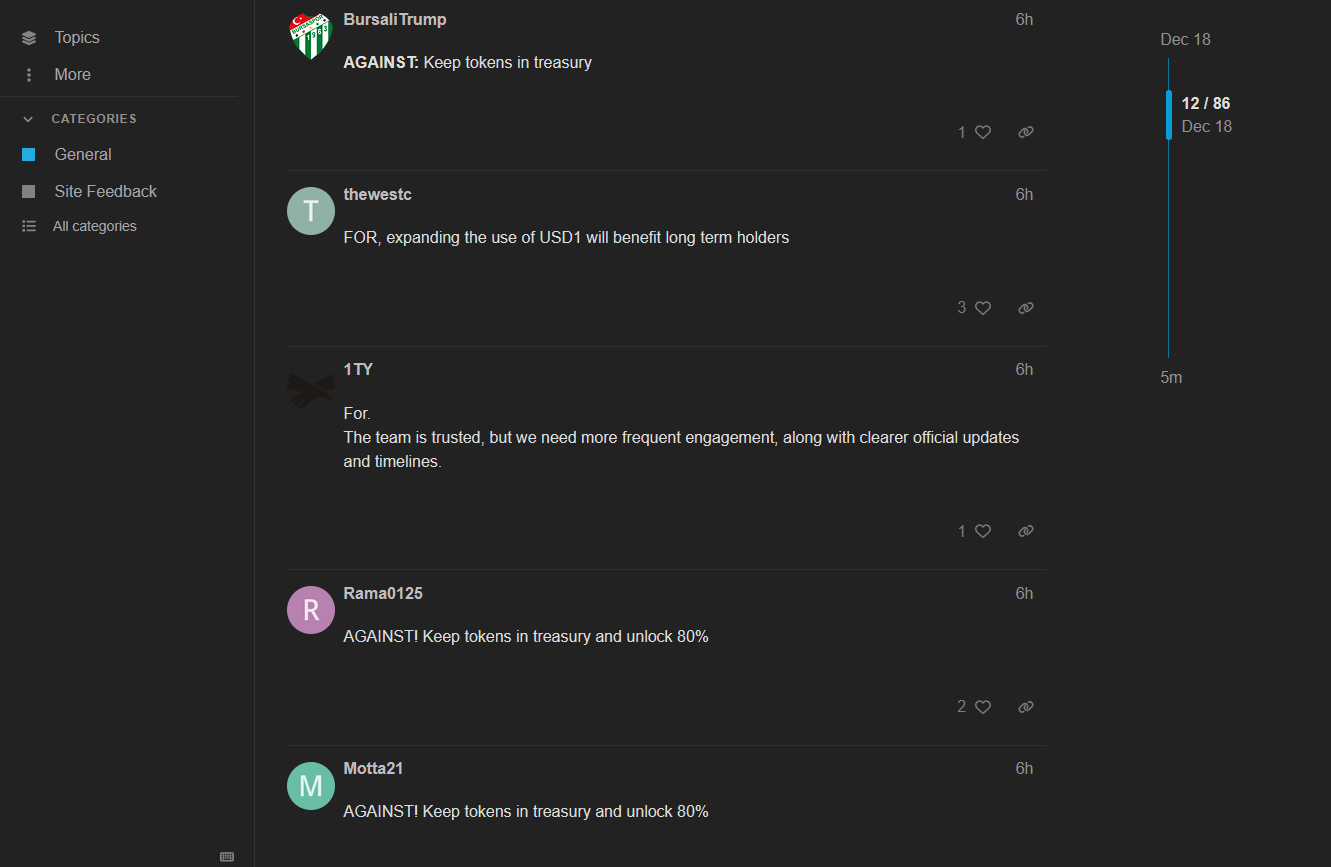
Community responses to the proposal. Source: World Liberty Financial

The project’s stablecoin launched in March and has a market cap of $2.74 billion according to CoinGecko data, making it the seventh-largest USD-pegged stablecoin on the market.

The 5% treasury unlock may help spur growth of the asset; however, it has a lot of catching up to do if it wants to displace competitors, with sixth-placed PYUSD from PayPal having a market cap $1.1 billion larger than USD1.

Magazine: Big questions: Would Bitcoin survive a 10-year power outage?
Related Reads

Duan Yongping Opens Position in Circle: What Is He Betting On?

Duan Yongping, the renowned value investor known as the "Chinese Buffett," has made a surprising move by taking a $19 million position in Circle (CRCL), a leading regulated stablecoin issuer, via his H&H International investment vehicle. This signals a significant embrace of Web3 assets by traditional capital. The article analyzes Circle's recent strategic shift to diversify beyond its core model, where 99% of its 2024 revenue came from interest on USDC reserves. To transform from an "interest rate proxy" into an infrastructure platform, Circle has launched two major initiatives. First, it raised $222 million in a token presale for Arc, a new Layer-1 blockchain optimized for USDC-native finance. This move is seen as a defensive play to build a proprietary settlement rail and reduce its heavy reliance on a revenue-sharing agreement with Coinbase, which claimed over half of Circle's 2024 income. Second, Circle introduced the Circle Agent Stack, a developer toolkit for building AI agents that can transact with USDC, targeting the emerging field of nanopayments for autonomous AI activity. This is framed as an offensive strategy against competitors like Stripe. However, Circle's core business faces headwinds from falling interest rates and new U.S. regulations (the GENIUS Act) that could encourage banks to issue their own stablecoins. While new revenue streams from Arc and Agent Stack are growing, they currently constitute less than 6% of total revenue. The bullish thesis depends on successful execution of all three strategic pillars: USDC circulation growth, Arc adoption generating meaningful fees, and Agent Stack gaining early dominance. The bear case warns that structural pressures on the core business may outpace these new ventures' growth. The market currently prices CRCL cautiously, reflecting the high stakes of this transition.

marsbit13m ago

Duan Yongping Opens Position in Circle: What Is He Betting On?

marsbit13m ago

NVIDIA Earnings Countdown: Beating Expectations Is a Near Certainty, but Wall Street Is Most Concerned About These Five Questions

NVIDIA Earnings Countdown: Beating Expectations is a Given, but Wall Street Cares Most About These Five Issues The upcoming NVIDIA Q1 earnings report is expected to easily surpass the consensus revenue estimate of ~$78.7B. However, Wall Street's focus has shifted from the numbers themselves to five key strategic questions. **1. Shareholder Returns: Will "Frugality" Change?** Despite being the S&P 500's largest company, NVIDIA's shareholder returns (dividends + buybacks) averaged only 47% of its free cash flow from 2022-2025, far below the 80% peer average and its own historical norm. Its 0.02% dividend yield also lags the peer average of 0.89%. This low cash return, partly due to investments in AI ecosystem partners, is cited as a core reason for NVIDIA's valuation discount compared to other "Magnificent 7" stocks. Increasing returns could attract long-term income funds and be a catalyst. **2. Vera Rubin: The Next-Gen Chip Timeline** Analysts expect the next-generation Vera Rubin (R200) platform to ramp in the second half of 2026, following the current Blackwell series. It will use TSMC's 3nm process and share Blackwell Ultra's "Oberon" rack architecture, suggesting a smooth transition with limited gross margin impact. The market also awaits any update on NVIDIA's $1 trillion cumulative revenue forecast for 2025-2027. **3. Gross Margin: Can the 75% Level Hold?** Gross margin, a key valuation support, is expected to stabilize in the near term due to the shared architecture between Blackwell and Vera Rubin. The consensus sees it fluctuating between 74-75%. The main long-term pressure is the rising cost contribution of HBM memory. **4. AI Accelerator Market Forecast Update** The report anticipates the total AI accelerator market will reach ~$1.17 trillion by 2030, with NVIDIA maintaining a 68-70% share. The focus is on whether NVIDIA will update its forecast to include new growth drivers: LPU racks, its Vera CPU, and the Vera Rubin Ultra platform. **5. Competition: Are Threats from Google TPU/CPU Overstated?** The analysis disputes narratives that the rise of "Agentic AI" elevates CPU importance over GPU, threatening NVIDIA. It notes NVIDIA's own "Vera CPU" is competitive, and current Blackwell/TPU clusters already use a 1:2 CPU-to-GPU ratio, contrary to the "more CPUs needed" story. NVIDIA's dominance in AI accelerators is seen as secure. **Valuation Discount:** NVIDIA trades at a significant discount to Mag-7 peers: ~50% based on CY26/27 P/E (26x/19x vs. 49x/42x avg.) and over 66% based on EV/FCF. Bank of America maintains a "Buy" rating with a $320 price target.

marsbit15m ago

NVIDIA Earnings Countdown: Beating Expectations Is a Near Certainty, but Wall Street Is Most Concerned About These Five Questions

marsbit15m ago

Interlace: The World's Leading Agentic Payment and Stablecoin Infrastructure Platform, Building the Next-Generation Digital Financial Foundation

Interlace: A Leading Agentic Payment and Stablecoin Infrastructure Platform Interlace is a global stablecoin infrastructure platform bridging traditional and crypto finance. It addresses the fragmentation between crypto assets, global payments, and enterprise treasury management by integrating stablecoin payments, digital business banking, asset management, virtual card issuance, and AI payment capabilities into a unified global financial network. Key product pillars include: 1. **Next-Generation Payment Network**: Features **Agent Card** for AI agents (enabling autonomous spending with controls) and **Scan to Pay** for seamless stablecoin (USDT/USDC) to fiat payments via QR codes in emerging markets. 2. **Stablecoin Payment & Card Issuance**: Offers **Infinity Card** for corporate spend management, **CaaS (Card as a Service)** for embedded card issuance APIs, and **Infinity Launch** for turnkey white-label financial systems. 3. **Enterprise Accounts & Banking**: Provides **Business Accounts** for multi-currency management and **BaaS (Banking as a Service)** APIs for embedded global payments and banking capabilities. 4. **Crypto Finance Infrastructure**: Enables **On/Off Ramp** services for fiat-crypto conversions and ensures security with PCI DSS Level-1 certification, MPC wallets, and global compliance licenses. 5. **Integrated Financial Ecosystem**: Includes **Yield Treasury** for idle cash management and a full suite of APIs, serving over 12,000 businesses across 180+ countries. Interlace aims to make stablecoins viable for everyday payments and empower AI agents with secure spending, building the foundational infrastructure for the future of digital finance.

链捕手25m ago

Interlace: The World's Leading Agentic Payment and Stablecoin Infrastructure Platform, Building the Next-Generation Digital Financial Foundation

链捕手25m ago

Stanley Druckenmiller: From Soros' Comrade-in-Arms to the Godfather of Macro Investing—System, Disciples, and Latest Thoughts

Stanley Druckenmiller is a pivotal figure in global macro investing, renowned for his partnership with George Soros, his legendary fund Duquesne Capital, and a decades-long track record of near-30% annualized returns without a single annual loss. His methodology uniquely blends value, growth, macro, and trend investing. A key early experience was as a bank stock analyst, grounding him in both company fundamentals and macro forces. His most famous trade, shorting the British Pound in 1992, exemplified his approach: identifying unsustainable structural contradictions and concentrating capital on high-probability, high-payoff opportunities. The "Duquesne System" is built on four pillars: macro-directional analysis, concentrated bets on best ideas, rapid error correction, and acute awareness of liquidity. His famous phrase "Invest, then investigate" reflects a dynamic approach of entering a position based on a strong initial thesis and then adjusting based on market feedback. This differs fundamentally from Warren Buffett's focus on long-term intrinsic business value; Druckenmiller focuses on marginal changes, cycles, and capital allocation at inflection points. His influence extends through protégés like Scott Bessent (market execution) and Kevin Warsh (policy insight), representing the dual market-and-institutional understanding he embodies. He closed his flagship fund in 2010 at its peak, prioritizing flexibility and performance over asset-gathering. Recent moves highlight his core logic: reducing AI exposure as expectations became crowded while investing in copper, recognizing the underlying infrastructure and resource demands of the AI boom. He remains concerned about long-term US dollar purchasing power due to fiscal deficits and monetary policy. His core skill is judging risk/reward payoff, not just prediction accuracy. For ordinary investors, key lessons are to focus on marginal changes, align position size with conviction and risk, and seek second-order opportunities beneath surface-level narratives. Ultimately, Druckenmiller is a strategist who combines macro insight with price discipline, decisive action with rigorous risk management, succeeding by identifying major market mispricings, acting before full consensus, and exiting swiftly when proven wrong.

marsbit1h ago

Stanley Druckenmiller: From Soros' Comrade-in-Arms to the Godfather of Macro Investing—System, Disciples, and Latest Thoughts

marsbit1h ago

Trading

Spot
Futures
活动图片