Hawkish Rate Cut Triggers Rally Then Plunge: The Truth Behind Bitcoin's 'Painting the Door' Pattern

marsbitPublished on 2025-12-11Last updated on 2025-12-11

Abstract

The Federal Reserve cut interest rates by 25 basis points on December 11, 2025, triggering a brief Bitcoin surge to $94,476, followed by a sharp reversal to $91,384. The initial rally was driven by algorithmic misinterpretation of a headline announcing the Fed’s $40 billion monthly Treasury purchases, mistakenly seen as quantitative easing (QE). In reality, these were short-term Reserve Management Purchases (RMP) aimed at maintaining banking system liquidity, not stimulating risk assets. The market downturn accelerated as traders digested the Fed’s hawkish undertones: upward revisions to 2026 GDP growth (from 1.8% to 2.3%) and lower unemployment projections signaled economic strength, reducing the urgency for further rate cuts. This "no-landing" scenario weakened Bitcoin’s appeal as an inflation hedge or safe-haven asset. Additionally, the Fed’s internal division—with three dissenting votes reflecting stark policy disagreements—highlighted unprecedented uncertainty about future monetary policy. Despite the rate cut, real interest rates remained restrictive due to persistent inflation. The episode underscored that Bitcoin can no longer rely solely on Fed-driven liquidity narratives and may face continued pressure as markets repricing risk amid economic resilience and policy ambiguity.

At 3:00 AM Beijing time on December 11, 2025, Federal Reserve Chair Jerome Powell finally pressed the button that had long been priced in by the market: a 25 basis point interest rate cut.

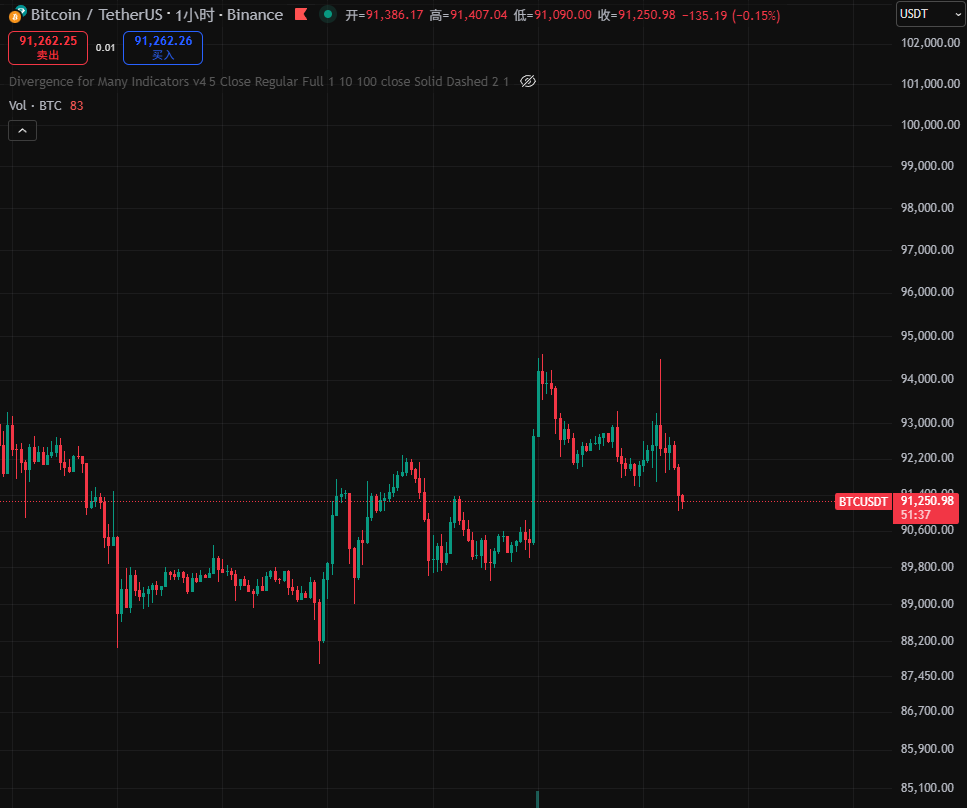
The subsequent script was supposed to follow the crypto market's playbook: the liquidity floodgates open, the US Dollar Index plunges, and Bitcoin charges towards the $100,000 mark. Indeed, for the first 15 minutes, that's exactly how it played out—Bitcoin instantly surged violently to $94,476, with the sound of alerts for liquidated short positions ringing out across exchanges.

However, the狂欢 (celebration) lasted less than an hour. As Wall Street traders finished parsing the Federal Open Market Committee (FOMC) statement and the Summary of Economic Projections (SEP) line by line, market sentiment underwent a cliff-like reversal. Bitcoin not only gave back all its gains but also bled steadily over the next few hours to $91,384, tracing out a classic inverted-V 'liquidation' pattern.
Why, under the seemingly dual tailwinds of a "rate cut + bond buying," did major capital choose to decisively flee?

This wasn't a simple case of "buy the rumor, sell the news"; it was a time-arbitrage game caused by algorithms misreading headlines and humans correcting the logic. When you dissect the three core details of this FOMC meeting—the upward revision of GDP expectations, the fake QE, and the unprecedented internal rift—you'll find that $94,000 was not the starting point for a bull market, but a trap set by macro fundamentals for the bulls.


The Algorithm's Illusion: The $40 Billion "Fake QE"

Revisiting the sharp rally at 3:00 AM, its core driver wasn't the rate cut itself (after all, the CME FedWatch Tool had already priced in an 88% probability), but a highly misleading breaking news headline: The Federal Reserve announced it would purchase $40 billion in short-term Treasury securities per month.

For high-frequency trading algorithms and headline-scanning media, the keyword scraping logic was非常简单 (very simple): "Fed" + "Buying Bonds" = "QE" = "Liquidity Injection".

Instantly, machines filled buy orders. The market mistakenly believed the Fed had launched quantitative easing alongside the rate cut—a double happiness.

But the devil was in the details of the operational guidelines subsequently released by the New York Fed. This was not QE (Quantitative Easing) aimed at suppressing long-term rates and stimulating the economy, but RMP (Reserve Management Purchases) targeting only short-term Treasuries.

The details showed that the Fed was buying bonds because reserve balances in the banking system had fallen to the edge of "ample levels," and to address potential liquidity drainage from the upcoming April tax season. In other words, this $40 billion is merely a patch to fix the "plumbing" of the interbank market, aimed at preventing repo rate spikes from causing financial system gridlock, not injecting water into the risk asset pool.

When human traders realized this capital would be locked in bank reserve accounts and wouldn't spill over into Bitcoin or the Nasdaq, the first round of valuation correction began. Those funds chasing the highs above $94,000 were essentially paying for their cognitive blind spot regarding monetary policy tools.


The "Backstab" from GDP Data: Prosperity is Bitcoin's Enemy

If the "fake QE" only triggered an emotional pullback, then the revision of GDP data in the Summary of Economic Projections (SEP) fundamentally shook the logical foundation of Bitcoin's "rate cut bull" thesis.

In the updated projections, the Fed significantly raised its 2026 US GDP growth forecast from 1.8% in September to 2.3%. Simultaneously, the 2027 unemployment rate expectation was lowered from 4.3% to 4.2%.

This data sent an extremely hawkish signal to the market: the US economy is not only not in recession but is demonstrating surprising resilience at this level of interest rates. This isn't the Fed's imagination; it's a lagging confirmation of real data.

If we look at real-time data, the situation is even "hotter."
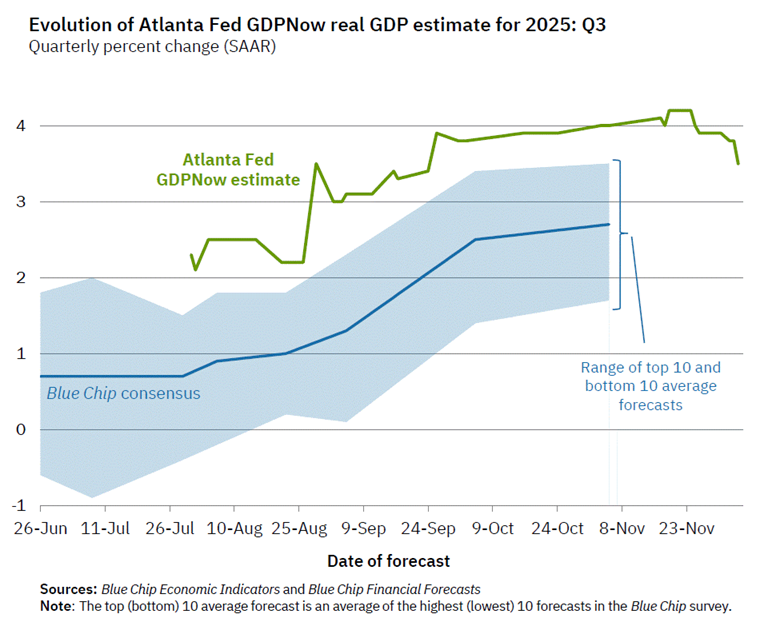
Atlanta Fed GDPNow

The model shows the Q3 2025 real GDP growth estimate once surged near 4%, far exceeding the Blue Chip consensus expectation of 2.5%. This indicates the US economy is in a period of extremely strong expansion, not on the brink of recession.

For traditional financial markets, this is good news for a "soft landing" or even "no landing"; but for Bitcoin, this is the most awkward script.

First, strong economic growth means the Fed has no urgent need to cut rates at all. Powell emphasized during the press conference that "the economy is strong but needs rebalancing," essentially hinting that the future path of rate cuts would be longer and more diluted. The market originally expected the Fed to flood the system with liquidity because the economy couldn't hold up (recessionary cuts), but instead got cuts offered as a precautionary measure because the economy is actually too strong (preventive cuts).

Second, the upward GDP revision directly pushed up the pricing of the neutral rate (R-star). When the US economy can grow at 2.3% or higher, capital can get decent risk-free or low-risk returns by staying in dollar-denominated assets (like US stocks and bonds). This削弱 (weakens) Bitcoin's appeal as an "inflation hedge" and "recession hedge" asset.


Broken Consensus: The Largest Internal Split in 37 Years

The final blow that caused Bitcoin to continue its steady decline below the $92,000 level came from the market's deep suspicion about the Fed's control.

This vote saw the most severe dissent since 2019, and arguably in 37 years. Among the 12 voting members, a staggering 3 dissented, a rate of 25%.

Even more unsettling was the composition of the opposition, showing completely opposing policy fractures: On one side was Trump-appointed Governor Miran, who thought the cut was too small, advocating for a direct 50 basis point cut, representing the aggressive easing camp. On the other side were Kansas City Fed President Schmid and Chicago Fed President Goolsbee, who believed there should be no cut at all, advocating for holding rates steady, representing the stubborn hawkish camp.

This "internal conflict" scenario is extremely rare in Fed history. It sent a dangerous signal to the market: Powell has lost absolute control of the Committee. The Fed内部 (internally) is completely unable to reach a consensus on the two core issues: "is inflation controlled" and "is the labor market deteriorating."

The dot plot further confirmed this split. Although the median suggests one more cut next year, as many as 7 officials (including non-voters) actually opposed this cut or favor higher rates next year than expected. This means every FOMC meeting going forward will become a political博弈 (game) full of variables.

Capital doesn't most fear bad news, but uncertainty. A divided Fed means the predictability of monetary policy plummets to rock bottom. For crypto markets reliant on liquidity expectations, this is a blow to the head. Institutional capital choosing to take profits around $91,000 is precisely to avoid the risks brought by this policy chaos.


The Real Interest Rate Noose Remains Tight

Looking beyond last night's candlestick, when we examine the longer-term macro environment, we find the pressure on Bitcoin hasn't eased with the rate cut.

Although the nominal rate was cut by 25 basis points, the pace of decline in inflation data remains slow (the core PCE expectation was only slightly adjusted to 2.4%). This means the inflation-adjusted "real interest rate" remains at restrictive levels.

Powell admitted during the press conference that inflation risks remain tilted to the upside and job growth might be overestimated. But he didn't provide clear guidance for subsequent cuts, instead repeatedly emphasizing "no preset path." This ambiguous stance, combined with the $40 billion "fake QE" and strong GDP expectations, creates an extremely awkward "middle ground."

In this zone, the economy is too good to need flooding, and inflation is too high to allow flooding.


Conclusion: Awaiting a New Narrative Amid Deleveraging

This rally-then-plunge script taught all crypto investors a lesson: at this point in late 2025, the macro narrative relying solely on the single factor of "Fed rate cut" has失效 (failed). The market is shifting from "hunting for liquidity" to "repricing risk."

As the Nasdaq Index meets resistance and falls back from its historical highs, traditional financial markets have already begun trading the "hawkish cut" logic. For Bitcoin, having lost its "recession hedge" halo in the short term and failing to receive the support of "flooding liquidity," a回调 (pullback) to clean out leverage might be an unavoidable fate.

Over the next 24 hours, pay close attention to ETF flow data. If institutional capital认可 (endorses) the above correction in macro logic, then the selling pressure we saw last night might just be the beginning.


Related Questions

QWhat was the immediate market reaction to the Fed's rate cut announcement, and why did it reverse so quickly?

AThe immediate reaction was a sharp spike in Bitcoin's price to $94,476, driven by algorithmic trading misinterpreting the Fed's announcement of buying $40 billion in short-term Treasuries as a new Quantitative Easing (QE) program. The rally reversed within an hour as human traders realized the purchases were merely 'Reserve Management Purchases' (RMP) to address banking system plumbing and seasonal liquidity needs, not a stimulus injection that would benefit risk assets like Bitcoin.

QHow did the upward revision of the GDP forecast in the Summary of Economic Projections (SEP) impact the market's outlook for Bitcoin?

AThe Fed's significant upward revision of the 2026 GDP growth forecast from 1.8% to 2.3% was a hawkish signal that fundamentally undermined the 'rate cut bull' thesis for Bitcoin. It indicated the U.S. economy was resilient and growing strongly, reducing the urgency for the Fed to cut rates aggressively. This meant future rate cuts would be slower and shallower ('preventive cuts' rather than 'recession cuts'), making high-yielding dollar assets more attractive and diminishing Bitcoin's appeal as an anti-inflation or anti-recession hedge.

QWhat was unprecedented about the FOMC vote, and why did it create uncertainty for markets?

AThe vote saw the most severe internal dissent in 37 years, with 3 out of 12 voting members (25%) opposing the decision. The dissent came from both sides: one member wanted a larger 50 basis point cut (dovish), while two members wanted no cut at all (hawkish). This rare 'left-right confrontation' signaled that Chair Powell had lost absolute control of the committee, creating high policy unpredictability. Markets, especially those like crypto that rely on liquidity expectations, detest such uncertainty, leading to risk-off moves and selling.

QAccording to the article, what was the true nature of the Fed's $40 billion bond-buying operation, and how did it differ from Quantitative Easing (QE)?

AThe $40 billion monthly purchase of short-term Treasuries was not QE. It was a Reserve Management Purchase (RMP) designed to maintain 'ample' reserves in the banking system and prevent a liquidity crunch ahead of the tax season. Unlike QE, which aims to压低长期利率 and stimulate the economy by injecting liquidity into risk assets, these RMP funds are locked in bank reserve accounts to ensure financial system stability and do not flow into markets like cryptocurrencies or stocks.

QWhat is the broader macro implication of a 'hawkish cut' for Bitcoin's price action in the short term, as concluded in the article?

AThe 'hawkish cut' creates an awkward 'middle ground' where the economy is too strong to warrant massive stimulus, yet inflation remains too high to allow for easy money. This scenario invalidates the simple 'Fed rate cut' narrative for Bitcoin. The article concludes that the market is shifting from 'hunting for liquidity' to 'repricing risk,' leading to a short-term correction to deleverage. The price action suggests the sell-off pressure seen could be just the beginning, especially if institutional ETF flows confirm this macro logic.

Related Reads

Interlace: The World's Leading Agentic Payment and Stablecoin Infrastructure Platform, Building the Next-Generation Digital Financial Foundation

Interlace: A Leading Agentic Payment and Stablecoin Infrastructure Platform Interlace is a global stablecoin infrastructure platform bridging traditional and crypto finance. It addresses the fragmentation between crypto assets, global payments, and enterprise treasury management by integrating stablecoin payments, digital business banking, asset management, virtual card issuance, and AI payment capabilities into a unified global financial network. Key product pillars include: 1. **Next-Generation Payment Network**: Features **Agent Card** for AI agents (enabling autonomous spending with controls) and **Scan to Pay** for seamless stablecoin (USDT/USDC) to fiat payments via QR codes in emerging markets. 2. **Stablecoin Payment & Card Issuance**: Offers **Infinity Card** for corporate spend management, **CaaS (Card as a Service)** for embedded card issuance APIs, and **Infinity Launch** for turnkey white-label financial systems. 3. **Enterprise Accounts & Banking**: Provides **Business Accounts** for multi-currency management and **BaaS (Banking as a Service)** APIs for embedded global payments and banking capabilities. 4. **Crypto Finance Infrastructure**: Enables **On/Off Ramp** services for fiat-crypto conversions and ensures security with PCI DSS Level-1 certification, MPC wallets, and global compliance licenses. 5. **Integrated Financial Ecosystem**: Includes **Yield Treasury** for idle cash management and a full suite of APIs, serving over 12,000 businesses across 180+ countries. Interlace aims to make stablecoins viable for everyday payments and empower AI agents with secure spending, building the foundational infrastructure for the future of digital finance.

链捕手9m ago

Interlace: The World's Leading Agentic Payment and Stablecoin Infrastructure Platform, Building the Next-Generation Digital Financial Foundation

链捕手9m ago

Stanley Druckenmiller: From Soros' Comrade-in-Arms to the Godfather of Macro Investing—System, Disciples, and Latest Thoughts

Stanley Druckenmiller is a pivotal figure in global macro investing, renowned for his partnership with George Soros, his legendary fund Duquesne Capital, and a decades-long track record of near-30% annualized returns without a single annual loss. His methodology uniquely blends value, growth, macro, and trend investing. A key early experience was as a bank stock analyst, grounding him in both company fundamentals and macro forces. His most famous trade, shorting the British Pound in 1992, exemplified his approach: identifying unsustainable structural contradictions and concentrating capital on high-probability, high-payoff opportunities. The "Duquesne System" is built on four pillars: macro-directional analysis, concentrated bets on best ideas, rapid error correction, and acute awareness of liquidity. His famous phrase "Invest, then investigate" reflects a dynamic approach of entering a position based on a strong initial thesis and then adjusting based on market feedback. This differs fundamentally from Warren Buffett's focus on long-term intrinsic business value; Druckenmiller focuses on marginal changes, cycles, and capital allocation at inflection points. His influence extends through protégés like Scott Bessent (market execution) and Kevin Warsh (policy insight), representing the dual market-and-institutional understanding he embodies. He closed his flagship fund in 2010 at its peak, prioritizing flexibility and performance over asset-gathering. Recent moves highlight his core logic: reducing AI exposure as expectations became crowded while investing in copper, recognizing the underlying infrastructure and resource demands of the AI boom. He remains concerned about long-term US dollar purchasing power due to fiscal deficits and monetary policy. His core skill is judging risk/reward payoff, not just prediction accuracy. For ordinary investors, key lessons are to focus on marginal changes, align position size with conviction and risk, and seek second-order opportunities beneath surface-level narratives. Ultimately, Druckenmiller is a strategist who combines macro insight with price discipline, decisive action with rigorous risk management, succeeding by identifying major market mispricings, acting before full consensus, and exiting swiftly when proven wrong.

marsbit55m ago

Stanley Druckenmiller: From Soros' Comrade-in-Arms to the Godfather of Macro Investing—System, Disciples, and Latest Thoughts

marsbit55m ago

Morning Report | xAI Launches Skills; Duan Yongping Takes First Position in Circle in Q1 2026; Polymarket Partners with Nasdaq to Launch Prediction Market

**Title:** Daily Brief: Musk's xAI Launches "Skills"; Duan Yongping's First Circle Investment; Polymarket Partners with Nasdaq **Key Highlights:** * **AI Developments:** Elon Musk's xAI released "Skills," enabling its Grok AI to retain memory across conversations. OpenAI co-founder Andrej Karpathy joined rival Anthropic. * **Crypto & DeFi:** May saw 14 crypto hack incidents, including 3 major DeFi attacks in 5 days (Echo Protocol, THORChain, Verus). The Ethereum Foundation faces another exodus with two core members departing. * **Corporate Moves:** Investor Duan Yongping disclosed a new $19M position in Circle. Analog Devices is in talks to acquire AI chip firm Empower Semiconductor for ~$1.5B. * **Financials & Partnerships:** Canaan reported Q1 2026 revenue of $62.7M and record-high crypto reserves. Prediction market Polymarket partnered with Nasdaq to launch markets for private companies. * **Market Data:** VanEck predicts digital credit markets could reach $2.5T in a decade, with Bitcoin potentially hitting $1M. Top trending meme tokens on ETH, Solana, and Base networks are listed. **Featured Articles:** Three analysis pieces explore: 1) potential regulatory pressures on DEXs like Hyperliquid, 2) challenges to Solana's "internet capital market" narrative, and 3) the future emergence of a dedicated capital market for autonomous AI agents (Agents).

链捕手1h ago

Morning Report | xAI Launches Skills; Duan Yongping Takes First Position in Circle in Q1 2026; Polymarket Partners with Nasdaq to Launch Prediction Market

链捕手1h ago

Why is HYPE Still Surging? Has It Topped Out?

The article analyzes the reasons behind the continued surge of the HYPE token, despite the current market conditions. The primary drivers identified are: 1. **ETF Inflows and a New Buyback Mechanism:** The launch of two ETFs (THYP by 21Shares and BHYP by Bitwise) has opened a channel for traditional capital. Crucially, Bitwise announced it will allocate 10% of BHYP's management fee income to acquire and stake HYPE, creating a potential source of recurring buy pressure linked to the ETF's growth. 2. **USDC Integration and New Revenue Stream:** The return of USDC to Hyperliquid, facilitated by Coinbase and Circle, is significant. It establishes a protocol revenue-sharing model from USDC reserve yields. Community estimates suggest this could generate substantial daily income (approx. $440k), which could be used for HYPE buybacks, decoupling token demand from just trading fees and linking it to the platform's stablecoin deposits. 3. **Expansion into New Markets:** Hyperliquid is broadening beyond being just a Perp DEX. Its HIP-4 feature launches it into the prediction market space, already showing high volume. This requires HYPE staking for market creation, directly increasing token utility and staking demand. Furthermore, the platform's Real-World Asset (RWA) trading has seen Open Interest hit a new high of $2.6B, indicating growth in trading traditional assets like stocks and commodities. 4. **Regulatory Tailwinds for RWA:** Potential SEC exemptions for tokenized stock trading could further accelerate Hyperliquid's RWA business, turning a niche into a major battleground for on-chain trading. In summary, the market is re-rating HYPE as Hyperliquid evolves from a single-purpose DEX into a comprehensive on-chain trading system with multiple growing revenue streams (trading fees, reserve yields, prediction markets) and expanding asset classes (crypto, RWAs). However, the article notes that despite the strong long-term fundamentals, short-term price action is currently volatile due to a large-scale showdown between whale long and short positions exceeding $60 million.

marsbit1h ago

Why is HYPE Still Surging? Has It Topped Out?

marsbit1h ago

Trading

Spot
Futures

Hot Articles

Discussions

Welcome to the HTX Community. Here, you can stay informed about the latest platform developments and gain access to professional market insights. Users' opinions on the price of S (S) are presented below.

活动图片