Why Do Memes Only Cut You? An Article That Explains Their True Growth Mechanism

比推Publié le 2026-01-21Dernière mise à jour le 2026-01-21

Résumé

The article "Why Do Meme Coins Only 'Cut' You? Clarifying Their True Growth Mechanism" offers a fresh, analytical perspective on meme coin dynamics, framing their growth not as irrational speculation but as a mathematically explainable phenomenon. The core argument is that a meme coin’s market capitalization isn't just driven by price increases (Z-axis), but is fundamentally supported and "propped up" by two underlying factors: narrative density (X-axis) and the network of传播 nodes (Y-axis). Together, these form the base radius of a "Wealth Cone." A meme with only height (price) but no base (narrative and community) is like a thin needle—easily toppled. A strong, expanding base is necessary to support sustainable, exponential growth. The proposed XYZ three-dimensional growth spiral model explains the interaction: * **X-axis (Narrative Density):** The meme's core idea, cultural resonance, originality, and the richness of community-created content. * **Y-axis (Propagation Network):** The transmission pipelines, from major influencers (e.g., Elon Musk) to KOLs and finally to retail investors. * **Z-axis (Capital Flow):** The monetization of attention, measured by market cap, trading volume, and crucially, liquidity depth. The lifecycle of a successful meme is a reflexive, spiral ascent through stages: **Ignition** (a Y-axis spike from a KOL callout lifts the Z-axis), **Spin** (price growth attracts more discussion, enriching the narrative), and **Ascension** (an expande...

Author: danny

Original Title:

Why Do the Memes You Buy Only Fall? — Deconstructing the Growth Spiral and Volume of Memes Using First Principles


In the eyes of most people, Meme coins are irrational狂欢, a fool's赌场. But from a mathematical perspective, the birth of every ten-thousand-fold myth is not accidental; it is actually a middle school spatial geometry evolution word problem.

This article proposes a颠覆性的 perspective: The market value of Meme coins is not "grown" but "propped up." The value of Memes can be calculated!

We are accustomed to focusing on the fluctuations of the Z-axis (price height), but we overlook that what determines life and death is the base radius constructed by the X (narrative density) and Y (propagation nodes) axes. A Meme with only height and no base is just a very thin "needle" that topples with the wind; only by continuously expanding the consensus radius can it support a stable, geometrically growing wealth cone under the gravity of capital.

Note: This article is a popular science article on "financial physics," not a rigorous econometric paper, and is only intended to provide a new perspective for viewing Memes.

1. The Beginning of the Theory: The Three-Dimensional Coordinate System of Memes

In the current cryptocurrency market, Meme coins are often seen as irrational狂欢. But is that really the case?

If we strip away the noise of emotions, KOL shilling, and community bandwagoning, we will find that the birth and death of every phenomenal Meme follows a strict mathematical logic.

The essence of Meme coins is the tokenization of the attention economy. Their market value is not determined by traditional discounted cash flow (DCF) but is jointly constructed by the breadth of the narrative, community resonance, and the explosive power of funds.

For better discussion, we define these factors as the XYZ three-dimensional growth spiral model.

These three axes are not just independent variables; there is a strong reflexivity between them—that is, a change in one variable reinforces another, forming a positive feedback loop.

Let's explain these parameters:

X-axis: Narrative Density and Cultural Memes

Definition: The "genes" of a Meme. Includes the core梗 (e.g., Doge), origin story (e.g., CZ's pet name), cultural symbols (e.g., Pepe the Frog), and the richness of community二次创作.

Key metrics: Narrative originality, replicability, emotional resonance.

Y-axis: Propagation Potential and Node Network

Definition: The transmission pipeline of information. From top-tier nodes (CZ, Elon Musk) to secondary nodes (Alpha Callers, KOLs), and then to end nodes (ordinary retail investors).

Key metrics: Node weight, propagation coverage, shilling frequency.

Z-axis: Fund Flow and Liquidity Carrier

Definition: The monetization result of attention. Includes on-chain fund inflows, liquidity depth—i.e., the沉淀的价值 or the total amount of sell orders that can be承接.

Key metrics: Market capitalization, trading volume, turnover rate, and liquidity (the most important metric).

2. Diagram of the Growth Curve of XYZ Axis Interaction

If we plot these three axes in three-dimensional space, the growth trajectory of a successful Meme will generally show a spiral upward trend: (as shown in the figure below)
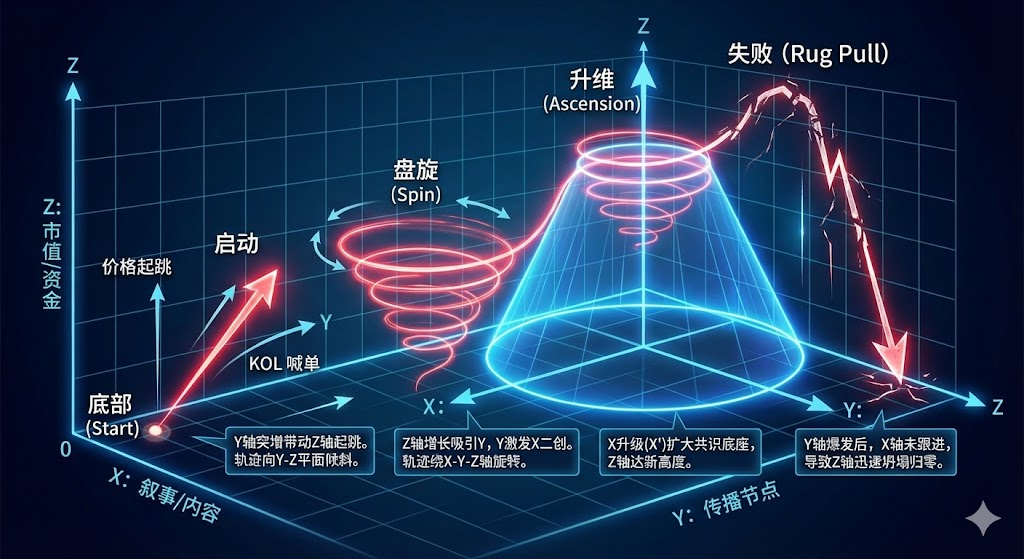
Bottom (Start): X, Y, Z are all close to zero.

Ignition: The Y-axis surges (KOL shilling), driving the Z-axis (price) to jump. The trajectory line tilts toward the Y-Z plane.

Spin: The growth of the Z-axis attracts more Y (more people discussing), and Y stimulates X's二次创作 (enriching content). The trajectory line begins to rotate around the X-Y-Z axes.

Ascension: As X is upgraded (X'), the base area of the cone expands (broader consensus range), and the Z-axis (market capitalization) reaches a new height.

Failed Meme (Rug Pull): Usually表现为 the Y-axis爆发后, the Z-axis briefly rises, but the X-axis fails to follow up with an upgrade (narrative scarcity), causing the Z-axis to quickly collapse to zero. The trajectory line shows an inverted V-shaped fall.

3. Evolution of the Growth Curve: The Spiral Ascension of Four Stages

From the previous section, we know that the lifecycle of a Meme is not linear but a vortex that continuously expands around the Z-axis (fund flow). In this section, we will analyze it based on the four development stages of Memes.

The figure below shows its standard evolution path: (I was also shocked at how cool AI drew it?!)


Original link:https://www.bitpush.news/articles/7604686

Questions liées

QWhat is the core perspective proposed in the article regarding the growth of Meme coins?

AThe article proposes that Meme coin market capitalization is not simply 'rising' but is 'propped up' by a mathematical model involving narrative density (X-axis) and propagation nodes (Y-axis), which together form the base supporting the value (Z-axis).

QHow does the article define the X-axis in its Meme growth model?

AThe X-axis is defined as 'Narrative Density and Cultural Memes,' which includes the core meme, origin story, cultural symbols, and the richness of community-created content.

QAccording to the article, what is the role of the Y-axis in the Meme coin growth spiral?

AThe Y-axis represents 'Propagation Potential and Node Network,' which refers to the information transmission pipelines, from top nodes like influencers to secondary and end nodes like ordinary retail investors.

QWhat does the Z-axis represent in the XYZ model for Meme coins?

AThe Z-axis represents 'Capital Flow and Liquidity Carrier,' which is the monetization result of attention, including on-chain capital inflow, liquidity depth, and the total value that can absorb selling pressure.

QWhat is the key difference between a successful Meme and a failed one (Rug Pull) according to the model?

AA successful Meme undergoes a spiral ascent where narrative (X) and propagation (Y) expand to support the value (Z). A failed Meme (Rug Pull) sees a brief spike in Y and Z, but a lack of narrative development (X) causes the value to collapse back to zero.

Lectures associées

Où sera le champ de bataille principal du prochain bull market ? La réponse se cache dans ces deux types d'actifs

Le marché des cryptomonnaies montre des signes de reprise. Le prochain cycle haussier sera probablement axé sur la fusion entre la finance traditionnelle et la finance décentralisée (DeFi), notamment via l'adoption des stablecoins, la tokenisation d'actifs et des infrastructures de négociation 24h/24 et 7j/7. Cette évolution, soutenue par une valeur utilitaire réelle, vise le marché financier mondial. Deux actifs illustrent cette convergence : **Hyperliquid (HYPE)**, une blockchain de dérivés perpétuels qui étend son offre aux actifs traditionnels comme le pétrole, et **Robinhood (HOOD)**, un courtier traditionnel qui a lancé sa propre blockchain pour la négociation d'actions tokenisées. Pour en tirer parti, deux types d'investissements se distinguent : 1. Les applications DeFi natives avec des revenus réels et un modèle économique robuste, comme Hyperliquid, qui utilise la majorité de ses revenus pour racheter et brûler son token. 2. Les entreprises financières traditionnelles qui déploient activement des infrastructures blockchain à grande échelle, comme Robinhood, Coinbase ou BlackRock. La prochaine étape majeure sera l'intégration invisible de la blockchain au cœur du système financier. Les investisseurs ont intérêt à se positionner dès maintenant sur cette tendance de fond.

Foresight NewsIl y a 14 mins

Où sera le champ de bataille principal du prochain bull market ? La réponse se cache dans ces deux types d'actifs

Foresight NewsIl y a 14 mins

Kalshi contre Polymarket : la guerre commerciale entre fondateurs est bien plus féroce qu'il n'y paraît

En novembre 2024, le fondateur de Polymarket, Shayne Coplan, a été perquisitionné par le FBI. Derrière cette enquête se cache une rivalité féroce avec son concurrent Kalshi, dirigé par Tarek Mansour. Les deux plateformes de marchés prédictifs, bien que leaders du secteur, s'affrontent bien au-delà de la concurrence commerciale habituelle. Le conflit oppose leurs approches radicalement différentes. Kalshi privilégie une voie strictement réglementée aux États-Unis, tandis que Polymarket a opéré depuis l'étranger, restant accessible aux utilisateurs américains via un VPN, ce qui a attiré les foudres des régulateurs. Mansour considère les pratiques de Polymarket comme "illégales et contraires à l'éthique". Coplan, de son côté, est convaincu que Kalshi tente de l'éliminer par tous les moyens. La guerre s'étend à tous les domaines : batailles pour des investisseurs (comme l'Intercontinental Exchange), tentatives de saboter des acquisitions, sponsoring concurrentiel (Kalshi avec le Madison Square Garden), et campagnes médiatiques agressives. Des allégations de dénonciations aux autorités et de manipulation de l'opinion publique parsèment leur histoire. Aujourd'hui, Kalshi semble en tête avec une valorisation et un volume d'échanges plus élevés, mais Polymarket a finalement obtenu une licence américaine via une acquisition. Alors que le secteur explose, attirant une surveillance réglementaire accrue, l'animosité personnelle entre les deux fondateurs continue d'alimenter une lutte qui façonne l'avenir des marchés prédictifs.

marsbitIl y a 28 mins

Kalshi contre Polymarket : la guerre commerciale entre fondateurs est bien plus féroce qu'il n'y paraît

marsbitIl y a 28 mins

Pour acheter un médicament amaigrissant en cours de recherche, un groupe d'Américains apprend à payer en Bitcoin

Un Américain de 49 ans, initialement sceptique envers le Bitcoin, a finalement appris à utiliser cette cryptomonnaie pour acheter 20 flacons d'un médicament expérimental pour la perte de poids, le retatrutide, auprès d'un vendeur chinois. La motivation : une économie substantielle, le prix étant bien inférieur à celui du marché américain. Ce cas illustre un marché croissant où les peptides expérimentaux non approuvés par la FDA sont achetés en ligne par des consommateurs ordinaires, souvent novices en cryptomonnaies. Face au refus des réseaux de paiement traditionnels de servir ces vendeurs, le Bitcoin et les stablecoins sont devenus la principale méthode de paiement. Les analyses de Chainalysis et TRM Labs estiment que les paiements en cryptomonnaies pour ces peptides « gris » pourraient dépasser 100 millions de dollars annuels, bien que ce montant reste faible par rapport au marché noir global estimé entre 1 et 3 milliards de dollars. Ce phénomène trouve un écho dans des communautés à l'intersection de la science décentralisée (DeSci), du bio-hacking et de la cryptographie, comme en témoigne une conférence populaire à New York sur les peptides. Cependant, l'avenir de ce cas d'usage des cryptomonnaies est incertain. Les autorités américaines, dont la FDA, envisagent une régularisation partielle de certains peptides, ce qui pourrait réduire la dépendance au marché noir et, par conséquent, à ses canaux de paiement alternatifs. L'acheteur interviewé, Zach, a quant à lui déclaré avoir atteint son poids cible et prévoit d'arrêter ses achats.

marsbitIl y a 34 mins

Pour acheter un médicament amaigrissant en cours de recherche, un groupe d'Américains apprend à payer en Bitcoin

marsbitIl y a 34 mins

Bank of America s'installe discrètement : 6 000 milliards de dollars de dépôts bancaires pourraient affluer vers les stablecoins ?

Bank of America a discrètement renforcé son équipe dirigeante pour accélérer le développement de ses plateformes d'actifs numériques, couvrant les stablecoins, les dépôts tokenisés, la garde et les règlements en crypto. Cette décision survient alors que le marché crypto traverse une période de ralentissement. Bien que des rumeurs circulent sur les réseaux sociaux concernant un potentiel transfert de 6 000 milliards de dollars de dépôts bancaires vers les stablecoins, le PDG de la banque, Brian Moynihan, avait précisé en janvier que cela ne serait possible que si les stablecoins étaient autorisés à verser des intérêts – une fonctionnalité non permise par le GENIUS Act actuel. Malgré l’incertitude réglementaire (le GENIUS Act entrera en vigueur au plus tard le 18 janvier 2027), les grandes institutions financières comme JPMorgan et Citigroup ne restent pas inactives et développent déjà leurs propres services de paiement et de dépôts tokenisés. Les données montrent une forte croissance des transactions en stablecoins (33 000 milliards de dollars réglés en 2025), même si certains analystes estiment que l’adoption par les institutions en est encore à un stade prudent et que les fondamentaux du secteur n’ont pas radicalement changé. La course pour se positionner dans l’écosystème des actifs numériques est donc lancée, laissant entrevoir une fusion accélérée entre la finance traditionnelle et les cryptomonnaies.

marsbitIl y a 37 mins

Bank of America s'installe discrètement : 6 000 milliards de dollars de dépôts bancaires pourraient affluer vers les stablecoins ?

marsbitIl y a 37 mins

Trading

Spot
活动图片