The Scriptures Chanted by OpenAI and Anthropic Might Be Crooked

marsbitPublié le 2026-05-28Dernière mise à jour le 2026-05-28

Résumé

In the current AI landscape, "Harness-style" Multi-Agent Systems (MAS)—where multiple AI agents with temporary roles collaborate under a central workflow for task efficiency—dominates the conversation, championed by players like OpenAI and Anthropic. However, the author argues this approach, focused on orchestration and software engineering, may be misguided. A more transformative, yet less discussed, alternative is the "Protocol-Native Agent System." Here, the core unit shifts from task-specific agents to persistent "Personal Agents" or "unmanned companies" that represent individuals. These agents possess sovereignty, long-term memory, identity, resources, and relationships. This paradigm change transforms MAS from a distributed software system into a digital society. Collaboration can no longer rely on shared prompts or context, but must be built on protocols governing identity, trust, incentives, reputation, and value exchange—essentially, "Protocol as Organization." The future's true challenge lies not in improving single-agent capabilities, but in enabling long-term coordination among autonomous entities with differing goals, world models, and values. The author suggests that future organizations might themselves be dynamic alliances of such sovereign agents, leading to an "intelligence-native civilization."

Over the past year, "Multi-Agent System (MAS)" has become one of the hottest directions in the AI world.

A large number of frameworks and products have emerged simultaneously. The most famous among them are obviously Claude Code and Codex. This step indeed makes money, but this path might not be the right one!

The early internet was about portals, but that wasn't the final form!

At the very least, we should know there is another path entirely parallel to this.

Today, we are talking about what other routes exist besides: "How multiple AI Agents collaborate to complete complex tasks."

Let's first summarize this popular and familiar route.

We can touch on this topic a bit in a live stream, but I don't want to focus entirely on it. There aren't many people watching anyway, and I'm worried it might get the stream taken down...

The First Route: Harness-style MAS

This is the current mainstream direction for MAS. Its essence is: "Multiple AI roles collaborate to complete tasks." For example:

  • One Agent writes code
  • One Agent does testing
  • One Agent does planning
  • One Agent does searching
  • One Agent does review

They cooperate with each other, forming an automated workflow. The core characteristics of such systems are:

  • Shared context
  • Shared goal
  • Centralized scheduling
  • Temporary roles
  • No long-term identity
  • No sustained interests
  • No true ownership

Essentially, it's more like: A Workflow Engine. Adding Ontology merely makes the workflow flexible and complex; it doesn't change this essence.

It is not a Society. So, most of today's MAS is essentially LLM Orchestration, where one large model schedules multiple sub-roles to complete complex reasoning.

The Agent here is more like:

  • A callable function
  • A tool with personality
  • A task node

Their existence is to improve the efficiency of completing individual tasks. Therefore, keywords associated with Harness MAS are (each has been hot, and might even cycle back):

  • Prompt Engineering
  • Context Management
  • Task Routing
  • Tool Calling
  • Planning
  • Memory
  • Workflow

Essentially, I think this still falls under software engineering problems. So, the experienced "old masters" good at programming have been reborn. To control these things well, without solid programming skills and good abstraction ability, it's actually very difficult to manage.

If you can't manage it, the large model will be like the Monkey King, occasionally popping out and hitting you with a stick.

The word "Harness" is used in reverse here.

Springtime for the old masters.

The Second Route: Protocol-Native Agent System

But there is another route, one almost nobody mentions. I've written a bit about it in my upcoming new book, but this line of thinking actually presupposes the concept of an "unmanned company." Without deeply understanding the unmanned company, it's easy to misunderstand.

The core of this route is no longer about multiple Agents completing tasks. Instead, it's "each person owns their own Personal Agent" or "each person owns their own dedicated unmanned company."

This is an extremely huge change. Because when an Agent truly belongs to an "individual," the nature of the Agent undergoes a fundamental transformation.

It is no longer task-scoped, but becomes identity-scoped. These are two terms the model helped me coin; I struggled for a long time to come up with the English words.

The core idea here is actually decision-making sovereignty. The biggest difference between a Personal Agent/an unmanned company and a general system is that they need to have a certain kind of sovereignty. Otherwise, the essence discussed later doesn't hold. The difference between an unmanned company and an unmanned system also lies in the sovereignty over cash flow.

In other words, the future Personal Agent or unmanned company needs to possess the following characteristics:

  • Has long-term memory
  • Has a persistent identity
  • Has preferences
  • Has resources
  • Has permissions
  • Has history
  • Has a relationship network
  • Has interests/boundaries
  • Has representation (represents "you")

It is no longer a one-time AI Tool. It is a continuously existing proxy personality with a certain kind of sovereignty.

Dual-native architecture, the key to not misusing AI.

From "Software Module" to "Digital Society"

Once entering the world of Personal Agents and true unmanned companies, the entire system philosophy changes completely. Because Agents are no longer:

  • Belonging to the same model
  • Belonging to the same company
  • Sharing the same context
  • Sharing the same goal

Therefore, collaboration between systems can no longer rely on (this current hot keyword list can be extended further):

  • Prompt
  • Workflow
  • Shared Context

It can only rely on protocols (Protocol). This means: the core of the AI world will shift from Prompt Engineering to Protocol Engineering. It also means the various current hot keywords become largely meaningless.

Why will protocol become the core? Because when massive Agents exist independently, they must solve among themselves:

  • Identity confirmation
  • Permission boundaries
  • Trust mechanisms
  • Delegation relationships
  • Negotiation mechanisms
  • Incentive mechanisms
  • Reputation systems
  • Value exchange
  • Capability declaration
  • Long-term contracts

These needs are different from the needs of current task-oriented multi-agents. At this point, interactions between Agents are no longer like API Calls, but more like Institutional Interaction. With sovereignty comes a complex intertwined system of rights and responsibilities. For humans, this is contracts, laws, etc. What about for intelligent agents?

This is why it was said earlier that this would build a completely different kind of Multi-Agent System. Here, the essence of MAS changes from a distributed software system to a digital social system.

Philosophical Notes (7)

"Protocol as Organization"

In the traditional internet, the role of protocols is data communication, where the sender and receiver agree on the format for talking to each other. For example:

  • TCP/IP
  • HTTP
  • SMTP

They define how data is transmitted. In the blockchain world, protocols have further evolved into: Protocol as State Computation. For example: The essence of Ethereum is not merely message passing, but the entire network jointly executing state transition rules. Thus all nodes: Same input → Same execution → Same state. For the first time, protocol becomes a shared state machine.

But entering the stage of Agent Society, protocols will continue to evolve. Future protocols will not only define:

  • Communication
  • Computation
  • But also define:
  • Coordination
  • Permissions
  • Incentives
  • Identity
  • Organizational relationships

This is clearly a brand-new system of rights and responsibilities, so protocols will begin to assume the function of "organization." Ultimately evolving into: Protocol as Organization.

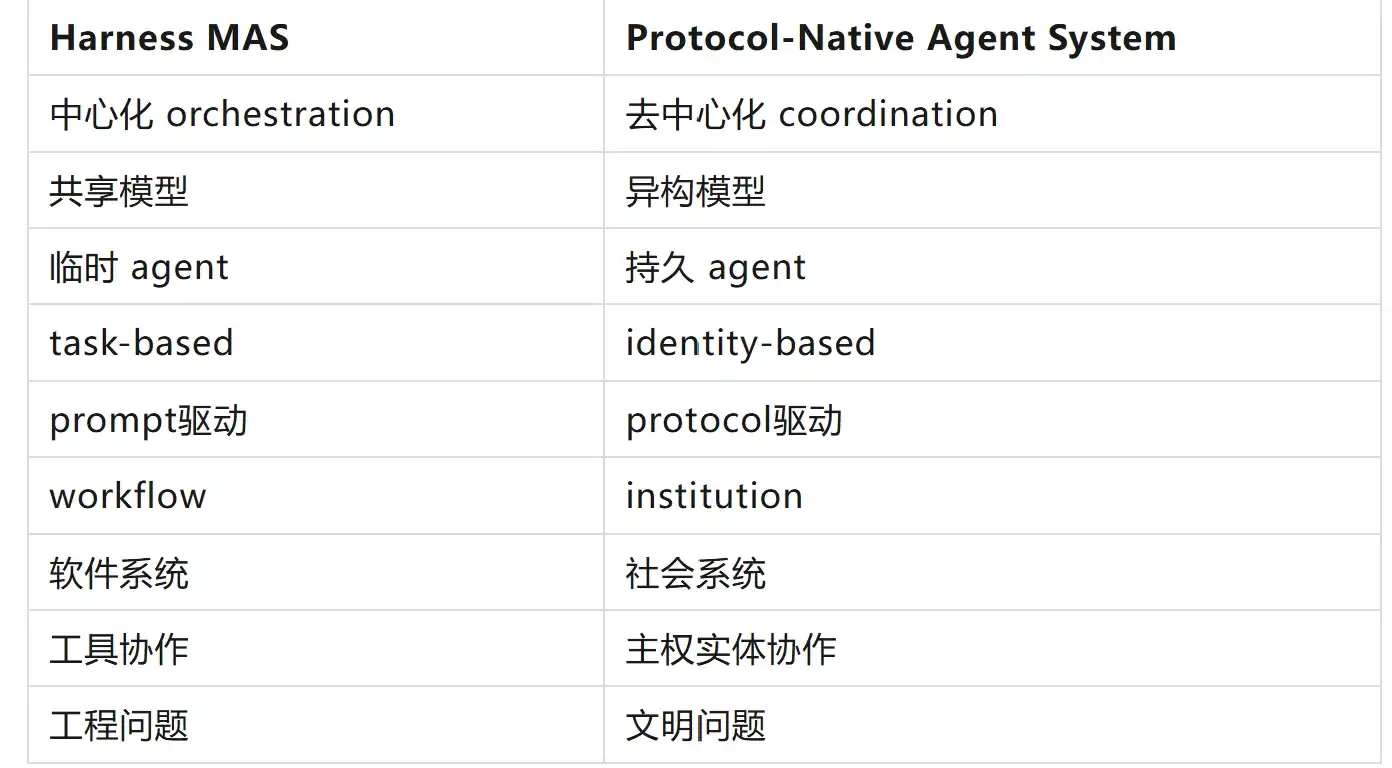
Let's make a table to compare the fundamental differences between the two MAS approaches mentioned earlier:
After "Intelligence"

Many people today believe the biggest problems with AI are:

  • Reasoning ability
  • Model capability
  • Long context
  • Multimodality
  • Agent execution

These indeed pose current challenges, but I truly believe all these will be solved soon. However, upon truly entering Agent Society, the most difficult problem might become: how autonomous entities achieve long-term collaboration.

Kepler was revered as the "lawgiver of the heavens" because of his three laws. But what are the laws for Agents here? When sovereignty is partially separated, this is an unavoidable question.

Because in the future:

  • Agents will have different goals
  • Agents will have different world models
  • Agents will have different interests
  • Agents will have different memories
  • Agents will have different value systems

Therefore, the truly difficult thing in the future is not "making Agents talk," but "enabling Agents to form a coherently interpretable world model."

This means: Ontology, Semantic Protocol, these fields once neglected by the internet, will become core again. There are already some signs; Ontology, such an obscure term, is now almost becoming a mainstream engineering vocabulary. It's truly an astonishing thing.

The Secret of Palantir

Companies Might Just Be "Agent Associations"

Pushing this further, future "companies" might not even be human organizations. (Students who often read my articles, does this sound familiar? The high-end game of unmanned companies has appeared.) They could be protocol alliances of numerous Personal Agents.

For example:

  • Your Agent
  • My Agent
  • AI CFO
  • AI Lawyer
  • AI Sales
  • AI Factory

Dynamically forming organizations through protocols. Organizations are no longer fixed structures, but Agent associations that can be reorganized in real-time.

Therefore, many future systems may no longer be software running, but may be transforming into: organizations computing. And this might be the true: Intelligence-Native Civilization.

Finally, I'll use an AI-generated image to summarize the entire article:
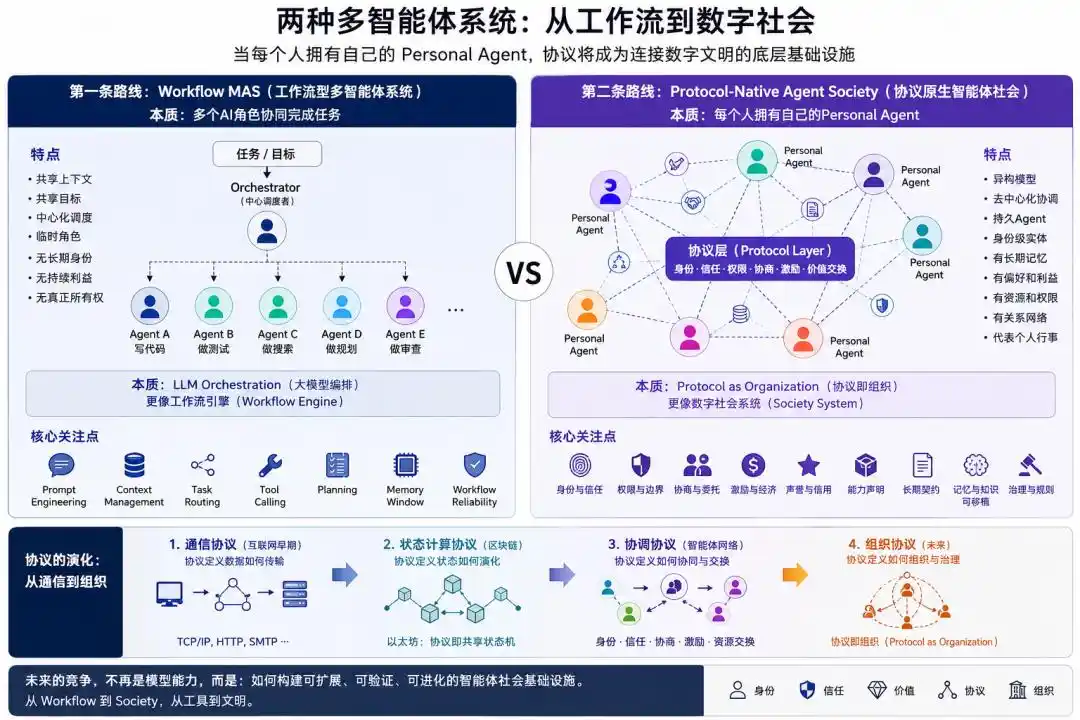
(The summary is indeed better than banana)

I have established a "universe" of AI ontology.

Galloping with the wind, spring grows old; The world is fickle, the traveler's steps are slow.

This article is from the WeChat public account "琢磨事," author: Li Zhiyong

Cryptos en tendance

Questions liées

QWhat are the two main AI Multi-Agent System (MAS) development paths discussed in the article, and how do they fundamentally differ?

AThe article discusses two main MAS paths. The first is 'Harness-style MAS,' which is currently mainstream. It involves multiple AI agents (like coders, testers) orchestrated by a central system to complete complex tasks. It's essentially a sophisticated workflow or orchestration system. The second path is 'Protocol-Native Agent System.' Here, the focus shifts to personal or sovereign agents (like a Personal Agent or an 'unmanned company') that represent individuals with long-term memory, identity, and resources. The fundamental difference is in their nature: the first is a task-oriented, centrally controlled software system, while the second envisions a society-like system of autonomous entities that must coordinate through protocols.

QAccording to the article, why will 'protocols' become the core challenge in a future populated by autonomous Personal Agents?

AIn a future with many independent, sovereign Personal Agents (each with its own goals, memory, and value systems), central coordination methods like shared context or workflows become impossible. Therefore, protocols will become the core mechanism for enabling coordination. These protocols will need to solve complex social and institutional problems like identity verification, trust establishment, permission boundaries, incentive mechanisms, reputation systems, and long-term contracts between autonomous entities. The core challenge thus shifts from 'prompt engineering' to 'protocol engineering' to manage interactions in this digital society.

QWhat key characteristics define a true 'Personal Agent' or 'unmanned company' as opposed to a task-specific agent in the first MAS path?

AA true Personal Agent or unmanned company is defined by sovereignty and persistent identity, unlike temporary task agents. Its key characteristics include: long-term memory, a continuous identity, personal preferences, owned resources, specific permissions, a personal history, a relationship network, defined interest boundaries, and the ability to represent its owner ('you'). It is an identity-scoped entity, not a task-scoped tool. This sovereignty is what necessitates the complex protocol-based interactions described in the article.

QThe article suggests the concept of 'Protocol as Organization.' What does this mean in the context of Agent Society?

A'Protocol as Organization' means that in an Agent Society, the protocols governing agent interactions will take on the functions traditionally associated with human organizations. Beyond just defining data communication (like HTTP) or shared state computation (like blockchain), these advanced protocols will define coordination rules, permission structures, incentive models, identity management, and the very organizational relationships between agents. In this way, a 'company' or collective entity could be formed dynamically not by legal documents and fixed structures, but by a set of protocols that allow a coalition of Personal Agents and specialized AI agents to collaborate and operate together.

QWhat does the author believe will be the most difficult challenge after basic AI 'intelligence' problems (like reasoning, context) are solved?

AThe author believes the most difficult challenge will be enabling long-term collaboration between autonomous entities (agents). Once agents have different goals, world models, interests, memories, and value systems, the core problem shifts from making agents intelligent to making their interpretations of the world align enough for cooperation. This will make fields like Ontology (defining shared conceptual frameworks) and Semantic Protocols (protocols with shared meaning) critically important, moving the focus from technical execution to social and philosophical coordination within a digital civilization.

Lectures associées

Dialogue avec Ray Dalio : Nous sommes actuellement dans une bulle de l'IA, 1% de mon portefeuille est en Bitcoin

Ray Dalio, fondateur de Bridgewater Associates, met en garde contre la bulle actuelle de l'IA, présentant des signes classiques similaires aux précédents krachs financiers. Il explique qu'une combinaison de spéculation excessive, d'endettement et de changements de taux d'intérêt pourrait provoquer son éclatement, entraînant une récession économique. Dalio décrit également un « grand cycle » mondial d'environ 80 ans, caractérisé par des inégalités croissantes, des déficits publics élevés et des tensions géopolitiques. Nous serions actuellement dans une phase de déclin de ce cycle, avec un ordre mondial en transition. Pour protéger leur patrimoine, il conseille aux investisseurs de diversifier leurs actifs (actions, obligations, or, immobilier) plutôt que de détenir uniquement des liquidités. Il mentionne détenir environ 1% de Bitcoin, mais préfère l'or physique pour sa stabilité. Concernant l'IA, Dalio souligne qu'elle remplacera progressivement le travail intellectuel humain, creusant les inégalités. L'avenir appartiendra à ceux qui sauront allier intelligence humaine et collaboration avec l'IA. Enfin, il évoque un monde de plus en plus régionalisé, avec un affaiblissement de la puissance américaine, visible dans des conflits comme celui avec l'Iran, et la montée en puissance d'autres pôles, notamment la Chine.

marsbitIl y a 44 mins

Dialogue avec Ray Dalio : Nous sommes actuellement dans une bulle de l'IA, 1% de mon portefeuille est en Bitcoin

marsbitIl y a 44 mins

7,2 billions de KRW en une journée, les achats nets des investisseurs étrangers atteignent un record historique ce vendredi ! Wall Street : Les vents contraires sur les flux de capitaux sud-coréens se sont dissipés

Les marchés boursiers sud-coréens montrent des signes tangibles d'amélioration des flux de capitaux. Le 31 juillet, les investisseurs étrangers ont réalisé un achat net record de 7 200 milliards de wons sur une seule journée dans le KOSPI, marquant un renversement de la tendance de sorties massives observée ces derniers mois. En juillet, leurs ventes nettes mensuelles se sont fortement réduites à 9 800 milliards de wons, contre 48 400 et 44 500 milliards en juin et mai respectivement. Parallèlement, les institutions domestiques comme les fonds de pension ont inversé leur tendance, passant à un achat net de 1 000 milliards de wons en juillet. La Commission des services financiers a également resserré l'accès aux ETF à effet de levier sur actions individuelles pour les investisseurs de détail, réduisant ainsi la volatilité du marché. Citigroup Research maintient son objectif pour le KOSPI à 10 000 points, estimant que les vents contraires liés aux flux de capitaux s'atténuent. Des facteurs tels que les fondamentaux solides du secteur des puces mémoire, les faibles valorisations du marché, une économie robuste et un environnement politique favorable devraient soutenir le marché. La possibilité d'interventions des autorités pour stabiliser le marché offre également un filet de sécurité.

marsbitIl y a 44 mins

7,2 billions de KRW en une journée, les achats nets des investisseurs étrangers atteignent un record historique ce vendredi ! Wall Street : Les vents contraires sur les flux de capitaux sud-coréens se sont dissipés

marsbitIl y a 44 mins

Choc ! La prochaine IA d'OpenAI résout 10 problèmes du calibre de la Médaille Fields

**OpenAI provoque un séisme mathématique avec son nouveau modèle Astra** OpenAI a dévoilé des avancées mathématiques majeures réalisées par son modèle interne Astra, présenté par Sam Altman. L'IA aurait résolu ou fait progresser dix problèmes complexes dans des domaines variés comme la géométrie haute dimension, la théorie des groupes et la complexité quantique. Le résultat le plus marquant est la construction du premier groupe "non sofic" infini et finiment présenté, réfutant une conjecture de Mikhail Gromov vieille de 27 ans. Cette seule découverte est qualifiée de niveau "Prix Fields". Astra a également amélioré une borne fondamentale sur le problème de l'empilement des sphères en haute dimension, stagnant depuis 1978, et a réfuté la conjecture de rigidité d'Alain Connes en construisant une infinité de groupes non isomorphes partageant la même algèbre de von Neumann. Ces résultats, compilés dans un document de 249 pages, sont accompagnés de preuves formelles vérifiées par l'assistant Lean 4. OpenAI précise que le coût total de génération de ces démonstrations aurait été inférieur à 2000 dollars. La communauté mathématique réagit avec stupeur, certains experts y voyant un tournant historique où l'IA démontre une intuition et une capacité de raisonnement pouvant surpasser les meilleurs mathématiciens humains.

marsbitIl y a 2 h

Choc ! La prochaine IA d'OpenAI résout 10 problèmes du calibre de la Médaille Fields

marsbitIl y a 2 h

Grâce aux lancers de dés, les clés Bitcoin sont stockées hors ligne, mais tout le monde ne s'y mettra pas

Le titre « Les clés Bitcoin protégées par des dés, mais la méthode reste marginale » introduit un article sur la génération manuelle de graines de portefeuille Bitcoin à l'aide de dés. L'article explique le concept d'entropie, illustré par Claude Shannon, où un dé à six faces génère environ 2,585 bits d'incertitude. Il aborde le scandale récent de Coldcard, où une vulnérabilité du générateur de nombres aléatoires matériel a compromis des fonds. Les utilisateurs ayant généré leur phrase de récupération avec des dés (environ 99 lancers pour une haute sécurité) n'étaient pas affectés pour leur seed principal. Cependant, l'analyse du chercheur Kevin Loaec montre que d'autres fonctions du portefeuille (clés de copie, portefeuilles papier, mots de passe, etc.) utilisaient ce générateur défectueux et restaient vulnérables. L'article souligne les défis pratiques de la méthode des dés : elle est longue, sujette aux erreurs de saisie, et peu adaptée aux nouveaux utilisateurs qui pourraient mal l'exécuter. Il conclut que si cette méthode manuelle est robuste pour les experts, l'objectif à long terme est d'avoir un matériel et des logiciels générant une entropie fiable de manière simple et sécurisée. Il conseille aux propriétaires de Coldcard de vérifier leur firmware et les fonctions utilisées, et rappelle l'intérêt des solutions multi-signatures avec différents fabricants pour limiter les risques.

cryptonews.ruIl y a 5 h

Grâce aux lancers de dés, les clés Bitcoin sont stockées hors ligne, mais tout le monde ne s'y mettra pas

cryptonews.ruIl y a 5 h

Trading

Spot

Articles tendance

Comment acheter ONE

Bienvenue sur HTX.com ! Nous vous permettons d'acheter Harmony (ONE) de manière simple et pratique. Suivez notre guide étape par étape pour commencer votre parcours crypto.Étape 1 : Création de votre compte HTXUtilisez votre adresse e-mail ou votre numéro de téléphone pour ouvrir un compte sur HTX gratuitement. L'inscription se fait en toute simplicité et débloque toutes les fonctionnalités.Créer mon compteÉtape 2 : Choix du mode de paiement (rubrique Acheter des cryptosCarte de crédit/débit : utilisez votre carte Visa ou Mastercard pour acheter instantanément Harmony (ONE).Solde :utilisez les fonds du solde de votre compte HTX pour trader en toute simplicité.Prestataire tiers :pour accroître la commodité d'utilisation, nous avons ajouté des modes de paiement populaires tels que Google Pay et Apple Pay.P2P :tradez directement avec d'autres utilisateurs sur HTX.OTC (de gré à gré) : nous offrons des services personnalisés et des taux de change compétitifs aux traders.Étape 3 : stockage de vos Harmony (ONE)Après avoir acheté vos Harmony (ONE), stockez-les sur votre compte HTX. Vous pouvez également les envoyer ailleurs via un transfert sur la blockchain ou les utiliser pour trader d'autres cryptos.Étape 4 : tradez des Harmony (ONE)Tradez facilement Harmony (ONE) sur le marché Spot de HTX. Il vous suffit d'accéder à votre compte, de sélectionner la paire de trading, d'exécuter vos trades et de les suivre en temps réel. Nous offrons une expérience conviviale aux débutants comme aux traders chevronnés.

550 vues totalesPublié le 2024.12.12Mis à jour le 2026.06.02

Comment acheter ONE

Discussions

Bienvenue dans la Communauté HTX. Ici, vous pouvez vous tenir informé(e) des derniers développements de la plateforme et accéder à des analyses de marché professionnelles. Les opinions des utilisateurs sur le prix de ONE (ONE) sont présentées ci-dessous.

活动图片













