Strategy Takes a Hard Line Against MSCI: The Ultimate Defense of DAT

深潮Publié le 2025-12-11Dernière mise à jour le 2025-12-11

Résumé

In a significant industry clash, digital asset treasury company Strategy has issued a forceful 12-page public letter to MSCI opposing its proposal to exclude companies with over 50% digital asset holdings from its global investable market indices. Strategy argues the move is discriminatory, misleading, and threatens billions in capital flow, potentially causing up to $2.8 billion in passive outflows from its stock alone. The company defends its business model, asserting that digital asset treasuries (DATs) are operational companies—not passive funds—with active strategies like issuing digital debt instruments to fund Bitcoin acquisitions and generate shareholder returns. It compares its role to historic infrastructure builders like Standard Oil and AT&T, emphasizing Bitcoin’s transformative potential in finance. Strategy highlights four key objections: the proposal is arbitrarily discriminatory against digital assets; it violates index providers' neutrality principles; it is impractical due to Bitcoin's volatility and accounting disparities; and it contradicts the U.S. government’s pro-digital asset strategy. The firm demands MSCI withdraw the proposal or extend consultations. Backed by industry advocates and data showing over 200 public companies hold more than 5% of Bitcoin’s supply, Strategy urges MSCI to let markets—not biased rules—determine the value of digital asset companies. The decision, expected by January 2026, could redefine the role of crypto-native firms in ...

Author: KarenZ, Foresight News

The博弈 concerning the development of the Digital Asset Treasury (DAT) industry continues to intensify.

In October, global index provider MSCI put forward a proposal to exclude companies with digital asset holdings accounting for 50% or more of their total assets from its Global Investable Market Indexes. This move directly threatens the market position of companies like Strategy, representative of digital asset treasury companies, and could potentially redirect capital flows for the entire DAT sector.

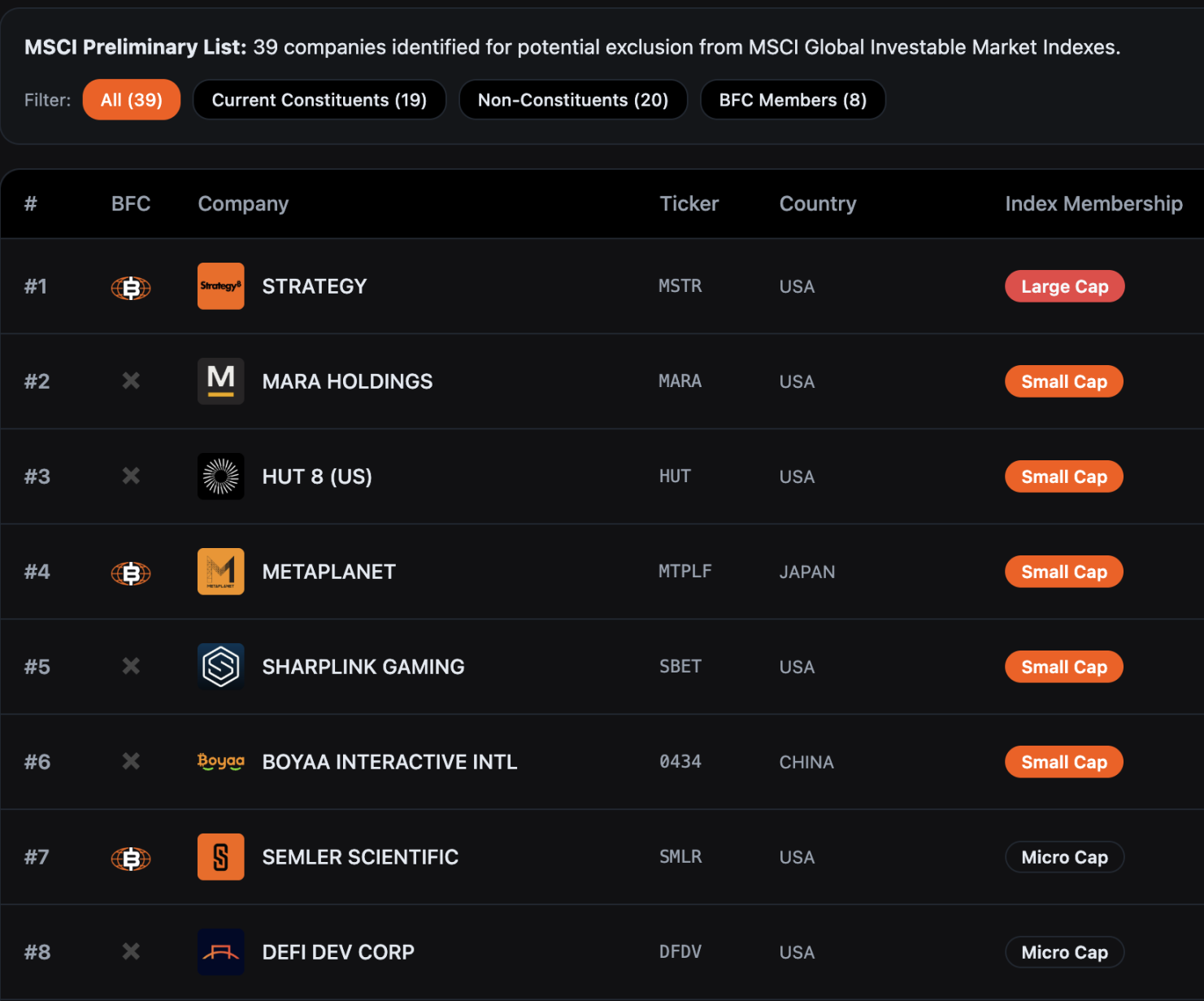
According to statistics from Bitcoin for Corporations, 39 companies risk exclusion from the MSCI Global Investable Market Indexes. J.P. Morgan analysts previously warned that the exclusion of Strategy alone could lead to nearly $2.8 billion in passive fund outflows. If other index providers follow suit with similar rules, outflows could reach as high as $8.8 billion.
The consultation period for this MSCI proposal is currently open until December 31, 2025, with a final conclusion expected by January 15, 2026. Any adjustments would be formally implemented during the February 2026 index review.

Faced with this urgent situation, Strategy submitted a strongly worded 12-page public letter to the MSCI Equity Index Committee on December 10th. Signed jointly by Executive Chairman and Founder Michael Saylor and President & CEO Phong Le, the letter clearly expressed firm opposition to the proposal. It stated unequivocally: "This proposal is seriously misleading and will have far-reaching destructive consequences for the interests of global investors and the development of the digital asset industry. We strongly urge MSCI to completely withdraw this plan."

Strategy's Four Core Arguments

Digital Assets Are a Revolutionary Foundational Technology Reshaping the Financial System

Strategy believes MSCI's proposal underestimates the strategic value of Bitcoin and other digital assets. Since Satoshi Nakamoto introduced Bitcoin 16 years ago, this digital asset has gradually grown into a key component of the global economy, with a current total market value of approximately $1.85 trillion.

In Strategy's view, digital assets are far more than simple financial instruments; they represent a fundamental technological innovation capable of reshaping the global financial system — companies investing in Bitcoin-related infrastructure are building a new financial ecosystem, much like leading companies that deeply invested in single emerging technologies throughout history.

Just as Standard Oil focused on oil well extraction in the 19th century and AT&T全力 built telephone networks in the 20th century, these companies laid a solid foundation for subsequent economic transformations through前瞻性 investment in core infrastructure, ultimately becoming industry benchmarks. Strategy argues that companies focusing on digital assets today are following this path of "technology pioneers" and should not be simply dismissed by traditional index rules.

DATs Are Operating Companies, Not Passive Funds

This is the core of Strategy's argument — Digital Asset Treasury companies (DATs) are operating companies with complete business models, not merely investment funds passively holding Bitcoin. Although Strategy currently holds over 600,000 Bitcoin, its core value does not rely solely on Bitcoin's price fluctuations. Instead, it creates sustainable returns for shareholders by designing and offering unique "digital credit" instruments.

Specifically, Strategy issues "digital credit" instruments including various types of preferred stock with fixed dividend rates, floating dividend rates, different priority levels, and credit protection terms. It uses the funds raised from selling these instruments to acquire more Bitcoin. As long as the long-term investment return on Bitcoin exceeds Strategy's USD-denominated financing costs, it can generate stable returns for shareholders and clients. Strategy emphasizes that this model of "active operation + asset appreciation" is fundamentally different from the passive management logic of traditional investment funds or ETFs and should be regarded as a normal operating company.

Furthermore, Strategy questions in the letter: Why can oil giants, Real Estate Investment Trusts (REITs), timber companies, etc., concentrate holdings in a single asset class without being classified as investment funds and excluded from indexes? Imposing special restrictions only on digital asset companies clearly violates the principle of industry equity.

The 50% Digital Asset Threshold is Arbitrary, Discriminatory, and Impractical

Strategy points out that MSCI's proposal employs discriminatory standards. Many large companies in traditional industries also hold a highly concentrated single asset class in their portfolios, including oil and gas companies, REITs, timber companies, and power infrastructure firms. Yet, MSCI has set special exclusion criteria only for digital asset companies, constituting obvious unfair treatment.

From an implementation feasibility perspective, the proposal also has serious issues. Due to the high volatility of digital asset prices, the same company could frequently enter and exit MSCI indexes within days due to changes in asset value, causing market chaos. Additionally, differences between accounting standards (the treatment of digital assets differs under US GAAP and international IFRS standards) will lead to differential treatment for companies with the same business model based on their jurisdiction of incorporation.

Violates Index Neutrality Principle, Introduces Policy Bias

Strategy argues that MSCI's proposal is essentially a value judgment on a certain asset class, violating the fundamental principle that index providers should remain neutral. MSCI claims to markets and regulators that its indexes provide "exhaustive" coverage, aiming to reflect the "evolution of the underlying equity market," and should not "make judgments about the goodness or appropriateness of any market, company, strategy, or investment."

By selectively excluding digital asset companies, MSCI is effectively making a policy judgment on behalf of the market, which is precisely what index providers should avoid.

Contradicts US Digital Asset Strategy

Strategy specifically emphasizes that this proposal conflicts with the strategic goals of the Trump administration to advance US leadership in digital assets. The Trump administration signed an executive order in its first week to promote growth in digital financial technology and established a strategic Bitcoin reserve, aiming to make the US the global leader in digital assets.

However, if MSCI's proposal is implemented, it would directly prevent long-term US capital, such as pension funds and 401(k) plans, from investing in digital asset companies, leading to tens of billions of dollars flowing out of the sector. This would not only hinder the development of US digital asset innovation companies but could also weaken US competitiveness in this strategic field, running counter to the government's stated policy direction.

Citing analyst estimates, Strategy states that it alone could face up to $2.8 billion in passive stock liquidation due to MSCI's proposal. This harms not only Strategy itself but will also have a chilling effect on the entire digital asset ecosystem. For example, it might force Bitcoin mining companies to sell assets prematurely to adjust their asset structure, thereby distorting the normal supply and demand dynamics of the digital asset market.

Strategy's Ultimate Demands

Strategy puts forward two main demands in its public letter:

First, it hopes MSCI will completely withdraw the exclusion proposal, allowing the market to test the value of Digital Asset Treasury companies (DATs) through free competition, enabling indexes to neutrally and faithfully reflect the development trends of next-generation financial technology.

Second, if MSCI still insists on "special treatment" for digital asset companies, it must expand the scope of industry consultation, extend the consultation period, and provide more substantial logical support to explain the rationality of the rules.

Strategy Is Not Fighting Alone

Strategy is not fighting alone. According to data from BitcoinTreasuries.NET, as of December 11th, 208 publicly listed companies globally hold over 1.07 million Bitcoin, exceeding 5% of Bitcoin's total supply, currently worth approximately $100 billion.
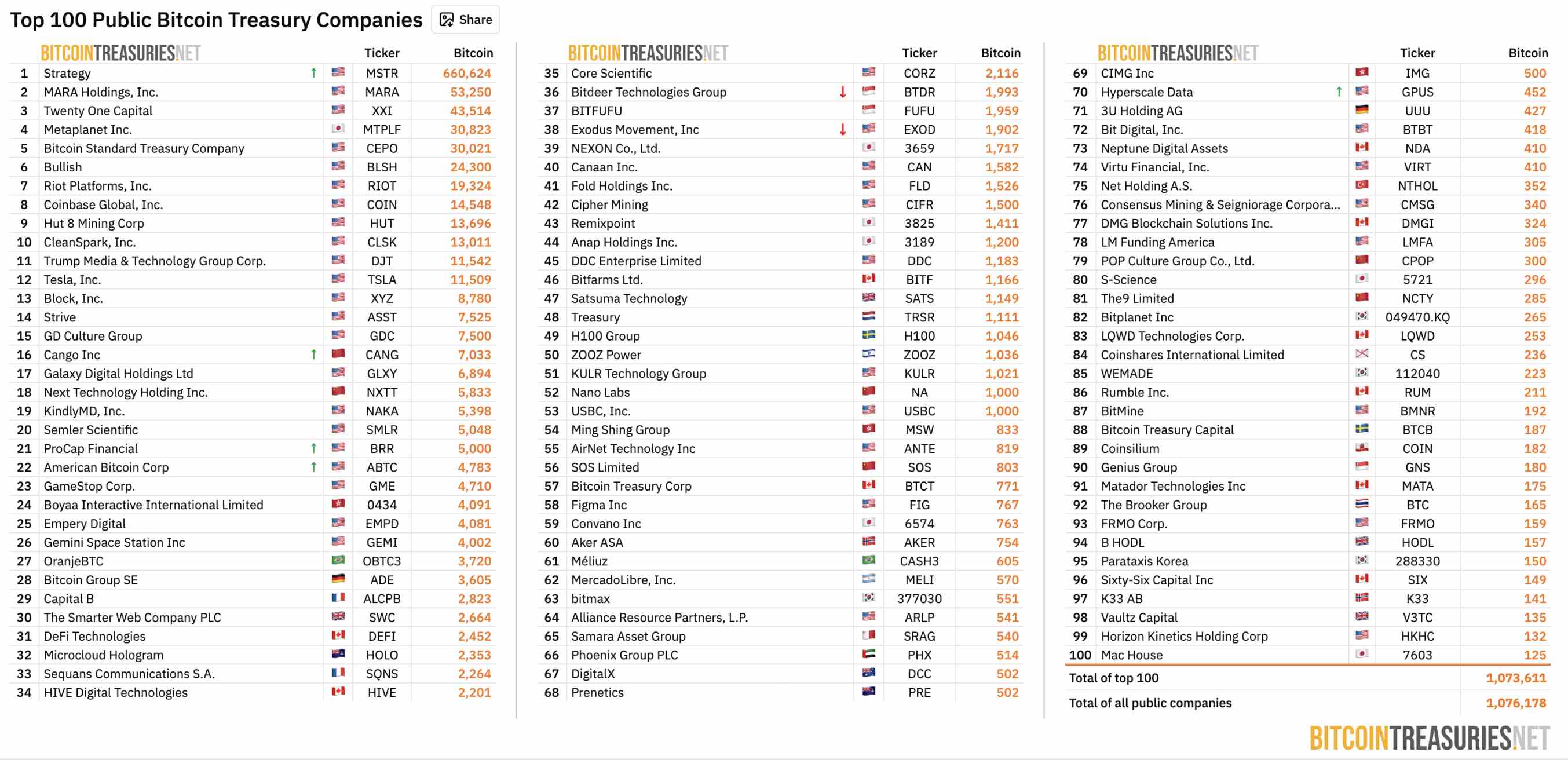
Source: BitcoinTreasuries.NET

These digital asset treasury companies have become important bridge for institutional adoption of cryptocurrency, providing compliant indirect exposure for traditional financial institutions like pension funds and endowments.

Previously, Strive, a Bitcoin-holding public company, suggested that MSCI should leave the "choice" regarding digital asset companies to the market. A simple and direct solution would be to create "ex-Digital Asset Treasury" versions of existing indexes, such as the MSCI USA ex Digital Asset Treasuries Index and the MSCI ACWI ex Digital Asset Treasuries Index. A transparent screening mechanism would allow investors to choose their tracking benchmark independently, preserving index integrity while meeting the needs of different investors.

Additionally, the industry organization Bitcoin for Corporations has initiated a joint petition calling on MSCI to withdraw the digital asset proposal. It advocates that classification should be based on a company's actual business model, financial performance, and operational characteristics, rather than simply drawing a line based on asset percentage. According to the organization's website, 309 companies or investors have currently signed the joint letter. Signatories, besides Strategy, include executives from industry-known firms like Strive, BitGo, Redwood Digital Group, 21MIL, Btc inc, DeFi Development Corp, as well as numerous individual developers and investors.

Summary

The standoff between Strategy and MSCI is essentially a fundamental debate about "how emerging financial innovations integrate into the traditional system." Digital Asset Treasury companies (DATs), as "cross-border" entities between traditional finance and the cryptocurrency world, are neither pure technology companies nor simple investment funds, but represent a new business model built upon digital assets.

MSCI's proposal attempts to use a "50% asset threshold" to classify these complex entities as "investment funds" and exclude them from indexes; Strategy insists that this simplified treatment is a serious misunderstanding of their business essence and a departure from the principle of index neutrality. As the January 15, 2026 decision date approaches, the outcome of this博弈 will not only determine the index "eligibility" of several Bitcoin-holding public companies but will also delineate a critical "survival boundary" for the future position of the digital asset industry within the global traditional financial system.


Cryptos en tendance

Questions liées

QWhat is the core argument that Strategy uses to defend its classification as an operational company rather than a passive fund?

AStrategy argues that it is an operational company with a complete business model, not a passive investment fund. Its core value is not derived from Bitcoin's price fluctuations but from creating sustainable returns for shareholders through its unique 'digital credit' instruments, such as preferred shares with fixed or floating dividend rates, which it sells to raise capital for acquiring more Bitcoin. This active operational model is fundamentally different from the passive management of ETFs or funds.

QWhat potential financial impact does Strategy claim the MSCI proposal could have on it and the broader digital asset market?

AStrategy, citing analyst estimates, claims that its exclusion from the MSCI index alone could trigger nearly $2.8 billion in passive fund outflows. If other index providers adopt similar rules, the outflows could reach as high as $8.8 billion. This would not only harm Strategy but also create a chilling effect on the entire digital asset ecosystem, potentially forcing companies like Bitcoin miners to sell assets prematurely and distorting market supply and demand.

QHow does Strategy's public letter justify the strategic value of Bitcoin and digital assets?

AStrategy's letter argues that Bitcoin and digital assets represent a revolutionary foundational technology reshaping the financial system, not merely financial instruments. It compares companies investing in Bitcoin infrastructure to historical pioneers like Standard Oil and AT&T, which made foundational investments in oil and telephone networks. These companies laid the groundwork for economic transformation and became industry benchmarks, a path Strategy believes digital asset companies are now following.

QWhat alternative solution does the industry group Bitcoin for Corporations suggest to MSCI's proposal?

AThe industry group Bitcoin for Corporations, along with companies like Strive, suggests that MSCI should create new versions of its existing indices that explicitly exclude Digital Asset Treasury companies, such as 'MSCI USA ex Digital Asset Treasuries' and 'MSCI ACWI ex Digital Asset Treasuries'. This would give investors the transparent choice of which benchmark to follow, preserving the integrity of the main indices while catering to different investor preferences.

QWhat is Strategy's ultimate request to MSCI regarding the proposed rule change?

AStrategy's primary request is for MSCI to completely withdraw the proposal to exclude companies based on their digital asset holdings. It argues the market should freely compete to validate the value of Digital Asset Treasury companies (DATs) and that the index should neutrally reflect the evolution of next-generation fintech. If MSCI insists on special treatment for these companies, Strategy demands a broader industry consultation, an extended consultation period, and a more robust logical justification for the rule.

Lectures associées

En seulement 11 jours, Claude réécrit un million de lignes de code, un projet épique d'IA qui suscite la colère

Ces derniers jours, l'écosystème tech est en émoi suite à la réaction enflammée d'Andrew Kelley, créateur du langage de programmation Zig. La cause : le projet Bun, un runtime JavaScript/TypeScript performant initialement écrit en Zig et considéré comme un sérieux concurrent à Node.js, a été entièrement réécrit en Rust par son fondateur, Jarred Sumner. Cette réécriture, d'environ un million de lignes de code, a été réalisée en seulement 11 jours grâce à l'utilisation intensive de l'outil d'IA Claude Fable 5 d'Anthropic, qui a récemment acquis Bun. Le coût estimé de cette opération via l'API est d'environ 165 000 dollars. L'équipe de Bun a justifié cette décision radicale par des problèmes persistants de stabilité et de sécurité mémoire (use-after-free, double-free) dans la version Zig, difficile à éradiquer dans ce langage, alors que le système de propriété de Rust les aurait empêchés à la compilation. De plus, la politique stricte de la communauté Zig contre le code généré par IA était en contradiction avec la dépendance croissante de l'équipe Bun à ces outils. La réponse d'Andrew Kelley a été cinglante. Dans un billet de blog, il a attribué les problèmes de Bun non pas à Zig, mais aux mauvaises pratiques d'ingénierie de Jarred Sumner, qualifiant son code de "bricolages sur des bricolages" (hacks on top of hacks) et le traitant de "mauvais manager". Il a exprimé un certain soulagement que Bun abandonne Zig, craignant que le projet ne donne une mauvaise image du langage. Cette affaire a déclenché un vif débat dans la communauté. Certains critiquent le manque de professionnalisme de Kelley, tandis que d'autres le soutiennent pour sa défense de la qualité technique. Les interrogations principales portent désormais sur la maintenabilité à long terme du nouveau code Rust, généré automatiquement et contenant encore 27 000 blocs de code "unsafe", et sur la question de savoir si les économies de temps et d'argent réalisées aujourd'hui ne se transformeront pas en une dette technique colossale pour l'avenir.

marsbitIl y a 36 mins

En seulement 11 jours, Claude réécrit un million de lignes de code, un projet épique d'IA qui suscite la colère

marsbitIl y a 36 mins

De la finance automobile au Bitcoin, puis au moteur d'IA : Analyse de la stratégie « Ce qu'il ne faut pas faire » de Cango

De l'automobile au bitcoin, puis à l'IA : l'analyse de la stratégie « Ne pas faire » de Cango L'entreprise chinoise Cango, initialement plateforme de financement automobile, a radicalement changé de cap. Après une entrée remarquée dans le minage de bitcoin avec l'acquisition de matériel de Bitmain, elle opère aujourd'hui une nouvelle transformation en lançant EcoHash, une filiale dédiée à l'inférence d'intelligence artificielle (IA). Contrairement à la tendance des grands mineurs qui louent leur capacité électrique à des géants du cloud pour l'entraînement d'IA, Cango adopte une approche différente. Sa stratégie, résumée par « Savoir ce qu'il ne faut pas faire », consiste à éviter la concurrence frontale avec les hyperscalers sur le segment de l'entraînement. Au lieu de cela, Cango cible le vaste marché de l'inférence d'IA, qu'elle estime devoir être déployée de manière distribuée et proche des utilisateurs pour réduire la latence. L'entreprise mise sur son réseau d'une trentaine de sites miniers, généralement de petite taille (10 à 50 MW), inadaptés aux besoins massifs des géants mais idéaux pour l'inférence. Elle vise à former un écosystème symbiotique avec les nombreux petits opérateurs miniers indépendants (détenant plus de 70% de l'électricité du secteur) qui possèdent l'énergie et le terrain mais pas la technologie ou les clients IA. Son logiciel EcoLink permettrait de répartir la charge de travail entre ces sites pour assurer la fiabilité. Cango maintient néanmoins une activité de minage bitcoin (environ 31,7 EH/s) pour générer des liquidités, tout en ayant considérablement réduit sa dette. Le scepticisme existe quant à la viabilité financière de ces transitions et à leur impact sur le réseau Bitcoin, mais Cango parie que l'avenir de l'inférence IA réside dans cette myriade de petits sites énergétiques décentralisés.

Foresight NewsIl y a 50 mins

De la finance automobile au Bitcoin, puis au moteur d'IA : Analyse de la stratégie « Ce qu'il ne faut pas faire » de Cango

Foresight NewsIl y a 50 mins

Rapport Goldman Sachs démêle la concurrence des grands modèles d'IA en Chine : Qui deviendra le gagnant à long terme ?

Le rapport de Goldman Sachs analyse le paysage concurrentiel des grands modèles d'IA en Chine, identifiant un point d'inflexion historique. Les modèles à poids ouvert/ouvert chinois rattrapent les performances des meilleurs modèles propriétaires mondiaux, grâce à des innovations d'architecture (comme MoE) et une efficacité paramétrique permettant des coûts bien inférieurs. Le marché se structure en deux niveaux : un segment haut de gamme (ex: GLM5.2 de Zhipu, Qwen3.7 Max d'Alibaba) avec une tarification d'environ 1$/million de tokens, et un segment bas de gamme (0.06-0.2$/million de tokens) ciblant les PME mondiales. Les revenus totaux par API et abonnements devraient exploser, passant de 35 milliards de yuans estimés en 2026 à 879 milliards en 2030. La stratégie dominante est l'open source, favorisant l'adoption et l'itération, mais limitant la monétisation directe. Une évolution vers des modèles "à poids ouvert avec licence communautaire", incluant des accords de partage de revenus, est anticipée pour améliorer la rentabilité. Le cadre d'évaluation de Goldman Sachs, basé sur le pouvoir tarifaire, l'avantage de coût et la solidité financière, désigne Zhipu et DeepSeek comme les mieux positionnés dans les modèles de texte fondamentaux. ByteDance mène dans le domaine multimodal/vidéo. MiniMax et Kuaishou sont également bien notés, MiniMax bénéficiant d'une forte adoption internationale.

marsbitIl y a 57 mins

Rapport Goldman Sachs démêle la concurrence des grands modèles d'IA en Chine : Qui deviendra le gagnant à long terme ?

marsbitIl y a 57 mins

La stratégie de vente de BTC dépasse largement 12,5 milliards de dollars : un détail négligé par le marché

Article original de : Bankless Compilé par : Odaily Planet Daily ; Traducteur : Azuma Strategy a révélé le 7 juillet avoir vendu 3 588 BTC, d'une valeur d'environ 216 millions de dollars, entre le 29 juin et le 5 juillet. Ces fonds ont servi à payer les dividendes de STRC et à reconstituer la réserve de dollars. L'entreprise précise que sa capacité totale de constitution de réserve de 1,25 milliard de dollars reste intacte. Un détail crucial est souvent négligé : le "plan de monétisation du BTC" de Strategy ne limite pas les ventes totales de bitcoin à 1,25 milliard de dollars. Ce plafond ne s'applique qu'à un usage spécifique : "construire" (build) la réserve de dollars. Le plan prévoit deux autres motifs de vente majeurs, sans plafond explicite pour certains : 1. **Construire la réserve** : Vendre jusqu'à 1,25 Md$ de BTC. 2. **Couvrir les coûts des actions privilégiées et de la dette** : Vendre des BTC pour payer les dividendes et intérêts fixes. 3. **Financer des rachats d'actions** : Vendre des BTC pour racheter jusqu'à 1 Md$ d'actions privilégiées et 1 Md$ d'actions ordinaires MSTR. Ainsi, le potentiel total de vente de BTC dépasse largement les 1,25 Md$ évoqués, pouvant dépasser 3 Md$ rien qu'avec les plafonds connus. La distinction sémantique entre "construire" et "reconstituer" (replenish) la réserve est fondamentale. Les deux actions consistent à convertir du BTC en cash pour couvrir les obligations, mais seule la première est comptabilisée dans le plafond médiatisé de 1,25 Md$. La vente récente de 216 M$ a été classée en "reconstitution", laissant donc le plafond intact. Cette approche marque un changement de paradigme pour Strategy, passant d'une simple accumulation passive de BTC à une "gestion active du capital". Le bitcoin devient un outil du bilan pour maintenir la structure financière complexe de l'entreprise, notamment le système d'actions privilégiées. Cette nouvelle flexibilité crée aussi des conflits d'intérêts potentiels entre les différentes parties prenantes (actionnaires ordinaires, détenteurs d'actions privilégiées). En conclusion, les investisseurs doivent désormais analyser minutieusement chaque terme technique utilisé par Strategy ("construire", "reconstituer", "émettre", "racheter"), car chacun implique des conséquences différentes sur les ventes futures de BTC et la gestion du capital. La société s'est transformée en une structure complexe dont la capacité à jongler avec ces leviers actifs est désormais l'enjeu central.

marsbitIl y a 57 mins

La stratégie de vente de BTC dépasse largement 12,5 milliards de dollars : un détail négligé par le marché

marsbitIl y a 57 mins

Trading

Spot

Articles tendance

Comment acheter O

Bienvenue sur HTX.com ! Nous vous permettons d'acheter O1 exchange (O) de manière simple et pratique. Suivez notre guide étape par étape pour commencer votre parcours crypto.Étape 1 : Création de votre compte HTXUtilisez votre adresse e-mail ou votre numéro de téléphone pour ouvrir un compte sur HTX gratuitement. L'inscription se fait en toute simplicité et débloque toutes les fonctionnalités.Créer mon compteÉtape 2 : Choix du mode de paiement (rubrique Acheter des cryptosCarte de crédit/débit : utilisez votre carte Visa ou Mastercard pour acheter instantanément O1 exchange (O).Solde :utilisez les fonds du solde de votre compte HTX pour trader en toute simplicité.Prestataire tiers :pour accroître la commodité d'utilisation, nous avons ajouté des modes de paiement populaires tels que Google Pay et Apple Pay.P2P :tradez directement avec d'autres utilisateurs sur HTX.OTC (de gré à gré) : nous offrons des services personnalisés et des taux de change compétitifs aux traders.Étape 3 : stockage de vos O1 exchange (O)Après avoir acheté vos O1 exchange (O), stockez-les sur votre compte HTX. Vous pouvez également les envoyer ailleurs via un transfert sur la blockchain ou les utiliser pour trader d'autres cryptos.Étape 4 : tradez des O1 exchange (O)Tradez facilement O1 exchange (O) sur le marché Spot de HTX. Il vous suffit d'accéder à votre compte, de sélectionner la paire de trading, d'exécuter vos trades et de les suivre en temps réel. Nous offrons une expérience conviviale aux débutants comme aux traders chevronnés.

219 vues totalesPublié le 2026.06.19Mis à jour le 2026.06.29

Comment acheter O

Comment acheter PROS

Bienvenue sur HTX.com ! Nous vous permettons d'acheter Pharos (PROS) de manière simple et pratique. Suivez notre guide étape par étape pour commencer votre parcours crypto.Étape 1 : Création de votre compte HTXUtilisez votre adresse e-mail ou votre numéro de téléphone pour ouvrir un compte sur HTX gratuitement. L'inscription se fait en toute simplicité et débloque toutes les fonctionnalités.Créer mon compteÉtape 2 : Choix du mode de paiement (rubrique Acheter des cryptosCarte de crédit/débit : utilisez votre carte Visa ou Mastercard pour acheter instantanément Pharos (PROS).Solde :utilisez les fonds du solde de votre compte HTX pour trader en toute simplicité.Prestataire tiers :pour accroître la commodité d'utilisation, nous avons ajouté des modes de paiement populaires tels que Google Pay et Apple Pay.P2P :tradez directement avec d'autres utilisateurs sur HTX.OTC (de gré à gré) : nous offrons des services personnalisés et des taux de change compétitifs aux traders.Étape 3 : stockage de vos Pharos (PROS)Après avoir acheté vos Pharos (PROS), stockez-les sur votre compte HTX. Vous pouvez également les envoyer ailleurs via un transfert sur la blockchain ou les utiliser pour trader d'autres cryptos.Étape 4 : tradez des Pharos (PROS)Tradez facilement Pharos (PROS) sur le marché Spot de HTX. Il vous suffit d'accéder à votre compte, de sélectionner la paire de trading, d'exécuter vos trades et de les suivre en temps réel. Nous offrons une expérience conviviale aux débutants comme aux traders chevronnés.

218 vues totalesPublié le 2026.06.22Mis à jour le 2026.06.29

Comment acheter PROS

Qu'est ce que VERONA

I. Introduction du projet VERONA est une blockchain conçue pour tout le monde, partout grâce à l'abstraction de chaîne. En utilisant sa couche d'abstraction généralisée, VERONA se distingue en intégrant des fonctionnalités blockchain complexes, telles que les comptes, les signatures et l'interopérabilité, directement au niveau du protocole. Cette approche permet d'interagir avec des applications blockchain sans avoir besoin de comprendre les technologies sous-jacentes.1) Informations de base Nom : VERONA (VERONA)III. Liens associés Lien vers le site officiel : https://xion.burnt.com/ Whitepaper : https://xion.burnt.com/whitepaper.pdf Explorateurs : https://explorer.burnt.com/ Médias sociaux : https://x.com/burnt_xion Remarque : L'introduction du projet provient des documents publiés ou fournis par l'équipe officielle du projet, qui est à titre de référence uniquement et ne constitue pas un conseil en investissement. HTX ne prend pas la responsabilité des pertes directes ou indirectes qui en résultent.

185 vues totalesPublié le 2026.06.22Mis à jour le 2026.06.22

Qu'est ce que VERONA

Discussions

Bienvenue dans la Communauté HTX. Ici, vous pouvez vous tenir informé(e) des derniers développements de la plateforme et accéder à des analyses de marché professionnelles. Les opinions des utilisateurs sur le prix de A (A) sont présentées ci-dessous.

活动图片