Manufacturing's Share Drops Below 25%: Is Hangzhou Unconcerned?

marsbitPublié le 2026-08-19Dernière mise à jour le 2026-08-19

Résumé

Hangzhou is entering a critical phase of industrial restructuring. While its manufacturing-to-GDP ratio has fallen below 25%, the city is not alarmed. Instead, it is strategically navigating a dual focus: advancing advanced manufacturing and expanding its service sector, particularly producer services. Recently, the city celebrated the IPO of a humanoid robotics company, seen as a milestone in moving beyond its e-commerce era. Simultaneously, it set an ambitious target for its service sector: to exceed 2 trillion yuan in value by 2030, with producer services making up over 60%. Data shows a clear trend: the service sector's share of GDP has risen to 75.3%, while manufacturing's share has declined to around 20.1%. This shift revives the debate on whether a strong service sector weakens a city's manufacturing "foundation." Hangzhou's approach challenges the notion of a fixed manufacturing "red line" near 25%. The city argues that the quality and integration of industries matter more than simple ratios. Its strategy is "using software to drive hardware," leveraging its core strengths in digital economy and producer services—like R&D, software, and supply chain management—to empower and add value to manufacturing. This is embodied by its emerging "AI era" companies, whose innovation in Hangzhou feeds into national industrial chains. The city believes that for a hub like Hangzhou, the key is not merely boosting visible manufacturing output, but strengthening the "invisible" co...

Hangzhou is entering a critical period of a new round of industrial adjustment.

On August 19, Unitree Robotics will list on the SSE Sci-Tech Innovation Board, becoming the "first humanoid robot stock" on the A-share market. The first of the "Six Little Dragons" to achieve an IPO is considered another milestone for Hangzhou in moving beyond the "e-commerce era."

Just a few days earlier, Hangzhou further deepened its commitment to its "traditional strength" in the services sector—setting a clear goal at a high-profile city-wide services industry conference: by 2030, the added value of the services industry will exceed 2 trillion yuan, with producer services accounting for over 60%.

On one side is manufacturing, on the other is services, bringing to light the long-discussed issue of Hangzhou's perceived "imbalance" in manufacturing.

In recent years, Hangzhou has continuously ramped up its emphasis on manufacturing, proposing to "rebuild a Hangzhou industry." However, from the data, the proportion of added value from large-scale industries in Hangzhou has been declining, accounting for only 20.1% of GDP last year.

The other side of the coin is the continuous growth of the services sector. In the first half of this year, the added value of Hangzhou's services industry reached 904.5 billion yuan, a year-on-year increase of 5.4%, the highest growth rate in two years; the services sector's share of GDP exceeded 75% for the first time, reaching 75.3%, second only to Beijing, Shanghai, and Guangzhou.

This "rise and fall" has brought an old question back to the surface: as the services sector climbs higher, will the "foundation" of manufacturing become thinner? Under the requirement to maintain a reasonable proportion of manufacturing, what kind of reference can Hangzhou provide for cities hoping to bet on the next "little dragon"?

"25%"

25% was once considered a "red line" for the proportion of manufacturing in a city's economy.

The most representative example is Shanghai, which, in the "Shanghai Three-Year Action Plan for Promoting High-Quality Development of the Manufacturing Industry (2023-2025)" issued in 2023, explicitly drew a red line: by 2025, the proportion of industrial added value in Shanghai's regional GDP should reach over 25%. This was also the first time in seven years that Shanghai re-emphasized this goal.

Authoritative validation comes from a report by a World Bank research team: for megacities like Shanghai, the proportion of manufacturing should be between 25% and 30%. Consistent with this, many cities have also drawn their own "red lines." For example, Shenzhen, a major industrial city, although its manufacturing share is still significantly above 30%, still proactively set a red line for the city, mandating that the proportion of industrial land should not be less than 30%.

Although Hangzhou did not explicitly state such a red line at the time, under the national overall requirement to keep manufacturing's share "basically stable," Hangzhou also made similar arrangements in its 14th Five-Year Plan outline, proposing to deeply implement the "New Manufacturing Plan" and advance the "New Factory Plan."

However, this did not prevent the continuous rise in the services sector share in many cities. Several years later today, the manufacturing "red lines" in more and more cities are showing signs of loosening.

Looking at data from the first half of this year, as most cities have not released specific manufacturing data, if we only refer to the proportion of services sector added value in GDP, among the trillion-yuan GDP cities, there are four where this indicator exceeds 75%. Particularly Shanghai, where this indicator reached 79.4%, an increase of 4.2 percentage points compared to 2023, second only to Beijing.
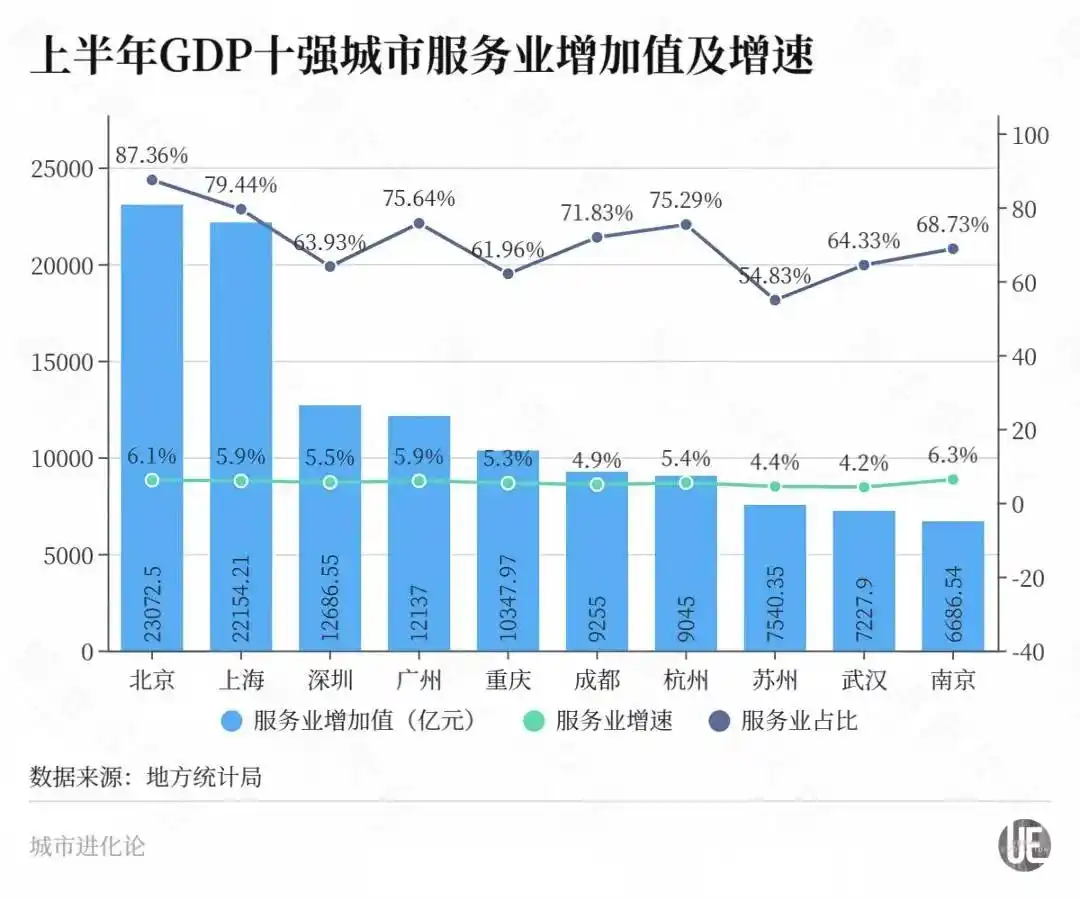
Hangzhou is one of them.

A set of data repeatedly cited by local media is that in 2023, after Hangzhou's services sector added value share exceeded 70%, it continued to rise, increasing by 5 percentage points in three years, and further broke through 75% in the first half of this year, with the gap with Guangzhou narrowing to 0.3 percentage points.

In fact, Hangzhou has not relaxed its emphasis on manufacturing. In the past few years, under the goal of building a "global advanced manufacturing base," Hangzhou has, on one hand, reshaped its industrial geography, creating the East Hangzhou Intelligent Manufacturing Corridor to synergize with the West Hangzhou Science and Technology Innovation Corridor, forming a "two corridors" linkage. On the other hand, it has restructured its industrial framework, building the "296X" advanced manufacturing clusters, aiming to break the "significant deficiencies" in manufacturing in terms of total volume, growth rate, investment, industrial level, and enterprise attraction capacity.

But at the same time, the services sector remains a key development direction for Hangzhou. Just from a policy perspective, starting in 2022, Hangzhou has held high-level conferences on the high-quality development of the modern services industry for three consecutive years, hoping to further promote the upgrading of the services industry.

At this year's services industry conference, Hangzhou Municipal Party Committee Secretary Liu Fei further pointed out that the services industry is the "driving force industry" for Hangzhou to promote economic and social development, concerning industrial development, economic circulation, and people's livelihood and employment. It is necessary to "take promoting the expansion, quality improvement, and efficiency enhancement of the services industry as a major task, continuously achieve new results, and continue to lead the nation."

"Dual 70%"

Why does Hangzhou continue to push for an increase in the services sector share while under the requirement to stabilize the industrial proportion? One reason is that Hangzhou experienced the debate between manufacturing and services very early on.

One consensus is that the year 2000 was the starting point for Hangzhou's new-era promotion of the "industry revitalizing the city" strategy. Subsequently, Hangzhou's total industrial output value grew at a pace of crossing a 100-billion-yuan threshold almost every year, reaching 800 billion yuan by 2007.

The 2008 financial crisis became a turning point in Hangzhou's development. For many years thereafter, Hangzhou's GDP growth rate once fell to the bottom among sub-provincial cities. Issues such as a lack of land resources and high production factor prices made it difficult for manufacturing to maintain its inherent development model. Also in 2008, Hangzhou officially proposed the "services first" development strategy, achieving a landmark "tertiary-secondary-primary" industrial structure transformation the following year, marking a new starting point for Hangzhou's development of the services industry.

The lever for the shift towards services was precisely what later became Hangzhou's pride: the electronic information industry. As Liu Ting, former Deputy Director of the Zhejiang Provincial Development and Reform Commission, pointed out, from the "industry revitalizing the city" strategy to the information economy as the "No. 1 Project," Hangzhou's economy underwent a strategic leap from industrial-led to information-led, from industrial economy-dominated to information economy-dominated. This became the major background for Hangzhou's leading development in the new economy.

And now, more than a decade of accumulation in the services sector has, in turn, become the key to Hangzhou's advancement in manufacturing.

Last year, the emergence of Hangzhou's "Six Little Dragons" was seen as a milestone marking Hangzhou's transition from the "e-commerce era" to the "AI era." But if we look closely at the "Six Little Dragons," peeling back the shell of "hardcore manufacturing," it is precisely the core of Hangzhou's services industry, represented by the digital economy, that provides support.

Among them, Game Science and DeepSeek, which gained attention earlier, are backed by Hangzhou's advantage in software and information services—in 2025, the revenue of just large-scale information services exceeded 1.3 trillion yuan. Even Unitree Robotics, which focuses more on hardware development, has in the past year "conquered" many cities across the country, integrating into the industrial chains of major manufacturing cities like Chongqing. However, as a research and development center, Hangzhou's focus remains on its advantages in the digital economy, technological innovation, and the integration of the digital and real economies.

As pointed out in an article published on the official WeChat account of the Hangzhou Investment Promotion Bureau, this essentially injects Hangzhou's innovation genes into the national industrial and innovation chains. Such a city "truly deserves the term 'national strategic force.'" To achieve this goal, Hangzhou's services must not be just the "human touch" of consumer services; more importantly, they must be producer services that act as an "accelerator" for manufacturing.

Looking closely at the composition of "Hangzhou Services," the keyword also falls on "producer services"—a set of data repeatedly cited by local media in Hangzhou is that as early as 2024, the share of producer services in Hangzhou's services sector added value reached 63.2%, surpassing Shanghai and second only to Beijing.

In Hangzhou's 5.3% services sector growth last year, revenue from information transmission, software, and information technology services maintained double-digit growth for 11 consecutive months, with a full-year growth of 13.4%.

Comparing with the internationally commonly used "dual 70%" indicator for observing urban economic development levels, Hangzhou's services sector share has already "crossed the line." The next step is to fill the gap in producer services.

"Imbalance"?

In this sense, for Hangzhou, a more fundamental question is whether it actually needs to maintain an unchanged proportion of manufacturing.

Last year, at a Hangzhou conference on producer services, Huang Qifan, former Mayor of Chongqing, raised an "Apple question":

Apple doesn't build factories, has no production lines, and doesn't engage in manufacturing, so why does it take the vast majority of the product's profit? The reason is that it firmly controls every link of producer services, including research and development, logistics and distribution, market access, inspection and testing, digital empowerment, financial clearing, sales, and after-sales service. These are the foundation of the industrial chain and the bestowers of its core value.

In other words, to increase added value, manufacturing must extend into links such as R&D design, industrial software, supply chain management, brand services, and financial services. It is precisely these producer services that ultimately determine the profit and industrial added value of manufacturing, determining the gold content of modern manufacturing.

Going further, industry insiders have summarized the development path of Hangzhou's "Six Little Dragons" as a "soft driving hard" development model with Hangzhou characteristics. Compared to the longboards of Beijing, Shanghai, and Shenzhen in computing infrastructure and talent density, Hangzhou's artificial intelligence industry, based on the advantages of the digital economy and the services sector, has the potential to carve out a distinctive path of promoting innovation through application and gathering resources through ecology.

It is difficult to fully reflect the quality of a region's manufacturing development simply by looking at the increase or decrease in numbers.

Liu Ting once recalled in an interview that a few years ago, Hangzhou's economic growth rate was once at the bottom within the province. The local government became anxious, wondering whether to invite back heavy and chemical industries to boost the manufacturing proportion. After debate, a sober judgment emerged: the root of Hangzhou's problem was not insufficient industry, but insufficiently strong producer services. Sacrificing invisible competitiveness for visible numbers was not worthwhile.

One reason is that, unlike the "visible" manufacturing, the manufacturing growth driven by producer services is relatively "invisible." Many places have already realized this issue. According to media reports, in order to make this part of manufacturing data visible, Jiangsu changed its assessment method for manufacturing, no longer isolating and assessing the secondary industry share, but instead looking at the combined proportion of manufacturing and producer services in GDP. "The former is the 'skeleton,' the latter is the 'muscle'; looking at either one alone will be distorted."

From a national perspective, policies are also changing.

In the outline of the 15th Five-Year Plan, the phrasing of keeping manufacturing's share "basically stable" was replaced with a "reasonable proportion." Xiao Rongmei, Deputy Director of the Policy and Economics Research Institute of the China Academy of Information and Communications Technology, and others once wrote in an article that this means "after fully considering various internal and external risk impacts and balancing development stages and industrial structure issues, allowing the proportion of manufacturing to fluctuate within a certain reasonable range," "not only pursuing the scale expansion of manufacturing, but more importantly striving to achieve a systematic improvement in quality."

Under the new round of adjustment, how should we re-examine the judgment of Hangzhou's services sector "imbalance"? Where exactly is the "reasonable proportion" for Hangzhou's manufacturing? Hangzhou has already made its judgment. According to the "Hangzhou Three-Year Action Plan for Accelerating Manufacturing Development (2025-2027)," by 2027, the total added value of large-scale industries will reach 530 billion yuan, with an average annual growth of over 6%, and the proportion of industrial added value in GDP will be over 22%.

This article is from the WeChat public account "City Evolution Theory," author: Yang Qifei

Cryptos en tendance

Questions liées

QWhy is the service industry considered the 'main driving force industry' for Hangzhou's economic and social development?

AThe service industry is considered the 'main driving force industry' for Hangzhou's economic and social development because it is crucial for industrial development, economic circulation, and people's livelihoods and employment. Hangzhou aims to continuously promote the expansion and quality improvement of the service industry to maintain its leading position nationally.

QWhat is the significance of the '25%' manufacturing share threshold mentioned for major cities?

AThe '25%' manufacturing share threshold is a benchmark often discussed for major cities. A World Bank research team report suggests that for megacities like Shanghai, the manufacturing share should be between 25% and 30%. Many cities, including Shanghai and Shenzhen, have used or referenced this threshold in their planning to ensure a stable industrial foundation. However, the article notes that this threshold is becoming more flexible in many cities.

QHow does Hangzhou's development of 'producer services' relate to its manufacturing sector?

AHangzhou's development of 'producer services' is closely tied to and supports its manufacturing sector. Producer services act as an 'accelerator' for manufacturing. The high value-added segments of manufacturing, such as R&D, industrial software, and supply chain management, are embedded within producer services. Hangzhou's strength in the digital economy and information services provides the core support for its advanced manufacturing clusters, enabling a 'soft drives hard' development model.

QWhat was the strategic shift in Hangzhou's industrial policy around 2008, and what triggered it?

AAround 2008, Hangzhou shifted its strategy from 'industrial revitalization' to prioritizing the service industry ('service industry first'). This strategic shift was triggered by the 2008 financial crisis, which exposed challenges for Hangzhou's traditional manufacturing model, including a lack of land resources and high production factor costs. This marked the beginning of Hangzhou's transition towards an economy led by information and services.

QAccording to the article, how has the national policy perspective on the manufacturing share in GDP changed recently?

AThe national policy perspective on the manufacturing share in GDP has shifted from emphasizing the need to keep its share 'basically stable' to maintaining a 'reasonable share' or 'reasonable proportion.' This change, noted in the context of the 15th Five-Year Plan, indicates a more flexible approach. It recognizes that the manufacturing share can fluctuate within a reasonable range based on various factors, with a greater focus on achieving systematic quality improvement rather than just scale expansion.

Lectures associées

Portefeuilles cryptographiques des institutions de Wall Street au T2 : La majorité des institutions ont augmenté leurs positions contre la tendance, l'exposition à l'ETH surpasse systématiquement celle au BTC

En raison de la déclaration obligatoire du formulaire 13F pour le Q2, les positions cryptographiques des institutions de Wall Street ont été révélées, montrant une tendance contraire à la performance des prix. Alors que le Bitcoin a chuté d'environ 14,2%, les positions institutionnelles déclarées en BTC ont augmenté de 7,5% pour atteindre environ 536 000 unités. Dans le même temps, les ETF américains sur le Bitcoin ont subi des rachats nets importants, avec un record de sorties en juin. De manière significative, l'exposition des banques à l'Ethereum a surpassé celle du Bitcoin. Morgan Stanley a vu sa position ETH augmenter de 18,6% (contre +3,7% pour le BTC), et JPMorgan a enregistré une hausse de 67,3% pour l'ETH (contre +12,2% pour le BTC). Des institutions comme Bank of America ont multiplié leur position dans l'ETHA par environ 29. Ceci survient malgré des sorties nettes globales des ETF spot Ethereum au Q2. Jane Street, qui avait réduit sa position dans l'IBIT au Q1, l'a fortement reconstituée avec une augmentation d'environ 324%. Plusieurs hedge funds ont réduit leurs positions spot mais ont utilisé des options pour maintenir leur exposition. Les institutions ont affiché des opinions divergentes sur les actions liées à la cryptomonnaie comme MicroStrategy, certaines réduisant leurs positions tandis que d'autres achetaient. De nouveaux entrants comme la Banco Santander ont divulgué pour la première fois des positions dans des ETF Bitcoin et Ethereum. D'autres, comme Morgan Stanley, ont initié des positions dans des produits Solana et XRP. Dans l'ensemble, les flux des ETF et les actions institutionnelles semblent se découpler, l'institutionnalisation des actifs cryptographiques s'approfondissant, avec un intérêt croissant pour l'Ethereum. Les flux dans les ETF Ethereum sont devenus positifs au Q3, accompagnant une hausse des prix.

marsbitIl y a 12 mins

Portefeuilles cryptographiques des institutions de Wall Street au T2 : La majorité des institutions ont augmenté leurs positions contre la tendance, l'exposition à l'ETH surpasse systématiquement celle au BTC

marsbitIl y a 12 mins

TSMC, encore une fois, a parié et gagné

TSMC (Taiwan Semiconductor Manufacturing Company) a encore vu sa stratégie payante. Samsung Foundry a reporté son objectif de production en masse du procédé 1,4 nm de 2027 à 2029, choisissant de concentrer ses efforts sur la maturation, l'amélioration du rendement et l'acquisition de clients pour sa plateforme 2 nm. Ce délai reflète une évolution dans la compétition des procédés avancés : la course au simple chiffrage des nœuds (2nm, 1,4nm...) laisse place à une compétition globale intégrant le rendement, le coût, la performance et l'écosystème. Samsung n'adopte pas non plus précipitamment la lithographie EUV à haut NA, la jugeant plus critique pour les nœuds au-delà du 1nm. Pendant ce temps, TSMC avance : son nœud N2 est en production et son successeur, A16 (environ 1,6nm), intégrant une technologie d'alimentation électrique par l'arrière (Super Power Rail), est prévu pour la seconde moitié de 2026. Cette innovation vise à améliorer l'efficacité énergétique, cruciale pour les puces IA et HPC. Ainsi, la décision de Samsung de consolider sa plateforme 2nm représente un rééquilibrage entre avancée technologique et retour sur investissement. Cependant, cela laisse à TSMC une fenêtre d'avance significative. La compétition future ne se mesurera plus seulement à l'aune du nœud le plus fin, mais à la capacité de maîtriser un ensemble de technologies (GAA, alimentation par l'arrière, EUV, packaging avancé) pour produire à grande échelle des puces performantes et économiquement viables. La question centrale devient : où en seront TSMC et Intel lorsque Samsung lancera enfin son 1,4nm en 2029 ?

marsbitIl y a 20 mins

TSMC, encore une fois, a parié et gagné

marsbitIl y a 20 mins

Trading

Spot

Articles tendance

Qu'est ce que $S$

Comprendre SPERO : Un aperçu complet Introduction à SPERO Alors que le paysage de l'innovation continue d'évoluer, l'émergence des technologies web3 et des projets de cryptomonnaie joue un rôle central dans la façon dont se dessine l'avenir numérique. Un projet qui a attiré l'attention dans ce domaine dynamique est SPERO, désigné comme SPERO,$$s$. Cet article vise à rassembler et à présenter des informations détaillées sur SPERO, afin d'aider les passionnés et les investisseurs à comprendre ses fondations, ses objectifs et ses innovations dans les domaines du web3 et de la crypto. Qu'est-ce que SPERO,$$s$ ? SPERO,$$s$ est un projet unique dans l'espace crypto qui cherche à tirer parti des principes de décentralisation et de la technologie blockchain pour créer un écosystème qui favorise l'engagement, l'utilité et l'inclusion financière. Le projet est conçu pour faciliter les interactions entre pairs de nouvelles manières, offrant aux utilisateurs des solutions et des services financiers innovants. Au cœur de SPERO,$$s$, l'objectif est d'autonomiser les individus en fournissant des outils et des plateformes qui améliorent l'expérience utilisateur dans l'espace des cryptomonnaies. Cela inclut la possibilité de méthodes de transaction plus flexibles, la promotion d'initiatives dirigées par la communauté et la création de voies pour des opportunités financières via des applications décentralisées (dApps). La vision sous-jacente de SPERO,$$s$ tourne autour de l'inclusivité, visant à combler les lacunes au sein de la finance traditionnelle tout en exploitant les avantages de la technologie blockchain. Qui est le créateur de SPERO,$$s$ ? L'identité du créateur de SPERO,$$s$ reste quelque peu obscure, car il existe peu de ressources publiques fournissant des informations détaillées sur son ou ses fondateurs. Ce manque de transparence peut découler de l'engagement du projet envers la décentralisation—une éthique que de nombreux projets web3 partagent, privilégiant les contributions collectives plutôt que la reconnaissance individuelle. En centrant les discussions autour de la communauté et de ses objectifs collectifs, SPERO,$$s$ incarne l'essence de l'autonomisation sans désigner des individus spécifiques. Ainsi, comprendre l'éthique et la mission de SPERO reste plus important que d'identifier un créateur unique. Qui sont les investisseurs de SPERO,$$s$ ? SPERO,$$s$ est soutenu par une diversité d'investisseurs allant des capital-risqueurs aux investisseurs providentiels dédiés à favoriser l'innovation dans le secteur crypto. L'objectif de ces investisseurs s'aligne généralement avec la mission de SPERO—priorisant les projets qui promettent des avancées technologiques sociétales, l'inclusivité financière et la gouvernance décentralisée. Ces fondations d'investisseurs s'intéressent généralement à des projets qui non seulement offrent des produits innovants, mais qui contribuent également positivement à la communauté blockchain et à ses écosystèmes. Le soutien de ces investisseurs renforce SPERO,$$s$ en tant que concurrent notable dans le domaine en rapide évolution des projets crypto. Comment fonctionne SPERO,$$s$ ? SPERO,$$s$ utilise un cadre multifacette qui le distingue des projets de cryptomonnaie conventionnels. Voici quelques-unes des caractéristiques clés qui soulignent son unicité et son innovation : Gouvernance décentralisée : SPERO,$$s$ intègre des modèles de gouvernance décentralisée, permettant aux utilisateurs de participer activement aux processus de décision concernant l'avenir du projet. Cette approche favorise un sentiment de propriété et de responsabilité parmi les membres de la communauté. Utilité du token : SPERO,$$s$ utilise son propre token de cryptomonnaie, conçu pour servir diverses fonctions au sein de l'écosystème. Ces tokens permettent des transactions, des récompenses et la facilitation des services offerts sur la plateforme, améliorant ainsi l'engagement et l'utilité globaux. Architecture en couches : L'architecture technique de SPERO,$$s$ supporte la modularité et l'évolutivité, permettant une intégration fluide de fonctionnalités et d'applications supplémentaires à mesure que le projet évolue. Cette adaptabilité est primordiale pour maintenir la pertinence dans le paysage crypto en constante évolution. Engagement communautaire : Le projet met l'accent sur des initiatives dirigées par la communauté, utilisant des mécanismes qui incitent à la collaboration et aux retours d'expérience. En cultivant une communauté forte, SPERO,$$s$ peut mieux répondre aux besoins des utilisateurs et s'adapter aux tendances du marché. Accent sur l'inclusion : En proposant des frais de transaction bas et des interfaces conviviales, SPERO,$$s$ vise à attirer une base d'utilisateurs diversifiée, y compris des individus qui n'ont peut-être pas engagé auparavant dans l'espace crypto. Cet engagement envers l'inclusion s'aligne avec sa mission globale d'autonomisation par l'accessibilité. Chronologie de SPERO,$$s$ Comprendre l'histoire d'un projet fournit des aperçus cruciaux sur sa trajectoire de développement et ses jalons. Voici une chronologie suggérée cartographiant les événements significatifs dans l'évolution de SPERO,$$s$ : Phase de conceptualisation et d'idéation : Les idées initiales formant la base de SPERO,$$s$ ont été conçues, s'alignant étroitement avec les principes de décentralisation et de concentration sur la communauté au sein de l'industrie blockchain. Lancement du livre blanc du projet : Suite à la phase conceptuelle, un livre blanc complet détaillant la vision, les objectifs et l'infrastructure technologique de SPERO,$$s$ a été publié pour susciter l'intérêt et les retours de la communauté. Construction de la communauté et engagements précoces : Des efforts de sensibilisation actifs ont été entrepris pour construire une communauté d'adopteurs précoces et d'investisseurs potentiels, facilitant les discussions autour des objectifs du projet et recueillant du soutien. Événement de génération de tokens : SPERO,$$s$ a organisé un événement de génération de tokens (TGE) pour distribuer ses tokens natifs aux premiers soutiens et établir une liquidité initiale au sein de l'écosystème. Lancement de la première dApp : La première application décentralisée (dApp) associée à SPERO,$$s$ a été mise en ligne, permettant aux utilisateurs d'interagir avec les fonctionnalités principales de la plateforme. Développement continu et partenariats : Des mises à jour et des améliorations continues des offres du projet, y compris des partenariats stratégiques avec d'autres acteurs de l'espace blockchain, ont façonné SPERO,$$s$ en un acteur compétitif et évolutif sur le marché crypto. Conclusion SPERO,$$s$ se dresse comme un témoignage du potentiel du web3 et de la cryptomonnaie pour révolutionner les systèmes financiers et autonomiser les individus. Avec un engagement envers la gouvernance décentralisée, l'engagement communautaire et des fonctionnalités conçues de manière innovante, il ouvre la voie vers un paysage financier plus inclusif. Comme pour tout investissement dans l'espace crypto en rapide évolution, les investisseurs et utilisateurs potentiels sont encouragés à mener des recherches approfondies et à s'engager de manière réfléchie avec les développements en cours au sein de SPERO,$$s$. Le projet illustre l'esprit d'innovation de l'industrie crypto, invitant à une exploration plus approfondie de ses nombreuses possibilités. Bien que le parcours de SPERO,$$s$ soit encore en cours, ses principes fondamentaux pourraient en effet influencer l'avenir de nos interactions avec la technologie, la finance et entre nous dans des écosystèmes numériques interconnectés.

375 vues totalesPublié le 2024.12.17Mis à jour le 2024.12.17

Qu'est ce que $S$

Qu'est ce que AGENT S

Agent S : L'avenir de l'interaction autonome dans Web3 Introduction Dans le paysage en constante évolution de Web3 et des cryptomonnaies, les innovations redéfinissent constamment la manière dont les individus interagissent avec les plateformes numériques. Un projet pionnier, Agent S, promet de révolutionner l'interaction homme-machine grâce à son cadre agentique ouvert. En ouvrant la voie à des interactions autonomes, Agent S vise à simplifier des tâches complexes, offrant des applications transformantes dans l'intelligence artificielle (IA). Cette exploration détaillée plongera dans les subtilités du projet, ses caractéristiques uniques et les implications pour le domaine des cryptomonnaies. Qu'est-ce qu'Agent S ? Agent S se présente comme un cadre agentique ouvert révolutionnaire, spécifiquement conçu pour relever trois défis fondamentaux dans l'automatisation des tâches informatiques : Acquisition de connaissances spécifiques au domaine : Le cadre apprend intelligemment à partir de diverses sources de connaissances externes et d'expériences internes. Cette approche double lui permet de construire un riche répertoire de connaissances spécifiques au domaine, améliorant ainsi sa performance dans l'exécution des tâches. Planification sur de longs horizons de tâches : Agent S utilise une planification hiérarchique augmentée par l'expérience, une approche stratégique qui facilite la décomposition et l'exécution efficaces de tâches complexes. Cette fonctionnalité améliore considérablement sa capacité à gérer plusieurs sous-tâches de manière efficace et efficiente. Gestion d'interfaces dynamiques et non uniformes : Le projet introduit l'Interface Agent-Ordinateur (ACI), une solution innovante qui améliore l'interaction entre les agents et les utilisateurs. En utilisant des Modèles de Langage Multimodaux de Grande Taille (MLLMs), Agent S peut naviguer et manipuler sans effort diverses interfaces graphiques. Grâce à ces fonctionnalités pionnières, Agent S fournit un cadre robuste qui aborde les complexités impliquées dans l'automatisation de l'interaction humaine avec les machines, préparant le terrain pour d'innombrables applications en IA et au-delà. Qui est le créateur d'Agent S ? Bien que le concept d'Agent S soit fondamentalement innovant, des informations spécifiques sur son créateur restent insaisissables. Le créateur est actuellement inconnu, ce qui souligne soit le stade naissant du projet, soit le choix stratégique de garder les membres fondateurs sous le radar. Quoi qu'il en soit, l'accent reste mis sur les capacités et le potentiel du cadre. Qui sont les investisseurs d'Agent S ? Étant donné qu'Agent S est relativement nouveau dans l'écosystème cryptographique, des informations détaillées concernant ses investisseurs et soutiens financiers ne sont pas explicitement documentées. Le manque d'aperçus publiquement disponibles sur les fondations d'investissement ou les organisations soutenant le projet soulève des questions sur sa structure de financement et sa feuille de route de développement. Comprendre le soutien est crucial pour évaluer la durabilité du projet et son impact potentiel sur le marché. Comment fonctionne Agent S ? Au cœur d'Agent S se trouve une technologie de pointe qui lui permet de fonctionner efficacement dans divers environnements. Son modèle opérationnel est construit autour de plusieurs caractéristiques clés : Interaction homme-ordinateur semblable à l'humain : Le cadre offre une planification IA avancée, s'efforçant de rendre les interactions avec les ordinateurs plus intuitives. En imitant le comportement humain dans l'exécution des tâches, il promet d'élever l'expérience utilisateur. Mémoire narrative : Utilisée pour tirer parti des expériences de haut niveau, Agent S utilise la mémoire narrative pour suivre les historiques de tâches, améliorant ainsi ses processus de prise de décision. Mémoire épisodique : Cette fonctionnalité fournit aux utilisateurs un accompagnement étape par étape, permettant au cadre d'offrir un soutien contextuel au fur et à mesure que les tâches se déroulent. Support pour OpenACI : Avec la capacité de fonctionner localement, Agent S permet aux utilisateurs de garder le contrôle sur leurs interactions et flux de travail, s'alignant avec l'éthique décentralisée de Web3. Intégration facile avec des API externes : Sa polyvalence et sa compatibilité avec diverses plateformes IA garantissent qu'Agent S peut s'intégrer sans effort dans des écosystèmes technologiques existants, en faisant un choix attrayant pour les développeurs et les organisations. Ces fonctionnalités contribuent collectivement à la position unique d'Agent S dans l'espace crypto, alors qu'il automatise des tâches complexes en plusieurs étapes avec un minimum d'intervention humaine. À mesure que le projet évolue, ses applications potentielles dans Web3 pourraient redéfinir la manière dont les interactions numériques se déroulent. Chronologie d'Agent S Le développement et les jalons d'Agent S peuvent être encapsulés dans une chronologie qui met en évidence ses événements significatifs : 27 septembre 2024 : Le concept d'Agent S a été lancé dans un document de recherche complet intitulé “Un cadre agentique ouvert qui utilise les ordinateurs comme un humain”, présentant les bases du projet. 10 octobre 2024 : Le document de recherche a été rendu publiquement disponible sur arXiv, offrant une exploration approfondie du cadre et de son évaluation de performance basée sur le benchmark OSWorld. 12 octobre 2024 : Une présentation vidéo a été publiée, fournissant un aperçu visuel des capacités et des caractéristiques d'Agent S, engageant davantage les utilisateurs et investisseurs potentiels. Ces jalons dans la chronologie illustrent non seulement les progrès d'Agent S, mais indiquent également son engagement envers la transparence et l'engagement communautaire. Points clés sur Agent S Alors que le cadre Agent S continue d'évoluer, plusieurs attributs clés se distinguent, soulignant sa nature innovante et son potentiel : Cadre innovant : Conçu pour offrir une utilisation intuitive des ordinateurs semblable à l'interaction humaine, Agent S propose une approche nouvelle de l'automatisation des tâches. Interaction autonome : La capacité d'interagir de manière autonome avec les ordinateurs via une interface graphique signifie un bond vers des solutions informatiques plus intelligentes et efficaces. Automatisation des tâches complexes : Avec sa méthodologie robuste, il peut automatiser des tâches complexes en plusieurs étapes, rendant les processus plus rapides et moins sujets aux erreurs. Amélioration continue : Les mécanismes d'apprentissage permettent à Agent S de s'améliorer grâce à ses expériences passées, améliorant continuellement sa performance et son efficacité. Polyvalence : Son adaptabilité à travers différents environnements d'exploitation comme OSWorld et WindowsAgentArena garantit qu'il peut servir un large éventail d'applications. Alors qu'Agent S se positionne dans le paysage Web3 et crypto, son potentiel à améliorer les capacités d'interaction et à automatiser les processus représente une avancée significative dans les technologies IA. Grâce à son cadre innovant, Agent S incarne l'avenir des interactions numériques, promettant une expérience plus fluide et efficace pour les utilisateurs à travers divers secteurs. Conclusion Agent S représente un saut audacieux en avant dans le mariage de l'IA et de Web3, avec la capacité de redéfinir notre interaction avec la technologie. Bien qu'il soit encore à ses débuts, les possibilités de son application sont vastes et convaincantes. Grâce à son cadre complet abordant des défis critiques, Agent S vise à mettre les interactions autonomes au premier plan de l'expérience numérique. À mesure que nous plongeons plus profondément dans les domaines des cryptomonnaies et de la décentralisation, des projets comme Agent S joueront sans aucun doute un rôle crucial dans la façon dont la technologie et la collaboration homme-machine évolueront à l'avenir.

1.1k vues totalesPublié le 2025.01.14Mis à jour le 2025.01.14

Qu'est ce que AGENT S

Comment acheter S

Bienvenue sur HTX.com ! Nous vous permettons d'acheter Sonic (S) de manière simple et pratique. Suivez notre guide étape par étape pour commencer votre parcours crypto.Étape 1 : Création de votre compte HTXUtilisez votre adresse e-mail ou votre numéro de téléphone pour ouvrir un compte sur HTX gratuitement. L'inscription se fait en toute simplicité et débloque toutes les fonctionnalités.Créer mon compteÉtape 2 : Choix du mode de paiement (rubrique Acheter des cryptosCarte de crédit/débit : utilisez votre carte Visa ou Mastercard pour acheter instantanément Sonic (S).Solde :utilisez les fonds du solde de votre compte HTX pour trader en toute simplicité.Prestataire tiers :pour accroître la commodité d'utilisation, nous avons ajouté des modes de paiement populaires tels que Google Pay et Apple Pay.P2P :tradez directement avec d'autres utilisateurs sur HTX.OTC (de gré à gré) : nous offrons des services personnalisés et des taux de change compétitifs aux traders.Étape 3 : stockage de vos Sonic (S)Après avoir acheté vos Sonic (S), stockez-les sur votre compte HTX. Vous pouvez également les envoyer ailleurs via un transfert sur la blockchain ou les utiliser pour trader d'autres cryptos.Étape 4 : tradez des Sonic (S)Tradez facilement Sonic (S) sur le marché Spot de HTX. Il vous suffit d'accéder à votre compte, de sélectionner la paire de trading, d'exécuter vos trades et de les suivre en temps réel. Nous offrons une expérience conviviale aux débutants comme aux traders chevronnés.

2.3k vues totalesPublié le 2025.01.15Mis à jour le 2026.06.02

Comment acheter S

Discussions

Bienvenue dans la Communauté HTX. Ici, vous pouvez vous tenir informé(e) des derniers développements de la plateforme et accéder à des analyses de marché professionnelles. Les opinions des utilisateurs sur le prix de S (S) sont présentées ci-dessous.

活动图片