BTC Faces Triple Resistance at $80,000 Milestone, HYPE Hits New Highs Signaling Potential | Invited Analysis

Odaily星球日报Publié le 2026-05-26Dernière mise à jour le 2026-05-26

Résumé

This weekly analysis maintains a structured framework, focusing on Bitcoin (BTC) and HYPE, dissecting their multi-timeframe price action to identify key support and resistance zones and formulate actionable trading plans. The previous week's short position on BTC yielded a 2.78% gain, reinforcing the "signal-driven, disciplined" approach. For Bitcoin, the core scenario revolves around the battle between the 78,500–79,500 USD resistance zone and the 73,500–75,000 USD support area. The daily chart shows BTC within a rising channel; a failure to hold support at the channel's midline could lead to a test of the lower boundary. The 4-hour chart details an 8-segment corrective structure from the 82,850 USD high. Two short-term strategies are proposed: (A) Selling on a failed rally into the 78.5k-79.5k zone, with a stop above 80,600, or (B) Selling a confirmed breakdown below the 73.5k-75k support, with a stop above 76,500. Medium-term positioning remains neutral. For HYPE, the 4-hour chart indicates a five-wave advance from the May 14th low, now showing potential exhaustion and a top warning signal near 65 USD. The core view is to watch for a potential short-term peak formation. The recommended strategy is to avoid chasing the rally and instead look for a long setup upon a pullback to the 47.5–50 USD support zone, provided clear stabilization and model confirmation signals appear. The report concludes with a detailed review of the prior BTC short trade, executed based on model s...

Continuing with our structured analytical framework this week, we dissect the current movements of Bitcoin and HYPE from multiple time dimensions, assess the struggle between buyers and sellers around key resistance and support zones, and formulate specific, actionable operational plans accordingly.

Last week's short position successfully yielded a 2.78% profit, once again validating the trading logic of 'signal-driven, strict discipline'. However, a single profitable trade does not necessarily indicate that the market direction is definitively correct – the market always retains the possibility of exceeding expectations.

The core variable for this week remains the battle between the $78,500–$79,500 resistance zone and the $73,500–$75,000 support zone. The outcome will be answered by the market itself.

Summary of Core Trading Views for This Week:

• Analysis of BTC's multi-cycle price structure. (Detailed in Part I)

• BTC price forecast and mid-term, short-term operational strategies for this week. (Detailed in Part II)

• Analysis of HYPE's hourly chart structure. (Detailed in Part III)

• HYPE price forecast and short-term operational strategy for this week. (Detailed in Part IV)

Market Verification of Last Week's Trading Strategies and Core Views:

• BTC Short-term Trading Results: Bitcoin completed one short-term short position (1x leverage) last week, achieving a profit of approximately 2.78%. (Detailed in Table I)

• Market Verification of BTC Price Forecast: In last week's article, we noted: If the price effectively breaks below the support zone of $78,500–$79,500, it will test the support strength near $75,000. The current market movement verifies our previous forecast.

I. Analysis of Bitcoin's Multi-Cycle Price Structure

1. BTC Daily Chart Structure Analysis

Bitcoin _ Daily Chart:
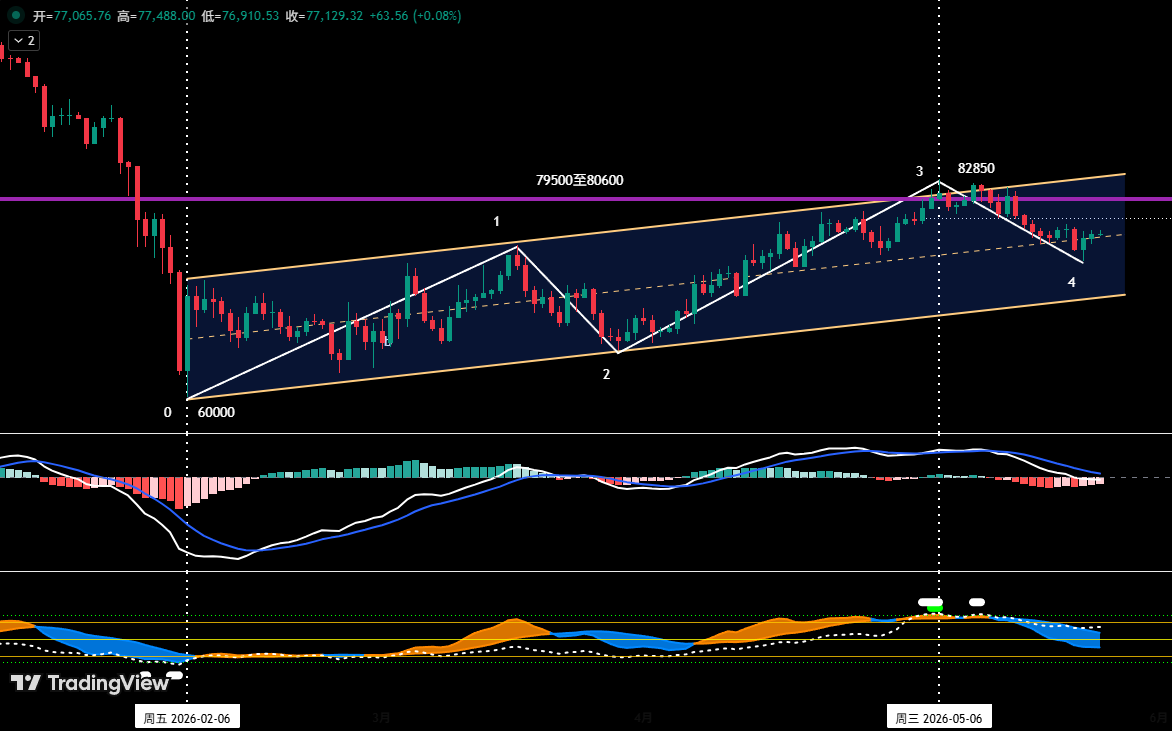
Figure 1

• As shown in (Figure 1), since establishing a stage low near $60,000 on February 6, 2026, Bitcoin's daily chart has constructed and maintained a clearly structured ascending channel: its lower boundary is formed by connecting the lows of February 6 and March 29, while the upper boundary is drawn parallel to the lower boundary through the high of March 17.

• In our April 27th weekly review, we pointed out: "The current price is facing dual pressure from the channel's upper boundary and the $79,500 to $80,600 resistance zone, making a breakthrough likely difficult". Subsequent market action confirmed this assessment. After nearly 20 days of tug-of-war between bulls and bears, although a new rebound high of $82,850 was reached on May 6, it failed to effectively break through this zone's resistance, and the price subsequently began to fluctuate downward.

From the current structure, the price has retraced from near the channel's upper boundary to the mid-channel area. If the price fails to find effective support near the mid-channel and resume its uptrend, the probability of subsequently seeking support at the channel's lower boundary is increasing.

2. In-Depth Analysis of BTC's Hourly Chart Structure

Bitcoin _ 4-Hour Chart
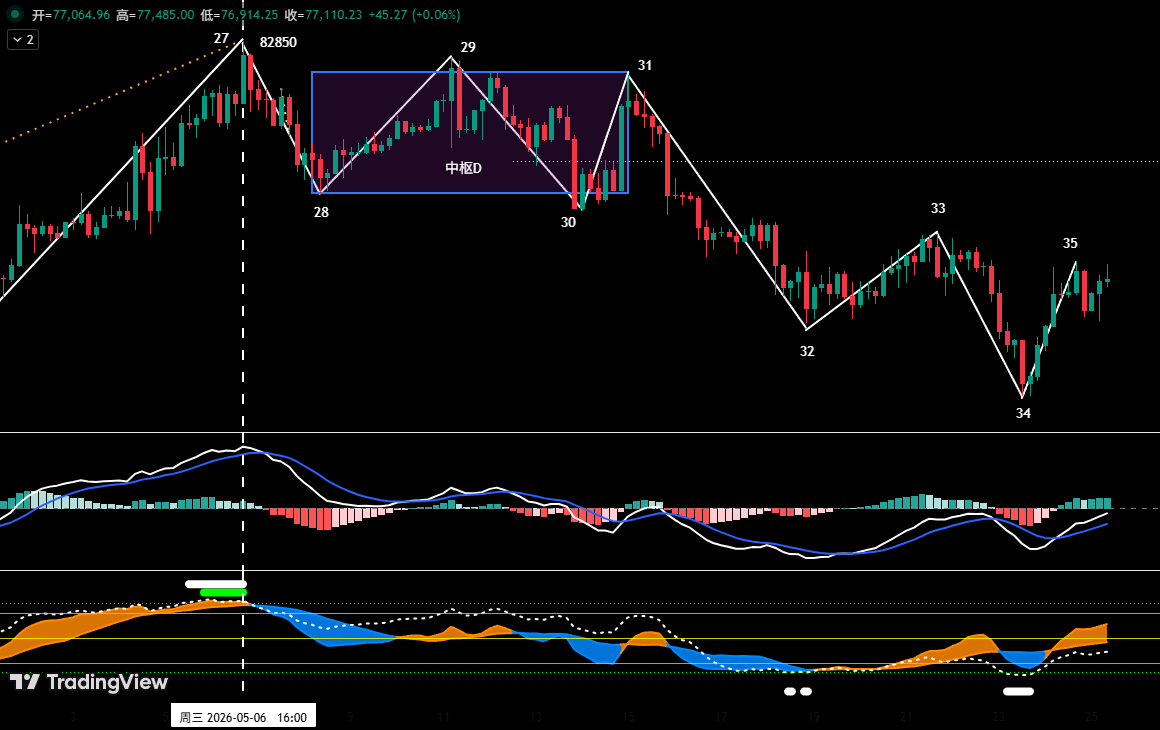
Figure 2

As shown in (Figure 2), from the May 6 high of $82,850 to the ongoing adjustment;

• On the 4-hour chart, it can be subdivided into an 8-segment adjustment structure: from "Segment 27-28" to "Segment 34-35"; Central D: Due to the overlapping of segments 28-29, 29-30, and 30-31, they constitute Central D.

• From the 4-hour chart structure, segment 34-35 is about to rebound to the $78,500–$79,500 zone. If the price faces resistance and falls back after rebounding to this zone, failing to form an effective breakthrough, the market is likely to continue the current fluctuating adjustment pattern and test the core support band of $73,500–$75,000 again.

II. Bitcoin Price Forecast and Operational Strategy for This Week

1. BTC Price Forecast for This Week:

Core View This Week: Focus on the outcome of the battle between bulls and bears for the $78,500–$79,500 resistance zone and the $73,500–$75,000 support zone.

2. Core Resistance Levels:

• First Resistance Zone: $78,500–$79,500 (near the boundaries of two central zones)

• Second Resistance Zone: $83,500–$84,500 (previous dense trading area)

3. Core Support Levels:

• First Support Zone: $73,500–$75,000 (previous key support area)

• Second Support Zone: $69,500–$70,500 (previous key support area)

4. Operational Strategy for This Week (Excluding Impact of Sudden News)

1. Mid-term Strategy:

Bitcoin _ Daily Chart: (Position Monitoring Model)
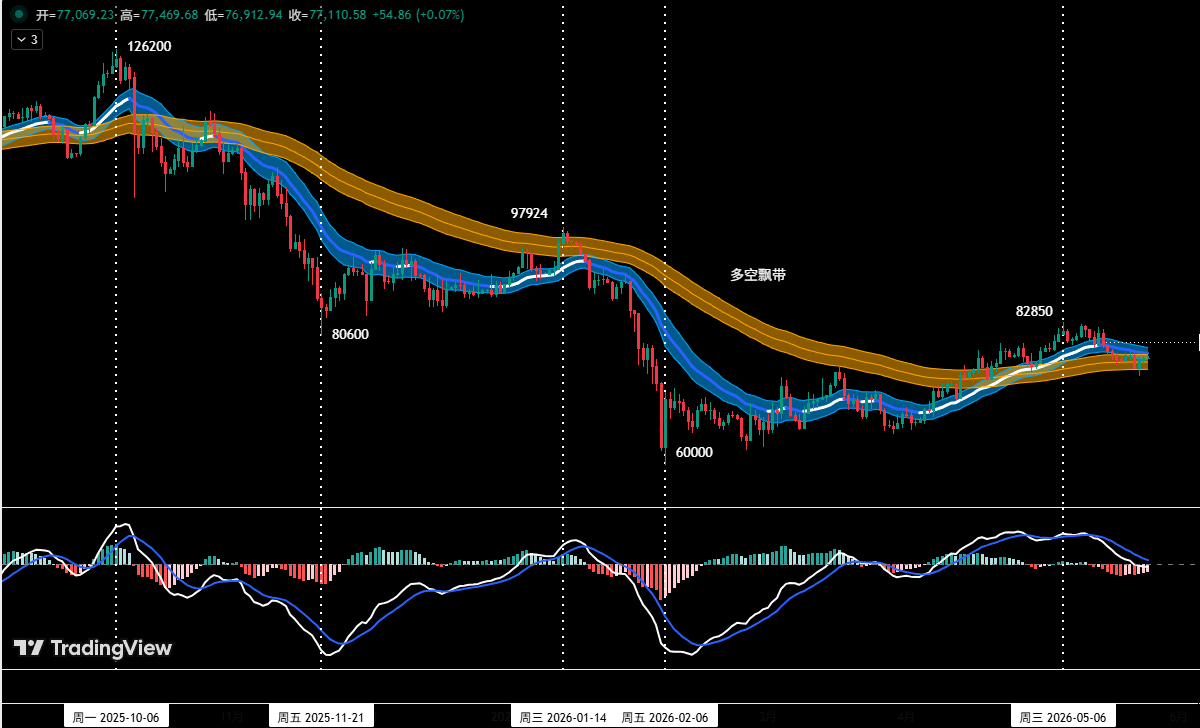
Figure 3

Position Monitoring Model: As shown in (Figure 3), based on trading rules, the market's mid-term direction is not yet clear. This week's mid-term strategy is to maintain a no-position, wait-and-see approach.

2. Short-term Strategy: Utilize 30% of capital, set stop-loss points, and look for "spread" opportunities based on support and resistance levels. (Using 30-minute/60-minute as the operational cycle).

3. In short-term operations, to dynamically respond to complex market developments, we have prepared two specific operational plans in advance: Plan A/B.

Plan A: Rebound Meets Resistance, Sell High.

• Entry: When the price rebounds to the $78,500–$79,500 zone and encounters resistance, combined with a top signal from the quantitative model, a short position below 30% can be established.

• Risk Control: Initial stop-loss set above $80,600.

• Exit: When the price adjusts near important support levels combined with model signals, gradually close the position to take profits.

Plan B: Effectively Breaks Support, Follow the Trend Short.

• Entry: When the price effectively breaks below the $73,500–$75,000 support zone combined with a model top signal, a short position below 30% can be established.

• Risk Control: Initial stop-loss set above $76,500.

• Exit: When the price falls to important support levels combined with model signals, gradually close the position to take profits.

III. HYPE Price Structure Analysis

HYPE_4-Hour Chart
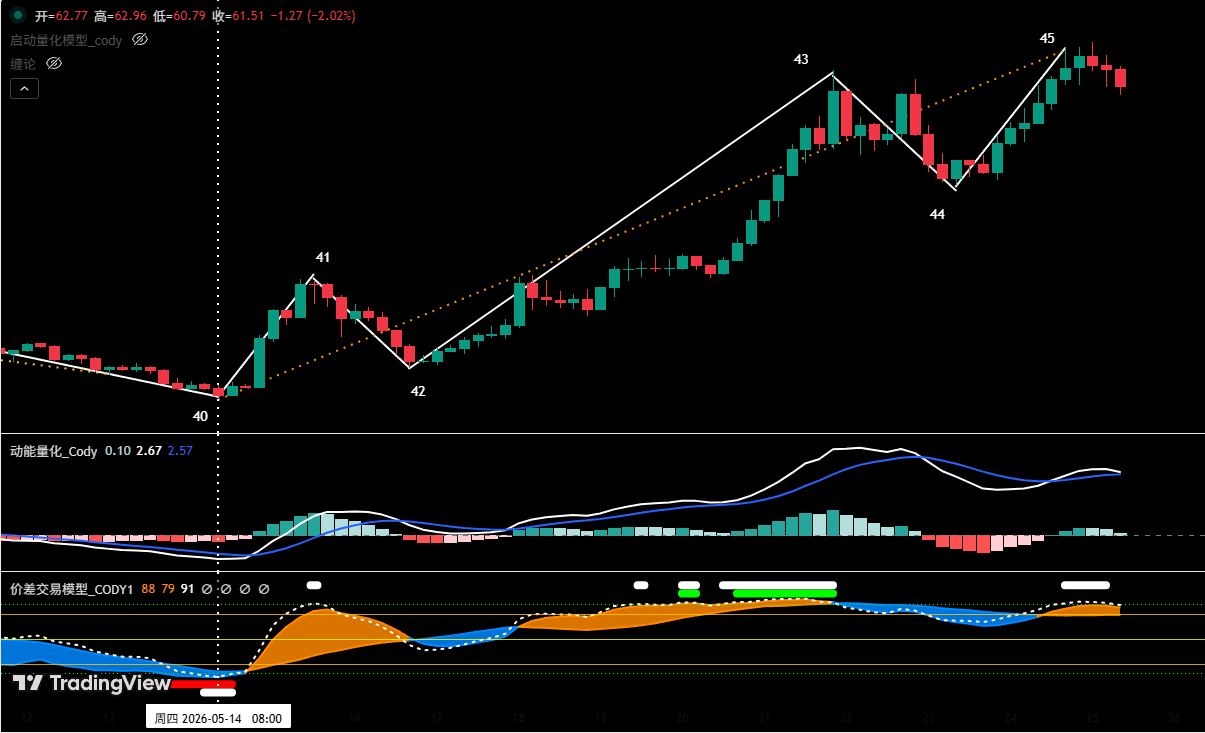
Figure 4

1. As shown in (Figure 4), the uptrend in HYPE starting from the May 14 low of $38.14 can be divided into a five-segment structure on the 4-hour chart: segments 40-41, 41-42, 42-43, 43-44, 44-45.

2. Our proprietary "Spread Trading Model" indicates that near endpoint 45, a top warning signal (white dot) has been triggered.

3. From the "Momentum Quantification Model" perspective, the rising segment (44-45) near $65 has shown signs of weakening upward momentum.

4. If the price forms a momentum bearish divergence state at "endpoint 45" and resonates with the top warning signal from the "Spread Trading Model", the probability of the price forming a short-term high here increases significantly.

IV. HYPE Price Forecast and Short-Term Operational Strategy for This Week

1. HYPE Price Forecast for This Week:

Core View on HYPE This Week:

• Observe whether "endpoint 45" can form a short-term high since the rise began on May 14.

• If a short-term high is formed, subsequently, look for short-term long opportunities when the price retraces to key support areas (e.g., $47.5 to $50) and shows clear signs of stabilization.

2. HYPE Short-Term Operational Strategy for This Week: (Buy on Support)

Currently, the strategy of "avoid blind chasing of highs, buy on dips" should be followed. If the price retraces to the $47.5 to $50 zone, finds support, and shows stabilization signals, combined with bottom signals triggered by both models, consider a light long position. Position size must be controlled below 30%, and strict stop-loss discipline must be maintained.

V. Operational Review

1. Short-Term Operation Review:(See Table I)

We strictly followed the operational plan. Based on trading signals from our proprietary "Spread Trading Model" and "Momentum Quantification Model", we completed one short-term (short) operation last week, achieving a trading profit of 2.78%.

1. Bitcoin Short-Term Trading Details Summary: (Leverage*1x)
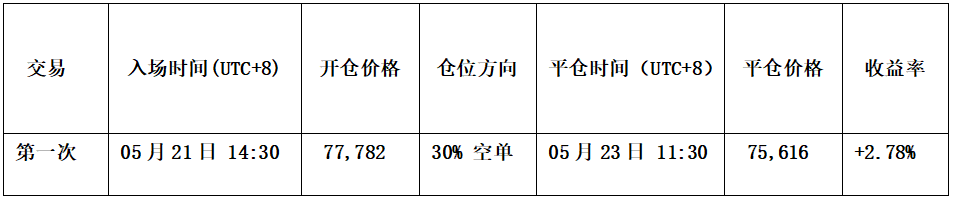
Table I

2. Short-Term Trading Review: (See Figure VI)

• Entry Strategy:

a. When the price rebounded near $78,500, encountered resistance, showed pressure signals, and the candlestick formed a "top reversal" bearish signal;

b. The "Spread Trading Model" triggered a top warning signal (white dot), and the "Momentum Quantification Model" formed a momentum bearish divergence signal.

Therefore, we established a 30% short position at $77,782.

• Exit Strategy:

a. When the price fell near $75,000 and found support, and the candlestick formed a "bottom reversal" signal;

b. The "Spread Trading Model" triggered a strong bottom warning signal (red dot + white dot), resonating with a bottom signal from the "Momentum Quantification Model".

Therefore, we closed all positions near $75,616.

• Summary: This trade successfully yielded a profit of approximately 2.78%.

BTC_30 Minute Chart: (Momentum Quantification Model + Spread Trading Model)
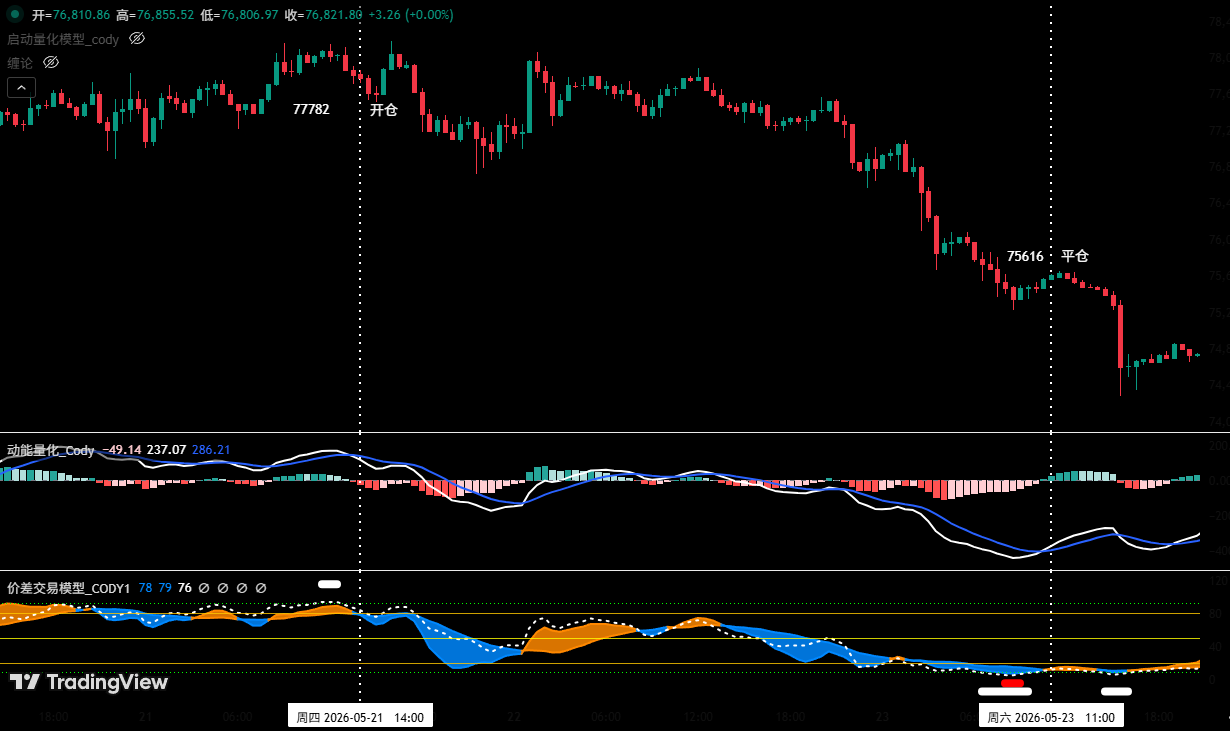
Figure V (Short-Term Trading Illustration)

VI. Special Note:

1. When opening a position: Immediately set the initial stop-loss point.

2. When profit reaches 1%: Move the stop-loss to the entry cost price (break-even point) to ensure capital safety.

3. When profit reaches 2%: Move the stop-loss to the 1% profit level.

4. Continuous Tracking: Thereafter, for every additional 1% profit, move the stop-loss up by 1%, dynamically protecting and locking in profits.

Financial markets are ever-changing; all market analysis and trading strategies require dynamic adjustment. All views, analytical models, and operational strategies mentioned in this article are derived from personal technical analysis, intended solely for personal trading log purposes, and do not constitute any investment advice or operational basis. The market carries risks; investment requires caution. Please do not make decisions based on this.


Cryptos en tendance

Questions liées

QAccording to the article's analysis, what are the two main resistance and support zones for Bitcoin this week?

AThe core resistance zone is 78,500-79,500 USD, and the core support zone is 73,500-75,000 USD.

QWhat was the primary technical reason for the author's successful short trade on Bitcoin the previous week?

AThe trade was executed based on a confluence of signals: the price encountered resistance near 78,500 USD forming a top reversal candlestick pattern, and both the author's 'Price Difference Trading Model' and 'Dynamic Energy Quantification Model' triggered top warning signals, including momentum divergence.

QBased on the analysis, what is the key condition for HYPE to present a potential short-term buying opportunity?

AA short-term buying opportunity for HYPE may arise if the price pulls back to the 47.5 to 50 USD support zone, shows clear signs of stabilization, and is confirmed by bottom signals from the author's trading models.

QWhat is the author's current medium-term (midline) strategy for Bitcoin, as indicated by their 'Position Monitoring Model'?

AAccording to the 'Position Monitoring Model', the medium-term market direction is not yet clear. Therefore, the author is maintaining a strategy of staying out of the market (holding no medium-term positions) and observing.

QIn the article's proposed short-term trading plans for Bitcoin, what are the two main scenarios (Plan A and Plan B)?

APlan A: Sell short on rallies if the price rebounds to the 78,500-79,500 USD resistance zone and encounters selling pressure. Plan B: Sell short on breakouts if the price effectively breaks below the 73,500-75,000 USD support zone.

Lectures associées

Venus Protocol Intègre des Actions Tokenisées comme Collatéral de Prêt sur BNB Chain

Venus Protocol intègre désormais des actions tokenisées comme garantie pour les prêts sur la BNB Chain, élargissant ainsi les cas d'utilisation des actifs du monde réel (RWA) dans le marché du crédit DeFi. **Points clés :** * Des actions tokenisées d'entreprises comme Apple, Tesla et Microsoft sont acceptées comme collatéral dans des pools de prêt isolés. * Ces actifs seraient adossés à 1:1 à des actions réelles détenues par des dépositaires régulés. * Les déposants peuvent emprunter des stablecoins ou du BNB contre ces garanties. Cette initiative permet aux détenteurs d'accéder à des liquidités sans vendre leurs positions sous-jacentes, rapprochant le crédit DeFi du financement sur marge traditionnel. Elle représente également une étape dans la compétition des blockchains pour attirer l'activité RWA. Cependant, ce collatéral introduit un profil de risque différent des actifs crypto-natifs, dépendant d'entités régulées hors-chaîne, de garde d'actifs et de processus de rachat. La gestion de l'évaluation des garanties, notamment avec des horaires de marché traditionnels, constitue un autre défi. Dans le contexte actuel du marché, cette intégration s'inscrit dans les tendances majeures que sont la tokenisation des actifs réels et la recherche d'une liquidité moins spéculative. Son succès dépendra de l'adoption réelle, de la fiabilité des custodians et des oracles de prix, ainsi que de la clarté des règles opérationnelles.

bitcoinistIl y a 1 h

Venus Protocol Intègre des Actions Tokenisées comme Collatéral de Prêt sur BNB Chain

bitcoinistIl y a 1 h

Le Triangle impossible est en réalité un faux problème

L'auteur conteste la pertinence du "trilemme" classique (décentralisation, scalabilité, sécurité) pour les blockchains. Il propose que les vrais freins à l'adoption massive sont la légitimité (environnement réglementaire) et le manque de confidentialité par défaut. La blockchain est définie comme un ordinateur partagé, lent et cher, dont la seule valeur unique est de fonctionner sans propriétaire ni permission. Seul l'argent natif (comme les stablecoins) est un actif adapté, car sa simple inscription au registre constitue sa valeur. Le marché actuel ne sert qu'une niche ("les gens assez aisés"). Les gros capitaux institutionnels restent à l'écart, principalement à cause des risques opérationnels et de deux défauts structurels : 1. **Légitimité** : L'absence de permission, essentielle, crée des zones grises réglementaires. Des progrès législatifs récents (ex: loi GENIUS) commencent à combler ce fossé. 2. **Transparence** : Celle-ci est présentée comme une vertu, mais constitue en réalité une taxe. Elle expose chaque transaction, position et paiement, permettant le MEV (extraction de valeur maximale) et décourageant toute entité sérieuse de révéler sa trésorerie au monde. L'auteur souligne l'ironie d'un système fondé sur la cryptographie qui ne protège pas la vie financière des utilisateurs. La solution réside dans une **confidentialité par défaut avec des preuves de conformité** (via des preuves à connaissance nulle - ZK). Cela permet de prouver un fait (solvabilité, respect des limites, KYC) sans révéler les données sous-jacentes, combinant ainsi protection individuelle et vérifiabilité pour les auditeurs et régulateurs. Cette évolution, purement améliorative, pourrait enfin attirer les milliers de milliards de capitaux institutionnels et faire de la blockchain l'infrastructure financière qu'elle était censée être.

marsbitIl y a 11 h

Le Triangle impossible est en réalité un faux problème

marsbitIl y a 11 h

L'impossible trilemme est un faux problème

L'industrie de la cryptographie a construit le système de cryptographie le plus puissant de l'histoire, mais son principal échec est l'absence de confidentialité financière par défaut. Chaque transaction, paiement et portefeuille est diffusé publiquement. La blockchain est essentiellement un ordinateur partagé, lent et coûteux, dont la seule valeur réside dans son absence de propriétaire unique et sa résistance à la censure. Pendant des années, le débat s'est concentré sur le "trilemme" (décentralisation, évolutivité, sécurité), qui est aujourd'hui largement résolu. Le vrai frein à l'adoption massive n'est pas là. La véritable contrainte est double : la légitimité juridique et le manque de confidentialité. Les fonds sont l'actif natif de la blockchain, mais les grands capitaux institutionnels restent à l'écart car l'environnement est perçu comme trop risqué et non conforme. La transparence totale de la chaîne n'est pas une vertu, mais une taxe. Elle expose les utilisateurs au MEV (Maximum Extractable Value), où les transactions sont espionnées et exploitées avant leur règlement, drainant des milliards de dollars de valeur. La plus grande ironie est que ce système, bâti sur la cryptographie, n'applique pas le chiffrement aux activités financières des utilisateurs, contrairement à la communication qui l'a adopté il y a des décennies. La solution n'est pas un anonymat total, mais une confidentialité prouvable et conforme. Les technologies cryptographiques modernes (comme les preuves à connaissance nulle) permettent de vérifier la solvabilité, la conformité KYC ou les limites de risque sans révéler les données sous-jacentes. Cela préserve les avantages de l'auditabilité tout en éliminant l'exposition permanente. En combinant un cadre réglementaire émergent (comme le GENIUS Act) et une confidentialité par défaut avec des mécanismes de divulgation vérifiable, la blockchain peut effectuer une mise à niveau pure. Elle cesse d'être un "tableur public coûteux" pour devenir une machine partagée qui confirme la véracité des transactions sans en divulguer le contenu. C'est le pont qui permettra aux capitaux institutionnels et à la finance traditionnelle de rejoindre la chaîne, débloquant ainsi les milliers de milliards de dollars qui attendent. Le système cryptographique le plus puissant apprend enfin à garder un secret, et cela change tout.

链捕手Il y a 11 h

L'impossible trilemme est un faux problème

链捕手Il y a 11 h

Des puces optiques en pleine expansion de production collective

La demande de puces photoniques connaît une croissance exponentielle, stimulée par les besoins en interconnexion optique des centres de données d'IA. Une course mondiale aux capacités de production est engagée. Aux États-Unis, Coherent étend sa ligne de production de semi-conducteurs InP de 6 pouces au Texas, soutenue par un financement et un investissement stratégique de Nvidia. Nokia développe ses capacités de test et d'emballage avancés en Pennsylvanie. Le japonais JX Advanced Metals prévoit d'augmenter sa production de substrats InP par 7 à 10 fois. En Europe, IQE et Tower Semiconductor ont conclu un accord d'approvisionnement à long terme pour les plaquettes InP, illustrant la tendance à l'intégration hétérogène des composants InP performants dans les plateformes silicium-optique matures. En Chine, l'expansion est rapide. Suzhou TFC Optical Communication (Solstice) investit 12 milliards de dollars dans un projet d'expansion. San'an Photonics possède une capacité de production mensuelle de 2 750 plaquettes pour les puces InP. Yunnan Germanium a lancé un projet pour augmenter la production de tranches de monocristal InP. La chaîne d'approvisionnement chinoise se consolide de la matière première au module. Malgré les débats sur les délais de déploiement du CPO (Co-Packaged Optics), l'augmentation globale de la consommation de contenu optique (moteurs photoniques, lasers) est incontestable, tirée par la demande croissante de bande passante dans l'IA. Le paysage futur impliquera probablement plusieurs architectures (silicium-optique, VCSEL, MicroLED) coexistant pour différentes distances et besoins. Cette frénésie d'expansion mondiale, des États-Unis et du Japon à l'Europe et la Chine, représente un pari collectif de l'industrie des semi-conducteurs sur l'avenir photonique de l'informatique à haute performance.

marsbitIl y a 13 h

Des puces optiques en pleine expansion de production collective

marsbitIl y a 13 h

Trading

Spot
Futures

Articles tendance

Comment acheter HYPE

Bienvenue sur HTX.com ! Nous vous permettons d'acheter Hyperliquid (HYPE) de manière simple et pratique. Suivez notre guide étape par étape pour commencer votre parcours crypto.Étape 1 : Création de votre compte HTXUtilisez votre adresse e-mail ou votre numéro de téléphone pour ouvrir un compte sur HTX gratuitement. L'inscription se fait en toute simplicité et débloque toutes les fonctionnalités.Créer mon compteÉtape 2 : Choix du mode de paiement (rubrique Acheter des cryptosCarte de crédit/débit : utilisez votre carte Visa ou Mastercard pour acheter instantanément Hyperliquid (HYPE).Solde :utilisez les fonds du solde de votre compte HTX pour trader en toute simplicité.Prestataire tiers :pour accroître la commodité d'utilisation, nous avons ajouté des modes de paiement populaires tels que Google Pay et Apple Pay.P2P :tradez directement avec d'autres utilisateurs sur HTX.OTC (de gré à gré) : nous offrons des services personnalisés et des taux de change compétitifs aux traders.Étape 3 : stockage de vos Hyperliquid (HYPE)Après avoir acheté vos Hyperliquid (HYPE), stockez-les sur votre compte HTX. Vous pouvez également les envoyer ailleurs via un transfert sur la blockchain ou les utiliser pour trader d'autres cryptos.Étape 4 : tradez des Hyperliquid (HYPE)Tradez facilement Hyperliquid (HYPE) sur le marché Spot de HTX. Il vous suffit d'accéder à votre compte, de sélectionner la paire de trading, d'exécuter vos trades et de les suivre en temps réel. Nous offrons une expérience conviviale aux débutants comme aux traders chevronnés.

682 vues totalesPublié le 2024.12.11Mis à jour le 2026.06.02

Comment acheter HYPE

Discussions

Bienvenue dans la Communauté HTX. Ici, vous pouvez vous tenir informé(e) des derniers développements de la plateforme et accéder à des analyses de marché professionnelles. Les opinions des utilisateurs sur le prix de HYPE (HYPE) sont présentées ci-dessous.

活动图片