Original | Odaily Planet Daily (@OdailyChina)
Author | Wenser(@wenser 2010 )
Overnight, the entire crypto market has seen a bullish return, with HYPE standing out as one of the brightest performers.
At the time of writing, HYPE's price is temporarily reported at $73.9, marking a 26.86% increase in the last 24 hours. It is now less than $3 away from its previous all-time high of around $76.5, ending a nearly two-month period of volatile decline.
Regarding the positive catalysts behind this move, aside from factors we previously mentioned in articles such as "From Hedge Funds to Family Offices: Who Is Quietly Increasing HYPE Exposure Through PURR?" and "On the Eve of HYPE's Breakout: AQAv2 Begins Yield Accrual This Month, HIP-4 Poised for Launch," which include Wall Street's entry and the growth of the Hyperliquid ecosystem, the most direct catalyst was last night's statement from former President Trump. During a White House meeting, Trump explicitly mentioned that "U.S. CFTC Chairman is pushing for Hyperliquid to enter the United States in a fully compliant and legal manner." Combined with the earlier news about the "Hyperliquid Policy Center and trade.xyz jointly proposing that the U.S. SEC introduce pre-IPO perpetual contracts," it appears the process for Hyperliquid to enter the U.S. market in a compliant manner may be progressing faster than the market anticipated.
A battle for "U.S.-compliant on-chain Perp DEX" and "pre-market pricing power for U.S. stocks" has quietly begun, with Hyperliquid positioned as the "industry's best enabler."
Hyperliquid Emerges as a Top Contender for U.S.-Compliant On-Chain Trading Platform: Trump's Personal Endorsement, CFTC Chairman Actively Advancing
For Hyperliquid and HYPE, the primary positive catalyst is undoubtedly Trump's vocal support.
As the mid-term elections draw nearer, Trump has launched a new round of political campaigning and publicity efforts, with the crypto industry once again serving as prime evidence for his "Make America Great Again" agenda. Importantly, he views various improvements in crypto regulation as crucial measures to "encourage innovation and compete for dominance in finance, crypto, and technology."
As an on-chain trading platform currently under close watch by both the traditional finance industry and the crypto market, Hyperliquid's industry standing and liquidity scale present an ideal case study. Hyperliquid has not been waiting idly; it has already begun actively lobbying and proactively promoting its compliant entry into the U.S. market.
Hyperliquid Policy Center and trade.xyz Actively Lobby U.S. SEC: Opening Regulatory Doors for Pre-Market Contracts
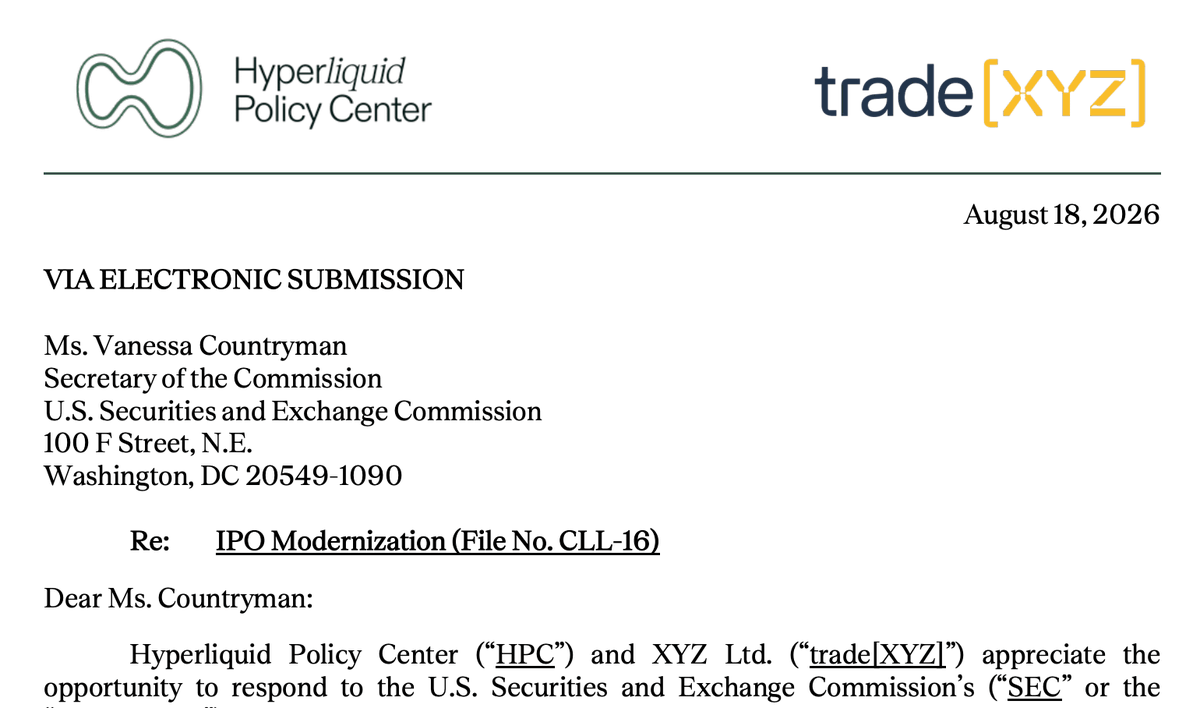
On August 18, the Hyperliquid Policy Center and trade.xyz jointly submitted a comment letter to the U.S. SEC, proposing the inclusion of IPO pre-market perpetual contracts (IPOPs) within the IPO modernization reform framework. This would allow investors to trade price exposure for a company's shares through perpetual contracts before its official listing, forming a public, continuous market price.
It's important to note that "IPOP" contracts do not represent company shares, nor do they grant holders voting rights or other shareholder privileges. They only provide price exposure and will cease their pre-IPO function upon the related company's official listing.
trade.xyz indicated that it has already launched 5 IPOP markets on Hyperliquid, including Cerebras, SpaceX, SK Hynix, and ChangXin Memory Technologies. In some cases, the pre-listing prices formed in these markets were relatively close to the post-listing opening stock prices, potentially providing issuers and underwriters with additional public price discovery signals.
Both parties also suggested that the U.S. SEC and CFTC clarify the regulatory classification of stock-like perpetual contracts and establish rules regarding disclosure, listing qualifications, market manipulation prevention, as well as leverage and position limits. The ultimate goal is to allow U.S. investors, including retail participants, to access the IPO pre-market perpetual contracts market.
Earlier, in March of this year, S&P Dow Jones Indices officially authorized trade.xyz to use the S&P 500 index to launch on-chain perpetual contracts, targeted at eligible non-U.S. investors. On May 26, U.S. SEC Chairman Paul Atkins initiated proposal CLL-16, inviting market discussion on reforms to IPOs, direct listings, and other listing methods.
On July 14, representatives from the Hyperliquid Policy Center, trade.xyz, and Sullivan & Cromwell already held a formal meeting with the SEC's Crypto Assets and Cyber Unit, introducing the Hyperliquid protocol, technology, and HIP-3 markets.
In the competition for pre-market pricing power in U.S. stocks, the past performance and mature operational systems within the Hyperliquid ecosystem provide ample evidence to support the aforementioned lobbying efforts and their subsequent ability to offer reliable price discovery mechanisms for the market.
Just as Robinhood's CEO and Uniswap's founder have previously mentioned regarding "tokenization reshaping the global financial industry," regardless of the traditional finance industry's stance, the transformation of traditional financial assets using on-chain trading platforms is already a reality. The distinction lies in whether regulators can proactively intervene to clarify boundaries and establish management rules. This is a genuine historical trend.
U.S. CFTC Chairman Becomes Key Driver for Hyperliquid's Compliant U.S. Entry: Hyperliquid's "Invisible Connections in Washington"?
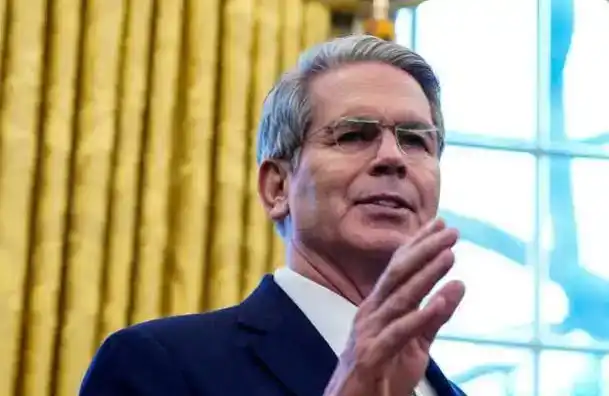
Aside from active lobbying, Hyperliquid's other major "ally" is the current CFTC Chairman, Michael Selig, whom Trump mentioned as responsible for pushing Hyperliquid's compliant entry.
On August 14, Michael Selig pre-announced that the inaugural meeting of the CFTC's Technology Advisory Committee would take place on August 20 in Washington D.C., focusing on topics including crypto asset regulation, artificial intelligence, and prediction markets, with the meeting to be livestreamed on the CFTC's website.
This morning, during the White House Crypto Meeting, he reiterated regarding tomorrow's inaugural CFTC Technology Advisory Committee meeting that more details on the future regulatory pathway would be shared tomorrow—a pathway designed to provide greater certainty for innovators while boosting market confidence for decades to come.
Selig added: "Innovation relies on regulatory clarity. Clear rules foster confidence, confidence attracts investment, investment creates jobs, strengthens our markets, and retains top global talent to build right here in the United States."
Previously, the development of derivative contract trading on platforms like Kalshi and Coinbase also proceeded under the regulatory approval of the U.S. CFTC and Selig. It's no exaggeration to say that Selig and U.S. SEC Chairman Paul Atkins could be considered "two of the most proactive champions of crypto-friendly regulation in the Trump administration," particularly active in the realm of derivatives trading oversight.
Furthermore, Selig has deep connections with Hyperliquid.
According to a disclosure by Hyperliquid community member "Dongdong Fosi": In May of last year, when Hyperliquid Labs submitted two comment letters to the U.S. CFTC regarding perpetual contract regulation, former CFTC Chairman Giancarlo served as legal counsel in drafting them. Giancarlo and Selig had a mentor-mentee relationship during their early years at the CFTC, and later worked together for three years at the law firm Willkie. Selig had left that firm just two months before Hyperliquid Labs submitted the comment letters. Coincidentally, before Selig's appointment as CFTC Chairman, Giancarlo publicly endorsed his "protégé" on multiple occasions.
Thus, through its connection with the former CFTC Chairman as legal counsel, Hyperliquid successfully linked up with the current CFTC Chairman, paving the way for potential acquisition of a "regulatory ticket" for compliant U.S. entry.
Regarding this, Galaxy's Head of Research, Alex Thorn, has also expressed keen interest, posting that he is very interested in the question of "how Hyperliquid achieves compliance." Commenters speculated that solutions might involve using HIP-3 whitelists or approaches similar to those of platforms like Kalshi and Coinbase, such as enabling derivative trading features post-KYC. For now, specific operational pathways remain under discussion.
Exploring Feasible Pathways for Hyperliquid's Compliant U.S. Entry: Clearing Partnerships, Asset Onboarding, and Starting Anew
After covering the positive news catalysts, Odaily Planet Daily will now discuss potential reference pathways for Hyperliquid to truly achieve compliant entry into the U.S. market.
First, from the perspectives of operational difficulty and market efficiency, adopting a "clearing layer gateway partnership + backend technical support" scheme seems most realistic.
In simple terms, Hyperliquid could partner with already-licensed U.S. DCMs, FCMs, or clearing institutions, allowing them to connect to Hyperliquid's execution/clearing layer. The partner would handle KYC, client protection, and reporting, while Hyperliquid primarily manages the on-chain settlement-matching processes. This is the path Hyperliquid Policy Center CEO Jake Chervinsky has publicly expressed a preference for, rather than building a new U.S. trading platform from scratch.
Second, from the perspectives of product implementation and asset access, a scheme involving "regulated trading platforms listing Hyperliquid platform assets" could be employed.
Simply put, assets and data related to the Hyperliquid platform could be integrated into compliant trading platforms like Coinbase, Kraken, or Kalshi, packaging the on-chain assets as compliant platform assets. This would be akin to adding a frontend gateway, potentially transforming the HIP-3 and HIP-4 Builder mechanisms into "compliant partnerships."
Third, from the perspectives of profit sharing and brand preservation—though it is the most difficult and least efficient option—Hyperliquid could acquire or build a new, compliant trading platform specifically for the U.S. market. This would be similar to Polymarket's acquisition of QCX. However, it would mean Hyperliquid needing to build U.S. infrastructure with KYC from the ground up or establish a full DCM, potentially sacrificing core advantages like permissionless access and self-custody.
It is worth noting that the U.S. CFTC cannot unilaterally bypass core U.S. investment regulatory principles (such as customer protection, fraud prevention, anti-money laundering) for Hyperliquid's sake. However, it could reduce the compliance burden for on-chain models by interpreting core principles of the existing Commodity Exchange Act (CEA), employing no-action strategies, or undertaking rulemaking.
Based on current information, Hyperliquid likely still needs at least a few months, and potentially a year or more, of preparation before compliant U.S. entry becomes a reality. Nevertheless, from the perspectives of financial innovation and crypto regulation, "Hyperliquid's compliant entry into the U.S." has entered a substantive promotion phase. Consequently, HYPE's price ceiling has gained further momentum, with the potential to once again reach new all-time highs.