200,000 fake AI ‘victims’ deployed to scam bait online fraudsters

cointelegraphPublié le 2026-08-19Dernière mise à jour le 2026-08-19

Résumé

A tech company called Apate is using 200,000 AI personas to pose as scam victims, wasting millions of hours of fraudsters' time each month and saving the public an estimated $13 million in a six-week period. Founded by Dali Kaafar, the idea came from his own experience of wasting a scammer's time. Apate's bots, trained on real scam-baiting conversations, engage fraudsters via phone and chat platforms like WhatsApp, extracting valuable intelligence such as new crypto wallet addresses and scam tactics. This data helps banks and telcos combat criminal rings globally. While scammers are also starting to use AI, Apate believes defensive AI bots have a strategic advantage in gathering intelligence and disrupting these operations.

Australian tech firm Apate deploys a vast array of AI-bot characters worldwide that play the role of gullible scam victims to waste millions of hours of con artists’ time each month.

Hilariously, one of the company’s monthly performance metrics is how many times frustrated scammers swear at the idiot ‘victims’ who are playing dumb and stringing them along.

“I think we’re the only company in the world that is actually keeping as part of their KPIs the number of F-words that scammers are dropping at them,” Apate founder Dali Kaafar tells Magazine with a chuckle.

The company has a stable of almost 200,000 AI characters that are able to hold convincing phone conversations and to chat on social media and messaging platforms.

”I can tell you that we’re basically servicing, as we call them, hundreds of thousands of calls a day, and pretty much hundreds of thousands of conversations on the other channels,” he says.

Every hour of a con artist’s time they waste is another hour they’re not scamming a member of the public. In the six weeks up to the end of 2025, Apate’s bots engaged in 600,000 scam calls for a single telco called TPG in Australia.

“Essentially, we wasted more than five hundred days of scammers’ time,” he explains. “That roughly equates to somewhere around thirteen million dollars being saved.”

The bots’ other goal is to elicit actionable intelligence for banks and telcos to combat scam rings across Australia, Asia, Africa and the UK and Europe.
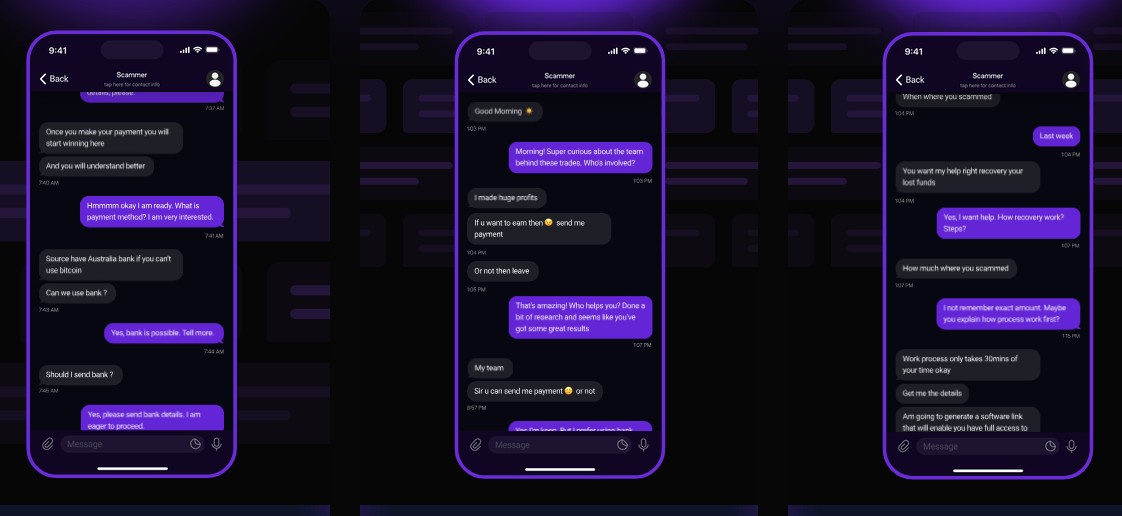
Apate bots deal with scammers via chat. Source: Apate

Scam baiting at scale with AI victims

Kaafar says he got the idea when he received a scam call while having a picnic with his family in Sydney back in November 2021.

To his wife’s annoyance, but his kids’ delight, he strung the scammer along for 44 minutes by pretending to be a gullible rube falling for the scam.

“What followed was really literally a full comedy show for my kids,” he says, adding that during the call he’d also learned a lot of potentially useful information about the mechanics of the scam and the tactics used.

“As I hung up that call, I remember thinking very clearly: if I could do that just for fun, imagine what technology can do at scale.”

Working as a professor at Macquarie University at the time, he raised the idea with some of his doctoral students working on AI and security.

“I said, ‘Guys, there has to be a much better way of doing this. Let’s build something that is really automating this whole process of engaging scammers at scale, but also, perhaps most importantly, extracting all sorts of intelligence from these conversations.’ And that’s literally how it started.”

Related: AI-powered bot stands in for absent candidate in Virginia debate

Within a few months they’d secured funding from the Office of National Intelligence to research the idea, and the project was spun off from the university into Apate in 2023. The company now works with most of the big banks in Australia, as well as numerous banks in the UK, South Africa and South East Asia.

Apate is far from the only company scam baiting fraudsters using AI bots — though they are doing it on a greater scale than most. United Kingdom telco O2 rolled out an AI Granny campaign last year, which frustrates scammers by taking up hours of their time talking about her 28 cats. It was as much an ad campaign to warn the public about the dangers of scam calls as anything else.

O2’s highly entertaining AI Granny. Source: 02

Creating the perfect AI victims

Apate launched with 120 different personas across different genders, ages and personality types, and now have 197,000 personas with identifiable vocal tics, accents, and they make the same noises people make when they’re trying to think of what to say.

“We spent a lot of time refining and building these AI bots that sound exactly like you and I and our neighbors,” he says.

The AI models were trained on “hundreds and hundreds” of hours of recorded conversations between human scam baiters and scammers, so they can employ counter strategies.

“They know that they’re talking to bad guys, if you like, and they really navigate the conversations so that it sounds really very, very realistic to any scammer out there, even if a scammer is skeptical about things.”
The bots get sent out on WhatsApp and Telegram to act as honeypots for scammers. While the old cliché that you can’t scam an honest man is not true, it’s still very possible to exploit the scammer’s desire for money.

“They are cybercriminals, really. I think we just very often forget that they’re cybercriminals who are trying to get people’s life savings. And so that element of greed is sometimes what our bots also exploit.”

Bots collect valuable intel from each scam call

In the crypto industry, Apate works for “one of the leaders in blockchain analysis,” which may or may not be Chainalysis. They aren’t interested in wasting scammers’ time — they want intelligence on which wallets and methods scammers are using so they can track the flow of funds.

“These bots, as they engage across different conversations, extract new crypto wallet addresses by the hundreds and by the thousands,” he says. “It’s data and intelligence that is coming literally before their damage happens.”

Scamming is big business, and the call centers are “pretty much corporate organizations,” Kaafar explains.

“This data is very, very important because, literally, that’s the new account or the new wallet where you really need to pay extreme attention to. Because this is where these... scammer compounds are collecting their money or their funds with.”

“Think about it literally as being always ahead of the scammer’s tactics. And the more you know before the money gets transferred, the better it is.”

In July, Apate’s bots uncovered a marketplace for brokers soliciting verified bank accounts in India, offering commissions of up to 5% paid in USDT on the proceeds from scams passing through the accounts.
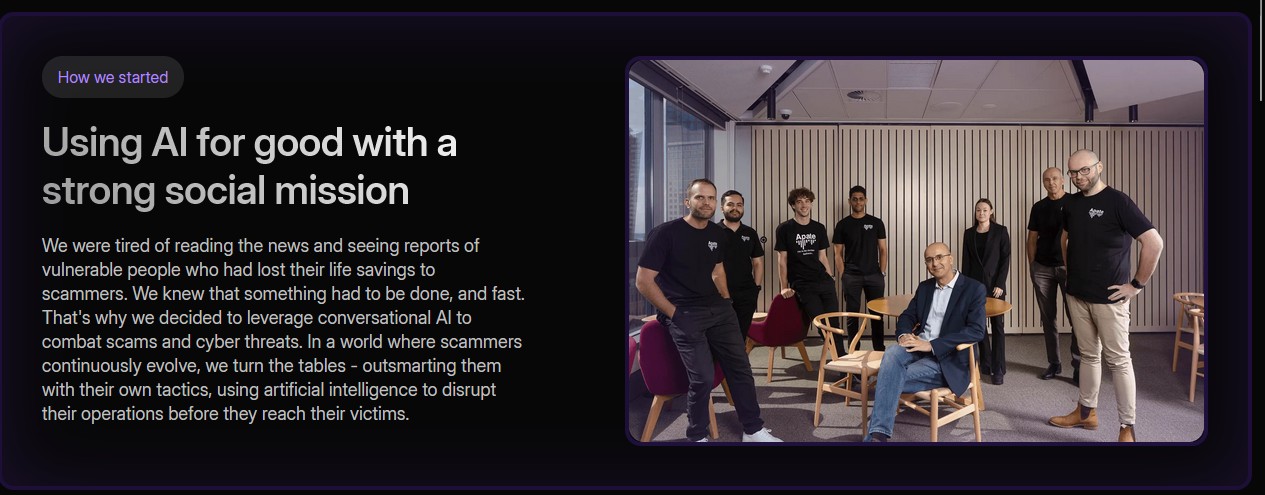
Apate’s human staff in Sydney. Source: Apate

AI arms race between good guys and bad guys

Scammers are increasingly using AI bots themselves, and it won’t be too long before AI scammers are as ubiquitous as spam emails. Scamming people is a $1.24 trillion business, so the industry can afford the compute required to scale up operations.
Apate’s research suggests that about 20% to 30% of scam text conversations employ AI already, but Kaafar isn’t too worried about the outcome of anti-scam bots fighting scam bots.
He says their researchers believe that AI bots playing defense have an advantage, according to game theory, because they’re trying to extract intelligence, while the scam bots are trying to get the other AI to perform an action.

“You can also demonstrate mathematically that that is to the advantage of a defender because it becomes easier to extract intelligence from the attacker’s AI model,” he says.

“We can imagine a world where scammers become a lot more sophisticated and deploy such technology. But that also means that if they do, they’re actually deemed to lose the game, which is great news in the fight against scams.”

Magazine: Agent wastes 14 hours of scammers’ time, LLMs ‘poisoned’ by Iran — AI Eye

Cryptos en tendance

Questions liées

QWhat is the main purpose of Apate's AI bots, according to the article?

AThe main purpose of Apate's AI bots is to act as fake scam victims, engaging with online fraudsters to waste their time and prevent them from scamming real people, while simultaneously gathering valuable intelligence for banks and telecom companies to combat scam operations.

QHow did Apate's founder, Dali Kaafar, get the initial idea for the company?

AThe idea came when Dali Kaafar received a scam call during a family picnic in November 2021. He intentionally strung the scammer along for 44 minutes, entertaining his children and learning about the scam's mechanics. This experience led him to think about automating and scaling this process using technology.

QWhat is one of Apate's unique monthly performance metrics mentioned in the article?

AOne of Apate's unique monthly performance metrics is the number of times frustrated scammers swear, specifically using profanities like the F-word, at the AI bots during conversations.

QApart from wasting scammers' time, what other crucial function do the AI bots serve?

ABeyond wasting time, the AI bots extract actionable intelligence from conversations, such as identifying new crypto wallet addresses, scammer methods, and verified bank account marketplaces. This information helps financial institutions and law enforcement track illicit funds and disrupt scam networks before significant damage occurs.

QHow does Kaafar view the potential future where both scammers and anti-scam fighters use AI bots?

AKaafar believes that anti-scam AI bots have a strategic advantage in such a scenario, based on game theory. The defender bots aim to extract intelligence, while scammer bots aim to elicit an action (like a money transfer). He argues this setup makes it easier for defenders to gather information, suggesting scammers who deploy sophisticated AI are 'deemed to lose the game.'

Lectures associées

Décryptage du rapport de Bank of America : Marvell récupère la périphérie du TPU, Broadcom conserve un noyau de valeur de 250 milliards de dollars

Un nouveau contrat de puces personnalisées entre Google et Marvell redéfinit la répartition des rôles dans la chaîne d'approvisionnement des TPU (Tensor Processing Units), selon un rapport de Bank of America (BofA). Marvell se voit attribuer le développement de puces périphériques dites "XPU-attach" (comme des accélérateurs d'inférence, des contrôleurs de mémoire), liées à l'écosystème TPU, pour un potentiel d'achats cumulés pouvant atteindre 120 milliards de dollars de la part de Google. Cependant, BofA estime que le cœur de la valeur reste fermement détenu par Broadcom. Ce dernier conserve la conception des ASIC de calcul principaux, de l'intégration HBM, des interfaces SerDes hautes vitesses et des composants réseau avancés, représentant environ 55 à 60 % de la valeur totale du système TPU. Cette part correspond à un marché potentiel (TAM) de 250 à 350 milliards de dollars sur les 400 à 600 milliards de dollars que BofA prévoit pour les dépenses en TPU de Google au cours des cinq prochaines années. Le rapport souligne que la position de Broadcom est protégée par des accords à long terme jusqu'en 2031, une forte intégration technique et une valeur unitaire élevée de ses composants. La part de Marvell, bien que significative (10 à 20 % du TAM, soit 50 à 100 milliards de dollars), concerne des puces plus fragmentées et à valeur unitaire moindre. MediaTek interviendrait également sur des segments à coût optimisé. En conclusion, BofA considère que la concurrence sur les puces périphériques est surestimée et que la position dominante de Broadcom sur le cœur de calcul, essentiel à la performance, reste inchangée et sous-évaluée par le marché.

marsbitIl y a 15 mins

Décryptage du rapport de Bank of America : Marvell récupère la périphérie du TPU, Broadcom conserve un noyau de valeur de 250 milliards de dollars

marsbitIl y a 15 mins

Mi-temps pour les semi-conducteurs : quelle ampleur reste-t-il dans la dernière phase du rallye ?

**Résumé de l'article : Le marché des semi-conducteurs en milieu de parcours - Quelle est l'ampleur du mouvement restant ?** L'article compare la situation actuelle du marché des semi-conducteurs au scénario de correction puis de rebond qu'a connu Nvidia en 2024. **La correction de Nvidia en 2024 :** Entre juillet et août 2024, l'action Nvidia a chuté d'environ 33%, déclenchée par une combinaison de rumeurs négatives (retards des puces Blackwell, enquête antitrust) et d'un choc macroéconomique (relèvement des taux par la BoJ entraînant des ventes de panique). Le creux a été marqué par des signaux techniques (chandelier haussier à fort volume) et un extrême de peur sur les marchés (pic de volatilité VIX). **Caractéristiques d'un sommet intermédiaire :** L'article identifie plusieurs signaux avant un repli : signes techniques (double sommet, modèle de chandelier baissier), surchauffe des capitaux (concentration des positions, effet de levier élevé des investisseurs) et un déclencheur fondamental (par ex., résultats jugés "imparfaits" malgré de bonnes performances). La recommandation est de réduire l'exposition face à ces signaux. **Caractéristiques d'un creux / rebond :** Les creux se forment souvent sur des chocs macroéconomiques non liés aux fondamentaux solides de l'entreprise. Ils sont signalés par des modèles techniques de retournement haussier confirmés par un volume élevé, et coïncident avec des indicateurs de sentiment de marché extrêmes. La reprise s'ensuit lorsque les fondamentaux se rappellent au marché (annonce positive sur Blackwell pour Nvidia) et que l'environnement macro s'améliore (assouplissement monétaire). **Conclusion :** L'analyse suggère que le marché des semi-conducteurs pourrait suivre une dynamique similaire. La clé est de surveiller les signes de surchauffe (technique, capitaux) pour les sommets, et de reconnaître les creux causés par des chocs externes comme des opportunités, à condition que les perspectives fondamentales à long terme restent intactes.

marsbitIl y a 35 mins

Mi-temps pour les semi-conducteurs : quelle ampleur reste-t-il dans la dernière phase du rallye ?

marsbitIl y a 35 mins

Trading

Spot

Articles tendance

Comment acheter T

Bienvenue sur HTX.com ! Nous vous permettons d'acheter Threshold Network Token (T) de manière simple et pratique. Suivez notre guide étape par étape pour commencer votre parcours crypto.Étape 1 : Création de votre compte HTXUtilisez votre adresse e-mail ou votre numéro de téléphone pour ouvrir un compte sur HTX gratuitement. L'inscription se fait en toute simplicité et débloque toutes les fonctionnalités.Créer mon compteÉtape 2 : Choix du mode de paiement (rubrique Acheter des cryptosCarte de crédit/débit : utilisez votre carte Visa ou Mastercard pour acheter instantanément Threshold Network Token (T).Solde :utilisez les fonds du solde de votre compte HTX pour trader en toute simplicité.Prestataire tiers :pour accroître la commodité d'utilisation, nous avons ajouté des modes de paiement populaires tels que Google Pay et Apple Pay.P2P :tradez directement avec d'autres utilisateurs sur HTX.OTC (de gré à gré) : nous offrons des services personnalisés et des taux de change compétitifs aux traders.Étape 3 : stockage de vos Threshold Network Token (T)Après avoir acheté vos Threshold Network Token (T), stockez-les sur votre compte HTX. Vous pouvez également les envoyer ailleurs via un transfert sur la blockchain ou les utiliser pour trader d'autres cryptos.Étape 4 : tradez des Threshold Network Token (T)Tradez facilement Threshold Network Token (T) sur le marché Spot de HTX. Il vous suffit d'accéder à votre compte, de sélectionner la paire de trading, d'exécuter vos trades et de les suivre en temps réel. Nous offrons une expérience conviviale aux débutants comme aux traders chevronnés.

910 vues totalesPublié le 2024.12.10Mis à jour le 2026.06.02

Comment acheter T

Discussions

Bienvenue dans la Communauté HTX. Ici, vous pouvez vous tenir informé(e) des derniers développements de la plateforme et accéder à des analyses de marché professionnelles. Les opinions des utilisateurs sur le prix de T (T) sont présentées ci-dessous.

活动图片