Korean Stocks Rally 22% in 10 Days, Enter Technical Bull Market, AI Chip Rally Back with a Vengeance?

marsbitPublié le 2026-08-13Dernière mise à jour le 2026-08-13

Résumé

The South Korean benchmark KOSPI index has rebounded roughly 22% from its July 30 low, entering a technical bull market after a dramatic month. This surge follows a 22% crash in July—the worst monthly performance since the global financial crisis—triggered by forced liquidations of leveraged positions in chip stocks. The recovery is driven by major chipmakers Samsung Electronics and SK Hynix, buoyed by several key factors. Robust AI infrastructure spending from global tech giants continues to fuel demand for high-bandwidth memory. Favorable U.S. inflation data has eased fears of aggressive Federal Reserve rate hikes, and financial regulators have tightened rules on single-stock leveraged ETFs to curb excessive volatility. Additionally, strong market anticipation surrounds new shareholder return plans from Samsung and SK Hynix. Analysts estimate potential programs worth tens to hundreds of trillions of won, supported by significant projected free cash flows. This expectation has boosted investor sentiment. While foreign investors showed net buying interest recently, they remain net sellers year-to-date. Analysts caution that sustained market gains depend on the stability of the AI investment narrative and U.S. interest rates, suggesting the rally's continuity is not yet assured.

The South Korean benchmark KOSPI index rose 3.6% on Thursday, marking a cumulative rebound of about 22% from the low on July 30, officially entering a technical bull market.

Samsung Electronics and SK Hynix were the core drivers of this rally, with both heavyweight chip stocks surging close to or over 5% in a single day.
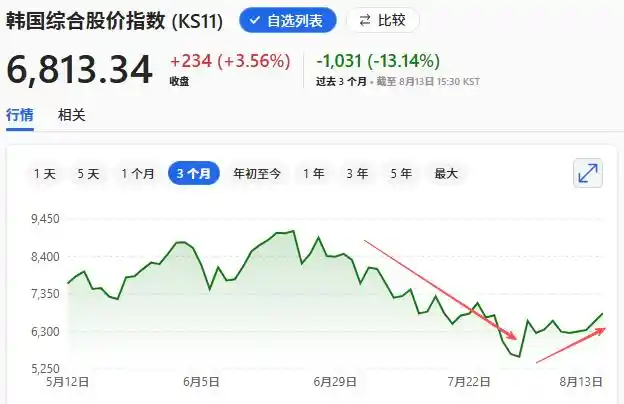
This rebound follows a period of extreme volatility. KOSPI plunged 22% in July alone, its worst monthly performance since the global financial crisis. Back then, forced liquidation of leveraged chip positions triggered chain-reaction trading halts, causing significant wealth losses for retail investors.

Behind this rally is a convergence of multiple positive factors: the latest earnings reports from global tech giants show persistently high AI capital expenditures, mild U.S. inflation data has eased market fears of further Fed rate hikes, regulators tightened rules on single-stock leveraged ETFs, and market expectations for upcoming shareholder return plans from Samsung and SK Hynix.

From Plunge to Bull: A Dramatic Reversal Within a Month

Just a month ago, the South Korean stock market was mired in a slump. KOSPI fell 22% in July alone, its worst monthly drop since the global financial crisis.

The trigger for the plunge was the forced liquidation of leveraged positions. Retail investors held large amounts of single-stock leveraged ETFs linked to chip stocks. When the tide turned, chain liquidations frequently caused intraday swings exceeding 5%, triggering exchange circuit breakers multiple times, wiping out billions of dollars in retail wealth in a short period.

Regulators stepped in quickly. Authorities tightened the minimum margin requirements for single-stock leveraged ETFs, significantly shrinking the daily trading volume of such products. Meanwhile, investors actively reduced leverage, and market volatility has fallen back to its lowest level since April.

Kang DaeKwun, CEO of Life Asset Management, said: "I believe the market became oversold during the liquidation of leveraged positions. As fund flows stabilize, the current rebound is a natural recovery."

AI Spending Remains Robust, Chip Demand Logic Intact

The fundamental support for this rally comes from the continued strength of AI demand.

The latest earnings reports from global tech giants show that investment in AI infrastructure has not slowed down, directly boosting expectations for demand for AI chips such as High Bandwidth Memory (HBM). Despite being driven mainly by retail investors, the South Korean stock market is still up over 60% year-to-date. However, even with this gain, KOSPI remains about 25% below its peak at the end of June.

Qian Zhang, an emerging markets equities specialist at Baillie Gifford, pointed out: "Due to the rise of AI agents and physical AI, memory demand has exploded, but we entered this phase with a fairly limited supply capability—the bottleneck is right here." "We are not saying the world will build data centers at this speed forever, but this is a real physical bottleneck, and there are only a few companies globally that can solve it."

Increased competitive threats from China had poured cold water on the strong momentum of memory stocks, but analysts believe the near-term demand outlook remains solid. The penetration of AI into more application scenarios and increased daily usage frequency continue to drive chip demand growth.

Shareholder Return Expectations Heat Up; Samsung, SK Hynix May Announce Trillion-Won Level Plans

Beyond the AI narrative, the upcoming shareholder return plans from the two chip giants have also become an important catalyst for recent market sentiment.

Samsung Electronics: During its Q2 earnings call, the company stated, "The board and management are actively discussing specific implementation plans, including special dividends, and the next phase of shareholder return policy." Its current three-year policy covering 2024-2026 expires this year.

According to calculations by DS Investment & Securities, Samsung Electronics' free cash flow (FCF) for this year is estimated at 263.2 trillion won. After deducting regular dividends, the additional return potential, corresponding to 50% of the cumulative three-year FCF, is about 131.8 trillion won.

KB Securities predicts that Samsung's annual shareholder return scale could be a minimum of 100 trillion won, up to a maximum of 200 trillion won—more than 10 times the current annual scale of 9.8 trillion won.

SK Hynix: The company has announced that it is "actively studying additional shareholder return plans, with specific details to be finalized and announced within Q3." Mirae Asset Securities expects SK Hynix's FCF to reach 180 trillion won this year, with net cash of 173 trillion won by year-end, estimating that funds available for returns amount to about 40 trillion won.

Daishin Securities believes that, if combining share buybacks for cancellation and special dividends, the return potential could reach up to 100 trillion won.

Mirae Asset Securities researcher Kim Young-gun noted that Samsung Electronics' "share price is down 39% from its peak; the current moment is a stage where the justification, yield, and perceived practical utility for advancing shareholder returns are all significantly enhanced."

He also stated that SK Hynix' "share price is down 51% from its peak, making it the optimal time for measures like buybacks, and the larger the return scale, the more the market will interpret it as the company's confidence in its future cash-generating ability."

Foreign Investor Sentiment Nuanced; Sustainability of Rally Uncertain

The moves of foreign investors warrant attention. Foreign investors were net buyers of Korean stocks on Thursday, but year-to-date, they remain net sellers, with cumulative withdrawals exceeding $100 billion—overheating and high valuations were the main reasons previously.

As this decline brought valuations down to more attractive levels, some overseas capital has begun to flow back.

However, whether the market can sustain its upward momentum remains uncertain. Kang DaeKwun said, "Until the AI narrative and US interest rates stabilize to some extent, it will be difficult for the market to maintain a continuous rise."

This article is from the WeChat public account "Wall Street News", author: Long Yue

Cryptos en tendance

Questions liées

QWhat is a technical bull market and what key condition did the KOSPI meet to enter one?

AA technical bull market is typically defined as a 20% or greater rise in a major index from a recent low. The KOSPI entered a technical bull market after rallying approximately 22% from its July 30 low.

QWhat were the two main drivers behind the recent strong rebound in the South Korean stock market, as highlighted in the article?

AThe two main drivers were: 1) Continued strong demand expectations for AI chips, fueled by high AI infrastructure spending from global tech giants, and 2) Market anticipation of significant shareholder return plans from the chip giants Samsung Electronics and SK Hynix.

QWhat event in July triggered the massive sell-off and circuit breakers in the KOSPI, and what was the regulatory response?

AThe massive sell-off in July was triggered by the forced liquidation of leveraged positions, primarily in single-stock leveraged ETFs tied to chip stocks held by retail investors. The regulatory response was to tighten the minimum margin requirements for single-stock leveraged ETFs, which significantly reduced their daily trading volume.

QAccording to analysts, what is the primary 'bottleneck' supporting the demand logic for AI memory chips like HBM, and which companies can address it?

AThe primary bottleneck is the limited global supply capacity for high-bandwidth memory (HBM) needed for AI. This demand has grown explosively with the rise of AI agents and embodied AI. The article states that only a few companies worldwide are capable of solving this supply bottleneck.

QDespite the recent rebound, what key uncertainty does the article mention that could challenge the sustainability of the market's upward trend?

AThe article mentions that sustaining the upward trend will be difficult until there is a degree of stabilization in both the AI investment narrative and U.S. interest rates. Additionally, foreign investor sentiment, which has been net sellers for the year, remains a variable.

Lectures associées

Grayscale : « Si les propositions sont adoptées, les prix de ces deux altcoins pourraient augmenter »

Zach Pandl, responsable de la recherche chez Grayscale, estime que des modifications envisagées de la tokenomique d'Ethereum (ETH) et de Solana (SOL) pourraient ralentir considérablement la croissance de leur offre, exerçant ainsi une pression haussière sur leurs prix. Ces propositions visent à réduire le taux d'inflation annuel des jetons ETH et SOL. Un ralentissement de la création de nouveaux jetons augmenterait la rareté des actifs existants. Grayscale prévoit que, si elles sont adoptées, l'inflation annuelle de l'offre d'Ethereum pourrait tomber à environ 0,4% d'ici fin 2031, se rapprochant ainsi du Bitcoin, tandis que celle de Solana pourrait atteindre environ 1,1%. En comparaison, l'offre d'or croît d'environ 1,8% par an et l'inflation (IPC) aux États-Unis est d'environ 3,3%. Pandl note que les propositions pour Solana semblent rencontrer un soutien plus large et ont donc une probabilité de mise en œuvre plus élevée. Cependant, il souligne un compromis potentiel : une inflation réduite pourrait diminuer les récompenses pour les investisseurs pratiquant le staking, une partie importante de leurs revenus provenant de l'émission de nouveaux jetons. En conclusion, un ralentissement de l'offre pourrait profiter aux prix des deux actifs, les détenteurs de jetons sans staking étant particulièrement bien placés pour en bénéficier. Ces changements restent à l'étude et ne sont pas encore approuvés.

cryptonews.ruIl y a 7 mins

Grayscale : « Si les propositions sont adoptées, les prix de ces deux altcoins pourraient augmenter »

cryptonews.ruIl y a 7 mins

Les experts ont nommé les raisons de la chute du bitcoin après la baisse de l'inflation aux États-Unis

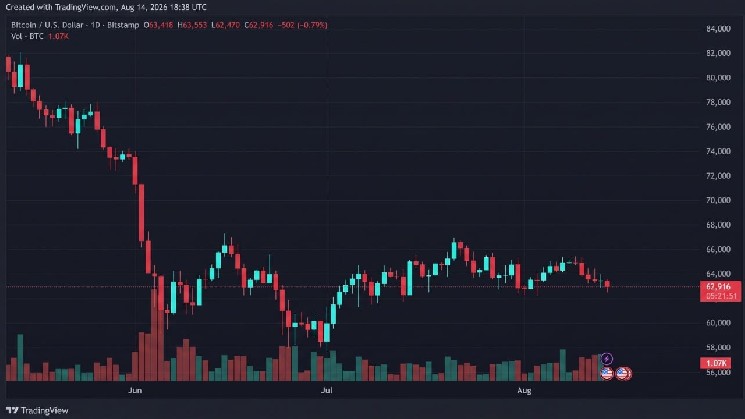
Les données favorables sur l’inflation aux États‑Unis n’ont pas réussi à soutenir le bitcoin. Selon les analystes de CryptoQuant, la principale raison est la faible demande sur le marché au comptant. Le bitcoin n’a pas réagi aux chiffres de l’inflation de juillet, publiés le 12 août, et a même légèrement baissé, passant d’environ 64 500 $ à près de 63 000 $. Pourtant, l’indice des prix à la production (PPI) était meilleur que prévu. Alors que les rendements des obligations du Trésor américain ont reculé et que les marchés actions ont progressé, le bitcoin est resté dans une fourchette de 63 000 à 64 000 $. Cette absence de réaction s’explique notamment par la faible demande au comptant : les entrées de capitaux dans les ETF américains spot de bitcoin restent limitées, et l’indice Coinbase Premium (reflétant l’écart de prix entre Coinbase et les autres grandes plateformes) est négatif depuis mai, indiquant une pression d’achat modérée de la part des investisseurs américains. Dans le même temps, le positionnement des traders sur le marché à terme reste élevé, créant un déséquilibre entre une faible liquidité, une demande spot atone et un volume important de positions à effet de levier. Les analystes estiment que dans ces conditions, même des nouvelles macroéconomiques positives pourraient ne pas déclencher de hausse. Si le prix n’évolue pas malgré un contexte favorable, les traders pourraient commencer à clôturer leurs positions longues à effet de levier, ce qui exercerait une pression supplémentaire à la baisse. Un niveau de résistance clé se situe autour de 68 700 $, coût moyen approximatif pour les détenteurs à court terme, au‑delà duquel une prise de bénéfices est possible. Pour CryptoQuant, une reprise soutenue nécessiterait : une reprise des entrées dans les ETF américains, un retour de l’indice Coinbase Premium en territoire positif, une hausse des volumes de trading au comptant et un franchissement stable des 68 700 $.

cryptonews.ruIl y a 57 mins

Les experts ont nommé les raisons de la chute du bitcoin après la baisse de l'inflation aux États-Unis

cryptonews.ruIl y a 57 mins

Trading

Spot

Articles tendance

Comment acheter CHIP

Bienvenue sur HTX.com ! Nous vous permettons d'acheter USD.AI (CHIP) de manière simple et pratique. Suivez notre guide étape par étape pour commencer votre parcours crypto.Étape 1 : Création de votre compte HTXUtilisez votre adresse e-mail ou votre numéro de téléphone pour ouvrir un compte sur HTX gratuitement. L'inscription se fait en toute simplicité et débloque toutes les fonctionnalités.Créer mon compteÉtape 2 : Choix du mode de paiement (rubrique Acheter des cryptosCarte de crédit/débit : utilisez votre carte Visa ou Mastercard pour acheter instantanément USD.AI (CHIP).Solde :utilisez les fonds du solde de votre compte HTX pour trader en toute simplicité.Prestataire tiers :pour accroître la commodité d'utilisation, nous avons ajouté des modes de paiement populaires tels que Google Pay et Apple Pay.P2P :tradez directement avec d'autres utilisateurs sur HTX.OTC (de gré à gré) : nous offrons des services personnalisés et des taux de change compétitifs aux traders.Étape 3 : stockage de vos USD.AI (CHIP)Après avoir acheté vos USD.AI (CHIP), stockez-les sur votre compte HTX. Vous pouvez également les envoyer ailleurs via un transfert sur la blockchain ou les utiliser pour trader d'autres cryptos.Étape 4 : tradez des USD.AI (CHIP)Tradez facilement USD.AI (CHIP) sur le marché Spot de HTX. Il vous suffit d'accéder à votre compte, de sélectionner la paire de trading, d'exécuter vos trades et de les suivre en temps réel. Nous offrons une expérience conviviale aux débutants comme aux traders chevronnés.

967 vues totalesPublié le 2026.04.21Mis à jour le 2026.06.02

Comment acheter CHIP

Discussions

Bienvenue dans la Communauté HTX. Ici, vous pouvez vous tenir informé(e) des derniers développements de la plateforme et accéder à des analyses de marché professionnelles. Les opinions des utilisateurs sur le prix de CHIP (CHIP) sont présentées ci-dessous.

活动图片