Grayscale Has Identified 4 Blockchains for AI Development

cryptonews.ruPublié le 2026-08-12Dernière mise à jour le 2026-08-12

Résumé

Grayscale Research has identified four public blockchains poised to benefit from the proliferation of artificial intelligence (AI). According to researcher Zach Pandl, AI adoption will create new demand for blockchain in three key areas: AI-agent finance, verifiable computation records, and decentralized alternatives to centralized AI. The report highlights four networks for these use cases. Ethereum and Solana are seen as foundational infrastructure for financial transactions involving autonomous AI agents, enabling micropayments and automated trading. The World blockchain could provide a layer for verifiable digital identity and reputation, helping distinguish humans from AI online. Finally, Bittensor and its $TAO token are cited as a potential decentralized alternative to centralized AI platforms, though the project faces scrutiny over its actual level of decentralization following internal conflicts.

Zach Pandl, Head of Research at Grayscale, stated that the proliferation of artificial intelligence will create new demand for public blockchains. In his research for Grayscale, he highlighted three key directions—AI agent-involved finance, verifiable records of computations and identity, and decentralized alternatives to centralized AI.

According to Pandl, infrastructure for these scenarios could be provided by four cryptocurrency networks, linked to three potential needs of the AI economy:

  • Ethereum – settlement infrastructure for AI agent finance;
  • Solana – fast blockchain settlements for the agent economy;
  • World – verifiable digital identity;
  • Bittensor – decentralized alternative to centralized AI platforms.

AI Agents Will Create Demand for Blockchain Payments

Pandl believes that artificial intelligence and public blockchains are complementary technologies. As AI spreads, traditional financial infrastructure may face new requirements that are better met by the capabilities of programmable blockchain networks.

The most obvious example, according to the researcher, is finance involving AI agents. Such systems will be able to act on behalf of users, but they will need programmable wallets capable of storing and using funds without constant human intermediation.

According to Pandl, the activity of AI agents could stimulate demand for:

  • micropayments;
  • instant cross-border settlements;
  • automated trading;
  • automated risk management.

It is precisely for such scenarios, in Grayscale's view, that Ethereum and Solana are suitable as infrastructure for settlements.

At the same time, the development of agentic AI will require not only payments but also ways to verify the actions of the agents themselves. For example, companies will need to determine which models, data, and rules the AI used when making a particular decision.

Blockchain Could Become a Layer for Identity and Reputation

Another direction Pandl mentioned is creating verifiable records of computations, human identity, and the reputation of AI agents.

This is especially important in cases where a user grants an AI the right to perform financial or other high-risk actions on their behalf. Before making an investment or purchasing goods on a person's behalf, an agent may need a verified reputation.

Separately, the researcher drew attention to the problem of distinguishing between humans and AI on the internet. For example, social platforms could verify whether an account belongs to a unique human without requiring disclosure of their identity.

In this context, Grayscale sees a potential role for World. The World infrastructure could be used to verify human identity and distinguish between humans and AI agents.

Bittensor Offers an Alternative to Centralized AI

The third direction Grayscale identified is decentralized artificial intelligence. Pandl noted that the development of AI concentrates capital, computational resources, and control in the hands of a small number of technology companies.

In his opinion, this raises questions regarding the governance, bias, and censorship of AI systems. An alternative could be open, decentralized networks that users can access, contribute to, and own a stake in.

One example Pandl named is Bittensor and its token $TAO.

However, the network itself was previously at the center of a debate about its level of decentralization. One of the key developers, Covenant AI, announced its departure from Bittensor, accusing the project's leadership of de facto centralization and pressure on the ecosystem. Amid the conflict, the market capitalization of $TAO decreased by approximately $820 million.

end-content


Cryptos en tendance

Questions liées

QWhat are the three key directions for public blockchains in the AI economy identified by Grayscale's Zach Pandl?

AThe three key directions identified are: AI agent-powered finance, verifiable records for compute and identity, and decentralized alternatives to centralized AI.

QWhich two blockchains did Grayscale highlight as potential settlement infrastructure for AI agent economies, and why?

AGrayscale highlighted Ethereum and Solana as potential settlement infrastructure. Ethereum is mentioned as a general settlement infrastructure, while Solana is noted for its fast transaction speeds suitable for high-frequency agent activity.

QWhat specific problem does Grayscale suggest World could help solve in the context of AI development?

AGrayscale suggests World could help solve the problem of verifying human identity and distinguishing between humans and AI agents online, which is crucial for social platforms and reputation systems.

QWhat is the main criticism or challenge associated with Bittensor mentioned in the article?

AThe main challenge mentioned is the debate over its level of decentralization. A key developer left the project, accusing its leadership of centralization and exerting pressure on the ecosystem, leading to a significant drop in its market cap.

QAccording to Zach Pandl, what types of financial activity could AI agents drive demand for?

AAI agents could drive demand for micropayments, instant cross-border settlements, automated trading, and automated risk management.

Lectures associées

Grayscale : « Si les propositions sont adoptées, les prix de ces deux altcoins pourraient augmenter »

Zach Pandl, responsable de la recherche chez Grayscale, estime que des modifications envisagées de la tokenomique d'Ethereum (ETH) et de Solana (SOL) pourraient ralentir considérablement la croissance de leur offre, exerçant ainsi une pression haussière sur leurs prix. Ces propositions visent à réduire le taux d'inflation annuel des jetons ETH et SOL. Un ralentissement de la création de nouveaux jetons augmenterait la rareté des actifs existants. Grayscale prévoit que, si elles sont adoptées, l'inflation annuelle de l'offre d'Ethereum pourrait tomber à environ 0,4% d'ici fin 2031, se rapprochant ainsi du Bitcoin, tandis que celle de Solana pourrait atteindre environ 1,1%. En comparaison, l'offre d'or croît d'environ 1,8% par an et l'inflation (IPC) aux États-Unis est d'environ 3,3%. Pandl note que les propositions pour Solana semblent rencontrer un soutien plus large et ont donc une probabilité de mise en œuvre plus élevée. Cependant, il souligne un compromis potentiel : une inflation réduite pourrait diminuer les récompenses pour les investisseurs pratiquant le staking, une partie importante de leurs revenus provenant de l'émission de nouveaux jetons. En conclusion, un ralentissement de l'offre pourrait profiter aux prix des deux actifs, les détenteurs de jetons sans staking étant particulièrement bien placés pour en bénéficier. Ces changements restent à l'étude et ne sont pas encore approuvés.

cryptonews.ruIl y a 1 h

Grayscale : « Si les propositions sont adoptées, les prix de ces deux altcoins pourraient augmenter »

cryptonews.ruIl y a 1 h

Les experts ont nommé les raisons de la chute du bitcoin après la baisse de l'inflation aux États-Unis

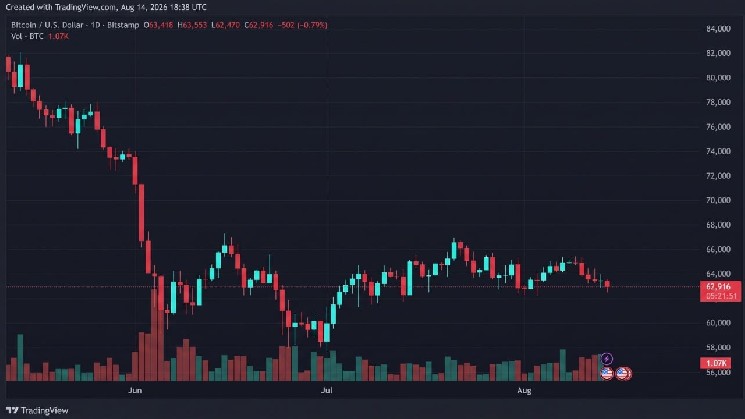
Les données favorables sur l’inflation aux États‑Unis n’ont pas réussi à soutenir le bitcoin. Selon les analystes de CryptoQuant, la principale raison est la faible demande sur le marché au comptant. Le bitcoin n’a pas réagi aux chiffres de l’inflation de juillet, publiés le 12 août, et a même légèrement baissé, passant d’environ 64 500 $ à près de 63 000 $. Pourtant, l’indice des prix à la production (PPI) était meilleur que prévu. Alors que les rendements des obligations du Trésor américain ont reculé et que les marchés actions ont progressé, le bitcoin est resté dans une fourchette de 63 000 à 64 000 $. Cette absence de réaction s’explique notamment par la faible demande au comptant : les entrées de capitaux dans les ETF américains spot de bitcoin restent limitées, et l’indice Coinbase Premium (reflétant l’écart de prix entre Coinbase et les autres grandes plateformes) est négatif depuis mai, indiquant une pression d’achat modérée de la part des investisseurs américains. Dans le même temps, le positionnement des traders sur le marché à terme reste élevé, créant un déséquilibre entre une faible liquidité, une demande spot atone et un volume important de positions à effet de levier. Les analystes estiment que dans ces conditions, même des nouvelles macroéconomiques positives pourraient ne pas déclencher de hausse. Si le prix n’évolue pas malgré un contexte favorable, les traders pourraient commencer à clôturer leurs positions longues à effet de levier, ce qui exercerait une pression supplémentaire à la baisse. Un niveau de résistance clé se situe autour de 68 700 $, coût moyen approximatif pour les détenteurs à court terme, au‑delà duquel une prise de bénéfices est possible. Pour CryptoQuant, une reprise soutenue nécessiterait : une reprise des entrées dans les ETF américains, un retour de l’indice Coinbase Premium en territoire positif, une hausse des volumes de trading au comptant et un franchissement stable des 68 700 $.

cryptonews.ruIl y a 2 h

Les experts ont nommé les raisons de la chute du bitcoin après la baisse de l'inflation aux États-Unis

cryptonews.ruIl y a 2 h

Trading

Spot

Articles tendance

Comment acheter 4

Bienvenue sur HTX.com ! Nous vous permettons d'acheter 4 (4) de manière simple et pratique. Suivez notre guide étape par étape pour commencer votre parcours crypto.Étape 1 : Création de votre compte HTXUtilisez votre adresse e-mail ou votre numéro de téléphone pour ouvrir un compte sur HTX gratuitement. L'inscription se fait en toute simplicité et débloque toutes les fonctionnalités.Créer mon compteÉtape 2 : Choix du mode de paiement (rubrique Acheter des cryptosCarte de crédit/débit : utilisez votre carte Visa ou Mastercard pour acheter instantanément 4 (4).Solde :utilisez les fonds du solde de votre compte HTX pour trader en toute simplicité.Prestataire tiers :pour accroître la commodité d'utilisation, nous avons ajouté des modes de paiement populaires tels que Google Pay et Apple Pay.P2P :tradez directement avec d'autres utilisateurs sur HTX.OTC (de gré à gré) : nous offrons des services personnalisés et des taux de change compétitifs aux traders.Étape 3 : stockage de vos 4 (4)Après avoir acheté vos 4 (4), stockez-les sur votre compte HTX. Vous pouvez également les envoyer ailleurs via un transfert sur la blockchain ou les utiliser pour trader d'autres cryptos.Étape 4 : tradez des 4 (4)Tradez facilement 4 (4) sur le marché Spot de HTX. Il vous suffit d'accéder à votre compte, de sélectionner la paire de trading, d'exécuter vos trades et de les suivre en temps réel. Nous offrons une expérience conviviale aux débutants comme aux traders chevronnés.

896 vues totalesPublié le 2025.10.20Mis à jour le 2026.06.02

Comment acheter 4

Discussions

Bienvenue dans la Communauté HTX. Ici, vous pouvez vous tenir informé(e) des derniers développements de la plateforme et accéder à des analyses de marché professionnelles. Les opinions des utilisateurs sur le prix de 4 (4) sont présentées ci-dessous.

活动图片