Tether's USDT Supply Shrinks by $4 Billion Over 60 Days Amid Declining Crypto Demand

cryptonews.ruPublié le 2026-08-12Dernière mise à jour le 2026-08-12

Résumé

Tether's USDT supply has decreased by approximately $4 billion over 60 days, with about $870 million of that reduction occurring in just the last 11 days. This contraction, following years of rapid growth, suggests capital may be exiting the crypto space entirely for fiat currencies rather than simply shifting between stablecoins. While USDT remains dominant with a $184 billion circulating supply, rival USDC has also seen significant supply reductions, weakening the argument that funds are merely rotating between stablecoin issuers. Analysts point to a combination of factors, including investors taking profits after Bitcoin's 2025 peak, a search for yield in other ecosystems, and a general cooling of speculative activity. Despite the overall supply decline, USDT remains heavily concentrated on the Tron and Ethereum blockchains, which together host about 97% of its supply. The broader implication is that a sustained reduction in stablecoin liquidity could signal a wider cooling of risk appetite in cryptocurrency markets, potentially leading to weakened trading activity.

The supply of $USDT from Tether is declining after years of rapid growth, amplifying signs that some cryptocurrency capital is moving off the blockchain rather than simply being reallocated among stablecoins.

Data from Cryptoquant shows that the 60-day rolling change in $USDT supply is approximately minus $4 billion. About $870 million of this decline occurred in the last 11 days.

$USDT remains the dominant stablecoin with a circulating supply of around $184 billion, estimated to account for 60% of the total stablecoin supply. However, the recent supply reduction has raised questions about whether investors are reducing their overall exposure to cryptocurrencies.

Analyst Stacy Moore noted that part of this movement appears to be a direct exit into fiat currencies following Bitcoin's pullback from its 2025 peak. "Some investors are exchanging stablecoins for fiat currency and exiting cryptocurrencies altogether," she said.
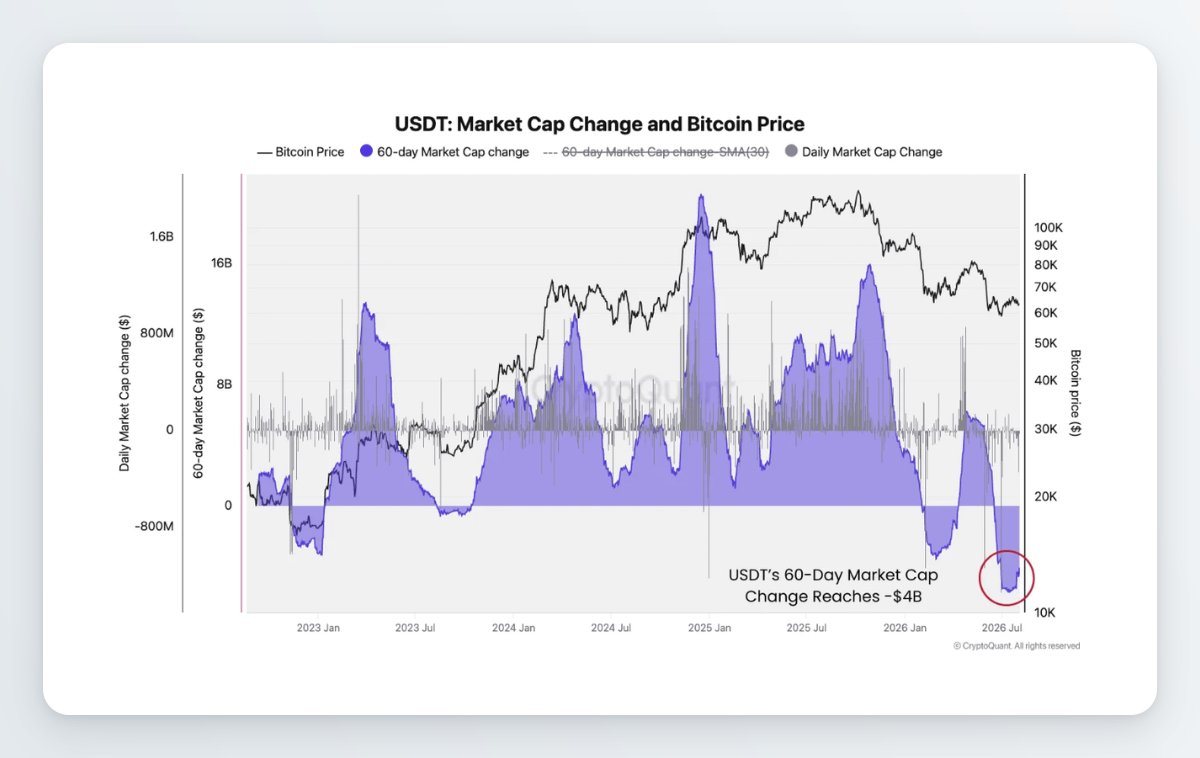
Source: Cryptoquant

Yield Competition Is Only Part of the Picture

Changes in stablecoin economics may also be playing a role. $USDC offers a broader ecosystem of rewards through platforms like Coinbase, while lending protocols including Morpho and Aave provide additional avenues for yield.

However, Moore pointed out that the supply of $USDC has also declined sharply. This weakens the argument that capital is simply flowing from Tether to Circle's stablecoin.

"I think it's just a combination of factors," she said. "Some capital is chasing yield, some is returning to fiat, and stablecoin demand is decreasing as speculative activity cools."

This distinction matters because stablecoins are often viewed as an indicator of available cryptocurrency liquidity. A broad decline among major issuers could signal capital leaving digital asset markets rather than merely waiting on the sidelines.

Tron and Ethereum Still Dominate $USDT

Despite the supply contraction, $USDT remains heavily concentrated on two networks. Tron and Ethereum each account for roughly $90 billion worth of Tether, together making up about 97% of the token's circulating supply.

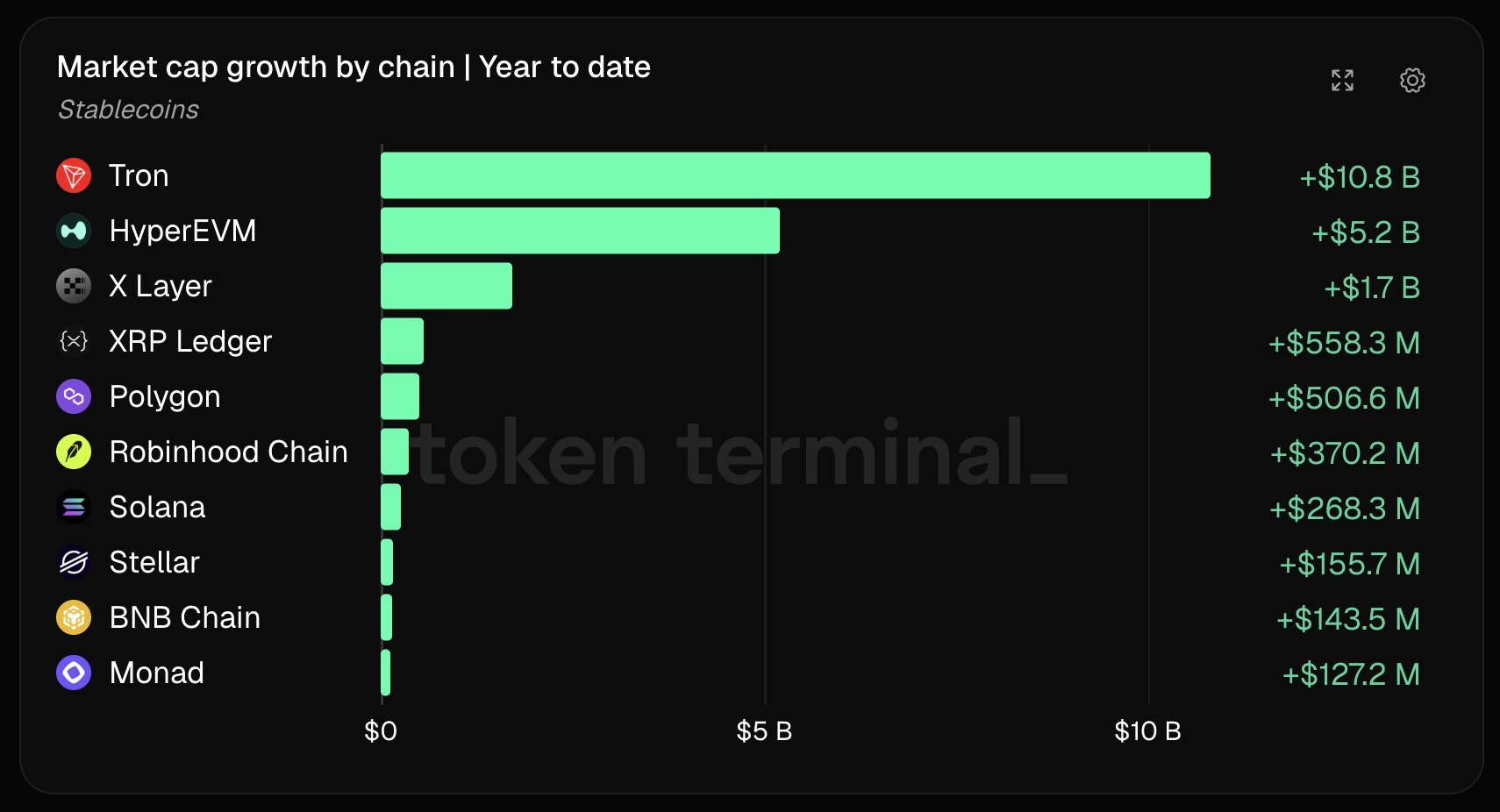
Tron is also leading stablecoin growth this year. The market capitalization of its stablecoins has increased by approximately $10.8 billion, outpacing HyperEVM ($5.2 billion) and X Layer ($1.7 billion).
Source: Token Terminal

Thus, the overall picture is mixed. Tether remains deeply entrenched in cryptocurrency payments, trading, and dollar demand in emerging markets, but its aggregate supply is no longer growing linearly.

For investors, a more significant signal may be whether a decline in stablecoin balances is followed by weaker trading activity and liquidity. If so, the latest $USDT contraction could indicate a broader cooling of appetite for crypto risk rather than a temporary redistribution of digital dollars.


Cryptos en tendance

Questions liées

QWhat is the total reduction in Tether's USDT supply over the past 60 days according to Cryptoquant data?

AAccording to Cryptoquant data, the 60-day rolling change in USDT supply is approximately a decrease of $4 billion.

QAccording to analyst Stacey Moore, what is one key reason for the reduction in stablecoin supply?

AAnalyst Stacy Moore stated that some investors are exchanging stablecoins for fiat currencies and exiting the cryptocurrency space entirely, particularly following Bitcoin's retreat from its 2025 peak.

QDoes the concurrent decrease in both USDT and USDC supply suggest a simple capital shift between these stablecoins?

ANo, the concurrent sharp decrease in USDC supply weakens the argument that capital is simply shifting from Tether to Circle's stablecoin, indicating a broader trend of capital leaving stablecoins.

QWhich two blockchain networks currently dominate the distribution of the circulating USDT supply?

ATron and Ethereum are the two dominant networks, with each holding approximately $90 billion worth of USDT, accounting for roughly 97% of the token's circulating supply.

QWhy is the overall decline in supply from major stablecoin issuers considered a significant signal for the crypto market?

AA decline in supply from major issuers signals that capital may be exiting digital asset markets entirely, rather than simply waiting on the sidelines. This could indicate a broader cooling of risk appetite, potentially leading to weakened trading activity and liquidity.

Lectures associées

Grayscale : « Si les propositions sont adoptées, les prix de ces deux altcoins pourraient augmenter »

Zach Pandl, responsable de la recherche chez Grayscale, estime que des modifications envisagées de la tokenomique d'Ethereum (ETH) et de Solana (SOL) pourraient ralentir considérablement la croissance de leur offre, exerçant ainsi une pression haussière sur leurs prix. Ces propositions visent à réduire le taux d'inflation annuel des jetons ETH et SOL. Un ralentissement de la création de nouveaux jetons augmenterait la rareté des actifs existants. Grayscale prévoit que, si elles sont adoptées, l'inflation annuelle de l'offre d'Ethereum pourrait tomber à environ 0,4% d'ici fin 2031, se rapprochant ainsi du Bitcoin, tandis que celle de Solana pourrait atteindre environ 1,1%. En comparaison, l'offre d'or croît d'environ 1,8% par an et l'inflation (IPC) aux États-Unis est d'environ 3,3%. Pandl note que les propositions pour Solana semblent rencontrer un soutien plus large et ont donc une probabilité de mise en œuvre plus élevée. Cependant, il souligne un compromis potentiel : une inflation réduite pourrait diminuer les récompenses pour les investisseurs pratiquant le staking, une partie importante de leurs revenus provenant de l'émission de nouveaux jetons. En conclusion, un ralentissement de l'offre pourrait profiter aux prix des deux actifs, les détenteurs de jetons sans staking étant particulièrement bien placés pour en bénéficier. Ces changements restent à l'étude et ne sont pas encore approuvés.

cryptonews.ruIl y a 1 h

Grayscale : « Si les propositions sont adoptées, les prix de ces deux altcoins pourraient augmenter »

cryptonews.ruIl y a 1 h

Les experts ont nommé les raisons de la chute du bitcoin après la baisse de l'inflation aux États-Unis

Les données favorables sur l’inflation aux États‑Unis n’ont pas réussi à soutenir le bitcoin. Selon les analystes de CryptoQuant, la principale raison est la faible demande sur le marché au comptant. Le bitcoin n’a pas réagi aux chiffres de l’inflation de juillet, publiés le 12 août, et a même légèrement baissé, passant d’environ 64 500 $ à près de 63 000 $. Pourtant, l’indice des prix à la production (PPI) était meilleur que prévu. Alors que les rendements des obligations du Trésor américain ont reculé et que les marchés actions ont progressé, le bitcoin est resté dans une fourchette de 63 000 à 64 000 $. Cette absence de réaction s’explique notamment par la faible demande au comptant : les entrées de capitaux dans les ETF américains spot de bitcoin restent limitées, et l’indice Coinbase Premium (reflétant l’écart de prix entre Coinbase et les autres grandes plateformes) est négatif depuis mai, indiquant une pression d’achat modérée de la part des investisseurs américains. Dans le même temps, le positionnement des traders sur le marché à terme reste élevé, créant un déséquilibre entre une faible liquidité, une demande spot atone et un volume important de positions à effet de levier. Les analystes estiment que dans ces conditions, même des nouvelles macroéconomiques positives pourraient ne pas déclencher de hausse. Si le prix n’évolue pas malgré un contexte favorable, les traders pourraient commencer à clôturer leurs positions longues à effet de levier, ce qui exercerait une pression supplémentaire à la baisse. Un niveau de résistance clé se situe autour de 68 700 $, coût moyen approximatif pour les détenteurs à court terme, au‑delà duquel une prise de bénéfices est possible. Pour CryptoQuant, une reprise soutenue nécessiterait : une reprise des entrées dans les ETF américains, un retour de l’indice Coinbase Premium en territoire positif, une hausse des volumes de trading au comptant et un franchissement stable des 68 700 $.

cryptonews.ruIl y a 2 h

Les experts ont nommé les raisons de la chute du bitcoin après la baisse de l'inflation aux États-Unis

cryptonews.ruIl y a 2 h

Trading

Spot

Articles tendance

Comment acheter 4

Bienvenue sur HTX.com ! Nous vous permettons d'acheter 4 (4) de manière simple et pratique. Suivez notre guide étape par étape pour commencer votre parcours crypto.Étape 1 : Création de votre compte HTXUtilisez votre adresse e-mail ou votre numéro de téléphone pour ouvrir un compte sur HTX gratuitement. L'inscription se fait en toute simplicité et débloque toutes les fonctionnalités.Créer mon compteÉtape 2 : Choix du mode de paiement (rubrique Acheter des cryptosCarte de crédit/débit : utilisez votre carte Visa ou Mastercard pour acheter instantanément 4 (4).Solde :utilisez les fonds du solde de votre compte HTX pour trader en toute simplicité.Prestataire tiers :pour accroître la commodité d'utilisation, nous avons ajouté des modes de paiement populaires tels que Google Pay et Apple Pay.P2P :tradez directement avec d'autres utilisateurs sur HTX.OTC (de gré à gré) : nous offrons des services personnalisés et des taux de change compétitifs aux traders.Étape 3 : stockage de vos 4 (4)Après avoir acheté vos 4 (4), stockez-les sur votre compte HTX. Vous pouvez également les envoyer ailleurs via un transfert sur la blockchain ou les utiliser pour trader d'autres cryptos.Étape 4 : tradez des 4 (4)Tradez facilement 4 (4) sur le marché Spot de HTX. Il vous suffit d'accéder à votre compte, de sélectionner la paire de trading, d'exécuter vos trades et de les suivre en temps réel. Nous offrons une expérience conviviale aux débutants comme aux traders chevronnés.

896 vues totalesPublié le 2025.10.20Mis à jour le 2026.06.02

Comment acheter 4

Discussions

Bienvenue dans la Communauté HTX. Ici, vous pouvez vous tenir informé(e) des derniers développements de la plateforme et accéder à des analyses de marché professionnelles. Les opinions des utilisateurs sur le prix de 4 (4) sont présentées ci-dessous.

活动图片