Avalanche Price Forecast for August 2026: Can AVAX Break Above $7 When Kenya Launches on the Network?

cryptonews.ruPublié le 2026-08-05Dernière mise à jour le 2026-08-05

Résumé

Avalanche (AVAX) Price Forecast for August 2026: Key Factors and Levels Avalanche (AVAX) is trading at $6.782 on August 4, showing signs of a potential breakout after consolidating between $5.50 and $7 since June. The price has recently moved above its 20-day and 50-day EMAs, with the Parabolic SAR turning bullish for the first time in months. Key resistance levels are $7 (range top), $7.483 (100-day EMA), and $9.368 (200-day EMA). Support lies at $6.775 (50-day EMA), $6.532 (20-day EMA), $6.040 (Parabolic SAR), and $5.50 (range bottom). Historically, August is AVAX's strongest month with an average return of +25.1%, though median returns are more modest. The token enters August from a low base after a significant June sell-off. Fundamentally, the network is seeing increased institutional adoption. Kenya's National Examinations Council (KNEC) has placed over 15 million academic records on Avalanche. Other developments include Securitize tokenizing ~$300M, Progmat migrating $2.7B+ in securities, Aave V4 expanding to Avalanche, and Hyundai launching a stablecoin payment pilot. The Avalanche Payments Collective has also launched with 29 members. The weekly forecast suggests a range between $6.60-$8.50 for the month, with a close above the 100-day EMA at $7.483 being a key bullish target. The bearish risk involves a rejection at $7 and a fall back towards the $5.50 range low. The progress of the U.S. CLARITY Act by August 7 is noted as a potential macro catalyst.

$AVAX is trading at $6.782 on August 4th, up 3.23% on the day, having broken above its 20-day and 50-day EMAs for the first time in several months as a packed summer of institutional adoption sets the stage for what is historically the strongest calendar month for the token.

$AVAX to Break Above Range Midpoint in Early August
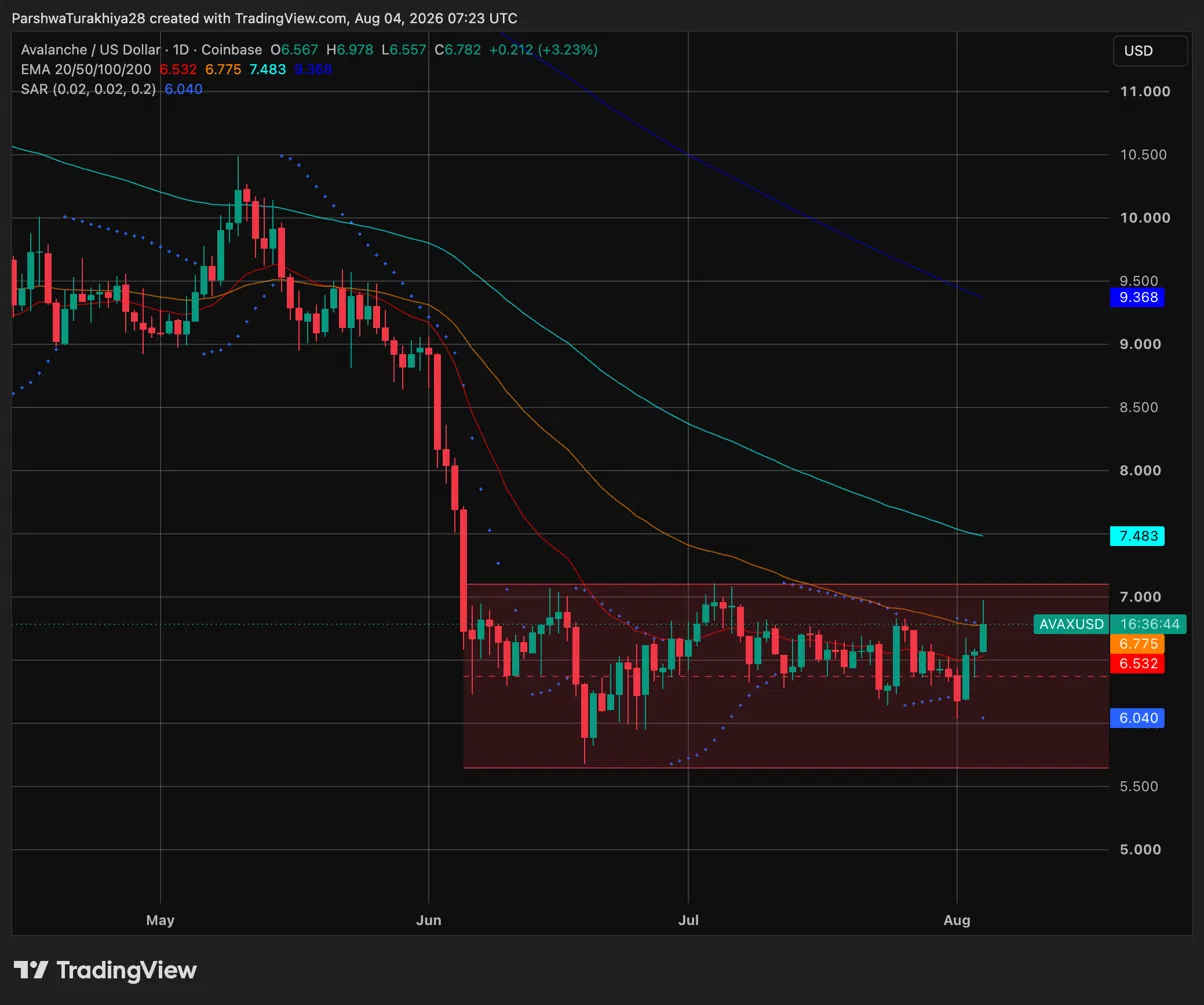
$AVAX Price Dynamics (Source: TradingView)

The daily chart shows $AVAX has consolidated roughly between $5.50 and $7 since the June sell-off, which dropped the price by 27.2% in one month. The August opening session breached the upper half of this range, reaching a high of $6,978 before settling at $6,782. The Parabolic SAR at $6.040 has dropped below price and is now bullish—the first time such a reading has occurred in several months.

The 20-day EMA at $6,532 and the 50-day at $6,775 were reclaimed in the same session, giving bulls a meaningful foothold for the first time since May. The 100-day EMA at $7.483 is the next test higher and sits just above the current consolidation range. The 200-day at $9.368 reflects the long-term ceiling. The round number $7 and the range top are the immediate resistance zone, while the SAR at $6.040 and the range low around $5.50 define the downside.

$AVAX Support and Resistance Levels, August 2026

Type Price Level
Resistance $7 Range Top and Round Number
Resistance $7.483 100-day EMA, First Major Target Above Range
Resistance $9.368 200-day EMA, Long-Term Ceiling
Support $6.775 50-day EMA, Need to Hold on Pullback
Support $6.532 20-day EMA
Support $6.040 Parabolic SAR, Bullish Level Below Price
Support $5.50 Range Floor and Last Major Support

August Seasonality: Historically Strongest Month, with Caveats
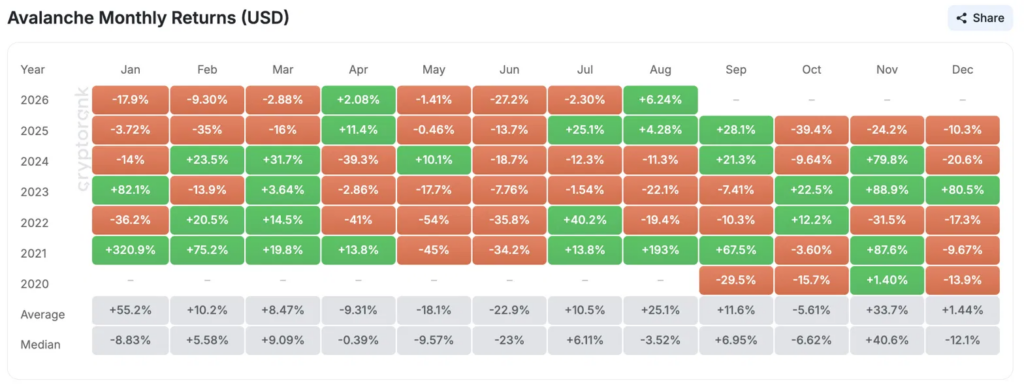
$AVAX Monthly Returns (Source: CryptoRank)

August is the highest-returning month for $AVAX on record, averaging +25.1% across all years with available data. The +193% performance in 2021 significantly skews this average, but even excluding that, August showed gains in 2025 (+4.28%), while losses in 2024 (-11.3%) and 2023 (-22.1%) show volatility on both sides. The median August return is -3.52%, a more cautious figure than the average suggests.

Related: SkyAI Price Forecast: SKYAI Price Surges Over 100% as Bulls Aim for New Breakout

What distinguishes 2026 is the starting point. $AVAX enters August from a low base after one of its worst-performing Junes on record (-27.2%), which historically lowers downside risk in the following month. The shallow -2.30% decline in July suggests sellers have largely exhausted the June momentum, and the early August breakout above both short-term EMAs adds technical confirmation that the seasonal setup lacked in previous years.

Kenya Stores 15 Million Academic Records on Avalanche

Kenya's National Examinations Council (KNEC) has placed over 15 million academic records on the Avalanche C-Chain, dating back to 1989. The 2025 KCSE certificates for nearly one million students are now issued exclusively through this platform. What used to take up to six months for manual institutional requests now requires a few seconds for verification.

This is not the first governmental deployment for Avalanche. The same LegitDoc platform digitized 700,000 land records in India's Dantewada district, the California Department of Motor Vehicles migrated 42 million vehicle titles, and Bergen County, New Jersey, is tokenizing 370,000 property deeds worth $240 billion. Kenya is the latest and largest addition to this list.

Packed Summer of Institutional Adoption

Summer on Avalanche, where much was built 🔺

Hyundai together with @Tether and @AxiymFinance, launches Stablecoin payment pilot on Avalanche.@AvalancheFDN publishes research on blockchain tokenomics@AvaxTeam1 launches their Builder Grants program with up to $30,000 in... pic.twitter.com/4XhEITLZBx

— Avalanche🔺 (@avax) August 3, 2026

Beyond Kenya, Avalanche's summer recap points to a broad base of institutional activity that has been quietly building while prices ranged. Securitize tokenized roughly $300M on the network, Progmat completed a $2.7B+ securities migration onto its Avalanche L1, and RWAs on Avalanche hit all-time highs.

Aave V4 expanded to Avalanche as the first network post-Ethereum. Hyundai launched a stablecoin payment pilot with Tether and Axiym Finance, and the Avalanche Payments Collective launched with 29 participants including WisdomTree and VanEck.

Related: Meme Coin Price Forecast: Dogecoin, Shiba Inu, MemeCore

The pattern across all this is consistent: institutions are choosing Avalanche for real settlement infrastructure, not experiments, giving August's technical breakout a fundamental underpinning that previous recovery attempts lacked.

Catalyst Details
Securitize ~$300M tokenized on Avalanche
Progmat $2.7B+ securities migrated to Avalanche L1
Aave V4 First chain post-Ethereum to get expansion
Hyundai Pilot Stablecoin payments with Tether & Axiym Finance
RWAs Reached all-time highs on Avalanche over summer
Payments Collective 29 participants including WisdomTree & VanEck

Weekly Forecast for August 2026

Week Price Range Key Level to Watch Scenario
Aug 1-8 $6.60–$7.20 Break or Rejection at $7 CLARITY Act deadline Aug 7th could be macro catalyst; Holding above 50-day EMA is key
Aug 11-15 $6.80–$7.50 100-day EMA at $7.483 If $7 holds, next test is 100-day EMA; Failure sends price back to 20-day at $6.532
Aug 18-22 $7–$8 Zone from $7.483 to $8 Mid-month consolidation above 100-day EMA leads to push toward $8 area; Failure keeps price range-bound
Aug 25-31 $6.50–$8.50 Monthly Close Above $7.483 Monthly close above 100-day EMA would be most constructive for September continuation

Avalanche Price Forecast August 2026: Upside Targets & Downside Risk

Bull Case, Target: $7.483 (100-day EMA)

$AVAX holds the reclaimed 50-day EMA at $6.775 and confirms the range breakout above $7 on a weekly close. Progress on the CLARITY Act ahead of the Aug 7th recess deadline adds macro catalyst, and summer institutional adoption news continues to attract new capital. Maintaining the Parabolic SAR's bullish price reading throughout the month keeps momentum in buyers' favor, and price advances towards the 100-day EMA at $7.483, aligning with August's historical average return.

Bear Risk, Risk Level: $5.50 (Range Low)

Rejection at $7 persists, and $AVAX loses the 50-day EMA at $6,775 within the first two weeks, invalidating the early August breakout. The CLARITY Act stalls post-recess without a vote, removing the near-term regulatory catalyst. Price retreats to the 20-day EMA at $6,532, and upon failure, to the SAR at $6,040 and the range bottom around $5.50, repeating the failed recovery pattern seen throughout July.

end-content

Cryptos en tendance

Questions liées

QBased on the technical analysis provided, what are the key immediate support and resistance levels for AVAX price in August 2026?

AThe key immediate resistance level is the round number $7, which coincides with the top of its recent consolidation range. The key immediate support levels are the 50-day EMA at $6.775 and the 20-day EMA at $6.532. The Parabolic SAR at $6.040 and the range floor at ~$5.50 represent major support levels below the EMAs.

QAccording to the article, what historical seasonal trend does August show for AVAX, and what is the critical nuance in this data?

AHistorically, August is AVAX's strongest calendar month with an average return of +25.1%. However, the median return is -3.52%, indicating that the average is heavily skewed by an extreme outlier year (like 2021's +193%). The data shows mixed results, with gains in 2025 but losses in 2024 and 2023.

QWhat are some of the major institutional adoption milestones for Avalanche mentioned in the article from the summer of 2026?

AMajor milestones include: Kenya's KNEC placing over 15 million academic records on Avalanche; Securitize tokenizing ~$300M on the network; Progmat migrating $2.7B+ of securities to Avalanche L1; Aave V4 expanding to Avalanche as its first chain post-Ethereum; Hyundai's stablecoin payment pilot with Tether and Axiym Finance; and the launch of the Avalanche Payments Collective with 29 participants like WisdomTree and VanEck.

QWhat are the price target scenarios (Bull Case and Bear Case) presented for AVAX in August 2026, and their respective conditions?

AThe Bull Case target is the 100-day EMA at $7.483. Conditions include holding above the 50-day EMA ($6.775), a weekly close above $7, progress on the CLARITY Act, and continued institutional adoption news. The Bear Case risk level is the range floor at $5.50. This would occur if AVAX faces rejection at $7, loses the 50-day EMA, and sees the CLARITY Act stall, invalidating the early August breakout.

QAccording to the weekly forecast table, what is the key event and level to watch in the week of August 1-8, 2026?

AThe key event is the CLARITY Act deadline on August 7, which is identified as a potential macro catalyst. The key level to watch is a breakout or rejection at the $7 resistance level. Holding above the 50-day EMA at $6.775 is cited as crucial for the bullish scenario during this period.

Lectures associées

Le financement en crypto divisé par deux au premier trimestre, comment le paiement en stablecoin attire-t-il l'argent contre la tendance ?

Le financement par capital-risque dans le secteur des crypto-monnaies a chuté d'environ 50% au premier trimestre 2026, les investisseurs se concentrant désormais sur les entreprises matures avec des revenus réels. Dans ce contexte, le secteur des paiements en stablecoins se distingue en continuant à lever des fonds importants. Les stablecoins évoluent d'un outil de trading vers une infrastructure de paiement, avec une capitalisation boursière dépassant 3170 milliards de dollars. Les investisseurs soutiennent désormais toute la pile technologique des paiements : cartes (Rain, RedotPay), paiements transfrontaliers et devises (OpenFX, Conduit), portefeuilles (Mesh), connexions bancaires (Stablecore) et infrastructures blockchain sous-jacentes. Cette attractivité s'explique par plusieurs facteurs : la résolution de problèmes d'inefficacité des paiements transfrontaliers, des modèles de revenus clairs (frais de transaction, spreads de change), l'intégration discrète des stablecoins dans des interfaces familières (WhatsApp, cartes), un cadre réglementaire plus clair élargissant la clientèle potentielle, et une visibilité accrue sur les sorties d'investissement via des acquisitions par des géants comme Stripe ou Mastercard. Cependant, l'engouement doit être nuancé. Le volume des transactions en chaîne ne reflète pas le volume des paiements réels pour des biens et services. Les financements sont concentrés sur quelques leaders, et les services de base risquent une banalisation rapide. L'expansion mondiale reste un défi, nécessitant des partenariats locaux dans chaque marché, et les institutions financières traditionnelles sont à la fois des clients et des concurrents potentielles. Les prochains investissements devraient se porter sur les paiements B2B transfrontaliers, les connexions entre banques et stablecoins, les cartes liées aux stablecoins, les couches d'orchestration multi-chaînes, et les paiements pour agents IA. En résumé, l'intérêt des investisseurs ne signale pas un retour en force des financements crypto globaux, mais un recentrement sur les infrastructures générant des revenus réels en intégrant les stablecoins au système financier traditionnel. La valeur future dépendra de la capacité à transformer le volume de transactions en paiements clients réels et rentables.

marsbitIl y a 4 mins

Le financement en crypto divisé par deux au premier trimestre, comment le paiement en stablecoin attire-t-il l'argent contre la tendance ?

marsbitIl y a 4 mins

Les 9 derniers jours de BitMart : la véritable crise d'une plateforme d'échange n'a jamais été sa fermeture

En août 2026, à 9 jours de l’arrêt définitif de ses services, BitMart fait face à une crise de confiance. Des utilisateurs et employés réclament publiquement la transparence sur les actifs, dettes, portefeuilles et réserves disponibles pour les retraits, en plus d’un plan de remboursement et d’un audit indépendant. Si le PDG Sheldon Lee dément les accusations, la controverse soulève une question cruciale : une plateforme d’échange centralisée peut-elle faire face à un retrait massif de fonds ? L’annonce initiale de fermeture progressive semblait ordonnée, mais la demande concentrée de retraits a transformé un problème commercial en test de solvabilité. L’affaire rappelle que dans un CEX, les soldes des comptes ne sont que des créances enregistrées en interne, distinctes des actifs réels sur la blockchain. La confiance inhérente au modèle est soumise à une pression extrême lors d’une fermeture. Les demandes de preuves de réserves (Proof of Reserves) seules sont jugées insuffisantes : ce qui importe, c’est la relation entre les actifs disponibles et le total des créances clients. L’industrie est appelée à réfléchir à des mécanismes de fermeture transparents et structurés, similaires à ceux des institutions financières traditionnelles. L’échéance du 19 août pour une réponse de BitMart et celle du 26 août pour l’arrêt des transactions sont des points d’attention, mais la véritable mesure de la crédité d’un exchange se joue au moment où le dernier utilisateur récupère ses actifs en toute sécurité.

marsbitIl y a 2 h

Les 9 derniers jours de BitMart : la véritable crise d'une plateforme d'échange n'a jamais été sa fermeture

marsbitIl y a 2 h

Pas de paris sur des tokens à x100, mais des paris sur les "vaches à lait" : quels projets méritent un DCA pendant le marché baissier ?

Face à la morosité du marché cryptographique actuel, l'auteur propose une stratégie d'investissement alternative à la spéculation effrénée sur les memecoins : se concentrer sur les projets générant des revenus réels et soutenus, même en période de baise. L'article analyse les performances financières de quatre protocoles en se basant sur leurs revenus nets mensuels. **Pump.fun**, plateforme de création de memecoins sur Solana, se distingue comme une véritable "machine à cash", avec 4153 M$ de revenus sur les 30 derniers jours et un cumul de 256 M$ sur les sept premiers mois de l'année. Ses revenus, provenant des frais sur les transactions et les "graduations" de jetons, fluctuent avec l'engouement pour les memes mais restent impressionnants. **Hyperliquid**, un DEX de contrats perpétuels, est encore plus performant avec 352 M$ de revenus cumulés sur la même période. Sa force réside dans un modèle économique robuste qui voit 99% de ses frais de transaction utilisés pour racheter et brûler son jeton natif HYPE, créant une pression acheteuse constante. Le vénérable **Uniswap** a réactivé ses "fees switch", permettant désormais à son protocole de capturer une partie des frais d'échange. Cela génère une revenu stable, autour de 440 à 510 M$ par mois, désormais lié à la destruction de jetons UNI, donnant une nouvelle utilité économique à l'actif. Enfin, **Chainlink**, l'infrastructure de référence pour les oracles et les services de données, montre une résilience remarquable avec des revenus mensuels stables autour de 460 à 580 M$. Son modèle, essentiel au fonctionnement de la DeFi et de la finance institutionnelle sur chaîne, en fait un "péage" quasi-incontournable dont les revenus sont progressivement convertis en LINK. La thèse centrale est qu'investir dans les jetons de ces "vaches à lait" du crypto, qui démontrent une capacité à générer des flux de trésorerie durables, pourrait être une stratégie plus fiable pour traverser le marché baissier en vue du prochain cycle haussier.

marsbitIl y a 2 h

Pas de paris sur des tokens à x100, mais des paris sur les "vaches à lait" : quels projets méritent un DCA pendant le marché baissier ?

marsbitIl y a 2 h

Trading

Spot

Articles tendance

Comment acheter AVAX

Bienvenue sur HTX.com ! Nous vous permettons d'acheter Avalanche (AVAX) de manière simple et pratique. Suivez notre guide étape par étape pour commencer votre parcours crypto.Étape 1 : Création de votre compte HTXUtilisez votre adresse e-mail ou votre numéro de téléphone pour ouvrir un compte sur HTX gratuitement. L'inscription se fait en toute simplicité et débloque toutes les fonctionnalités.Créer mon compteÉtape 2 : Choix du mode de paiement (rubrique Acheter des cryptosCarte de crédit/débit : utilisez votre carte Visa ou Mastercard pour acheter instantanément Avalanche (AVAX).Solde :utilisez les fonds du solde de votre compte HTX pour trader en toute simplicité.Prestataire tiers :pour accroître la commodité d'utilisation, nous avons ajouté des modes de paiement populaires tels que Google Pay et Apple Pay.P2P :tradez directement avec d'autres utilisateurs sur HTX.OTC (de gré à gré) : nous offrons des services personnalisés et des taux de change compétitifs aux traders.Étape 3 : stockage de vos Avalanche (AVAX)Après avoir acheté vos Avalanche (AVAX), stockez-les sur votre compte HTX. Vous pouvez également les envoyer ailleurs via un transfert sur la blockchain ou les utiliser pour trader d'autres cryptos.Étape 4 : tradez des Avalanche (AVAX)Tradez facilement Avalanche (AVAX) sur le marché Spot de HTX. Il vous suffit d'accéder à votre compte, de sélectionner la paire de trading, d'exécuter vos trades et de les suivre en temps réel. Nous offrons une expérience conviviale aux débutants comme aux traders chevronnés.

755 vues totalesPublié le 2024.12.12Mis à jour le 2026.06.02

Comment acheter AVAX

Discussions

Bienvenue dans la Communauté HTX. Ici, vous pouvez vous tenir informé(e) des derniers développements de la plateforme et accéder à des analyses de marché professionnelles. Les opinions des utilisateurs sur le prix de AVAX (AVAX) sont présentées ci-dessous.

活动图片