Bitcoin: Rising oil prices keep BTC in check – Long-term holders in limbo

ambcryptoPublié le 2026-07-21Dernière mise à jour le 2026-07-21

Résumé

Bitcoin faces mixed signals as it tests $64,500. While traditional investors added modest inflows, long-term holders (those holding coins for 155+ days) remain a focal point of caution. On-chain data shows this group is still selling at a loss, with their Spent Output Profit Ratio (SOPR) at 0.94, indicating 6% losses—a significant improvement from earlier 27% losses but not yet a sign of full conviction. Market activity is currently dominated by short-term holders, as indicated by the Exchange Coin Days Destroyed (CDD) metric, suggesting a more relaxed selling phase. Exchange reserves have also declined slightly. However, macroeconomic risks pose a headwind. Rising oil prices, driven by Middle East tensions, threaten to reignite inflation concerns. This could dampen the risk-on sentiment crucial for Bitcoin and potentially lead US investors to reduce exposure via spot Bitcoin ETFs. The market's recovery hinges on balancing these improving on-chain dynamics against persistent external economic pressures.

Bitcoin [BTC] has absorbed a run of blows, and although sentiment looks steadier with the asset testing $64,500 again, the market has yet to earn a bullish label.

Traditional investors appear to be circling back, adding $75.76 million in inflows between the 13th and the 17th of July, yet several forces keep the market in a cautious state. Long-term holders remain at the center of that caution.

Bitcoin long-term holders still need watching

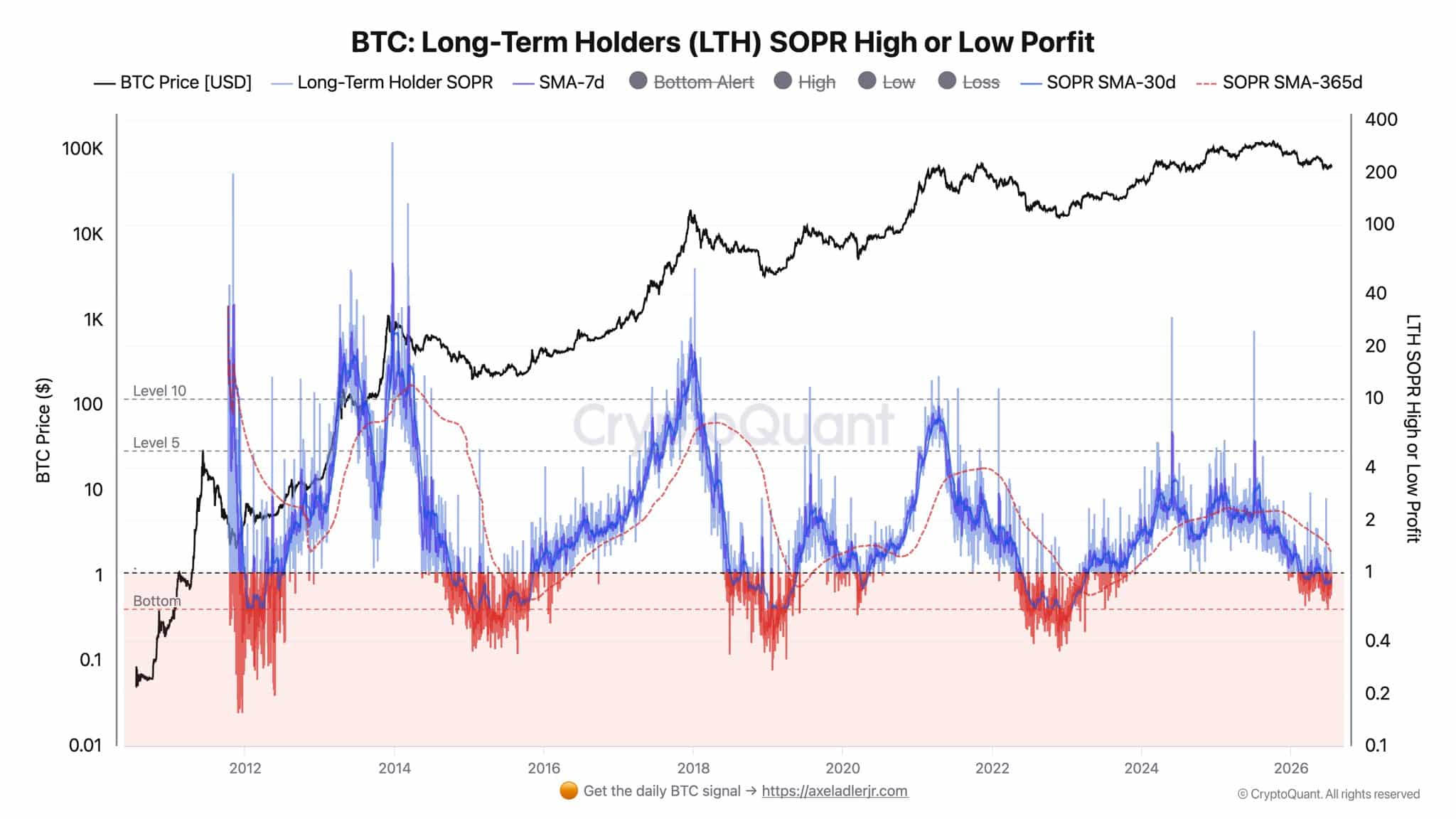
Long-term holders are investors who have held their coins for no less than 155 days without moving them, and on-chain data shows this group selling at a loss rather than a profit.

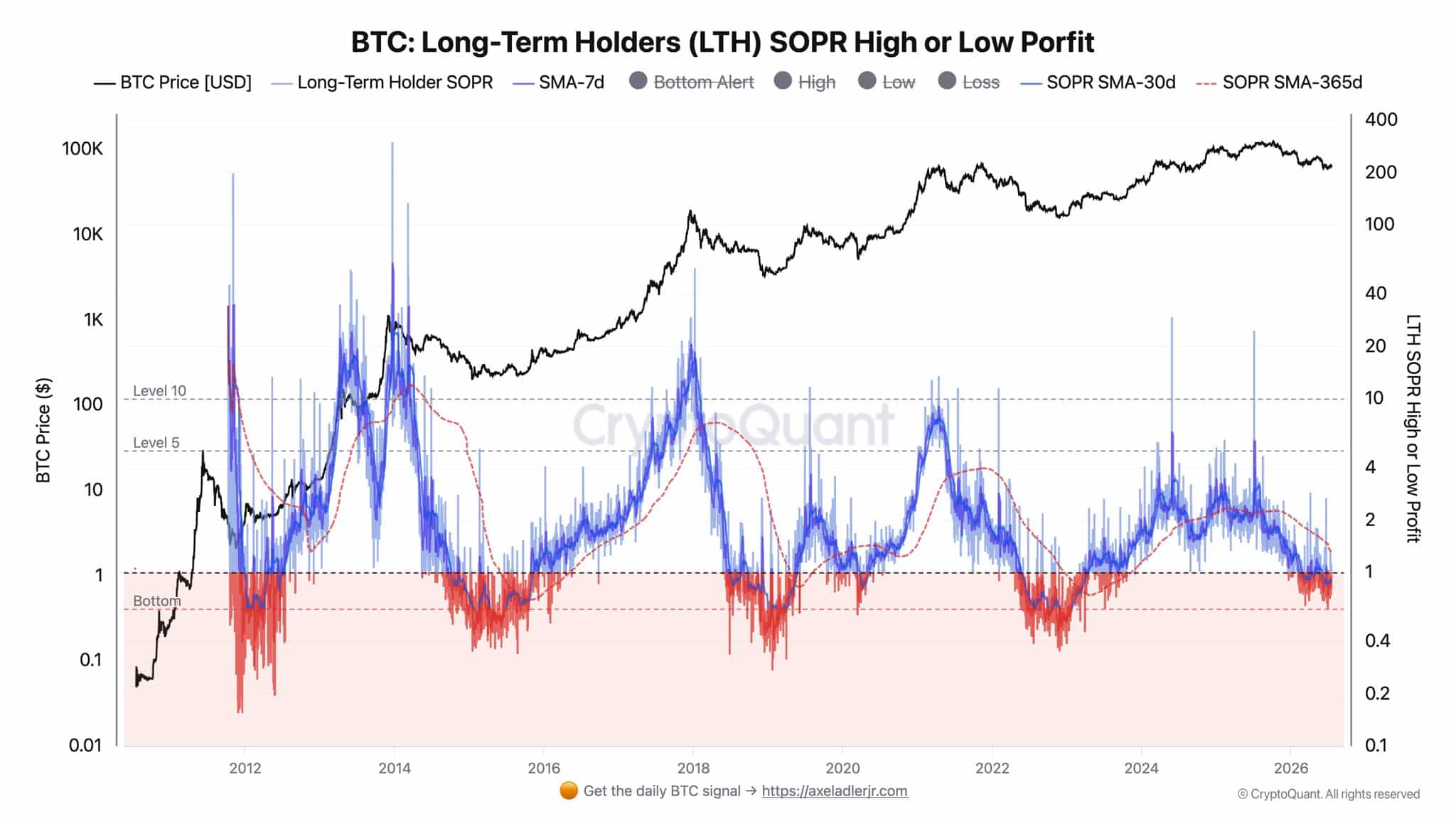
The 7-day moving average of the long-term holder SOPR – the Spent Output Profit Ratio (SOPR), which measures whether coins move at a profit or a loss – sits at 0.94 at press time, below the breakeven mark of 1.

That reading tells us long-term holders have parted with their Bitcoin at roughly a 6% loss so far.
Source: CryptoQuant

The figure marks a sharp improvement from earlier in the cycle, when the group sold at a 27% loss and the LTH SOPR fell to 0.73.

Less selling does not translate to full conviction, and the improvement does not mean the market has locked in a rebound, so long-term holders remain exposed to further price swings.

The monthly picture reinforces that caution, with the LTH SOPR showing these investors selling at a 12% loss since June.

History still offers a counterweight, as prolonged stretches of loss-taking have often preceded Bitcoin rallies, including the 2020 and 2023 runs to fresh all-time highs after the market exited similar phases.

Exchange CDD points to short-term holder dominance

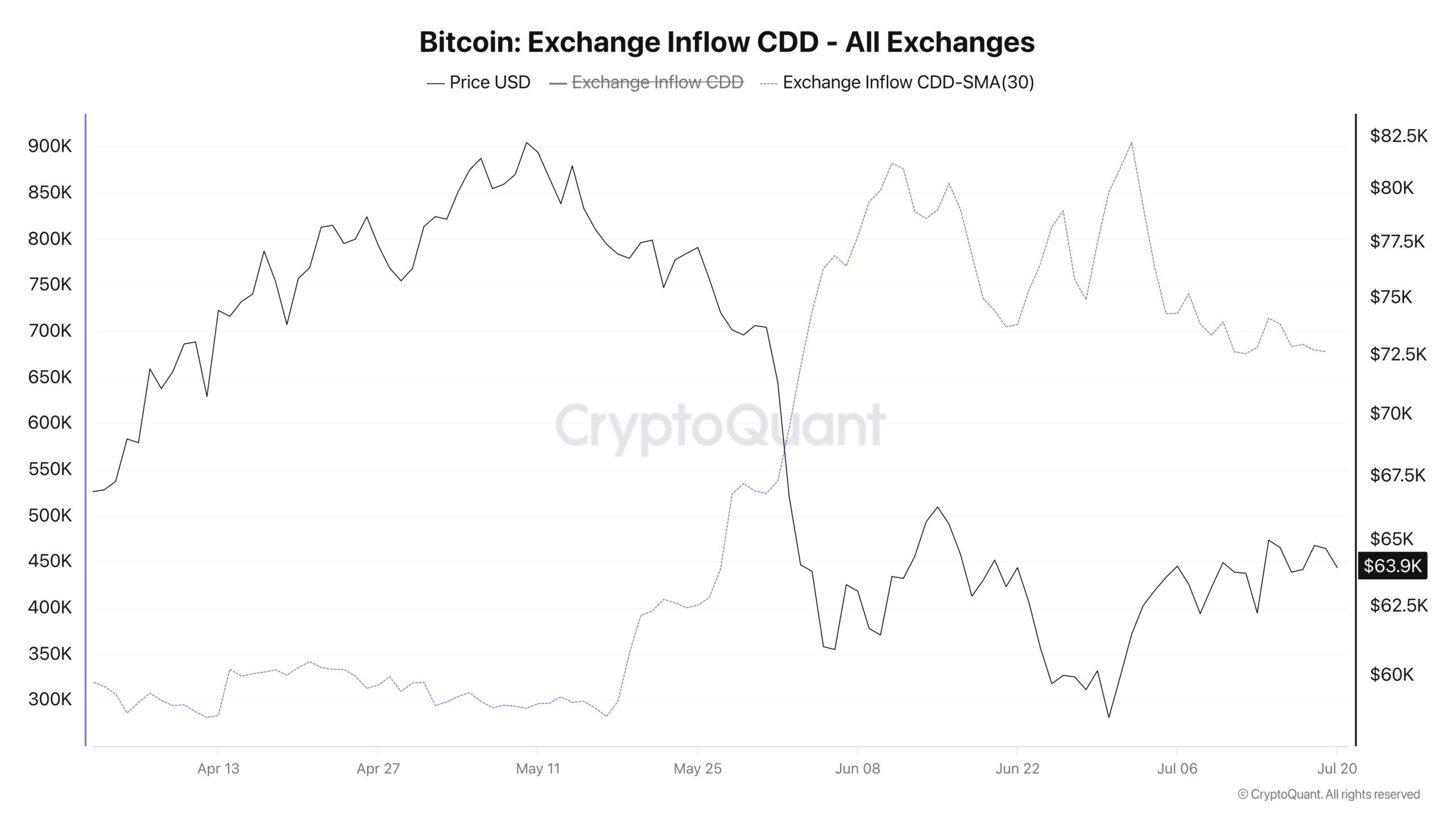
Exchange Coin Days Destroyed (CDD) weights each moving coin by how long it stayed dormant, which lets analysts see whether long-term or short-term holders drive the coins landing on exchanges, and the metric currently marks short-term, active participants as the dominant force.

An elevated Exchange CDD normally signals that sellers control the market as selling pressure builds, a classic bearish read, yet the opposite is playing out here and points to a more relaxed phase.
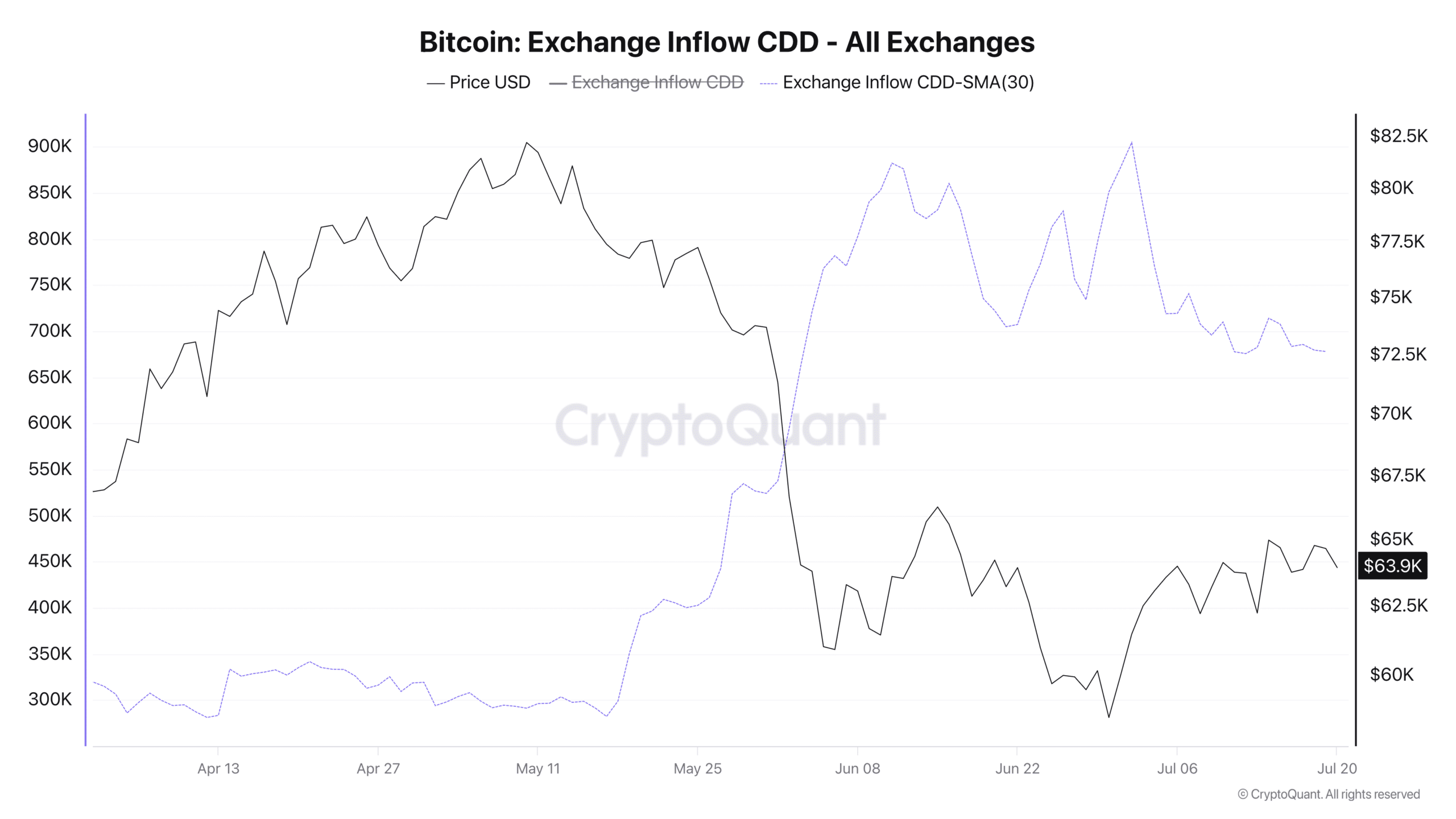
Source: CryptoQuant

Fewer long-term holders are moving coins, and with that group nursing losses of only about 6%, the setup leans constructive and raises the odds of a faster recovery from current levels.

The exchange reserve reflects that shift, and although long-term holders do not dominate the reserve, they contribute to a decline that has carried it from a high of 2.718 million BTC to 2.704 million BTC.

That drop returns the reserve to its late-June footing, around the 24th of June.

Will US investors keep funding?

Economic pressures and the threat of resurgent inflation still weigh on the market.

Inflation cooled over the past week on official readings, yet concern has climbed as the conflict involving the US, Iran, and Israel has escalated. Oil has answered the tension, with WTI crude climbing to $85.59 at Monday’s open, its highest level since the 12th of June.

The inflation worry runs largely through oil, since rising crude lifts production costs across the economy and increases the risk-off mood—and Bitcoin depends on risk-on appetite. Should oil continue to climb, US investors may reduce their exposure through spot US Bitcoin ETFs.


Final Summary

  • Long-term holders have eased their selling, now offloading at a 6% loss versus 27% earlier.
  • Bitcoin still needs a risk-on appetite, so rising oil and fresh inflation fears could push US investors to trim exposure.


Cryptos en tendance

Questions liées

QWhat is the current state of long-term Bitcoin holders' selling behavior according to the LTH SOPR metric?

ALong-term Bitcoin holders are currently selling at a loss, with the 7-day moving average of the LTH SOPR at 0.94, indicating they are parting with their Bitcoin at roughly a 6% loss.

QWhat does a low Exchange Coin Days Destroyed (CDD) reading indicate about the current market participants?

AA low Exchange CDD indicates that short-term, active participants are the dominant force moving coins to exchanges, rather than long-term holders, which points to a more relaxed market phase.

QWhat external economic factor is mentioned as a potential threat to Bitcoin's risk-on appetite and US investor funding?

ARising oil prices are mentioned as a key threat, as they lift production costs and increase a risk-off mood. This could lead US investors to reduce their exposure through spot Bitcoin ETFs.

QHow does the article describe the potential historical significance of long-term holders selling at a loss?

AThe article notes that history shows prolonged periods of long-term holders selling at a loss have often preceded significant Bitcoin rallies, such as the runs to all-time highs in 2020 and 2023.

QWhat is the trend mentioned for Bitcoin's exchange reserves, and what does it signify?

ABitcoin's exchange reserves have declined from a high of 2.718 million BTC to 2.704 million BTC, returning to levels seen in late June. This decline, while long-term holders are not the dominant sellers, is viewed as a constructive, positive sign for the market.

Lectures associées

Fin 2026, l'ère des "Cygnes Noirs à Haute Fréquence" pour les matières premières

Un rapport de Citigroup souligne qu'à partir de la seconde moitié de 2026, le marché des matières premières pourrait entrer dans une ère de « cygnes noirs à haute fréquence », où les événements extrêmes deviendraient quasi-normaux sous l'effet conjugué de la géopolitique, du climat et des chocs technologiques. Parmi les principaux risques de queue identifiés : une escalade du conflit américano-iranien pourrait entraîner une crise d'approvisionnement pétrolier prolongée, propulsant les prix du brut au-delà de 200 dollars le baril. Une intensification des tensions en Ukraine pourrait perturber davantage le marché du gaz naturel que celui du pétrole. Une course aux stocks de minéraux critiques par les gouvernements pourrait faire bondir le prix du cuivre au-dessus de 20 000 dollars la tonne. Un épisode El Niño extrême menace de faire remonter le cacao à 10 000 dollars la tonne. La bulle ou le succès de l'IA pourrait impacter différemment la demande d'électricité, de gaz et de métaux comme le cuivre. La signature du gazoduc « Force de Sibérie 2 » entre la Russie et la Chine pourrait créer une surabondance de GNL, faisant chuter les prix asiatiques. Enfin, une application extrême de la « doctrine Monroe » par les États-Unis, bloquant les exportations de pétrole des Amériques, pourrait déclencher une crise pétrolière majeure. Le rapport souligne que l'or pourrait subir une correction à court terme avant de potentiellement doubler à long terme, porté par les achats des banques centrales et les inquiétudes géopolitiques. Ces scénarios, bien que de probabilité variable, visent à compléter les prévisions de base en envisageant des chocs de prix suffisamment importants pour rendre caduques les analyses traditionnelles de l'offre et de la demande.

marsbitIl y a 9 mins

Fin 2026, l'ère des "Cygnes Noirs à Haute Fréquence" pour les matières premières

marsbitIl y a 9 mins

Le yen à un plus bas de 40 ans, comment le Japon va-t-il fixer le prix des vendeurs à découvert ?

Le yen japonais a atteint un niveau proche de son plus bas en 40 ans face au dollar, approchant 164. La ministre des Finances, Shunichi Suzuki, a averti d'une action "audacieuse" contre les fluctuations désordonnées. La zone 163-165 est devenue une bande de test pour la politique japonaise. La faiblesse du yen, visible également sur le taux de change effectif (indicateur large), exacerbe l'inflation importée, notamment via le pétrole brut. Cela pourrait inciter la Banque du Japon (BoJ) à relever les taux plus tôt que prévu. Le ministère des Finances utilise d'abord des interventions verbales pour renchérir le coût des paris contre le yen. Une intervention directe sur le marché des changes, coûteuse en réserves, n'est pas encore confirmée pour juillet. Deux leviers plus lents mais potentiellement plus durables sont à l'œuvre : les anticipations de hausse des taux de la BoJ, qui réduisent l'attrait du "carry trade" (emprunt en yen à bas coût), et les discussions sur un rééquilibrage des actifs du Fonds de pension public (GPIF) vers les actifs nationaux, ce qui pourrait soutenir le yen. Le principal risque pour les investisseurs engagés dans le "carry trade" n'est pas un effondrement immédiat, mais une hausse soudaine de la volatilité du yen qui pourrait déclencher des rachats forcés. Pour l'instant, la transaction reste valable, mais sa marge de sécurité se réduit face aux risques politiques, pétroliers et de taux. Le yen devient un facteur clé du coût du levier pour les actifs risqués mondiaux.

marsbitIl y a 10 mins

Le yen à un plus bas de 40 ans, comment le Japon va-t-il fixer le prix des vendeurs à découvert ?

marsbitIl y a 10 mins

Trading

Spot

Articles tendance

Comment acheter CHECK

Bienvenue sur HTX.com ! Nous vous permettons d'acheter Checkmate (CHECK) de manière simple et pratique. Suivez notre guide étape par étape pour commencer votre parcours crypto.Étape 1 : Création de votre compte HTXUtilisez votre adresse e-mail ou votre numéro de téléphone pour ouvrir un compte sur HTX gratuitement. L'inscription se fait en toute simplicité et débloque toutes les fonctionnalités.Créer mon compteÉtape 2 : Choix du mode de paiement (rubrique Acheter des cryptosCarte de crédit/débit : utilisez votre carte Visa ou Mastercard pour acheter instantanément Checkmate (CHECK).Solde :utilisez les fonds du solde de votre compte HTX pour trader en toute simplicité.Prestataire tiers :pour accroître la commodité d'utilisation, nous avons ajouté des modes de paiement populaires tels que Google Pay et Apple Pay.P2P :tradez directement avec d'autres utilisateurs sur HTX.OTC (de gré à gré) : nous offrons des services personnalisés et des taux de change compétitifs aux traders.Étape 3 : stockage de vos Checkmate (CHECK)Après avoir acheté vos Checkmate (CHECK), stockez-les sur votre compte HTX. Vous pouvez également les envoyer ailleurs via un transfert sur la blockchain ou les utiliser pour trader d'autres cryptos.Étape 4 : tradez des Checkmate (CHECK)Tradez facilement Checkmate (CHECK) sur le marché Spot de HTX. Il vous suffit d'accéder à votre compte, de sélectionner la paire de trading, d'exécuter vos trades et de les suivre en temps réel. Nous offrons une expérience conviviale aux débutants comme aux traders chevronnés.

690 vues totalesPublié le 2026.01.19Mis à jour le 2026.06.02

Comment acheter CHECK

Discussions

Bienvenue dans la Communauté HTX. Ici, vous pouvez vous tenir informé(e) des derniers développements de la plateforme et accéder à des analyses de marché professionnelles. Les opinions des utilisateurs sur le prix de CHECK (CHECK) sont présentées ci-dessous.

活动图片