You Use Claude and Codex Every Day, but Meta Has Restricted Internal Use

marsbitPublié le 2026-06-30Dernière mise à jour le 2026-06-30

Résumé

In May, Meta imposed internal restrictions on its engineers regarding the use of Claude Code and Codex, two widely used AI programming tools. Despite being a major client, Meta's guidelines, still in effect, prohibit these external models from being used for specific tasks to prevent potential "escalations with partners." The core concern is "distillation"—the risk that outputs from Claude or Codex could inadvertently contaminate the training data and evaluation processes for Meta's in-house AI coding assistant, MetaCode. If MetaCode is trained or evaluated using data generated by these external models, it risks learning their capabilities rather than developing its own, blurring the line of intellectual origin. The restrictions are precise: engineers cannot use the external models to generate test questions, debug source code, or suggest test cases. AI-generated content is also barred from environments accessible to MetaCode. However, AI can still assist with peripheral tasks like workflow setup and code organization, provided all outputs are manually reviewed. This caution reflects a broader industry dilemma. While distillation is a common technique, using a competitor's model output for training raises legal and ethical questions about the ownership of derived capabilities. Contractual terms from companies like OpenAI and Anthropic explicitly forbid using their outputs to build competing products, putting enforcement power in the hands of rivals. The move is also financ...

In May of this year, Meta drew a clear line for its own engineers.

People in the Applied AI Engineering department can no longer freely use Claude Code and Codex.
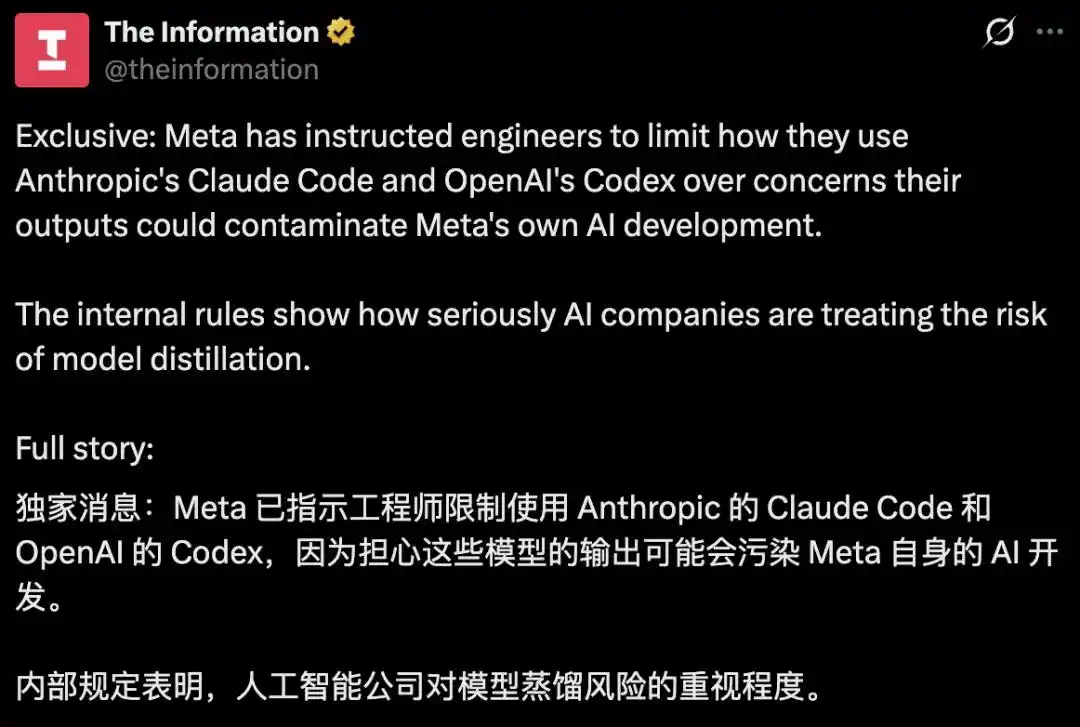
According to an internal guide obtained by The Information, a memo even directly called for a pause on certain tasks involving these two models. The wording was severe, stating this could trigger a "serious escalation with partners."

However, the strangeness lies precisely here.

Meta is one of Claude Code's largest global customers. Its total internal AI bill this year is heading towards tens of billions of dollars.

A tool used daily, purchased by the company at great cost, is now being restricted internally. And the reason for the restriction is probably something you wouldn't expect.

It's not that they aren't useful. On the contrary, it's because they are *too* useful.

This Red Line is Still in Effect

According to The Information report, these restrictions were set in May and are still in effect today.

To understand why Meta is so tense, we need to start with an internal AI coding assistant project.

This year, it formed an Applied AI Engineering team, focusing on its self-developed AI coding assistant MetaCode (formerly DevMate).

The goal is to stop Meta from spending huge sums continuing to use others' AI coding models and to train its own.
The official interface of Claude Code. Together with OpenAI's Codex, they have become the de facto standard for professional developers doing agentic programming.

But training a model that can write code is not simple.

You need to feed it massive amounts of high-quality data, and also generate enough, sufficiently tricky programming problems for it to practice on and be graded on. This set of problems and evaluations almost determines how powerful a coding model ultimately becomes.

But the problem lies precisely here.

The difficulty Meta encountered is how to prevent employees from becoming too reliant on these external tools while building the internal replacement.

What it worries about is the outputs from these external models seeping into the training data, causing the model it builds to secretly learn the competitor's capabilities.

To understand this concern, you need to know how a model "learns": You feed it what kind of data, it becomes that kind of model.

MetaCode wants to become stronger by relying on the training data and programming problem sets accumulated by engineers.

But once these problems, answers, and even grading criteria come from Claude or Codex, what MetaCode learns is no longer "skills trained by human engineers," but "Claude's skills."

It's copying answers from the competitor's test paper, becoming more and more like the competitor.

Even more hidden is the evaluation part.

Every time a model answers a question, something must tell it if it answered well so it knows where to improve.

If both problem creation and grading are handed to Codex, then MetaCode is evolving towards what "Codex thinks is correct," essentially copying the competitor's judgment standards bit by bit into its own mind.

This is why Meta's guide prohibits AI from being the problem creator or grader, and even governs whether "AI-generated materials can enter the environment accessible to the model under test."

As long as the competitor's output seeps into the training or evaluation chain in any way, the line of "who taught whom" becomes blurred.

Ultimately, Meta's pause on certain tasks is about isolating the training data.

It fears that the AI writes so well that it becomes unclear which skills were trained internally and which were learned from Claude and Codex.

And the latter set of capabilities is rented, not its own.

Surprisingly Detailed Restrictions

It must be clarified first that Meta's internal documents show no actual records of employees violating rules.

A Meta spokesperson also responded that the company has "clear policies" governing the use of AI tools. So this document is more like an internal early warning.

What tasks can't AI handle? Mainly the following three categories:

First, you cannot use Claude or Codex outputs to create test questions for your own model. The guide's exact words are, this "clearly falls into the category where engineers are not in the driver's seat," "We do not want tasks derived from models."

Second, AI cannot find bugs in source code, nor can it help you think about "what to test" based on code analysis.

Third, anything generated by AI cannot be placed anywhere accessible by the model under test.

Simply put, as long as AI participates in the judgment of "what to test" or "whether the answer is correct," the competitor's skills might mix in. The three rules block this opening.

What tasks can AI still do?

Setting up workflows, organizing code and files, building test frameworks for internal tools—these daily chores are allowed. The guide calls this type of work "test scaffolding" and "solution calibration," essentially assisting and building frameworks.

Even for these tasks, there is one ironclad rule: Every line of AI output must be reviewed by a human first.

In Meta's view, once you let a competitor's model create the test and grade it, it becomes unclear whose test this is.

What it truly wants to protect is that line of "who taught whom."

The Unavoidable "Distillation Trap"

What Meta worries about has a specific name in the industry: distillation.

The meaning is easy to understand: Use a stronger model to continuously answer questions, then use these answers to train a weaker model.

It's a bit like having the top student redo the entire exam paper, and the struggling student copies it, catching up to years of effort in months.

The massive investment others put into data, computing power, and research, you almost get for free.

Training a cutting-edge model from scratch costs astronomical sums of money and time. Distillation, however, might only require a batch of outputs from the other model, reducing costs and timelines to a fraction.

Distillation itself is standard industry practice; big companies also often distill their own large models to create smaller, cheaper versions for users.

The trouble only arises: Once you are copying someone else's model, the capabilities you train—are they your own, or borrowed? It's unclear.

Some call this the "distillation trap": The more you rely on the strongest model to build your own foundation, the harder it is to prove where your intelligence actually came from.
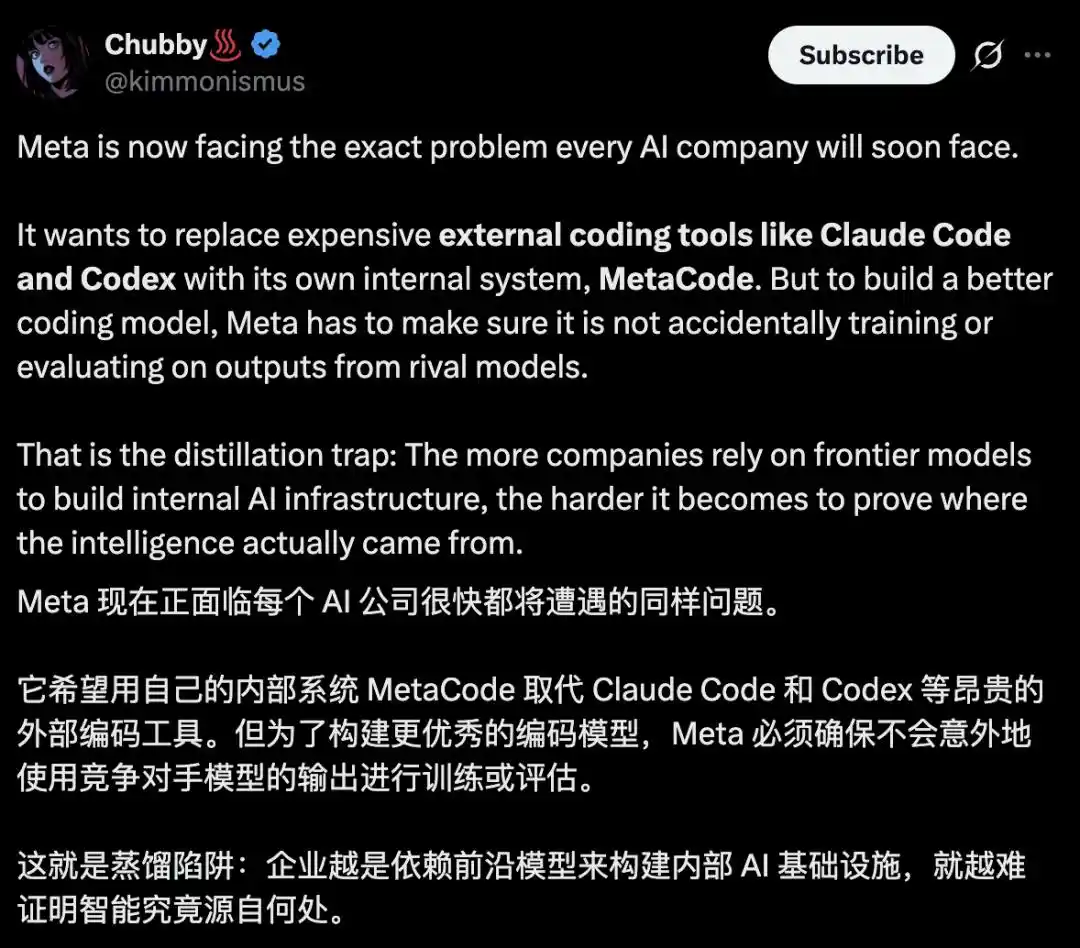
In the United States, the law does not explicitly prohibit distillation, and AI-generated content is not protected by copyright. Using the other's output to train your own model basically passes the legal hurdle.

The only barrier is the contract.

Both OpenAI's and Anthropic's terms of service contain similar restrictions: You cannot use the model's outputs to create something that competes with them.

Moreover, the enforcement power for this barrier lies entirely with the competitor.

Last year, Anthropic directly cut off OpenAI's API access to Claude, even though OpenAI claimed it was only for evaluating capabilities and safety, a "standard industry" practice.

Even Musk was forced to admit in a court hearing this past April that his xAI "partially" distilled OpenAI's models.

April 30, 2026, in the witness stand at a California federal court, Musk was asked if xAI used distillation techniques on OpenAI models to train Grok. He first said this was common practice for AI companies.

When pressed if this amounted to a "yes," he replied "partially."

The rules are fuzzy, and "enforcement power" is held by competitors. Who dares to bet their billions in investment that a competitor won't turn hostile?

From this perspective, Meta's tension is not at all excessive.

Here, there's also the consideration of saving money.

According to internal memos, Meta will burn tens of billions of dollars this year just on internal AI use. It has even started setting token usage limits for employees. Even a cash-rich giant like Meta is starting to find AI too expensive and is calculating carefully.

If development work can be shifted from expensive external tools to its own MetaCode, it saves money while avoiding the minefield of distillation—killing two birds with one stone.

A Tightrope-Walking Map

Regarding Meta's internal documents, tech law scholar and legal advisor Mark Leiser has a vivid phrase: This is "almost like a map for walking a tightrope."

On one side, you need to gain the benefits of external models; on the other, you must prevent their capabilities from slipping into your own system.

Of course, Meta isn't the only company walking this tightrope; it touches a vital point for the entire industry.

When you use a sufficiently smart AI to build another equally smart AI, in the end, you might find it hard to say clearly: Is this intelligence something you trained yourself, or did you secretly learn it from someone else's AI?

And this issue isn't that far from ordinary people either.

The code you write with AI, the plans you modify, the materials you compile—feeding them back becomes nourishment for the next generation of models.

In this cycle, who is standing on whose shoulders? That line has become increasingly blurred.

When AI starts helping us build AI, can we still tell whose capabilities are whose?

References:

https://x.com/kimmonismus/status/2071591755351224344

https://www.theinformation.com/articles/internal-docs-show-meta-putting-limits-claude-codex-fearing-distillation

This article is from the WeChat public account "New Zhiyuan", author: ASI Apocalypse

Cryptos en tendance

Questions liées

QWhy did Meta restrict its engineers from using Claude Code and Codex internally?

AMeta restricted their internal use to prevent knowledge distillation, where the outputs from these powerful external AI models could inadvertently influence and shape the training of Meta's own in-house AI coding assistant, MetaCode. The concern is that if MetaCode is trained on data or evaluations generated by Claude or Codex, its capabilities would be learned from the competitor's model rather than developed independently.

QWhat specific tasks does Meta's policy forbid using Claude or Codex for?

AThe policy forbids three main tasks: 1) Using their outputs to create test cases or benchmarks for Meta's own models. 2) Using them to find bugs in source code or to suggest what should be tested. 3) Placing any AI-generated content in an environment accessible by the model being trained (MetaCode).

QWhat is 'distillation' in the context of AI model training, and what is the 'distillation trap' mentioned in the article?

AIn AI, distillation refers to using a larger, more powerful model's outputs to train a smaller or weaker model. The 'distillation trap' is the dilemma where a company heavily relies on a competitor's model outputs to build its own. This makes it difficult to prove that the resulting model's intelligence and capabilities were developed independently rather than being copied or derived from the competitor.

QWhat are the potential consequences for a company if it's found to have distilled a competitor's AI model?

AWhile not explicitly illegal under current US law, using a competitor's model outputs for training likely violates their Terms of Service. The primary consequence is that the competitor can take action, such as cutting off API access (as Anthropic did to OpenAI). This creates significant business and legal risk, potentially jeopardizing a company's multi-billion dollar AI investments.

QBesides avoiding 'distillation,' what is another key reason for Meta to develop and push its own MetaCode assistant?

AAnother key reason is cost reduction. Meta's internal AI usage is projected to cost tens of billions of dollars this year. By shifting development work from expensive external tools like Claude and Codex to its own MetaCode, the company can save significant money while also mitigating the legal and strategic risks associated with knowledge distillation.

Lectures associées

À l'ère de l'IA, que reste-t-il au Bitcoin ?

La chute récente du Bitcoin sous les 60 000 dollars relance la réflexion sur sa valeur à l'ère de l'IA. Alors que l'intelligence artificielle réduit à presque zéro le coût de production de l'information et génère des contenus (textes, images, vidéos) de plus en plus réalistes, un nouveau défi émerge : la crise de la véracité. Dans ce contexte de prolifération où le vrai et le faux sont indissociables, ce qui devient précieux n'est plus l'abondance de contenus, mais la capacité à vérifier leur authenticité, la "vérifiabilité". C'est ici que la perspective sur le Bitcoin se renverse. Souvent critiqué pour sa consommation énergétique élevée, il n'est peut-être pas simplement une machine à créer de la monnaie numérique. Son mécanisme de preuve de travail (minage) brûle de l'énergie non pas pour accélérer les calculs, mais pour rendre extrêmement coûteuse toute tentative de falsification de son registre historique, la blockchain. Ainsi, le Bitcoin produit de la "vérifiabilité". Il ne requiert pas la confiance en une institution centrale (banque, plateforme), mais permet à chacun de vérifier mathématiquement l'intégrité du grand livre des transactions. Une analogie historique éclaire cette complémentarité potentielle : à la Renaissance, l'imprimerie de Gutenberg a drastiquement réduit le coût de reproduction des connaissances, tandis que la comptabilité en partie double a structuré et fiabilisé les échanges commerciaux. Aujourd'hui, l'IA jouerait le rôle de la nouvelle presse à imprimer, inondant le monde de contenus. La blockchain, dont le Bitcoin est la première incarnation, pourrait être l'équivalent moderne de la comptabilité en partie double – un système fondamental pour l'enregistrement et la vérification indépendante dans l'univers numérique, notamment pour les actifs et leur historique. Par conséquent, l'IA et la blockchain ne seraient pas en compétition, mais plutôt les deux faces d'une même pièce : l'une abaisse le coût de la création et de la génération, l'autre le coût de la vérification et de la preuve. Dans un monde où l'IA peut tout générer, la rareté ultime pourrait bien résider non pas dans plus de contenus, mais dans plus de faits indépendamment vérifiables. Le Bitcoin, en tant que "machine à produire de la vérifiabilité", trouve peut-être ainsi une nouvelle raison d'être, au-delà des spéculations sur son prix.

链捕手Il y a 24 mins

À l'ère de l'IA, que reste-t-il au Bitcoin ?

链捕手Il y a 24 mins

Le label 'chaîne fantôme' de Cardano démystifié ? Pourquoi les 34 dApps d'ADA ne racontent pas toute l'histoire

L'article traite de l'étiquette de "chaîne fantôme" parfois attribuée à Cardano (ADA) en raison de son activité on-chain et de son nombre d'applications décentralisées (dApps) nettement inférieurs à ceux de ses principaux concurrents comme Ethereum et Solana. L'auteur définit d'abord une "chaîne fantôme" comme une blockchain techniquement opérationnelle mais avec très peu d'activité et de développement. Il passe ensuite en revue les forces des principales blockchains de couche 1 : Ethereum pour la DeFi, XRP pour les règlements transfrontaliers, Solana pour le débit, Tron pour les transferts USDT et Bitcoin comme réserve de valeur. Concernant Cardano, l'article reconnaît des signes de faiblesse : la fermeture de l'explorateur TapTools, des avertissements sur la possible disparition de projets et seulement 34 dApps. Cependant, il souligne que son activité de développement reste forte. L'explication principale avancée pour justifier le faible nombre de transactions et d'utilisateurs actifs est le modèle technique unique de Cardano, l'EUTXO (Extended Unspent Transaction Output), qui regroupe (batch) les transactions. Cette fonctionnalité, bien qu'avantageuse pour la sécurité et la détermination, sous-estime l'activité réelle sur la chaîne. La conclusion est que si Cardano affiche des métriques d'activité bien inférieures, son modèle technique spécifique et son approche méthodique axée sur la sécurité et la durabilité l'empêchent d'être simplement catalogué comme une "chaîne fantôme". Chaque blockchain sacrifie certains aspects du trilemme (décentralisation, sécurité, évolutivité) pour se spécialiser dans un créneau.

ambcryptoIl y a 1 h

Le label 'chaîne fantôme' de Cardano démystifié ? Pourquoi les 34 dApps d'ADA ne racontent pas toute l'histoire

ambcryptoIl y a 1 h

UK FCA dévoile son livre de règles pour les cryptomonnaies : Approche basée sur les risques débutant en octobre 2027

Le régulateur financier britannique (FCA) a dévoilé un nouveau cadre réglementaire pour le secteur de la cryptomonnaie, qui entrera en vigueur en octobre 2027. Plutôt qu’une approche uniforme, cette réglementation adopte une méthode basée sur les risques : les entreprises devront détenir des capitaux proportionnés à leur exposition au risque et réaliser leurs propres tests de résistance annuels. Les petites structures et celles présentant moins de risques bénéficieront d’obligations de déclaration allégées pour réduire leurs coûts de conformité. La FCA supervisera les évaluations des entreprises sans imposer de règles identiques à toutes, dans le but de renforcer la confiance sur le marché et d’attirer 3 à 4 millions d’utilisateurs supplémentaires au Royaume-Uni. Concernant les stablecoins, le cadre maintient des protections pour les consommateurs – comme la détention des réserves sous un trust légal – tout en assouplissant certaines exigences. Les émetteurs jugés systémiques pourraient toutefois faire face à une surveillance renforcée. Cette initiative vise à offrir une clarté réglementaire tout en tenant compte des spécificités du secteur, bien que certains acteurs alertent sur les risques d’appliquer des règles conçues pour la finance traditionnelle à des infrastructures décentralisées.

ambcryptoIl y a 2 h

UK FCA dévoile son livre de règles pour les cryptomonnaies : Approche basée sur les risques débutant en octobre 2027

ambcryptoIl y a 2 h

Trading

Spot

Articles tendance

Comment acheter PEOPLE

Bienvenue sur HTX.com ! Nous vous permettons d'acheter ConstitutionDAO (PEOPLE) de manière simple et pratique. Suivez notre guide étape par étape pour commencer votre parcours crypto.Étape 1 : Création de votre compte HTXUtilisez votre adresse e-mail ou votre numéro de téléphone pour ouvrir un compte sur HTX gratuitement. L'inscription se fait en toute simplicité et débloque toutes les fonctionnalités.Créer mon compteÉtape 2 : Choix du mode de paiement (rubrique Acheter des cryptosCarte de crédit/débit : utilisez votre carte Visa ou Mastercard pour acheter instantanément ConstitutionDAO (PEOPLE).Solde :utilisez les fonds du solde de votre compte HTX pour trader en toute simplicité.Prestataire tiers :pour accroître la commodité d'utilisation, nous avons ajouté des modes de paiement populaires tels que Google Pay et Apple Pay.P2P :tradez directement avec d'autres utilisateurs sur HTX.OTC (de gré à gré) : nous offrons des services personnalisés et des taux de change compétitifs aux traders.Étape 3 : stockage de vos ConstitutionDAO (PEOPLE)Après avoir acheté vos ConstitutionDAO (PEOPLE), stockez-les sur votre compte HTX. Vous pouvez également les envoyer ailleurs via un transfert sur la blockchain ou les utiliser pour trader d'autres cryptos.Étape 4 : tradez des ConstitutionDAO (PEOPLE)Tradez facilement ConstitutionDAO (PEOPLE) sur le marché Spot de HTX. Il vous suffit d'accéder à votre compte, de sélectionner la paire de trading, d'exécuter vos trades et de les suivre en temps réel. Nous offrons une expérience conviviale aux débutants comme aux traders chevronnés.

574 vues totalesPublié le 2024.12.12Mis à jour le 2026.06.02

Comment acheter PEOPLE

Discussions

Bienvenue dans la Communauté HTX. Ici, vous pouvez vous tenir informé(e) des derniers développements de la plateforme et accéder à des analyses de marché professionnelles. Les opinions des utilisateurs sur le prix de PEOPLE (PEOPLE) sont présentées ci-dessous.

活动图片