Critical Game Week: BTC Retracement Confirmation vs. HYPE Support Battle | Guest Analysis

marsbitPublié le 2026-06-22Dernière mise à jour le 2026-06-22

Résumé

This weekly analysis outlines a critical juncture for BTC and HYPE markets, focusing on key price level confirmations. **BTC Analysis:** BTC is at a pivotal point after a five-wave rally from the June 5th low of $59,100. The price has broken below a short-term rising channel's lower boundary, with the current move seen as a pullback to test this breakdown. Failure to reclaim this level could lead to a retest of the $59,000-$60,000 support zone. The core scenario hinges on this channel retest outcome. * **Key Levels:** Resistance at $64,500-$65,000 (channel boundary) and $69,500-$70,500. Support at $59,000-$60,000 and $55,000. * **Strategy:** A core bearish stance is maintained (20% short from last week), with short-term plans for tactical trades. Three detailed contingency plans (A/B/C) are provided for short positions on resistance tests or breakdowns, emphasizing strict stop-loss discipline. **HYPE Analysis:** HYPE shows strong momentum but is currently in a corrective phase after hitting a new high of $76.94. The price is retesting the crucial $64-$66 support area. * **Key Levels:** Resistance near $77 and $80-$82. Support at $64-$66 and $52-$54. * **Strategy:** The short-term approach is "buy on dips, avoid chasing rallies." A long position is considered only if clear stabilization signals appear at the $64-$66 or deeper $52-$54 support zones, with tight risk controls. **General Risk Management:** A standardized trailing stop-loss protocol is emphasized: set in...

This week, the market enters a critical phase of contention.

At the macro level, marginal changes in Federal Reserve policy expectations continue to dictate the pricing rhythm of risk assets. In the crypto market, after the previous period of consolidation, the divergence between bulls and bears is intensifying around key price levels.

This weekly review maintains the consistent framework: based on multi-timeframe structural analysis and combined with quantitative model signals, it assesses the market outlook for BTC and HYPE this week and formulates specific short- to medium-term trading plans.

It is crucial to note that all content herein represents personal technical analysis records, serving solely as a reference framework and review basis for my own trading decisions, and does not constitute any form of investment advice. The market is always more complex than predictions. Strict adherence to risk control and stop-loss discipline remains the top priority.

Summary of Core Trading Views for This Week:

  • BTC Hourly Timeframe Structure Analysis (Detailed in Part 1)
  • BTC Weekly Outlook & Medium/Short-Term Trading Strategies (Detailed in Part 2)
  • HYPE Hourly Timeframe Structure Analysis (Detailed in Part 3)
  • HYPE Weekly Outlook & Short-Term Trading Strategy (Detailed in Part 4)

Market Verification of Last Week's Trading Strategies & Core Views:

  • BTC Market Outlook Verification: Last week, strictly following trading discipline, we promptly established an approximately 20% short position when market entry opportunities emerged. The medium-term trading plan outlined in the weekly review article was executed.

I. In-depth Analysis of Bitcoin's Hourly Timeframe Structure

Bitcoin _4-Hour K-line Chart
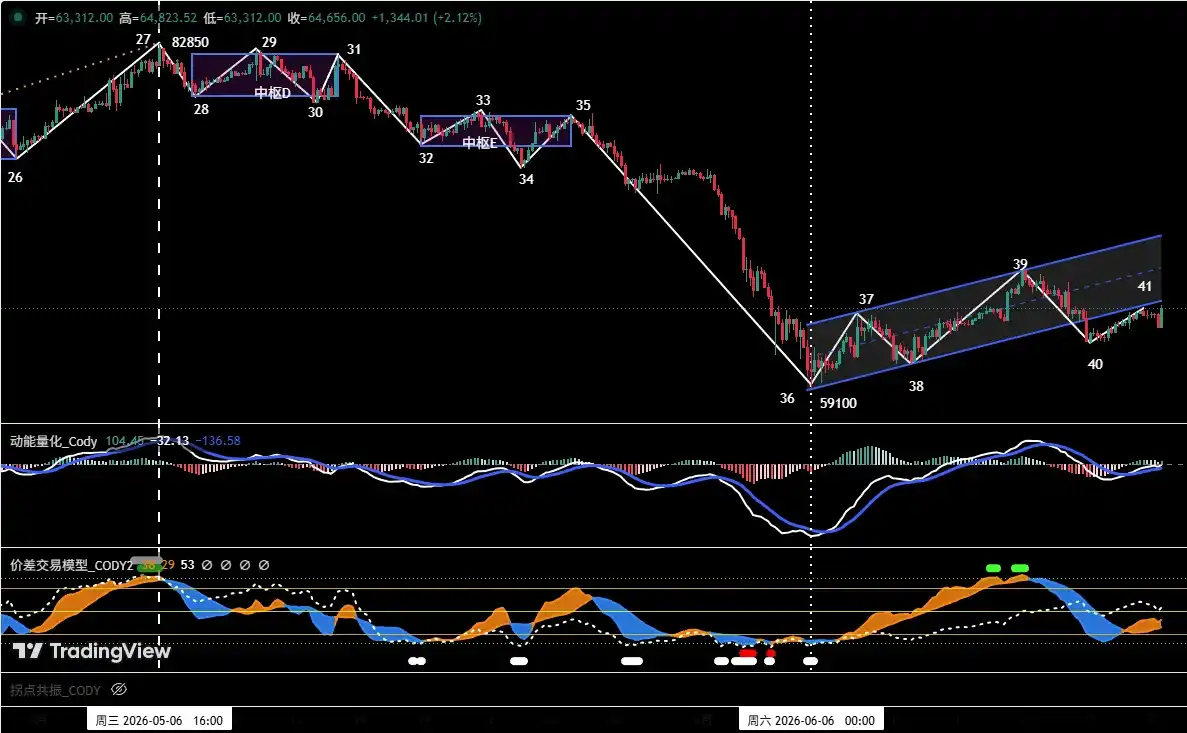
Figure 1

1 As shown in (Figure 1): From a 4-hour structural perspective, the price rebound initiated from the June 5th low of $59,100 can be subdivided into a five-wave structure, corresponding sequentially to segments 36-37, 37-38, 38-39, 39-40, and 40-41.

2 The overall trend presents a short-term rising channel pattern (blue channel in the chart): its upper bound is formed by connecting the two rebound highs at (point 37) and (point 39), while the lower bound is established by connecting the two correction lows at (point 36) and (point 38). The chart shows that the price has already breached the channel's lower bound at (point 40). The current (40-41) rebound segment can be viewed as a retracement confirmation phase for the breakdown below the channel's lower bound. If (point 41) fails to decisively reclaim a position above the channel's lower bound, the probability of the price revisiting the previous low support around $59,100 will significantly increase.

II. Bitcoin Weekly Outlook and Trading Strategies

1. BTC Weekly Market Outlook:

Core View for the Week: Focus on the outcome of the price's retracement confirmation of the short-term channel's lower bound.

  • If it holds firmly above, the price may continue its rebound along the short-term rising channel, potentially challenging the core resistance zone of $69,500~$70,500.
  • If it fails to hold, the market may retest the core support zone of $59,000~$60,000.

2. Core Resistance Levels:

  • First Resistance Zone: $64,500~$65,000 area (near the short-term rising channel's lower bound)
  • Second Resistance Zone: $69,500~$70,500 area (previous high-volume congestion zone)

3. Core Support Levels:

  • First Support Level: $59,000~$60,000 area (previous significant support level)
  • Second Support Level: Around $55,000 (previous significant support level)

4. Trading Strategies for This Week (Excluding Unexpected News Impact)

1 Medium-Term Strategy:

Bitcoin _ Daily K-line Chart (Position Monitoring Model)
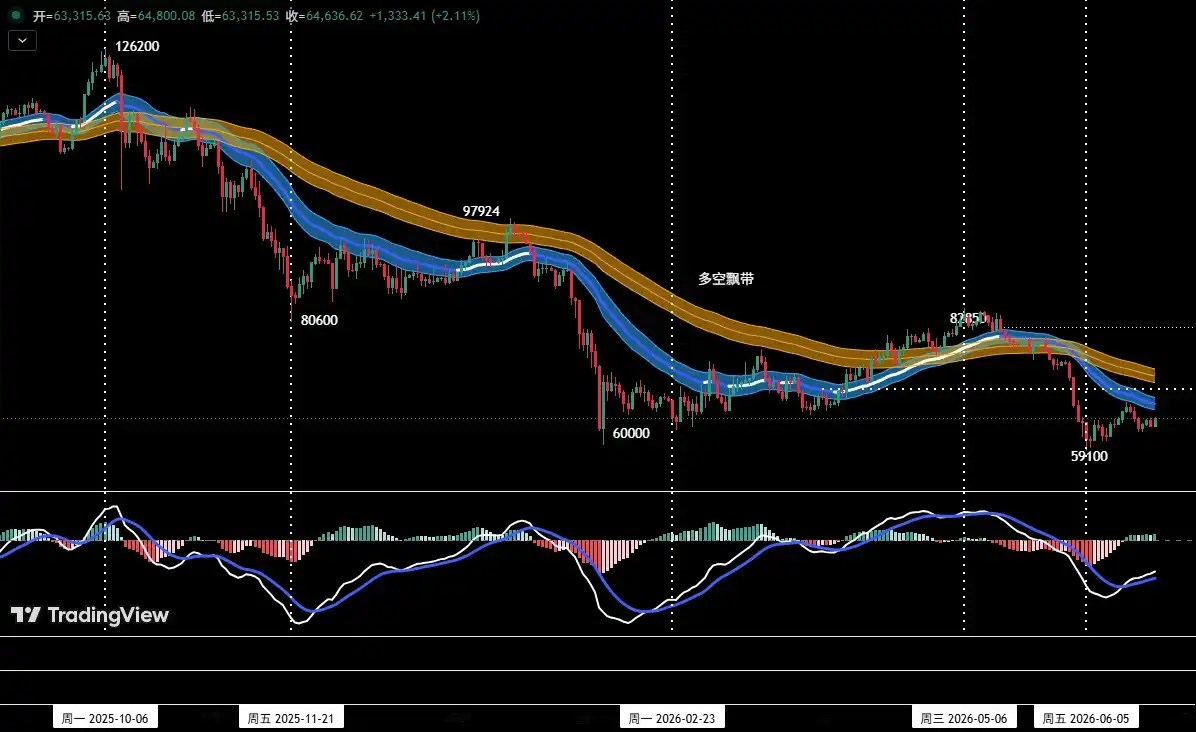
Figure 2

Position Monitoring Model: As shown in (Figure 2), the current price has decisively broken below the "Bull-Bear Channel," confirming a shift in market structure to a bear-dominated regime. Following the pre-set plan last week, we entered a short position around $64,500, with the initial medium-term position controlled at approximately 20% of total capital. Subsequent actions will adhere to stop-loss discipline, awaiting the next opportunity to add to the position.

2 Short-Term Strategy: Utilize 30% of capital, set stop-loss points, and seek "spread" trading opportunities based on support and resistance levels (using 30-minute/60-minute cycles).

3 To dynamically respond to the market's complex evolution in short-term operations, we have pre-formulated three specific contingency plans: A, B, and C.

Plan A: Tentative Positioning in Resistance Zone

  • Entry: If the price rallies to the $64,500~$65,000 zone showing signs of exhaustion, combined with a quantitative model top signal, an initial short position of around 15% can be established.
  • Risk Control: Set an initial stop-loss.
  • Exit: When the correction approaches significant support levels and aligns with model signals, gradually close positions to take profits.

Plan B: Adding to Position in Strong Resistance Zone

  • Addition: If the price breaks above the $65,000 resistance and continues to rally to the $69,500~$70,500 zone showing pressure signs, combined with a quantitative model top signal, increase the short position to within 30%.
  • Risk Control: Set an initial stop-loss.
  • Exit: When the correction approaches significant support levels and aligns with model signals, gradually close positions to take profits.

Plan C: Following the Break Below Support to Add Shorts

  • Addition: If the price decisively breaks below the $65,000 support, continues its decline, and loses the $59,000~$60,000 support zone, consider adding to the short position (within 30%) when price shows weakness during a retracement confirmation.
  • Risk Control: Set an initial stop-loss.
  • Exit: When the decline reaches significant support levels and aligns with model signals, gradually close positions to take profits.

III. HYPE Hourly Timeframe Structure Analysis

HYPE_4-Hour K-line Chart
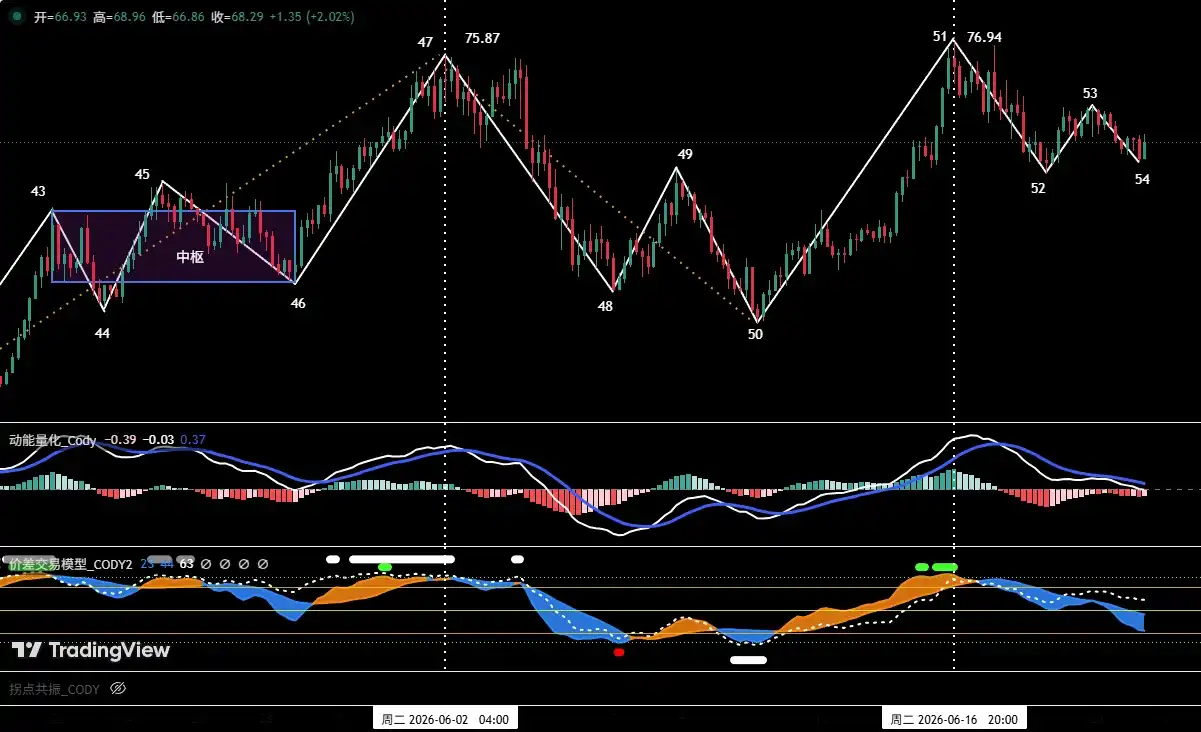
Figure 3

1 As shown in (Figure 3), on the 4-hour timeframe, HYPE initiated a correction from the June 2nd high of $75.87 (point 47), finding support near $52.62 (point 50) on June 10th, a correction lasting about 9 trading days. Subsequently, the market began a strong upward wave (segment 50-51), breaking the previous high within 6 trading days to reach a new high of $76.94 since the January rally, indicating that bullish momentum remains strong.

2 The decline from the new high presents a clear three-wave corrective structure (51-52, 52-53, 53-54). The price has currently retraced back to the critical support zone of $64~$66.

  • Bullish Scenario: If the price finds effective support in this zone, the uptrend from (point 50) is likely to continue, with subsequent prices challenging new highs.
  • Bearish Scenario: If this level is lost, the correction period will extend, and the price may retest the core support band of $52~$54, which marks the starting point of the previous uptrend.

IV. HYPE Weekly Outlook and Short-Term Trading Strategy

1. HYPE Weekly Market Outlook:

1 Core Resistance Levels:

  • First Resistance Level: Around $77
  • Second Resistance Zone: $80~$82 area

2 Core Support Levels:

  • First Support Level: $64~$66 area
  • Second Support Level: $52~$54 area

Core View for HYPE This Week:

  • Observe the outcome of the battle between bulls and bears over the $64~$66 zone.

2. HYPE Short-Term Trading Strategy for This Week (Long on Support)

This week's short-term HYPE trading should adhere to the strategy of "buying the dip, avoiding chasing rallies."

Short-Term Strategy: Testing Longs on Support Zone Stabilization

When the HYPE price retests and finds support, showing signs of stabilization in the $64~$66 key support zone or the deeper $52~$54 zone, and this aligns with bottom signals triggered by the two models, consider a light long position trial. Position size must be controlled below 30%, and strict stop-loss discipline must be maintained.

V. Special Notes:

  1. Upon Entry: Immediately set the initial stop-loss.
  2. Upon Reaching 1% Profit: Move the stop-loss to the entry price (break-even point), ensuring capital safety.
  3. Upon Reaching 2% Profit: Move the stop-loss to the position of 1% profit.
  4. Continuous Tracking: Thereafter, for every additional 1% profit gained, move the stop-loss up by 1%, dynamically protecting and locking in profits.

Financial markets change rapidly. All market analysis and trading strategies require dynamic adjustment. All views, analytical models, and operational strategies mentioned in this article are derived from personal technical analysis, intended solely for personal trading log purposes, and do not constitute any investment advice or operational basis. Markets involve risk, investment requires caution. Please do not make decisions based solely on this content.


Cryptos en tendance

Questions liées

QWhat is the key technical situation for Bitcoin according to the analysis?

AThe key technical situation for Bitcoin is its current position in a short-term rising channel on the 4-hour chart. The price has already broken below the channel's lower rail at point 40. The current move (40-41) is seen as a retest to confirm this break. If point 41 fails to hold above the lower rail, the probability of a retest of the previous low at $59,100 increases significantly.

QWhat are the two main scenarios for HYPE this week based on its price action?

AFor HYPE, there are two main scenarios based on its price action around the key support zone of $64-$66. In the bullish scenario, if the price finds effective support in this zone, the uptrend from point 50 is expected to continue, potentially challenging new highs. In the bearish scenario, if this support is decisively broken, the correction will likely extend, and the price may test the more critical support band of $52-$54.

QWhat is the core medium-term trading strategy for Bitcoin, and what action was already taken?

AThe core medium-term strategy for Bitcoin is bearish, as the price has broken below the 'Bull-Bear Channel' on the daily chart, confirming a market structure shift to bearish dominance. Following the plan, a short position of approximately 20% of total capital was established near $64,500 last week. The strategy involves holding this initial position while waiting for potential opportunities to add to it.

QAccording to the analysis, what is the primary short-term trading approach recommended for HYPE?

AThe primary short-term trading approach for HYPE is to 'buy on dips and avoid chasing rallies.' The specific strategy is to attempt long positions on support levels. When the price retests and shows signs of stabilization in the key support zones of $64-$66 or $52-$54, and this is confirmed by bottom signals from the analysis models, a light long position (under 30% of capital) can be considered, with strict adherence to stop-loss discipline.

QWhat are the three contingency plans (A, B, C) outlined for Bitcoin's short-term trading?

AThe three contingency plans for Bitcoin's short-term trading are: Plan A (Resistance Zone Test): Initiate a ~15% short position if the price shows signs of stalling in the $64,500-$65,000 resistance zone with a model top signal. Plan B (Strong Resistance Zone): Increase the short position to under 30% if the price rallies further and faces pressure in the $69,500-$70,500 zone with a model top signal. Plan C (Breakdown Follow-through): Add to the short position (to under 30%) if the price decisively breaks below $65,000 and then $59,000-$60,000 support, showing weakness on any retest.

Lectures associées

L'IA déferle sur le monde, pourquoi la combinaison Crypto + IA est-elle si morose ?

Résumé : Alors que l'IA connaît un essor mondial, la convergence avec la blockchain (Crypto + IA) reste en retrait. L'analyse révèle que le problème n'est pas une contradiction logique, mais un décalage structurel entre l'offre technologique et la demande actuelle du marché. Le secteur traditionnel de l'IA investit massivement pour résoudre des goulots d'étranglement immédiats (performance, coût, stabilité). En revanche, les projets Blockchain+IA se concentrent sur des avantages à long terme comme la propriété des données, la transparence ou la décentralisation, qui ne sont pas des priorités pour les entreprises. Quatre sous-secteurs sont examinés : 1. **Calcul décentralisé & stockage décentralisé** : Malgré une logique valable (coûts, souveraineté), ils manquent d'un avantage technique décisif pour justifier le risque de migration depuis les géants du cloud (AWS, Google Cloud). 2. **Marchés de données sur chaîne & vérification des modèles (ZKML)** : Ces solutions répondent à des besoins (transparence, confidentialité) qui ne sont pas encore des impératifs commerciaux urgents. Leur adoption dépendra probablement de régulations futures, comme l'AI Act de l'UE. 3. **Infrastructure pour agents IA** : La technologie devance la demande. Les entreprises automatisent d'abord des processus internes, tandis que les projets blockchain construisent l'infrastructure pour une économie future d'agents autonomes interagissant entre eux. 4. **Paiement pour agents IA** : C'est le seul sous-secteur où la blockchain est sur un pied d'égalité avec la finance traditionnelle, car aucun système n'a encore résolu le défi des micro-paiements en temps réel entre machines. Le principal obstacle est l'absence de cas d'utilisation à grande échelle et convaincant prouvant la valeur commerciale. La voie à suivre dépendra de la capacité du secteur à s'adapter aux standards actuels de performance ou à persister dans le développement d'une infrastructure pour les besoins futurs de l'IA.

Foresight NewsIl y a 7 mins

L'IA déferle sur le monde, pourquoi la combinaison Crypto + IA est-elle si morose ?

Foresight NewsIl y a 7 mins

Les ETF ont connu des sorties nettes continues, les institutions se retirent-elles ?

Lors des six dernières semaines, les ETF Bitcoin spot américains ont enregistré des sorties nettes d’environ 6 milliards de dollars, soit la plus longue série hebdomadaire de retraits depuis leur lancement en 2024. Le fonds IBIT de BlackRock est particulièrement touché, ayant représenté plus de 70 % des sorties sur une semaine récente. Les données on-chain indiquent que les détenteurs à long terme (plus de 155 jours) ne vendent pratiquement pas, détenant encore environ 83 % de l’offre en circulation. Les ventes proviennent principalement des investisseurs institutionnels ou de configuration ayant acheté via des comptes de courtage, qui utilisent désormais la même facilité pour sortir. Cette vague de ventes ressemble à une réduction des risques face au durcissement de la Fed, à une inflation persistante et à la concurrence d’autres actifs (infrastructure IA, introductions en bourse), plutôt qu’à un rejet du Bitcoin. Les pertes réalisées ont bondi de 78 %, de nombreux vendeurs ayant acheté entre 55 000 et 68 000 dollars. Le rythme des sorties ralentit cependant, passant de 1,72 milliard début juin à 226,8 millions mi-juin, suggérant que la panique de vente pourrait s’épuiser. Néanmoins, la taille d’IBIT en fait une source structurelle de pression : ses sorties pèsent directement sur le marché spot, d’autant plus que les nouveaux acheteurs et les volumes sont actuellement faibles. Les prochaines sessions seront déterminantes : si les sorties d’IBIT se calment et que le Bitcoin dépasse 60 000 dollars, le marché pourrait se stabiliser. En revanche, si les rachats massifs reprennent et que le prix tombe sous 58 000 dollars, la pression de vente institutionnelle devra être absorbée par les acheteurs spot non-ETF, ce qui pourrait marquer un tournant.

marsbitIl y a 51 mins

Les ETF ont connu des sorties nettes continues, les institutions se retirent-elles ?

marsbitIl y a 51 mins

Introduction au Concept de Modèle du Monde : Une Histoire de la Psychologie à l'AI

Le concept de "modèle du monde" (World Model) est aujourd'hui central en IA, bien que sa définition reste floue. Il s'agit de doter les machines d'un "sandbox mental" interne, capable de prédire et de simuler les conséquences d'actions avant leur exécution réelle, à l'instar de la réflexion humaine. Cette capacité est cruciale pour des applications comme la conduite autonome, la robotique ou la création de contenus. L'idée puise ses racines dans les travaux du psychologue Kenneth Craik (1943) et a été reprise en IA par des pionniers comme Marvin Minsky. Le terme a été remis au goût du jour en 2018 par David Ha et Jürgen Schmidhuber. Aujourd'hui, les approches divergent. Des chercheurs comme Yann LeCun (avec son architecture JEPA) privilégient la prédiction en espace abstrait pour comprendre la physique. D'autres, comme Fei-Fei Li, proposent une taxonomie distinguant les modèles qui *rendent* (pixels), *simulent* (états physiques) ou *planifient* (actions). OpenAI (Sora), Google DeepMind (Genie 3) et NVIDIA (Cosmos) développent des "simulateurs du monde" génératifs basés sur des vidéos. Dans l'industrie, les acteurs chinois (Alibaba, Tencent, constructeurs automobiles) développent leurs propres solutions, souvent centrées sur des cas d'usage concrets comme la conduite autonome. Techniquement, trois voies coexistent : la génération de pixels (comme Sora), la prédiction en espace latent (comme JEPA), et la création d'environnements 3D paramétriques (comme Omniverse). La tendance est à leur convergence vers un modèle unifié. Un paradigme émergent en 2026 est le "World Action Model" (WAM), qui intègre directement la génération d'actions et la prédiction de l'état futur en un seul système, visant une meilleure "unité de la pensée et de l'action" pour les robots. Malgré la confusion des définitions, un consensus se dégage sur l'objectif final : créer pour les machines une représentation interne du monde, exploitable pour raisonner, planifier et agir de manière plus sûre et générale. Cette période de flou terminologique est typique des phases de rupture technologique et signale l'entrée du concept sur le champ de bataille principal de l'IA.

marsbitIl y a 1 h

Introduction au Concept de Modèle du Monde : Une Histoire de la Psychologie à l'AI

marsbitIl y a 1 h

IBIT a connu une sortie de 1,3 milliard de dollars en une semaine, le plus grand ETF sur Bitcoin devient un mur de vente que les haussiers doivent franchir

L'ETF bitcoin de BlackRock, iShares Bitcoin Trust (IBIT), a enregistré des sorties nettes de 1,3 milliard de dollars sur la semaine du 22 au 26 juin, représentant environ 73% des sorties totales des ETF spot américains sur Bitcoin. Cette concentration des rachats sur le plus grand ETF du marché transforme ce qui était un canal majeur d'entrée de capitaux institutionnels en une source potentielle de pression vendeuse structurelle. Alors que le Bitcoin lutte pour maintenir le seuil des 60 000 dollars, ces flux inversés soumettent le marché à un test critique. La narration initiale d'une "demande institutionnelle" via les ETF se retourne : le même véhicule qui facilitait l'accès peut désormais faciliter la sortie des investisseurs sensibles au prix. La taille de l'IBIT rend ses mouvements de trésorerie marginaux particulièrement significatifs pour la structure du marché. L'interprétation de cette pression dépendra des prochaines sessions. Si les sorties de l'IBIT ralentissent et que le Bitcoin se stabilise au-dessus de 59 000 dollars, cette semaine pourra être vue comme un épisode d'assainissement. En revanche, si les rachats importants se poursuivent et empêchent une reprise ferme, la thèse du "mur de vente" lié aux ETF gagnera en crédibilité, obligeant les acheteurs hors ETF à supporter seuls le poids des sorties. Les prochains jours seront déterminants pour savoir si cette pression est passagère ou le début d'une tendance plus durable.

marsbitIl y a 2 h

IBIT a connu une sortie de 1,3 milliard de dollars en une semaine, le plus grand ETF sur Bitcoin devient un mur de vente que les haussiers doivent franchir

marsbitIl y a 2 h

Trading

Spot

Articles tendance

Comment acheter HYPE

Bienvenue sur HTX.com ! Nous vous permettons d'acheter Hyperliquid (HYPE) de manière simple et pratique. Suivez notre guide étape par étape pour commencer votre parcours crypto.Étape 1 : Création de votre compte HTXUtilisez votre adresse e-mail ou votre numéro de téléphone pour ouvrir un compte sur HTX gratuitement. L'inscription se fait en toute simplicité et débloque toutes les fonctionnalités.Créer mon compteÉtape 2 : Choix du mode de paiement (rubrique Acheter des cryptosCarte de crédit/débit : utilisez votre carte Visa ou Mastercard pour acheter instantanément Hyperliquid (HYPE).Solde :utilisez les fonds du solde de votre compte HTX pour trader en toute simplicité.Prestataire tiers :pour accroître la commodité d'utilisation, nous avons ajouté des modes de paiement populaires tels que Google Pay et Apple Pay.P2P :tradez directement avec d'autres utilisateurs sur HTX.OTC (de gré à gré) : nous offrons des services personnalisés et des taux de change compétitifs aux traders.Étape 3 : stockage de vos Hyperliquid (HYPE)Après avoir acheté vos Hyperliquid (HYPE), stockez-les sur votre compte HTX. Vous pouvez également les envoyer ailleurs via un transfert sur la blockchain ou les utiliser pour trader d'autres cryptos.Étape 4 : tradez des Hyperliquid (HYPE)Tradez facilement Hyperliquid (HYPE) sur le marché Spot de HTX. Il vous suffit d'accéder à votre compte, de sélectionner la paire de trading, d'exécuter vos trades et de les suivre en temps réel. Nous offrons une expérience conviviale aux débutants comme aux traders chevronnés.

694 vues totalesPublié le 2024.12.11Mis à jour le 2026.06.02

Comment acheter HYPE

Discussions

Bienvenue dans la Communauté HTX. Ici, vous pouvez vous tenir informé(e) des derniers développements de la plateforme et accéder à des analyses de marché professionnelles. Les opinions des utilisateurs sur le prix de HYPE (HYPE) sont présentées ci-dessous.

活动图片