a16z Crypto Partner: Cash Flow is the Moat

marsbitPublié le 2026-06-12Dernière mise à jour le 2026-06-12

Résumé

Cash Flow as the Moat: A Playbook for Crypto Founders Historically, the most enduring businesses have been built by positioning themselves within the "flow of funds"—facilitating the creation and transfer of value in a network and extracting a portion of it. Cryptocurrency is the first modern technology natively built for this purpose. For startups, failing to architect products and businesses to leverage these principles means missing a major opportunity. Blockchains are inherently network businesses. Each transaction settles on a shared ledger, and every new participant strengthens the underlying network for all. Well-designed network tokens amplify this by aligning users, developers, and validators around growing the network, with value flowing back to contributors in a transparent feedback loop. This model is not new; companies from railroads and Standard Oil to Google, Meta, and AWS have thrived by inserting themselves into critical flows of value (goods, attention, compute). Financial markets make it even clearer: firms like Visa and major market makers generate immense revenue not by predicting markets but by being in the path of transactions. The combination of fund flow and network effects creates one of the most durable business structures. The high margins in traditional finance (payments, custody, lending, FX) represent prime targets. Crypto founders have the opportunity to build the next version—programmable, instant, global, and natively in the flow of funds...

Author: Jason Rosenthal, a16z Operating Partner

Translation: Hu Tao, ChainCatcher Selection

Many of history's greatest businesses were built by positioning themselves in the "flow of funds"—facilitating the creation and transfer of value within a network and taking a cut of it. The more value that flows through the network, the larger the business typically becomes.

Cryptocurrency is the first modern technology natively built for this purpose. If your startup hasn't yet architected its product and business to benefit from these principles, you're missing an opportunity. Thanks to stablecoins, capital and value now flow at internet speed—settling globally, 24/7, with end-to-end programmability. Payment channels are unobstructed, unit economics are transparent, and every dollar flowing anywhere in the world is reachable.

The Model

Blockchains are network businesses by design. Every transaction settles on a shared ledger. Each new participant reinforces the same underlying network that the next builder can use. As more people use and build on it, the network becomes more valuable to all users.

Most companies spend years manufacturing network effects on top of traditional infrastructure. Crypto founders inherit them as a starting condition.

Network tokens amplify this. Well-designed tokens can align users, developers, suppliers, validators, and protocols around a single outcome—growing the network—and pay proportionally to each participant's contribution. But the protocol's revenue belongs to the people who use it. No partner rebates, no side deals. Just a feedback loop between value flowing through the system and value accruing to the hands of those building and growing it.

This isn't a new model. Cryptocurrency just makes it accessible and scalable for startups for the first time.

Railroads didn't make money from locomotives. They made money from every ton of grain, coal, and steel that crossed their tracks. Standard Oil, U.S. Steel, and AT&T were all companies in the flow of funds. Google and Meta displaced print and TV not because their ads were better, but because they sat at the chokepoint where attention converts to commerce, enabling them to take a cut of trillions in commercial intent. AWS is in the flow of computation.

The model is consistent: find where value flows, and position yourself in the middle of it.
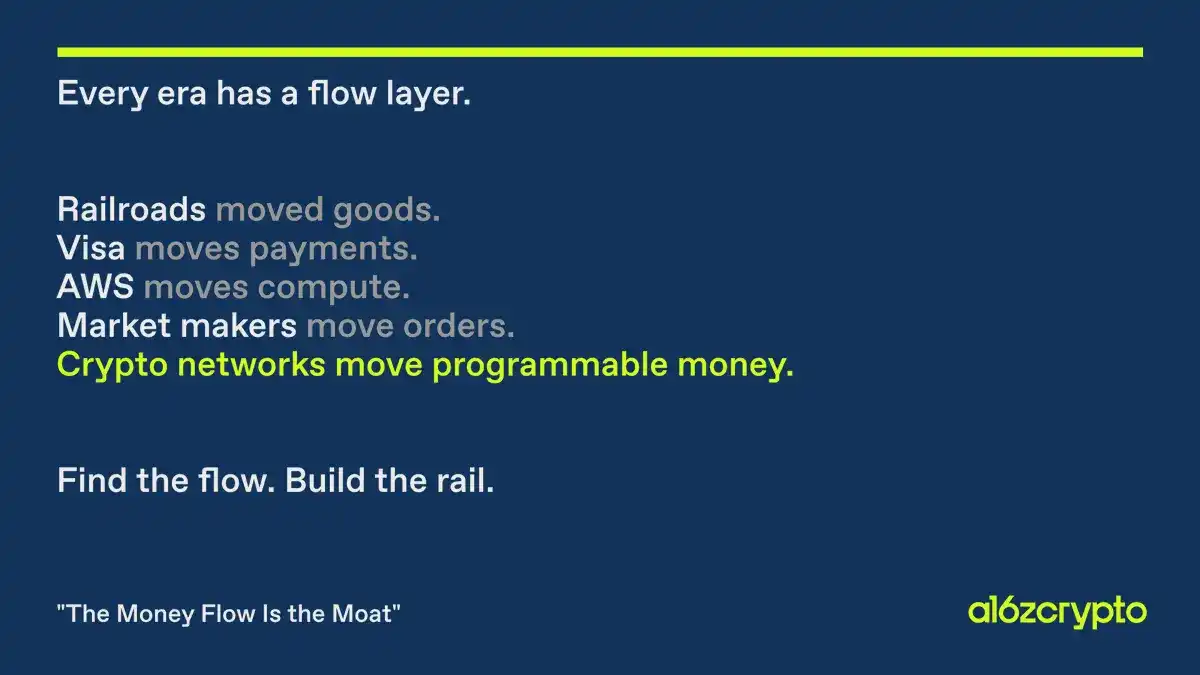
Financial markets make this model even clearer. Visa processed $15.7 trillion in payment volume in FY2024, reporting $35.9 billion in net revenue. Jane Street posted $20.5 billion in net trading revenue last year—more than Citigroup or Bank of America. The top five U.S. market makers handled 87% of order flow payment: they don't predict the market; they sit in the flow of every order and earn more as trading volume grows.

These businesses share another commonality: network effects. Visa is more useful to more merchants because there are more cards; more useful to more cardholders because more merchants accept it. It's the same with order flow—each additional broker narrows spreads, attracting more brokers, which attracts more flow.

The flow of funds plus network effects is one of the most durable business structures ever.

Your Margin is My Opportunity

Bezos called it "your margin is my opportunity." He was talking about retail, but it applies even more to traditional financial services—the world's largest pool of margin extraction. Payments, custody, lending, FX, securitization, settlement, market making—all of it. Visa and Mastercard charge 2-3% transaction fees on networks designed in the 1960s. Remittance corridors charge 6-9%. Prime brokers and custodians take a piece of every securities trade. Even after the U.S. shifted to T+1 settlement in 2024, money still sits idle overnight as a structural tax on every participant.

Each of these margins is a target. Compress cost, increase speed, and potentially expand the entire market. Stripe and Square proved this is possible in payments.

Crypto founders have the opportunity to build the next version—programmable, instant, global, and natively in the flow of funds.

And the frontier extends far beyond financial services. Compute and GPU markets. Memory chips. AI training data. Energy. Robotics. Space. Rare earth metals. Each category is an area where global value can begin to flow at volumes the existing rails were never designed to handle.

Each is an open field for building flow-of-funds businesses from the ground up on programmable infrastructure. These markets have no existing rails, no entrenched intermediaries, and nothing to defend.

As a founder, ask yourself:

1. Are you in the flow of funds today?

2. When the value of activity on your product grows 10x, does your revenue grow with it?

3. If you're building a new product, where in your target market is the margin extraction highest relative to the value being created?
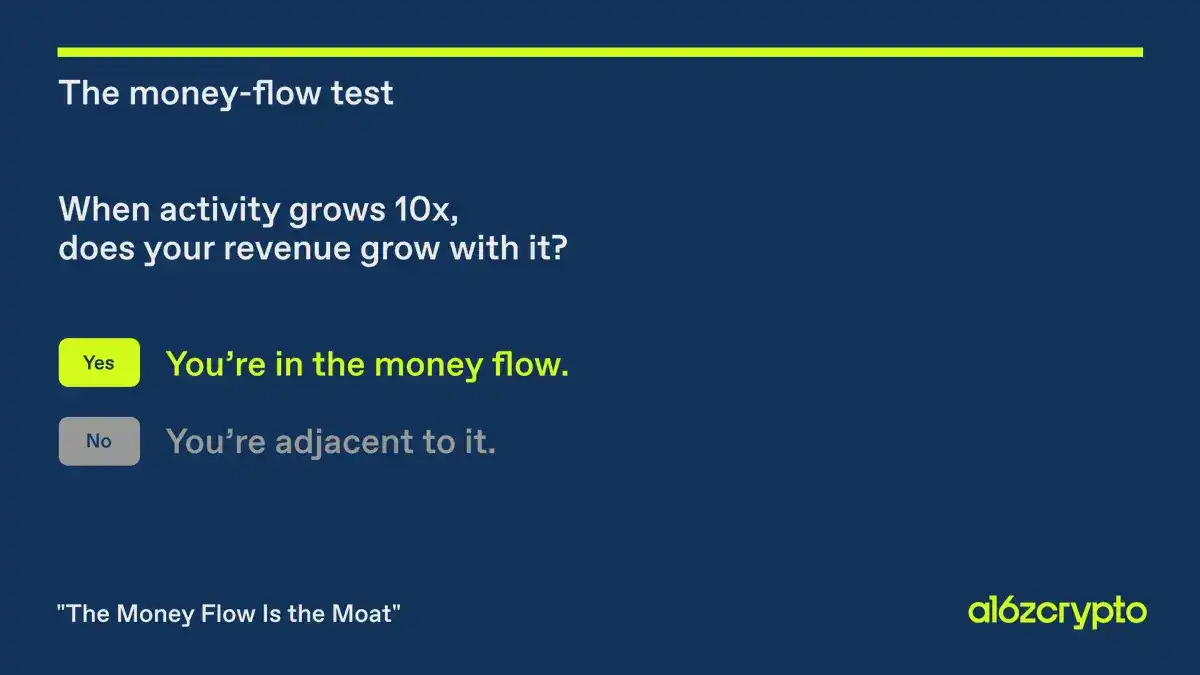
The opportunity is there. Seize it, ride the new flow, and let the network compound from there.


Cryptos en tendance

Questions liées

QAccording to the article, what are the core characteristics of successful business models historically?

AHistorically, many of the best businesses positioned themselves within 'cash flows'—facilitating the creation and transfer of value within a network and taking a cut of that flow. The more value that flows through the network, the larger the business typically becomes.

QHow does the article describe the fundamental advantage that cryptocurrency offers for startups?

ACryptocurrency is the first modern technology natively built for cash flow. It enables value to move at internet speed—24/7, global settlement, with end-to-end programmability—providing startups with accessible and scalable network effects and open unit economics from the start.

QWhat is the relationship between network tokens and business growth as explained in the text?

AWell-designed network tokens align users, developers, suppliers, validators, and the protocol around a single outcome: growing the network. Participants are paid proportionally to their contributions. This creates a feedback loop between the value flowing through the system and the value accumulating to those building it, without private deals or rebates.

QWhat does the phrase 'your margin is my opportunity' refer to in the context of the article?

AIt refers to the opportunity for new, often crypto-native, businesses to compete by targeting high-margin areas in traditional industries (especially financial services). By reducing costs, increasing speed, and building on programmable infrastructure, they can capture market share from established players with inefficient profit structures.

QWhat are the three key questions founders should ask themselves, according to the article's conclusion?

A1. Are you in the cash flow today? 2. When the value of activity on your product grows 10x, does your revenue grow with it? 3. If you're building a new product, where in your target market is the profit-taking highest relative to the value being created?

Lectures associées

Bitcoin en août : les experts s'attendent à une vérification de la fourchette de prix, et non à un retournement rapide

Le Bitcoin pourrait rester sous pression en août, estiment les analystes. Après le rebond de juillet, le marché ne semble pas prêt pour une hausse soutenue et le risque d'une baisse sous les 60 000 $ persiste. La principale cryptomonnaie, négociée autour de 63 500 $ fin juillet, reste dans le couloir 60 000-65 000 $ observé depuis juin. Les experts citent un environnement macroéconomique difficile : des taux d'intérêt américains élevés, une inflation tenace et un dollar fort pèsent sur l'appétit pour les actifs risqués. Les ETF américains sur Bitcoin ont connu des sorties nettes record au premier semestre, reflétant un intérêt institutionnel modéré. Historiquement, août est un mois faible pour le marché crypto. Les scénarios pour le mois à venir vont d'un mouvement latéral (58 000-68 000 $, probabilité de 50%) à une baisse vers 50 000-55 000 $ (probabilité de 30%) ou une hausse vers 71 000-75 000 $ (probabilité de 20%). Les niveaux clés à surveiller sont le support à 60 000-61 000 $ et une résistance à 67 000 $. Bien que certains experts voient les niveaux actuels comme intéressants pour un investissement à long terme, ils conseillent la prudence, estimant qu'un cycle haussier plus significatif ne pourrait intervenir qu'au quatrième trimestre. Les investisseurs sont invités à surveiller les taux d'intérêt, l'inflation, les flux des ETF et le sentiment général envers le risque.

cryptonews.ruIl y a 2 h

Bitcoin en août : les experts s'attendent à une vérification de la fourchette de prix, et non à un retournement rapide

cryptonews.ruIl y a 2 h

Portefeuille matériel Coldcard piraté : les hackers ont retiré 594 bitcoins en 25 minutes

Les portefeuilles matériels, comme le Coldcard de Coinkite, ont subi une faille majeure : une erreur de codage vieille de cinq ans a compromis la génération sécurisée des phrases de récupération (seed). Au lieu d'utiliser un véritable générateur de nombres aléatoires, les appareils produisaient des clés à partir de données prédictibles (numéro de série et horloge interne), réduisant drastiquement l'entropie (environ 40 à 72 bits contre 128 requis). Le 30 juillet 2026, des pirates ont exploité cette vulnérabilité pour extraire 594,5 bitcoins (environ 40 millions de dollars) en seulement 25 minutes, via une attaque hors ligne par force brute. Coinkite a reconnu que tous les appareils utilisant les micrologiciels affectés étaient vulnérables. La société a publié des mises à jour de sécurité (versions 4.2.0 pour Mk3, 5.6.0 pour Mk4/Mk5, 1.5.0Q pour le modèle Q) mais exclut toute compensation financière. Pour se protéger, les utilisateurs doivent impérativement : installer la mise à jour, générer une **nouvelle** phrase de récupération sur l'appareil mis à jour, et transférer **tous** leurs fonds vers de nouvelles adresses dérivées de cette nouvelle seed. Une phrase secrète BIP-39 peut compléter la sécurité, mais ne remplace pas cette migration. Cet incident, similaire à une faille passée dans OpenSSL/Debian, souligne que même le matériel spécialisé n'est pas infaillible et nécessite des audits indépendants continus, notamment pour les fonctions cryptographiques. Il remet en question la frontière perçue entre la sécurité matérielle et logicielle.

cryptonews.ruIl y a 2 h

Portefeuille matériel Coldcard piraté : les hackers ont retiré 594 bitcoins en 25 minutes

cryptonews.ruIl y a 2 h

Circle atteint une étape importante en matière de régulation, obtenant une licence d'activité fiduciaire du Département des Services Financiers de l'État de New York (NYDFS)

Circle, une société de services financiers et de stablecoins, a atteint une étape importante en obtenant une licence d'activité fiduciaire limitée du Département des services financiers de l'État de New York (NYDFS). Cette licence permet à Circle d'élargir ses activités dans l'État, notamment en offrant des services de garde d'actifs, en émettant des stablecoins approuvés par l'État et en gérant les réserves qui les soutiennent. La société est enregistrée en tant que fiduciaire à champ d'activité limité, tandis que sa division financière détient déjà une licence BitLicense. Circle devient ainsi l'une des entreprises les plus réglementées du secteur des cryptomonnaies. Le cofondateur et PDG Jeremy Allaire a salué cette réalisation, soulignant que la licence était un objectif de longue date pour Circle, offrant une clarté réglementaire. Il a qualifié le NYDFS d'autorité internationale fixant les normes pour les actifs numériques et a affirmé que cette licence positionnait le stablecoin USDC de Circle au sein d'un système solide et respecté. Cette approbation fait suite à l'autorisation précédente de l'OCC pour la création de Circle National Trust, plaçant les activités de stablecoins de la société sous supervision fédérale et visant un nouveau standard de transparence et de gouvernance.

cryptonews.ruIl y a 3 h

Circle atteint une étape importante en matière de régulation, obtenant une licence d'activité fiduciaire du Département des Services Financiers de l'État de New York (NYDFS)

cryptonews.ruIl y a 3 h

Trading

Spot

Articles tendance

Comment acheter FLOW

Bienvenue sur HTX.com ! Nous vous permettons d'acheter Flow (FLOW) de manière simple et pratique. Suivez notre guide étape par étape pour commencer votre parcours crypto.Étape 1 : Création de votre compte HTXUtilisez votre adresse e-mail ou votre numéro de téléphone pour ouvrir un compte sur HTX gratuitement. L'inscription se fait en toute simplicité et débloque toutes les fonctionnalités.Créer mon compteÉtape 2 : Choix du mode de paiement (rubrique Acheter des cryptosCarte de crédit/débit : utilisez votre carte Visa ou Mastercard pour acheter instantanément Flow (FLOW).Solde :utilisez les fonds du solde de votre compte HTX pour trader en toute simplicité.Prestataire tiers :pour accroître la commodité d'utilisation, nous avons ajouté des modes de paiement populaires tels que Google Pay et Apple Pay.P2P :tradez directement avec d'autres utilisateurs sur HTX.OTC (de gré à gré) : nous offrons des services personnalisés et des taux de change compétitifs aux traders.Étape 3 : stockage de vos Flow (FLOW)Après avoir acheté vos Flow (FLOW), stockez-les sur votre compte HTX. Vous pouvez également les envoyer ailleurs via un transfert sur la blockchain ou les utiliser pour trader d'autres cryptos.Étape 4 : tradez des Flow (FLOW)Tradez facilement Flow (FLOW) sur le marché Spot de HTX. Il vous suffit d'accéder à votre compte, de sélectionner la paire de trading, d'exécuter vos trades et de les suivre en temps réel. Nous offrons une expérience conviviale aux débutants comme aux traders chevronnés.

297 vues totalesPublié le 2024.12.10Mis à jour le 2026.06.02

Comment acheter FLOW

Discussions

Bienvenue dans la Communauté HTX. Ici, vous pouvez vous tenir informé(e) des derniers développements de la plateforme et accéder à des analyses de marché professionnelles. Les opinions des utilisateurs sur le prix de FLOW (FLOW) sont présentées ci-dessous.

活动图片