From Spring Festival Gala Robots to the Computing Power Energy War: Why Does China Hold the 'Trump Card' in the AI Era?

marsbitPublié le 2026-02-22Dernière mise à jour le 2026-02-22

Résumé

China's 2026 Spring Festival Gala showcased a breakthrough in embodied AI, featuring robots from companies like Magic Atom, Unitree, and Galaxy General performing complex tasks such as dancing, martial arts, and comedy. This demonstrated China's advanced progress in robotics and AI physical integration. Meanwhile, the U.S. faces an escalating energy crisis, with electricity prices rising 36% by early 2026. Training AI models like GPT-4 consumes power equivalent to 100,000 households annually, and U.S. data centers are projected to use 600,000 GWh by 2028. Aging infrastructure, fragmented grids, and lengthy approval processes for new transmission lines exacerbate the problem. In contrast, China has built a strategic advantage through decades of infrastructure investment. It operates 45 ultra-high-voltage (UHV) power transmission projects, spanning 40,000 kilometers, efficiently delivering clean energy from the west to eastern data centers. Renewable energy accounts for over 60% of China’s power capacity, with 40% of electricity coming from green sources. China also dominates transformer production, holding 60% of global capacity. While the U.S. excels in AI algorithms, China’s robust energy infrastructure—UHV grids, renewable energy, and manufacturing capacity—provides a foundational edge in the AI era, turning energy into a critical competitive asset.

In the Spring Festival of 2026, while the world was still marveling at OpenAI's latest model parameters, China used a Spring Festival Gala to showcase another facet of AI to the world—the physical implementation of embodied intelligence.

Looking at the program list of the 2026 CCTV Spring Festival Gala, we witnessed an unprecedented "AI military parade." This was no longer the simple mechanical dance displays of a few years ago but a concentrated explosion of China's robotics industry featuring "multiple enterprises, multiple models, and full-scene applications."
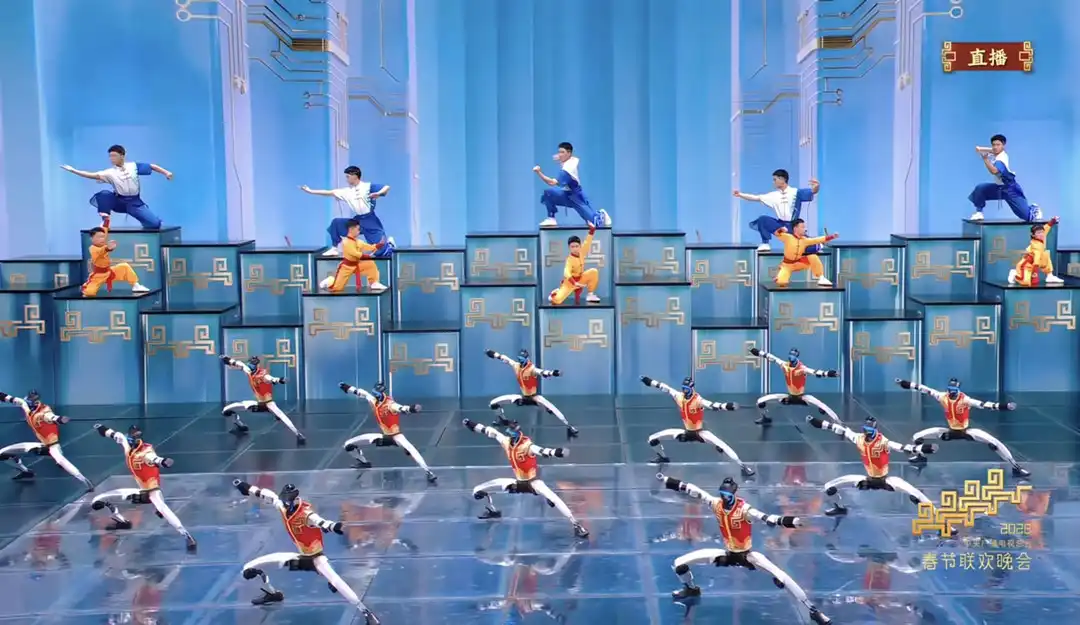
  • Magic Atom's full-stack cluster made robots the best "atmosphere group," accompanying Chen Xiaochun and Yi Yangqianxi in "Intelligent Manufacturing Future" with coordination so seamless it was hard to distinguish from humans.
  • Unitree's G1 and H2 robots demonstrated astonishing motion control capabilities in "Wǔ BOT"—without real-time remote control, relying entirely on edge-side computing power for autonomous balance. When the H2, draped in a red robe, performed a sword dance, it proved that the motion cerebellum of Chinese robots had matured.
  • Songyan Power, in the skit "Grandma's Favorite," assigned robots the comedic role of delivering and responding to punchlines, completing the transition from "prop" to "actor."
  • Galaxy General's Galbot G1 performed "walnut rolling" in a microfilm—a seemingly simple action that showcased the pinnacle of dexterous hand and tactile feedback technology.

The Gala sent a clear signal: China's AI is not just confined to servers; it has grown limbs and entered reality.

However, just as we were cheering for the robots, Wall Street was plunged into silent panic. They discovered that the "lifeblood" powering these systems—electricity—was running dry. Shifting our gaze from the Gala stage to Silicon Valley's data centers, we encounter the elephant in the room—power.

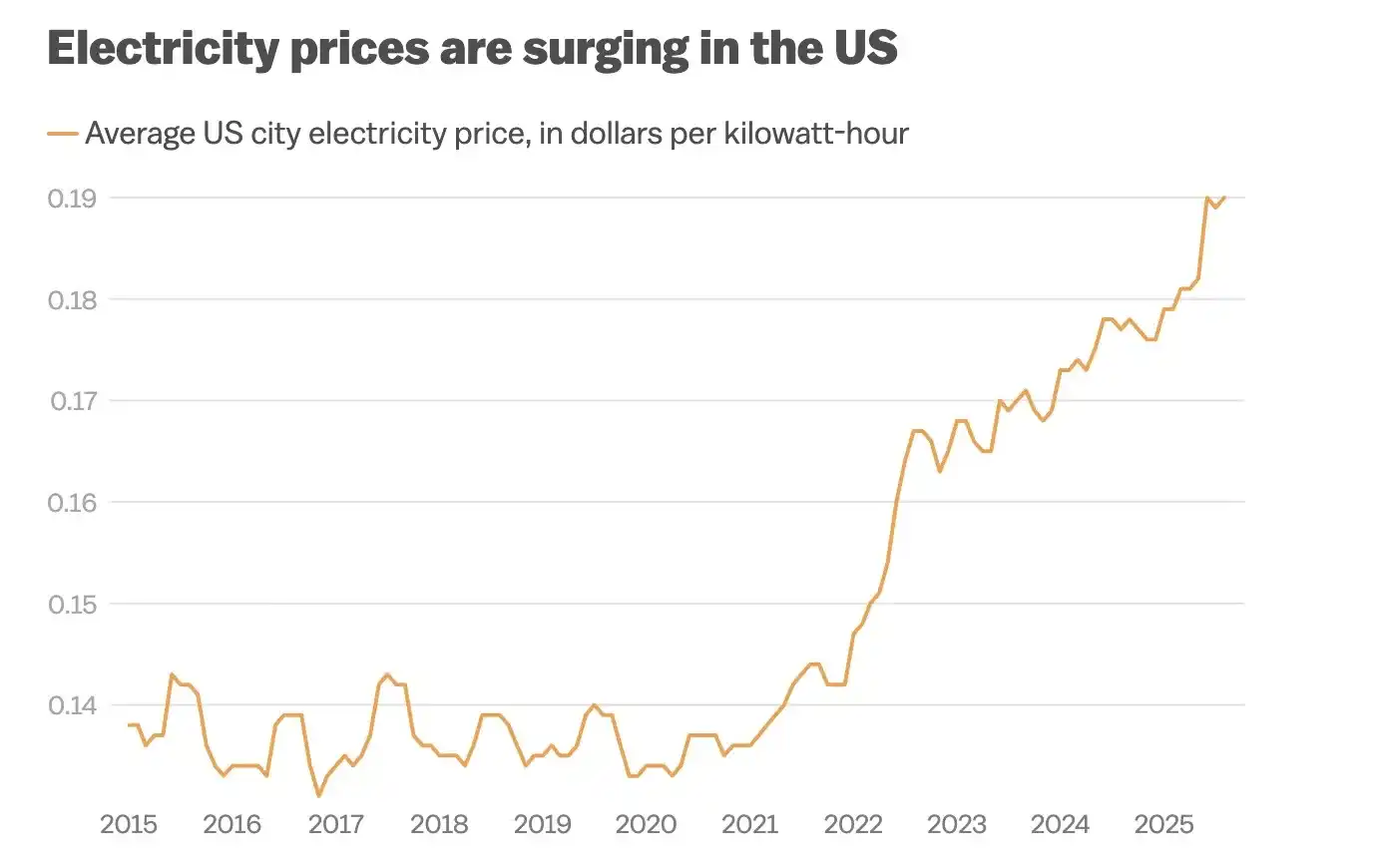
By early 2026, U.S. residential electricity prices had surged by 36%, reaching $0.18 per kWh. But this was just the surface; the core crisis lay in the collapse of the supply side. Training a GPT-4-level model consumes as much electricity as 100,000 households use in a year. By 2028, the annual electricity consumption of U.S. data centers is projected to skyrocket to 600,000 GWh.
The U.S. power grid is facing a dual crisis of "heart disease" and "vascular blockage." Five percent of its electricity relies on aging fossil fuels and nuclear power, and these units are facing a retirement wave. The U.S. grid is fragmented into three major islands—East, West, and Texas—with poor interconnectivity. Approving an interstate transmission line can take up to 15 years, preventing wind power from the Midwest from reaching East Coast data centers.

As Sam Altman said, "Energy is currency." In Silicon Valley today, CEOs are no longer troubled by chip quotas but by—where can they find enough electricity to run these chips?

If computing power is the engine of AI, then electricity is its fuel. In this energy game, China, with a decade of超前布局 (forward-looking planning), has built a strategic moat that the U.S. cannot easily replicate. If computing power is the engine of AI, then electricity is its fuel. In this energy game, China, with a decade of超前布局 (forward-looking planning), has built a strategic moat that the U.S. cannot easily replicate.

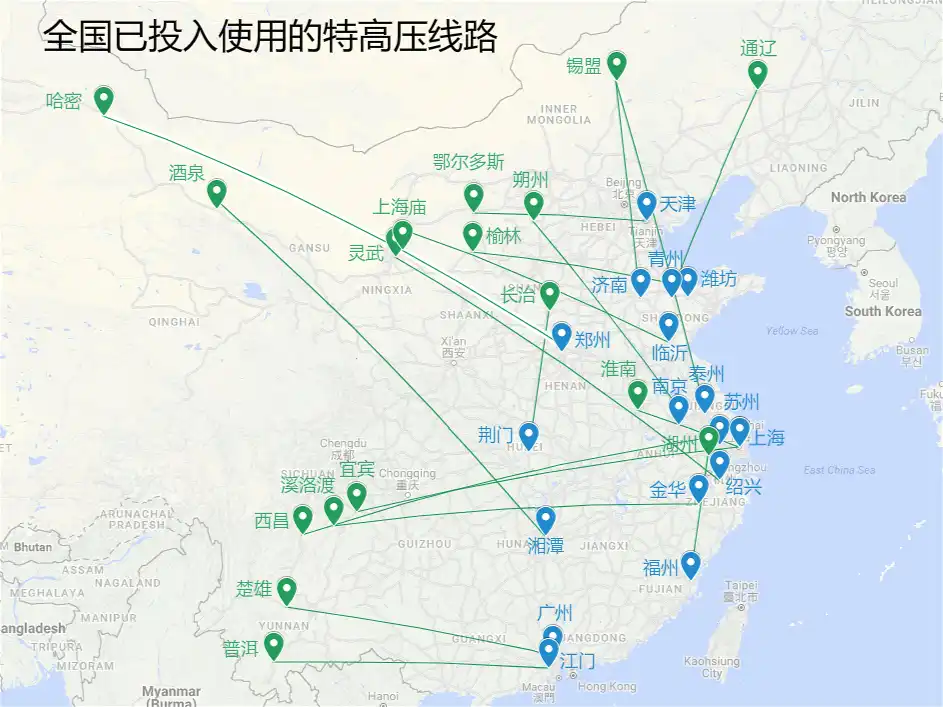
By 2025, China had completed 45 ultra-high voltage (UHV) projects, with the total length of UHV DC transmission lines exceeding 40,000 kilometers. These "electricity superhighways" can transmit abundant clean energy from the west to data centers in the east at millisecond speeds, or directly support the "East Data West Computing" hubs. China possesses 35 of the world's 37 largest high-voltage direct current cable systems—an infrastructure gap that is an insurmountable chasm for the U.S. in the short term.
The high energy consumption of AI inherently demands clean energy. In 2025, the proportion of renewable energy installed capacity in China historically surpassed 60%, with new wind and solar installations exceeding 430 million kilowatts. Of the total electricity consumption, nearly 4 out of every 10 kWh came from green power. While the U.S. is still grappling with nuclear power plant delays, China has achieved grid parity for photovoltaics and wind power, providing a cheap and green energy solution for high-consumption AI data centers.

China is the global manufacturing center for transformers, accounting for over 60% of global production. The biggest pain point for U.S. grid upgrades is transformer shortages, with delivery times now stretching to 3-4 years. Whether through transshipment via Mexico or direct procurement, the maintenance of the U.S. grid is highly dependent on Chinese manufacturing. While U.S. data centers face shutdowns due to transformer shortages, China's power equipment companies are operating at full capacity, supporting the rapid expansion of domestic computing infrastructure.

The 2026 Spring Festival Gala was not just a carnival of robots but also a profile of China's industrial strength.

When we watch Unitree's robotic dogs tumble and Galaxy General's robots perform tasks on screen, we must not forget: behind every agile movement, there is not only advanced algorithms but also a stable current transmitted thousands of kilometers through UHV lines, supported by a robust power grid.

In the second half of this AI revolution, the marginal cost of computing power growth will no longer depend on the nanometer size of chips but on the cost of acquiring joules. The U.S. possesses top-tier algorithm design, but China has the most powerful energy conversion and delivery system.

For investors, the logic is clear: in this gold rush, if NVIDIA is selling shovels, then China's infrastructure builders (UHV, power equipment, green energy) control the water source.


Cryptos en tendance

Questions liées

QWhat was the significance of the 2026 CCTV Spring Festival Gala in showcasing China's AI capabilities?

AThe 2026 CCTV Spring Festival Gala served as a significant demonstration of China's advancements in embodied AI and physical robotics. It featured a multi-enterprise, multi-model, and all-scenario display of China's robot industry, moving beyond simple mechanical dances to show highly coordinated performances, advanced motion control, and robots taking on complex roles like comedy and delicate manipulation, signaling that China's AI has tangible, real-world applications.

QWhat is the core energy crisis facing the United States in relation to AI development as described in the article?

AThe core energy crisis facing the U.S. is a severe shortage of electricity to power its AI data centers. The U.S. grid is struggling with an aging infrastructure reliant on fossil fuels and nuclear power, which is facing a retirement wave. Additionally, the grid is fragmented into three major isolated networks, and bureaucratic delays in approving new transmission lines (taking up to 15 years) prevent the efficient transfer of renewable energy from the Midwest to data centers on the coasts. This has caused electricity prices to soar and threatens the operational capacity of AI systems.

QHow has China built a strategic advantage in the AI energy game according to the article?

AChina has built a strategic advantage through a decade of超前布局 (forward-looking planning) in its energy infrastructure. It has constructed 45 ultra-high voltage (UHV) power transmission projects, creating a 'power highway' over 40,000 kilometers long that efficiently transmits clean energy from the west to data centers in the east. China also dominates global transformer manufacturing (over 60% capacity) and has achieved a historic milestone with renewable energy accounting for over 60% of its installed capacity, providing a cheap and green power solution for its AI data centers.

QWhat does the article suggest is the new limiting factor for AI's computational growth?

AThe article suggests that the new limiting factor for AI's computational growth is no longer the nanometer size of chips, but the cost of acquiring energy (the cost per joule). The marginal cost of increasing computing power is becoming dependent on the availability and cost of the electrical energy required to run the powerful hardware.

QWhat analogy does the article use to describe the role of Chinese infrastructure companies in the AI 'gold rush'?

AThe article uses the analogy of a gold rush. It states that if NVIDIA is selling shovels (the hardware/tools for AI), then Chinese infrastructure builders—those involved in ultra-high voltage power transmission, power equipment, and green energy—control the water source. This means they provide the essential, foundational resource (energy) that is required for the entire AI industry to function and grow.

Lectures associées

Dialogue avec Ray Dalio : Nous sommes actuellement dans une bulle de l'IA, 1% de mon portefeuille est en Bitcoin

Ray Dalio, fondateur de Bridgewater Associates, met en garde contre la bulle actuelle de l'IA, présentant des signes classiques similaires aux précédents krachs financiers. Il explique qu'une combinaison de spéculation excessive, d'endettement et de changements de taux d'intérêt pourrait provoquer son éclatement, entraînant une récession économique. Dalio décrit également un « grand cycle » mondial d'environ 80 ans, caractérisé par des inégalités croissantes, des déficits publics élevés et des tensions géopolitiques. Nous serions actuellement dans une phase de déclin de ce cycle, avec un ordre mondial en transition. Pour protéger leur patrimoine, il conseille aux investisseurs de diversifier leurs actifs (actions, obligations, or, immobilier) plutôt que de détenir uniquement des liquidités. Il mentionne détenir environ 1% de Bitcoin, mais préfère l'or physique pour sa stabilité. Concernant l'IA, Dalio souligne qu'elle remplacera progressivement le travail intellectuel humain, creusant les inégalités. L'avenir appartiendra à ceux qui sauront allier intelligence humaine et collaboration avec l'IA. Enfin, il évoque un monde de plus en plus régionalisé, avec un affaiblissement de la puissance américaine, visible dans des conflits comme celui avec l'Iran, et la montée en puissance d'autres pôles, notamment la Chine.

marsbitIl y a 1 h

Dialogue avec Ray Dalio : Nous sommes actuellement dans une bulle de l'IA, 1% de mon portefeuille est en Bitcoin

marsbitIl y a 1 h

7,2 billions de KRW en une journée, les achats nets des investisseurs étrangers atteignent un record historique ce vendredi ! Wall Street : Les vents contraires sur les flux de capitaux sud-coréens se sont dissipés

Les marchés boursiers sud-coréens montrent des signes tangibles d'amélioration des flux de capitaux. Le 31 juillet, les investisseurs étrangers ont réalisé un achat net record de 7 200 milliards de wons sur une seule journée dans le KOSPI, marquant un renversement de la tendance de sorties massives observée ces derniers mois. En juillet, leurs ventes nettes mensuelles se sont fortement réduites à 9 800 milliards de wons, contre 48 400 et 44 500 milliards en juin et mai respectivement. Parallèlement, les institutions domestiques comme les fonds de pension ont inversé leur tendance, passant à un achat net de 1 000 milliards de wons en juillet. La Commission des services financiers a également resserré l'accès aux ETF à effet de levier sur actions individuelles pour les investisseurs de détail, réduisant ainsi la volatilité du marché. Citigroup Research maintient son objectif pour le KOSPI à 10 000 points, estimant que les vents contraires liés aux flux de capitaux s'atténuent. Des facteurs tels que les fondamentaux solides du secteur des puces mémoire, les faibles valorisations du marché, une économie robuste et un environnement politique favorable devraient soutenir le marché. La possibilité d'interventions des autorités pour stabiliser le marché offre également un filet de sécurité.

marsbitIl y a 1 h

7,2 billions de KRW en une journée, les achats nets des investisseurs étrangers atteignent un record historique ce vendredi ! Wall Street : Les vents contraires sur les flux de capitaux sud-coréens se sont dissipés

marsbitIl y a 1 h

Choc ! La prochaine IA d'OpenAI résout 10 problèmes du calibre de la Médaille Fields

**OpenAI provoque un séisme mathématique avec son nouveau modèle Astra** OpenAI a dévoilé des avancées mathématiques majeures réalisées par son modèle interne Astra, présenté par Sam Altman. L'IA aurait résolu ou fait progresser dix problèmes complexes dans des domaines variés comme la géométrie haute dimension, la théorie des groupes et la complexité quantique. Le résultat le plus marquant est la construction du premier groupe "non sofic" infini et finiment présenté, réfutant une conjecture de Mikhail Gromov vieille de 27 ans. Cette seule découverte est qualifiée de niveau "Prix Fields". Astra a également amélioré une borne fondamentale sur le problème de l'empilement des sphères en haute dimension, stagnant depuis 1978, et a réfuté la conjecture de rigidité d'Alain Connes en construisant une infinité de groupes non isomorphes partageant la même algèbre de von Neumann. Ces résultats, compilés dans un document de 249 pages, sont accompagnés de preuves formelles vérifiées par l'assistant Lean 4. OpenAI précise que le coût total de génération de ces démonstrations aurait été inférieur à 2000 dollars. La communauté mathématique réagit avec stupeur, certains experts y voyant un tournant historique où l'IA démontre une intuition et une capacité de raisonnement pouvant surpasser les meilleurs mathématiciens humains.

marsbitIl y a 3 h

Choc ! La prochaine IA d'OpenAI résout 10 problèmes du calibre de la Médaille Fields

marsbitIl y a 3 h

Grâce aux lancers de dés, les clés Bitcoin sont stockées hors ligne, mais tout le monde ne s'y mettra pas

Le titre « Les clés Bitcoin protégées par des dés, mais la méthode reste marginale » introduit un article sur la génération manuelle de graines de portefeuille Bitcoin à l'aide de dés. L'article explique le concept d'entropie, illustré par Claude Shannon, où un dé à six faces génère environ 2,585 bits d'incertitude. Il aborde le scandale récent de Coldcard, où une vulnérabilité du générateur de nombres aléatoires matériel a compromis des fonds. Les utilisateurs ayant généré leur phrase de récupération avec des dés (environ 99 lancers pour une haute sécurité) n'étaient pas affectés pour leur seed principal. Cependant, l'analyse du chercheur Kevin Loaec montre que d'autres fonctions du portefeuille (clés de copie, portefeuilles papier, mots de passe, etc.) utilisaient ce générateur défectueux et restaient vulnérables. L'article souligne les défis pratiques de la méthode des dés : elle est longue, sujette aux erreurs de saisie, et peu adaptée aux nouveaux utilisateurs qui pourraient mal l'exécuter. Il conclut que si cette méthode manuelle est robuste pour les experts, l'objectif à long terme est d'avoir un matériel et des logiciels générant une entropie fiable de manière simple et sécurisée. Il conseille aux propriétaires de Coldcard de vérifier leur firmware et les fonctions utilisées, et rappelle l'intérêt des solutions multi-signatures avec différents fabricants pour limiter les risques.

cryptonews.ruIl y a 6 h

Grâce aux lancers de dés, les clés Bitcoin sont stockées hors ligne, mais tout le monde ne s'y mettra pas

cryptonews.ruIl y a 6 h

Trading

Spot

Articles tendance

Comment acheter GALA

Bienvenue sur HTX.com ! Nous vous permettons d'acheter GALA (GALA) de manière simple et pratique. Suivez notre guide étape par étape pour commencer votre parcours crypto.Étape 1 : Création de votre compte HTXUtilisez votre adresse e-mail ou votre numéro de téléphone pour ouvrir un compte sur HTX gratuitement. L'inscription se fait en toute simplicité et débloque toutes les fonctionnalités.Créer mon compteÉtape 2 : Choix du mode de paiement (rubrique Acheter des cryptosCarte de crédit/débit : utilisez votre carte Visa ou Mastercard pour acheter instantanément GALA (GALA).Solde :utilisez les fonds du solde de votre compte HTX pour trader en toute simplicité.Prestataire tiers :pour accroître la commodité d'utilisation, nous avons ajouté des modes de paiement populaires tels que Google Pay et Apple Pay.P2P :tradez directement avec d'autres utilisateurs sur HTX.OTC (de gré à gré) : nous offrons des services personnalisés et des taux de change compétitifs aux traders.Étape 3 : stockage de vos GALA (GALA)Après avoir acheté vos GALA (GALA), stockez-les sur votre compte HTX. Vous pouvez également les envoyer ailleurs via un transfert sur la blockchain ou les utiliser pour trader d'autres cryptos.Étape 4 : tradez des GALA (GALA)Tradez facilement GALA (GALA) sur le marché Spot de HTX. Il vous suffit d'accéder à votre compte, de sélectionner la paire de trading, d'exécuter vos trades et de les suivre en temps réel. Nous offrons une expérience conviviale aux débutants comme aux traders chevronnés.

683 vues totalesPublié le 2024.12.11Mis à jour le 2026.06.02

Comment acheter GALA

Discussions

Bienvenue dans la Communauté HTX. Ici, vous pouvez vous tenir informé(e) des derniers développements de la plateforme et accéder à des analyses de marché professionnelles. Les opinions des utilisateurs sur le prix de GALA (GALA) sont présentées ci-dessous.

活动图片












