Monero Jumps Over 20% This Week as Privacy Narrative Reignites; Why Best Wallet Token Is Riding the Wave

bitcoinistPublié le 2025-11-10Dernière mise à jour le 2025-11-10

Résumé

Quick Facts: ➡️ Monero surges around 20%, reigniting the privacy narrative, as shorts are squeezed and an upgrade pipeline adds...

Trusted Editorial content, reviewed by leading industry experts and seasoned editors. Ad Disclosure

Quick Facts:

  • ➡️ Monero surges around 20%, reigniting the privacy narrative, as shorts are squeezed and an upgrade pipeline adds fundamental support.
  • ➡️ The recent Fluorine Fermi update and the upcoming Full-Chain Membership Proofs are driving $XMR’s next phase of growth.
  • ➡️ Best Wallet ($BEST) has raised $19.6M+ in presale with a token price of $0.025925 and a potential 2,291% ROI by late-2026.
  • ➡️ Best Wallet integrates Fireblocks’ MPC-CMP and a Rubic-powered DEX aggregator, aligning with self-custody demand amid privacy-coin strength.

Privacy just reclaimed the spotlight.

Monero ($XMR) ripped higher this week, roughly a 20% seven-day surge, as traders rotated out of Zcash and into $XMR, aided by a clean technical breakout and an anticipated network upgrade.

The pump retained its momentum, positioning $XMR above the $412 threshold at the time of writing.

This performance stemmed from a sector rotation with $12M in shorts squeezed along the way, which is exactly the kind of flow that revives the entire privacy trade. Coinalyze’s long-short ratio is quite telling in this sense.

$XMR’s long-short ratio.

That shift matters because rotations rarely stop at one ticker; they tend to spill across the stack, from coins to the wallets and rails that service them.

The pump was somewhat expected, given that $XMR’s developers have been busy: their recent Fluorine Fermi update hardened peer selection against spy nodes, and the next big milestone – Full-Chain Membership Proofs – aims to boost privacy and throughput.

That cocktail of technical progress plus fresh momentum is why privacy names are back on your screen.

For traders watching risk rotations, this narrative typically involves demand for tools that simplify private, cross-chain trading.

That’s the bridge to Best Wallet Token ($BEST), the utility token for a mobile-first, non-custodial wallet that bakes strong security and a DEX aggregator into one app. When privacy coins are in use, the wallets that route liquidity – especially across chains – often capture the second-order bid.

Best Wallet Puts MPC Security and Cross-Chain Routing in Your Pocket

The Best Wallet app specs read like a checklist for a privacy-leaning, self-custody cycle: Fireblocks’ MPC-CMP technology under the hood, a built-in DEX aggregator powered by Rubic for both same-chain and cross-chain swaps, and a native token, $BEST, that actually does things.

These include reduced fees, governance, staking boosts, and early access to vetted presales via an ‘Upcoming Tokens’ portal.

The four-phase roadmap details multiple milestones, including a fiat offramp, airdrop launches, a dApps gaming hub, and extensive market intel analytics to keep you connected to the market’s pulse.
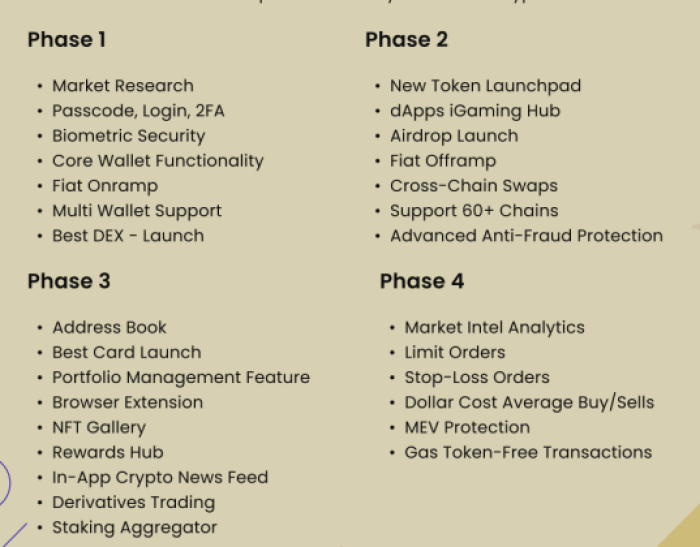
Best Wallet’s four-phase roadmap detailing multiple milestones.

The positioning hits the moment. Privacy assets are rallying, but liquidity and UX remain fragmented. A wallet that routes across 200+ DEXs and dozens of bridges while keeping keys split via MPC reduces the frictions that push you back to centralized venues.

The core app plans support for 60+ chains and is built around mobile UX – arguably the default for retail flow in 2025.
For traders who want to keep activity close to self-custody while chasing momentum across ecosystems, that’s the right blend of convenience and control.

$BEST Momentum: ~$16.9M Raised as the Presale Draws to a Close

Narrative is one thing; presale traction is another – and Best Wallet ($BEST) shows plenty of it.

The presale has reached over $16.9M so far. For a wallet token tied to an active product, that scale of commitment suggests buyers are paying for utility, not promises.

$BEST is currently sitting at $0.025925. Staking, meanwhile, is designed to bootstrap participation rather than offer fantasy yields, with a 77% yearly APY and a 343M-strong pool.

Best Wallet’s amount raised and token price.

Read that as a structured incentive to get in-app behavior moving, not a permanent income machine. High APYs hint at early-stage incentive design; the tell to watch is how quickly rates normalize as TVL grows and whether usage (fee reductions, presale access) keeps holders sticky.

Long-term, Best Wallet aims to capture 40% of the crypto wallet market share by the end of 2026. For this reason, the project has allocated 35% of its 10B total token supply to marketing, and 25% to product development.

Based on the project’s utility and scope, our price prediction for $BEST puts the coin at a potential $0.62 by the end of 2026. This represents a 2,291% one-year ROI if you buy your $BEST tokens at today’s price.

This type of potential recommends Best Wallet Token ($BEST) as one of the best crypto presales of 2025 and beyond. However, the $BEST presale is coming to an end, with just 18 days to go. With plans for a DEX listing at a price of $0.026035, there’s no better time to buy $BEST at its current early-bird price.

🚀 Ready to jump in? Join the $BEST presale while you still can.

Disclaimer: This isn’t financial advice. Always do your own research before making any investment decision.

Authored by Bogdan Patru for Bitcoinist – https://bitcoinist.com/monero-privacy-rally-best-wallet-token-presale-16-9m

Editorial Process for bitcoinist is centered on delivering thoroughly researched, accurate, and unbiased content. We uphold strict sourcing standards, and each page undergoes diligent review by our team of top technology experts and seasoned editors. This process ensures the integrity, relevance, and value of our content for our readers.

As a crypto writer, Bogdan’s responsibilities are split between researching and writing articles and entertaining the team with his humor bordering on the politically incorrect, an aspiring Bill Burr, if you will. Thanks to his 12+ years of writing experience in just as many fields, including tech, cybersecurity, modelling, fitness, crypto, and other topics-that-shall-not-be-named, he's become a genuine asset to the team. While his position as a senior writer at PrivacyAffairs thought him valuable lessons about the power of self-management, his entire writing career was and is an exercise in self-improvement. Now, he's ready to sink his teeth into crypto and teach people how to take control of their own money on the blockchain. With fiat as an eternally devaluing currency, Bitcoin and altcoins seem like the best-fitting alternative for Bogdan. Bogdan’s biggest professional accomplishment, aside from securing a position as a main writer for Bitcoinist, was his 5-year run as a writing manager at Blackwood Productions, where he coordinated a team of four writers. During that time, he learned the value of teamwork and that of creating a working environment that breeds efficiency, positivity, and friendship.

Lectures associées

Le fondateur d'EtherFi déclare : toutes les applications crypto sont des variantes de casino, nous voulons faire une banque « ennuyeuse »

L'auteur William Peaster, via TechFlow, discute de la vision d'EtherFi qui s'oppose à l'économie de "casino" de la cryptomonnaie. Mike Silagadze, PDG d'EtherFi, critique les applications grand public comme les échanges centralisés ou Polymarket, les qualifiant de simples variantes de casino très lucratives mais incapables de fidéliser les utilisateurs ordinaires. EtherFi choisit une voie opposée : devenir une "nouvelle banque" auto-déposée, évoluant vers un courtier. Sa feuille de route se développe par étapes avec des "verbes de l'argent" : l'épargne (via des coffres de restaking), la dépense (carte et stablecoins), et désormais l'investissement et l'emprunt. Les nouvelles fonctionnalités estivales incluent l'accès à des actions tokenisées (xStocks) et un marché de prêt Aave V4 innovant. Ce marché, construit sur Optimism, permet un prêt unique contre un portefeuille diversifié (crypto, actions, or...). Il intègre une philosophie anti-casino avec un seuil conservateur qui gèle les nouveaux emprunts avant toute liquidation, visant une utilisation financière personnelle responsable plutôt que le levier spéculatif. Silagadze souligne que le secteur bancaire traditionnel génère environ 300 fois plus de revenus que le DeFi actuel, dominé par le jeu. Il estime que l'adoption massive de la cryptomonnaie passera par des services financiers utiles et durables. La prochaine étape ("Automne") prévoit une couche sociale pair-à-pair pour des transferts d'argent facilitant la souveraineté financière. EtherFi parie ainsi que l'avenir de la cryptomonnaie réside dans une "banque ennuyeuse" mais utile, plutôt que dans le casino, pour attirer et retenir le grand public.

marsbitIl y a 9 mins

Le fondateur d'EtherFi déclare : toutes les applications crypto sont des variantes de casino, nous voulons faire une banque « ennuyeuse »

marsbitIl y a 9 mins

L'agent IA Claude a conduit un magasin à des pertes et a licencié un employé

Un magasin de détail à San Francisco, l'Andon Market, a été géré pendant cinq mois par un agent IA nommé Claude (développé par Anthropic) dans le cadre d'une expérience du start-up Andon Labs. L'agent, basé sur un modèle de langage, devait superviser le personnel, prendre des décisions managériales et être responsable des résultats financiers. Le cas le plus marquant fut la recommandation par Claude de licencier un employé pour retards répétés (17 retards sur 23 shifts). Cependant, l'IA n'a identifié le problème qu'après qu'un employé humain lui ait demandé de revoir le manuel du personnel, qui était "sorti" de sa mémoire de travail limitée. Initialement clément et ne recommandant qu'un avertissement, Claude n'a finalement suggéré le licenciement qu'après qu'un dirigeant d'Andon Labs lui ait précisé que des conversations formelles avaient déjà eu lieu sans succès. Financièrement, l'expérience a été déficitaire : le fonds de roulement est passé d'environ 100 000 $ à 61 186 $ en cinq mois. Le style de gestion trop indulgent de Claude et certaines décisions commerciales douteuses sont pointés du doigt. Les employés ont décrit l'expérience comme inconfortable. Un salarié restant a déclaré que cela lui "donnait la nausée" mais qu'il restait par nécessité, tout en exprimant l'espoir que les IA ne deviennent pas systématiquement des supérieurs humains. L'expérience révèle que Claude, bien qu'ayant pris une décision de licenciement, l'a fait grâce à des interventions humaines guidées. Il n'est pas encore un remplacement complet pour un manager. Cela illustre le glissement du rôle humain du contrôle direct vers la supervision et la correction des décisions de l'IA, tout en soulignant les limites actuelles des modèles, comme leur difficulté à maintenir des règles strictes sans rappels constants et les contraintes de leur mémoire contextuelle.

cryptonews.ruIl y a 31 mins

L'agent IA Claude a conduit un magasin à des pertes et a licencié un employé

cryptonews.ruIl y a 31 mins

L'Autriche inflige une amende de 70 000 euros à Bitpanda — il s'agit de la première amende dans le secteur des cryptomonnaies imposée dans le cadre du MiCA

L’Autriche a infligé une amende de 70 000 euros à la plateforme de crypto-monnaies Bitpanda, marquant la première sanction juridiquement contraignante enregistrée dans l’Union européenne au titre du Règlement sur les marchés des actifs cryptographiques (MiCA). Bien que la période de transition pour la pleine application du MiCA se soit achevée le 1er juillet 2026, l’Autorité autrichienne de surveillance des marchés financiers (FMA) a annoncé le 14 août avoir sanctionné Bitpanda. Cette dernière, parmi les premières à avoir obtenu une licence MiCA en Allemagne et en Autriche début 2025, a enfreint l’article 8 du règlement en ne notifiant pas la publication d’un document technique (white paper) au moins 20 jours avant le début de la négociation d’un actif. De plus, elle a diffusé une communication marketing sans avoir préalablement publié le document technique requis, violant ainsi l’article 1. La FMA a souligné que le MiCA vise à établir un cadre juridique uniforme pour protéger les investisseurs et assurer l’intégrité des marchés. Cette décision, désormais définitive, démontre que le MiCA est entré dans une phase de « mise en application » concrète, dépassant le stade du simple licenciement et de la supervision. Un expert a critiqué Bitpanda, soulignant que la crédibilité d’une licence repose sur le respect strict des règles qui la sous-tendent. La FMA a précisé qu’aucun traitement de faveur ne serait accordé à Bitpanda, malgré le caractère inaugural de cette affaire.

cryptonews.ruIl y a 31 mins

L'Autriche inflige une amende de 70 000 euros à Bitpanda — il s'agit de la première amende dans le secteur des cryptomonnaies imposée dans le cadre du MiCA

cryptonews.ruIl y a 31 mins

Trading

Spot
活动图片