Ripple CTO Schwartz Revisits NSA Past And Satoshi Speculation

bitcoinistPublié le 2025-10-24Dernière mise à jour le 2025-10-24

Résumé

Ripple chief technology officer David “JoelKatz” Schwartz has resurfaced a years-long thread of speculation around Bitcoin’s origins and his own...

Trusted Editorial content, reviewed by leading industry experts and seasoned editors. Ad Disclosure

Ripple chief technology officer David “JoelKatz” Schwartz has resurfaced a years-long thread of speculation around Bitcoin’s origins and his own pre-Ripple work with US government agencies, clarifying once again that he neither possessed “high level” intelligence nor claims special insight into Satoshi Nakamoto’s identity—while acknowledging that a US intelligence provenance for Bitcoin is “not a terrible theory.”

The renewed attention follows a fresh exchange on X on October 23, 2025, in which Schwartz responded to questions about prior employment and nondisclosure obligations—context that traces back to an October 24, 2022 thread where he weighed in on Satoshi debates and litigation risk tied to public claims about identity. “There is nothing defamatory about saying that Craig Wright is not Satoshi, just as there is nothing defamatory about saying that I am not Satoshi,” Schwartz wrote in 2022, adding, “There is nothing inherently wrong with not being Satoshi.”

In the same 2022 exchange, after community member @XRPcryptowolf joked “David Schwartz is Satoshi confirmed jk lol” and floated the notion that “Satoshi is really the CIA or NSA,” the Ripple CTO replied: “That’s not a terrible theory. If the NSA or the CIA happened to stumble on how to make bitcoin, it might make sense that they would implement and deploy it to eliminate the risk that someone hostile to the US would do it first and potentially made billions of dollars.”

Ripple CTO Shuts Down Satoshi Claims

The 2025 follow-ups drilled into Schwartz’s own past work and what, if anything, it implies. In response to a commenter’s claim—“Well, you’ve worked at the NSA, getting high level information, by your own words.” The Ripple CTO flatly rejected the characterization, indirectly doubling down that he isn’t (part of) Satoshi Nakamoto: “I never got anything even remotely resembling high level information. I had to certify that the thing I was working on would meet the NSA’s requirements without even being allowed to see most of them.”


He then shared vignettes about the compartmentalization he encountered. “One requirement that I was allowed to see was that you had to be able to stop it from processing classified data if you lost control over it. I was puzzled—if you lost control over it, by definition you can’t stop it, right? It was explained to me that that’s…” He also noted signage he wasn’t permitted to have explained: “They wouldn’t even tell me why there’s little signs all over the place (generally on entrances or containers) that can be set to ‘OPEN’ or ‘CLOSED’ and what ‘OPEN’ and ‘CLOSED’ mean on those signs.”

Schwartz further recounted how, at one point, he recognized the user interface of “one thing I worked on” not through briefings but “because late one night I happened to have the Discovery Channel on and saw our UI on a screen.” He clarified the lineage of that code: “To be precise, that was work I did (on the same core code) for NATO shortly before I adapted it for the NSA. I don’t remember how I found out what the NSA was using it for. I don’t think I should reveal the exact uses, but they’re pretty boring.”

Asked when his nondisclosure agreement would expire, he answered: “I have no idea. They didn’t let me keep a copy and I don’t remember—if I ever even knew. I just hope nobody really cares any more. Plus, I never really knew anything all that secret.”

The through-line between the 2022 and 2025 messages is clear: a willingness to treat state-origin hypotheses for Bitcoin as plausible without endorsing them. “There is nothing inherently wrong with not being Satoshi,” the Ripple CTO emphasized in 2022. By 2025, his clarifications around the nature of his NSA and NATO work add color but not conspiracy: process-driven engineering inside a tightly siloed environment, limited visibility into end use, and no privileged window into intelligence secrets.

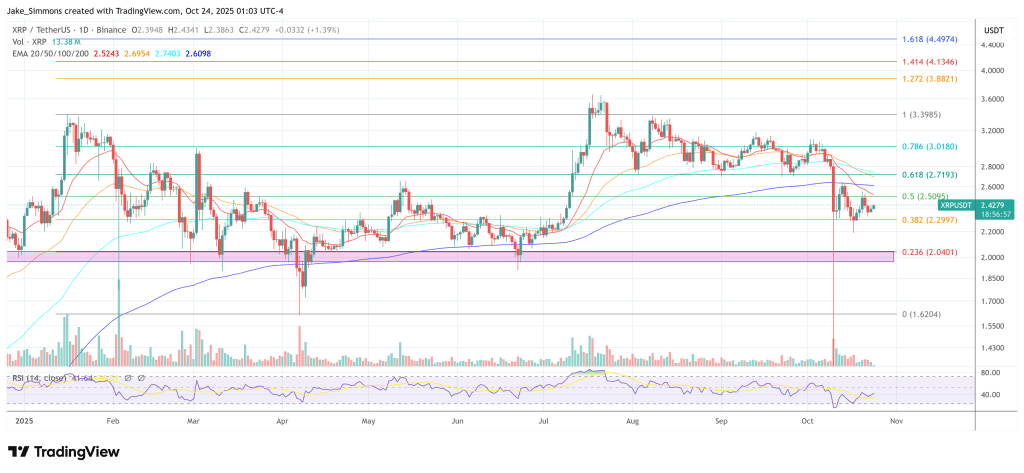
At press time, XRP traded at $2.42.
XRP price
XRP bulls face the 0.5 Fib, 1-day chart | Source: XRPUSDT on TradingView.com
Featured image created with DALL.E, chart from TradingView.com
Editorial Process for bitcoinist is centered on delivering thoroughly researched, accurate, and unbiased content. We uphold strict sourcing standards, and each page undergoes diligent review by our team of top technology experts and seasoned editors. This process ensures the integrity, relevance, and value of our content for our readers.

Jake Simmons has been a Bitcoin enthusiast since 2016. Ever since he heard about Bitcoin, he has been studying the topic every day and trying to share his knowledge with others. His goal is to contribute to Bitcoin's financial revolution, which will replace the fiat money system. Besides BTC and crypto, Jake studied Business Informatics at a university. After graduation in 2017, he has been working in the blockchain and crypto sector. You can follow Jake on Twitter at @realJakeSimmons.

Lectures associées

HYPE à l'aube de l'explosion : L'AQAv2 démarre l'accumulation des revenus ce mois-ci, le HIP-4 se prépare au décollage

L'hypothèse d'une reprise de HYPE se renforce, tant sur le plan technique que fondamental. Après deux mois de correction suivant son record de mi-juin, une analyse technique indique un potentiel rebond vers 76-77 dollars. Fondamentalement, l'intérêt croissant des institutions financières traditionnelles via le produit PURR constitue un support structurel. Le principal catalyseur est le lancement imminent du mécanisme de partage des revenus AQAv2 le 26 août. Ce système obligera les émetteurs de stablecoins (comme USDC, dominant sur Hyperliquid avec 56 milliards de dollars) à redistribuer 90% des revenus de leurs réserves au protocole. Ces fonds seront intégralement utilisés pour racheter et brûler le token HYPE. Des estimations prévoient que cela pourrait générer environ 2 milliards de dollars de rachats annuels, renforçant considérablement la capture de valeur de HYPE et rendant les revenus du protocole plus résilients aux cycles de marché. Parallèlement, HIP-4, le marché de prédictions d'Hyperliquid, s'apprête à lancer son déploiement sans autorisation sur le mainnet. Déjà testé avec succès (plus de 180 contrats déployés en testnet, majoritairement sur le sport), cette fonctionnalité vise à dynamiser l'écosystème et à rivaliser avec des acteurs établis comme Polymarket. En résumé, la combinaison du mécanisme de rachat massif via AQAv2 et de l'expansion potentielle de HIP-4 crée un contexte favorable pour HYPE à moyen terme.

marsbitIl y a 35 mins

HYPE à l'aube de l'explosion : L'AQAv2 démarre l'accumulation des revenus ce mois-ci, le HIP-4 se prépare au décollage

marsbitIl y a 35 mins

Cette nuit où les cryptomonnaies ont flambé : qu’a dit Trump ?

Lors d'une réunion à la Maison Blanche le 20 août rassemblant des dirigeants de l'industrie cryptographique, des régulateurs et des figures de la finance traditionnelle, le président Trump a prononcé un discours soulignant l'engagement de son administration en faveur des crypto-monnaies et de l'innovation financière. Il a remercié les participants, dont les PDG de Coinbase, Robinhood, Kraken, Ripple, Gemini, a16z, ainsi que les dirigeants de la SEC et de la CFTC. Trump a vivement critiqué l'approche régulative de l'administration Biden précédente, affirmant avoir mis fin à la "guerre contre les crypto-monnaies" en licenciant l'ancien président de la SEC, Gary Gensler. Il a énuméré les actions de son gouvernement : l'interdiction des CBDC, le lancement du "Project Crypto" pour moderniser la réglementation, la création d'une réserve stratégique de Bitcoin pour le Trésor américain et l'adoption du "GENIUS Act" pour favoriser les stablecoins adossés au dollar. Trump a insisté sur la volonté d'établir un cadre réglementaire clair pour que l'innovation reste aux États-Unis, affirmant que le pays est désormais leader dans les domaines de la crypto, de l'IA et des marchés prédictifs, devançant largement la Chine. Il a également lié la forte performance des marchés actions et la création d'emplois à ces politiques, appelant le Congrès à adopter le "CLARITY Act" pour consolider cet avantage et ouvrir la voie à la prochaine génération d'innovations. Le discours s'est conclu sur un ton très optimiste quant à la domination économique américaine retrouvée.

Odaily星球日报Il y a 48 mins

Cette nuit où les cryptomonnaies ont flambé : qu’a dit Trump ?

Odaily星球日报Il y a 48 mins

Trading

Spot
活动图片