Stablecoins to Hit $4 Trillion by 2030, Says Citi Report: Best Time to Try Best Wallet

bitcoinistPublié le 2025-09-26Dernière mise à jour le 2025-09-26

Résumé

Stablecoins are rapidly becoming one of the dominant use cases linking crypto and tradfi. Recent forecasts, institutional moves, and regulatory...

Trusted Editorial content, reviewed by leading industry experts and seasoned editors. Ad Disclosure

Stablecoins are rapidly becoming one of the dominant use cases linking crypto and tradfi.

Recent forecasts, institutional moves, and regulatory efforts suggest the sector is reaching an inflection point. And now, at least one analysis believes the stablecoin market cap alone could reach $4 trillion by 2030.

That’s twice the current size of the entire crypto economy in stablecoins alone.

Forecasting a Stablecoin Boom

That projection originates from Citi, whose analysts now estimate a base case of $1.9 trillion in stablecoin issuance by 2030, up from earlier forecasts. In a bullish scenario, the bank predicts issuance reaching $4 trillion.
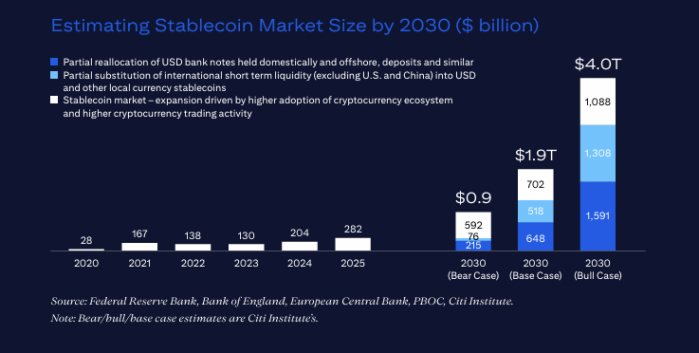
Stablecoin market size

If stablecoins were to be integrated everywhere, the analysts suggest they could support as much as $100T of annual transaction volume, a scale dwarfing today’s markets.

Citi tempers its optimism with caution. Many firms remain hesitant to adopt stablecoins in core operations, treating them as experimental tools rather than foundational infrastructure. In many domestic markets, conventional payment systems already operate at low cost and in near real time. Still, as legislation finally catches up, stablecoin utility has steadily grown.

The biggest real opportunity is in cross-border settlement, where inefficiencies still exist. Even so, Citi highlights that tokenized bank deposits may surpass stablecoins in usage by 2030.

Bank tokens are tokenized deposits, deposit tokens, and other bank-issued tokenized assets. They provide the trust, familiarity, and regulatory safeguards of bank money, and many corporations prefer them over stablecoins.
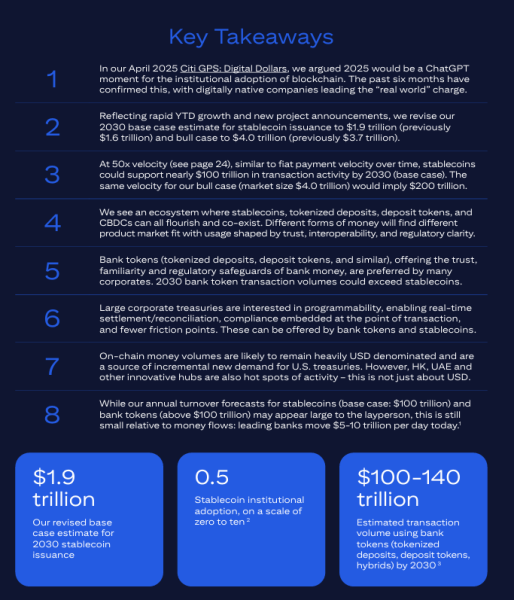
Key takeaways

The final takeaway from the report highlights just how big the market could be. Still, just how much growth remains – even in a bullish case of $100T in payments annually, stablecoins would be a small percentage of the $5T-$10T leading banks send and receive daily.

The current stablecoin market grew from around $200B in early 2025 to nearly $280B, despite experiencing significant market swings. Governments and regulators are actively discussing how to regulate the issuance, backing, and redemption of these asset instruments.

Beyond market risk, stablecoins carry macro and geopolitical stakes.

If dollar-pegged stablecoins maintain dominance, capital flows and payments globally may increasingly favor U.S. influence.

The more stablecoins proliferate, the more issuers will likely hold U.S. Treasuries as reserve backing.

This creates a strategic vulnerability for Europe: a foreign digital currency could undermine domestic monetary control.

Europe’s Move: Consortium for a Euro-Backed Stablecoin

In response, nine European banks — including UniCredit, ING, CaixaBank, SEB, and Raiffeisen — have teamed up to launch a euro-denominated stablecoin, aiming for a debut in late 2026.

Incorporated in the Netherlands, the initiative will operate under a regulated license framework, with room for additional participants.

The goal is more than technological innovation; it is part of a broader strategy for European payment sovereignty in the midst of concerns over a growing US stablecoin lead.

The stablecoin project aligns with the enforcement of the EU’s MiCA regulation and complements efforts by the European Central Bank to push forward a digital euro.

There’s a bit of urgency to the project – the dominance of U.S. dollar tokens could erode monetary control and expose Europe to external leverage. U.S. stablecoin incumbents like Tether ($USDT) and Circle ($USDC) already command massive network effects and liquidity.

For the European project to succeed, it must overcome regulatory barriers, build trust, and provide liquidity – and fast.

Best Wallet Token ($BEST) – The Best Non-Custodial Wallet for Stablecoins and Crypto Presales

Best Wallet Token ($BEST) is the latest offering in a growing, powerful Best Wallet ecosystem. At the core, there’s a non-custodial Web3 wallet where users can safely store, swap, and send their tokens.
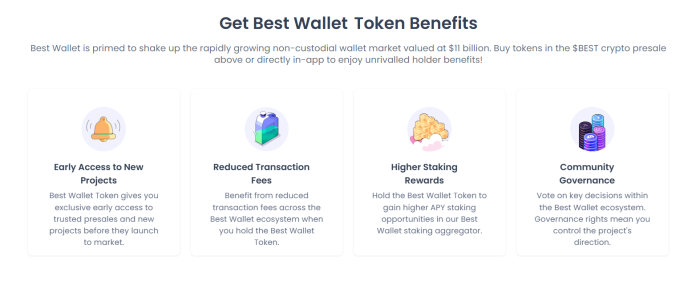
Best Wallet Token benefits

Next comes the $BEST utility token. With $BEST, investors get lower transaction fees and higher staking yields. There’s also access to the best crypto presales, where investors can find a curated selection of upcoming projects. Research and purchase tokens directly within the app.

What is Best Wallet token? It’s the key to powering up a vibrant wallet-based suite of tools. The upcoming Best Card will make it even easier to spend your crypto. In the meantime, learn how to buy $BEST and see why our price prediction thinks the token could reach $0.72,

Visit the Best Wallet token presale page for the latest information.

The coming years may well decide whether stablecoins become pillars of a hybrid financial future or remain niche infrastructure. Citi’s forecasts hint at the scale and ambition of stablecoins, and Best Wallet gives investors the tools they need to navigate a stablecoin future.

Authored by Bogdan Patru on Bitcoinist — https://bitcoinist.com/stablecoins-$4-trillion-by-2030-best-time-to-try-best-wallet

Editorial Process for bitcoinist is centered on delivering thoroughly researched, accurate, and unbiased content. We uphold strict sourcing standards, and each page undergoes diligent review by our team of top technology experts and seasoned editors. This process ensures the integrity, relevance, and value of our content for our readers.

As a crypto writer, Bogdan’s responsibilities are split between researching and writing articles and entertaining the team with his humor bordering on the politically incorrect, an aspiring Bill Burr, if you will. Thanks to his 12+ years of writing experience in just as many fields, including tech, cybersecurity, modelling, fitness, crypto, and other topics-that-shall-not-be-named, he's become a genuine asset to the team. While his position as a senior writer at PrivacyAffairs thought him valuable lessons about the power of self-management, his entire writing career was and is an exercise in self-improvement. Now, he's ready to sink his teeth into crypto and teach people how to take control of their own money on the blockchain. With fiat as an eternally devaluing currency, Bitcoin and altcoins seem like the best-fitting alternative for Bogdan. Bogdan’s biggest professional accomplishment, aside from securing a position as a main writer for Bitcoinist, was his 5-year run as a writing manager at Blackwood Productions, where he coordinated a team of four writers. During that time, he learned the value of teamwork and that of creating a working environment that breeds efficiency, positivity, and friendship.

Lectures associées

La Fondation recule, Ethlabs avance : L'Ethereum connaît sa plus grande réorganisation de l'histoire

**Résumé en français :** Le 23 juin, l'écosystème Ethereum a été marqué par deux annonces majeures. D'une part, d'anciens chercheurs de l'Ethereum Foundation (EF) ont fondé Ethlabs, une organisation à but non lucratif indépendante axée sur les besoins pratiques de l'adoption institutionnelle (vitesse de règlement, émissions d'actifs, interopérabilité, scalabilité). Elle bénéficie du soutien financier de gros détenteurs d'ETH comme Bitmine et Sharplink, mais le cofondateur Vitalik Buterin n'apparaît pas parmi ses soutiens publics. D'autre part, l'Ethereum Foundation a annoncé une restructuration majeure, réduisant ses effectifs d'environ 20% (54 personnes) et se repositionnant comme un organe de gouvernance et de maintenance du protocole plus léger, cédant délibérément du terrain en tant que principal moteur de développement. Ces mouvements simultanés – l'avancée d'Ethlabs et le recul de l'EF – signalent une correction de gouvernance historique pour Ethereum. L'objectif est de passer d'un écosystème perçu comme trop centralisé autour de la Fondation et de la vision de Vitalik, et parfois lent à exécuter, vers un modèle plus décentralisé et efficace, avec des organisations spécialisées comme Ethlabs prenant en charge des fonctions d'exécution plus "terrain" et orientées marché. En somme, l'EF se concentrerait désormais à maintenir Ethereum "correct" sur le plan de la décentralisation et de la neutralité, tandis que des entités comme Ethlabs auraient pour mission de le rendre plus "efficace" en répondant aux demandes du marché et des institutions, afin de renforcer la compétitivité et l'adoption du réseau.

链捕手Il y a 3 h

La Fondation recule, Ethlabs avance : L'Ethereum connaît sa plus grande réorganisation de l'histoire

链捕手Il y a 3 h

Seconde mi-temps de la politique cryptographique américaine : La loi CLARITY tente d'obtenir 60 voix, le CFTC "comité d'une seule personne" est la plus grande inconnue

L'industrie de la cryptographie aux États-Unis attend un moment décisif avec l'avancée du projet de loi CLARITY au Sénat, qui nécessite 60 voix pour être adopté. Les républicains doivent négocier avec la Maison Blanche et rallier des sénateurs indécis. Dans un calendrier législatif chargé (seulement 40 jours de travail restants), d'autres propositions fiscales et réglementaires liées aux crypto-monnaies cherchent également à être intégrées dans des textes législatifs plus larges cette année. Un obstacle majeur est la composition incomplète de la CFTC, avec quatre postes de commissaires vacants, ce qui crée de l'incertitude. La question de la juridiction sur les marchés prédictifs (États, CFTC, SEC ou Cour suprême) reste également en suspens. Le secteur subira par ailleurs la perte de deux figures clés : la commissaire de la SEC, Hester M. Peirce, et la sénatrice Cynthia Lummis, qui ont joué un rôle central dans l'élaboration des politiques. Des experts soulignent que l'adoption de CLARITY durant cette session du Congrès est peu probable en raison des contraintes de temps et des élections. Ils estiment que des mesures fiscales ciblées sur les cryptos pourraient passer en étant intégrées à des projets de loi plus vastes. La CFTC travaille à un cadre pour les marchés prédictifs, dont le statut (infrastructure financière ou jeu) est crucial pour leur avenir. La fenêtre d'opportunité pour des progrès législatifs concrets en 2025 est étroite, exigeant une collaboration bipartite soutenue.

marsbitIl y a 6 h

Seconde mi-temps de la politique cryptographique américaine : La loi CLARITY tente d'obtenir 60 voix, le CFTC "comité d'une seule personne" est la plus grande inconnue

marsbitIl y a 6 h

Trading

Spot
Futures
活动图片