Dogecoin Volume Remains Low Despite Price Rebound, What’s Going On?

bitcoinistPublié le 2025-06-12Dernière mise à jour le 2025-06-12

Résumé

The Dogecoin price has been on the rebound, with Bitcoin barreling toward its all-time high levels once again. The break...

Trusted Editorial content, reviewed by leading industry experts and seasoned editors. Ad Disclosure

The Dogecoin price has been on the rebound, with Bitcoin barreling toward its all-time high levels once again. The break of $110,000 triggered an altcoin run after the Ethereum price moved 10% in a single day, and by extension, Dogecoin also followed with a more than 5% rebound already. However, the meme coin’s volume has not risen as high as expected, and this could suggest low market participation from investors during this time.

Dogecoin Volume Still Muted

Despite the rebound toward $0.2, the Dogecoin volume has not seen a notable jump during this time. In fact, the volume remains well below levels seen back in May and continues to trend at levels recorded during the market decline. This could mean that Dogecoin is merely following the market direction and not necessarily being driven by factors of its own.

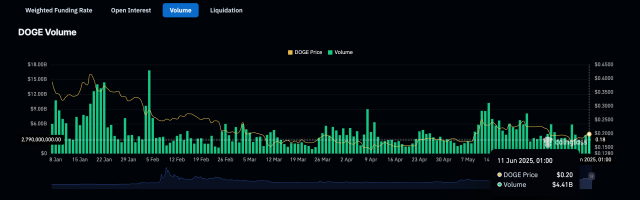
According to data from Coinglass, the daily Dogecoin trading volume remains below $5 billion. This is low compared to the levels that the DOGE trading volume has risen to, especially during times of rapid recovery.

For context, back in February, the Dogecoin daily trading volume had risen above the $10 billion mark as the market struggled. Then, back in May 2025, the meme coin had crossed the $10 billion mark once again when the market had recovered and DOGE pushed above $0.25.
Dogecoin volume
Source: Coinglass

However, so far in the month of June, the Dogecoin trading volume is yet to cross the $10 billion mark, even after almost two weeks into the month. The highest daily volume recorded so far for the month is $5.89 billion on June 6, driven by shorters as the market tanked.

Open Interest Show No Notable Moves

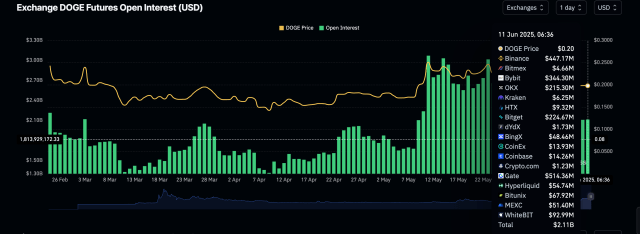
In the same vein as the DOGE daily trading volume, the Dogecoin open interest has not recorded any notable movements during this time. Since the start of the month, open interest in the meme coin has remained rather steady, averaging around $2 billion on a daily basis.
Dogecoin open interest
Source: Coinglass

This suggests that crypto traders are not making any moves and opening more positions at the same time. It also points to the fact that investors are waiting to see what the market does before making their moves. As of June 11, the Dogecoin open interest was sitting at $2.11 billion, a decline from the $2.5 billion average recorded toward the end of May.

Dogecoin price chart from TradingView.com
DOGE price moves back toward $0.18 support | Source: DOGEUSDT on TradingView.com
Featured image from Dall.E, chart from TradingView.com
Editorial Process for bitcoinist is centered on delivering thoroughly researched, accurate, and unbiased content. We uphold strict sourcing standards, and each page undergoes diligent review by our team of top technology experts and seasoned editors. This process ensures the integrity, relevance, and value of our content for our readers.

Scott Matherson is a leading crypto writer at Bitcoinist, who possesses a sharp analytical mind and a deep understanding of the digital currency landscape. Scott has earned a reputation for delivering thought-provoking and well-researched articles that resonate with both newcomers and seasoned crypto enthusiasts. Outside of his writing, Scott is passionate about promoting crypto literacy and often works to educate the public on the potential of blockchain.

Lectures associées

Tiger Research : Zuckerberg commence à miser sur les marchés de prédiction, tandis que les pays asiatiques les considèrent toujours comme des jeux d'argent

Les marchés prédictifs, autrefois cantonnés à des concepts académiques, se sont transformés en une industrie établie depuis 2020, avec un volume mensuel dépassant 140 milliards de dollars. L'entrée de Meta, avec l'application Arena dirigée par Mark Zuckerberg, valide ce modèle économique. Historiquement, ces marchés trouvent leurs racines dans des paris politiques informels du 18e siècle et se sont structurés via des expériences académiques comme le Iowa Electronic Market dans les années 1980. Leur mécanisme s'apparente aux options binaires, où un contrat paie 1$ si un événement se produit, 0$ sinon, le prix négocié reflétant la probabilité perçue par le marché. Aujourd'hui, ils couvrent des sujets variés (sports, politique, économie). Les prix émergent d'un carnet d'ordres, et les résultats sont validés par des « oracles », centralisés ou décentralisés. Leur force réside dans le « skin in the game » : les participants risquant leur propre capital, les prix intègrent efficacement l'information, souvent avec plus de précision que les sondages ou prévisions d'experts, comme observé lors d'élections ou pour des prévisions de taux d'intérêt. Cependant, la régulation diverge fortement. Aux États-Unis, une décision judiciaire a reconnu leur nature financière, ouvrant la voie aux institutions traditionnelles. En revanche, la plupart des juridictions asiatiques les assimilent encore au jeu de hasard, les excluant des discussions politiques. Cette approche pose trois problèmes : un arbitrage réglementaire poussant les utilisateurs vers des plates-formes offshore risquées, une perte de souveraineté sur des données informationnelles précieuses, et une absence de protection des utilisateurs. L'article conclut que l'Asie doit engager un débat prospectif pour intégrer ces marchés dans un cadre réglementaire transparent, les considérer comme une infrastructure d'information et canaliser les données générées en atout sociétal, plutôt que de tenter de les bloquer.

marsbitIl y a 4 h

Tiger Research : Zuckerberg commence à miser sur les marchés de prédiction, tandis que les pays asiatiques les considèrent toujours comme des jeux d'argent

marsbitIl y a 4 h

JPMorgan soutient le projet de loi sur les crypto-monnaies alors que Donald Trump promet de « ne signer aucun autre projet de loi » – Et maintenant ?

La Chambre des représentants a adopté le projet de loi "Digital Asset Market Clarity Act of 2025" il y a près d'un an, mais son adoption reste incertaine. Un soutien majeur est toutefois venu de JP Morgan, dont le ralliement public à ce texte est perçu comme un changement de jeu significatif, susceptible d'encourager les institutions financières traditionnelles à s'engager dans le secteur des crypto-actifs. Le soutien réglementaire est considéré comme l'obstacle clé à une adoption massive. Si la loi était adoptée, elle pourrait attirer davantage d'investisseurs institutionnels. Cependant, les chances d'approbation sur Polymarket sont tombées à 45%, en baisse par rapport aux mois précédents. Le projet de loi bénéficie également du soutien de personnalités politiques, comme le représentant French Hill, qui plaide pour un vote avant la pause parlementaire d'août afin de forcer un compromis. D'autres soutiens incluent l'ancien président de la CFTC, Michael S. Selig, et le cofondateur d'Ethereum, Joseph Lubin. La sénatrice Elizabeth Warren exprime, quant à elle, des réserves concernant les risques de contournement des sanctions. L'adoption finale est compliquée par la déclaration de Donald Trump, qui affirme ne vouloir signer aucun autre projet de loi avant que le "SAVE America Act" ne soit adopté par les républicains. Le "CLARITY Act" a donc une nouvelle échéance, fixée au 7 août, pour progresser.

ambcryptoIl y a 5 h

JPMorgan soutient le projet de loi sur les crypto-monnaies alors que Donald Trump promet de « ne signer aucun autre projet de loi » – Et maintenant ?

ambcryptoIl y a 5 h

Trading

Spot
活动图片