Stablecoin Adoption Is Exploding – This Is the Best Wallet to Ride the Wave

bitcoinistPublié le 2025-06-11Dernière mise à jour le 2025-06-11

Résumé

The world can’t get enough of stablecoins. Central banks are taking action, regulators are scrambling, and crypto fans are quietly...

Trusted Editorial content, reviewed by leading industry experts and seasoned editors. Ad Disclosure

The world can’t get enough of stablecoins. Central banks are taking action, regulators are scrambling, and crypto fans are quietly stocking up for what’s coming next.

In South Korea, the Bank of Korea’s governor has called a high-level meeting with top banks to discuss how won-backed stablecoins should be handled.

Over in the US, Ripple’s Brad Garlinghouse pointed to Circle’s initial public offering (IPO) as a sign that long-awaited stablecoin regulation could soon pass – with the GENIUS Act potentially becoming law by August.

Across the pond, the UK’s Financial Conduct Authority appointed Sarah Pritchard as deputy CEO to bolster its oversight of stablecoins and digital assets.

In the digital dollar age, every investor needs a secure, user-friendly wallet built for stablecoins.

Powered by the Best Wallet Token ($BEST), Best Wallet delivers the tools, rewards, and security investors need to thrive in the next phase of crypto adoption.

Everyone’s Talking About Stablecoins

Stablecoins, cryptocurrencies pegged to a stable asset like a national currency, have gone from background buzz to front-page news.

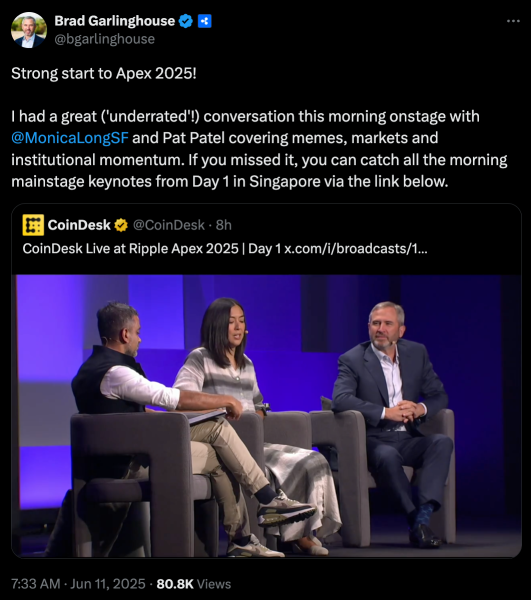
Just this week, South Korea’s central bank scheduled a meeting with the country’s largest commercial banks to address stablecoin issuance, as political support grows for won-pegged tokens. The move reflects increasing pressure to balance innovation with monetary sovereignty.Brad Garlinghouse at Apex 2025.Meanwhile, Ripple’s CEO Brad Garlinghouse, speaking at the Apex 2025 summit, called Circle’s IPO a wake-up call for American lawmakers — saying it signals real momentum behind stablecoin regulation and the likely passage of the GENIUS Act this summer.
Over in the UK, the Financial Conduct Authority appointed Sarah Pritchard as its first-ever deputy CEO to oversee the stablecoin push.

Translation? Governments no longer ban or ignore stablecoins – they’re gearing up to control them.

The fact is, stablecoins like $USDC and $USDT are now the lifeblood of crypto. They let people move money across borders, earn yield, and escape inflation – all without relying on traditional banks.

But as adoption grows, so do the risks.

Hacks, scams, rug pulls – you name it. In a space that’s moving this fast, holding your stablecoins in the wrong wallet is like carrying water in a hemp sack.

Enter Best Wallet & $BEST: Two Power Players in One Ecosystem

Best Wallet happens when you toss everything frustrating about MetaMask and build something smarter, faster, and even fun.

The first of a new generation of non-custodial crypto wallets, Best Wallet combines cutting-edge tech, sleek usability, and industry-first tools to help you trade in and store everything from stablecoins to meme coins.
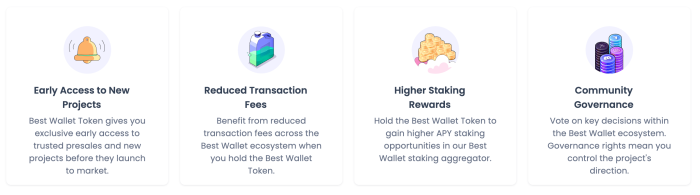
Best Wallet benefits.

Fireblocks’ MPC-CMP technology provides military-grade security, without the military-grade complexity.

But what sets this wallet apart is Best Wallet’s exclusive Upcoming Tokens feature, which gives you exclusive access to new token launches – all within the app.

The wallet aims to capture 40% of the burgeoning crypto wallet market, and to do so, it has launched Best Wallet Token ($BEST). The token is now in presale, and available through the Best Wallet app or the official presale website.

Holding $BEST unlocks early access to new crypto projects, reduced fees, ecosystem governance, and even bonus perks through Best Wallet’s fast-growing iGaming partnerships.

You can buy $BEST at the early bird price of $0.025165. So far, investors have poured in over $13.2M, hoping to capitalize on Best Wallet’s anticipated meteoric rise.

Why $BEST Might Be 2025’s Smartest Buy

At the current price of $0.025165, $BEST is still in the early innings, but forecasts suggest it could reach $0.072 by the end of 2025 if the wallet continues to see 50% month-on-month growth.
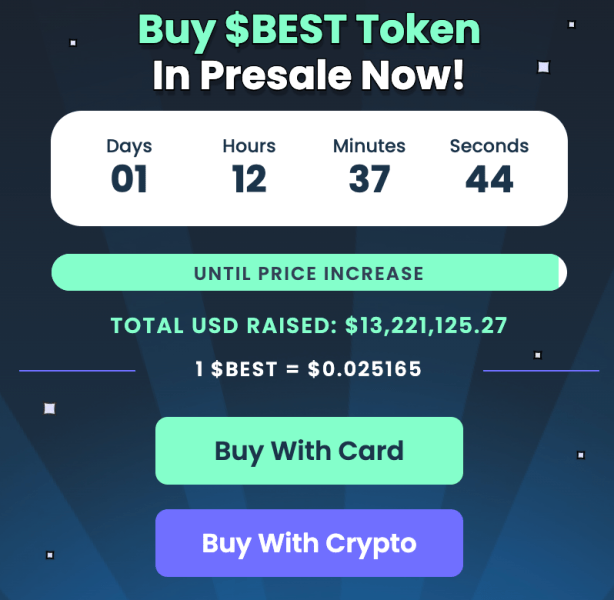
Buy $BEST in the presale phase.

That’s a 186% increase. And if you’re more patient? Predictions for 2026 hit $0.62, which is over 2,360% of today’s price.

Let’s say you grab 10K $BEST at the current price – a $251.65 investment. $BEST offers a 20% APY through staking, so after one year, you’d have 12,000 $BEST.

Even if the price stayed flat, that’s already more tokens in your bag. But if that price hits $0.072 in 2025, your stack would be worth $864 – that’s more than 3x your money in less than a year.

Fast forward to 2026. At $0.62, your 12K tokens could be worth $7,440. That’s from a $250 starting point. You didn’t find a golden goose – you just downloaded a wallet and made a smart play.

Presales come and go, but when a token powers a fast-growing product and delivers real utility, the upside isn’t just hype – it’s structural.

A Smart Time to Get In

The stablecoin era is just getting beginning. Regulation is coming, adoption is rising, and the tools we use today will shape the future of finance.

If you’re looking for a safe bet in a wild market, Best Wallet and $BEST are worth your attention.

Remember that this is not financial advice. Always do your research before investing in crypto.

Editorial Process for bitcoinist is centered on delivering thoroughly researched, accurate, and unbiased content. We uphold strict sourcing standards, and each page undergoes diligent review by our team of top technology experts and seasoned editors. This process ensures the integrity, relevance, and value of our content for our readers.

As a crypto writer, Bogdan’s responsibilities are split between researching and writing articles and entertaining the team with his humor bordering on the politically incorrect, an aspiring Bill Burr, if you will. Thanks to his 12+ years of writing experience in just as many fields, including tech, cybersecurity, modelling, fitness, crypto, and other topics-that-shall-not-be-named, he's become a genuine asset to the team. While his position as a senior writer at PrivacyAffairs thought him valuable lessons about the power of self-management, his entire writing career was and is an exercise in self-improvement. Now, he's ready to sink his teeth into crypto and teach people how to take control of their own money on the blockchain. With fiat as an eternally devaluing currency, Bitcoin and altcoins seem like the best-fitting alternative for Bogdan. Bogdan’s biggest professional accomplishment, aside from securing a position as a main writer for Bitcoinist, was his 5-year run as a writing manager at Blackwood Productions, where he coordinated a team of four writers. During that time, he learned the value of teamwork and that of creating a working environment that breeds efficiency, positivity, and friendship.

Lectures associées

Tiger Research : Zuckerberg commence à miser sur les marchés de prédiction, tandis que les pays asiatiques les considèrent toujours comme des jeux d'argent

Les marchés prédictifs, autrefois cantonnés à des concepts académiques, se sont transformés en une industrie établie depuis 2020, avec un volume mensuel dépassant 140 milliards de dollars. L'entrée de Meta, avec l'application Arena dirigée par Mark Zuckerberg, valide ce modèle économique. Historiquement, ces marchés trouvent leurs racines dans des paris politiques informels du 18e siècle et se sont structurés via des expériences académiques comme le Iowa Electronic Market dans les années 1980. Leur mécanisme s'apparente aux options binaires, où un contrat paie 1$ si un événement se produit, 0$ sinon, le prix négocié reflétant la probabilité perçue par le marché. Aujourd'hui, ils couvrent des sujets variés (sports, politique, économie). Les prix émergent d'un carnet d'ordres, et les résultats sont validés par des « oracles », centralisés ou décentralisés. Leur force réside dans le « skin in the game » : les participants risquant leur propre capital, les prix intègrent efficacement l'information, souvent avec plus de précision que les sondages ou prévisions d'experts, comme observé lors d'élections ou pour des prévisions de taux d'intérêt. Cependant, la régulation diverge fortement. Aux États-Unis, une décision judiciaire a reconnu leur nature financière, ouvrant la voie aux institutions traditionnelles. En revanche, la plupart des juridictions asiatiques les assimilent encore au jeu de hasard, les excluant des discussions politiques. Cette approche pose trois problèmes : un arbitrage réglementaire poussant les utilisateurs vers des plates-formes offshore risquées, une perte de souveraineté sur des données informationnelles précieuses, et une absence de protection des utilisateurs. L'article conclut que l'Asie doit engager un débat prospectif pour intégrer ces marchés dans un cadre réglementaire transparent, les considérer comme une infrastructure d'information et canaliser les données générées en atout sociétal, plutôt que de tenter de les bloquer.

marsbitIl y a 2 h

Tiger Research : Zuckerberg commence à miser sur les marchés de prédiction, tandis que les pays asiatiques les considèrent toujours comme des jeux d'argent

marsbitIl y a 2 h

JPMorgan soutient le projet de loi sur les crypto-monnaies alors que Donald Trump promet de « ne signer aucun autre projet de loi » – Et maintenant ?

La Chambre des représentants a adopté le projet de loi "Digital Asset Market Clarity Act of 2025" il y a près d'un an, mais son adoption reste incertaine. Un soutien majeur est toutefois venu de JP Morgan, dont le ralliement public à ce texte est perçu comme un changement de jeu significatif, susceptible d'encourager les institutions financières traditionnelles à s'engager dans le secteur des crypto-actifs. Le soutien réglementaire est considéré comme l'obstacle clé à une adoption massive. Si la loi était adoptée, elle pourrait attirer davantage d'investisseurs institutionnels. Cependant, les chances d'approbation sur Polymarket sont tombées à 45%, en baisse par rapport aux mois précédents. Le projet de loi bénéficie également du soutien de personnalités politiques, comme le représentant French Hill, qui plaide pour un vote avant la pause parlementaire d'août afin de forcer un compromis. D'autres soutiens incluent l'ancien président de la CFTC, Michael S. Selig, et le cofondateur d'Ethereum, Joseph Lubin. La sénatrice Elizabeth Warren exprime, quant à elle, des réserves concernant les risques de contournement des sanctions. L'adoption finale est compliquée par la déclaration de Donald Trump, qui affirme ne vouloir signer aucun autre projet de loi avant que le "SAVE America Act" ne soit adopté par les républicains. Le "CLARITY Act" a donc une nouvelle échéance, fixée au 7 août, pour progresser.

ambcryptoIl y a 3 h

JPMorgan soutient le projet de loi sur les crypto-monnaies alors que Donald Trump promet de « ne signer aucun autre projet de loi » – Et maintenant ?

ambcryptoIl y a 3 h

En seulement 11 jours, Claude réécrit un million de lignes de code, un projet épique d'IA qui suscite la colère

Ces derniers jours, l'écosystème tech est en émoi suite à la réaction enflammée d'Andrew Kelley, créateur du langage de programmation Zig. La cause : le projet Bun, un runtime JavaScript/TypeScript performant initialement écrit en Zig et considéré comme un sérieux concurrent à Node.js, a été entièrement réécrit en Rust par son fondateur, Jarred Sumner. Cette réécriture, d'environ un million de lignes de code, a été réalisée en seulement 11 jours grâce à l'utilisation intensive de l'outil d'IA Claude Fable 5 d'Anthropic, qui a récemment acquis Bun. Le coût estimé de cette opération via l'API est d'environ 165 000 dollars. L'équipe de Bun a justifié cette décision radicale par des problèmes persistants de stabilité et de sécurité mémoire (use-after-free, double-free) dans la version Zig, difficile à éradiquer dans ce langage, alors que le système de propriété de Rust les aurait empêchés à la compilation. De plus, la politique stricte de la communauté Zig contre le code généré par IA était en contradiction avec la dépendance croissante de l'équipe Bun à ces outils. La réponse d'Andrew Kelley a été cinglante. Dans un billet de blog, il a attribué les problèmes de Bun non pas à Zig, mais aux mauvaises pratiques d'ingénierie de Jarred Sumner, qualifiant son code de "bricolages sur des bricolages" (hacks on top of hacks) et le traitant de "mauvais manager". Il a exprimé un certain soulagement que Bun abandonne Zig, craignant que le projet ne donne une mauvaise image du langage. Cette affaire a déclenché un vif débat dans la communauté. Certains critiquent le manque de professionnalisme de Kelley, tandis que d'autres le soutiennent pour sa défense de la qualité technique. Les interrogations principales portent désormais sur la maintenabilité à long terme du nouveau code Rust, généré automatiquement et contenant encore 27 000 blocs de code "unsafe", et sur la question de savoir si les économies de temps et d'argent réalisées aujourd'hui ne se transformeront pas en une dette technique colossale pour l'avenir.

marsbitIl y a 5 h

En seulement 11 jours, Claude réécrit un million de lignes de code, un projet épique d'IA qui suscite la colère

marsbitIl y a 5 h

Trading

Spot
活动图片