2025 Global Crypto Regulatory Map: The Dawn of the Co-optation Era, The Year Crypto and TradFi Converged

marsbitPublié le 2025-12-30Dernière mise à jour le 2025-12-30

Résumé

The year 2025 marks a pivotal turning point for global crypto regulation, shifting from a period of "wild growth" to the beginning of an era of institutional "incorporation." This transition is characterized by a fundamental change in regulatory logic across major economies, moving crypto from the fringes into the mainstream financial system. In the U.S., a significant policy reversal occurred with the new administration. The SEC ended its aggressive enforcement-based approach under new leadership, and the passage of the GENIUS Act established a federal framework for stablecoins, granting holders priority claims in case of issuer bankruptcy. The U.S. also officially recognized Bitcoin as a strategic national asset. The EU fully implemented its MiCA framework, creating a unified regulatory landscape with high compliance costs that forced smaller players out of the market. It also exhibited "monetary protectionism" by imposing strict limits on non-euro stablecoins. Hong Kong adopted an aggressive strategy, enacting its Stablecoin Ordinance and positioning itself as a hub for institutional-grade asset clearing and RWA tokenization, creating a unique bridge between Chinese and international capital. Japan signaled a major shift by proposing to drastically reduce crypto taxation from 55% to 20%, aligning it with stocks, in an effort to reclaim its position in Asian crypto finance. The overarching theme of 2025 is "incorporation." Regulators are no longer trying to eliminate c...

Author: imToken

Objectively speaking, for Crypto/Web3, 2025 is absolutely the most pivotal year in the past decade.

If the past decade was a period of "wild growth" for the crypto industry on the fringes of mainstream finance, then 2025 marks the first year this species officially completed its "legitimization evolution":

From stablecoins to RWA, from the abrupt policy U-turn in Washington to the finalization of rules in Hong Kong and the EU, the global regulatory logic is undergoing an epic paradigm shift.

I. United States: Crypto's Institutional Vindication

For a considerable period, the US regulation of the crypto industry resembled more of a tug-of-war lacking consensus.

The US Securities and Exchange Commission (SEC) under Gary Gensler's tenure was particularly representative of this, frequently using enforcement actions to define the legal boundaries of crypto assets. Lawsuits, investigations, and deterrence became the main themes. This "enforcement first, define later" regulatory approach not only left many developers and entrepreneurs in a highly uncertain environment but also kept the entire industry under prolonged high pressure.

However, with the inauguration of a new administration in 2025, this situation underwent a fundamental reversal. Washington stopped trying to force crypto assets into the old securities law system born in the 1930s and instead began to publicly acknowledge their status as a "new hybrid asset" distinct from traditional securities, commodities, and currency.

The pinnacle of this shift was undoubtedly the formal signing of the GENIUS Act in July 2025. This act not only established a federal-level stablecoin regulatory framework, requiring issuers to hold 100% highly liquid reserves (such as cash or US Treasury bonds), but more importantly, it clarified that holders have priority claim rights in the event of issuer bankruptcy. This meant the on-chain form of the US dollar was incorporated into the national institutional purview for the first time.

Echoing this, the US also established a "National Digital Asset Reserve" via executive order in 2025, listing previously seized Bitcoin as a strategic asset. This move彻底 (completely) changed Bitcoin's position in global asset pricing, elevating it from a "fringe alternative asset" to a part of national strategic competition.

Of course, this shift was not accidental. With the appointment of new SEC Chairman Paul Atkins, the long-standing "regulation by enforcement" clouding the market came to an end. Protracted investigations and charges against projects like Coinbase (COIN.M), Ripple, and Ondo Finance were successively dropped or downgraded. Crypto officially moved from being an enforcement target back to the policy discussion table.

Simultaneously, the core team of the new administration showed an unprecedented level of overlap with tech capital and crypto capital—from Treasury Secretary Scott Bessent, Commerce Secretary Howard Lutnick, to Director of National Intelligence Tulsi Gabbard. A group of decision-makers explicitly supportive of AI, Web3, and new financial technologies entered the power center. Crypto assets were no longer "aliens" in the political system.
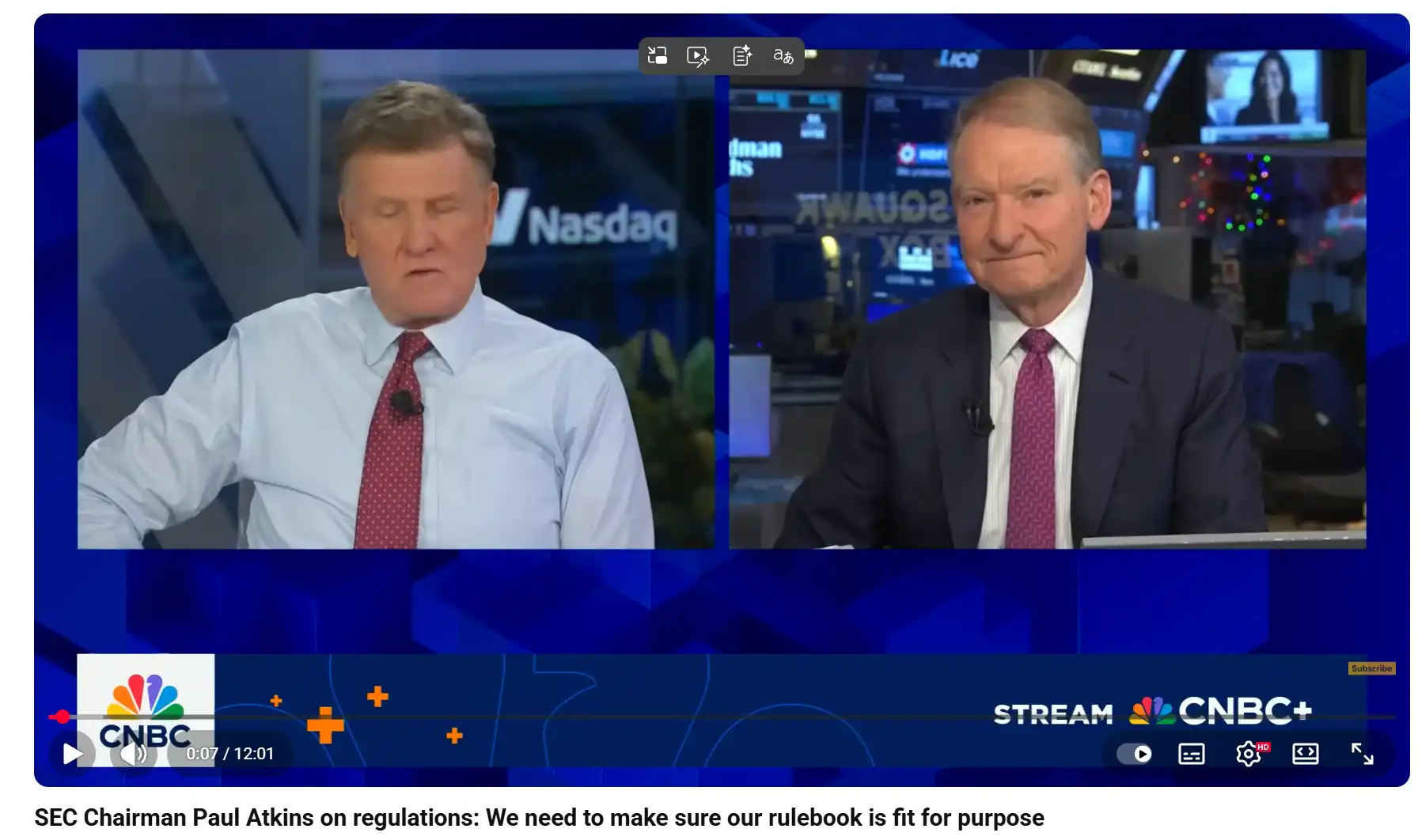
Interestingly, on December 2nd, US Securities and Exchange Commission (SEC) Chairman Paul Atkins, in a speech at the New York Stock Exchange, officially announced the end of the multi-year "regulation by enforcement" era for the crypto industry and stated that the SEC will usher in a new era of compliance in January 2026.

This new policy, dubbed the "Innovation Exemption," also marks the US regulators' shift from reactive case-by-case crackdowns to establishing a "compliance sandbox" with clear entry standards. According to the "Project Crypto" plan disclosed in November, qualified DeFi protocols and DAO organizations will receive a compliance buffer period of 12 to 24 months. During this time, project parties will not need to undergo cumbersome S-1 securities registration and only need to submit simplified information to operate.

This mechanism彻底 (completely) solves the long-standing vicious cycle where startup protocols couldn't afford high compliance costs yet faced charges for not being registered. Simultaneously, a new asset classification law categorizes digital assets into commodity-type, utility-type, collectible-type, and tokenized securities, providing a clear legal exit for assets that can prove "sufficient decentralization."

In summary, the signal from the US regulatory shift in 2025 is clear enough: Crypto is no longer a systemic risk that needs to be suppressed, but a institutional variable that is being incorporated into rules and can be guided.

II. EU, Hong Kong China, Japan: The Establishment of a Multipolar Order

While the US completed its policy reversal, other major economies did not choose to follow with looser regulations but instead charted three distinct regulatory paths, all pointing towards co-optation.

European Union

First, the European Union. 2025 is the first full year of the full implementation of the EU's Markets in Crypto-Assets (MiCA) regulation (formally implemented mid-2024). As is well known, MiCA's core goal is not to incentivize innovation but to trade unified rules for financial stability and cross-border controllability. For instance, through a "passporting" license, compliant crypto service providers can operate freely across all 27 member states, but the代价 (cost) is significantly raised compliance thresholds.

It is precisely in this context that in 2025, to meet MiCA's stringent audit transparency, pass-through supervision, and ultra-high capital requirements, a large number of small and medium-sized crypto service providers (VASPs) were forced to exit the European market due to their inability to bear the compliance premium. Even some leading DEXs temporarily delisted their front-end trading functions in the European region due to an inability to meet specific identity verification requirements.
At the stablecoin level, the EU has also shown strong "monetary protectionism," particularly by setting strict daily trading limits and reserve requirements for non-euro stablecoins,客观上 (objectively) building a barrier at the European retail level and forcing liquidity to flow back to compliant Euro-denominated stablecoins (like EuROC).

Hong Kong

Unlike the EU's defensive posture, Hong Kong China demonstrated极强的 (extremely strong) offensive capabilities in 2025. With the formal生效 (effectiveness) of Hong Kong's Stablecoin Ordinance on August 1, 2025, fiat-pegged stablecoins were formally incorporated into the licensed system, marking Hong Kong's transformation from a retail trading hub to a global institutional-grade asset settlement center.

Hong Kong's strategic intent is very clear. It is no longer just a platform for buying and selling crypto assets but an Asian institutional interface connecting Chinese capital, international capital, and on-chain finance. Therefore, this year Hong Kong massively promoted the tokenization process of RWA,致力于 (committed to) introducing traditional assets like government bonds and trade finance into the global视野 (view) through on-chain settlement.

More意味深长的是 (profound is) the functional positioning difference between Hong Kong and Mainland China regarding Web3. According to the latest relevant reports from Caixin, the Hainan Free Trade Port and Hong Kong form a complementary relationship: Hainan, as a trade hub for domestic and international trade, focuses on physical trade and data flow; while Hong Kong serves as a financial testing ground, undertaking high-pressure testing tasks such as Bitcoin strategic reserves and cross-border stablecoin payments.

This "front shop, back factory" model makes Hong Kong in 2025, and subsequently 2026, a unique node globally that can both access traditional Chinese capital and seamlessly connect to Web3 native liquidity.

Japan

In contrast, Japan's regulatory path appears more restrained. It had long managed by细分 (segmenting) businesses like exchanges, custody, and intermediation. It was also considered a crypto desert by developers due to extremely stringent regulations post-2018 and a comprehensive tax rate as high as 55%.

However, Japan's recently proposed FY2026 tax reform outline suggests gradually positioning crypto assets as "financial products contributing to the formation of national assets," exploring the application of separate taxation to spot, derivative, and ETF trading profits. The tax rate is expected to (有望) plummet from the 55% ceiling to a flat 20%, aligning with stocks, and introduces a maximum 3-year loss carryforward.

This could directly activate Japan's vast retail and institutional markets. Coupled with Japan's lifting of the ban on Bitcoin spot ETFs and issuing the first stablecoin operating licenses to giants like Circle and SBI, objectively speaking, Japan is attempting to leverage its mature compliance system to try and recapture the long-lost discourse power in Asian crypto finance.

III. After "Co-optation": Stablecoin Reshuffle, and Web3's Repositioning

Looking globally, the main theme of regulation in 2025 is "co-optation."

Regulators have深刻意识到 (deeply realized) that the decentralized financial power inherent in crypto technology cannot be completely eliminated. Therefore, the most effective governance strategy is to dismantle, absorb its logic, and ultimately incorporate it into the existing global financial landscape.

This co-optation does not negate the value of Crypto. On the contrary, it means regulators have默认 (defaulted to) a premise: that crypto technology itself is efficient, irreversible, and worth preserving. But the condition is that it must be incorporated into an institutional structure that is understandable, auditable, and accountable.

It is precisely for this reason that this regulatory shift has brought about an unprecedented dual effect. On the one hand, there is a rapid回流 (return) of liquidity and credit, as compliance身份 (status) indeed allows massive amounts of capital to enter boldly and institutions to愿意配置 (be willing to allocate). On the other hand, it poses a profound拷问 (questioning) of Web3's original spirit: when rules become a prerequisite, how much decentralization remains?

In this paradigm shift, stablecoins have become the first and most typical pressure point.

The reason is not complicated. As the infrastructure with the deepest intertwining of Crypto and TradFi and the widest penetration, stablecoins naturally lie right in the center of regulators'视野 (view). They connect to fiat currency, influence payments, participate in settlement, and are deeply embedded in the DeFi and on-chain liquidity system.

Therefore, this year stablecoins clearly entered an epic reshuffle period first.

In July, US President Trump formally signed the GENIUS Act, marking the final landing of stablecoin legislation; in August, Hong Kong's Stablecoin Ordinance also生效 (took effect), becoming the first regional regulatory framework; simultaneously, major economies like Japan and South Korea are also accelerating the跟进 (follow-up) of detailed rules, proposing to allow compliant entities to issue stablecoins.

In other words, the stablecoin track has迎来 (ushered in) a true "regulatory window"—evolving from a grey-area liquidity tool to a financial infrastructure where compliance and experimentation coexist (Extended reading: Grey Behemoths vs Whitelisted Players, A Look into the "Forking Moment" Brought by Compliant Stablecoins).

In this process, the track will inevitably分化 (differentiate). On one end, there are institutional-type stablecoins纳入 (incorporated into) the whitelist system,承担 (bearing) payment and settlement functions; on the other end, there are crypto-native stablecoins that continue to serve on-chain native finance, emphasizing censorship resistance and self-custody精神 (spirit). They will not simply be a life-or-death struggle but will serve completely different scenarios and user groups.

The real change is that stablecoins are being asked to answer a question for the first time: Which part of the financial system do you actually want to become?

This is also a question that other Crypto/Web3 tracks will have to answer in 2026.

Conclusion

2025 is undoubtedly a clear turning point year.

Regulation is no longer a vague, adversarial, passive existence but has begun to systematically shape the structure, boundaries, and development path of the crypto industry. From the US to the EU, from Hong Kong to Japan, rules are completing the institutional absorption of Crypto at an unprecedented speed.

But we also need to be清醒地认识到 (clearly aware):

Compliance is only a means, not the endgame of Web3.

In this global-scale co-optation and restructuring, discerning what is merely noise that will be washed away by the times and what is the true foundation承载 (carrying) the future will become a required course for every Web3 participant.

Regulation is no longer the "enemy" of the crypto industry, but its敲门砖 (stepping stone) to a multi-trillion-dollar market.


Cryptos en tendance

Questions liées

QWhat major shift in U.S. crypto regulation occurred in 2025, and what key legislation was signed?

AIn 2025, the U.S. shifted from a 'regulation by enforcement' approach to formally recognizing crypto as a 'new hybrid asset class.' The key legislation was the signing of the GENIUS Act in July, which established a federal regulatory framework for stablecoins, requiring 100% high-liquidity reserves and granting holders priority claim rights in case of issuer bankruptcy.

QHow did the European Union's MiCA regulation impact the crypto market in 2025?

AThe EU's Markets in Crypto-Assets (MiCA) regulation, fully implemented in 2025, created a unified rulebook but significantly raised compliance costs. This led many small and medium-sized crypto service providers (VASPs) to exit the European market due to stringent audit, transparency, and capital requirements. It also imposed strict limits on non-euro stablecoins to protect the eurozone.

QWhat strategic role did Hong Kong carve out for itself in the global crypto landscape in 2025?

AHong Kong positioned itself as a global institutional-grade asset clearing hub and a bridge between Chinese capital, international capital, and on-chain finance. Its Stablecoin Ordinance, effective August 2025, brought fiat-backed stablecoins into a licensed system. It focused heavily on Real World Asset (RWA) tokenization and acted as a financial testing ground, complementing mainland China's policies.

QWhat significant change did Japan propose regarding cryptocurrency taxation in its 2026 fiscal year tax reform outline?

AJapan's 2026 fiscal year tax reform outline proposed reclassifying crypto assets as 'financial products contributing to national asset formation.' This would change the tax treatment, potentially lowering the maximum tax rate on profits from crypto trading from 55% to 20% (aligning with stocks) and introducing a loss carry-forward system for up to three years.

QAccording to the article, what is the central theme of global crypto regulation in 2025 and its dual effect?

AThe central theme of global crypto regulation in 2025 was 'co-option' or assimilation. The dual effect was that while compliance brought massive liquidity and institutional capital into the market, it also posed a profound challenge to the original decentralized ethos of Web3, forcing projects to define their role within the traditional financial system.

Lectures associées

Ne pas investir n'est pas un laissez-passer pour Apple

Face aux géants technologiques comme Meta et Google qui font face à des critiques pour leurs dépenses d'investissement massives dans l'IA, Apple, bien qu'en retard dans ce domaine, se distingue par sa retenue budgétaire. Cette approche lui a même permis de retrouver brièvement la première place mondiale en termes de valorisation boursière. Le rapport trimestriel (T3 2026) d'Apple affiche des performances solides, avec un chiffre d'affaires en hausse de 16,4% et un bénéfice net en progression de 27,1%. L'iPhone et le Mac sont les principaux moteurs de cette croissance, compensant les résultats plus modestes de l'iPad (en baisse) et des services (ralentissement de la croissance). Cependant, le marché réagit négativement après la publication des résultats, en raison des perspectives prudentes pour le trimestre suivant. Apple anticipe des contraintes d'approvisionnement majeures, notamment pour les puces et la mémoire, entraînant des hausses de prix sur ses produits. Contrairement à ses concurrents qui investissent des milliards dans l'infrastructure IA, Apple maintient des dépenses d'investissement (capex) faibles, privilégiant les dépenses de R&D. Malgré cela, l'entreprise n'échappe pas aux répercussions de la frénésie de l'IA, qui exacerbe les tensions sur sa chaîne d'approvisionnement. Ce rapport marque la dernière conférence téléphonique de Tim Cook en tant que PDG, avant son départ prévu en septembre. Il exprime sa confiance dans l'avenir de l'entreprise.

marsbitIl y a 13 mins

Ne pas investir n'est pas un laissez-passer pour Apple

marsbitIl y a 13 mins

PA Figure | Une infographie pour comprendre les grands événements de l'écosystème Web3 en août 2026

Août 2026 s'annonce chargé pour l'écosystème Web3, marqué par plusieurs événements clés susceptibles d'influencer les marchés. L'agenda macroéconomique sera déterminant, avec la publication des données américaines sur l'emploi (non-farm payrolls) et l'inflation (CPI) de juillet, ainsi que les comptes-rendus de la Réserve Fédérale et le symposium annuel de Jackson Hole. Sur le front réglementaire, des développements majeurs sont attendus : le Sénat américain doit dévoiler un nouveau projet de loi (*CLARITY Act*), tandis que l'interdiction des transactions cryptos de l'UE envers la Biélorussie entre en vigueur. Les marchés devront également absorber des déblocages massifs de jetons (**ENA, AVAX, CONX, ZRO, KAITO**, etc.), susceptibles de créer de la volatilité. Par ailleurs, l'industrie continuera son consolidation, avec l'arrêt ou la refonte prévus de plusieurs services comme Exchange Art, Ctrl Wallet, Zapper, NFTfi et Summer.fi, incitant les utilisateurs à gérer leurs actifs en conséquence. Du côté des entreprises, les résultats du Q2 de **SpaceX, Circle et Nvidia** seront publiés, et des levées de fonds importantes sont au programme, notamment pour la société chinoise Moonshot AI (pré-IPO). Enfin, des événements sectoriels majeurs comme **Bitcoin Asia 2026** et le **China Digital Expo 2026** se tiendront. En résumé, le mois d'août sera structuré autour des anticipations macroéconomiques, de l'évolution réglementaire, des déblocages de tokens et de la consolidation continue du secteur.

marsbitIl y a 27 mins

PA Figure | Une infographie pour comprendre les grands événements de l'écosystème Web3 en août 2026

marsbitIl y a 27 mins

La voix la plus célèbre de « Cassandre » de Wall Street s'attaque cette fois à NVIDIA

Une récente divulgation de l’investisseur Michael Burry, connu pour avoir prédit la crise des subprimes et immortalisé dans « The Big Short », a relancé les débats sur le marché. Fin juin, il a annoncé avoir pris des positions à découvert sur plusieurs valeurs technologiques, dont Nvidia (à un prix d’entrée de 198,09 $), Tesla, Applied Materials, Caterpillar et l’ETF SOXX (semiconducteurs). Le 1er juillet, il a ajouté Micron à sa liste, avant d’augmenter fin juillet ses positions sur Nvidia, Micron et SOXX. Ses arguments portent principalement sur les pratiques comptables dans le secteur de l’IA : selon lui, la durée d’amortissement des puces (étirée à 6 ans par les géants du cloud comme Microsoft ou Google) ne reflète pas leur obsolescence rapide (2-3 ans), ce qui gonflerait artificiellement les profits. Il évoque également des risques de « financement circulaire hors bilan », où Nvidia pourrait garantir des prêts à des clients pour qu’ils achètent ses propres puces, créant ainsi une demande artificielle. Enfin, il critique les rachats d’actions de Nvidia, accusés de doper artificiellement le bénéfice par action – une affirmation que la société a contestée en soulignant des erreurs de calcul. Les réactions sont partagées. D’un côté, des voix comme Steve Eisman (autre figure de « The Big Short ») restent prudentes mais ne suivent pas la position découverte, notant la croissance soutenue des revenus et des investissements en IA. De l’autre, Jim Chanos, célèbre vendeur à découvert, partage l’inquiétude sur les écarts comptables mais préfère cibler d’autres acteurs financiers plutôt que les fabricants de puces. Historiquement, les appels de Burry ont connu des succès mitigés : corrects sur des crises structurelles (subprimes, COVID), mais souvent prématurés ou erronés sur des arguments de valorisation (Tesla, Nvidia en 2023). Aujourd’hui, les positions à découvert sur Nvidia restent marginales (environ 1,4 % des actions en circulation), même si les pertes cumulées des vendeurs à découvert sur la valeur dépassent 5 milliards de dollars. Pour les investisseurs, l’intérêt réside moins dans le suivi des positions de Burry que dans la méthodologie sous-jacente : scruter les flux de trésorerie, questionner les traitements comptables agressifs et identifier les risques structurels, surtout quand le marché semble euphorique. La question centrale n’est pas de savoir si Burry a raison cette fois, mais plutôt quels enseignements tirer de son analyse pour évaluer la solidité réelle de la bulle présumée de l’IA.

marsbitIl y a 49 mins

La voix la plus célèbre de « Cassandre » de Wall Street s'attaque cette fois à NVIDIA

marsbitIl y a 49 mins

Sélection de la semaine丨Émotions épiques sur le marché boursier, l'entrée en bourse de Changxin Tech redéfinit le paysage du stockage, Saylor vise à rétablir l'ancrage du STRC vers le 8 septembre

PANews présente un résumé hebdomadaire de contenus clés. Les marchés ont connu une volatilité significative, avec des indices boursiers sud-coréens subissant plusieurs interruptions et une chute des actions technologiques liées à l'IA. Dans ce contexte, le bitcoin apparaît comme un actif relativement stable. Le paysage technologique évolue rapidement. Le géant de la mémoire Longxin Technology a fait ses débuts en bourse avec une capitalisation importante, symbolisant une percée pour la DRAM nationale. Parallèlement, la convergence de l'IA, des agents autonomes et des besoins en calcul redéfinit les secteurs, des GPU aux infrastructures énergétiques, les entreprises de minage de bitcoin se repositionnant autour de la gestion de l'électricité. Dans le domaine crypto, l'innovation se poursuit. Les portefeuilles intelligents pour agents IA et les mécanismes de paiement programmables gagnent en importance, attirant l'attention de grandes plateformes. De nouveaux modèles économiques, comme le protocole à jeton FWA qui combine NFT et système de tirage, génèrent un fort engagement. Cependant, un décalage est observé entre la croissance des revenus des principaux protocoles et la performance de leurs jetons. Le secteur des Real World Assets (RWA) voit son volume augmenter mais peine à mobiliser ses actifs. Les perspectives macroéconomiques restent mitigées. La Réserve Fédérale américaine maintient des taux directeurs élevés, signalant une orientation durablement restrictive malgré des divisions internes. Des analystes comme Tom Lee considèrent les récentes corrections comme un assainissement nécessaire, affirmant que la logique de long terme du secteur reste intacte. Des personnalités anticipent un rôle accru du bitcoin dans le futur système monétaire. Les informations marquantes incluent : des mouvements réglementaires affectant les courtiers pour investisseurs chinois, le plan de développement technique d'Ethereum à horizon 2030, une importante migration de staking par Lido, et des performances boursières variées pour les entreprises liées à la crypto et à l'IA. Michael Saylor a également annoncé un objectif de réalignement pour le STRC autour du 8 septembre.

marsbitIl y a 56 mins

Sélection de la semaine丨Émotions épiques sur le marché boursier, l'entrée en bourse de Changxin Tech redéfinit le paysage du stockage, Saylor vise à rétablir l'ancrage du STRC vers le 8 septembre

marsbitIl y a 56 mins

Lorsque le marché commence à s'interroger sur les dépenses en capital liées à l'IA : Analyse complète des résultats du Q2 des cinq géants technologiques

À la fin juillet 2026, les résultats trimestriels d'Alphabet, Intel, Microsoft, Meta et Apple ont tous mis en évidence une croissance robuste des revenus et des bénéfices, largement portée par les investissements et la demande en IA. Cependant, les réactions des investisseurs ont divergé, soulignant un changement d'attention : le marché s'interroge désormais sur le calendrier du retour sur investissement de ces dépenses massives en capital. Alphabet a affiché une croissance record de son chiffre d'affaires et une performance cloud exceptionnelle, mais son augmentation des dépenses d'investissement, entraînant un flux de trésorerie libre négatif pour la première fois, a provoqué une chute de son cours. Intel, malgré ses meilleures ventes depuis quinze ans, a vu son rebond boursier anéanti après l'annonce d'une hausse significative de son budget d'investissement. À l'inverse, Microsoft, en abaissant ses prévisions de dépenses en capital et en promettant des flux de trésorerie positifs, a connu une forte hausse de son action. Meta, dont les dépenses ont explosé et le flux de trésorerie libre s'est effondré, a subi la plus forte vente. Enfin, Apple, malgré des résultats records, a vu son action chuter en raison de prévisions inférieures aux attentes, pointant des contraintes d'approvisionnement. En résumé, la demande en IA reste solide, mais le marché sanctionne désormais les entreprises dont les investissements massifs menacent à court terme la rentabilité et les flux de trésorerie, récompensant celles qui maîtrisent leur trajectoire financière.

Odaily星球日报Il y a 1 h

Lorsque le marché commence à s'interroger sur les dépenses en capital liées à l'IA : Analyse complète des résultats du Q2 des cinq géants technologiques

Odaily星球日报Il y a 1 h

Trading

Spot

Articles tendance

Comment acheter ERA

Bienvenue sur HTX.com ! Nous vous permettons d'acheter Caldera (ERA) de manière simple et pratique. Suivez notre guide étape par étape pour commencer votre parcours crypto.Étape 1 : Création de votre compte HTXUtilisez votre adresse e-mail ou votre numéro de téléphone pour ouvrir un compte sur HTX gratuitement. L'inscription se fait en toute simplicité et débloque toutes les fonctionnalités.Créer mon compteÉtape 2 : Choix du mode de paiement (rubrique Acheter des cryptosCarte de crédit/débit : utilisez votre carte Visa ou Mastercard pour acheter instantanément Caldera (ERA).Solde :utilisez les fonds du solde de votre compte HTX pour trader en toute simplicité.Prestataire tiers :pour accroître la commodité d'utilisation, nous avons ajouté des modes de paiement populaires tels que Google Pay et Apple Pay.P2P :tradez directement avec d'autres utilisateurs sur HTX.OTC (de gré à gré) : nous offrons des services personnalisés et des taux de change compétitifs aux traders.Étape 3 : stockage de vos Caldera (ERA)Après avoir acheté vos Caldera (ERA), stockez-les sur votre compte HTX. Vous pouvez également les envoyer ailleurs via un transfert sur la blockchain ou les utiliser pour trader d'autres cryptos.Étape 4 : tradez des Caldera (ERA)Tradez facilement Caldera (ERA) sur le marché Spot de HTX. Il vous suffit d'accéder à votre compte, de sélectionner la paire de trading, d'exécuter vos trades et de les suivre en temps réel. Nous offrons une expérience conviviale aux débutants comme aux traders chevronnés.

700 vues totalesPublié le 2025.07.17Mis à jour le 2026.06.02

Comment acheter ERA

Discussions

Bienvenue dans la Communauté HTX. Ici, vous pouvez vous tenir informé(e) des derniers développements de la plateforme et accéder à des analyses de marché professionnelles. Les opinions des utilisateurs sur le prix de ERA (ERA) sont présentées ci-dessous.

活动图片