Why Does No One Buy DeFi Insurance?

marsbitPublicado a 2026-06-23Actualizado a 2026-06-23

Resumen

**Title: Why Isn't DeFi Insurance Being Bought?** DeFi insurance, which promised automated, unbiased payouts via smart contracts, has failed to gain traction. The core issue is economic: high premiums severely erode the yields that attract users to DeFi in the first place. For example, insuring a USDC deposit on Aave V3 could cost 1.5–2.5% of the annual yield, leaving a net return barely above a savings account. For riskier platforms like Maple Finance or Ethena, premiums can even turn net yields negative. Consequently, users often forgo insurance, as it nullifies their profit motive. The market also suffers from structural flaws. First, DeFi risks are highly correlated (e.g., an oracle failure can impact multiple protocols simultaneously), unlike the independent risks in traditional insurance. This makes large-scale events potentially catastrophic for insurers. Second, the total capital in DeFi insurance pools (e.g., Nexus Mutual's ~$81.5M) is minuscule compared to the hundreds of billions in total value locked (TVL), creating a massive capacity gap. A single major hack could drain the entire industry's reserves. Furthermore, the governance model where tokenholders vote on claims creates a conflict of interest, incentivizing them to deny payouts to protect their own funds. As a result, the sector is shrinking. While pioneers like Nexus Mutual are pivoting to preventative measures (bug bounties) and seeking external capital via reinsurance, the fundamental problems remai...

Author: Thejaswini M A

Compiler: Luffy, Foresight News

"Insurance is purely a scam," is almost a consensus in the market.

There is good reason for people to think this way. Cigna in the US developed an algorithm that can deny claims directly without reviewing medical records. UnitedHealth Group stops paying for care as soon as the time limit set by its algorithm expires, completely ignoring the opinions of the treating doctors. The business model of traditional insurance has always been: first collect customer funds, take a high commission, then set up barriers at every level to hinder claims settlement.

Today, bank deposits are insured by the Federal Deposit Insurance Corporation (FDIC), but the coverage limit is only $250,000, a standard set in 1934 that has hardly been adjusted. Brokerage accounts are protected by the Securities Investor Protection Corporation (SIPC), with a limit of $500,000; once account assets exceed that amount, the protection becomes meaningless. The public perception of protection is far weaker than reality, with coverage limits set unilaterally by the insurance companies.

DeFi insurance could have completely solved this pain point: eliminate intermediaries. Payouts would be executed automatically as long as the smart contract's preset conditions are triggered, completely removing the possibility of malicious claim denials.

But the reality is that almost no one buys it. Insurance premiums would heavily erode investment returns. After deducting premiums, the remaining returns simply cannot match the investment risks users take.

This article will explain this market reality and the core root cause of why it's difficult to reverse this dilemma, even though everyone wants to solve this problem.

Nexus Mutual is currently the largest DeFi insurance provider. Since its launch in 2019, its cumulative total claims paid amount to just over $18 million.
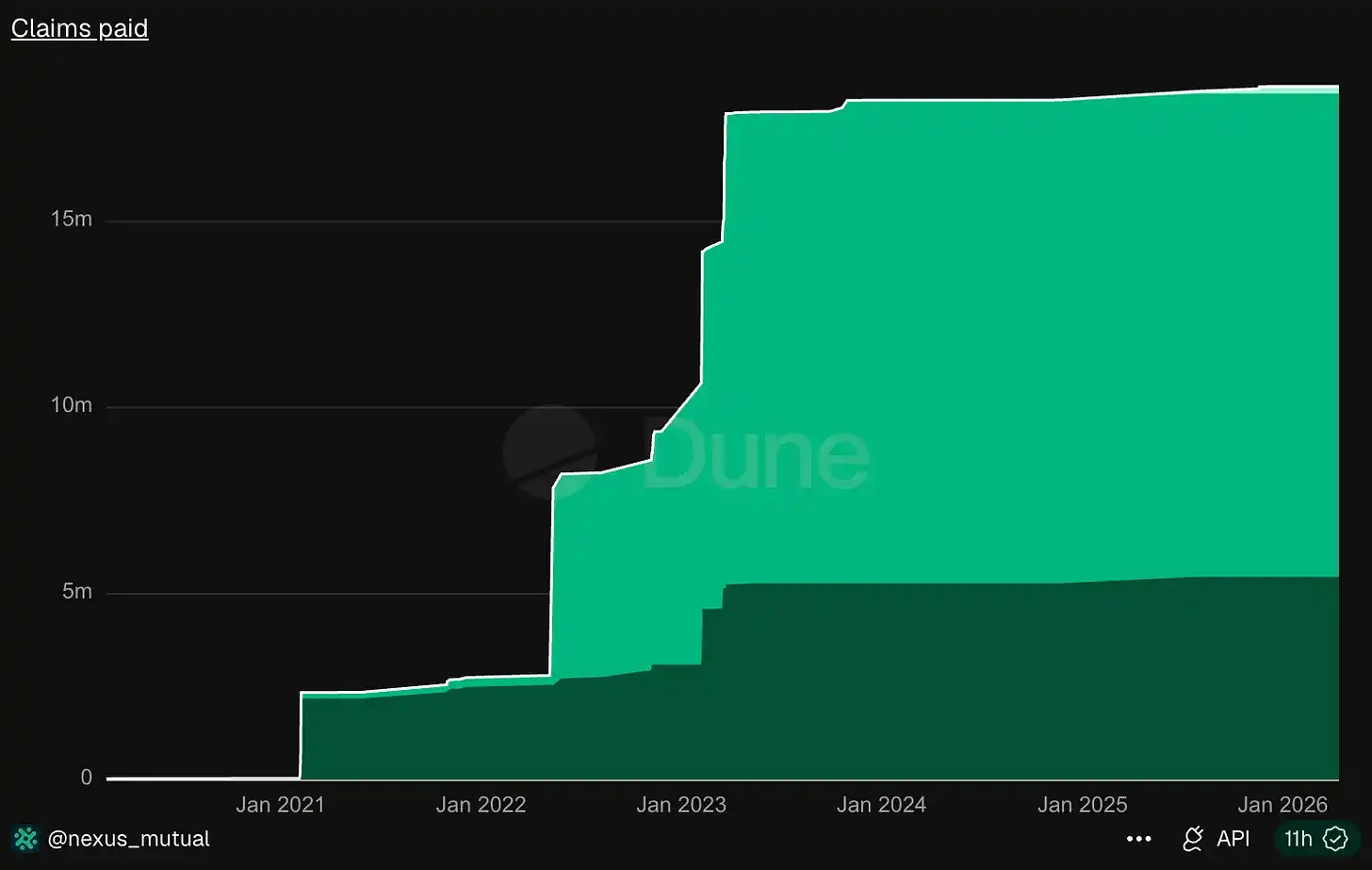
Data source: Dune Analytics

In April 2026, Kelp DAO suffered a hack, resulting in losses as high as $292 million. This single theft amount is equivalent to 16 times the total claims paid by this leading insurance institution over seven years.

This is in stark contrast to the current state of traditional insurance which denies claims aggressively. Traditional insurance collects high premiums but goes out of its way to block payouts; meanwhile, DeFi insurance has meager premium income, rooted in the fact that almost no investors are willing to insure.

Traditional insurance can operate stably because its risks are uncorrelated. One house fire doesn't cause damage to other houses. An insurance company can sell policies to 1 million users; a single fire claim can be covered by the premiums collected from everyone. But DeFi lacks this risk isolation mechanism: security incidents like oracle failures or cross-chain bridge vulnerabilities can have a chain reaction impacting all liquidity pools and lending protocols built on top of that underlying asset. The USDC depeg event in March 2023 affected all protocols using USDC as collateral that day. For DeFi insurance pools, the risks are strongly correlated. Insurers can only bet that losses from security incidents are manageable and that the insurance pool funds are sufficient to cover them.

In March 2023, Euler Finance was hacked for $197 million, and the contagious risk spread rapidly: Angle Protocol lost $17 million due to holding Euler's liquidity tokens, Yield Protocol urgently shut down its business, and several other platforms like Inverse Finance were also affected.

Once a protocol has a security vulnerability, it often affects multiple projects. An extreme one-day incident could even directly deplete an insurance pool's entire reserve for payouts.

I have compiled the current premium rates for Nexus Mutual and InsurAce, comparing them to the native annual yield of the protocols they insure: The annual yield for USDC deposits on Aave V3 is about 3.14%, with insurance premium rates ranging from 1.5% to 2.5%. After deducting premiums, the net return is only 0.6% to 1.6%. Investors take on on-chain security risks, only to end up with a return slightly higher than ordinary bank savings.
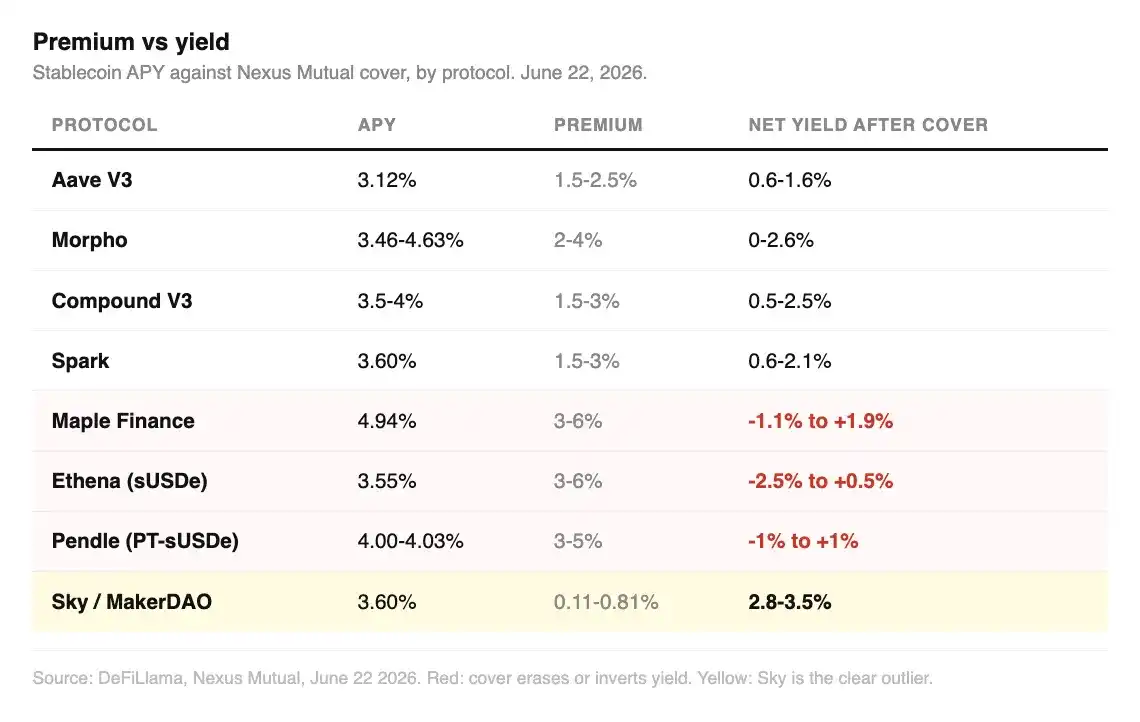
The yield situation is similar for Morpho, Compound, and Spark, with native annual yields of 3.5% to 4%. Premiums eat up one-third to half of the returns. Although there is still a slim profit, the cost-effectiveness is extremely low.

Maple Finance's institutional lending pools offer annual yields of 4.77% to 4.90%, but insurance premium rates are as high as 3% to 6%. The net return after insurance ranges from -1.1% to 1.9%. Ethena staking offers an annual yield of 3.6% to 4%, with premiums also at 3% to 6%, resulting in a net return of -2.4% to 1%. Buying insurance on these two types of platforms could even result in investors losing their principal in extreme cases.

Only the original MakerDAO (Sky) shows impressive performance. Its savings product offers a 3.6% annual yield, with the lowest insurance premium rate being only 0.11%. The market widely recognizes it as the lowest-risk asset in DeFi. After insurance, the net return remains between 2.8% and 3.5%, preserving the majority of the earnings.

Premium pricing strictly corresponds to risk levels, but premiums for emerging platforms are too high, directly consuming the high returns users seek when entering the market.

Crypto investors choose to forgo insurance not out of laziness or recklessness. They understand that in most cases, buying insurance is equivalent to zeroing out their returns. Even if all DeFi depositors collectively decided to purchase full coverage tomorrow, the entire industry would be unable to meet the demand: Nexus Mutual's total pool size is about $81.56 million. The entire industry's effective coverage capacity is at most a few hundred million dollars, while the total value locked (TVL) in major protocols amounts to hundreds of billions. The gap between supply and demand is astronomical.

A major security incident on the scale of Kelp DAO would directly drain the vast majority of the industry's insurance reserves in a single claim.

The historical total claims of $18 million precisely expose the fragility of the industry's capital pools. The entire market has never experienced a major risk event severe enough to break through the underwriting reserves.

After a user submits a claim request to Nexus Mutual, it must be voted on by all token-holding members of the platform to decide whether to pay. Members who vote to approve a claim risk having their own assets directly impaired if the claim is ultimately not paid. This mechanism naturally fosters a tendency to deny claims. Traditional insurance specifically employs underwriters and claims adjusters to balance conflicts, whereas DeFi insurance design merges all responsibilities onto the same group.

Before the 2008 financial crisis, financial risk pricing agencies generally believed a nationwide housing price collapse in the US was impossible, mainly because they had never experienced it. Insurance giant AIG massively sold risk protection contracts, but when the market crisis truly erupted, it was completely unable to pay.

Before the US government introduced FDIC deposit insurance, ordinary depositors had no safety net for their assets. The Great Depression forced the government to mandatorily implement bank insurance, making it a mandatory operating cost for banks.

In the DeFi field, no one can force protocols like Aave or Morpho to buy insurance. Smart contract deployment is completely permissionless; there is no entity that can mandate projects to configure risk coverage. This also leads to a lack of a safety net mechanism to withstand extreme market conditions in the industry.

The three largest claims in Nexus Mutual's history are: approximately $7.3 million paid in two batches for the FTX collapse, $5 million for the TribeDAO hack, and $3.4 million for the Euler Finance hack. The sum of these three amounts is almost equivalent to the platform's seven-year cumulative claims total of $18.6 million.

Now this mutual insurance platform is shifting towards pre-risk prevention. It has partnered with security audit firms like Immunefi, Cantina, and Sherlock to launch bug bounty protection products. Protocols only need to bear 20% of the critical bug bounty, with Nexus Mutual covering the remaining funds, proactively incentivizing white-hat hackers to find vulnerabilities to avoid theft incidents at the source. At the same time, Nexus Mutual is working on compliant insurance securitization, attempting to connect crypto risks to reinsurance capital pools, introducing larger external capital to supplement underwriting capacity.

Cantina went a step further in March 2025, launching an independent native protocol protection product. Even if a vulnerability is not discovered early by bounty hunters, users can still receive payouts if the protocol is hacked.

Both of these transformation moves essentially acknowledge a core reality: On-chain capital is insufficient to cover on-chain risks. Three inherent flaws cannot be eliminated: insurance pools are too small, risks are highly correlated, and the same group that adjudicates claims also provides the capital.

Nexus Mutual has $81.56 million in total value locked according to DeFiLlama, accounting for 85% of the DeFi insurance market share. Other peers continue to shrink: InsurAce peaked at $150 million TVL, now only $132,000 left; after the 2022 UST depeg, it only settled one major claim. Sherlock's pool shrunk from $60 million to $505,000 within a year. Unslashed Finance has millions of dollars trapped in old, un-updated code since late 2024. Other insurance projects have either shut down completely or pivoted to different business models.

A lighthouse warns all ships of hidden reefs, but it cannot charge passing vessels a usage fee, so it's hard for anyone to voluntarily fund its construction. The benefits are shared by all, but the cost is borne solely by the builder.

The value of DeFi insurance lies precisely in preventing the spread of chain-reaction liquidation crises. Assets in the crypto market are highly interconnected. Only when everyone insures simultaneously can overall market stability be maintained. But if everyone expects others to buy insurance as a backstop while they themselves are unwilling to bear the premium cost, ultimately no one will buy insurance, and the risk protection system will be meaningless. Protection without anyone actively providing a safety net ultimately cannot safeguard any assets.


Criptos en tendencia

Preguntas relacionadas

QWhat are the main reasons why DeFi insurance is not widely purchased by users?

AThe main reasons are: 1) High premiums that drastically erode investment yields, often making the net return unattractive or even negative. 2) Systemic and correlated risks in DeFi, where a single security incident can impact multiple protocols simultaneously, making it difficult for insurance pools to cover catastrophic events. 3) The limited capacity of existing DeFi insurance pools (totaling a few hundred million dollars) compared to the trillions of dollars in total value locked (TVL) across DeFi, creating a massive supply-demand gap. 4) The governance model where the same entities (token holders) who fund the pool also vote on claims, creating an inherent bias against payouts.

QHow does the risk profile in DeFi differ from traditional insurance, and why is this a problem for DeFi insurers?

AIn traditional insurance (e.g., home insurance), risks are largely uncorrelated—one house fire does not cause others to burn down. This allows insurers to pool premiums from many to cover rare, individual events. In DeFi, risks are highly correlated. A single exploit in a core protocol (like an oracle failure or bridge hack) can trigger losses across multiple interconnected platforms and asset pools simultaneously. This systemic nature means a major event can wipe out an entire insurance pool at once, making the business model unstable and requiring prohibitively high premiums.

QAccording to the article, what is the fundamental flaw in the design of platforms like Nexus Mutual regarding claim assessment?

AThe fundamental flaw is the conflation of roles. In platforms like Nexus Mutual, the members (token holders) who provide the capital for the insurance pool are also the ones who vote on whether to approve a claim. Since their own funds are at risk if a claim is paid out, this creates a built-in incentive to vote against approving claims, regardless of their validity. Traditional insurance separates these functions with dedicated underwriters and claims adjusters to balance the interests.

QWhat example does the article give to illustrate the massive mismatch between DeFi insurance capacity and potential losses?

AThe article cites the April 2026 Kelp DAO hack, which resulted in a loss of $292 million. This single incident's loss was 16 times greater than the entire cumulative payout history (around $18 million) of Nexus Mutual, the largest DeFi insurance provider, since its launch in 2019. This starkly highlights how a major security event could easily exhaust the entire industry's insurance reserves.

QWhat potential solutions or shifts in strategy are DeFi insurance projects like Nexus Mutual exploring?

ADeFi insurance projects are exploring strategies that acknowledge the insufficiency of on-chain capital to cover on-chain risks. Examples include: 1) Proactive risk prevention, such as partnering with bug bounty platforms (e.g., Immunefi) to fund preemptive security audits and vulnerability rewards, aiming to stop hacks before they happen. 2) Seeking external capital by creating compliant insurance tranches to connect crypto risks with traditional reinsurance pools, thereby increasing overall coverage capacity.

Lecturas Relacionadas

Operador veterano relata: ¿Cómo operar con las expectativas erróneas del mercado?

**Resumen en español europeo:** Un trader experimentado explica cómo operar basándose en las "expectativas erróneas" del mercado, tomando como ejemplo una operación reciente de venta en corto del índice Nasdaq (NQ). El caso se desencadenó tras la publicación de datos débiles de inflación (IPC) en EE.UU. Inicialmente, el mercado reaccionó con optimismo, haciendo subir el Nasdaq, asumiendo que un IPC bajo conduciría a un relajamiento general de las tasas de interés, incluidos los tipos a largo plazo ("relajamiento del denominador"). Sin embargo, el trader identificó una falla clave en esta cadena de expectativas del mercado: mientras que las tasas de interés a corto plazo bajaron, las tasas reales a largo plazo (como la del bono a 30 años) alcanzaron máximos de 20 años. Este escenario de "relajamiento a corto plazo pero negativa a largo plazo" no apoya la valoración de acciones tecnológicas, que dependen de financiación a largo plazo barata para su crecimiento. La metodología central presentada consiste en no limitarse a los datos mismos, sino analizar tres capas: 1. **Expectativa del dato:** ¿Cuál era el consenso? 2. **Expectativa de transmisión:** ¿Cómo se supone que el dato afecta a otras variables del mercado (política monetaria, tasas, crédito)? 3. **Expectativa de valoración de activos:** Dado lo anterior, ¿cómo debería repreciarse un activo? El autor argumenta que el "error" más común y explotable ocurre en la segunda capa: el mercado asume que un mecanismo de transmisión anterior sigue siendo válido cuando ya no lo es. En este caso, asumió que un IPC débil relajaría todas las tasas, pero la nueva realidad macroeconómica impide que las tasas a largo plazo bajen. El trader actuó vendiendo en corto el NQ (más sensible a las tasas largas) en lugar del S&P 500 (ES), y estructuró la operación en varias entradas. Define que la mejor oportunidad surge cuando las "variables rápidas" (como el precio del activo) se han recuperado, pero las "variables lentas" (como las condiciones de financiación subyacentes) se niegan a hacerlo, creando una discrepancia entre el precio y su lógica causal implícita. La ventaja (alpha) no proviene necesariamente de tener información mejor, sino de tener un "modelo de reacción" más actualizado que el del consenso del mercado.

marsbitHace 15 min(s)

Operador veterano relata: ¿Cómo operar con las expectativas erróneas del mercado?

marsbitHace 15 min(s)

Opinión: La relación de cobertura entre la deuda estadounidense y el mercado de valores ha fallado, el BTC como activo de riesgo soporta una doble presión

Durante las últimas dos décadas, la relación de cobertura entre los bonos del Tesoro estadounidense y las acciones, donde uno subía cuando el otro caía, se ha roto. Ahora, ambos caen simultáneamente, eliminando el "amortiguador" clave en las carteras de inversión. Bitcoin, como activo de riesgo en el extremo de la curva, soporta una doble presión. La correlación negativa entre el S&P 500 y la rentabilidad de los bonos a 10 años ha alcanzado su nivel más bajo desde 1996 (-0,69), lo que indica un movimiento sincronizado sin precedentes en 30 años. Este cambio se debe a que la inflación, y especialmente su volatilidad, se ha convertido en el factor dominante del mercado, perjudicando tanto a bonos como a acciones, a diferencia de cuando el crecimiento económico era el principal motor. Los inversores buscan ahora seguridad sin riesgo de duración, optando por efectivo en dólares y letras del Tesoro a corto plazo, mientras venden bonos a largo plazo. El rendimiento del bono a 30 años superó el 5%, reflejando un déficit creciente, mayores pagos de intereses y una demanda extranjera decreciente. Bitcoin es ahora tan sensible a las condiciones macroeconómicas como el dólar o el oro. Se ve perjudicado por el aumento de los rendimientos libres de riesgo (que elevan su costo de oportunidad) y por la disminución de la aversión al riesgo (que reduce la financiación para posiciones especulativas). Los factores que sustentan su lógica a largo plazo (como la emisión fija frente a la deuda soberana en expansión) lo perjudican a corto plazo en el entorno actual. Para que los bonos recuperen su papel tradicional de cobertura, la volatilidad inflacionaria debe ceder, permitiendo que los riesgos de crecimiento vuelvan a ser dominantes y que la Fed tenga margen para relajar la política. Hasta entonces, en un mercado donde la clase de activos más profunda ya no absorbe los impactos, los activos que no generan rendimiento, como Bitcoin, quedan más expuestos.

marsbitHace 17 min(s)

Opinión: La relación de cobertura entre la deuda estadounidense y el mercado de valores ha fallado, el BTC como activo de riesgo soporta una doble presión

marsbitHace 17 min(s)

Resumen Semanal de Financiación | Crypto.com obtiene 400 millones de dólares de inversión, los sectores CeFi y de stablecoins siguen atrayendo capital

**Resumen Financiero Semanal: Cripto y IA Acaparan Grandes Inversiones** La semana pasada, los mercados de capitales de cripto y IA experimentaron una actividad significativa. En el sector cripto, se registraron 17 rondas de financiación, sumando más de 812 millones de dólares, mostrando una concentración de capital en transacciones grandes. El titular principal fue la ronda de 400 millones de dólares para el exchange **Crypto.com**, respaldada por Citadel Securities, valorando la empresa en 200.000 millones. Otras operaciones destacadas en finanzas centralizadas (CeFi) e infraestructura incluyeron 135 millones para el bróker API **Alpaca** y 70 millones para la plataforma bancaria transfronteriza **Flex**. El sector de **infraestructura y herramientas** recaudó fuertes sumas, con proyectos enfocados en pagos con stablecoins y liquidación, como **Cyclops** (20 millones) y **Pact Labs** (7 millones liderados por Tether). **Glacis Labs**, una plataforma de liquidación, levantó 6,8 millones. La **IA y la robótica** dominaron las megainversiones fuera del ámbito cripto. **Fireworks**, servicio en la nube para IA, recaudó 1.500 millones con respaldo de NVIDIA. En robótica, **Walden Robotics** (separada de Toyota) y la china **逐际动力 (Climber Robotics)** completaron rondas de 300 y casi 200 millones, respectivamente, para el desarrollo de robots humanoides. Otras áreas con actividad fueron DeFi, mercados de predicción y AI+Web3, con rondas menores. Además, se reportaron varias adquisiciones estratégicas, como la de MoonPay sobre la startup de depósitos Glide. En general, el capital continúa fluyendo hacia segmentos maduros como CeFi, stablecoins e infraestructura de trading en cripto, mientras que la IA y la robótica atraen apuestas masivas de capital riesgo para su comercialización.

marsbitHace 1 hora(s)

Resumen Semanal de Financiación | Crypto.com obtiene 400 millones de dólares de inversión, los sectores CeFi y de stablecoins siguen atrayendo capital

marsbitHace 1 hora(s)

¿El mercado bajista más moderado? Los bajistas del BTC cierran posiciones, ARK y Bitwise colectivamente son optimistas

**Resumen:** El 20 de julio, BTC se mantenía cerca de 75.000 USD, mientras que ETH retrocedía a 1.900 USD tras acercarse a los 2.000 USD. El mercado altcoin se mostraba mayormente débil. En las últimas 24 horas, se liquidaron 116 millones de USD en contratos, principalmente posiciones cortas (62.7 millones). El índice de miedo se sitúa en 35, indicando un sentimiento de pánico. Las perspectivas de diversas instituciones y analistas sugieren un posible punto de inflexión. **Polymarket** indica una probabilidad del 33% de que BTC caiga por debajo de 50.000 USD este año. **ARK Invest** señala señales de agotamiento de los vendedores, como el aumento de la ofente en manos de "hodlers" a largo plazo y del suministro en pérdidas (~54%). **Bitwise** describe esta caída como el "mercado bajista estructuralmente más suave" registrado, con una corrección del ~50% desde máximos, menor que en ciclos anteriores. Destaca que los inversionistas institucionales están comprando en la baja y que la base de cada ciclo es más alta. El análisis técnico de **Bit** sugiere que el mínimo de la onda C podría haberse formado, con un rango de soporte clave entre 59.000 y 70.000 USD. Sin embargo, **Glassnode** advierte que si BTC no logra superar con fuerza los 66.000 USD, el riesgo de un techo local aumenta. El analista **Darkfost** resalta la intensa zona de soporte entre 59.000 y 70.000 USD, donde se ha intercambiado el 50% del suministro circulante. Finalmente, el trader **Doctor Profit** anunció haber cerrado todas sus posiciones cortas (reportando grandes ganancias) y haber comenzado a comprar BTC spot desde los 64.000 USD, su primera compra para largo plazo desde septiembre de 2025. Argumenta que el consenso del mercado que espera mínimos más bajos en septiembre/octubre podría estar equivocado, y que el fondo del ciclo podría llegar antes de lo esperado, citando también avances regulatorios e institucionales como motivos estructurales para su cambio de postura.

Foresight NewsHace 2 hora(s)

¿El mercado bajista más moderado? Los bajistas del BTC cierran posiciones, ARK y Bitwise colectivamente son optimistas

Foresight NewsHace 2 hora(s)

Trading

Spot

Artículos destacados

Cómo comprar ONE

¡Bienvenido a HTX.com! Hemos hecho que comprar Harmony (ONE) sea simple y conveniente. Sigue nuestra guía paso a paso para iniciar tu viaje de criptos.Paso 1: crea tu cuenta HTXUtiliza tu correo electrónico o número de teléfono para registrarte y obtener una cuenta gratuita en HTX. Experimenta un proceso de registro sin complicaciones y desbloquea todas las funciones.Obtener mi cuentaPaso 2: ve a Comprar cripto y elige tu método de pagoTarjeta de crédito/débito: usa tu Visa o Mastercard para comprar Harmony (ONE) al instante.Saldo: utiliza fondos del saldo de tu cuenta HTX para tradear sin problemas.Terceros: hemos agregado métodos de pago populares como Google Pay y Apple Pay para mejorar la comodidad.P2P: tradear directamente con otros usuarios en HTX.Over-the-Counter (OTC): ofrecemos servicios personalizados y tipos de cambio competitivos para los traders.Paso 3: guarda tu Harmony (ONE)Después de comprar tu Harmony (ONE), guárdalo en tu cuenta HTX. Alternativamente, puedes enviarlo a otro lugar mediante transferencia blockchain o utilizarlo para tradear otras criptomonedas.Paso 4: tradear Harmony (ONE)Tradear fácilmente con Harmony (ONE) en HTX's mercado spot. Simplemente accede a tu cuenta, selecciona tu par de trading, ejecuta tus trades y monitorea en tiempo real. Ofrecemos una experiencia fácil de usar tanto para principiantes como para traders experimentados.

586 Vistas totalesPublicado en 2024.12.12Actualizado en 2026.06.02

Cómo comprar ONE

Discusiones

Bienvenido a la comunidad de HTX. Aquí puedes mantenerte informado sobre los últimos desarrollos de la plataforma y acceder a análisis profesionales del mercado. A continuación se presentan las opiniones de los usuarios sobre el precio de ONE (ONE).

活动图片