Why Did It Take Prediction Markets Nearly 40 Years to Explode?

marsbitPublicado a 2025-12-31Actualizado a 2025-12-31

Resumen

This article explores the explosive growth of prediction markets in 2025, which saw an estimated 400% increase in trading volume, reaching $40 billion, and a user base growing to 15 million. It examines why, despite existing since the 1980s (e.g., Iowa Electronic Markets), prediction markets only recently surged in popularity. Key factors for the 2025 boom include major regulatory progress. The CFTC approved platforms like Polymarket as designated contract markets, allowing them to operate legally in the US. This compliance enabled wider distribution, integration into major apps like Robinhood, and attracted institutional investment, with both Polymarket and Kalshi securing over $1 billion in new funding. Regulatory clarity also allowed for a diversification of event types, including sports and crypto, which now dominate trading volume. The article contrasts prediction markets with traditional gambling, noting the US government distinguishes them based on their "positive externalities." Unlike sportsbooks that set odds, prediction markets facilitate peer-to-peer betting, aggregating collective knowledge to improve information efficiency and decision-making, which regulators view as socially beneficial despite gambling-like elements. A provocative section discusses insider trading. Some argue that insiders using non-public information on anonymous, decentralized platforms like Polymarket can enhance market accuracy and serve as a form of information discovery. However, this...

As this year draws to a close, the rapid growth of prediction markets has attracted increasing attention from both crypto enthusiasts and those outside the circle. When discussing prediction markets with different friends, I often explain the difference between them and traditional gambling through 'differences in betting models' and 'the financialization of information.' As these conversations multiplied, I gradually realized that these two points are still not intuitive enough for friends who haven't been exposed to prediction markets. They even raised some very interesting and sharp questions, such as:

I can understand the difference between 'betting against the house' and 'P2P gambling among players,' but in essence, both models still involve real-money betting. Why does the U.S. government treat the two so differently?

If the lenient attitude towards prediction markets is because 'the financialization of information' has many benefits, then why hasn't this good thing become popular before? Why did it only explode in 2025?

There has been much discussion about the advantages and future prospects of prediction markets. Therefore, this article will explore prediction markets from more interesting angles.

Why Did Prediction Markets Only Explode in 2025?

Report data shows that the prediction market is expected to achieve an astonishing 400% growth rate in 2025, with total trading volume projected to grow from approximately $900 million in 2024 to $40 billion. The user base is also expected to increase 3-4 times, from about 4 million in 2024 to 15 million in 2025.

Retail players familiar with prediction markets should be well-acquainted with the hot topics over the past two years, such as the 2024 U.S. presidential election and the 2025 League of Legends World Championship. One might instinctively think that these hot topics drove the development of prediction markets.

But this is clearly not the only or core factor. Traditional gambling platforms also offer the same markets, and compared to the binary 'Yes/No' of prediction markets, traditional gambling markets have even more variety, such as 'point spreads.' Moreover, before the rise of Polymarket and Kalshi, there were precedents for prediction markets. The earliest available prediction market platform was the Iowa Electronic Markets (IEM), launched by the University of Iowa in 1988 for predicting the 1988 U.S. presidential election. Even prediction market platforms incorporating blockchain technology were not pioneered by Polymarket; Augur on Ethereum came in 2018.

Significant progress in regulation is an important factor, and the relaxation of regulations has contributed to the explosion of prediction markets on multiple levels.

First, the rollout of distribution channels. On November 25, the CFTC approved Polymarket's Amended Order of Designation, allowing it to re-enter the U.S. market as a Designated Contract Market (DCM). Kalshi also integrated directly into Robinhood and Coinbase this year. More importantly, after compliance, prediction markets have broader distribution channels in the U.S. than traditional gambling, covering all 50 states, while traditional gambling distribution channels only cover over 30 authorized states.

The more profound significance is that compliance clarifies the positioning of prediction markets as legitimate commodity derivatives rather than gambling, affirming the positive significance of prediction markets. This expands the distribution audience beyond traditional gambling enthusiasts to include investors and decision-makers. For ordinary people, seeing traditional media reports citing prediction market data or seeing internet search engines like Google directly indexing prediction market data creates a positive perception of 'legitimacy' that the cryptocurrency industry has sought for many years.

Second, policy friendliness has given institutional investors sufficient confidence, leading to rapid growth in the financing path for prediction markets. Both Polymarket and Kalshi completed a total of three new rounds of financing in 2025, with new financing amounts each exceeding $1 billion. This has given them better conditions to provide better products and liquidity.

Finally, the variety of event types in prediction markets has also been enriched. In 2024, Kalshi won a lawsuit against the CFTC, allowing it to list more types of event predictions, such as cryptocurrency-related events, and since January this year, it has expanded to sports events. The CFTC abandoned its appeal in May this year. Currently, sports event predictions account for about 90% of Kalshi's trading volume. A report by Eilers & Krejcik believes that, in the long run, sports event predictions will account for 44% of the total trading volume in prediction markets.

Of course, whether it's Kalshi, which has always strictly followed a compliant, off-chain path, or Polymarket, which took an offshore-then-compliant, on-chain path, the improvement of the prediction market products themselves, along with advancements in AI technology that have provided more complete related tools for the entire prediction market ecosystem, are all reasons why 2025 became the year of prediction markets. As mentioned earlier, the earliest on-chain prediction market, Augur, was previously criticized for its poor user experience and, after four years of silence, announced in March this year that it would be restarted by the Lituus Foundation. The popularity of anything requires waiting for the 'right time, place, and people.' The wheel of fortune turns, and prediction markets have finally borne fruit in 2025.

Why Does the U.S. Government Treat 'Gambling' Differently?

This is a very interesting question. Even I was initially confused—although prediction markets themselves do not act as the house, do not provide odds, and do not bet against users, we cannot say that peer-to-peer betting is not gambling. Otherwise, we could also say that playing poker is not gambling because the organizer does not play but only takes a rake, and the betting only occurs among the players.

At the same time, traditional gambling platforms, for their own benefit, have professional teams to analyze various event bets and try to provide reasonable odds. In the past, traditional media and institutional reports have cited odds from traditional gambling platforms for event reporting and analysis. Although prediction markets, compared to traditional gambling, can better reflect 'collective cognition' without the bias of a single team, and unlike traditional gambling platforms, they do not deliberately align odds with the public to increase overall betting volume and use the rake to offset losses caused by unreasonable odds settings, and indeed show higher real-time responsiveness and accuracy in some events, this does not seem to constitute an overwhelming advantage over traditional gambling platforms.

And whether for traditional gambling enthusiasts or ordinary retail investors in prediction markets, our grasp and analysis of events are, in most cases, certainly not as good as professionals, which means losses are common.

So, isn't the U.S. government worried about the harm caused by the gambling nature of prediction markets to the public? Of course it is, otherwise the compliance path for prediction markets would not have been so difficult for many years.

Internationally, some prediction markets operate directly under gambling licenses, such as the political prediction market on the UK's Betfair. Recently, U.S. District Court Judge Andrew Gordon in Nevada revoked an injunction protecting prediction market company Kalshi from state regulation and ruled that Kalshi's sports event predictions do not constitute transactions under the 'Commodity Exchange Act.' The judge believed that these prediction events are very similar to sports betting wagers and therefore fall under the regulatory purview of the Nevada Gaming Control Board and the Nevada Gaming Commission.

But the government's starting point is 'overall positive externality.' Just as the stock market allows the vast majority of retail investors to 'pay tuition' while greatly promoting overall social and economic operation, prediction markets, although essentially still gambling, also have key social benefits such as improving information efficiency and aiding decision-making. As long as the harms can be avoided as much as possible through sound regulation, we should not give up eating for fear of choking.

Of course, after reading this, you might still say that 'overall positive externality' is a pale rebuttal, and traditional gambling can still play a similar role. However, at least one point is undeniable: the mechanism of prediction markets themselves determines that the platform can only 'choose topics' and cannot 'rig the game.' Whether Polymarket or Kalshi, they can at most choose topics that people like to encourage betting and cannot manipulate odds.

Moreover, besides the U.S., governments in other countries and regions currently agree with your thinking. The U.S. is the only country in the world that distinguishes the positioning of prediction markets from traditional gambling and issues 'event contract' licenses for prediction markets. As the scale of prediction markets grows, controversies surrounding gambling will continue, and whether the U.S. government's attitude will change remains unknown.

Maybe, let the prediction markets predict it...?

A Paradise for Insider Traders?

This is a very interesting question. If asked whether insider trading in the stock market is good or bad, we would all say it's bad. But if the subject of this question is changed to prediction markets?

My colleague believes this is the value of prediction markets. The existence of insider information certainly creates unfairness in betting, but it also most accurately discloses information. Therefore, a true prediction market should be like Polymarket, built on-chain, anonymous without KYC.

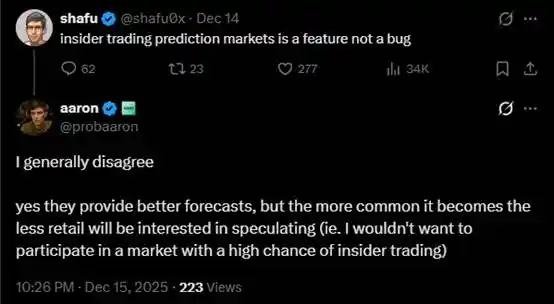
Such views are actually not uncommon. For example, this tweet by @shafu0x received considerable recognition:

Players who hold this view believe that as long as the information leaked through insider trading has 'overall positive externality,' it is justified. They also believe that prediction markets cannot do without these insiders because without them, the accuracy of event predictions in prediction markets would drop significantly, leaving only those without accurate information to bet against each other.

This view has some merit, but I think prediction market platforms themselves would resist such positioning because, in the long run, it would harm retail trust. The entire market would essentially change from a platform encouraging individual research and insight, aggregating collective wisdom, into a one-sided 'slaughter' by insiders, which is not conducive to the development of liquidity. If prediction markets were like this, it would be better to rename them 'information bounty platforms.'
Overall, I believe that platforms like Polymarket, built on-chain, with transparent movements and anonymity, fulfill our expectations of decentralization—anyone can freely send signals through prediction markets without worrying about anything, only needing to be responsible for their own bets. The harsh reality is that there are too many wealth transfers caused by information asymmetry in the world, and those that occur in prediction markets or stock markets might be the ones we feel most keenly.

As for whether prediction markets themselves should maintain a relatively fairer environment for retail investors and whether they need to sustain a more acceptable positioning for the public for sustainable development, that is a question they should consider.

Conclusion

There are actually many interesting questions, such as whether there will be a prediction market in the future that can challenge Kalshi and Polymarket? If prediction market compliance continues to advance worldwide, will each country and region have its own leader (because these markets can do better localization and provide prediction events more friendly to users in their respective countries and regions), etc.

Prediction markets are not exactly new, but the compliance of prediction markets is a very new, very avant-garde bold attempt. I believe that over time, the various questions mentioned in this article will have interesting answers that we cannot anticipate.


Criptos en tendencia

Preguntas relacionadas

QWhy did prediction markets take nearly 40 years to experience a major breakout in 2025?

APrediction markets saw explosive growth in 2025 due to key regulatory advancements, such as CFTC approvals allowing platforms like Polymarket and Kalshi to operate legally in the U.S., expanded distribution channels, increased institutional investment, richer event diversity including sports and crypto, and improved product experiences aided by AI tools.

QHow does the U.S. government distinguish prediction markets from traditional gambling?

AThe U.S. government treats prediction markets as legal commodity derivatives rather than gambling because of their 'positive externalities,' such as improving information efficiency and aiding decision-making. Unlike traditional gambling, prediction markets use peer-to-peer betting without a house setting odds, reducing manipulation risks, and they operate under specific regulatory frameworks like the Commodity Exchange Act.

QWhat role did regulatory changes play in the growth of prediction markets in 2025?

ARegulatory changes were crucial: the CFTC approved platforms like Polymarket as designated contract markets, allowing nationwide distribution in all 50 states. This legitimacy attracted institutional investors, facilitated major funding rounds, expanded event types like sports and crypto predictions, and enhanced public trust through media and tech integrations.

QAre prediction markets considered a haven for insider trading, and how is this viewed?

ASome argue that insider trading on prediction markets like Polymarket can be beneficial because it leads to more accurate information disclosure and positive externalities. However, platforms generally resist this perception, as it could undermine散户 trust and liquidity, turning the market into an 'information bounty' system rather than a fair collective intelligence platform.

QWhat are the main factors that contributed to the user and volume growth of prediction markets in 2025?

AKey factors include regulatory approvals expanding access, integration with major platforms like Robinhood and Coinbase, a wider range of预测事件 such as sports and elections, increased institutional funding improving liquidity and product quality, and AI-driven tools enhancing user experience and market efficiency.

Lecturas Relacionadas

Por qué el Bitcoin se mantiene en $64,000 tras la dura pausa de la Fed

Bitcóin cierra julio cerca de los 64.000 dólares tras una volátil reacción a la decisión de la Fed de mantener las tasas sin cambios, aunque sin indicar un pronto aflojamiento monetario. Esto ha provocado una rotación de capital hacia los ETF de Bitcoin, que registraron una entrada neta de 32,1 millones de dólares, mientras que los fondos de Ethereum experimentaron salidas. El mercado de criptomonedas, con una capitalización de unos 2,29 billones de dólares, se mantiene en un rango lateral, con Bitcoin encontrando soporte en 63.000-63.500 dólares y resistencia en 66.000 dólares. La Fed mantuvo su tasa clave, pero tres miembros votaron a favor de un aumento, señalando una postura más dura de lo esperada. En este entorno macroeconómico incierto, los inversores institucionales parecen favorecer a Bitcoin como activo principal, aunque persiste el interés selectivo en activos como Solana. Mientras, la aprobación de la ley CLARITY en EE.UU. se retrasa hasta después del receso de agosto. Para el último día de julio, el enfoque estará en los datos macro de EE.UU. El escenario base para Bitcoin es la consolidación entre 63.000 y 66.000 dólares, con su ruptura superior dependiendo de nuevos flujos institucionales. La estabilidad por encima de 63.000 dólares para BTC, el mantenimiento de Ethereum sobre 1.860 dólares y las entradas continuas en ETF son claves para una posible base de recuperación en la segunda mitad del año.

cryptonews.ruHace 1 hora(s)

Por qué el Bitcoin se mantiene en $64,000 tras la dura pausa de la Fed

cryptonews.ruHace 1 hora(s)

Parker Lewis responde por qué bitcoin sigue siendo el mejor dinero

El influyente analista de Bitcoin, Parker Lewis, critica las estrategias de marketing de corporaciones que actúan como tesorerías cripto. Advierte que la venta de "crédito digital" mediante acciones preferentes perpetuas distorsiona la esencia de la criptomoneda. Lewis enfatiza que Bitcoin no genera rendimiento fiduciario por diseño y que las promesas de dividendos son riesgosas, dependiendo de nuevos inversores. Destaca el riesgo de estos derivados, señalando que el mercado de acciones preferentes perpetuas es minúsculo comparado con el crédito global, lo que demuestra que los grandes actores evitan estos riesgos, trasladándolos a minoristas. Rechaza la idea de que Bitcoin es "demasiado volátil", argumentando que la volatilidad es una consecuencia natural de la adopción masiva de un activo con oferta fija e inelástica. En lugar de comprar derivados corporativos como acciones de MicroStrategy, recomienda adquirir Bitcoin directamente, considerándolo más seguro. Lewis alerta que este enfoque distrae de la verdadera amenaza: la rápida devaluación del dinero fiduciario. Ilustra la inflación real con su "Índice Ribeye", mostrando un aumento del 90% en el precio de un filete desde 2020, muy superior a las cifras oficiales. Concluye que la estrategia más prudente es la posesión directa de Bitcoin y el control total de las claves privadas, protegiendo así los ahorros de la inflación y los riesgos sistémicos de los derivados corporativos.

cryptonews.ruHace 1 hora(s)

Parker Lewis responde por qué bitcoin sigue siendo el mejor dinero

cryptonews.ruHace 1 hora(s)

Arrestados participantes en esquema fraudulento con XRP, que robaron 9 millones de dólares a 71 inversores

El periódico surcoreano "Chosun" informa que la Policía Metropolitana de Seúl detuvo a tres personas acusadas de operar una plataforma de inversión fraudulenta utilizando XRP. Según las autoridades, entre el 16 y el 23 de octubre, el grupo recaudó aproximadamente 3,4 millones de XRP (equivalentes a unos 9 millones de dólares) de 71 inversores, tras lo cual cerró el sitio web y desapareció. Los sospechosos promovían el sitio Fxrpntwork.com a través de blogs, artículos en línea y vídeos de YouTube, prometiendo la garantía del capital y un rendimiento mensual del 1,5% al 1,8%. Instruyeron a los inversores a transferir XRP desde intercambios surcoreanos a través de plataformas extranjeras y luego a carteras controladas por el grupo. La policía advirtió a los inversores que verifiquen fuentes oficiales antes de transferir activos a carteras o plataformas no verificadas, destacando el peligro de dejarse engañar por información no contrastada en YouTube u otras plataformas. Los estafadores copiaron el branding de "Flare Network" y "FXRP" para que su plataforma pareciera legítima. Ripple advierte que tales esquemas suelen imitar nombres, logotipos y sitios web de organizaciones confiables para crear una falsa apariencia de seguridad. Este caso ilustra cómo las promesas de rendimiento garantizado siguen siendo una señal común de fraude en criptomonedas. Las autoridades surcoreanas congelaron activos virtuales por valor de 17.300 millones de wons tras detectar el esquema, y el análisis de carteras reveló transferencias adicionales por 27.300 millones de wons, lo que sugiere que podría haber más víctimas y cómplices sin identificar.

cryptonews.ruHace 1 hora(s)

Arrestados participantes en esquema fraudulento con XRP, que robaron 9 millones de dólares a 71 inversores

cryptonews.ruHace 1 hora(s)

Trading

Spot

Artículos destacados

Cómo comprar O

¡Bienvenido a HTX.com! Hemos hecho que comprar O1 exchange (O) sea simple y conveniente. Sigue nuestra guía paso a paso para iniciar tu viaje de criptos.Paso 1: crea tu cuenta HTXUtiliza tu correo electrónico o número de teléfono para registrarte y obtener una cuenta gratuita en HTX. Experimenta un proceso de registro sin complicaciones y desbloquea todas las funciones.Obtener mi cuentaPaso 2: ve a Comprar cripto y elige tu método de pagoTarjeta de crédito/débito: usa tu Visa o Mastercard para comprar O1 exchange (O) al instante.Saldo: utiliza fondos del saldo de tu cuenta HTX para tradear sin problemas.Terceros: hemos agregado métodos de pago populares como Google Pay y Apple Pay para mejorar la comodidad.P2P: tradear directamente con otros usuarios en HTX.Over-the-Counter (OTC): ofrecemos servicios personalizados y tipos de cambio competitivos para los traders.Paso 3: guarda tu O1 exchange (O)Después de comprar tu O1 exchange (O), guárdalo en tu cuenta HTX. Alternativamente, puedes enviarlo a otro lugar mediante transferencia blockchain o utilizarlo para tradear otras criptomonedas.Paso 4: tradear O1 exchange (O)Tradear fácilmente con O1 exchange (O) en HTX's mercado spot. Simplemente accede a tu cuenta, selecciona tu par de trading, ejecuta tus trades y monitorea en tiempo real. Ofrecemos una experiencia fácil de usar tanto para principiantes como para traders experimentados.

560 Vistas totalesPublicado en 2026.06.19Actualizado en 2026.06.29

Cómo comprar O

Cómo comprar PROS

¡Bienvenido a HTX.com! Hemos hecho que comprar Pharos (PROS) sea simple y conveniente. Sigue nuestra guía paso a paso para iniciar tu viaje de criptos.Paso 1: crea tu cuenta HTXUtiliza tu correo electrónico o número de teléfono para registrarte y obtener una cuenta gratuita en HTX. Experimenta un proceso de registro sin complicaciones y desbloquea todas las funciones.Obtener mi cuentaPaso 2: ve a Comprar cripto y elige tu método de pagoTarjeta de crédito/débito: usa tu Visa o Mastercard para comprar Pharos (PROS) al instante.Saldo: utiliza fondos del saldo de tu cuenta HTX para tradear sin problemas.Terceros: hemos agregado métodos de pago populares como Google Pay y Apple Pay para mejorar la comodidad.P2P: tradear directamente con otros usuarios en HTX.Over-the-Counter (OTC): ofrecemos servicios personalizados y tipos de cambio competitivos para los traders.Paso 3: guarda tu Pharos (PROS)Después de comprar tu Pharos (PROS), guárdalo en tu cuenta HTX. Alternativamente, puedes enviarlo a otro lugar mediante transferencia blockchain o utilizarlo para tradear otras criptomonedas.Paso 4: tradear Pharos (PROS)Tradear fácilmente con Pharos (PROS) en HTX's mercado spot. Simplemente accede a tu cuenta, selecciona tu par de trading, ejecuta tus trades y monitorea en tiempo real. Ofrecemos una experiencia fácil de usar tanto para principiantes como para traders experimentados.

544 Vistas totalesPublicado en 2026.06.22Actualizado en 2026.06.29

Cómo comprar PROS

Qué es VERONA

I. Introducción al Proyecto VERONA es una blockchain construida para todos, en cualquier lugar, a través de la abstracción de la cadena. Utilizando su capa de Abstracción Generalizada, VERONA se distingue por integrar funcionalidades complejas de blockchain, como cuentas, firmas e interoperabilidad, directamente a nivel de protocolo. Este enfoque permite interactuar con aplicaciones de blockchain sin necesidad de entender las tecnologías subyacentes.1) Información Básica Nombre: VERONA (VERONA)III. Enlaces Relacionados Enlace al sitio web oficial: https://xion.burnt.com/ Libro Blanco: https://xion.burnt.com/whitepaper.pdf Exploradores: https://explorer.burnt.com/ Redes Sociales: https://x.com/burnt_xion Nota: La introducción del proyecto proviene de los materiales publicados o proporcionados por el equipo oficial del proyecto, que es solo para referencia y no constituye asesoramiento de inversión. HTX no se hace responsable de ninguna pérdida directa o indirecta resultante.

580 Vistas totalesPublicado en 2026.06.22Actualizado en 2026.06.22

Qué es VERONA

Discusiones

Bienvenido a la comunidad de HTX. Aquí puedes mantenerte informado sobre los últimos desarrollos de la plataforma y acceder a análisis profesionales del mercado. A continuación se presentan las opiniones de los usuarios sobre el precio de A (A).

活动图片













