When Transaction Fees Are No Longer a Barrier, What Will Determine the Winner Among Public Blockchains?

marsbitPublicado a 2026-04-08Actualizado a 2026-04-08

Resumen

As transaction fees decline across major blockchains due to scaling improvements, competition is shifting from cost to specialization. Bitcoin is enhancing programmability and asset utility through ZK rollups like Citrea and wrapped BTC, unlocking its dormant capital. Ethereum consolidates as the liquidity hub for stablecoins, DeFi, and RWA, with lower L1 fees and L2s evolving into specialized execution environments rather than mere scaling tools. Solana positions itself as an internet-scale capital market, leveraging sub-cent fees and sub-second finality for payments, micropayments, and high-frequency trading infrastructure like propAMMs. Upgrades like Ethereum’s Glamsterdam and Solana’s Alpenglow aim to further boost throughput and reduce latency. The industry is moving toward scenario-specific optimization, with chains differentiating by ecosystem liquidity, throughput, and tailored functionality rather than transaction cost alone.

Author: Tanay Ved, Coin Metrics

Compiled by: Luffy, Foresight News

TL;DR

  • As blockchains scale and transaction costs decrease, the differentiation among public chains is shifting from cost competition to specialized, scenario-based division of labor.
  • In March, the 20 millionth Bitcoin was mined. The ecosystem of wrapped tokens and ZK Rollups continues to grow, gradually unlocking Bitcoin's programmability and asset utility.
  • Ethereum is consolidating its position as the hub for on-chain liquidity and settlement. L1 fees hit record lows, while L2s are evolving from scaling solutions into specialized execution layers.
  • Solana is advancing its vision of an 'Internet Capital Market,' with increasing payment adoption and maturing on-chain trading infrastructure. The Alpenglow upgrade aims to achieve sub-second finality.

As network block space continues to expand, on-chain transaction costs have significantly decreased. Ethereum mainnet fees dropped notably after recent upgrades, Solana's fees remain under a few cents, and L2 networks offer similarly low-cost execution environments. In this context of compressed costs, the differentiation of block space increasingly depends on ecosystem liquidity, throughput, and scenario specialization, rather than mere marginal cost advantages.

This article explores how major public chains are evolving around their respective positions: Bitcoin is expanding its programmability and asset utility; Ethereum is consolidating its role as the liquidity and settlement center for stablecoins, real-world assets (RWA), and DeFi; and Solana is focusing on high-frequency payments and trading scenarios.

Bitcoin

In March 2026, the 20 millionth Bitcoin was mined, meaning only 1 million BTC remain to be issued. Over 95% of Bitcoin's total supply is already in circulation. After the halving in April 2024, the block reward dropped to 3.125 BTC, and the issuance rate continues to decline as programmed.
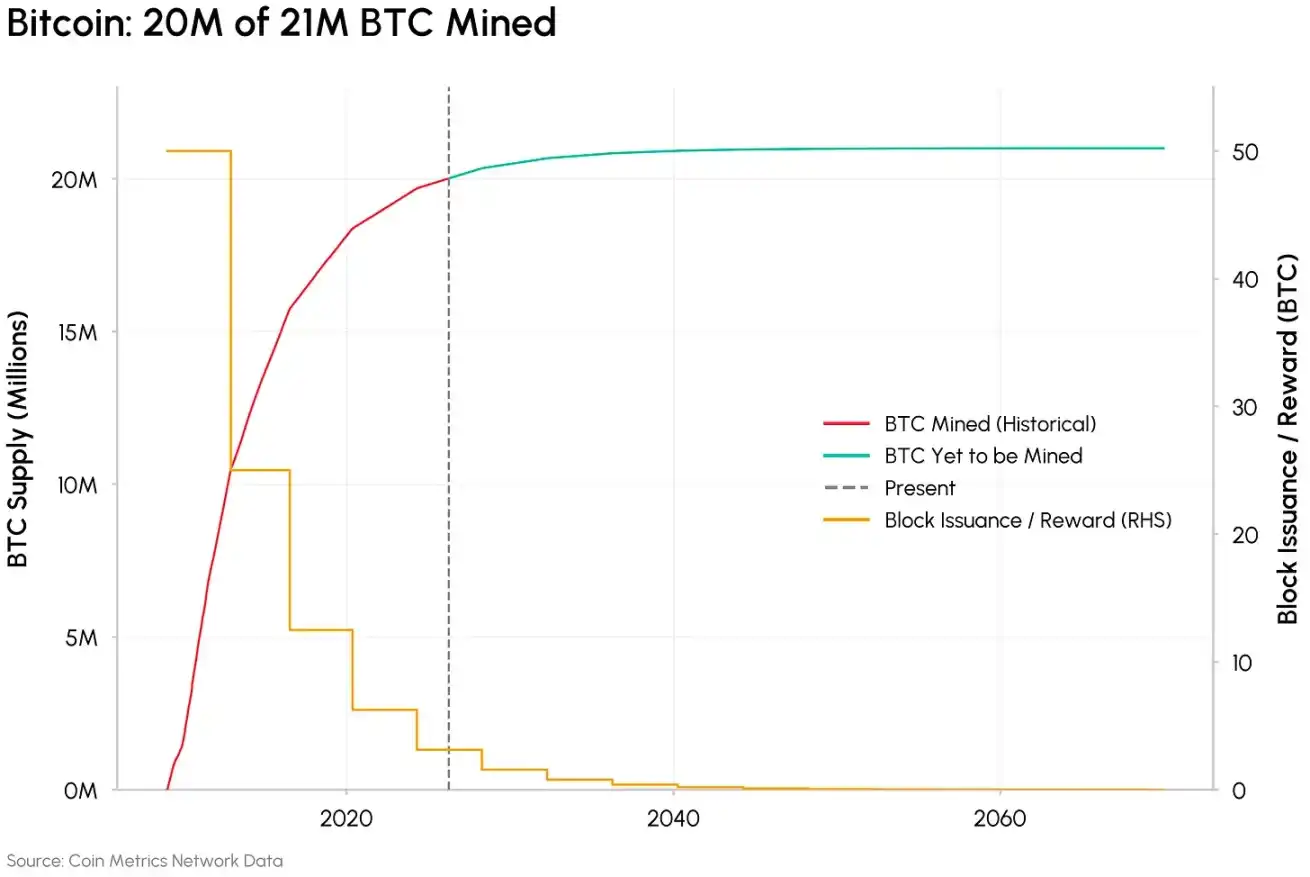
Bitcoin mining speed, Data source: Coin Metrics

As block rewards decrease, the importance of transaction fees in miner revenue continues to grow. Excluding periods of sharp spikes, transaction fees account for less than 1% of total miner income. Since all Bitcoin fees go to miners, a core long-term issue for its security model is whether naturally occurring fee demand can sustainably fill the gap left by declining block rewards.

Making Bitcoin Programmable and Assetized

Despite a market cap of approximately $1.3 trillion, about 60% of BTC has not moved in a year; around 2.4 million BTC (11% of the supply) is held on centralized exchanges, and another ~243,000 BTC circulates as wrapped tokens on other public chains.

Most Bitcoin capital remains idle, and the vast majority of related activity and fee generation occurs off the main chain.

Bitcoin's functional role is evolving along two main lines: expanding base-layer programmability and enhancing BTC's asset utility. Sidechains, L2s like Lightning Network, wrapped Bitcoin, and liquid staking protocols are enriching Bitcoin's practicality, but they also introduce varying degrees of trust assumptions, ranging from fully custodial to smart contract-based.
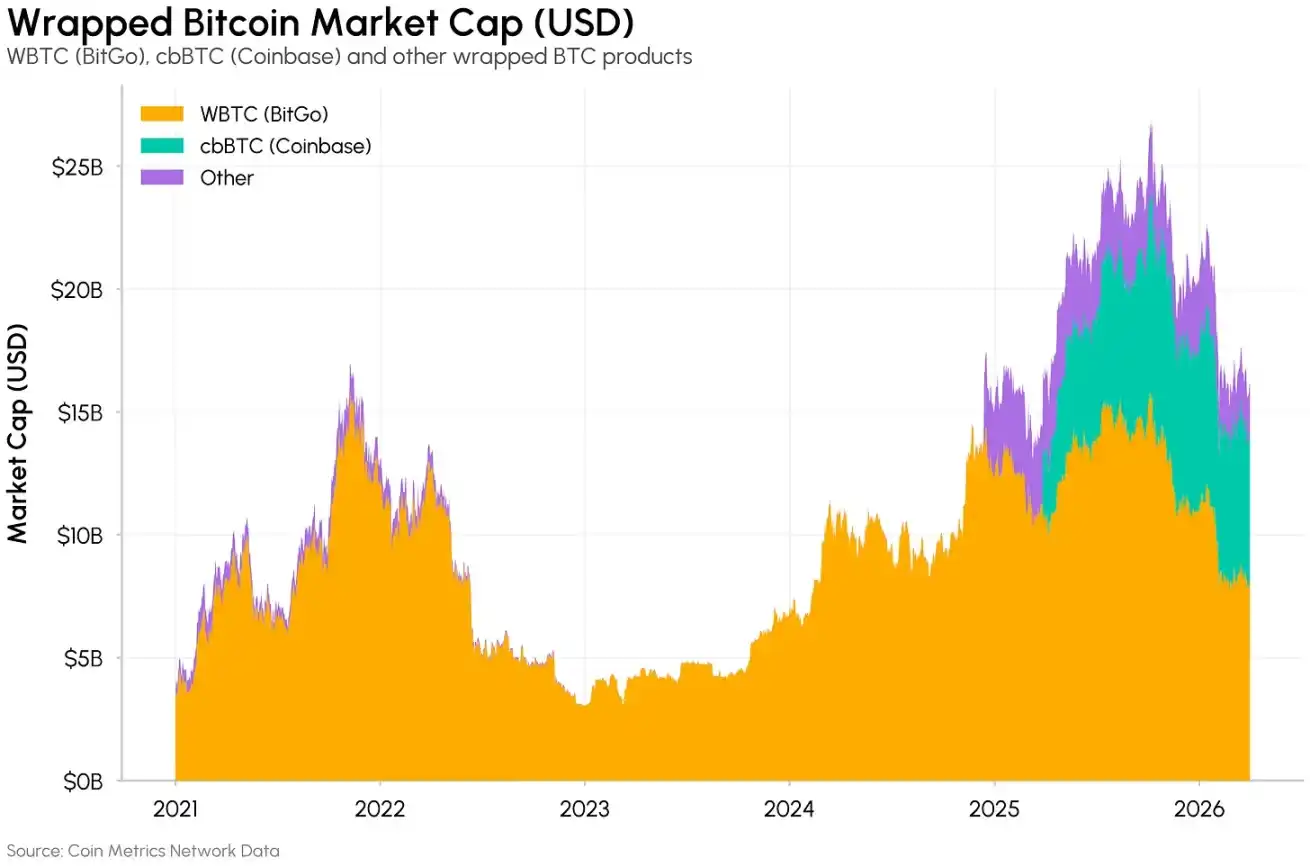
Market cap of wrapped Bitcoin, Source: Coin Metrics

In the direction of minimal trust, Citrea stands out as a ZK Rollup that settles directly on Bitcoin L1. It uses the BitVM framework to verify programs within Bitcoin's existing script system, enabling EVM-compatible applications, with security guaranteed by Bitcoin's proof-of-work. Unlike sidechains, it settles directly on Bitcoin via zero-knowledge proofs, with withdrawals relying on non-custodial bridges.

Simultaneously, the use of BTC as collateral continues to grow. The total value of wrapped Bitcoin across various chains exceeds $15 billion, and the lending market for Coinbase's cbBTC on Morpho has surpassed $1 billion. Liquid staking protocols like Babylon further expand this scenario, allowing BTC to provide economic security for external proof-of-stake networks. These developments are gradually unlocking the assetization potential of long-idle capital.

Ethereum

Ethereum remains the global center for on-chain liquidity and settlement. It holds about 62% of the total stablecoin market cap, boasts the deepest DeFi liquidity of any public chain, and is also a key platform for circulating tokenized real-world assets (RWA), including money market funds, tokenized treasuries, and stocks.

Recent upgrades have further strengthened Ethereum's底层 (base layer) position as the core of economic activity. PeerDAS, larger blob space, and the increased Gas limit from the Pectra and Fusaka upgrades have pushed L1 fees to multi-year lows, expanding the range of activities that can be settled directly on the mainnet.
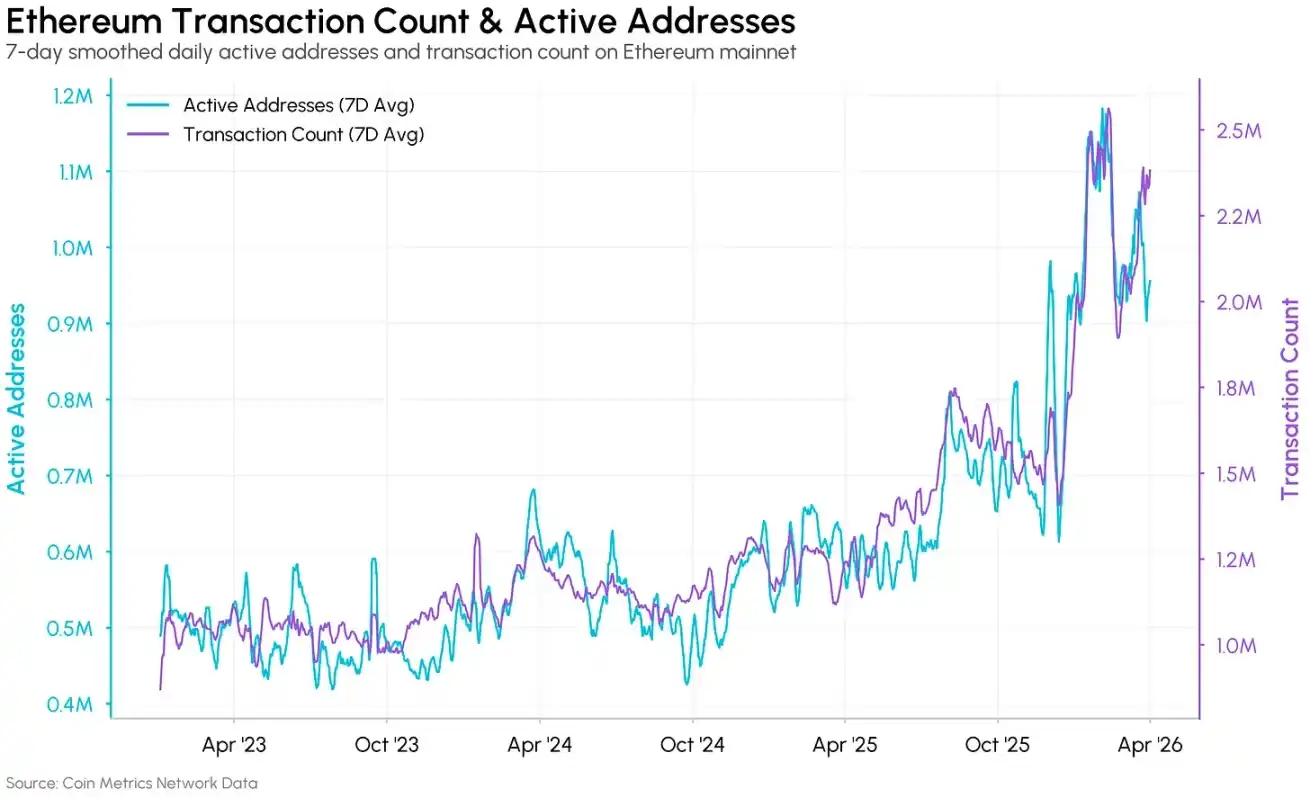
Ethereum transaction volume and active address count, Data source: Coin Metrics

Daily active addresses and transaction volume on Ethereum mainnet have nearly doubled year-over-year, exceeding 1 million and 2.4 million respectively. However, as we previously noted, part of this growth comes from address poisoning attacks and low-value economic activity addresses (transaction value less than $1), which sometimes constitute a very high proportion of daily active addresses.

The Evolving Relationship Between L1 and L2

With L1 transaction costs significantly reduced, the role of Ethereum L2 networks is being redefined. L2s were initially designed as core scaling solutions for Ethereum, reducing costs by offloading the execution layer. This positioning is now changing.

According to a recent Ethereum Foundation blog post, the core mission of L2s has shifted to providing differentiated functions, customized capabilities, and specialized execution environments, with scaling becoming a secondary function.

L2 usage of blob space for submitting transaction data to Ethereum is below 30%, with an average of about 3 blobs per block post-scaling. Blob usage is concentrated on a few L2s, and related fees constitute a negligible portion of total transaction fees. The pace of L1 scaling has now surpassed L2 settlement demand, making Ethereum settlement costs no longer a barrier for most L2s.
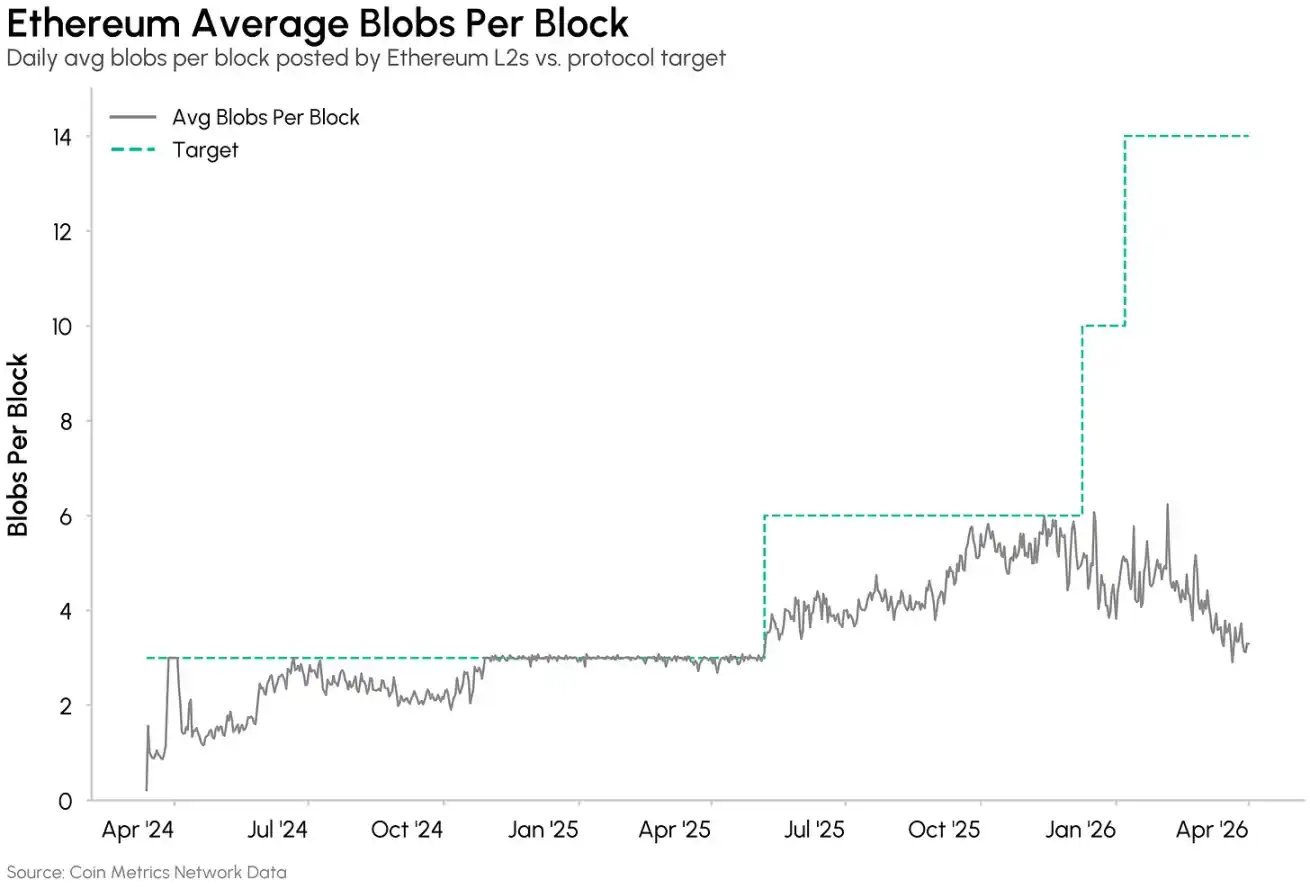
Average number of blobs per block on Ethereum, Data source: Coin Metrics

The L2s achieving sustained growth are those with unique value propositions: Base leverages Coinbase's distribution advantages, Arbitrum stands on its deep DeFi liquidity. A new generation of specialized chains like MegaETH, Lighter, Robinhood Chain, and Ink target specific scenarios, offering new business models and distribution channels.

The Ethereum roadmap, through native rollups and other interoperability and minimal-trust architectures, further promotes deep integration between L1 and L2, consolidating its position as the core of ecosystem liquidity and settlement.

Glamsterdam and Other Upgrades

The Glamsterdam upgrade, scheduled for the first half of 2026, will continue this trend. By increasing the Gas limit to 200 million and introducing parallel transaction execution, this upgrade aims to significantly increase L1 throughput while reducing fees for complex smart contract interactions. Additionally, the Proposer-Builder Separation mechanism (ePBS) integrates block building into the protocol, reducing MEV centralization and improving transaction ordering transparency. These changes are designed to make Ethereum L1 a more competitive execution environment, maintaining its status as a trusted platform for high-value settlement and DeFi.

Solana

Solana is shedding its early label as a 'retail and meme coin chain' and moving towards its vision of an Internet Capital Market. With transaction fees under 1 cent and block times below 400 milliseconds, it is a natural fit for high-frequency applications like payments, micropayments, and high-frequency trading. This characteristic attracts a range of professional applications requiring large-scale, low-latency execution.

Since late 2024, non-vote transactions on Solana have nearly doubled, exceeding 120 million daily on average.
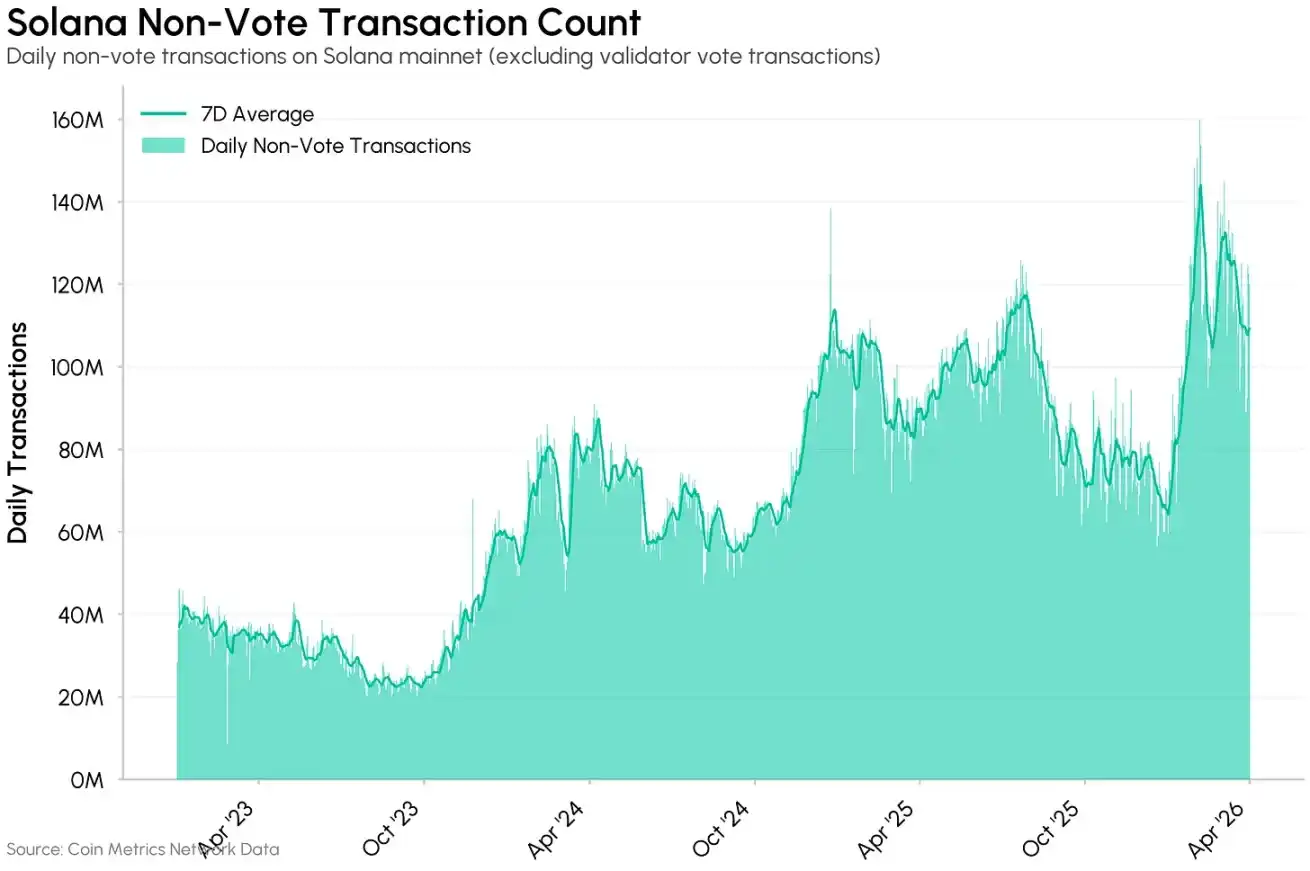
Number of non-vote transactions on the Solana network, Data source: Coin Metrics

Payments and High-Frequency Micropayments

Solana's low-cost environment makes it a top public chain for payments and peer-to-peer value transfer. Daily USDC transfers under $1000 are stable at around 3 million, with the median transaction amount consistently below $100.

An emerging development is the x402 protocol, an open HTTP payment protocol launched by Coinbase that allows any API or digital service to charge stablecoin fees per request. Despite competition from chains like Base and Stripe's Tempo, Solana captures a significant share of x402 transactions, becoming an early adoption layer for agent micropayments.

Trading Infrastructure

Solana's high throughput also attracts professional on-chain trading infrastructure. Proprietary AMMs (propAMMs) developed by professional market makers use private off-chain pricing models, resembling dark pools more than public DEXs. Unlike AMMs like Uniswap, which are susceptible to front-running and arbitrage, propAMMs update prices off-chain and settle on Solana, offering MEV resistance.

Alpenglow and Other Upgrades

Upcoming infrastructure upgrades will further strengthen Solana's advantages. Alpenglow replaces the original consensus with the lightweight vote aggregation protocol Votor, aiming to reduce block finality time from about 12 seconds to 100–150 milliseconds. The block assembly market developed by Jito allows trading applications to control transaction ordering themselves, supporting features like cancellation priority, thus improving execution fairness.

Conclusion

As block space expands and costs compress, the core of competition in the public chain industry is shifting from cost to specialized division of labor. Major public chains leverage their architectural strengths to meet diverse scenario needs; dedicated chains like Hyperliquid, Canton, Arc, and Tempo are optimized around application requirements, making clear trade-offs in permissioning, compliance, and execution design. A key question for the future is how the industry landscape will evolve when on-chain demand truly scales massively.

The entire on-chain infrastructure still faces common risks. A Google Quantum AI paper on March 31st suggested that the number of physical qubits required to break the elliptic curve cryptography underlying major blockchains like Bitcoin and Ethereum could be below 500,000, only 1/20th of the previous estimate of 20 million. Early solutions like Bitcoin's BIP-360 and Ethereum's post-quantum roadmap are beginning to take shape. A deeper challenge lies in coordinating community consensus and voluntary adoption within decentralized networks, a process that may be slower and less predictable than in centralized institutions.


Preguntas relacionadas

QWhat is the main shift in competition among public blockchains as transaction fees decrease?

AThe competition is shifting from cost advantages to specialization and ecosystem differentiation, focusing on areas like liquidity, throughput, and scenario-specific applications.

QHow is Bitcoin evolving to enhance its programmability and asset utility?

ABitcoin is evolving through developments like sidechains, Lightning Network, wrapped Bitcoin, liquid staking protocols, and ZK Rollups such as Citrea, which enable programmable applications and unlock the asset utility of idle BTC.

QWhat role does Ethereum play in the blockchain ecosystem, and how is it strengthened by recent upgrades?

AEthereum serves as the global hub for on-chain liquidity and settlement, hosting the majority of stablecoin value, DeFi liquidity, and tokenized real-world assets. Recent upgrades like PeerDAS and increased blob space have reduced L1 fees, consolidating its position as a core economic activity center.

QHow is Solana positioning itself in the blockchain space, and what are its key use cases?

ASolana is positioning itself as an 'internet capital market' focused on high-frequency applications like payments, micropayments, and trading due to its low transaction costs (under $0.01) and fast block times (under 400ms). It also attracts specialized infrastructure like proprietary AMMs and payment protocols.

QWhat are the emerging risks to blockchain infrastructure, as mentioned in the article?

AA key risk is the potential for quantum computing to break elliptic curve cryptography used by major blockchains like Bitcoin and Ethereum. Early solutions like Bitcoin's BIP-360 and Ethereum's post-quantum roadmap are being developed, but coordinating community consensus for adoption poses a challenge.

Lecturas Relacionadas

El "hecho de mercado ignorado": Intervención conjunta de EE.UU., Japón y Corea del Sur, la "inusual" participación del Departamento del Tesoro de EE.UU., ¿Bessant intervino discretamente para "salvar el mercado"?

**EE.UU., Japón y Corea del Sur lanzan una rara intervención coordinada en divisas para estabilizar los mercados aliados clave** En una acción conjunta poco frecuente, los gobiernos de Estados Unidos, Japón y Corea del Sur realizaron la mayor intervención coordinada en divisas en casi tres décadas. El objetivo fue contrarrestar la presión depreciatoria sobre el yen japonés y el won surcoreano, considerándose una medida para estabilizar los mercados financieros de estos aliados y prevenir la propagación de riesgos. Japón y Corea del Sur intervinieron vendiendo dólares para apoyar sus monedas. De manera destacada, el Tesoro de EE.UU. participó directamente en el apoyo al yen vendiendo euros y comprando yenes a través de los bancos Goldman Sachs y Morgan Stanley, la primera acción de este tipo en 30 años. Esta intervención, precedida por "consultas de tipos" del Banco de la Reserva Federal de Nueva York, empujó al yen y al won significativamente más altos desde sus mínimos recientes. Analistas sugieren que la acción va más allá de estabilizar los tipos de cambio. Estados Unidos busca proteger la estabilidad de los mercados de activos en Japón y Corea del Sur, actores cruciales en la cadena de suministro global de semiconductores e IA, para evitar que las tensiones financieras afecten a estas industrias estratégicas y al propio mercado estadounidense. La medida se interpreta como una operación para contener la volatilidad del mercado en una fase clave para la inversión en IA.

marsbitHace 4 min(s)

El "hecho de mercado ignorado": Intervención conjunta de EE.UU., Japón y Corea del Sur, la "inusual" participación del Departamento del Tesoro de EE.UU., ¿Bessant intervino discretamente para "salvar el mercado"?

marsbitHace 4 min(s)

¿La Fed subirá las tasas en septiembre? ¿Cómo soportarán la presión las criptomonedas y las acciones de EE.UU.?

En la última semana, las apuestas del mercado sobre una subida de tipos de la Reserva Federal en septiembre han aumentado drásticamente de menos del 50% a más del 80%, según datos de CME FedWatch. Este cambio refleja una creciente preocupación inflacionaria impulsada por el repunte en los precios del petróleo, vinculado a las tensiones geopolíticas en el Estrecho de Ormuz. La última reunión de la Fed mostró una división interna, con tres miembros votando a favor de una subida inmediata de 25 puntos básicos. Aunque los economistas aún prevén ciclos de bajadas para 2027, el mercado está reaccionando a los datos recientes. El próximo punto clave será el informe de IPC de julio, que determinará si la presión inflacionaria persiste y consolidará la probabilidad de una subida en septiembre. Para los criptoactivos como Bitcoin, una mayor expectativa de subidas de tipos supone presión, ya que aumenta el coste de oportunidad de mantener activos que no generan rendimiento. Históricamente, Bitcoin ha mostrado una alta sensibilidad a estos ciclos. Sin embargo, el impacto real puede ser limitado si el mercado interpreta la acción como el final del ciclo de endurecimiento monetario. En el mercado bursátil, las acciones vinculadas a las criptomonedas (como Coinbase o MicroStrategy) y las tecnológicas en general podrían experimentar una mayor volatilidad. Una subida de tipos aumenta las tasas de descuento en los modelos de valoración, presionando especialmente a las acciones de crecimiento. Esta expectativa coincide con una temporada de resultados en la que los gigantes tecnológicos están siendo evaluados por su capacidad para convertir grandes gastos de capital en IA en flujos de ingresos tangibles, un escrutinio que se intensificaría con unos costes de financiación más altos. En resumen, la probabilidad de una subida de tipos en septiembre es ahora significativa. Los inversores deberán monitorear de cerca la evolución de los precios del petróleo, los próximos datos de inflación y las declaraciones de los funcionarios de la Fed para calibrar el escenario final y su impacto en los activos de riesgo.

Odaily星球日报Hace 4 min(s)

¿La Fed subirá las tasas en septiembre? ¿Cómo soportarán la presión las criptomonedas y las acciones de EE.UU.?

Odaily星球日报Hace 4 min(s)

Intervención conjunta de Estados Unidos y Japón: ¿El inicio del nuevo "Acuerdo Plaza" y del sistema de Bretton Woods 2.0 y el fin de la era del carry trade del yen?

**Intervención conjunta de EE.UU. y Japón: ¿El fin de la era del carry trade en yen?** EE.UU. y Japón han llevado a cabo una intervención cambiaria conjunta para apoyar al yen, lo que ha desencadenado una fuerte revalorización de la moneda. El Secretario del Tesoro de EE.UU., Yellen, y el Presidente Trump han confirmado la participación estadounidense, con Yellen señalando la voluntad de seguir interviniendo para corregir la "grave infravaloración" del yen. La acción coordinada, que incluye compras directas y orientación a los bancos, hizo que el yen se fortaleciera hasta 157,40 frente al dólar. Los analistas señalan que esta medida va más allá de la gestión de tipos de cambio y podría marcar un punto de inflexión en el *carry trade* global basado en el yen barato, una práctica que ha definido los flujos de capital durante décadas. Si Japón necesita vender reservas de divisas, incluidos bonos del Tesoro de EE.UU., para defender su moneda, podría provocar una reevaluación al alza de los rendimientos de la deuda estadounidense a largo plazo. La presión sobre los bonos a largo plazo no se atribuye principalmente al riesgo de inflación, sino a factores estructurales: la posible liquidación de reservas japonesas y el cambio de rol de las grandes tecnológicas, que ahora emiten deuda masivamente para financiar inversiones en IA e infraestructura, pasando de ser proveedoras a demandantes netas de ahorro. Algunos observadores interpretan esta intervención como el posible inicio de una nueva coordinación internacional, un "Acuerdo Plaza" moderno o el comienzo de un "Bretton Woods 2.0", que reflejaría un reequilibrio de la economía global y el fin del orden financiero basado en el financiamiento barato en yenes.

marsbitHace 43 min(s)

Intervención conjunta de Estados Unidos y Japón: ¿El inicio del nuevo "Acuerdo Plaza" y del sistema de Bretton Woods 2.0 y el fin de la era del carry trade del yen?

marsbitHace 43 min(s)

¿Qué tan alta es la posibilidad de que TradeXYZ abandone Hyperliquid y siga su propio camino?

Con la expansión continua de TradeXYZ y su dominio de más del 90% del mercado HIP-3 de Hyperliquid, ha surgido un debate en la comunidad sobre la posibilidad de que TradeXYZ se independice y construya su propia plataforma. Los usuarios discuten principalmente si la plataforma buscaría capturar una mayor parte de las tarifas de transacción, ya que actualmente comparte los ingresos 50/50 con Hyperliquid, habiendo generado casi 5000 millones de dólares en volumen pero con ingresos limitados. Aunque la independencia podría ofrecer a TradeXYZ más control y beneficios, existen limitaciones significativas. Hyperliquid proporciona un rendimiento técnico superior y es un canal crucial de distribución y adquisición de usuarios. Además, existe una relación de confianza entre los fundadores de ambos proyectos. Una separación podría resultar en una situación perjudicial para ambos: Hyperliquid perdería su principal motor de crecimiento narrativo y TradeXYZ enfrentaría desafíos técnicos, la pérdida de usuarios y daños reputacionales. Por lo tanto, aunque TradeXYZ tiene un fuerte poder de negociación, es poco probable que abandone Hyperliquid en el corto plazo. La estrategia más sensata sería negociar mejores términos de colaboración mientras se mantiene la integración actual, evitando una competencia directa que beneficiaría a otros actores del mercado RWA.

marsbitHace 54 min(s)

¿Qué tan alta es la posibilidad de que TradeXYZ abandone Hyperliquid y siga su propio camino?

marsbitHace 54 min(s)

"Teletubbies" robots hacen limpieza a domicilio, 200 yuanes/hora, pura inteligencia *artificial*

La compañía de robótica Tau Robotics, con sede en San Francisco, ha presentado su nuevo servicio de limpieza doméstica utilizando robots humanoides teleoperados. Bautizados cariñosamente como "Teletubbies" por su antena similar a un router Wi-Fi en la cabeza, estos robots, llamados Chelsea, Elon y Tony, realizan tareas como limpiar cocinas, baños, recoger basura y trapear pisos. La gran revelación, y decepción para algunos, es que las demostraciones mostradas son operadas por control remoto en tiempo real ("inteligencia artificial 100% humana"). La empresa defiende este enfoque como una solución práctica para cerrar la brecha tecnológica actual, permitiendo la recolección de datos del mundo real para eventualmente desarrollar autonomía completa, similar al "modo sombra" en los coches autónomos. El servicio, disponible por invitación en el área de la Bahía de San Francisco, cuesta 30 dólares (unos 200 yuanes) por hora, un precio competitivo frente a los servicios de limpieza humana en EE.UU. El artículo analiza los desafíos de introducir robots humanoides en hogares, comparando el enfoque estadounidense con el chino, que prioriza entornos industriales más controlados. Se argumenta que la forma humanoide facilita la teleoperación intuitiva y podría ofrecer un valor emocional único, aunque su necesidad funcional frente a robots con ruedas sigue siendo objeto de debate.

marsbitHace 1 hora(s)

"Teletubbies" robots hacen limpieza a domicilio, 200 yuanes/hora, pura inteligencia *artificial*

marsbitHace 1 hora(s)

Trading

Spot
活动图片